



The Authentic Khmer Sculpture Buying Guide
The Authentic Khmer Sculpture Buying Guide
Quick Summary
Authentic khmer sculpture rests on four pillars: correct material, period-consistent carving technique, a documented ownership history, and physical evidence of age. Work through the authentication checklist in order and stop at the first failure, then request the provenance file and get an independent appraisal before finalizing.
- Period carving shows chisel rhythm and irregular depth, while modern abrasive tools leave parallel scratches.
- Khmer styles are dated by temple complexes, from stiff Sambor Prei Kuk figures to serene Bayon faces.
- A strong provenance file answers where a piece was made, how it left its country, and who owned it since.
- Score the hands, face, robe, base and surface separately; two modern zones mean a reproduction.
- Confirm a lawful export permit and a written provenance warranty before you commit to buying.
Table of Contents
- What Makes a Khmer Sculpture Authentic
- Khmer Sculpture Styles and the Angkorian Periods
- Cambodian Sculpture Materials: Stone, Bronze, and Wood
- How to Read Khmer Sculpture Provenance Before You Buy
- Authentic Cambodian Stone Buddha Statues: Details That Give a Fake Away
- Legal Due Diligence and Import Requirements for Cambodian Sculpture
- Choosing Your Khmer Sculpture from HD Asian Art
- Frequently Asked Questions
What Makes a Khmer Sculpture Authentic
Authenticity in Khmer sculpture rests on four pillars: correct material, period-consistent carving technique, a documented ownership history, and physical evidence of age. A genuine piece will satisfy all four. A convincing reproduction usually satisfies two or three and fails on the rest.
This guide from HD Asian Art walks you through each pillar in the order a serious buyer should check them. The questions buyers most often ask are the ones this guide answers: how do I know it is real, what paperwork should exist, and what happens after it arrives.
Below, we will show you exactly how to evaluate a piece before money changes hands, and where the traps sit.
The Step-by-Step Authentication Checklist
Work through these in order. Stop at the first failure.
- Identify the stone or metal. Khmer sandstone, the material of most Angkorian statuary, is a fine-grained grey-to-yellowish stone that shows characteristic weathering. Bronze should show casting seams and a patina that sits in recesses.
- Check tool marks under magnification. Period carving shows chisel rhythm and irregular depth. Modern abrasive tools leave parallel scratches and uniform edges.
- Examine surface wear. Hands, faces, and protruding ornaments should show the most loss. Uniform wear across a piece is a warning sign.
- Test the weight and temperature. Stone should feel cold and dense. Resin composites feel light and warm quickly in the hand.
- Match iconography to a period. Ornament, crown type, and garment style must be consistent with a known Angkorian phase.
- Request the provenance file. Ownership history, export documentation, and any prior sale records.
- Get an independent appraisal before finalizing, especially above a modest threshold.
For a material-specific deep dive on stone identification, read our guide on how to identify antique Khmer sandstone.
Khmer Sculpture Styles and the Angkorian Periods
Khmer sculpture styles are dated by the temple complexes they are associated with, and each phase has recognizable signatures. Buyers who learn three or four of them can spot most mismatches immediately.
The earliest distinct phase, associated with the Sambor Prei Kuk group, favors stiff, frontal figures with minimal ornament. The Koh Ker period brings a monumental, muscular quality and a characteristic forward stance. Baphuon work is finer, with delicate jewelry and softer modeling. The Bayon style, the last great phase, is recognizable by serene faces, dense ornament, and often multiple faces on a single tower.
A piece that combines Bayon-style faces with pre-Angkorian stiffness is not a rare transitional work. It is almost always a modern composite. Our fuller reference on Khmer style sculpture art, history and iconography covers each phase in detail.
Cambodian Sculpture Materials: Stone, Bronze, and Wood
Cambodian sculpture materials divide into three families, and each ages differently. Knowing which one you are looking at tells you what wear should look like.
| Material | What to Look For | Common Fake | Key Test |
|---|---|---|---|
| Sandstone | Fine grain, deep weathering, patina in crevices | Resin or cast stone with painted patina | Weight, temperature, tap sound |
| Bronze | Casting seams, layered patina, stable corrosion | Electroplated modern casts | Patina depth, magnet test |
| Wood | Grain continuity, tool marks, stable splits | New wood aged with acid washes | Grain inspection under light |
Sandstone is the material most associated with the great Khmer temples. Bronze is found in smaller figures, and wood survives less well in a tropical climate.
Watch out: a painted patina that flakes off in a clean line at the edges can be a sign of a reproduction. Real patina fades into the surface.
How to Read Khmer Sculpture Provenance Before You Buy
Khmer sculpture provenance is the documented chain of ownership from the piece's origin to the present seller. A strong file answers three questions: where was it found or made, how did it leave its country of origin, and who has owned it since.
Ask for the following, in writing:
- Acquisition records or invoices from prior owners
- Export permits or customs documentation from the country of origin
- Auction catalog entries or gallery records
- Any conservation or restoration reports
- Photographs showing the piece in earlier settings
Gaps are not automatically disqualifying. A piece held in a private collection for decades may have thin paperwork. But a seller who cannot explain a gap, or who offers only verbal assurances, is a seller to walk away from.
Our dedicated provenance guide for antique Khmer sculptures walks through how to read a file line by line.
Authentic Cambodian Stone Buddha Statues: Details That Give a Fake Away
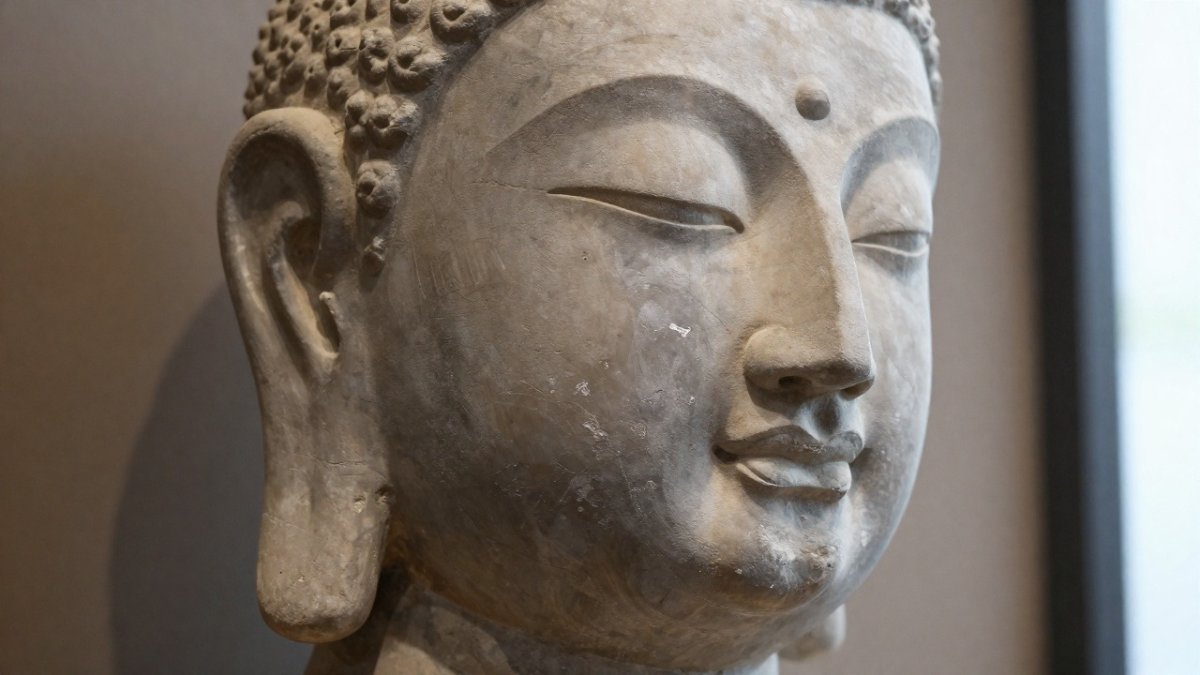
Authentic Cambodian stone Buddha statues carry small, hard-to-fake details, and the way to use them is to inspect in a fixed order and score what you see.
1. The hands. Period carving gives fingers a subtle taper, irregular spacing, and knuckles that are suggested rather than modeled. Modern copies tend to produce uniform, slightly thick fingers with crisp joints. Look at the mudra first, because the hand position is the hardest part of a Buddha to fake convincingly.
2. The face. Genuine pieces show asymmetrical wear, softer edges on the nose and brow, and a patina that has settled into the deepest carving rather than sitting on top of it. Reproduction faces often look too symmetrical, too crisp, and too evenly colored.
3. The robe. Monk's robes in Khmer work are carved as a thin, close-fitting garment with a distinct hem line. If the drapery looks heavy, if the folds are uniform, or if the hem is sharp rather than softened by age, treat the piece as suspect.
4. The base and underside. Turn the piece over. The underside and back are where modern makers get lazy. Tool marks, unfinished areas, and drill holes should all be consistent with hand carving. A base that is perfectly flat and machine-smooth is a warning sign.
5. The surface as a whole. Real patina fades into the stone; painted patina flakes off in a clean line at the edges. Look at the transition between weathered and unweathered areas, and check whether the loss pattern follows the geometry of the figure, which is what handling and exposure produce.
Watch out: a single strong signal, such as a convincing face, can pull a buyer past weak evidence elsewhere. Score each zone separately before you decide, and if two or more zones read as modern, treat the piece as a reproduction regardless of how good the best zone looks.
For a material-specific deep dive on stone identification, read our guide on how to identify antique Khmer sandstone.
Legal Due Diligence and Import Requirements for Cambodian Sculpture
Legal due diligence is the step most buyers skip, and it is the one that can cost the most. Buyers should be aware that import of certain archaeological and cultural material is regulated, so a Khmer sculpture entering the country should come with clear, verifiable documentation of its history.
Before you commit, confirm the following in writing:
-
A lawful export history. The piece should have left Cambodia under a permit issued by the Cambodian Ministry of Culture and Fine Arts, or it should have been outside the country before the relevant restrictions took effect. Ask for the permit number and a copy.
-
A written provenance warranty. The seller should warrant, in the purchase agreement, that the piece was lawfully exported and that the provenance stated is accurate. If the documentation later proves false, that warranty is your contractual path back to the seller.
-
A clear statement of the object's status. Ask whether the piece is listed on any national inventory or claimed by a foreign government. A seller who cannot answer is a seller to walk away from.
Watch out: a seller who offers only verbal assurances about export paperwork, or who says the documents were lost, is asking you to absorb the legal risk.
For a full breakdown of what authenticity paperwork should contain, see our guide to proof of authenticity for Buddhist statues.
Choosing Your Khmer Sculpture from HD Asian Art
Choosing well comes down to three decisions: what the piece is for, what period and material you want, and what documentation you require before you commit. Answer those and the shortlist narrows quickly.
At HD Asian Art, our collection of Buddhist and Hindu statues includes handpicked antique and contemporary Khmer and Southeast Asian sculptures, each selected for the altar, the meditation space, or the refined interior. Free shipping is offered, and our team is glad to discuss documentation and condition before you decide. As you weigh a sculpture’s material, finish, and place in your space, the same considerations can help distinguish Khmer works from handcrafted 3D sculptures.
If you are ready to find a piece that belongs in your sanctuary, browse authentic high-end Buddhist statues and see what speaks to you.
The hardest part of collecting Khmer sculpture is not finding something beautiful. It is finding something you can trust. That trust comes from documentation, material evidence, and a seller willing to answer hard questions. HD Asian Art curates Buddhist and Hindu statues with exactly that in mind: handpicked antique and contemporary Khmer and Southeast Asian pieces, free shipping, and a collection built for altars, meditation spaces, and refined spiritual interiors. Get started with HD Asian Art and choose a sculpture you can stand behind.
Frequently Asked Questions
What should I ask a seller before buying a Khmer sculpture?
Ask for the full ownership history in writing, including when and where the piece was acquired. Request high-resolution photos of the base, the back, and any repairs, plus details on material and period attribution. Confirm whether the seller provides an independent appraisal and how the piece will be packed and insured in transit. A reputable seller answers these questions directly and puts the provenance in writing rather than describing it vaguely.
How can I tell antique Khmer sculpture from contemporary work?
Age shows in the surface, not the silhouette. Genuine antique Khmer sculpture usually has uneven patina that settles into carved recesses, softened edges from centuries of handling and weather, and mineral staining that follows the grain of the stone. Contemporary pieces tend to have uniform surface color, crisp tool marks, and patina applied in a single layer. Ask for documentation of the piece's history and have an independent expert examine it under magnification before you commit.
What materials are commonly used in Khmer sculpture?
Sandstone and laterite were the main stones used in Angkorian carving, with bronze cast using the lost-wax method for smaller religious figures. Wood carving served temple and domestic use but survives less often because of climate and insects. Each material ages differently: sandstone develops surface loss and mineral staining, bronze forms a stable green-brown patina, and wood shows shrinkage and old repairs. Knowing the material helps you judge whether the wear on a piece is consistent with its claimed age.
Is it okay to buy a Buddha statue?
Yes, buying a Buddha statue is common among collectors and practitioners, provided the piece was legally exported and you treat it with respect. Check that the seller can document ownership history and that the sculpture was not removed from a temple or archaeological site. Import of certain archaeological material is regulated, so paperwork matters. Buy from sellers who provide provenance in writing and who can explain the piece's origin clearly.
What details should I consider when choosing a Khmer sculpture for a home altar?
Match the size to your space first; a piece that overwhelms a small meditation corner loses its calm. Check the figure's iconography so the image fits the practice you keep, and look at the face and hands, which carry most of the sculpture's presence. Confirm the base is stable and the piece can be displayed at eye level. Ask how the statue will be packed, since a well-protected arrival matters as much as the carving itself.

