



Where to Buy Authentic High-End Buddhist Statues
Where to Buy Authentic High-End Buddhist Statues
Table of Contents
- Where to Buy Authentic High-End Buddhist Statues: What Serious Buyers Check First
- Specialist Retailers vs. Marketplaces: A Seller-by-Seller Comparison
- A Verifiable Authenticity and Provenance Checklist
- How to Choose a Buddha Statue by Tradition, Iconography, and Intended Use
- Antique Buddhist Sculptures vs. Contemporary Buddhist Statues
- Buddhist Statues for Home Altar and Meditation Spaces
- Total Cost of Ownership: Shipping, Duties, Insurance, and After-Sales
- Conclusion: Buying With Confidence
- Frequently Asked Questions
Where to Buy Authentic High-End Buddhist Statues: What Serious Buyers Check First
Finding where to buy authentic high-end Buddhist statues comes down to one thing: the seller's willingness to document provenance before you pay. At HD Asian Art, we've built our reputation on handpicked antique and contemporary pieces, and we've watched too many buyers learn this lesson the hard way. The market rewards patience. Buyers who ask for documentation, compare seller policies side by side, and understand total landed cost consistently end up with pieces that hold their meaning and value for decades.
A Buddhist statue is a sculptural representation of a Buddha, bodhisattva, or revered figure, crafted in bronze, stone, wood, or gilded metal for devotional, ceremonial, or decorative use. The category spans everything from small altar figures to museum-quality temple pieces.
Here's the uncomfortable truth most buying guides skip: authenticity claims are cheap, but verifiable provenance is rare. Below, we break down exactly how to tell the difference, compare seller types honestly, and choose a piece that fits your tradition, space, and budget.
Smithsonian's guide to identifying and caring for Asian art collections
Specialist Retailers vs. Marketplaces: A Seller-by-Seller Comparison
Specialist retailers win on provenance and after-sales support; marketplaces win on price and volume. That trade-off defines almost every buying decision in this category. What the ranking pages never do is walk through each seller type in enough detail that you can match it to your own buying situation. That is the gap this section fills.
Here is how the main seller types compare across the factors that actually decide a purchase:
| Seller Type | Selection Breadth | Provenance Documentation | Buyer Protection | Best For |
|---|---|---|---|---|
| Specialist retailers | Curated, often 100-500 pieces | Detailed, often with certificates and object histories | Strong, personal service and named accountability | Collectors, high-value or devotional pieces |
| General marketplaces | Thousands of listings, mixed quality | Minimal or self-reported | Platform-mediated, slow resolution | Budget browsing, low-stakes decor |
| Auction houses | Varies by sale, strongest for rare antiques | Varies by lot; catalog notes and condition reports | Formal terms, buyer's premium, as-is sales | Rare antiques, experienced bidders |
| Direct artisan or gallery | Small, often commission-based | Case-by-case, strongest for living artists | Relationship-based, informal | Commissioned work, contemporary pieces |
Specialist retailers. These sellers stake their name on every statue they list. Expect a named contact, a written description of origin and age, high-resolution photography of the base, back, and any inscription, and a return window stated in writing. The trade-off is narrower selection and higher prices than a marketplace. That accountability is what you are paying for.
General marketplaces. Volume is the point and also the problem. Individual pieces get little scrutiny, seller identities are often pseudonymous, and dispute resolution runs through a platform process rather than a person. Marketplaces can work for lower-value decorative pieces, but they are a poor fit when documentation matters.
Auction houses. The strongest channel for rare antiques, but the terms are formal and largely as-is. Read the catalog notes and condition report carefully, confirm whether the lot carries a buyer's premium, and understand that returns are usually limited to cases of catalog error. First-time bidders should attend a sale or two before bidding.
Direct artisan or gallery. The best route for commissioned contemporary work. You can specify figure, material, finish, and size, and you deal with the maker directly. Documentation is strongest for living artists, weaker for resold pieces.
A practical way to choose: if you need documentation and recourse, start with a specialist retailer. If you are browsing for decor and accept the risk, a marketplace is fine. If you are chasing a rare antique and know the category, an auction house is worth the formality. If you want a specific figure made to order, go direct.
U.S. Federal Trade Commission guidance on online purchase protections
A Verifiable Authenticity and Provenance Checklist
A statue is authentic when its material, craftsmanship, and documented history match what the seller claims. Provenance is the paper trail proving it. Most guides stop at "ask for documentation." The useful version is a method you can run on any candidate piece, in order, before you commit.
Step 1, Confirm the claimed origin and age in writing. Ask the seller to state, in writing, where the piece came from and how old they believe it is. A serious seller will put this in an email or invoice, not just a listing blurb. Vague phrases like "old" or "temple-used" without a stated origin are a stop sign.
Step 2, Verify the material against the description. The listing should name the material specifically: bronze, stone, gilded copper, wood, or similar. Ask for close-up photos of the base, the back, and any worn edges. Cast metal shows seams, tool marks, and a patina that sits in recesses; carved stone shows tool chatter and grain. If the photos do not let you see these details, ask for more before you buy.
Step 3, Check the documentation chain. Provenance is strongest when it is a sequence, not a single document. Useful items include prior sale records, gallery or auction receipts, exhibition history, and a certificate of authenticity that names the piece and the seller. A certificate alone, with no supporting history, is weak evidence.
Step 4, Ask directly about restoration. Restoration is normal on older pieces and not automatically a problem, but it must be disclosed. Ask what has been repaired, replaced, or repatinated, and request photos of those areas. Undisclosed restoration is a bigger red flag than disclosed restoration.
Step 5, Confirm the return and damage terms in writing. Before payment, get the return window, who pays return shipping, how a damage claim is filed, and what payment method gives you recourse. A seller who will not put these in writing is telling you something.
Run every candidate through this checklist before committing:
- Seller provides a written description of origin and age
- Materials are named specifically (bronze, stone, gilded copper, wood)
- Craftsmanship details are visible in high-resolution photos of base, back, and edges
- Documentation forms a chain, not a single certificate
- Restoration is disclosed, with photos of repaired areas
- Seller answers provenance questions directly, not evasively
- Return and damage policies are stated in writing
- Payment method offers buyer recourse
How to Choose a Buddha Statue by Tradition, Iconography, and Intended Use
Choosing a Buddha statue starts with three questions: which tradition, which figure, and what purpose. Get those right and the rest follows.
For a home altar, match the figure to your practice. Guanyin, the bodhisattva of compassion, suits devotional spaces. Ksitigarbha is common in memorial and protective contexts. A classical Siddhartha Gautama figure works for general meditation.
Size matters more than buyers expect. A statue should feel grounded in its space, not lost or overwhelming. Measure your altar or shelf before you shop, and account for the base and any halo.
Metropolitan Museum of Art's Heilbrunn Timeline of Asian art
Antique Buddhist Sculptures vs. Contemporary Buddhist Statues
Antique Buddhist sculptures offer history and rarity; contemporary Buddhist statues offer precision, availability, and often superior structural integrity. Neither is automatically better.
Antiques carry the marks of time: patina, wear, sometimes restoration. That history is the appeal, but it also means condition varies widely and requires honest disclosure from the seller.
Contemporary pieces, including handcrafted Nepali Buddha figures and fire gilding work, let you buy with confidence in materials and finish. For daily devotional use, a well-made contemporary statue often serves better than a fragile antique.
Buddhist Statues for Home Altar and Meditation Spaces
A statue earns its place in a meditation space when scale, material, and light work together. A bronze figure on a low wooden table, lit by a nearby window, can anchor an entire room.
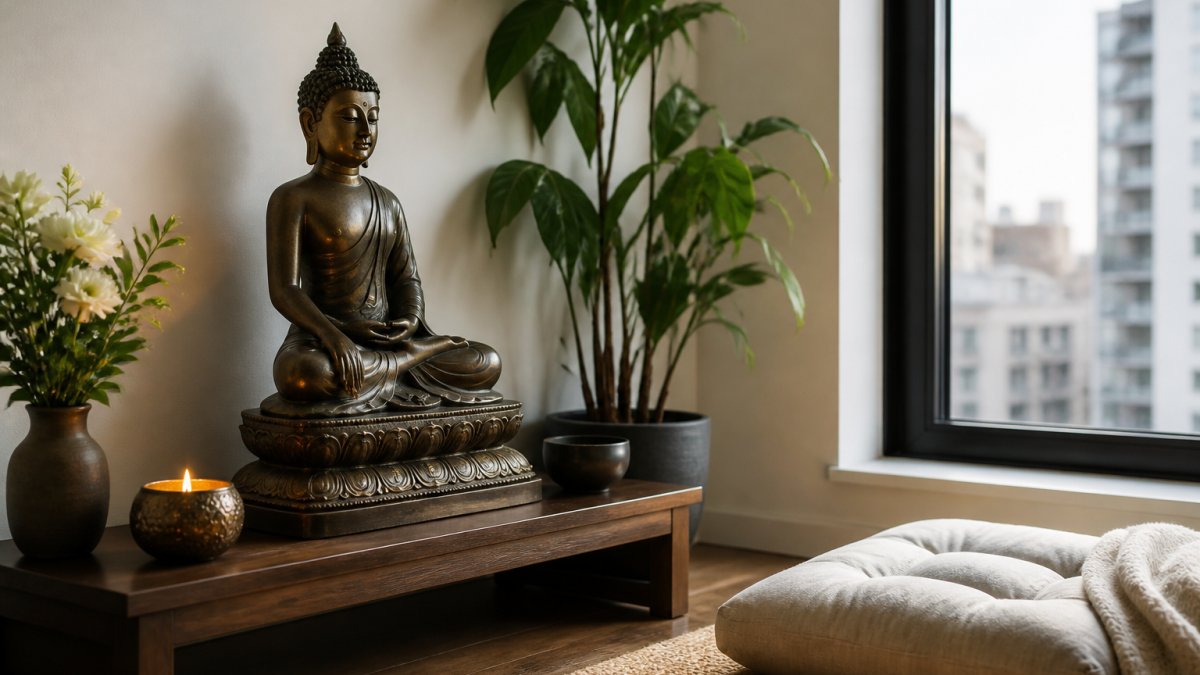
Small apartments are not a barrier. A modest statue on a dedicated shelf, kept clean and intentional, reads as a sanctuary rather than decoration. The mistake is buying oversized and crowding the space.
Total Cost of Ownership: Shipping, Duties, Insurance, and After-Sales
The sticker price is rarely the full cost. Shipping, import duties, insurance, and potential restoration all add to what you actually pay.
Ask every seller these questions before buying:
- Is shipping insured, and who files a damage claim?
- Are import duties and taxes included or billed separately?
- What is the return window, and who pays return shipping?
- Is there any after-sales support for repairs or conservation?
HD Asian Art offers free shipping, which removes one variable from the equation. For delicate, high-value pieces, insured transit and a clear damage policy matter more than a small price difference.
Conclusion: Buying With Confidence
The gap between a good purchase and a regretted one usually comes down to documentation and seller accountability. Buyers who verify provenance, compare policies, and understand total cost rarely get burned.
At HD Asian Art, we handpick antique and contemporary Buddhist and Hindu statues, specialize in Khmer and Southeast Asian sculptures, and ship free so you can focus on the piece, not the logistics. Browse our curated collection and find a statue worthy of your space.
Frequently Asked Questions
Where can I buy an authentic Buddhist statue?
Buy from specialist retailers that publish provenance details, material specifications, and condition notes for each piece. Ask for the statue's origin, the materials used, and any documentation the seller can share. Marketplaces can work for lower-value pieces, but high-end authentic statues usually come from galleries and specialists who can answer detailed questions about craftsmanship and history.
What makes a Buddhist statue high quality?
Look at the material, the level of detail, and the finishing. Bronze and stone pieces with hand-finished surfaces, consistent symmetry, and clear facial expression typically signal higher craftsmanship. Museum-quality statues also show careful attention to iconographic accuracy, such as correct hand positions, robes, and attributes that match the figure being depicted.
How do I choose the right size Buddhist statue for a meditation space?
Measure your space first, then pick a statue that fits without crowding the room. A small apartment corner can suit a statue under 30 centimeters, while a dedicated altar or larger room can hold a piece over 60 centimeters. The statue should sit at or slightly above eye level when you are seated, so you can meet its gaze during practice.
What should I ask a seller before buying a Buddhist statue?
Ask about the statue's origin, the materials, the date or period if it is antique, and whether any restoration has been done. Request additional photos from multiple angles, including the base and any marks. Confirm the shipping method, insurance coverage, and the return policy in writing before you pay, especially for high-value pieces.
