
















-
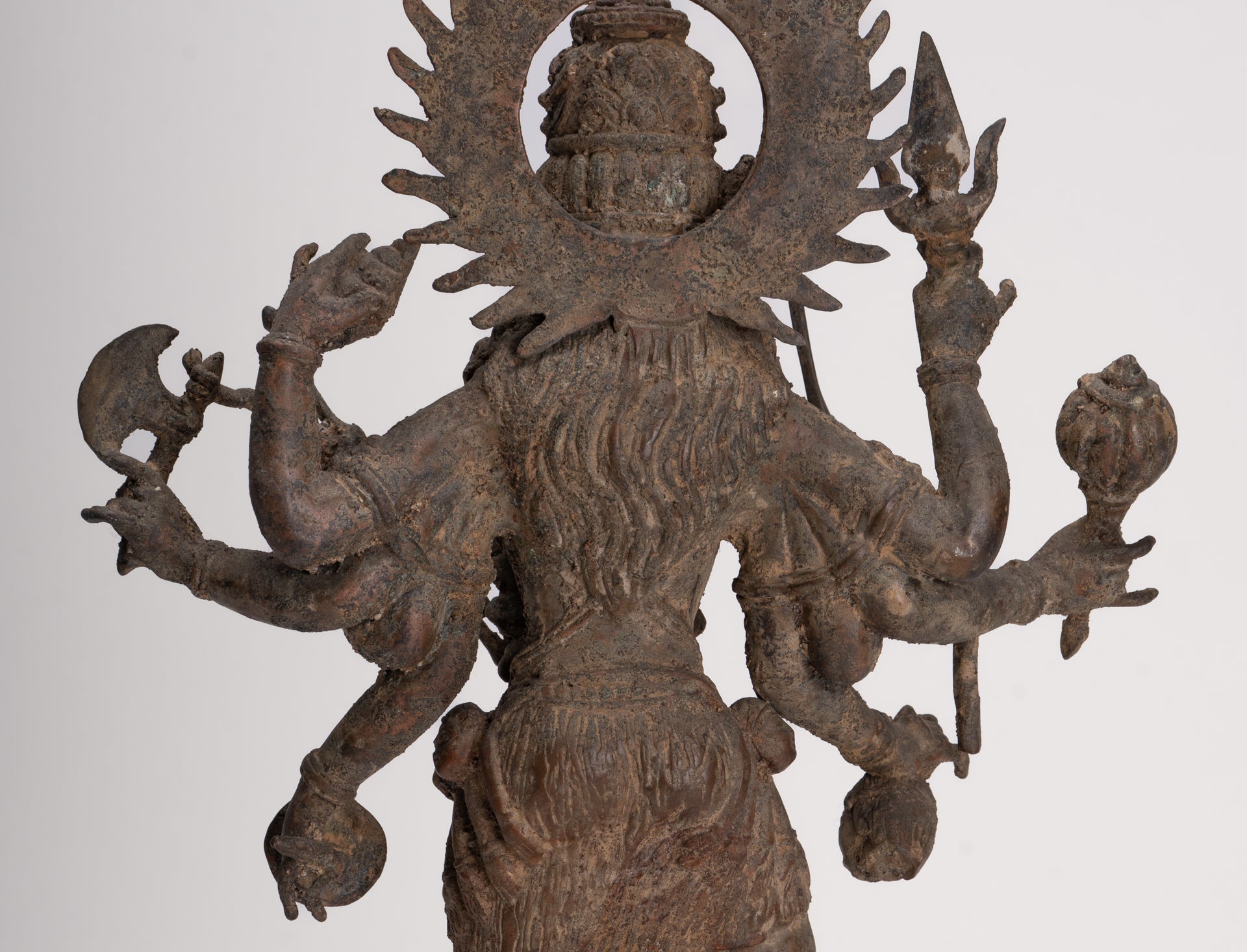
Antique Java Style Majapahit Standing Bronze Kali or Mahakali Statue - 45cm/18"
Measurements Height 45cm/18"
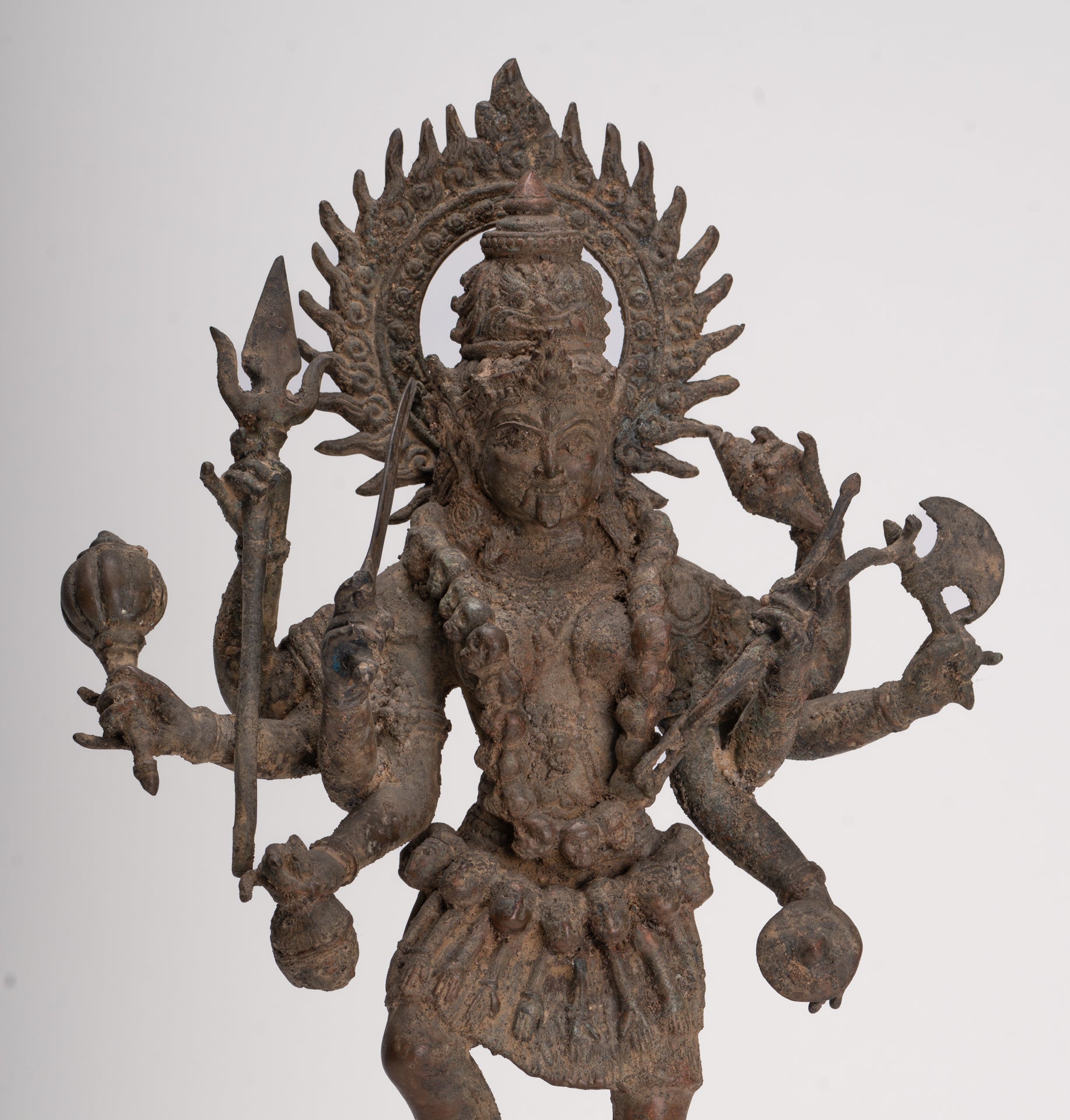
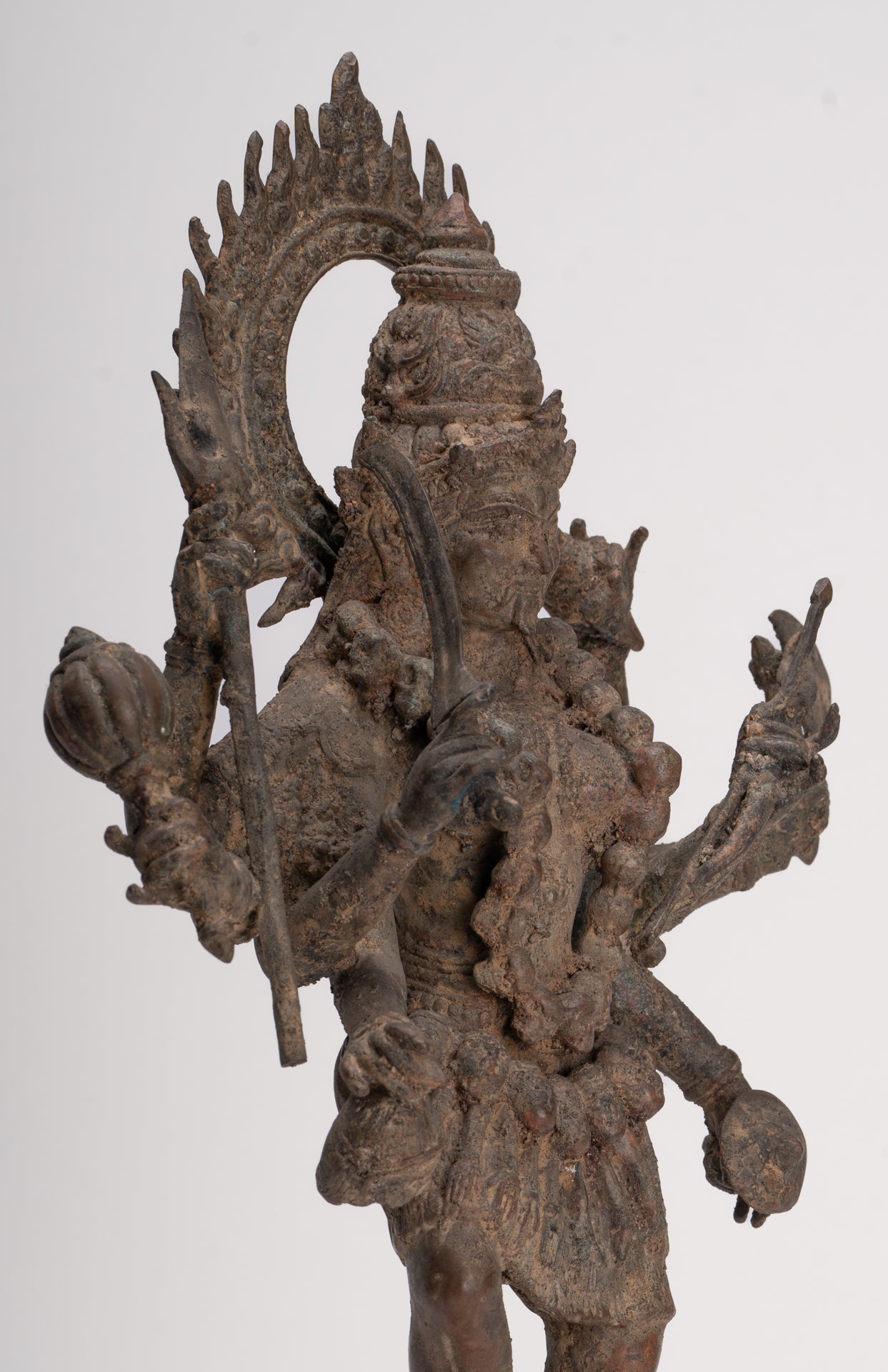
Commanding, intricate, and deeply expressive, this remarkable Majapahit-style sculpture portrays Kali, the formidable Hindu deity of transformation, divine protection, and the destruction of ignorance.
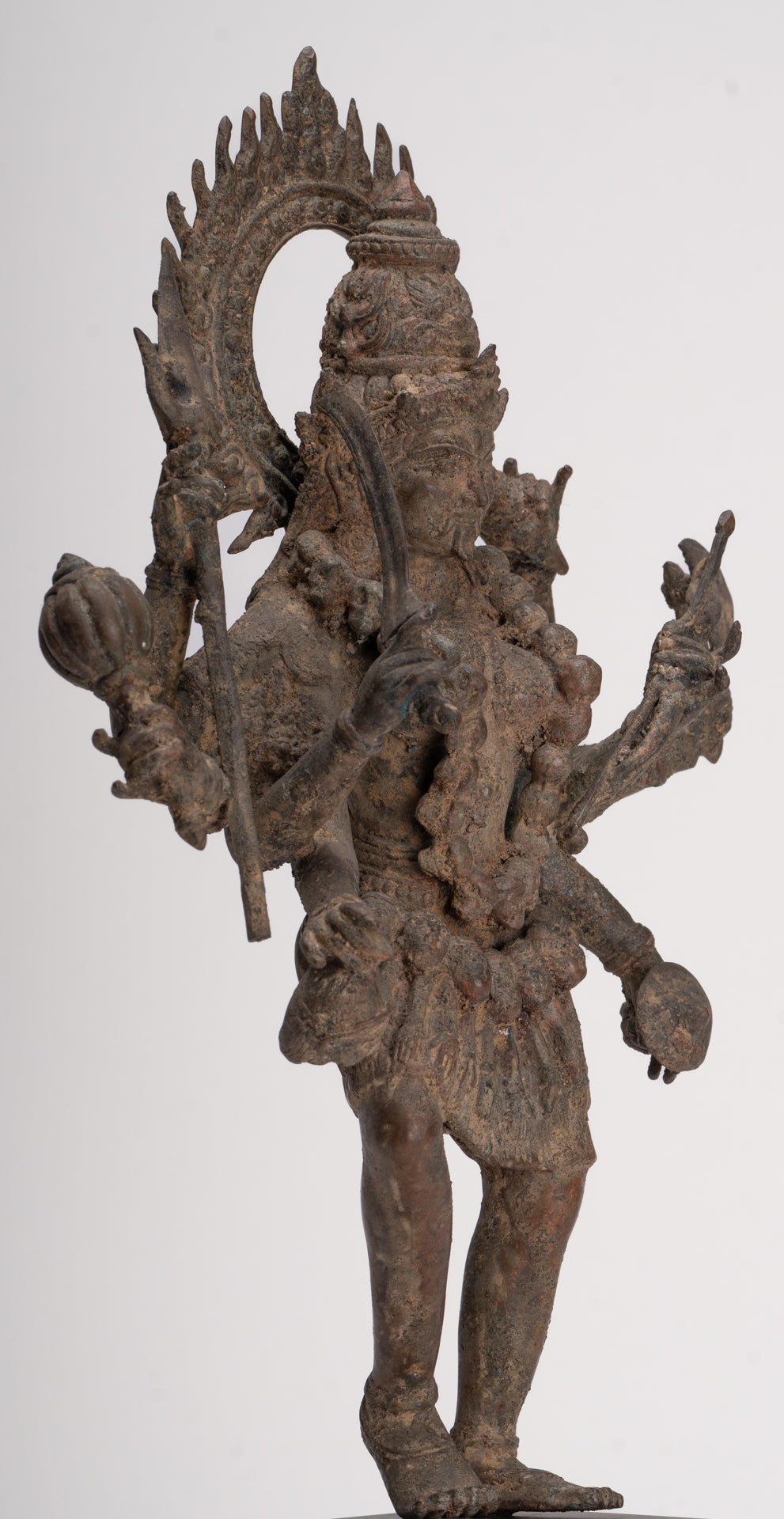
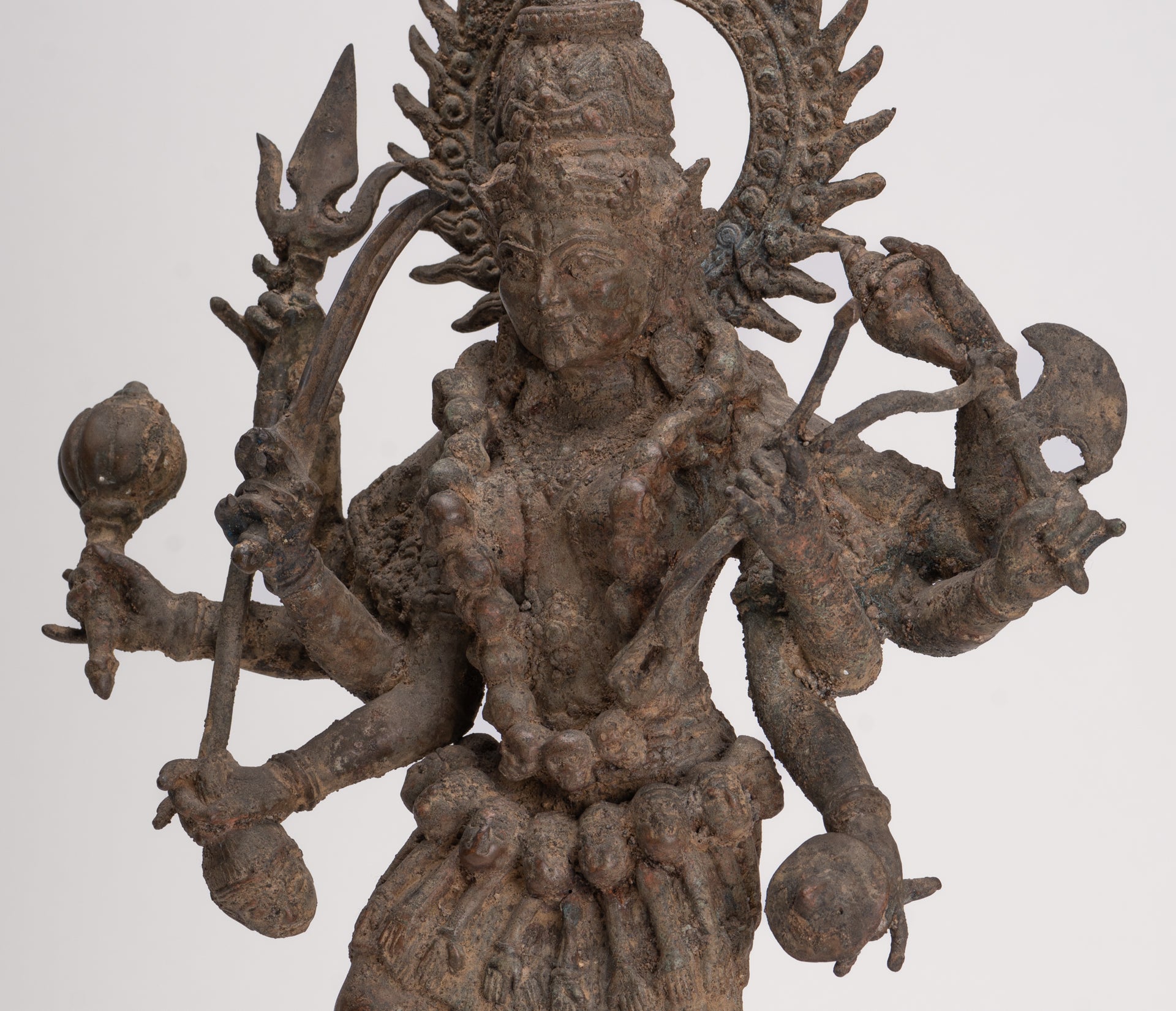
Standing in a powerful, animated pose, Kali is rendered with multiple arms, each carrying an emblem of sacred authority and spiritual force. The densely modeled composition captures the dynamism associated with Javanese Hindu art, where divine energy is expressed through elaborate ornaments, weaponry, movement, and richly layered symbolism.
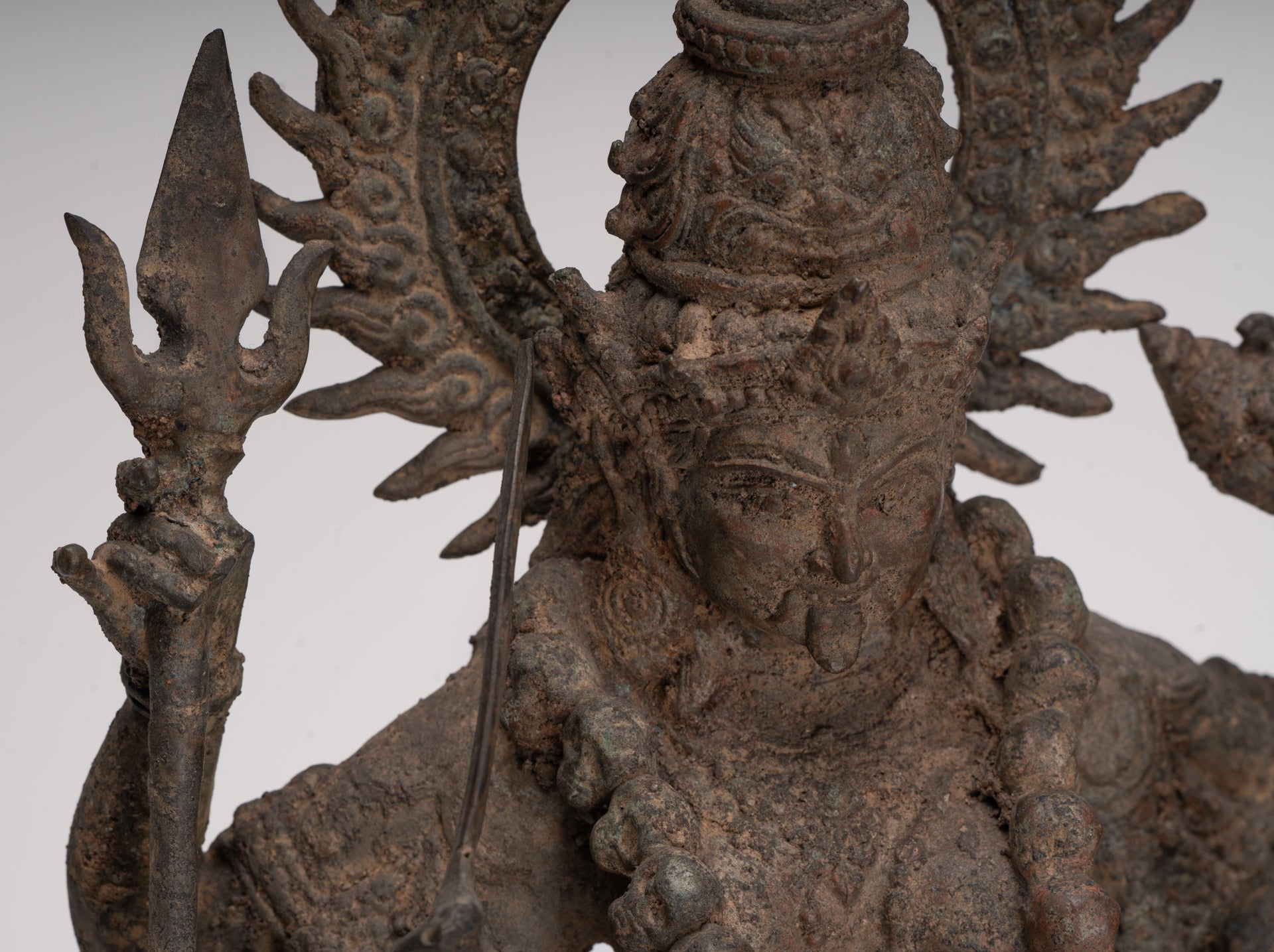
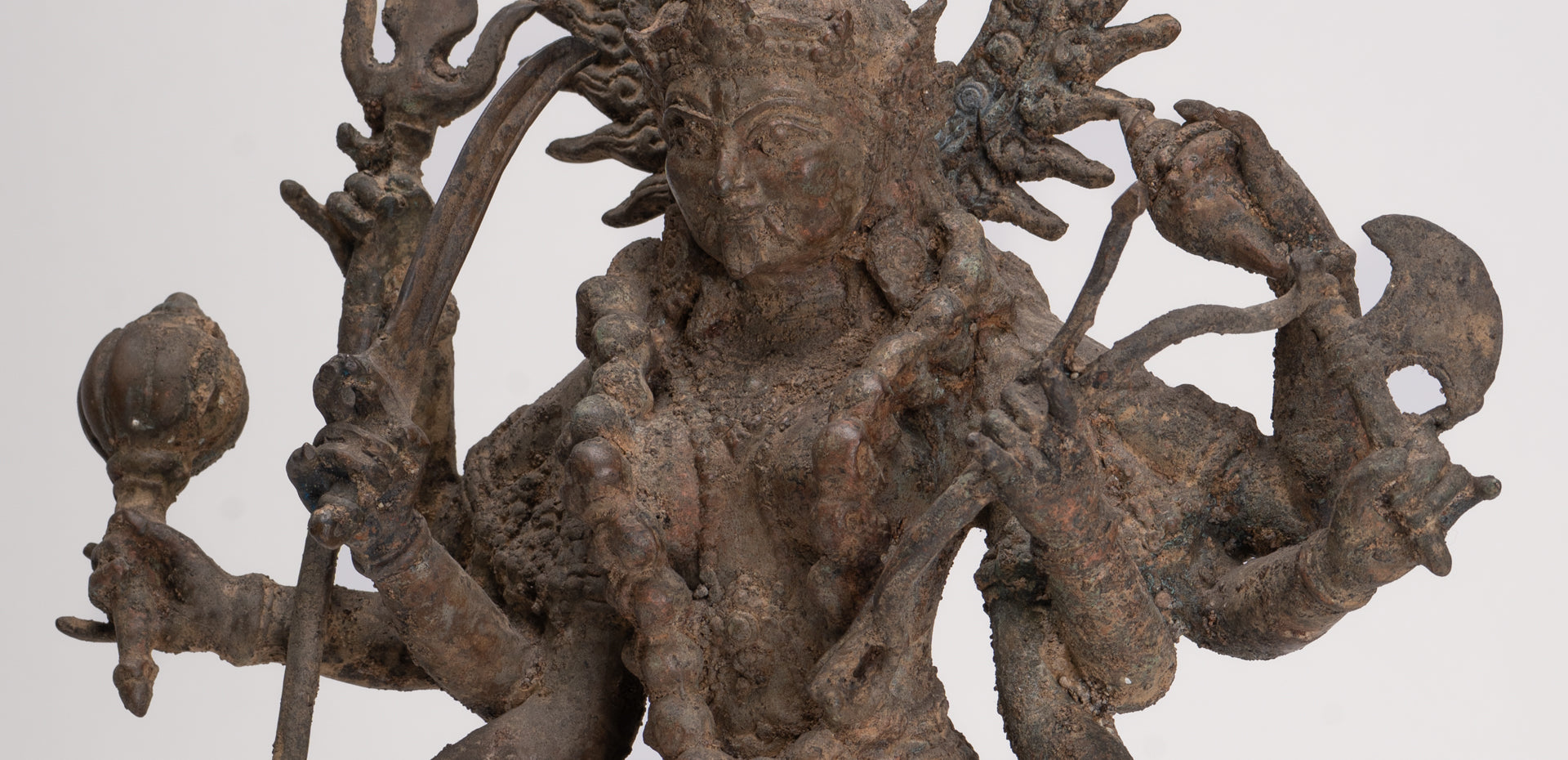
Kali’s many hands hold a bow and arrow, trident, axe, mace, kalasha, conch shell, and sword. Together, these attributes present her as an all-encompassing protector: prepared to overcome obstacles, cut through illusion, defend cosmic order, and grant renewal. The bow and arrow signify focus and the directed force of intention; the trident evokes supreme power and the transcendence of the three realms; the sword and axe represent the cutting away of ignorance and attachment; while the kalasha and conch introduce complementary associations of abundance, purity, sacred sound, and spiritual blessing.
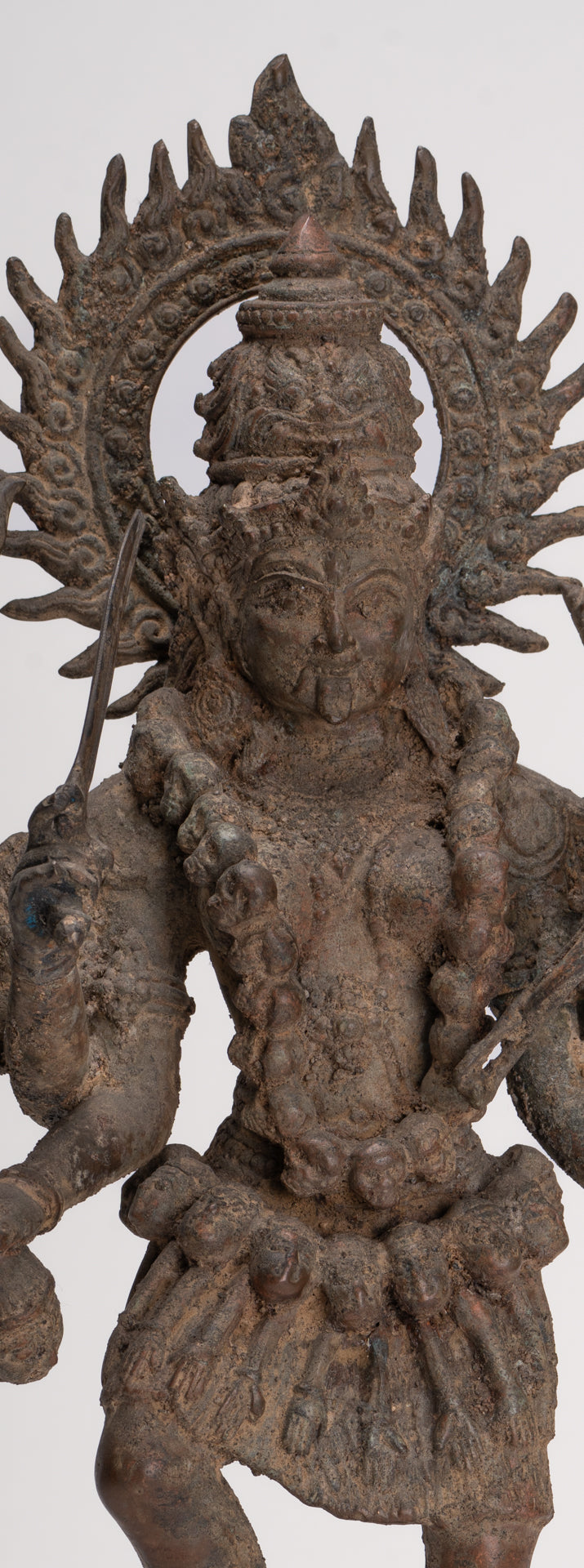
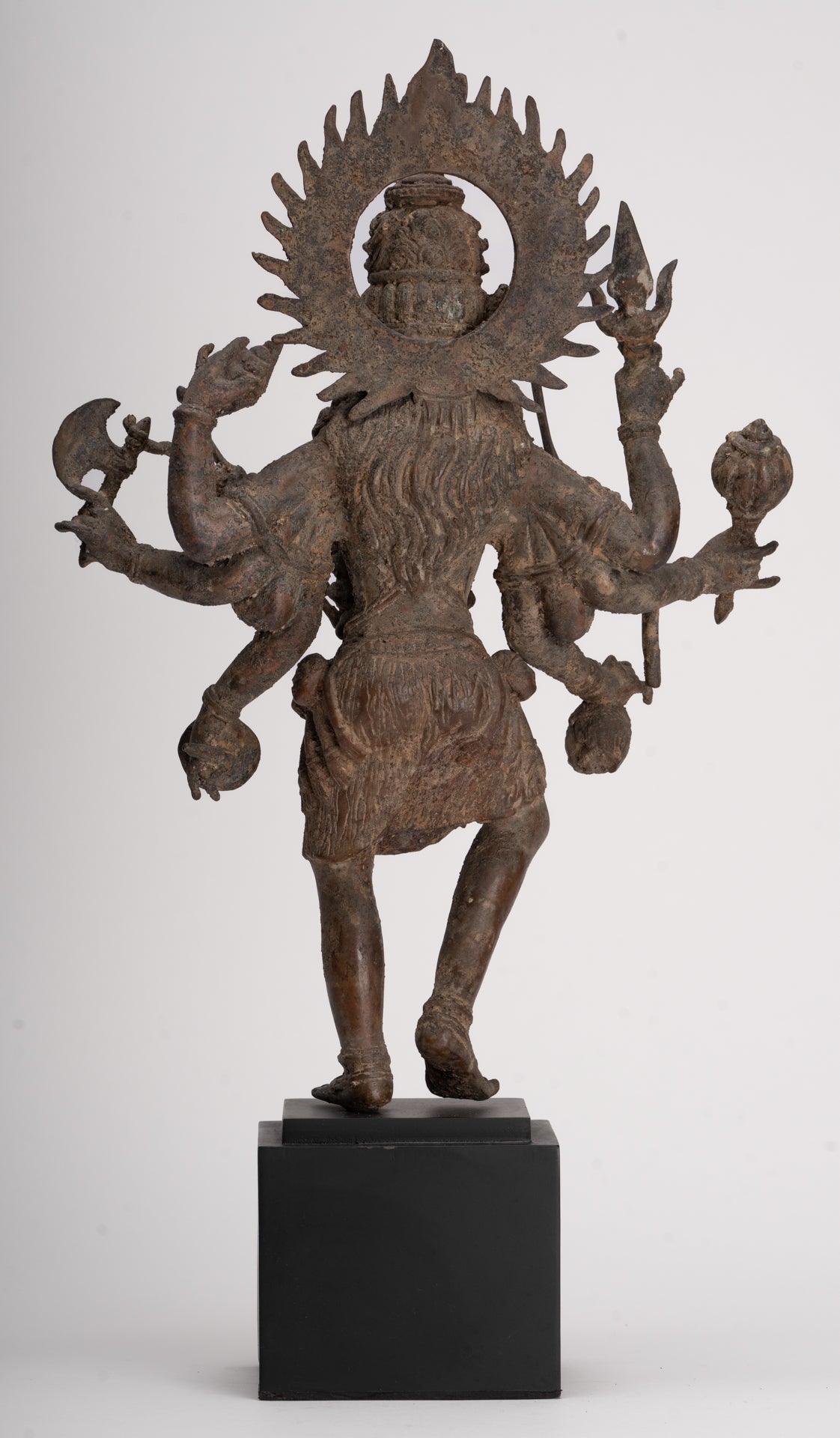
The deity is framed by a dramatic flaming aureole, its radiating tongues of fire creating a halo-like field of divine energy behind the head and upper body. Kali wears an elaborate crown and abundant jewelry, including a necklace of beads that further enriches the sacred and ceremonial character of the figure.
The harmonious balance between the calm central face and the energetic spread of arms gives the sculpture an exceptional presence from every angle.
The surface retains a dark, earthy aged patina, with subtle tonal variations that emphasize the sculptural modeling, hand-worked detail, and historic character of the piece.
Presented on a complementary black display base, this Kali is ideally suited to a serious collection of Asian art, a Hindu devotional space, a meditation room, or an interior seeking a single dramatic and meaningful focal point.
Key Features
-
Majapahit-style sculpture of Kali, the Hindu goddess associated with transformation, protection, and the triumph of divine order over destructive forces.
-
Dynamic multi-armed composition with a powerful standing posture.
-
Kali holds a bow, arrow, trident, axe, mace, kalasha, conch shell, and sword.
-
Elaborate flaming aureole forms a dramatic sacred halo behind the deity.
-
Detailed crown, facial modeling, ornaments, and beaded jewelry create a richly layered visual presence.
-
Each sacred attribute is individually modeled, making the sculpture compelling for close study as well as display.
-
Earthy dark patina lends depth, texture, and an aged character to the figure.
-
Mounted on a black presentation base for stable and elegant display.
-
A distinctive centerpiece for Asian art collections, Hindu-inspired interiors, meditation rooms, altars, libraries, offices, or galleries.
-
An exceptional gift for collectors of Indonesian, Javanese, Hindu, and Southeast Asian art.
Symbolism
Kali is one of Hinduism’s most powerful divine forms. Although she can appear fierce, her force is protective and transformative: she confronts fear, destroys illusion, and clears the way for spiritual renewal. In Hindu and Tantric traditions, her weapons are not simply signs of battle; they signify the capacity to overcome inner obstacles such as ego, ignorance, attachment, and harmful habits.
Kali’s necklace—more accurately described as a garland—is one of the most powerful and frequently misunderstood elements of her iconography. Known as the muṇḍamālā (“garland of heads”), it is traditionally interpreted as a profound symbol of time, mortality, sacred sound, the overcoming of ignorance, and spiritual liberation—not as a celebration of violence.
Kali’s muṇḍamālā, or garland of heads, is one of the most profound symbols in Hindu iconography. Rather than simply representing destruction, it signifies Kali’s power to overcome ego, ignorance, fear, and attachment. Often associated with the 50 or more letters of the Sanskrit alphabet, the heads also evoke sacred sound, language, mantra, and the creative energy of Shakti. As a reminder of impermanence and spiritual transformation, Kali’s garland expresses her role as the fierce yet compassionate Divine Mother who liberates her devotees from illusion.
The attributes held by this figure deepen that message:
Frequently Asked Questions
Who is Kali?
Kali is a major Hindu goddess whose fierce appearance expresses protective and transformative power. She is revered as a force that destroys ignorance, conquers harmful influences, and helps devotees move beyond fear and illusion. Her imagery is often especially important in devotional, Tantric, and Shakta traditions.
Why does Kali have many arms?
Multiple arms visually communicate a deity’s supernatural ability, expansive presence, and many powers. In this sculpture, the numerous arms allow Kali to hold a complete array of sacred implements, emphasizing her role as an active and fully equipped divine protector.
What objects does Kali hold in this sculpture?
This Kali holds a bow and arrow, trident, axe, mace, kalasha, conch shell, and sword. These attributes combine symbols of divine protection, discipline, spiritual abundance, sacred sound, strength, focused intention, and the removal of ignorance.
What is a kalasha?
A kalasha is a sacred vessel, often shown as a rounded pot or water vessel. In Hindu tradition, it is associated with abundance, fertility, life, purity, welcome, ritual blessing, and the fullness of spiritual and material prosperity.
What does the flaming aureole represent?
The aureole is the flame-like halo surrounding the deity. It represents divine radiance, spiritual power, transformation, and Kali’s presence beyond ordinary human limitations. Its energetic form also heightens the drama and visual authority of the sculpture.
Is this sculpture suitable for a home altar or meditation space?
Yes. Kali is widely revered as a protective and transformative deity, making this sculpture a meaningful addition to a Hindu altar, personal shrine, meditation area, yoga room, or contemplative space. It may also be displayed as an important work of Southeast Asian devotional art.
What does “Majapahit” refer to?
Majapahit refers to the influential Hindu-Buddhist kingdom that flourished in Java, Indonesia, from the late 13th to early 16th century. Majapahit art is admired for its synthesis of Hindu and Buddhist iconography, expressive sacred figures, refined ornament, and strong sculptural traditions. This work is presented in the Majapahit style, reflecting that rich Javanese artistic heritage.
How should I care for the sculpture?
Keep the figure indoors, away from sustained direct sunlight, excessive humidity, sharp temperature changes, and sources of water. Dust lightly with a soft, dry cloth or a soft brush. Avoid abrasive pads, commercial metal polish, chemical cleaners, and oils, as these may damage the patina and fine surface detail.
How should it be displayed?
Display the sculpture securely on its fitted base on a stable, level surface. Give it sufficient space around the aureole and extended arms so the silhouette can be appreciated fully. It is particularly effective as a central focal point on an altar, plinth, console, bookcase, or display cabinet.
Is this a good gift for a collector?
Yes. With its complex iconography, dramatic silhouette, multi-armed form, and Majapahit-inspired Javanese character, this Kali sculpture is a memorable gift for collectors of Hindu art, Indonesian art, Southeast Asian bronzes, sacred sculpture, and meaningful decorative objects.
What is the necklace Kali wears called?
Kali’s necklace is commonly called a muṇḍamālā (Sanskrit: muṇḍamālā), meaning “garland of heads.” It may also be called a kapālamālā—a garland of skulls—or rundamālā in some contexts. In sculpture and painting, it can appear as freshly severed heads, skulls, or stylised head-shaped beads.
Is it a necklace of skulls or severed heads?
Both forms occur in Hindu visual traditions. Some images show Kali wearing a garland of severed heads, while others show skulls. This is why it is often referred to in English as Kali’s “skull necklace,” although “garland of heads” is often closer to the Sanskrit muṇḍamālā. Artistic conventions vary by region, period, sectarian tradition, and the particular form of Kali depicted.
Why does Kali wear a garland of heads?
The garland expresses Kali’s command over the forces that bind human beings: fear, mortality, ego, ignorance, attachment, and the limiting sense of individual identity. Kali’s fierce appearance is transformative: she destroys what obstructs liberation and spiritual truth.
The heads are therefore not merely trophies of combat. They can represent the dissolution of ahaṃkāra—ego or the false sense of separate selfhood—and avidyā, spiritual ignorance. In this reading, Kali cuts through illusion so that wisdom and freedom can arise.blog.
Does the garland represent demons defeated by Kali?
Yes, this is one valid interpretation. In her mythic role as a powerful form of the Divine Mother, Kali defeats destructive beings and forces that threaten cosmic order. The heads can therefore signify conquered demons, enemies of dharma, and the negative qualities they represent—such as pride, greed, delusion, cruelty, and fear.
However, the imagery also turns inward. The “enemy” may be understood spiritually as the devotee’s own ignorance and attachment rather than as a literal human opponent.
Why are there often 50 heads on Kali’s necklace?
A widely known Tantric interpretation associates the heads with the letters or sounds of the Sanskrit alphabet. Depending on the tradition, depictions may show 50, 51, or 52 heads; variations reflect differing systems for counting Sanskrit letters and phonemes.
Each head can stand for a letter, and each letter for a creative vibration or power of sound. This identifies Kali with Śabda Brahman—ultimate reality understood through sacred sound—and with the source of language, mantra, knowledge, and creation itself.
What does the Sanskrit-alphabet symbolism mean?
In many Hindu and Tantric philosophical traditions, sound is not simply a human invention. Sacred sound, speech (vāk), syllables, mantras, and letters are understood as expressions of divine creative power, or Shakti.
Kali’s garland suggests that every letter, word, thought, prayer, mantra, and form of knowledge arises from her energy and ultimately returns to her. The necklace is therefore a statement of her sovereignty over language, thought, creation, and dissolution.
Is Kali associated with death?
Kali is closely associated with death, time, impermanence, and transformation—but this should not be simplified as “a goddess of evil” or “death worship.” In her symbolism, death is part of the universal rhythm in which forms arise, pass away, and are renewed.
Her garland reminds viewers that bodies, status, possessions, and social identities are temporary. At the same time, Kali is worshipped as a fiercely compassionate mother who protects devotees and removes what prevents spiritual awakening.
What does the garland teach about ego?
The severed heads are often interpreted as the “cutting off” of ego: the habits of pride, possessiveness, false identity, and attachment that keep a person spiritually confined. Kali’s weapon, usually a curved sword, is often read alongside the garland: the sword represents discriminating wisdom, while the severed head represents the ego that wisdom has overcome.
This does not mean rejecting one’s personality or ordinary responsibilities. Rather, it points to releasing the belief that the temporary personality, body, social role, or possession is the whole of one’s being.
What is the relationship between Kali’s necklace and time?
The name Kali is often connected with kāla, meaning time. Time consumes all forms: every life, body, object, kingdom, and identity eventually changes or disappears. The skull or severed head is therefore a potent image of impermanence.
By wearing the garland, Kali is shown as greater than time and death. She represents the divine power through which creation appears, transforms, dissolves, and is renewed.
Is the necklace intended to be frightening?
It can be deliberately startling, especially to confront the viewer with realities people often avoid: death, change, attachment, and the instability of worldly identity. Yet its purpose is not simply horror. Kali’s fierce form is intended to awaken fearlessness and honesty.
In devotional practice, her frightening imagery may be understood as protective. She is fierce toward ignorance, exploitation, destructive forces, and the inner obstacles that keep devotees from freedom. Her appearance is thus both terrible and compassionate.
Why is Kali’s skull garland important in art?
The muṇḍamālā helps identify Kali and related fierce forms of the Divine Mother in Hindu sculpture, bronzes, paintings, temple reliefs, and ritual images. It is especially significant because it condenses several major ideas into one visual element:
-
The inevitability of death and impermanence
-
Kali’s victory over hostile or obstructive forces
-
The destruction of ego and ignorance
-
The creative power of sacred sound and language
-
The cyclical union of creation, dissolution, and renewal
-
Kali’s role as a fierce but compassionate liberating power
In an antique or artisan statue, the rendering of the heads—whether naturalistic, schematic, skull-like, or bead-like—may also reflect the workshop’s regional style and the intended iconographic form of the goddess.
Is Kali’s necklace the same as her girdle of severed arms?
No. Kali is often shown with two separate symbolic ornaments:
Both ornaments contribute to Kali’s message that liberation involves moving beyond fear, ego, attachment, and limited identification with the body.
Does every Kali statue have the same number of heads?
No. The number varies widely. A statue may show a short garland, a long garland, 50 heads, 51 heads, 52 heads, or a simplified stylised sequence. Small-scale sculptures often reduce the number for practical and aesthetic reasons, while devotional images may follow a regional or workshop convention rather than a fixed textual count.
How should the necklace be described respectfully?
A respectful and accurate description might read:
“Kali wears a muṇḍamālā, or garland of heads, a sacred iconographic emblem associated with the transcendence of ego and ignorance, the impermanence of embodied life, and—in Tantric interpretation—the creative powers of the Sanskrit letters and sacred sound.”
Avoid presenting it as merely “a gruesome necklace” or as evidence that Kali is inherently violent. The garland belongs to a complex devotional and philosophical tradition in which fierce imagery communicates protection, wisdom, transformation, and liberation.
SATISFACTION GUARANTEE - We have been offering SE Asian Art for many years and are proud of the reputation we have developed for fair and honest listings. However, if for any reason, whatsoever, you are unhappy with your purchase please just let us know and we will provide a full refund. We want you to be 100% happy with your purchase.
-
-
The majority of orders will be shipped with DHL. This is a secure, express and fully tracked service.
Items less than 2Kg we typically ship using Royal Mail.
Once we receive your order we try to ship all orders the same or next working day.
Large and/or fragile pieces requiring palletising, specialist crating and/or extra packaging may take a little longer. Palletised shipments will be delivered curbside.
All orders over 35 GBP will be shipped free of charge.

-
We genuinely hope that all purchases delight.
However, if they do not, regardless of reason, we will refund all orders upon receipt of the unwanted item. Just notify us within 14 days of receiving your order that you wish to make a return and send the piece back to us with 30 days of delivery.


