





-
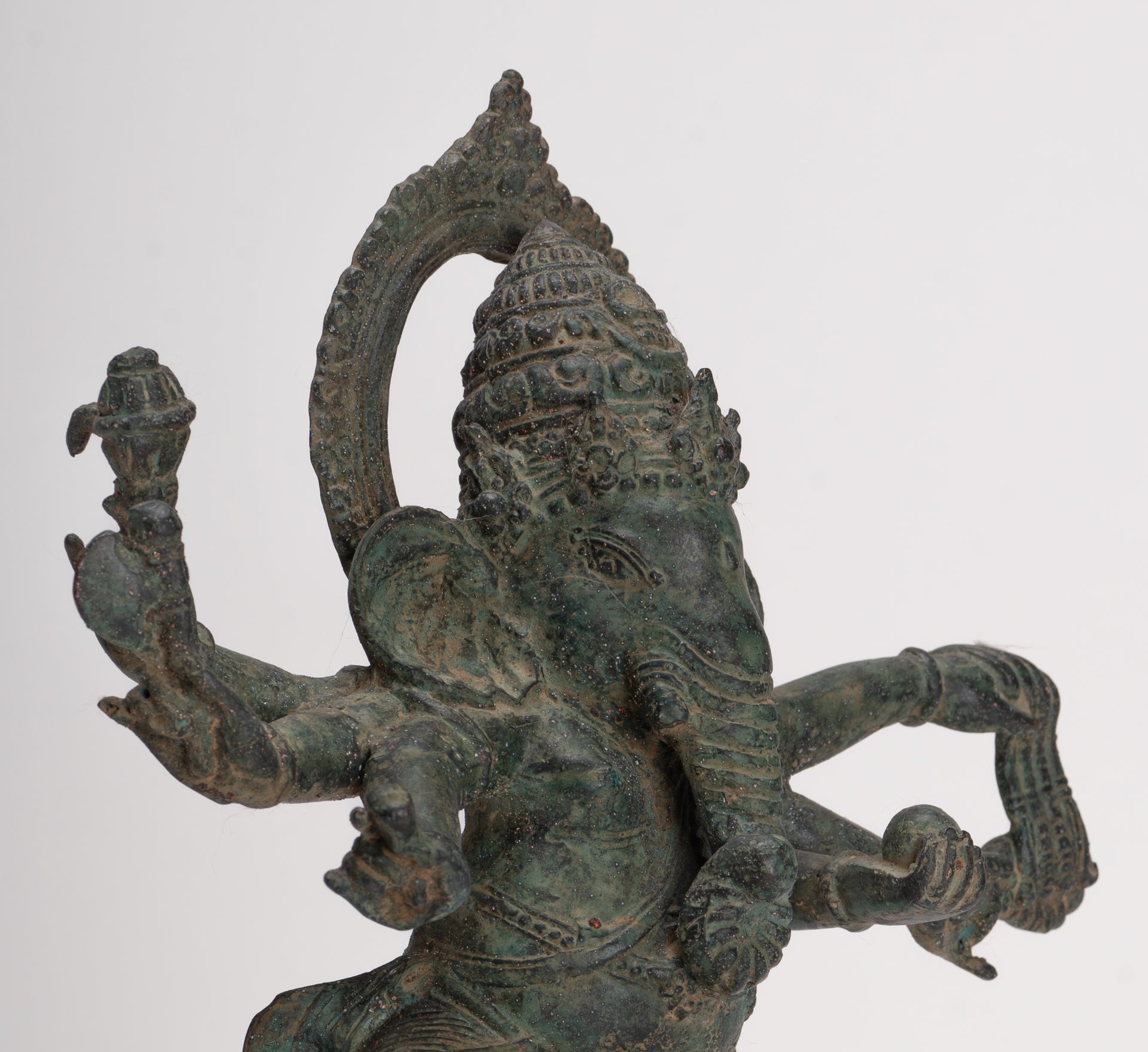
Antique Javanese Style Bronze Dancing Indonesian Ganesha Statue - 32cm/13"
Indonesian Nṛtya Gaṇapati on a Double Lotus Base
Measures (Height) 32cm/13"
A dynamic antique Javanese-style bronze of Dancing Ganesha, the elephant-headed Hindu deity shown in a joyous, multi-armed pose of movement and divine energy. Measuring 32 cm / 13 inches high, the sculpture captures Ganesha as Nṛtya Gaṇapati—the dancing manifestation associated with creativity, celebration, resilience, and the overcoming of obstacles.
Ganesha balances with one leg raised in a lively dance posture, while his multiple arms extend around the body in an animated, rhythmical composition. Behind him rises an ornate arched aureole or halo, reinforcing the deity’s sacred status and giving the sculpture a powerful silhouette. He stands upon a finely cast double lotus pedestal, whose layered petals symbolise purity, spiritual growth, and awakening.
The figure wears an elaborate crown, jewellery, armlets, anklets, and a patterned lower garment, all rendered with a distinctly Indonesian Hindu-Buddhist sensibility. His richly developed surface carries a varied dark bronze, brown, and green patina that accentuates the crisp cast detail and gives the work considerable visual depth.
Ganesha as the divine dancer
Ganesha is the elephant-headed son of Shiva and Parvati, revered across Hindu traditions as the remover of obstacles, lord of beginnings, patron of learning, protector of creative work, and deity of wisdom and practical intelligence.
In his dancing form, Nṛtya Gaṇapati expresses a special kind of spiritual confidence. He is not motionless before life’s challenges; he moves through them with balance, buoyancy, and awareness. The raised foot and sweeping arms suggest that change need not be feared. Like the dance itself, life requires rhythm, flexibility, discipline, and the ability to remain centred while circumstances move around us.
Dancing Ganesha is especially meaningful for artists, students, writers, entrepreneurs, musicians, and anyone beginning a new project or navigating a period of transition. Ganesha is often shown dancing in playful imitation of his father Shiva, the great cosmic dancer.
Sacred attributes
The figure holds an important group of Ganesha’s symbolic attributes:
-
Axe — represents the cutting away of ignorance, fear, attachment, and the obstacles that prevent spiritual or practical progress.
-
Mala beads — symbolise meditation, concentration, sacred recitation, discipline, and the patient cultivation of wisdom.
-
Lotus flower — represents purity, spiritual unfolding, beauty, and the possibility of enlightenment rising above the difficulties of ordinary life.
-
Laddus or modaka sweets — signify prosperity, fulfilment, abundance, and the sweet inner reward of wisdom and devotion.
-
Broken tusk — represents sacrifice, perseverance, scholarship, and the transformation of apparent imperfection into insight.
The broken tusk is one of Ganesha’s best-known attributes. In a well-known tradition, he breaks off his own tusk to use as a writing instrument while recording the Mahābhārata. It therefore expresses determination, learning, and the willingness to give up something lesser in service of a greater purpose.
The combination of axe, mala, sweet offering, lotus, and tusk presents Ganesha as both joyful and deeply contemplative: an active remover of obstacles, but also a guide to disciplined inner growth. Traditional Nṛtya Gaṇapati iconography may include the axe, prayer beads, broken tusk, and sweet offering, although individual sculptures vary in the exact number and combination of attributes.
Javanese-style Hindu-Buddhist form
Java has a long and sophisticated Hindu-Buddhist sculptural tradition in which Indian religious imagery was adapted into local artistic forms. Javanese Ganesha images can be recognised through their elaborate crowns, richly patterned garments, formal jewellery, balanced compositions, and sometimes highly animated or Tantric visual energy.
Double lotus pedestal
Ganesha stands on a double lotus pedestal, formed from two tiers of overlapping petals. The lotus is sacred in both Hindu and Buddhist traditions. It grows from muddy water yet opens clean and beautiful above the surface, symbolising purity, rebirth, spiritual development, and the capacity for wisdom to arise within the changing conditions of life.
The double-tiered base raises the deity above the ordinary world and gives the sculpture a formal, temple-like presence. It also provides a strong visual anchor for the energetic dance above.
Key Features
-
Antique Indonesian bronze of Dancing Ganesha, or Nṛtya Gaṇapati.
-
Height: 32 cm / 13 inches.
-
Javanese-style Hindu-Buddhist artistic influence.
-
Multi-armed Ganesha captured in a lively raised-leg dance pose.
-
Dramatic arched aureole or halo behind the head.
-
Holds symbolic attributes including an axe, mala beads, lotus flower, laddus / modaka sweets, and a broken tusk.
-
Axe represents cutting away obstacles, attachment, and ignorance.
-
Mala beads symbolise meditation, recitation, focus, and spiritual discipline.
-
Lotus flower represents purity, spiritual awakening, and inner growth.
-
Laddus or modaka represent abundance, fulfilment, and the sweetness of wisdom.
-
Broken tusk symbolises sacrifice, learning, perseverance, and creative intelligence.
-
Elaborate crown, jewellery, anklets, armlets, and patterned Indonesian-style garments.
-
Raised on an ornate double lotus base.
-
A compelling addition to a collection of Indonesian, Hindu, Buddhist, Javanese, or Southeast Asian bronze sculpture.
FAQs
Who is Dancing Ganesha?
Dancing Ganesha is a joyful manifestation of the Hindu deity Ganesha, known as Nṛtya Gaṇapati. The name means “Ganesha the Dancer.” He represents creativity, celebration, rhythm, resilience, and the ability to move through obstacles with wisdom and balance.
What does the axe mean?
The axe represents Ganesha’s ability to cut away obstacles, fear, ignorance, harmful habits, and attachment. It is a symbol of clear action and the courage to remove what prevents spiritual or practical progress.
Why does Ganesha hold a broken tusk?
The broken tusk represents sacrifice, perseverance, learning, and wisdom. According to a popular tradition, Ganesha broke off his tusk to use as a stylus while writing the Mahābhārata. It reminds devotees that insight and achievement may require dedication and the willingness to let go of lesser concerns.
What are the laddus or modaka sweets?
The round sweets are laddus, often understood in Ganesha imagery as modaka. They symbolise prosperity, contentment, abundance, spiritual fulfilment, and the sweetness of wisdom.legacyweb.
What do the mala beads represent?
Mala beads represent meditation, prayer, recitation, concentration, and disciplined spiritual practice. In this context, they balance the dynamic movement of Ganesha’s dance with an emphasis on inner stillness and wisdom.
What does the lotus base mean?
The lotus represents purity and spiritual growth. Because it rises from muddy water and opens above the surface, it is a symbol of transformation, enlightenment, and the possibility of inner clarity amid life’s difficulties. The double lotus base gives the figure a sacred, elevated presence.
How should I care for this bronze Ganesha?
Display the sculpture indoors on a stable, level surface away from direct sunlight, moisture, high humidity, and heat sources. Handle it from the base or strongest central sections—not by the raised arms, trunk, halo, crown, lotus petals, or individual attributes. Dust gently with a soft dry brush or microfibre cloth. Do not use metal polish, oils, waxes, solvents, abrasive products, or household cleaning agents, as these can damage the bronze surface and patina.
SATISFACTION GUARANTEE - We have been offering SE Asian Art for many years and are proud of the reputation we have developed for fair and honest listings. However, if for any reason, whatsoever, you are unhappy with your purchase please just let us know and we will provide a full refund. We want you to be 100% happy with your purchase.
-
-
The majority of orders will be shipped with DHL. This is a secure, express and fully tracked service.
Items less than 2Kg we typically ship using Royal Mail.
Once we receive your order we try to ship all orders the same or next working day.
Large and/or fragile pieces requiring palletising, specialist crating and/or extra packaging may take a little longer. Palletised shipments will be delivered curbside.
All orders over 35 GBP will be shipped free of charge.

-
We genuinely hope that all purchases delight.
However, if they do not, regardless of reason, we will refund all orders upon receipt of the unwanted item. Just notify us within 14 days of receiving your order that you wish to make a return and send the piece back to us with 30 days of delivery.


