



Types de sculptures de divinités hindoues : identifier et classer
Types de sculptures de divinités hindoues : identifier et classer
Les sculptures de divinités hindoues sont classées selon cinq axes principaux : mobilité (Achala, Chala, Chalachala), forme/dimensionnalité (Chitra, Chitrardha, Chitrabhasa), rôle émotif (Sattvika, Rajasa, Tamasa), matériel et technique (pierre, bronze, bois, métal doré), et style régional/historique (Chola, Hoysala, Newar, Pallava).
Termes de classification en un coup d'œil :
- Mobilité : Achala (immeuble), Chala (mobile/processionnel), Chalachala (hybride)
- Formulaire : Chitra (en ronde-bosse), Chitrardha (demi-relief), Chitrabhasa (peint/plat)
- Humeur : Sattvika (calme/bénédicteur), Rajasa (énergique/héroïque), Tamasa (féroce/destructeur)
Pour une identification pratique, les attributs (ayudhas), les vahanas (véhicules) et les mudras (gestes de la main) sont les principaux outils de terrain. Le vahana d’une sculpture résout souvent à lui seul l’identification lorsque d’autres marqueurs sont endommagés ou absents.
Table des matières
Qu'est-ce qu'une murti et en quoi diffère-t-elle de la sculpture profane ?
Un murti (également orthographié murthi) est une image sacrée consacrée à un usage dévotionnel. Il ne s’agit pas seulement d’une statuaire décorative. Une fois installé rituellement lors de la cérémonie de prana pratishtha, un murti est traité comme une présence vivante de la divinité. En revanche, la sculpture profane ou décorative peut représenter la même divinité mais n’a aucun statut rituel et n’est pas soumise aux mêmes protocoles de soins, d’habillement ou de culte.
La distinction est importante dans la pratique. Un murti dans un temple garbha-griha (sanctuaire intérieur) ne peut pas être manipulé ou déplacé avec désinvolture. Un bronze décoratif de Ganesha exposé sur une étagère de collection occupe une toute autre catégorie, même si la forme iconographique est identique. Les musées font preuve de prudence dans cette distinction lorsqu’ils acquièrent et exposent des pièces dont la provenance est connue du temple.
Iconographie hindoue régit les deux catégories à travers les mêmes sources canoniques. Le Shilpa Shastras et Agamas sont les textes normatifs qui spécifient les proportions, les attributs, la posture et le matériau de chaque forme de divinité. Il ne s’agit pas de lignes directrices artistiques au sens moderne du terme ; ils fonctionnent comme des manuels techniques qui lient chaque élément sculptural à une signification théologique.
"Les Shilpa Shastras veillent à ce que chaque élément d'une image sacrée - posture, bijoux, nombre d'armes, armes détenues - porte une signification symbolique enracinée dans la théologie et non dans une préférence artistique." Iconographie hindoue, Achari, 2015
sculpture indienne supprime intentionnellement la ressemblance individuelle en faveur de la perfection archétypale. Les bras et têtes multiples ne sont pas un excès stylistique ; ce sont des dispositifs symboliques qui affichent les multiples pouvoirs d’une divinité dans une seule image.
Comment la mobilité classe-t-elle les sculptures de divinités hindoues ?
La mobilité est l'un des axes de classification les plus pratiques pour les sculptures de divinités hindoues, déterminant directement le choix des matériaux, l'échelle, le traitement rituel et les besoins de conservation.
- Achala (immeuble) : Installé en permanence dans le sanctuaire intérieur du temple. Généralement taillées dans la pierre ou le granit, ces images sont fixées au sol ou au socle et ne sont jamais déplacées après la consécration. Ils reçoivent quotidiennement une puja sur place.
- Chala (mobile/utsava) : Conçu pour les processions et les festivals. Coulées en bronze ou en alliages métalliques plus légers selon la méthode de la cire perdue, ces images sont habillées, ornées de guirlandes et transportées dans les rues sur des palanquins lors des fêtes.
- Chalachala (hybride) : Installé mais capable d'être déplacé lorsque la nécessité rituelle l'exige. Ceux-ci occupent une catégorie intermédiaire et peuvent être en pierre ou en métal selon la tradition régionale.
| Catégorie | Matériau typique | Échelle | Rôle rituel | Note de conservation |
|---|---|---|---|---|
| Achala | Pierre, granit | Grand à colossal | Image permanente du sanctuaire ; puja quotidienne | Stable ; l'humidité et la croissance biologique sont les principales préoccupations |
| Chala (utsava) | Bronze, métal doré | Petit à moyen | Processionnel ; habillé et paré | Sensible aux dommages mécaniques ; les joints et les joints de coulée doivent être surveillés |
| Chalachala | Pierre ou métal | Variable | Installé mais mobile | Nécessite une évaluation des protocoles de conservation de la pierre et du métal |
La logique matérielle est directe : la pierre convient à une installation permanente car elle est durable et lourde ; le bronze convient aux processions car il est plus léger, peut être coulé dans les moindres détails et peut être habillé de tissu et de bijoux, comme expliqué dans Pourquoi les statues décoratives élèvent les pièces et créent du caractère. Les images Achala sont généralement en pierre ou en terre pour rester fixées de manière permanente, tandis que les images Chala sont généralement des métaux plus légers conçus pour les processions et les vêtements.
Quelles sont les trois formes de dimensionnalité sculpturale hindoue ?
La dimensionnalité sculpturale dans la tradition hindoue est classée en trois types formels, chacun correspondant à la manière dont l'image occupe l'espace physique.
- Chitra (en rond) : Une sculpture entièrement tridimensionnelle, visible de tous les côtés. Les figures processionnelles en bronze et les grandes images de temples en pierre en sont les exemples les plus clairs. Les bronzes Chola de Nataraja ou Parvati sont des œuvres canoniques de Chitra.
- Chitrardha (demi-relief) : La figure se projette sur un fond mais n'est pas totalement détachée. Les niches murales des temples et les stèles sculptées entrent dans cette catégorie. La stèle Vishnu de la période Pala du nord-est Indie, avec sa figure centrale profondément tridimensionnelle surélevée sur un fond incisé, est un exemple de musée bien connu.
- Chitrabhasa (images peintes/à plat) : représentations bidimensionnelles sur des surfaces en tissu, en papier ou murales. Les peintures murales des temples, les panneaux peints utilisés dans le culte à domicile et les images de festivals sur tissu appartiennent ici.
Notes pratiques d'identification par formulaire :
- Pour les sculptures Chitra, photographiez le recto, les deux profils et le verso. Les joints de coulée, les panneaux d'inscription sur la base et le traitement de la surface arrière portent tous des informations d'attribution.
- Pour les reliefs de Chitrardha, un gros plan de la profondeur de sculpture du fond et le traitement du halo (prabhamandala) permettent de distinguer les styles régionaux.
- Pour les images Chitrabhasa, documentez le support (pigment sur plâtre, tissu ou papier), l'iconographie de la bordure et toute inscription dans la marge inférieure.
Modèles régionaux dominants : les bronzes Chitra autoportants sont les plus associés aux traditions des temples du sud de l'Inde ; Les reliefs de Chitrardha dominent les murs du temple de Hoysala et les sites creusés dans la roche de Pallava ; Les traditions de Chitrabhasa sont fortes dans les peintures murales du Kerala et les panneaux peints du Rajasthan.

Comment les catégories émotionnelles façonnent-elles le sens d’une sculpture ?
Les trois catégories d'ambiance, Sattvika, Rajasa et Tamasa, vous expliquent ce qu'est une sculpture. pour avant de lire un seul attribut.
Sattvika les formes sont calmes, sereines et bénéfiques. Le visage est calme, la posture droite ou doucement détendue, et les mains affichent généralement l'abhaya mudra (protection) ou le varada mudra (cadeau). Lakshmi assis sur un lotus, Vishnu dans sa forme princière debout et Saraswati avec sa vina sont des représentations Sattvika standards. Ces images sont placées en position centrale du sanctuaire et reçoivent la dévotion quotidienne la plus soutenue.
Rajasa (ou Rajasika) sont énergiques et héroïques. La posture est active, souvent avec une jambe pliée ou le corps dans une position dynamique tribhanga (trois flexions). Les attributs incluent des armes tenues dans plusieurs bras, et l'expression transmet la puissance plutôt que la sérénité. Krishna sous sa forme dansante et Kartikeya en tant que commandant guerrier sont des archétypes du Rajasa.
Tamasa (ou Tamasika) sont féroces et destructrices. Des yeux écarquillés, des dents à crocs, des armes dans toutes les mains et une posture d'agressivité ou de piétinement caractérisent ces images. Kali debout sur Shiva, Mahishasuramardini (Durga tuant le démon buffle) et Bhairava sont les formes Tamasa les plus reconnues. Leur rôle rituel est protecteur et apotropaïque : ils gardent les entrées des temples et sont favorisés lors de fêtes spécifiques.
L’humeur recoupe directement le nombre d’attributs. Une forme Tamasa à plusieurs bras tenant des armes dans chaque main communique un pouvoir destructeur grâce à la pure densité visuelle. Une forme Sattvika à deux bras avec les mains ouvertes et vides communique l'accessibilité et la grâce.
Conseil de pro : Lorsqu'une sculpture est endommagée et que des attributs manquent, regardez d'abord le visage et la posture. Une position aux yeux écarquillés et penchée vers l'avant avec un froncement de sourcils prononcé signale presque toujours une forme Tamasa, même sans armes. Un regard posé, légèrement vers le bas, avec un doux sourire, pointe vers Sattvika, quels que soient les attributs manquants de la main.
Quels matériaux et techniques définissent l’artisanat des idoles hindoues ?
Le choix des matériaux dans la sculpture hindoue n’est pas arbitraire. Cela découle de la fonction rituelle, de la disponibilité régionale et des prescriptions canoniques des Shilpa Shastras.
Le fonte à la cire perdue Le processus (cire-perdue) est la technique déterminante pour les images de procession en bronze. Un modèle en cire est construit sur un noyau d'argile, enveloppé d'argile et cuit. La cire fond et le métal en fusion se déverse dans le vide. Après refroidissement, l'argile extérieure est détachée. La tradition du bronze Chola a raffiné ce processus pour produire des figures aux détails de surface extraordinaires, avec des bijoux raffinés, des plis de tissu et des traits du visage que la sculpture sur pierre ne peut égaler à petite échelle. Les joints de coulée au niveau des poignets et des chevilles constituent un marqueur d'authenticité fiable sur les véritables bronzes à la cire perdue.
| Matériel | Utilisation principale | Contexte typique de la divinité | Risque clé pour la conservation |
|---|---|---|---|
| Granit / pierre dure | Images du temple d'Achala | Shiva linga, grand Vishnu | Croissance biologique, pénétration d'humidité |
| Bronze (cire perdue) | Images de la procession Chala | Nataraja, Parvati, figures utsava | Corrosion, dommages mécaniques au niveau des joints |
| Marbre | Sanctuaires domestiques, temples de l'Inde du Nord | Lakshmi, Sarasvati, Ganesha | Taches de surface, écailles |
| Bois | Traditions régionales ; Kérala, Karnataka | Ganapati, formes de divinités locales | Dommages causés par les insectes, fentes, perte de peinture |
| Alliage de cuivre doré | Ferronnerie newar; Népal | Tara, formes influencées par le Vajrayana | Perte de dorure, corrosion sous dorure |
| Terre cuite | Traditions domestiques et folkloriques | Divinités du village, figures votives | Fragilité, efflorescence saline |
Pour les collectionneurs, le type de pierre compte beaucoup tant pour l’attribution que pour les soins de longue durée. Les images des temples du sud de l'Inde sont principalement en granit ou en basalte ; Les pièces de l'Inde du Nord utilisent plus souvent du grès ou du marbre. La pierre elle-même est une empreinte régionale.
Les sculptures en bois nécessitent une attention particulière. La tradition du Kerala en matière de panneaux de bois sculptés et d’images processionnelles utilise des essences de bois spécifiques, et les couches de peinture (souvent plusieurs générations de repeinture) sont un témoignage de conservation de la vie rituelle de l’objet.
Comment identifiez-vous les attributs d’une sculpture de divinité hindoue ?
Les musées identifient les divinités principalement par leurs attributs et leurs vahanas, et ces marqueurs restent fiables malgré de grandes variations stylistiques et régionales. La hiérarchie d'identification s'exécute : le vahana d'abord, puis les ayudhas (attributs détenus), puis les mudras et la posture, puis la couleur et les accompagnateurs.
Matrice d'attributs pour les divinités majeures :
- Vishnu : Le chakra (disque) et le shankha (coquille de conque) sont les principaux marqueurs ; tient également une masse (gada) et un lotus. Vahana : Garuda (aigle-humain). Couronne : kirita-mukuta haute et cylindrique.
- Shiva : Trishula (trident), damaru (tambour de sablier) et croissant de lune dans les cheveux. Vahana : Nandi (taureau). La forme Linga n'a aucun attribut anthropomorphique.
- Ganesh : Tête d'éléphant, défense cassée, modaka (doux) dans une main. Vahana : souris (mushika). Norme à quatre bras ; plus de bras sous des formes tantriques.
- Lakshmi : Lotus dans les deux mains, pièces d'or coulant d'une paume (varada mudra). Vahana : chouette ou éléphant. Flanqué d'éléphants en forme de Gajalakshmi.
- Sarasvati : Vina (instrument à cordes) est le marqueur principal. Contient également un livre et un chapelet. Vahana : paon ou cygne (hamsa).
- Parvati/Devi : La forme Uma est calme, à deux bras, tenant un lotus. La forme Durga est multi-armée avec des armes. Vahana : lion ou tigre sous forme Durga.
- Krishna : La flûte (bansuri) est le principal marqueur des formes pastorales. Chakra Sudarshana sous des formes guerrières. Vahana : Garuda (partagé avec les avatars de Vishnu).
- Hanuman : Visage de singe, masse (gada), et souvent représenté portant une montagne ou avec une flamme dans la queue. Pas de vahana ; Hanuman lui-même est une figure vahana pour Rama.
Conseil de pro : Quand identifier une divinité sans son véhicule ni ses attributs, les experts recherchent d'abord le vahana sur la base ou le piédestal, puis les mudras. Les avatars de Vishnu peuvent porter des attributs différents de la forme principale – Rama tient un arc, Narasimha a des traits de lion – donc la connaissance de l'iconographie des avatars est nécessaire avant de conclure à une erreur d'identification.
Pour les photographes et les écrivains documentant des pièces : capturez toujours un gros plan des deux mains, le panneau d'inscription de la base s'il est présent, le type de couronne et le vahana ou figure de base. Ces quatre détails résolvent la plupart des questions d’identification.
Archétypes de divinités majeures : comment sont-ils généralement représentés ?
Shiva
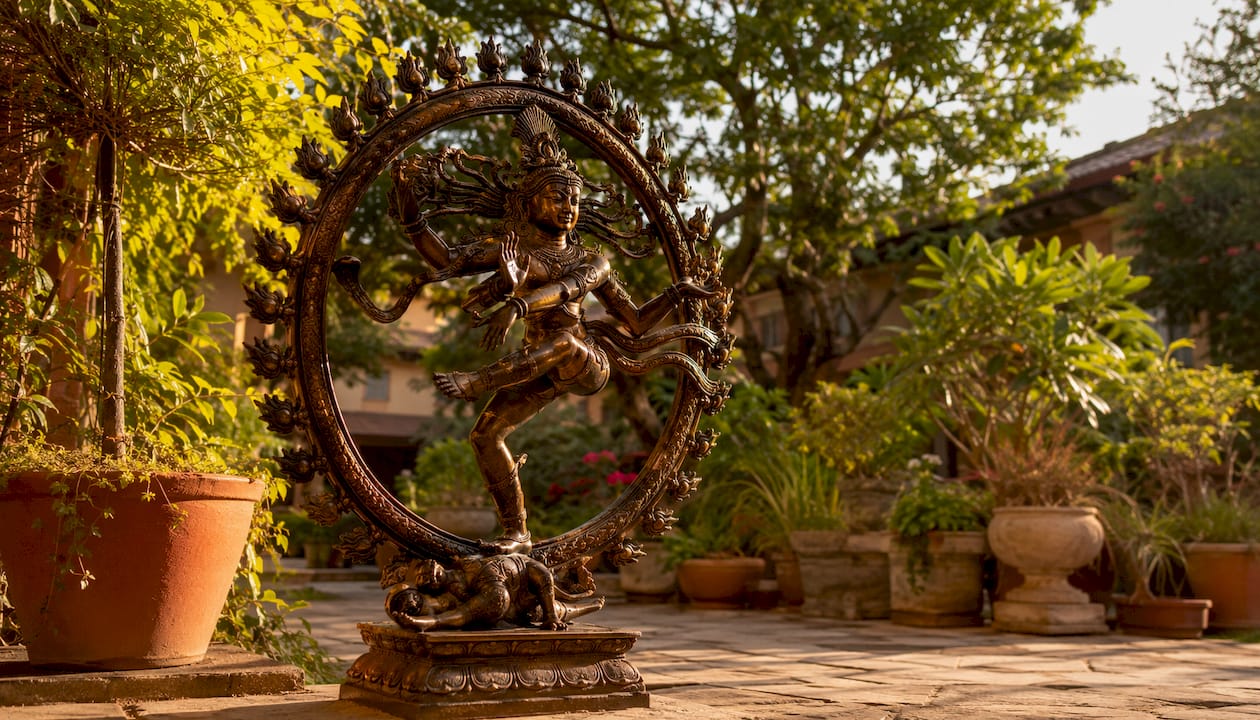
Shiva apparaît sous des formes sculpturales plus distinctes que toute autre divinité. Le Shiva Nataraja (Seigneur de la Danse) est le plus reconnu mondialement : à quatre bras, dansant dans un cercle de flammes, un pied levé et l'autre appuyant sur le nain Apasmara (ignorance). Le trident, le tambour et le croissant de lune l'identifient à travers les styles régionaux. Le Shiva linga, une forme cylindrique aniconique, est l'image Achala la plus courante dans les temples du sud de l'Inde. Ardhanarisvara, la forme androgyne mi-Shiva/mi-Parvati, est une innovation de la période Gupta qui a persisté au cours des dynasties ultérieures.
Vishnu
Vishnu se tient généralement debout sur un double piédestal de lotus, à quatre bras, avec le chakra et le shankha comme principaux identifiants. La stèle Vishnu de la période Pala du Musée d'art asiatique montre clairement cette forme canonique : Garuda apparaît sous Lakshmi comme une figure humaine-oiseau, et la main inférieure droite de Vishnu est en varada mudra. Les avatars de Vishnu (Krishna, Rama, Narasimha, Varaha) portent chacun des attributs distincts, c'est pourquoi la connaissance des avatars est une condition préalable à une identification précise.
Ganesh
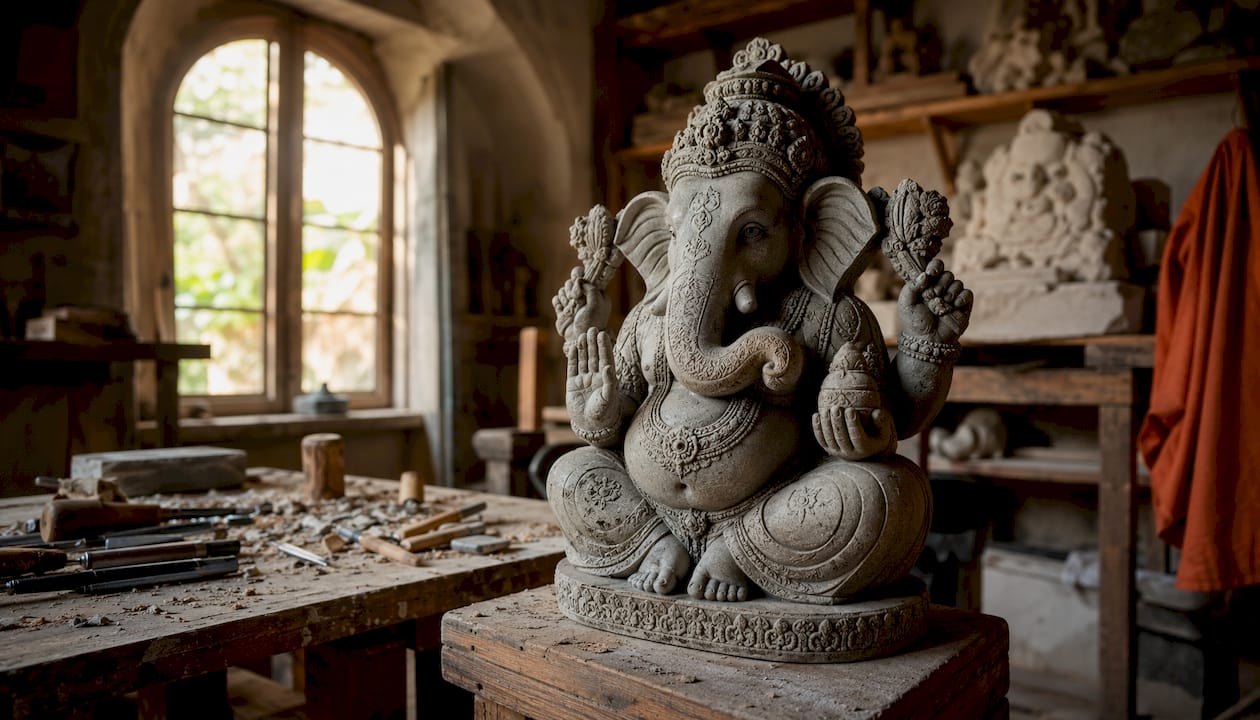
La tête d’éléphant de Ganesha rend toute identification erronée presque impossible. Le Ganesha couché La forme, moins courante que la version assise, apparaît dans des traditions régionales spécifiques et porte une signification iconographique distincte. La défense brisée tenue dans une main est un marqueur constant dans toutes les formes. Les variantes régionales incluent le Ganesha dansant du Sud Indie et les formes plus austères et à deux bras de traditions populaires.
Devi : Lakshmi, Saraswati et Parvati
Ces trois déesses sont fréquemment représentées ensemble ou comme servantes de divinités masculines. Lakshmi et Saraswati apparaissent aux côtés de Vishnu dans la stèle Pala décrite ci-dessus. Leur distinction repose entièrement sur des attributs : Lakshmi détient des lotus et de l'or ; Saraswati tient la vina et un livre ; Parvati sous sa forme Uma est calme et à deux bras, tandis que ses manifestations Durga et Kali sont multi-armées et féroces. Le nature multiforme des divinités hindoues signifie qu'une seule déesse peut apparaître sous des dizaines de formes nommées, chacune avec son propre ensemble d'attributs.
Krishna
Krishna dans sa forme pastorale (Gopala) tient une flûte et se tient souvent dans une posture tribhanga détendue avec une plume de paon dans sa couronne. Le contexte vacher, avec des vaches ou des gopis (vachères) comme accompagnatrices, confirme l'identification. Dans sa manifestation guerrière, les attributs de Krishna chevauchent ceux de Vishnu, puisque Krishna est le huitième avatar de Vishnu.
Hanuman
Hanuman est presque toujours représenté avec un visage de singe, un corps musclé et une masse. Sa queue, souvent représentée enroulée vers le haut avec une flamme au bout, est un identifiant secondaire. Il apparaît dans des postures debout et volantes. Les sculptures d'Hanuman sont courantes aux entrées des temples et dans les sanctuaires domestiques, où son rôle protecteur est primordial.
Styles régionaux et historiques qui façonnent les types de sculptures hindoues
Le Dynasties Chola, Pallava et Hoysala a produit les trois traditions sculpturales du sud de l’Inde les plus étudiées, chacune avec des signatures visuelles distinctes.
Principaux marqueurs de style régional :
- Bronzes Chola (9e-13e siècle de notre ère) : Le moulage à la cire perdue dans sa forme la plus raffinée. Les personnages sont grands, minces et élégamment proportionnés, avec de fins détails de surface en bijoux et en tissus. Le Nataraja est la forme canonique Chola. Conçues pour un usage processionnel, ce sont des images Chala par fonction.
- Sculpture sur pierre de Hoysala (XIe-XIVe siècle de notre ère) : Caractérisé par des figures plus courtes et plus compactes avec une ornementation de surface extraordinairement dense. Le plan des temples en forme d'étoile à Belur et Halebidu permettait aux sculpteurs de sculpter des figures sur des surfaces murales inclinées, produisant une composition rotationnelle distinctive. Les personnages ont des membres gracieux et des bijoux superposés qui ressemblent presque à du textile.
- Reliefs rupestres de Pallava (7e-9e siècle de notre ère) : Les artistes Pallava utilisaient des pierres dures disponibles localement, notamment du granit et du gneiss. Le temple côtier de Mahabalipuram et le relief de la Descente du Gange en sont les exemples les plus cités. Les figures sont plus sobres que les bronzes Chola, avec un calme classique qui a influencé les styles ultérieurs de l'Inde du Sud.
- Ferronnerie Newar (Népal, à partir du 10e siècle de notre ère) : Traditions de fonderie distinctes utilisant un alliage de cuivre doré. Les images Newar montrent souvent l'influence bouddhiste Vajrayana aux côtés de l'iconographie hindoue, produisant des formes hybrides que l'on ne trouve pas dans les styles régionaux indiens. La dorure en surface et les incrustations de pierres semi-précieuses sont des éléments de signature.
- Classicisme Gupta (IVe-VIe siècle de notre ère) : La période référence pour la sculpture de l’Inde du Nord. Les personnages affichent des proportions idéalisées, des surfaces doucement modelées et une intériorité sereine. Le Période Gupta a vu la consolidation d'iconographies de divinités majeures, notamment la forme Vaikuntha Vishnu et le Brahma à plusieurs têtes.
Chronologie de style compact :
- 2e siècle avant notre ère : Sculpture en relief narrative à Bharhut ; premières formes de divinités dérivées de Yaksha
- 4e-6e siècle de notre ère : Classicisme Gupta ; iconographies canoniques des divinités établies
- 7e-9e siècle de notre ère : Tradition de la taille de la roche Pallava ; Mahabalipuram
- 9e-13e siècle de notre ère : Tradition processionnelle en bronze Chola
- 11e-14e siècle de notre ère : Sculpture sur pierre complexe de Hoysala
- À partir du 10e siècle de notre ère : Ferronnerie Newar en cuivre doré, Népal
Sculpture hindoue indonésienne représente une autre extension régionale, où les conventions de Shilpa Shastra ont été adaptées aux matériaux locaux et aux préférences esthétiques, produisant des formes reconnaissables par l'hindouisme mais distinctement javanaises ou balinaises.
Comment fonctionnent les sculptures dans le culte hindou ?
Le cycle de vie rituel d’un murti suit une séquence définie depuis la mise en service jusqu’à l’utilisation quotidienne. Chaque étape façonne les exigences physiques de la sculpture.
- Mise en service : Un sculpteur formé aux conventions Shilpa Shastra est engagé. Les systèmes proportionnels (tala) régissent la hauteur de l’image, les rapports des membres et les traits du visage. Le matériau est sélectionné en fonction de la catégorie de mobilité prévue de l’image.
- Consécration (prana pratishtha) : L'image est rituellement installée et « animée » par une cérémonie qui comprend la récitation du mantra, le bain (abhisheka) et l'ouverture des yeux. Passé ce stade, la murti est traitée comme une présence vivante. Les images d'Achala sont consacrées in situ et ne peuvent pas être déplacées sans une cérémonie de désécration complète.
- Puja quotidienne : La divinité est réveillée, baignée, habillée, offerte à manger et mise au repos selon un horaire quotidien. Pour les images Chala, cela inclut l'acte physique de s'habiller avec du tissu et des bijoux, c'est pourquoi les bronzes de procession sont conçus avec des corps lisses et sans fioritures qui acceptent un emballage textile.
- Habillage et cortège de fête : Les images de l'Utsava (festival) sont sorties du sanctuaire intérieur, placées sur des palanquins décorés et transportées dans les rues environnantes. Les exigences physiques de la procession, notamment les vibrations, l'exposition aux intempéries et la manipulation par plusieurs personnes, expliquent pourquoi les images Chala sont coulées dans du bronze durable plutôt que sculptées dans la pierre.
- Entretien et réparation à long terme : Les sculptures des temples font l'objet d'un nettoyage rituel périodique et, dans certaines traditions, d'une repeinture ou d'une redorure. Cet entretien rituel est distinct de la conservation au sens muséal occidental et peut compliquer l'évaluation de la provenance pour les collectionneurs.
L'exposition muséale des murtis du temple soulève des questions éthiques sur le statut rituel. De nombreuses institutions incluent désormais des notes de provenance et, dans certains cas, entretiennent des relations de consultation avec les communautés religieuses concernées lors de l'affichage d'images consacrées.
Bases de la conservation des sculptures traditionnelles
Les soins appropriés varient considérablement selon le matériau. Les lignes directrices suivantes s’appliquent aux contextes de collection et d’exposition domestique.
Par matière :
- Pierre : Dépoussiérer avec une brosse douce et sèche. N’utilisez jamais de nettoyants acides. L’humidité est le principal ennemi ; éloignez les images de pierre des humidificateurs et des murs extérieurs. La croissance biologique (mousse, lichen) sur les pièces extérieures nécessite un traitement spécialisé et non un agent de blanchiment domestique.
- Bronzes : Essuyer avec un chiffon doux et sec. Évitez le contact de l’eau sur les surfaces patinées ; la patine est une couche protectrice, pas de saleté. N’utilisez jamais de produit à polir pour métaux sur des bronzes antiques. Les taches vertes poudreuses (maladie du bronze) nécessitent une conservation professionnelle immédiate.
- Bois : Maintenir une humidité stable (40 à 55 % d’humidité relative). Évitez la lumière directe du soleil, qui blanchit les pigments et sèche le bois. Les dommages causés par les insectes (petits trous de sortie, poudre fine) nécessitent une fumigation avant que la pièce ne soit stockée à proximité d'autres objets en bois.
- Métal doré : Manipuler avec des gants en coton. La couche de dorure est fine et irremplaçable ; l'abrasion à mains nues entraîne une perte cumulative. Tenir à l'écart des matières soufrées (caoutchouc, certaines peintures).
Repérer les reproductions modernes :
- De véritables bronzes à la cire perdue présentent des coutures de coulée au niveau des poignets, des chevilles et parfois du cou. Les reproductions moulées dans des moules montrent souvent des lignes de couture verticales sur les côtés de la figurine.
- La patine artificielle des reproductions a tendance à être de couleur uniforme et se pose en surface plutôt que de se développer dans les pores du métal. La véritable patine vieillie varie en ton et est souvent plus épaisse dans les zones en retrait.
- Les irrégularités proportionnelles sont un signal d’alarme. Les pièces authentiques suivent les systèmes proportionnels tala ; les reproductions montrent souvent des têtes trop grosses ou des membres mal articulés.
- Les inscriptions sur la base de pièces authentiques sont généralement réalisées dans des écritures d'époque. Les reproductions modernes omettent les inscriptions ou utilisent des lettres anachroniques.
Conseil de pro : Avant d'acheter une pièce importante, photographiez la base, tous les joints de moulage et tous les panneaux d'inscription. Partagez ces images avec un restaurateur ou un spécialiste avant de vous engager. La documentation au point d'acquisition est l'étape la plus précieuse pour la provenance et la conservation à long terme.
Textes clés, musées et pratiques de conservation pour la classification
Les systèmes de classification utilisés tout au long de cet article dérivent de deux traditions textuelles principales et sont appliqués dans la pratique par les principaux départements de conservation des musées.
Autorités iconographiques primaires :
- Shilpa Shastras : Un ensemble de textes techniques sanscrits régissant les proportions, les attributs, la posture et le matériau des images sacrées. Ils précisent le système tala (unités proportionnelles basées sur la longueur du visage), le nombre correct de bras pour chaque forme de divinité et la signification symbolique de chaque attribut. La représentation iconographique authentique suit ces codes, qui sont un premier signal d'authenticité pour les collectionneurs et les conservateurs.
- Agamas : Textes rituels sectaires (textes Shaiva Agamas, Vaishnava Pancharatra) qui régissent les rites de consécration, l'agencement des temples et les formes spécifiques de divinités appropriées à chaque contexte rituel. Ils complètent les Shilpa Shastras en spécifiant non seulement à quoi ressemble une image, mais aussi comment elle est utilisée.
Pratique de conservation de musée :
L’approche du Metropolitan Museum of Art pour reconnaître les dieux hindous s’appuie sur les attributs et les vahanas comme principaux outils d’identification, appliqués de manière cohérente à travers les variations stylistiques et régionales. Il s’agit du même flux de travail utilisé par les spécialistes des maisons de ventes et les conservateurs indépendants.
"Les attributs et les vahanas sont les identifiants les plus fiables dans toutes les variations régionales et stylistiques de la sculpture hindoue - un fait que les catalogueurs de musées et les chercheurs sur le terrain appliquent de manière cohérente, quelle que soit l'origine ou l'état de la pièce." Reconnaître les dieux, The Metropolitan Museum of Art
Les galeries Freer et Sackler du Smithsonian et le musée d’art asiatique de San Francisco gèrent tous deux des bases de données de collections en ligne contenant des notes iconographiques détaillées. La Galerie nationale d'art sculpture de Indie le catalogue reste une référence standard pour l’attribution des périodes historiques.
Pour les lecteurs souhaitant une vérification plus approfondie : consultez d'abord les essais de la collection du musée, puis faites des références croisées avec les commentaires de Shilpa Shastra disponibles via l'IGNCA (Centre national des arts Indira Gandhi). Pour les styles régionaux, la littérature académique sur les sculptures de Pallava, Chola et Hoysala est vaste et accessible via JSTOR et les bases de données des bibliothèques universitaires.
Points clés à retenir
Les sculptures de divinités hindoues sont classées selon cinq axes : mobilité, forme, humeur émotive, matériau/technique et style régional, le vahana, les attributs et les mudras servant de principaux outils d'identification.
| Point | Détails |
|---|---|
| Cinq axes de classement | La mobilité, la forme/dimensionnalité, l'ambiance émotive, le matériau/technique et le style régional définissent chaque type de sculpture de divinité hindoue. |
| La mobilité détermine le matériel | Les images Achala sont une pierre de permanence ; Les images de procession Chala sont en bronze, coulées à la cire perdue pour plus de durabilité et de détails. |
| Hiérarchie d'identification | Identifiez-vous d'abord par le vahana, puis par les ayudhas (attributs détenus), puis par les mudras et la posture — c'est la méthode utilisée par les conservateurs de musée. |
| Fonction rituelle des signaux d’humeur | Les formes Sattvika sont destinées à une dévotion quotidienne soutenue ; Les formes Tamasa sont protectrices et apotropaïques, placées aux entrées ou favorisées lors de festivals spécifiques. |
| Collection HDAsianArt | HDAsianArt organise des sculptures hindoues et bouddhistes authentifiées avec des recherches iconographiques expertes, utiles comme référence visuelle pour le style et l'attribution. |
Lire attentivement les sculptures : une perspective curatoriale
Les systèmes de classification abordés ici sont véritablement utiles, mais ils peuvent créer un faux sentiment de certitude. Un bronze Chola et une reproduction compétente du XXe siècle peuvent paraître presque identiques sur une photographie. Un formulaire Tamasa avec des attributs manquants peut être interprété à tort comme une pièce Sattvika endommagée. Les systèmes sont des outils, pas des verdicts.
Ce que le framework Shilpa Shastra fait bien, c'est de donner aux collectionneurs et aux étudiants un vocabulaire partagé. Lorsqu'un spécialiste dit qu'une pièce est « Chala, Chitra, Sattvika, Chola tradition, 11e-12e siècle », c'est une affirmation précise et vérifiable. Chaque terme peut être vérifié par rapport aux preuves matérielles. Cette précision est ce qui différencie la collecte éclairée des conjectures.
La dimension éthique est tout aussi importante. De nombreuses sculptures hindoues des collections occidentales ont été retirées de l’usage actif des temples, parfois sans le consentement de la communauté. La recherche de provenance n’est pas facultative pour les collectionneurs sérieux. Avant d'acquérir une pièce présentant les caractéristiques d'un temple (joints de moulage compatibles avec la fonction utsava, panneaux d'inscription de base, preuves de canaux de bain rituels), vérifiez la documentation d'exportation et consultez des ressources telles que le registre des pertes d'art. L’approche de HDAsianArt consistant à rechercher et à documenter individuellement chaque pièce reflète le niveau auquel le domaine s’attend désormais.
L’aspect le plus négligé de l’étude de la sculpture hindoue est la dimension régionale. Les traditions de l'Inde du Nord et de l'Inde du Sud se sont développées en grande partie indépendamment après la période Gupta, et leur fusion produit des erreurs d'attribution. Un collectionneur capable de distinguer un bronze Chola d'une pièce en cuivre doré Newar par son traitement de surface et ses conventions de proportionnalité opère à un niveau d'expertise véritablement utile.
Lectures complémentaires et sources primaires
- Reconnaître les dieux, The Metropolitan Museum of Art : L’essai curatorial du Met sur l’identification des divinités hindoues par attributs et vahanas. La ressource unique la plus claire pour le flux de travail d'identification utilisé par les professionnels des musées.
- Iconographie hindoue, Achari, 2015 (SAACS) : Un aperçu technique concis des conventions Shilpa Shastra, des systèmes proportionnels et des codes d'attribut. Utile pour comprendre les règles canoniques derrière toute forme spécifique de divinité.
- La Phase Classique, IGNCA : Documentation du Centre national des arts Indira Gandhi sur le développement iconographique de la période Gupta. Essentiel pour comprendre comment les formes canoniques des divinités ont été établies.
- Styles sculpturaux Pallava, Chola et Hoysala (Academia.edu) : Analyse comparative détaillée des trois grandes familles de styles de l'Inde du Sud, avec des indices visuels pour les distinguer.
- Sculpture de Indie, Galerie nationale d'art : L'essai du catalogue de la NGA couvrant l'arc historique complet de Bharhut à la période Chola. Référence standard pour l'attribution de périodes.
- Puja : Comment les sculptures sont utilisées dans le culte hindou, Smithsonian: L'aperçu accessible du Smithsonian de l'utilisation rituelle, couvrant la consécration, la puja quotidienne et la pratique processionnelle.
- Divinité hindoue Vishnu, Musée d'art asiatique: Une entrée pédagogique détaillée sur une stèle Vishnu de la période Pala, avec des notes d'identification attribut par attribut. Utile comme exemple concret de la méthode d’identification.
- Collection HDAsianArt.com: Photographies organisées et descriptions d'experts de sculptures hindoues et bouddhistes de toute l'Asie du Sud et du Sud-Est. Une référence visuelle pratique pour la comparaison de styles et la recherche de provenance.
- Caractéristiques d'identification de la statue de la déesse hindoue, HDAsianArt : Guide destiné aux collectionneurs pour identifier les formes de déesses par attributs, vahanas et marqueurs de style régional.
- De l'informe à plusieurs formes, Auro Society : Couvre le système de classification de la mobilité (Achala, Chala, Chalachala) et son lien avec la fonction rituelle et le choix des matériaux.
HDAsianArt : sculptures hindoues et bouddhistes organisées pour les collectionneurs et les universitaires
Les collectionneurs qui ont travaillé sur les systèmes de classification ci-dessus savent ce qu'ils recherchent. Trouver des pièces qui répondent à ces normes est un défi différent.

HDAsianArt se spécialise dans les sculptures hindoues et bouddhistes antiques et traditionnelles authentifiées d'Asie du Sud et du Sud-Est, y compris des pièces en bronze, en pierre et en bois de Indonésie, Cambodge, Thaïlande, Sri Lanka, et le Viêt Nam. Chaque pièce est étudiée et documentée individuellement par des spécialistes, avec des notes iconographiques détaillées couvrant l'identification des divinités, l'attribution du style régional et l'analyse des matériaux. L’expédition DHL assurée dans le monde entier est standard. La collection est destinée aux collectionneurs, aux étudiants et aux institutions qui ont besoin de plus qu'une photographie et un pays d'origine.
Pour un exemple direct de la norme curatoriale : le Bodhisattva javanais Avalokiteshvara la liste comprend des notes de provenance, l’attribution du style et une analyse iconographique à côté des photographies. Parcourez la collection complète HDAsianArt pour comparer les styles, les matériaux et les traditions régionales à travers une sélection organisée de pièces authentifiées.
Recommandé
- Caractéristiques d'identification de la statue de la déesse hindoue : guide du collectionneur – HD Asian Art
- La sculpture hindoue indonésienne expliquée aux amateurs d’art – HD Asian Art
- Shiva : mythologie, symbolisme et art sacré – HD Asian Art
- Comment sélectionner une statue hindoue pour l’autel de votre maison – HD Asian Art
