



7 lectures du symbolisme de Trishula : textes, tantra et collection
7 lectures du symbolisme de Trishula : textes, tantra et collection
Le trishula est un trident à trois branches dont le nom vient du sanscrit tri (trois) plus śūla (une épingle en fer pointue). Au-delà de son rôle de L'arme de Shiva, il fonctionne comme un diagramme compressé de plusieurs systèmes triadiques à la fois, comprenant la création, la préservation et la destruction.
Dans le bouddhisme Vajrayana, il apparaît comme un attribut tantrique avec une signification plus étroite et plus rituelle. Ce qui suit retrace à la fois les documents textuels et les détails au niveau des objets que les collectionneurs utilisent pour dater et authentifier la sculpture portant du trishula.
Principales caractéristiques :
- La branche centrale d'un trishula représente souvent le canal énergétique Suṣumnā et devrait être la plus importante dans les sculptures ou les représentations.
- Les histoires sur l’origine de Trishula diffèrent, certaines traditions la liant à l’attribut éternel de Shiva, d’autres à la création céleste de Vishvakarma, reflétant ainsi de multiples niveaux d’interprétation.
- Les différences régionales dans l'artisanat, telles que la forme des dents et la composition de l'alliage, aident à dater et à localiser les pièces de trishula, mais ne remplacent pas les conventions iconographiques.
- Dans le bouddhisme Vajrayana, la trishula est un attribut rituel utilisé dans les pratiques des divinités, avec moins d'accent sur ses triades cosmologiques que dans le symbolisme hindou.
- L'authentification d'une sculpture de trishula repose sur l'examen des marques de moulage, de la cohérence de la patine, de la provenance et des détails iconographiques plutôt que sur la seule intuition.
Table des matières
- Symbolisme de Trishula : les triades regroupées en une seule arme
- Ce que disent les Puranas, les Agamas et les Tantras sur les origines de Trishula
- La Trishula dans l'iconographie et le rituel hindous
- Comment le tantra bouddhiste recadre la Trishula
- Variation régionale de l'art et de l'artisanat de Trishula
- Trishula à la maison, sur le corps et au temple
- Ce que les collectionneurs devraient rechercher dans une sculpture portant Trishula
- Pourquoi la Trishula compte toujours
- Trouvez une sculpture authentifiée portant Trishula sur HD Asian Art
- Sources
- FAQ
Symbolisme de Trishula : les triades regroupées en une seule arme
Lu dans un sens, le trishula est une arme. Lisez la façon dont les commentateurs Shaiva l'ont lu pendant des siècles, c'est plus proche d'un dispositif mnémonique avec trois dents représentant au moins six systèmes de trois qui se chevauchent. Cette superposition est la véritable substance derrière le symbolisme de la trishula, et elle récompense le ralentissement plutôt que l’écrémage.
La correspondance la plus citée relie les branches à la Trimurti, la triade de Brahma le créateur, Vishnu le conservateur et Shiva le destructeur. Une seconde lecture mappe les trois mêmes points sur le gunas, les qualités de sattva (clarté), Rajas (activité), et tamas (inertie) que la philosophie Samkhya utilise pour décrire toute matière et tout esprit. Une troisième couche, trikala, attribue les volets au passé, au présent et au futur, tandis qu'un quatrième, triloka, les attribue aux trois mondes du ciel, de la terre et des enfers.
Deux lectures plus subtiles proviennent d'interprètes yogiques et tantriques plutôt que du texte classique du Purana. Tri-avastha cartographie les volets des trois états de conscience, veille, rêve et sommeil profond. Tri-naḍī les mappe aux trois canaux énergétiques primaires du Hatha Yoga, Ida, Piṅgalā, et Susumna. Les essais interprétatifs modernes sont allés encore plus loin, cataloguant jusqu'à sept codages triadiques distincts dans un seul trident, du trois gunas pour tri-doṣa, les trois humeurs corporelles de l'Ayurveda.
Aucune de ces lectures n’annule les autres. C’est le point sur lequel les interprètes reviennent sans cesse : la trishula fonctionne comme un index où plusieurs triades sont censées être gardées à l’esprit simultanément, et non comme un puzzle avec une seule bonne réponse.
- Trimurti: création, préservation, destruction
- Gunas: sattva, rajas, tamas
- Trikala: passé, présent, futur
- Triloka: ciel, terre, enfer
- Tri-avastha: veille, rêve, sommeil profond
- Tri-naḍī: Iḍā, Piṅgalā, Suṣumnā
Environ sept de ces cadres triadiques reviennent dans les synthèses interprétatives modernes du symbole, ce qui suggère que la trishula n’a jamais été censée avoir une signification fixe, même au sein d’une seule tradition.
Conseil de pro : Lorsque vous étudiez une trishula dans un relief de temple ou une icône en bronze, regardez d'abord la broche centrale. Les commentateurs yogiques le lisent comme Suṣumnā, le canal par lequel l'énergie éveillée monte. Les deux branches flanquantes, lues comme Iḍā et Piṅgalā, existent dans une tension équilibrée autour d'elles, c'est pourquoi les sculpteurs sculptent si souvent la dent du milieu légèrement plus haute ou plus prononcée que les deux à côté.
Ce que disent les Puranas, les Agamas et les Tantras sur les origines de Trishula
Les comptes d'origine pour les trishula ne sont pas d'accord les uns avec les autres, et ce désaccord est en soi informatif. Le Vishnu Purana la tradition veut que l'architecte divin Vishvakarma ait forgé l'arme à partir de matière solaire, lui donnant une origine manufacturée liée à l'artisanat et au feu céleste plutôt qu'à un pur mythe. D'autres sources Shaiva traitent la trishula comme un attribut éternel de Shiva, présent avant la création plutôt que créé en son sein. Les deux cadres persistent côte à côte dans la littérature dévotionnelle, et aucun n’a complètement remplacé l’autre.
C'est dans la littérature Agama et Tantra que le trishula reçoit son traitement le plus technique. Des textes comme le Kamikagama, le Netratantra, et le Srimatottara-tantra traitez-le comme un attribut formel dans l'iconographie des divinités, avec des instructions spécifiques sur la manière dont il doit être installé, consacré et lu symboliquement dans les contextes des temples. Certains passages tantriques le relient à la divinité Svacchanda et l'énumèrent aux côtés d'autres attributs d'armes attribués à des formes spécifiques de Shiva.
- Vishnu Purana : forgé par Vishvakarma à partir de matière solaire
- Tradition Shaiva : attribut éternel et incréé de Shiva
- Textes Agama : prescrivent des règles d'installation rituelle et de consécration
- Textes tantriques : associez la trishula à des formes de divinités et à des systèmes d'attributs spécifiques
Les résumés scientifiques de ces documents parlent franchement du désaccord. Des sources compilées dans des référentiels tels que les citations tantriques de Wisdom Library montrent que la trishula joue différents rôles techniques à travers les textes, parfois un objet rituel, parfois une aide visuelle méditative, parfois une arme simple. Traiter n’importe quelle histoire d’origine unique comme l’histoire définitive simplifie à l’extrême une tradition qui était à l’aise avec plusieurs récits à la fois.
La Trishula dans l'iconographie et le rituel hindous
En sculpture et en peinture, la trishula n'apparaît presque jamais seule. Shiva est représenté le tenant droit, souvent dans sa main gauche, fréquemment associé au Damaru, le petit tambour en forme de sablier dont la forme à deux têtes symbolise le son et le rythme cosmiques dans la tradition Shaiva. Là où le trishula représente la structure et les trois états du cosmos, le damaru représente la vibration qui l'anime. Ensemble, ils forment une déclaration compacte sur la forme et le son, la matière et le mouvement, apparaissant côte à côte sur d'innombrables bronzes du sud de l'ère Chola. Indie à travers des ateliers ultérieurs sur l'Himalaya et l'Asie du Sud-Est.
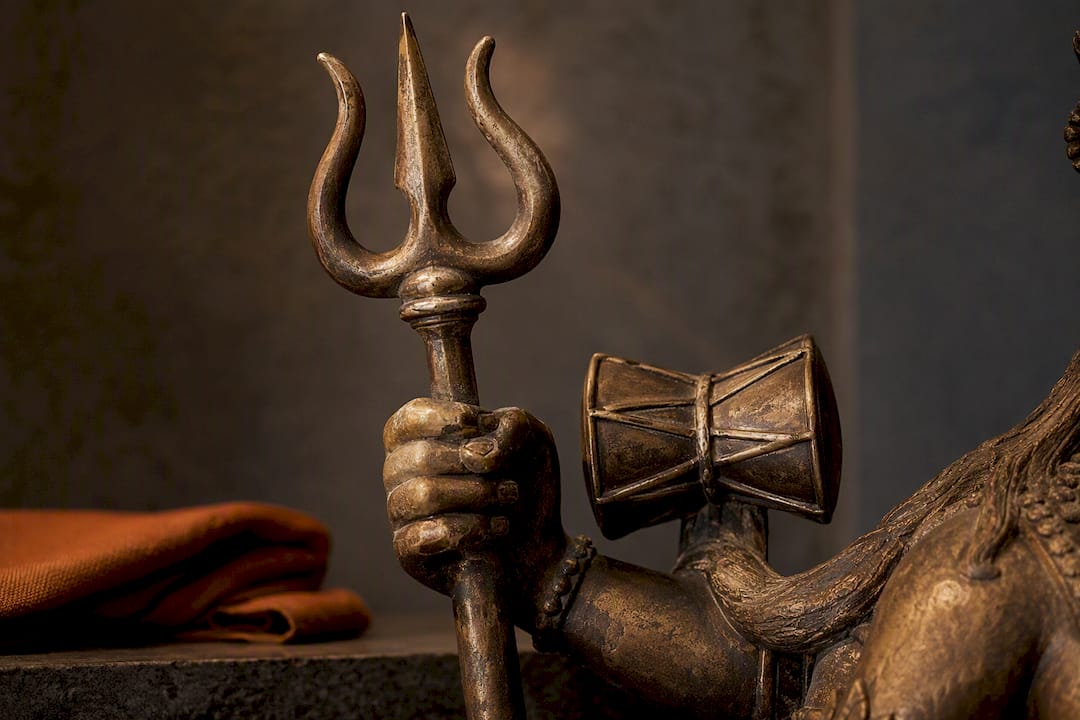
Durga porte également la trishula, généralement reçue en cadeau de Shiva parmi son arsenal d'armes divines dans la tradition Devi Mahatmya. Le motif de l’arme comme cadeau est important ici : il signale que le symbolisme du trident voyage entre les divinités sans perdre sa signification sous-jacente, renforçant l’idée que le pouvoir du trishula appartient au symbole lui-même plutôt qu’à un seul porteur.
Les trishulas rituelles et sculpturales diffèrent par leur matériau et leur objectif :
| Contexte | Matériau typique | Fonction principale |
|---|---|---|
| Objet rituel du temple | Fer, laiton ou alliage de cuivre | Outil consacré, installé selon les instructions d'Agama |
| Icône de dévotion autonome | Bronze, parfois argenté | Culte personnel ou domestique |
| Architecture du temple (fleuron) | Pierre ou métal moulé | Marque un espace sacré au sommet d'un shikhara ou d'une passerelle |
| Sculpture de qualité musée | Bronze, pierre, bois | Objet d'art de collection avec provenance documentée |
| Marqueur de crémation | Fer | Signale la présence de Shiva sur les sites liminaires et ascétiques |
Un journaliste explicatif du Des temps de Indie sur le damaru offre un point d'entrée accessible sur la raison pour laquelle les deux instruments sont si rarement séparés dans les récits populaires, même si les sources tantriques savantes les traitent comme des systèmes symboliques distincts.
Comment le tantra bouddhiste recadre la Trishula
Le bouddhisme Vajrayana a absorbé le trishula mais en a réutilisé le sens. Des divinités tantriques courroucées telles que Hérouka et des formes associées à Cakrasaṃvara sont représentées tenant le trishula comme un instrument parmi un plus grand ensemble d'attributs rituels, aux côtés de coupes crâniennes, de couteaux incurvés et d'autres emblèmes spécifiques à la pratique du Vajrayana.
Le changement est significatif. Dans les contextes hindous, la signification de la trishula est fortement ancrée dans la Trimurti et ses triades associées. Dans les contextes tantriques bouddhistes, il fonctionne davantage comme un outil méditatif et rituel, lié à des objectifs spécifiques. sadhana pratiques et visualisations de divinités plutôt qu’à un cadre cosmologique de création-préservation-destruction.
- Détenu par des divinités courroucées comme Hérouka dans l'iconographie du Vajrayana
- Fonctionne comme un attribut parmi plusieurs plutôt que comme un symbole unique
- Transmis dans les traditions artistiques tibétaines et himalayennes plus larges aux côtés d'autres instruments rituels indiens
- Conserve la forme à trois volets mais perd une grande partie de la lecture spécifique à Trimurti
Cette transmission dans les ateliers tibétains et himalayens explique pourquoi les bronzes à trishula de ces régions semblent souvent stylistiquement distincts des exemples d'Asie du Sud, même lorsque la forme centrale reste reconnaissable.
Variation régionale de l'art et de l'artisanat de Trishula
Le profil à broches est souvent l'indication la plus rapide de l'origine régionale. Les trishulas de la période Chola du sud de l'Inde ont tendance à avoir des dents minces et allongées avec une broche centrale prononcée. Les exemples himalayens et népalais montrent souvent des broches plus larges et plus angulaires avec des douilles de montage plus lourdes conçues pour une utilisation rituelle à main plutôt que pour un affichage.
Le motif avait également une valeur civique. Les emblèmes royaux et l'architecture des temples de l'Asie du Sud-Est ont adopté la trishula lors de son voyage avec la culture religieuse indienne. Cambodge, Java, et au-delà, apparaissent souvent comme des fleurons de temple, signalant à la fois l'autorité sacrée et le patronage royal. Le histoire de l'iconographie de Shiva en Asie du Sud-Est montre à quel point le formulaire a été adapté plutôt que simplement copié.
- Le profil des dents (mince ou large) signale souvent une origine régionale
- La proéminence du volet central varie selon la période et la tradition de l'atelier
- Le style de montage distingue les pièces à usage rituel des pièces purement sculpturales
- La composition de l'alliage et la technique de moulage permettent de dater une pièce au cours d'une période dynastique
Le matériau et la technique de moulage restent les outils de datation les plus fiables dont disposent les collectionneurs, plus fiables que le seul style iconographique, les ateliers régionaux empruntant souvent leurs conventions visuelles.
Trishula à la maison, sur le corps et au temple
Les fidèles posent régulièrement des questions pratiques sur la trishula que les chercheurs abordent rarement directement. Voici des conseils fondés sur les trois qui reviennent le plus.
- Garder un trishula à la maison: Une trishula rituelle consacrée comporte des attentes différentes de celles d'une trishula sculpturale décorative. La pratique traditionnelle considère qu'un objet consacré nécessite des soins et un respect continus, tandis qu'une pièce artistique ou de collection peut être exposée sans ces obligations rituelles.
- Porter un pendentif trishula: Un pendentif est généralement considéré comme acceptable lorsqu'il est porté avec une véritable intention de dévotion plutôt que comme une pure mode, et une taille modeste a tendance à être considérée comme plus respectueuse qu'un emblème surdimensionné.
- Offrir une trishula à un temple: La plupart des temples ont des protocoles spécifiques pour accepter les dons de dévotion, donc contacter l'administration du temple avant une offrande évite les faux pas logistiques et rituels.
Conseil de pro : Si vous êtes attiré par un trishula comme objet de collection plutôt que comme objet rituel, dites-le clairement au vendeur. Un revendeur réputé décrira si une pièce a déjà été consacrée, ce qui est extrêmement important pour la façon dont vous l'exposerez et en prendrez soin à l'avenir.
Ce que les collectionneurs devraient rechercher dans une sculpture portant Trishula
L'authentification d'une sculpture en bronze, en pierre ou en bois portant un trishula se résume à une poignée de détails vérifiables plutôt qu'à une intuition. Les coutures de coulée et les marques d'outils doivent correspondre aux techniques régionales connues pour la période revendiquée. La patine doit être uniforme sur toute la surface, car une patine mal assortie ou trop uniforme indique souvent une reproduction moderne ou un nettoyage agressif. La provenance documentée, comprenant idéalement les registres de désaccession au temple ou l’historique des collections antérieures, reste le signal de confiance le plus fort sur le marché.
- Vérifier la consistance de l'alliage typique de la période de coulée revendiquée
- Comparez la patine avec les modèles régionaux ou funéraires connus
- Donner la priorité aux pièces dont la provenance est documentée par rapport aux exemples « attribués » non documentés
- Faites correspondre les détails iconographiques (forme des dents, appariement des damaru, posture de la divinité) aux conventions régionales de datation
Conseil de pro : Les sculptures trishula en bois et en pierre nécessitent une gestion climatique différente de celle du bronze. Le bois est le plus sensible aux variations d'humidité et bénéficie de conditions intérieures stables à l'abri du soleil direct, tandis que le bronze tolère davantage de variations mais doit tout de même éviter une exposition prolongée à l'humidité qui accélère la corrosion.
Pourquoi la Trishula compte toujours
Travailler à travers les sources Purana, Agama et Tantrique aux côtés des objets eux-mêmes change la façon dont vous voyez un trishula dans une vitrine de galerie. Les textes sont en désaccord sur l'origine, mais les objets perpétuent honnêtement ce désaccord, chacun étant un enregistrement physique d'une tradition qui peut contenir plusieurs significations à la fois. C’est ce qui maintient le symbole vivant plutôt que fossilisé.
—James, HDAsianArt.com
Trouvez une sculpture authentifiée portant Trishula sur HD Asian Art
Lire sur le symbolisme de Trishula est une chose. Tenir un bronze vieux de plusieurs siècles qui le porte est une toute autre expérience, et c'est une expérience que HDAsianArt permet de rendre possible sans les conjectures qui accompagnent généralement l'achat d'art religieux antique en ligne.

Chaque pièce du Statues hindoues La collection est étudiée et décrite individuellement, avec une attention portée aux détails de moulage, à la patine et à la précision iconographique qui séparent une véritable pièce d'époque d'une reproduction moderne. Les collectionneurs recherchant spécifiquement des œuvres de grande valeur de qualité muséale devraient commencer par le Chefs-d'œuvre collection, où la documentation sur la provenance et les notes d’état font partie de la liste plutôt qu’après coup. Chaque commande est expédiée dans le monde entier avec une assurance complète, de sorte qu'une figurine de Shiva ou Durga portant le trishula arrive exactement comme photographiée et décrite. Parcourez la sélection actuelle ou contactez directement pour poser des questions sur une pièce spécifique avant d'acheter.
Sources
- Trishula — Wikipédia
- Trident — Bibliothèque de sagesse
- Trishul (Trident) : l'arme de Shiva, le symbolisme à trois dents, l'origine et la signification yogique | Raga éternel
FAQ
Que signifie spirituellement un trident ?
Les trois volets du trishula sont le plus souvent interprétés comme la Trimurti de création, de préservation et de destruction, bien que les trois mêmes points soient également mappés sur les trois gunas, les trois états de conscience et d'autres systèmes triadiques selon la tradition.
Faut-il garder un trishula à la maison ?
Une trishula rituelle consacrée comporte des obligations de soins continus, tandis qu'une pièce sculpturale décorative ou de collection peut être exposée sans ces exigences tant qu'elle est abordée dans le respect de ses origines.
Quel est le symbole du trishul ?
Le trishul, ou trishula, est un trident à trois branches, le plus étroitement associé à Shiva, et il est souvent associé visuellement au tambour damaru dans les sculptures des temples et les bronzes de dévotion.
Est-il acceptable de porter un pendentif trishul ?
Le port d'un pendentif trishul est généralement considéré comme acceptable lorsqu'il est fait avec une véritable intention de dévotion et à une échelle modeste, plutôt que comme une déclaration de mode purement décorative, déconnectée de sa signification religieuse.
