



Le rôle du rituel de consécration dans les statues bouddhistes
Le rôle du rituel de consécration dans les statues bouddhistes
La consécration est définie dans la pratique bouddhiste comme le processus rituel formel qui transforme une statue artisanale d'un objet matériel en un point focal sacré et spirituellement actif pour le culte et la pratique tantrique. Le rôle du rituel de consécration des statues bouddhistes n’est pas décoratif ou cérémonial au sens superficiel.
C'est le mécanisme par lequel une statue devient une interface légitime entre le praticien et un Bouddha ou un Bodhisattva spécifique. Les traditions, notamment le bouddhisme tibétain, le Bon et le bouddhisme japonais, appliquent chacune des rites distincts, mais partagent toutes la même fonction principale : une présence spirituelle invitante dans la forme physique, conférant à la statue un mérite spirituel hors du commun et une efficacité au-delà de son savoir-faire extérieur.
Quelles sont les étapes traditionnelles de la consécration d’une statue bouddhiste ?
Le processus de consécration en plusieurs étapes dans le bouddhisme tantrique indo-tibétain, il suit une séquence structurée qui relie la statue à un Bouddha tantrique spécifique, la transformant en un objet de pratique légitime plutôt qu'en un objet génériquement béni. Chaque étape a un poids symbolique distinct, et sauter une étape est considéré comme laissant la consécration incomplète.
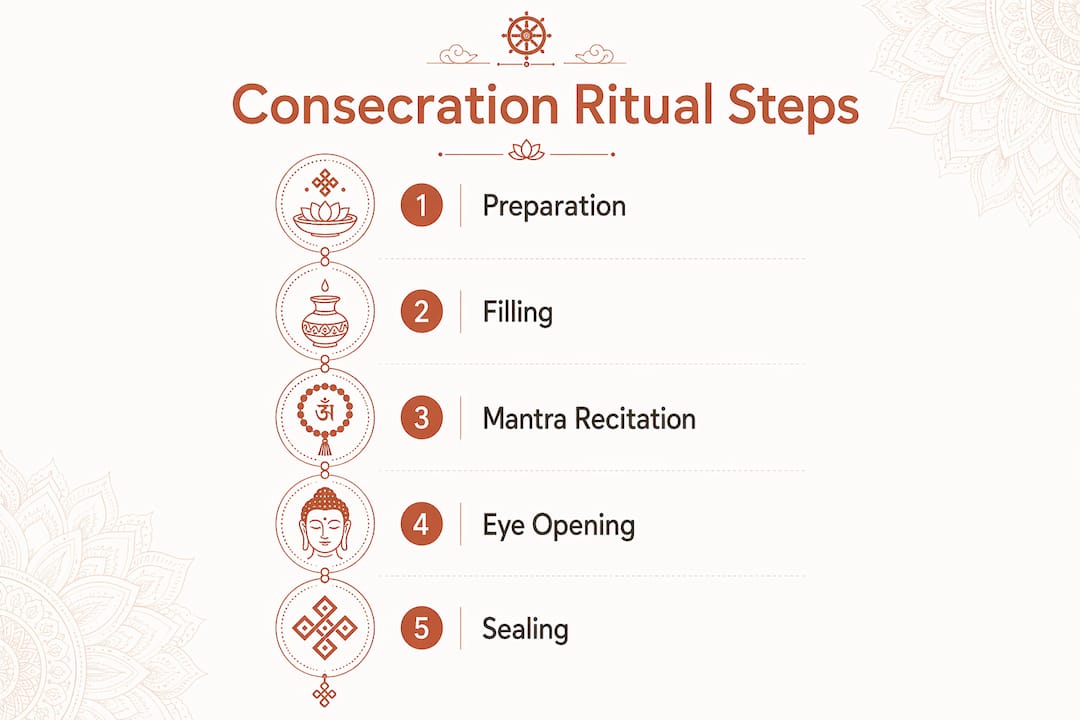
La séquence standard se déroule comme suit :
- Collecter des ingrédients sacrés. Les pratiquants ou les lamas officiants rassemblent du matériel rituel, notamment des mantras écrits sur du papier ou du tissu, des textes sacrés, des bâtons d'encens, des herbes médicinales et un « arbre de vie » en bois (tibétain : srogshing). Ces matériaux représentent la force vitale intérieure de la statue.
- Purifier et bénir les matériaux. Des mantras sont récités sur chaque ingrédient. Les textes sont consacrés séparément avant d'être placés à l'intérieur de la statue. Cette étape établit la puissance spirituelle de ce qui deviendra l’intérieur de la statue.
- Nettoyer la statue. L'extérieur est rituellement nettoyé, éliminant toutes les impuretés accumulées lors de la fabrication ou du transport. Il ne s’agit pas simplement d’un nettoyage physique. C'est une purification symbolique qui prépare l'objet à recevoir des contenus sacrés.
- Remplissage et scellement de l'intérieur creux. La cavité de la statue est remplie de matériaux rituels préparés puis scellée. Recherche en imagerie neutronique menée en 2026 a confirmé la présence de mantras enveloppés, d'arbres de vie en bois et de bâtons d'encens à l'intérieur des statues en bronze tibétaines, validant ce que les récits traditionnels décrivent depuis des siècles.
- Prière et récitation de mantras. Les lamas chantent des prières d'invocation spécifiques pour attirer la présence de la divinité dans la statue. C'est le moment de l'activation, où la statue passe d'un objet rempli à un objet consacré.
- Dédicace et prières de clôture. La cérémonie se termine par une dédicace au mérite et des prières pour l’efficacité continue de la statue dans la pratique.
La lignée et le type de statue introduisent des variations significatives à chaque étape. Un lama Vajrayana consacrant une figure de Vajrasattva suit des sources textuelles différentes de celles qui consacrent une Tara. Les praticiens du Bon suivent des procédures parallèles mais distinctes ancrées dans leurs propres transmissions lignées.
Conseil de pro : Lors de l'acquisition d'une statue tibétaine ou Bon, demandez directement si elle a été remplie et scellée. Une statue avec un contenu intérieur intact et une consécration documentée revêt en pratique un statut différent de celui qui est extérieurement identique mais non rempli.
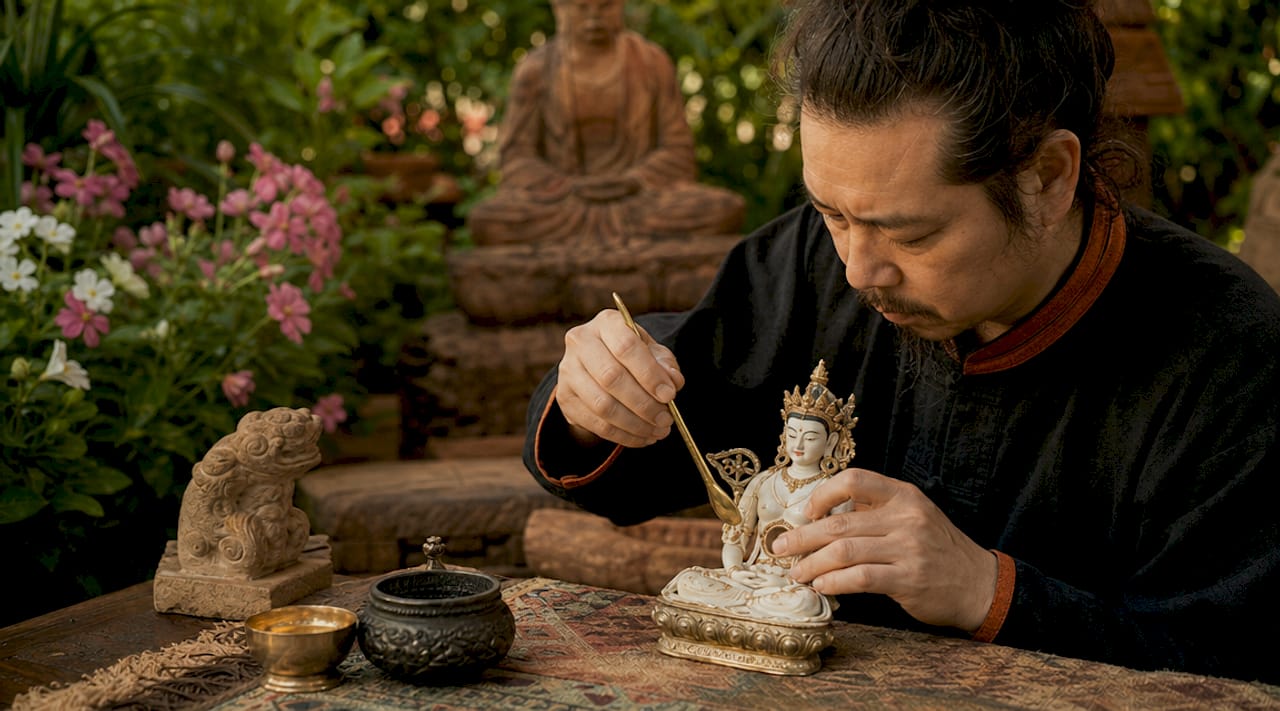
En quoi la consécration diffère-t-elle selon les traditions tibétaines, bon et japonaises ?
Les variations rituelles selon les lignées sont suffisamment importantes pour que les praticiens devraient considérer la connaissance de la consécration comme spécifique à la tradition plutôt qu'universelle. Trois cadres majeurs illustrent la gamme.
| Tradition | Rite Primaire | Accent essentiel | Matériaux clés |
|---|---|---|---|
| Bouddhisme tibétain | Consécration tantrique en plusieurs étapes (Rab gnas) | Transformation tantrique, lien avec la déité | Arbre de vie, mantras, textes sacrés, substances médicinales |
| Bon | Rites en plusieurs étapes spécifiques à la lignée | Transmission orale, formes de déité Bon | Semblable au tibétain mais avec des textes spécifiques au Bon et des invocations de divinités |
| Bouddhisme japonais | Kaigen (cérémonie de révélation) | Activation symbolique, préparation de l'image pour le respect | Pinceau à encre, outils rituels, concentration méditative du prêtre |
Le Tibétain Rab gnas la cérémonie est la procédure la plus élaborée. Il relie directement la statue à une forme spécifique de divinité tantrique, ce qui signifie que la fonction rituelle de la statue est définie par la pratique de cette divinité. Une statue de Chenrezig consacrée à travers Rab gnas devient un support de pratique de Chenrezig, et non un objet sacré générique.
Les Japonais Kaigen cérémonie adopte une approche conceptuelle différente. « Ouvrir les yeux » marque le moment où l'image devient propice au respect et à la pratique. Le prêtre utilise un pinceau pour peindre symboliquement les yeux, activant ainsi la capacité de la statue à recevoir des offrandes et des prières. Ce rite formalise la relation entre le praticien et l'image, façonnant le comportement de dévotion quotidien, y compris le placement et le type d'offrandes faites.
Principales distinctions à noter :
- Les traditions tibétaines et Bon donnent la priorité au remplissage interne comme marqueur principal de la consécration. Le contenu intérieur est ce qui anime la statue.
- La tradition japonaise met l'accent sur le moment d'activation externe. L’ouverture des yeux est le point de transition définitif.
- Les deux systèmes s’accordent sur le fait qu’une statue non consacrée, aussi magnifique soit-elle, fonctionne différemment dans la pratique d’une statue consacrée.
- La transmission orale dans les lignées Bon signifie que certains détails procéduraux ne sont pas écrits, créant ainsi des variations même au sein d'une même tradition.
Comprendre ces différences est important lorsque vous vous engagez avec une statue issue d'une tradition spécifique. Un bronze tibétain et une sculpture en bois japonaise peuvent tous deux être décrits comme « consacrés », mais la nature et les implications de ce statut diffèrent considérablement.
Pourquoi le remplissage de la cavité interne de la statue est-il important ?
La cavité interne d’une statue bouddhiste creuse n’est pas un espace vide attendant d’être rempli. C'est le lieu où la consécration devient physiquement réelle. L’étude d’imagerie neutronique réalisée en 2026 sur les statues en bronze tibétaines a confirmé ce que les praticiens soutiennent depuis des siècles : la présence de dépôts rituels à l’intérieur de la statue est le principal marqueur du véritable statut de consécration. Cette découverte signifie que le savoir-faire extérieur ne détermine pas à lui seul l’efficacité rituelle d’une statue.
Le contenu généralement trouvé à l’intérieur des statues tibétaines consacrées comprend :
- Mantras enveloppés sur papier ou tissu
- Un arbre de vie en bois (srogshing) représentant l’axe central et la force vitale de la statue
- Bâtons d'encens et herbes médicinales
- Emballages scellés de substances sacrées
"La présence du dépôt rituel intérieur est la marque clé du véritable statut de consécration. Les praticiens différencient l'achèvement de la consécration à la fois par la finition extérieure et le contenu rituel interne." — Etude d'imagerie neutronique 2026
L'arbre de vie mérite une attention particulière. Il est placé verticalement au centre de la statue, allant de la base à la couronne. Cela reflète le canal central de l’anatomie du corps tantrique, reliant la structure physique de la statue au cadre corporel subtil de la pratique du Vajrayana. Les mantras qui l’entourent ne sont pas décoratifs. Ce sont les invocations textuelles qui lient la présence de la divinité à l’objet.
L’implication pratique est directe : une statue sans contenu intérieur est, du point de vue d’un praticien traditionnel, incomplète, quelle que soit la beauté de son extérieur. Pour les collectionneurs et les praticiens travaillant avec art reliquaire bouddhiste antique, comprendre cette distinction sépare l’acquisition éclairée de l’achat mal informé.
Quel impact pratique la consécration a-t-elle sur la pratique dévotionnelle ?
La consécration façonne tous les aspects de la façon dont un pratiquant interagit avec une statue. Le Kaigen Le rite du bouddhisme japonais formalise la relation entre le praticien et l'image d'une manière qui influence directement la pratique quotidienne. Dans les traditions tibétaines, la consécration tantrique intègre la statue dans un cadre de dévotion spécifique lié au cycle de pratique de la divinité.
Les effets pratiques comprennent :
- Placement. Une statue consacrée est positionnée à une hauteur spécifique, généralement au-dessus du niveau des yeux, et fait face au praticien. Placer une statue consacrée au sol ou dans une salle de bain viole les termes de la relation établie par le rite.
- Offres. Des bols d'eau, de l'encens, des fleurs et de la lumière sont offerts régulièrement à une statue consacrée. Le type d'offrande correspond à la forme de la divinité. Une statue de Mandjoushri reçoit des offrandes associées aux pratiques de sagesse. Une statue de Bouddha de Médecine reçoit des offrandes liées à des intentions de guérison.
- Nettoyage. Les statues consacrées sont nettoyées avec soin et avec des matériaux spécifiques. Dans la pratique tibétaine, la statue n’est pas démontée ni le sceau de la base brisé sans effectuer au préalable un rituel visant à retirer temporairement la présence de la divinité.
- Focus dévotionnel. La statue sert de passerelle pour la pratique de la visualisation tantrique. Le pratiquant ne vénère ni le bronze ni le bois lui-même. Ils utilisent la statue comme support pour générer la forme de la divinité en méditation.
Conseil de pro : Si vous ne savez pas si une statue que vous possédez a été consacrée, consultez un lama ou un prêtre qualifié de la tradition concernée avant de commencer la pratique formelle. Le affichage respectueux L’art religieux bouddhiste commence par la connaissance du statut de l’objet.
La consécration soutient également la cohérence dans la pratique. Lorsqu’un pratiquant revient quotidiennement à la même statue, la relation rituelle accumulée s’approfondit. La statue devient un point de référence stable pour la vie dévotionnelle du pratiquant, et non seulement un rappel visuel.
Points clés à retenir
La consécration est le processus rituel qui transforme une statue bouddhiste d'un objet artisanal en un support de pratique spirituellement actif, défini par le contenu rituel interne, les procédures spécifiques à la lignée et l'invocation formelle de la présence de la divinité.
| Point | Détails |
|---|---|
| La consécration définit le statut rituel | La fonction sacrée d’une statue dépend de l’accomplissement des rites de consécration, et non du seul savoir-faire extérieur. |
| Le contenu interne est le marqueur principal | L'imagerie neutronique a confirmé que les mantras enveloppés, les arbres de vie et les substances scellées à l'intérieur de la cavité marquent une véritable consécration. |
| Les traditions diffèrent considérablement | Tibétain Rab gnas, les rites de la lignée Bon et le japonais Kaigen chacun définit et active la consécration différemment. |
| La consécration façonne le comportement de dévotion | Le placement, les offrandes, le nettoyage et la pratique de la méditation sont tous régis par le statut consacré de la statue et sa forme de divinité. |
| La connaissance de la lignée est importante | Les procédures rituelles sont souvent transmises oralement et spécifiques à une lignée, de sorte que la consécration ne doit jamais être considérée comme une norme universelle. |
Ce que j’ai appris sur la consécration et qui manque dans la plupart des articles
Après des années de travail avec des statues bouddhistes antiques tibétaines, cambodgiennes et japonaises, le malentendu le plus courant que je rencontre est de considérer la consécration comme une binaire : soit une statue est bénie, soit elle ne l'est pas. La réalité est bien plus complexe. Une statue consacrée par un lama Gelug à Lhassa et une autre consacrée par un maître Bon au Dolpo sont toutes deux « consacrées », mais elles portent des liens divins différents, des contenus internes différents et des implications différentes pour la pratique. Les traiter comme équivalents passe complètement à côté de l’essentiel.
La recherche d’imagerie neutronique menée en 2026 dans le cadre de l’étude Nature a été véritablement importante pour moi, non pas parce qu’elle a révélé quelque chose que les praticiens ne savaient pas, mais parce qu’elle a permis une vérification externe de ce que les détenteurs de la lignée ont toujours soutenu. Le contenu intérieur est la vie de la statue. Les collectionneurs qui se concentrent exclusivement sur la patine de la surface, les détails iconographiques ou la documentation sur la provenance tout en ignorant le statut de consécration n'évaluent que la moitié de l'objet.
Je pense aussi que la dimension de la transmission orale est sous-estimée. Certaines des connaissances procédurales les plus importantes des traditions Bon et Nyingma ne sont pas écrites. Cela passe du professeur à l’élève. Cela signifie que l’histoire de la consécration d’une statue peut être véritablement difficile à vérifier, et l’honnêteté intellectuelle nécessite de reconnaître cette lacune plutôt que de la combler d’hypothèses.
Pour les praticiens, ma position est simple : interagir avec les statues consacrées à travers la tradition qui les a produites. Apprenez le symbolisme de l'expression du visage de la forme de la divinité. Comprendre le contexte de pratique. Une statue consacrée n'est pas un objet passif. C'est un participant actif dans une relation rituelle que vous avez la responsabilité d'entretenir correctement.
— Jacques, HDAsianArt.com
Explorez d'authentiques statues bouddhistes chez HDAsianArt
HDAsianArt est spécialisé dans les statues bouddhistes et hindoues antiques et traditionnelles provenant de Cambodge, Thaïlande, Indonésie, Sri Lanka, Le Vietnam et au-delà. Chaque pièce de la collection est étudiée et décrite individuellement par des experts qui comprennent la différence entre une reproduction décorative et une statue ayant une véritable signification rituelle et historique de l'art.
Pour les praticiens et les collectionneurs qui prennent la consécration au sérieux, la documentation sur la provenance et le savoir-faire est importante. HDAsianArt fournit des descriptions détaillées, des photographies d'experts et une expédition DHL assurée dans le monde entier pour chaque pièce. Parcourez la collection complète de statues bouddhistes authentifiées pour trouver des œuvres qui honorent les traditions rituelles décrites dans cet article.
FAQ
Que signifie la consécration dans le bouddhisme ?
La consécration dans le bouddhisme est le processus rituel formel qui transforme une statue ou un objet sacré en un point focal spirituellement actif en y invitant la présence d'une divinité à travers un mantra, une prière et un remplissage rituel. Le résultat est un objet doté d’une efficacité rituelle spécifique liée à une forme particulière de Bouddha ou de Bodhisattva.
Comment savoir si une statue bouddhiste a été consacrée ?
Dans les traditions tibétaines et bon, une statue consacrée a une base scellée contenant des matériaux rituels, notamment des mantras et un arbre de vie en bois. La recherche par imagerie neutronique a confirmé que ces dépôts internes sont le principal marqueur physique du statut de consécration.
Comment s’appelle la cérémonie de consécration bouddhiste japonaise ?
Le rite de consécration bouddhiste japonais s'appelle Kaigen, signifiant « ouvrir les yeux ». Cette cérémonie active officiellement la statue pour le respect et la pratique en ouvrant symboliquement sa capacité à recevoir des offrandes et des prières.
N'importe quelle statue peut-elle être consacrée, ou seulement des types spécifiques ?
La consécration s'applique aux statues représentant des formes reconnues de Bouddha, de Bodhisattva ou de divinité au sein d'une tradition donnée. La procédure rituelle étant spécifique à la forme de la divinité consacrée, l’iconographie de la statue doit correspondre à une pratique établie au sein de la lignée du lama ou du prêtre officiant.
Une statue consacrée nécessite-t-elle des soins particuliers ?
Une statue consacrée nécessite un placement au-dessus du niveau des yeux, des offrandes régulières adaptées à sa forme de divinité et un nettoyage soigneux qui évite de briser la base scellée. Dans la pratique tibétaine, le sceau de base ne doit pas être ouvert sans avoir préalablement accompli un rituel visant à retirer temporairement la présence de la divinité.
Recommandé
- Le rôle de l’expression faciale dans les statues bouddhistes – HD Asian Art
- Le rôle du bodhisattva Avalokiteshvara dans l’art bouddhiste – HD Asian Art
- La sculpture bouddhiste Theravada expliquée aux chercheurs en art – HD Asian Art
- Comment afficher respectueusement l’art bouddhiste religieux – HD Asian Art
