



Statue de Lakshmi : symbolisme, formes et choix
Statue de Lakshmi : symbolisme, formes et choix
Vous vous trouvez dans une maison britannique, pesant une petite figurine en laiton par rapport à l'espace disponible sur une cheminée, une étagère de prière ou une console. C'est beau, mais la question pratique est plus difficile : est-ce une image de dévotion, une décoration de Diwali, une œuvre d'art sud-asiatique, ou les trois?
Une statue de Lakshmi mérite une réponse plus prudente qu’une promesse générique de richesse. Les images de Lakshmi communiquent la prospérité, le bon augure, la générosité et le bien-être du foyer, tandis que le matériau, l'échelle, la provenance et le cadre vous indiquent comment l'objet doit être compris. Les collections des musées britanniques fournissent des points de référence utiles, depuis une sculpture en pierre du Cachemire du début du Moyen Âge jusqu'à un alliage de cuivre du sud de l'Inde et des figures compactes en bronze. Les mêmes preuves peuvent aider un premier acheteur à faire un choix respectueux et éclairé.
Table des matières
- Ce que représente une statue de Lakshmi et à qui elle est destinée
- Le symbolisme derrière le lotus, l'or et les éléphants de Lakshmi
- Formes sculpturales courantes de Gaja-Lakshmi à Lakshmi-Narayana
- Matériaux et savoir-faire, du laiton au bronze à la cire perdue
- Placement, Vastu et culte dans les foyers britanniques
- Choisir une statue de Lakshmi pour la dévotion, la décoration ou la collection
- Prendre soin d'une statue de Lakshmi au fil du temps
Ce que représente une statue de Lakshmi et à qui elle est destinée
Lakshmi est largement reconnue comme la déesse hindoue associée à la prospérité, à la fortune et à l'abondance. Dans les traditions Vaishnava, elle est également l'épouse de Vishnu, liant sa présence à la préservation, à l'ordre et au maintien de la vie. Ici, la prospérité ne signifie pas uniquement l’argent. Cela peut inclure un foyer stable, de la générosité, une bonne conduite et les ressources nécessaires pour soutenir la famille et la communauté.
Le sens devient plus clair lorsque l’on identifie le rôle prévu de la statue.
Trois façons dont les gens abordent Lakshmi
- Culte à domicile : Un hindou pratiquant peut installer l'image dans un mandir domestique, entretenir son environnement et l'inclure dans la prière régulière ou dans l'observance d'un festival.
- Décoration de Diwali : Les familles britanniques peuvent afficher Lakshmi dans le cadre d'un décor de Diwali soigneusement aménagé, en particulier pendant Lakshmi Puja, tout en traitant l'image avec respect plutôt que comme un décor saisonnier jetable.
- Collectionner des œuvres d'art : Un collectionneur peut se concentrer sur la période, le style régional, les matériaux, l'état et la provenance, abordant la statue comme une œuvre de sculpture sud-asiatique ainsi que comme une image religieuse.
Ces objectifs peuvent se chevaucher, mais ils créent des priorités d’achat différentes. Une image de culte quotidienne doit être stable, convenablement finie et facile à entretenir. Une pièce décorative doit s’adapter à la pièce sans être réduite à une nouveauté. Une pièce de collection exige une plus grande attention à la documentation et au contexte artistique.
Règle pratique : Décidez de ce que la statue fera dans votre vie avant de décider à quoi elle devrait ressembler.
Les collections britanniques démontrent pourquoi le contexte est important. Le British Museum enregistre un Sculpture Lakshmi du Cachemire, VIe siècle, numéro du musée 2016,3059.1, sculpté dans de la chlorite grise et debout 36,5 centimètres de haut. La figure montre Lakshmi assis en pralambapadasana sur un trône de lion, avec une couronne de style sassanide, et est enregistrée telle qu'elle est exposée dans l'espace de la galerie du musée à Londres. Vous pouvez examiner ceci Sculpture de Lakshmi documentée au British Museum comme référence en matière d’âge, d’échelle, d’influence artistique matérielle et interculturelle.
Pour une introduction en langage simple à sa signification religieuse, ce guide sur Lakshmi en tant que déesse de la prospérité et de l'abondance offre un point de départ utile. À partir de là, regardez au-delà de l’étiquette de « déesse de la richesse ». Le lotus, les éléphants, les gestes, la couronne et la relation avec Vishnu ajoutent chacun une signification et peuvent vous aider à reconnaître si une statue convient à votre autel, à votre exposition Diwali ou à votre collection.
Le symbolisme derrière le lotus, l'or et les éléphants de Lakshmi
L'imagerie de Lakshmi commence par une histoire de création. Dans la cosmologie Vaishnava, elle émerge lors du barattage de l’océan, moment associé à l’apparition de forces précieuses et puissantes. Elle se connecte alors à Vishnu, le conservateur, créant un partenariat dans lequel la prospérité soutient l'ordre plutôt que de s'en séparer.
Cette relation explique pourquoi les ornements et les symboles de richesse de Lakshmi ne doivent pas être interprétés comme un simple luxe. Son abondance est censée être de bon augure, durable et correctement dirigée. Chaque élément visuel ajoute une couche à cette idée.
Lire l'image du sol vers le haut
Le lotus fournit généralement le premier indice. Lakshmi peut se tenir debout ou s'asseoir dessus, ou tenir des fleurs de lotus dans ses mains. Parce que la fleur s’élève proprement de l’eau boueuse, elle est communément comprise comme un signe de pureté, de résilience et de clarté spirituelle dans les conditions du monde. Son association avec la richesse comporte donc une tension : elle incarne la prospérité matérielle tandis que le lotus suggère que la prospérité ne doit pas se transformer en dépendance spirituelle.
Vous pouvez approfondir ce symbolisme à travers cette explication du lotus sacré dans l'hindouisme. L’intérêt pour un acheteur est pratique. Une base de lotus n'est pas qu'une simple décoration ornementale. Il vous indique que le sculpteur présente Lakshmi à travers un langage symbolique reconnu.
Elle teint doré, couronne et bijoux signalent une richesse, une dignité et une abondance de bon augure. Dans une sculpture, ces qualités peuvent apparaître à travers la dorure, le métal poli, le laiton chaud ou des ornements soigneusement sculptés plutôt que l'or littéral. Ne présumez pas qu’une finition brillante rend automatiquement une image plus significative spirituellement. La finition est un choix de matériau, tandis que l'iconographie véhicule le message le plus profond.
Pourquoi les éléphants changent la composition
Le Gaja-Lakshmi La forme ajoute deux éléphants, généralement positionnés de chaque côté de Lakshmi. Le British Museum décrit son Peinture à la gouache de 1956 de Gaja-Lakshmi comme montrant la déesse assise sur un lotus avec des éléphants de chaque côté, et identifie Lakshmi comme une image de fertilité et de bonne fortune. Celui du musée peinture de Gaja-Lakshmi cataloguée donne une référence britannique fiable pour cette formule.
Les éléphants évoquent le pouvoir royal, la fertilité, la pluie et l'abondance cérémonielle. Dans leur composition, ils donnent l’impression que la prospérité dépasse l’accumulation privée. L'eau qu'ils versent sur Lakshmi suggère le renouveau et la consécration, tandis que leur ampleur confère à la déesse une présence publique et digne.
Lorsque vous rencontrez une statue avec des lotus, des ornements et des éléphants, lisez ces éléments ensemble. L'image ne dit pas « argent ». Il présente pureté, richesse de bon augure, renouveau et vie épanouie dans un seul arrangement visuel.
Formes sculpturales courantes de Gaja-Lakshmi à Lakshmi-Narayana
La meilleure façon de comprendre les formes sculpturales de Lakshmi est de commencer par la composition qui apparaît le plus clairement sur différents supports : Gaja-Lakshmi. Lakshmi est assise sur un lotus, tandis que deux éléphants l'accompagnent et lui versent de l'eau. Une image peinte rend l’arrangement facile à voir, mais la même logique peut se traduire par la pierre, le bronze, l’alliage de cuivre et le bois sculpté.
Les fonds du British Museum comprennent un Relief Gaja-Lakshmi du VIIe siècle, un rappel important qu'il ne s'agit pas d'une invention décorative moderne. Les collections de manuscrits sud-asiatiques de la British Library conservent également des exemples peints, vous permettant de comparer les lignes, les couleurs et les gestes avec la sculpture tridimensionnelle.
Faites correspondre le formulaire au message
Gaja-Lakshmi convient à un acheteur attiré par l’abondance exprimée à travers les cérémonies, la fertilité et les bons auspices publics. Les éléphants créent une composition plus large, de sorte que même un petit exemple peut sembler plus formel qu'une simple figure assise. Un bronze en relief ou compact peut fonctionner sur une étagère domestique, tandis qu'une composition plus grande et plus élaborée nécessite un espace dégagé autour des personnages.
Lalita-Lakshmi est généralement représenté debout ou assis avec des fleurs de lotus. Sa présentation est gracieuse et accessible, ce qui rend cette forme adaptée à un autel domestique ou à un intérieur où le lotus est le principal centre symbolique. Examinez attentivement les mains, car les fleurs et les gestes véhiculent plus d’informations que la finition de la surface.
Shri-Lakshmi peut être représenté assis avec des bras supplémentaires et un geste vers le bas associé au don, parfois accompagné de pièces de monnaie qui tombent. C’est la forme que de nombreux acheteurs considèrent comme axée sur la prospérité. Cela peut bien fonctionner pour un autel compact, à condition que les détails restent lisibles à l’échelle choisie.
Lakshmi avec Vishnu
Le Lakshmi Narayana La forme rejoint Lakshmi avec Vishnu, également appelé Narayana. Le V&A enregistre un sud de l'Inde figure Lakshmi-Narayana en alliage de cuivre du début du XIXe siècle, transféré du Indie Musée de Londres au South Kensington Museum de 1879. C'est Record de collection V&A pour la figure de Lakshmi-Narayana fournit une référence utile au Royaume-Uni pour le matériel, la datation, la provenance et le lien entre les deux divinités.
Cette forme jumelée convient à un autel domestique ou à une collection axée sur l’harmonie entre prospérité et préservation. Cela nécessite également plus d’espace visuel qu’une figure autonome. N'achetez pas de composition commune car elle contient deux figurines. Vérifiez que la relation entre eux est claire, que l'échelle est équilibrée et que la pièce peut être vue sans qu'un seul personnage ne disparaisse dans l'ombre.
Un format connexe place Vishnu au centre avec Lakshmi et Bhudevi à ses côtés. Cet arrangement triadique a des associations de temples plus fortes et nécessite généralement un cadre d'exposition plus dédié. Pour une première statue, un Lakshmi autonome clairement modélisé ou un Lakshmi-Narayana compact peut être plus facile à comprendre et à entretenir.
Matériaux et savoir-faire, du laiton au bronze à la cire perdue
Le matériau affecte bien plus que la couleur. Il détermine le poids, la réponse de la surface, l'entretien, la durabilité et la façon dont une statue se trouve dans une pièce. Les acheteurs britanniques rencontrent généralement du laiton, du marbre, du bois et du bronze, mais ces catégories peuvent cacher des différences majeures en matière de moulage, de sculpture et de finition.
Un objet de musée offre une confrontation utile avec la réalité. La Wellcome Collection du Science Museum Group enregistre un Gaja-Lakshmi en bronze indien du XIXe siècle, mesurant 82 mm sur 48 mm sur 49 mm hors tout. Ceci Gaja-Lakshmi en bronze catalogué montre qu'une image de table compacte peut toujours porter une iconographie formelle et reconnaissable.
Comparez les principaux choix
| Matériel | Origine typique | Regardez et ressentez | Idéal pour |
|---|---|---|---|
| Laiton | Couramment associé aux centres de casting indiens, dont Moradabad | Couleur dorée chaude, poids important et surface qui se patine | Culte à domicile, expositions de Diwali et sculpture décorative accessible |
| Marbre | Sources indiennes et italiennes | Surface froide et pâle avec une présence formelle et architecturale | Intérieurs lumineux, exposition permanente et acheteurs qui préfèrent la pierre sculptée |
| Bois | Traditions de sculpture du sud de l'Inde, notamment le neem et le bois de rose | Grain tactile, caractère visuel plus chaleureux et manipulation plus légère | Intérieurs abrités et acheteurs qui apprécient la texture sculptée à la main |
| Bronze à la cire perdue | Traditions du sud de l'Inde, y compris les œuvres de style Chola de Swamimalai | Modélisation détaillée, gestes expressifs et variation de surface individuelle | Exposition sérieuse, collecte et images de culte soigneusement entretenues |
Le tableau est un point de départ et non un test d'authenticité. Le laiton peut être coulé ou fortement fini, le marbre peut être sculpté ou assisté par machine, et la qualité du bois dépend de l'assaisonnement, de la sculpture et du traitement de surface. Recherchez des mains nettes, des proportions cohérentes, des bijoux parfaitement résolus et une base qui soutient la silhouette en toute sécurité.
À quoi ressemble l’artisanat dans la pratique
Le moulage à la cire perdue crée une sculpture métallique unique car le modèle en cire est utilisé pour former le moule, qui est ensuite démoli après le moulage. De petites variations, des marques d'outillage et des différences subtiles de surface peuvent être la preuve d'une finition manuelle plutôt que de défauts. Ce guide du moulage à la cire perdue explique pourquoi la méthode est importante pour les collectionneurs.
Les fonds de métallurgie du sud de l'Inde du V&A constituent un point de comparaison institutionnel britannique pour les traditions en matière d'alliages de cuivre et de bronze. Pour votre rituel quotidien, choisissez une finition que vous pouvez entretenir sans anxiété. Pour la collection, préservez la patine d'origine si possible et demandez des informations claires sur l'alliage, la méthode de moulage, l'âge et la restauration plutôt que de juger la qualité uniquement sur la brillance.
Placement, Vastu et culte dans les foyers britanniques
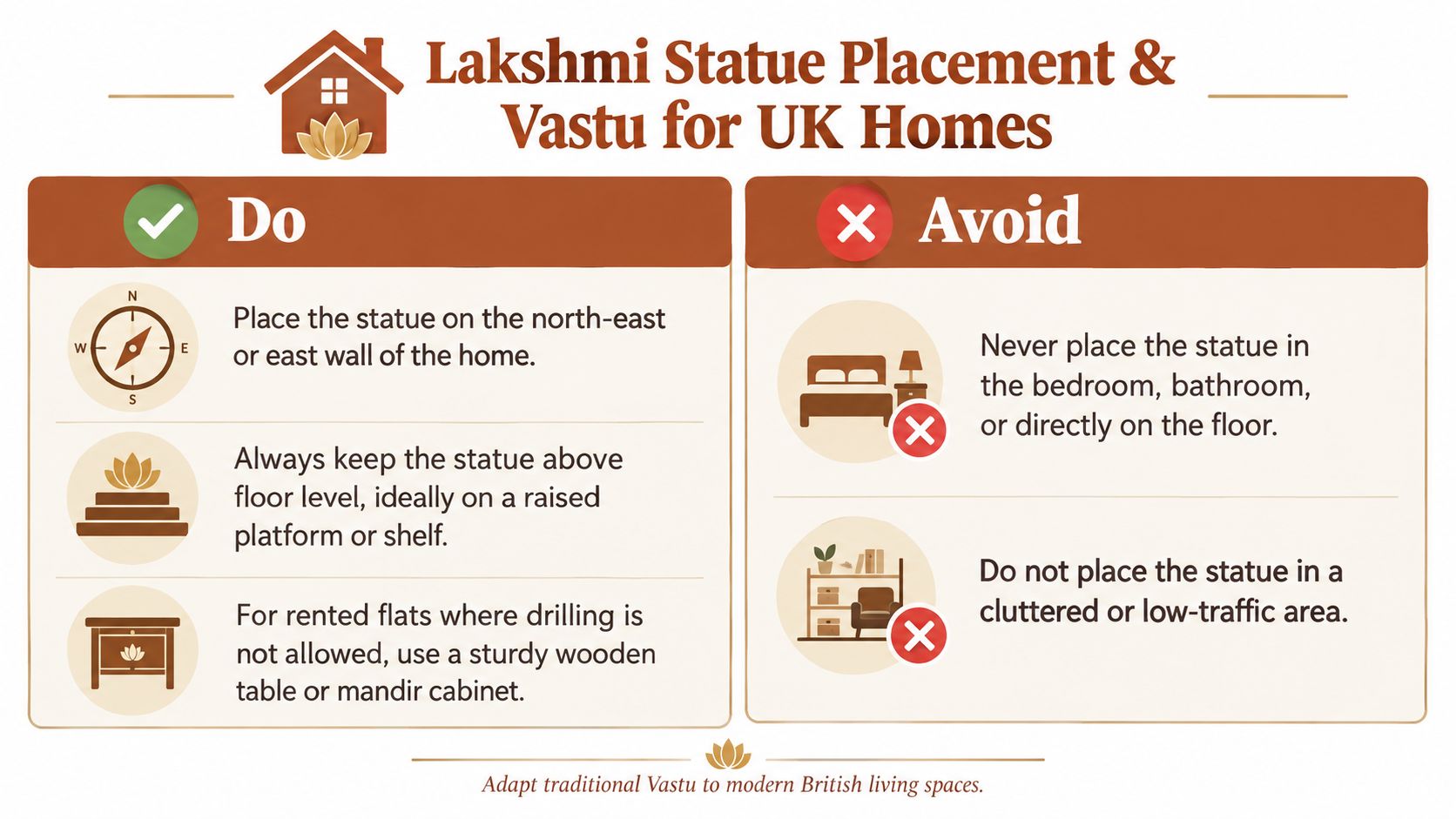
Une statue de Lakshmi a besoin d'un cadre propre, stable et surélevé. Les conseils Vastu traditionnels favorisent souvent mur nord-est ou est pour un mandir domestique, mais les foyers britanniques offrent rarement une salle de prière spécialement conçue. Un appartement loué, une maison partagée ou un bureau peuvent toujours offrir un agencement respectueux sans forcer l'espace à imiter un temple.
Commencez par la surface. Placez la statue sur une étagère surélevée, une table en bois, un meuble mandir ou une console stable, jamais directement sur le sol. Gardez-le au-dessus du stockage et loin de l'encombrement. Si vous louez et que vous ne pouvez pas percer le mur, une table autoportante robuste est plus pratique qu'une étagère flottante instable.
Construire un mandir domestique fonctionnel
Choisissez un endroit où les membres de la famille peuvent approcher l'image sereinement et la maintenir facilement. Le salon, une console de couloir calme ou un meuble dédié peuvent bien fonctionner. Évitez de placer la statue directement en face d'une salle de bain, dans une chambre, à côté de chaussures ou à proximité de déchets et de produits de nettoyage. De nombreux ménages évitent également les coins peu fréquentés où la poussière et les offrandes oubliées peuvent s’accumuler.
Une maison partagée a besoin d’une routine convenue. Si les colocataires ou les membres de la famille ne partagent pas la même pratique religieuse, utilisez une étagère ou une armoire définie et expliquez que la statue ne doit pas être déplacée avec désinvolture. Dans un bureau, une image modeste peut être placée sur un bureau propre ou sur une étagère de réception, mais uniquement là où le personnel peut la garder claire et empêcher les gens de la frôler.
Arrangements de Diwali dans les foyers britanniques
Une source britannique du mandir décrit Lakshmi comme étant priée pour le bien-être de toute la famille, pas seulement pour le gain financier, et identifie Diwali lors de la nouvelle lune de Kartik comme la célébration hindoue la plus largement observée en Grande-Bretagne. Ce contexte compte. Une exposition de Diwali peut inclure un petit rebord de diya, des offrandes fraîches et un chiffon propre, mais elle ne doit pas transformer la statue en un accessoire saisonnier jetable.
Certaines familles créent de petites empreintes de khôl et de riz menant à l'image, représentant l'arrivée de bon augure de Lakshmi. D'autres adaptent le panchopachara, ou offre à cinq éléments, aux réalités d'un foyer britannique en utilisant des objets disponibles tels qu'un parfum, une lampe, de la nourriture, de l'eau et des fleurs. Les traditions diffèrent selon les ménages, alors suivez les pratiques familiales ou communautaires plutôt que de considérer un arrangement comme universel.
Gardez les flammes, l'encens et l'huile loin des rideaux, des livres et de la surface de la statue. Un placement respectueux ne consiste pas à obtenir un plan d'étage parfait. Il s'agit de créer un point focal stable pour la propreté, la gratitude et l'adoration.
Choisir une statue de Lakshmi pour la dévotion, la décoration ou la collection
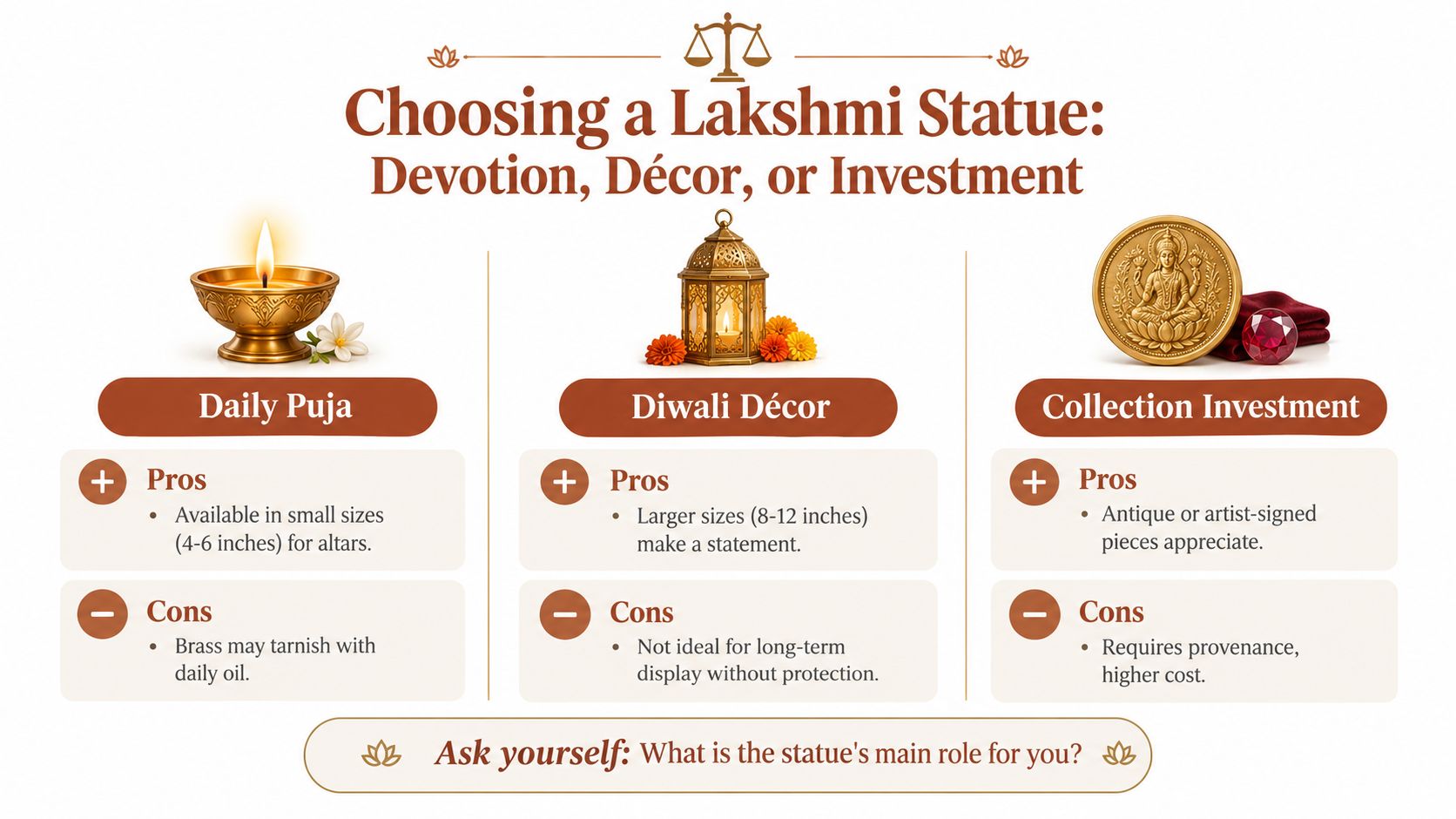
Nommez le but avant de cliquer sur acheter. La même statue peut être tout à fait adaptée à une puja quotidienne et totalement inadaptée à un collectionneur à la recherche de documents historiques documentés. La confusion commence lorsque les acheteurs comparent toutes les images de Lakshmi uniquement en fonction de leur apparence ou de leur prix.
Pour la puja quotidienne
Privilégiez une image iconographiquement claire, une base stable et une finition qui tolère votre routine domestique. Le laiton peut convenir à un culte régulier car il possède la chaleur visuelle associée au travail rituel du métal, mais l'huile, l'encens et la manipulation affecteront la surface. Choisissez une taille qui laisse suffisamment de place pour les offres sans encombrer l’étagère.
Demandez :
- Quelle forme est affichée ? Confirmez s'il s'agit d'un Lakshmi assis, Gaja-Lakshmi, Shri-Lakshmi ou Lakshmi-Narayana.
- Pouvez-vous le maintenir ? Une surface très détaillée peut être significative, mais elle collecte également la poussière et les résidus.
- La base semble-t-elle sécurisée ? Une statue qui bascule ou surplombe son étagère crée un risque évitable.
Pour la décoration de Diwali
Un affichage de Diwali peut être plus visible visuellement, mais le respect régit toujours le choix. Tenez compte de l'échelle de la salle, de la finition de la statue et de la question de savoir si l'image sera stockée en toute sécurité après le festival. Une figure plus grande peut ancrer une console, tandis qu'une petite image en bronze ou en laiton peut s'asseoir à côté de lampes et de fleurs sans surcharger l'agencement.
Évitez de choisir une pièce uniquement parce qu’elle comporte des pièces de monnaie ou une finition dorée brillante. Le lotus, les éléphants et les gestes des mains peuvent créer un message plus équilibré de bon augure et de bien-être.
Pour collectionner
Les collectionneurs devraient demander provenance, période, informations sur l'artiste ou l'atelier, détails de l'alliage, notes d'état et historique de la restauration. Les archives du musée montrent pourquoi ces détails sont importants. La sculpture cachemirienne du British Museum possède un numéro de catalogue, une identification du matériau, des mesures, une description iconographique et un enregistrement d'exposition. Ces détails transforment un objet attrayant en un objet traçable.
Soyez prudent avec les étiquettes telles que « antique », « style temple » ou « qualité musée » lorsque le vendeur ne fournit aucune pièce justificative. Une réplique montée en magasin peut être parfaitement attrayante, mais elle ne doit pas être confondue avec une sculpture plus ancienne dont l'âge et l'histoire sont établis. Des listes indépendantes d'antiquités et de récupération au Royaume-Uni montrent également que les objets hindous circulent sous forme de sculptures de collection, alors comparez attentivement les descriptions et ne présumez pas qu'une patine ancienne prouve l'âge.
HD Asian Art propose une collection dédiée de statues de Lakshmi aux côtés de sculptures de divinités hindoues et de ressources pédagogiques, offrant aux acheteurs une option de catalogue orientée vers le Royaume-Uni à examiner tout en comparant les matériaux, la forme et la provenance déclarée. Quel que soit le détaillant ou la maison de vente aux enchères que vous choisissez, achetez l'objet qui correspond à votre intention plutôt que de payer pour une histoire que l'annonce ne peut justifier.
Prendre soin d'une statue de Lakshmi au fil du temps
Le soin doit préserver à la fois la surface et la signification de l'objet. Un cadre propre et stable favorise le culte et l'exposition, tandis qu'un polissage agressif peut effacer la patine, les détails peints ou les traces de vieillissement. La bonne routine dépend si vous prenez soin du laiton, du marbre, du bois, du bronze, de la pierre ollaire ou d'un panneau peint.
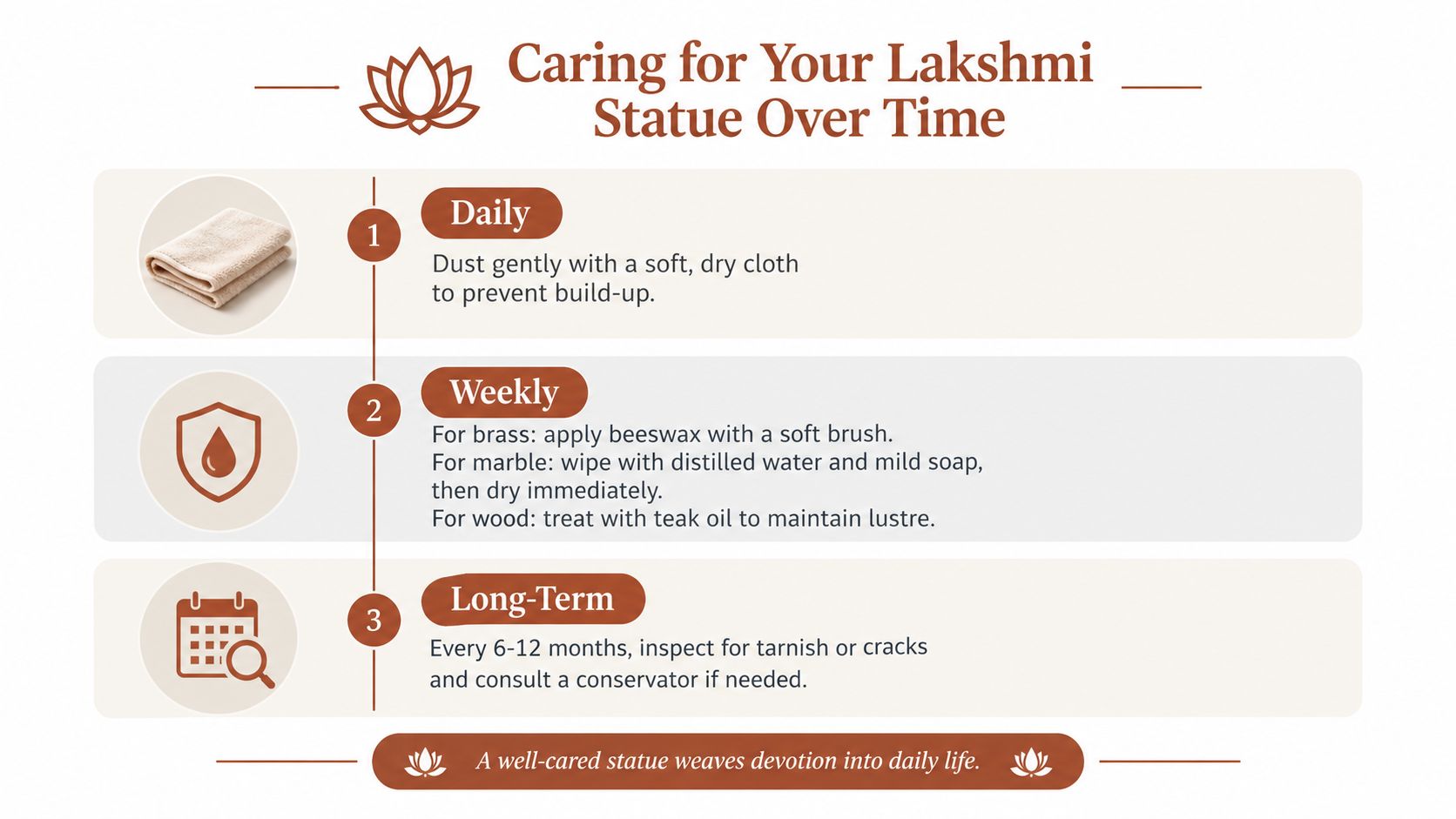
Commencez par un chiffon doux et sec. Époussetez doucement plutôt que de frotter sur les bijoux, les doigts ou les pétales de lotus. Utilisez une brosse douce pour les zones en retrait, en particulier sur les figurines Gaja-Lakshmi où les éléphants, les récipients à eau et les ornements sculptés peuvent emprisonner la poussière.
Adaptez le nettoyage au matériau
- Laiton : Époussetez d’abord, puis utilisez un traitement à la cire conservateur tel que la cire d’abeille si la finition le permet. Évitez de trop polir, car retirer la surface la plus sombre peut donner à une pièce plus ancienne un aspect anormalement neuf.
- Marbre : Utilisez de l'eau distillée avec parcimonie et du savon doux, puis séchez immédiatement. Le marbre peut présenter des traces de résidus, d’humidité et de produits nettoyants ménagers inadaptés.
- Bois: Gardez l'eau loin du grain. Une très légère application d'huile de bois appropriée peut aider à entretenir la surface, mais testez discrètement et évitez de saturer les détails sculptés.
- Bronzes : Conservez la patine, sauf avis contraire d'un restaurateur. Essuyez doucement et empêchez les huiles, le kumkum et les résidus d'encens de s'accumuler dans les crevasses.
- Pierre ollaire et travaux peints : Considérez la pierre poreuse et les surfaces peintes ou dorées comme vulnérables. L'eau peut pénétrer dans les joints ou endommager les pigments, en particulier derrière les dorures des panneaux de style Tanjore.
Préparez-vous avant Diwali
Le culte saisonnier peut laisser des traces d’huile, de cendre, d’encens et de kumkum. Inspectez la statue avant de disposer les lampes et nettoyez l'étagère environnante plutôt que d'appliquer un produit puissant directement sur la figurine. Éloignez les flammes du bois, des surfaces peintes, des rideaux et de tout textile instable.
Les foyers britanniques créent leurs propres défis en matière de conservation. Le chauffage central peut sécher le bois, les murs en pierre humides peuvent favoriser les problèmes d'humidité et une fenêtre orientée au nord peut fournir une faible luminosité sans éliminer le risque de condensation. Gardez la statue à l'intérieur, à l'écart des radiateurs, de la lumière directe du soleil et des changements environnementaux soudains. Son positionnement surélevé le protège également de l'humidité au niveau du sol et des chocs accidentels.
Pour une pièce de collection, utilisez un mouchoir sans acide et une boîte doublée de mousse pendant le stockage ou le transport. Photographiez la statue sous plusieurs angles avant toute restauration, et notez les éclats, fissures, marques et patine. Ne réparez pas une vieille sculpture juste pour lui donner un aspect neuf. Un restaurateur peut aider à préserver les signes de l’âge qui soutiennent son authenticité tout en stabilisant les dommages réels.
Choisissez votre statue en identifiant d'abord son rôle, puis vérifiez l'iconographie, le matériau, l'échelle, l'état et l'emplacement avant d'acheter. HD Asian Art propose des sculptures de Lakshmi aux côtés d'autres œuvres hindoues et d'Asie du Sud-Est, avec des informations de catalogue destinées à aider les collectionneurs, les praticiens et les acheteurs d'intérieur à comparer les formes.
Visite HD Asian Art pour explorer la collection et trouver une pièce que vous pouvez placer, utiliser et entretenir en toute confiance.
