



Lotus Flower in Hindu Iconography: Meaning & Symbolism
Lotus Flower in Hindu Iconography: Meaning & Symbolism
Table of Contents
- Why the Lotus Became Hinduism's Most Recognizable Symbol
- Padma and the Core Lotus Flower Meaning: Purity, Detachment, and Awakening
- Deities Associated with the Lotus Flower and How Each One Holds It
- Mudras, Postures, and Regional Variations in Lotus Iconography
- Lotus Flower Colors and What Each Shade Signals in Murtis
- The Lotus Flower in Meditation Spaces: Placement, Scale, and Presence
- Botanical Accuracy vs. Symbolic Form: Nelumbo nucifera and the Sculptor's Lotus
- Frequently Asked Questions
Why the Lotus Became Hinduism's Most Recognizable Symbol
The lotus became Hinduism's most recognizable symbol because it embodies a paradox: beauty and purity emerging from murky ground. This guide from HD Asian Art examines the meaning of lotus flower in hindu iconography, tracing how one aquatic plant became shorthand for enlightenment, detachment, and divine consciousness.
The lotus rises from muddy water each morning and opens clean and dry (kew.org). That daily cycle gave sculptors, painters, and temple builders a ready-made metaphor for the soul's movement out of samsara, the cycle of suffering and rebirth, toward awakening. In the Smithsonian's overview of Hindu art and symbolism, the flower appears again and again as a seat, a throne, and an offering, never merely as decoration.
What most guides miss is that the lotus is not one symbol but a system: its position, color, and the hand that holds it all change what a murti communicates.
Padma and the Core Lotus Flower Meaning: Purity, Detachment, and Awakening
The core lotus flower meaning centers on three linked ideas: purity that survives contact with impurity, detachment from worldly attachment, and the unfolding of spiritual awakening.
The Sanskrit word padma refers to the lotus and appears throughout Hindu scripture as both a literal flower and a state of being. Its petals open at dawn and close at dusk, the mind opening to divine consciousness and withdrawing from distraction.
Detachment works differently than most people assume: the lotus draws nourishment from the mud while remaining unstained, engagement without clinging, not withdrawal from life.
Deities Associated with the Lotus Flower and How Each One Holds It
The deities associated with the lotus flower each hold or stand upon it differently, and those differences carry precise meaning: the flower's position tells you what aspect of the divine a murti emphasizes.
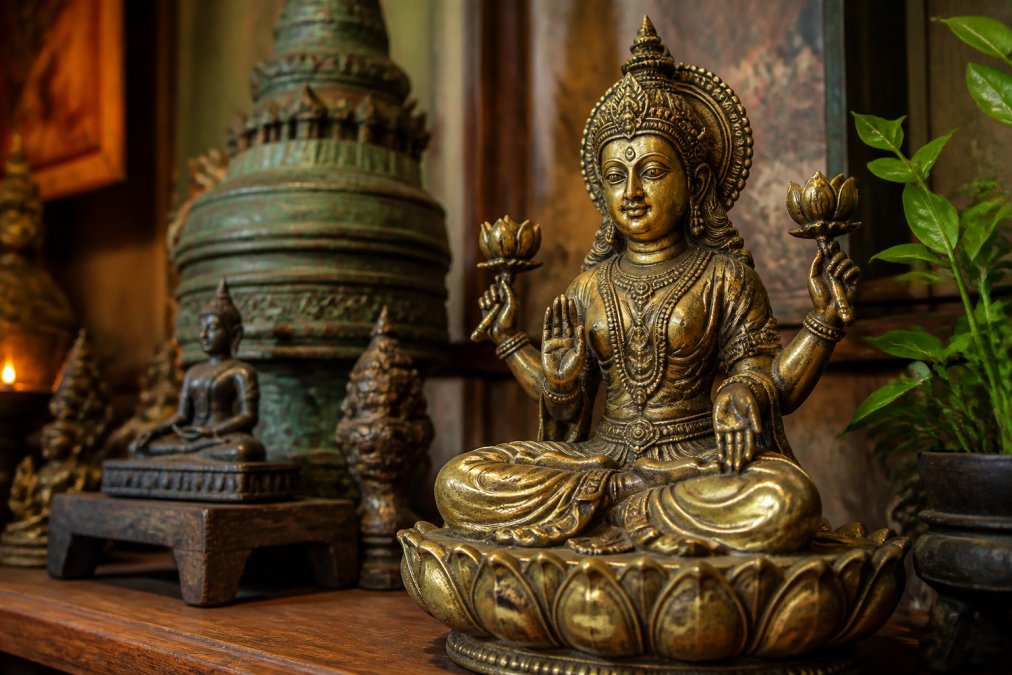
Lakshmi, Vishnu, and Brahma: The Lotus as Creation and Abundance
Lakshmi holds a fully opened lotus, signaling prosperity, fertility, and the earth's generosity. Vishnu rests on a cosmic lotus growing from his navel, from which Brahma emerges to create the world, the lotus as birthplace.
Ganesha, Saraswati, and Shiva: Wisdom, Arts, and the Question of Shiva's Lotus
Ganesha and Saraswati both carry the lotus as a mark of wisdom and the arts, with Saraswati often seated on a white lotus emphasizing clarity of thought. Shiva is the interesting case: he is more often associated with the trishula and serpent, and when the flower appears in his iconography it usually belongs to a consort or attendant. That absence is meaningful, Shiva represents transcendence beyond even the beauty of the blooming world.
| Deity | How the Lotus Appears | Primary Meaning |
|---|---|---|
| Lakshmi | Held open in hand | Prosperity, fertility |
| Vishnu | Rests upon it; source of Brahma | Creation, preservation |
| Brahma | Born from it | Divine origin |
| Saraswati | Seated upon white lotus | Wisdom, arts, clarity |
| Ganesha | Held in hand | Learning, auspiciousness |
| Shiva | Rarely; via consort | Transcendence beyond form |
Mudras, Postures, and Regional Variations in Lotus Iconography
Lotus iconography is not uniform, and the hand gestures known as mudras often carry as much information as the flower itself. How the flower is held, and where the figure sits, narrows the reading considerably.
The Mudras That Actually Involve the Lotus
A mudra is a codified hand gesture, and only a handful interact with the lotus directly:
- Padma mudra, the gesture that holds the stem itself. The fingers close gently around the stalk rather than gripping it, the visual cue for non-attachment. When Lakshmi or Saraswati carries a lotus, this is usually the gesture in play.
- Vitarka mudra, the gesture of teaching and reasoned discourse, thumb and index finger forming a circle. A lotus is sometimes threaded through it, combining instruction with purity.
- Abhaya mudra, the raised palm of reassurance. When a lotus is present, it is normally held in the other hand, so the two gestures read as a pair: protection offered, purity affirmed.
- Dhyana mudra, the meditation gesture, both hands resting in the lap. Here the lotus is not held at all; it sits beneath the figure, becoming the foundation of the meditative state rather than an object within it.
A useful rule of thumb: a lotus in the hand points to an active quality the deity grants, prosperity, learning, eloquence. A lotus under the figure points to a state the deity embodies, steadiness, transcendence, awakening.
Posture: Standing, Seated, and the Meaning of Padmasana
Posture shifts the reading as much as gesture does.
- Standing on a lotus, the figure is shown with dominion over the created, blooming world; the flower is a pedestal the deity rises above.
- Seated on a lotus, the figure rests in the flower rather than on top of it, the posture of meditative stillness and the more common arrangement for teaching and wisdom figures.
- Padmasana, literally the "lotus posture," the cross-legged seat in which each foot rests on the opposite thigh. The crossed legs are read as the petals of a closed lotus, so the seated practitioner's own body becomes the flower, which is why posture and symbol are treated as interchangeable in so much devotional art.
North and South: How the Same Flower Is Carved Differently
The regional split is the most useful thing a collector can learn.
Northern traditions tend to render the lotus as a flat, symmetrical rosette, a disc of evenly spaced petals viewed almost head-on, often tucked behind or beside the figure as a halo-like backdrop. The petals are broad, the outline crisp, and the emphasis is on geometric order, as seen in stone temple reliefs and the gilded rosettes behind many northern murtis.
Southern traditions more often show the lotus in profile or three-quarter view, with a visible stem and layered, tiered petals receding into depth. The flower reads as a plant rather than a disc. In bronze work especially, petals are separated into distinct rows and the stem is given real length so the bloom sits clearly above the base.
The practical takeaway: a flat, frontal rosette points toward northern conventions; a stemmed, layered, in-the-round bloom points toward southern ones. Neither is more correct, and workshops traveled, so the styles overlap, but the distinction is a genuine first-pass clue on an unlabeled piece.
Lotus Flower Colors and What Each Shade Signals in Murtis
Color changes the lotus flower meaning in ways that are easy to overlook. A white lotus signals purity and spiritual perfection, which is why Saraswati is so often seated on one. A pink lotus, the most common in devotional art, represents the fully realized human being and the highest awakening.
Red lotuses carry associations with the heart, compassion, and passionate devotion. Blue lotuses are rarer in sculpture and tie to the extraordinary and the infinite. When you look at a murti, check the petals before the base, the shade often tells you which quality the maker wanted you to feel first.
The Lotus Flower in Meditation Spaces: Placement, Scale, and Presence
A lotus-bearing figure works in a meditation space when its placement respects what the flower is doing in the iconography, not when the piece is simply the largest object in the room. The gap most guides leave is practical: how the lotus is actually used in worship, and how that should shape where a murti sits.
The Lotus in Puja: Offering Versus Symbol
There is a real distinction between the lotus as a symbol carved into a statue and the lotus as a material used in ritual; the two are not interchangeable.
- As an offering. In archana, the formal offering sequence in puja, flowers are presented to the deity, and the lotus is among the most highly regarded offerings where available. The flower is placed at the deity's feet or hands, offered, then set aside: an act, not a decoration.
- As a symbol. The lotus carved into a murti is not offered and not removed. It is part of the figure's identity, communicating a fixed quality, purity, wisdom, creation, every time the statue is seen.
Most home shrines cannot source fresh lotus blossoms regularly, so practitioners commonly substitute other flowers for the offering while the carved lotus on the murti continues to carry the symbolic role. Knowing which one you are looking at tells you whether the flower is meant to change or to stay.
Placement Rules That Follow From the Iconography
A few placement choices follow directly from what the lotus means rather than from decorating taste:
- Sightline over size. A figure seated on a lotus rests in meditative stillness; the flower is meant to be read as a base. Setting the murti so the lotus sits at or near your eye level when seated keeps that base visible. A figure placed too high hides the flower and loses the reading.
- The lotus posture connection. If the murti is seated in Padmasana, the crossed legs and the flower beneath them form a single visual unit. Give the base enough clearance that both are visible together.
- Dawn orientation. The lotus opens at first light, which is why morning light is traditionally favored for a shrine, a symbolic alignment, not a hard requirement.
- One focal figure. Because the lotus is a seat, a crowded arrangement competes with the very thing the flower is meant to anchor. A single well-placed murti usually reads more clearly than several.
Scale and the Lotus as a Focal Point
Scale matters most at the base. A lotus carved as a wide, flat platform needs more clearance than a compact, stemmed bloom, and a figure whose lotus is broad will look cramped on a narrow ledge even if the figure itself fits. Measure the base, not the head, when matching a piece to a space.
For collectors furnishing a personal sanctuary, HD Asian Art curates Buddhist and Hindu statues alongside Khmer and Southeast Asian sculptures, with pieces sized for both compact meditation corners and larger altars. Each statue is chosen to function as a focal point rather than background decor.
Botanical Accuracy vs. Symbolic Form: Nelumbo nucifera and the Sculptor's Lotus
Botanical accuracy and symbolic form rarely match in Hindu sculpture, and understanding the gap helps you date and evaluate a piece. The sacred lotus is Nelumbo nucifera, whose leaves and flowers rise well above the water on tall stems. Many carved lotuses, however, show short stems and stylized petals no botanist would recognize.
That stylization is deliberate: the sculptor is encoding a concept, and strict botanical fidelity would weaken the symbol. A lotus with exaggerated, symmetrically arranged petals signals divine order; one with naturalistic, slightly irregular petals often points to a later or more secular workshop.
The Royal Botanic Gardens' plant database entry on Nelumbo nucifera documents the real plant's structure, which is worth comparing against any piece you are considering. The gap between the two tells you how much the maker prioritized doctrine over observation.
Frequently Asked Questions
What does the lotus symbolize in Hinduism?
The lotus represents purity, spiritual awakening, and detachment. Because its roots sit in muddy water while the blossom rises clean above the surface, it mirrors the soul's movement through samsara toward enlightenment. In Hindu iconography, deities hold or stand on the padma to signal divine consciousness that remains untouched by worldly impurity. The unfolding petals also suggest gradual spiritual growth, which is why the flower appears across temple art, murtis, and ritual offerings.
Which Hindu deities are commonly depicted with a lotus?
Lakshmi holds a padma in each hand as the goddess of prosperity, and Vishnu rests on a lotus or holds one as a symbol of cosmic order. Brahma emerges from a lotus growing from Vishnu's navel, linking the flower to creation. Saraswati sits on a white lotus, Ganesha often carries one, and Surya is shown with lotus blossoms. Each placement tells you something specific about the deity's role, which is why collectors and practitioners read iconography closely.
Can you offer a lotus to Lord Shiva?
Yes. While Shiva is more often associated with the bilva leaf, lotus flowers are still offered during puja, particularly on Mondays and during Shivaratri. Some regional traditions emphasize the blue lotus for Shiva because of its rarity and its link to transcendence. If you keep a Shiva murti in a meditation space, a single fresh or sculpted lotus at the base works as a respectful focal offering.
How does the lotus represent detachment in daily practice?
The lotus grows in muddy water yet stays clean, which is the classic image of detachment in Hindu thought. Practitioners use this as a working metaphor: you live and act in the world without letting it cling. In a meditation space, a lotus-carved statue or lotus motif serves as a visual reminder to return to that steadiness. Many collectors choose pieces specifically for this quality because it anchors the room's purpose.
Choosing a lotus-bearing statue is really a question of what you want your space to hold: a reminder of detachment, a focus for devotion, or a piece of living art history.
HD Asian Art offers a carefully curated collection of Buddhist and Hindu statues and Southeast Asian sculptures, with handpicked antique and contemporary pieces and free shipping. Browse the collection and find the murti that belongs in your sanctuary.
