



Lord Shiva Statues for the Home: A Practical UK Guide
Lord Shiva Statues for the Home: A Practical UK Guide
You are comparing two Lord Shiva statues on your phone: a compact seated figure that could fit on a shelf, and a bronze Nataraja that would command the whole room. In a UK flat, the decision isn't just about which one looks better. You also need to think about what the image means to you, whether you'll use it for worship or display, and how the material will fare beside radiators, windows and everyday household activity.
A sound purchase starts with four decisions: form, material, scale and purpose. Get those right before comparing finishes or prices. Museum records and collection-care guidance offer a useful counterweight to generic placement rules: they help you look at a statue as an artwork with identifiable features, a history and practical care needs.
Table of Contents
- Choosing a Lord Shiva Statue That Suits Your Space
- Reading the Iconography of Shiva Statues
- Bronze, Stone and Other Materials Compared
- Regional Styles Worth Knowing
- Sizing, Placement and Vastu in a UK Home
- Murti or Decoration Understanding the Difference
- Authentication and Provenance Checks
- Care, Cleaning and Long-Term Display
Choosing a Lord Shiva Statue That Suits Your Space
The buyer in that flat has two different questions to answer. The seated figure might suit a quiet meditation corner or a small home shrine, while the Nataraja could become a focal point in a larger living room. Neither is automatically the better choice. The right one is the statue whose form and scale fit both its intended use and the space you can give it.
Start with purpose. A statue for daily puja has different practical demands from one bought for a gallery-style display. Offerings, water and incense can affect a statue's surface, so a delicate painted or gilded finish may not suit a routine that involves direct contact. If the statue will be decorative, choose for the visual effect you want and prioritise stable placement and suitable light.
Decide what the room can support
Measure the shelf, alcove or plinth before you browse. Allow space around the statue so it doesn't feel squeezed between books, plants or other objects, and consider how people move through the room. In a shared home, a prominent devotional image also needs a position that feels respectful to the people who live there.
Then consider heating and daylight. A statue beside a radiator or in direct sun may face avoidable changes in local temperature and surface conditions. A stable spot away from those sources is usually a better choice than a dramatic but exposed windowsill.
Form comes before finish. A serene seated Shiva and a dynamic dancing Nataraja communicate different things and occupy a room differently. Choose the form first, then compare materials and workmanship within that category. For broader ideas on balancing a focal piece with a room's other visual elements, see this guide to how to pick wall art pieces.
Before you buy, write down the intended use, available footprint, preferred form and any care limits you'll accept. That short list will make your search more focused, and it gives a dealer something concrete to respond to.
Reading the Iconography of Shiva Statues
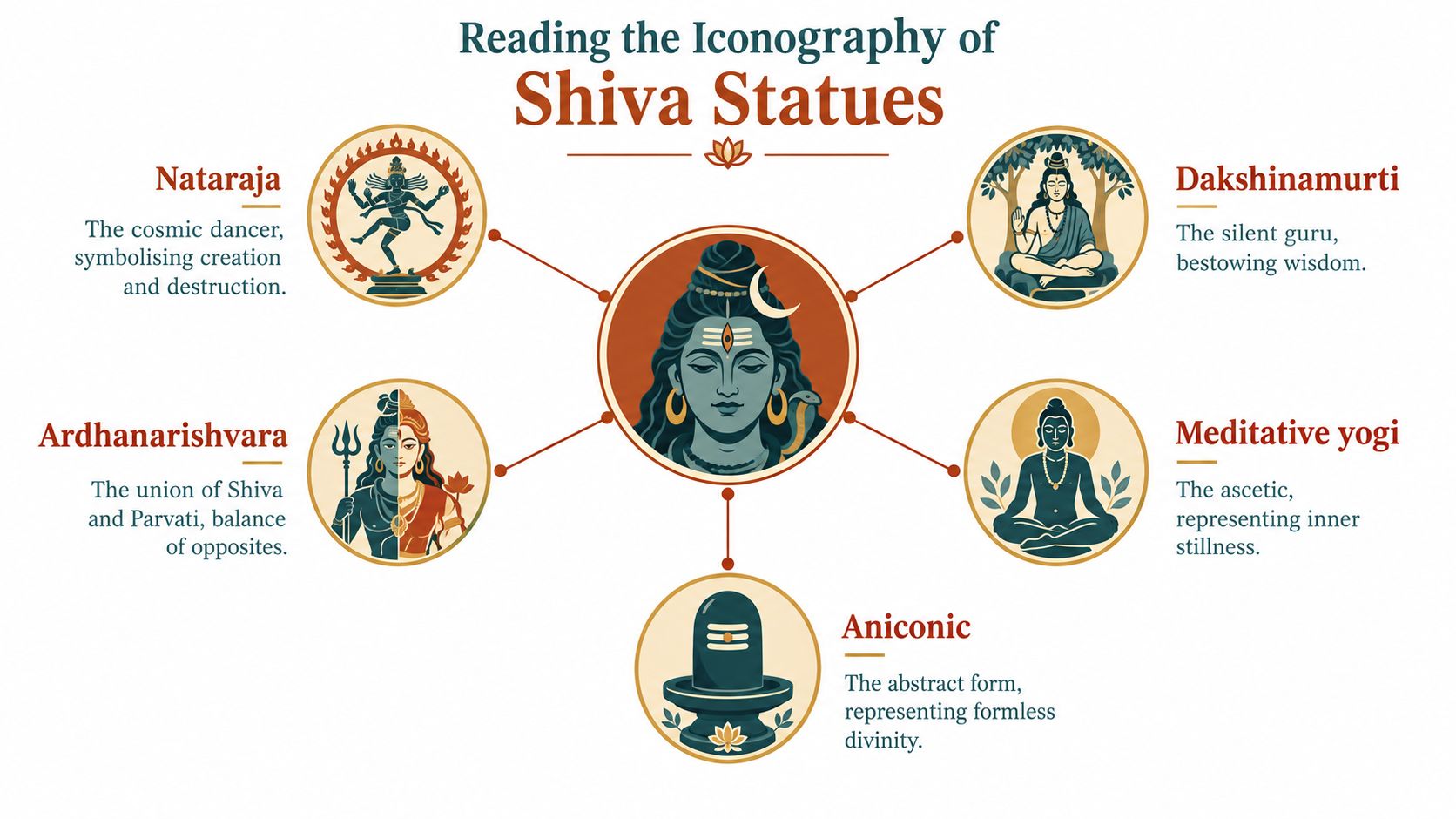
A figure labelled “Shiva” may show a dancer, a yogi, a teacher or a sacred linga. Read the pose, hands, attributes and base before choosing: these details tell you what the image represents and whether its form suits your intended setting. Museum records offer firmer references than a seller's broad product label.
Begin with the overall form
Nataraja shows Shiva dancing, often within a surrounding ring of flame. The V&A's South Indian copper-alloy example, dated to the 8th–9th century, provides a museum reference for this energetic composition (V&A Nataraja collection record). Choose a Nataraja when you can give the figure room to read from more than one angle. On a cramped shelf, its movement and surrounding details are harder to appreciate.
A seated yogic Shiva gives a calmer impression. A V&A figure from the 1780s depicts Shiva cross-legged with four arms. The lower hands form the abhaya mudra, associated with reassurance or protection, and the varada mudra, associated with generosity or granting favours. The raised hands once held attributes that are now missing. That distinction matters: a sound description should identify what is visible and acknowledge what is absent, rather than claim details the object no longer shows.
Dakshinamurti represents Shiva as teacher. A seated posture alone does not confirm this identity. Ask the seller to describe the figure's attributes and context before treating a contemplative Shiva as Dakshinamurti.
Look for the distinctions that change the reading
Ardhanarishvara joins Shiva and Parvati in one vertically divided figure. In the V&A's Mathura sandstone example, dated to approximately 150–200 CE, Parvati occupies the left side (V&A Ardhanarishvara record). This is a clear choice for buyers drawn to an image that unites male and female aspects in a single body.
A Shiva linga is an aniconic devotional form, not a reduced human figure. The V&A's early-fifth-century sandstone Ekamukhalinga from Mathura combines a cylindrical linga with Shiva's face emerging from its surface. Its third eye and ascetic hair tied in a topknot make the form legible (V&A Ekamukhalinga record). Use this distinction when comparing a linga with an anthropomorphic statue.
For more on the meanings associated with these forms, read this guide to the symbolism of Lord Shiva. Identify the iconography first, then decide whether the particular form belongs in a shrine, meditation space or collection.
Bronze, Stone and Other Materials Compared
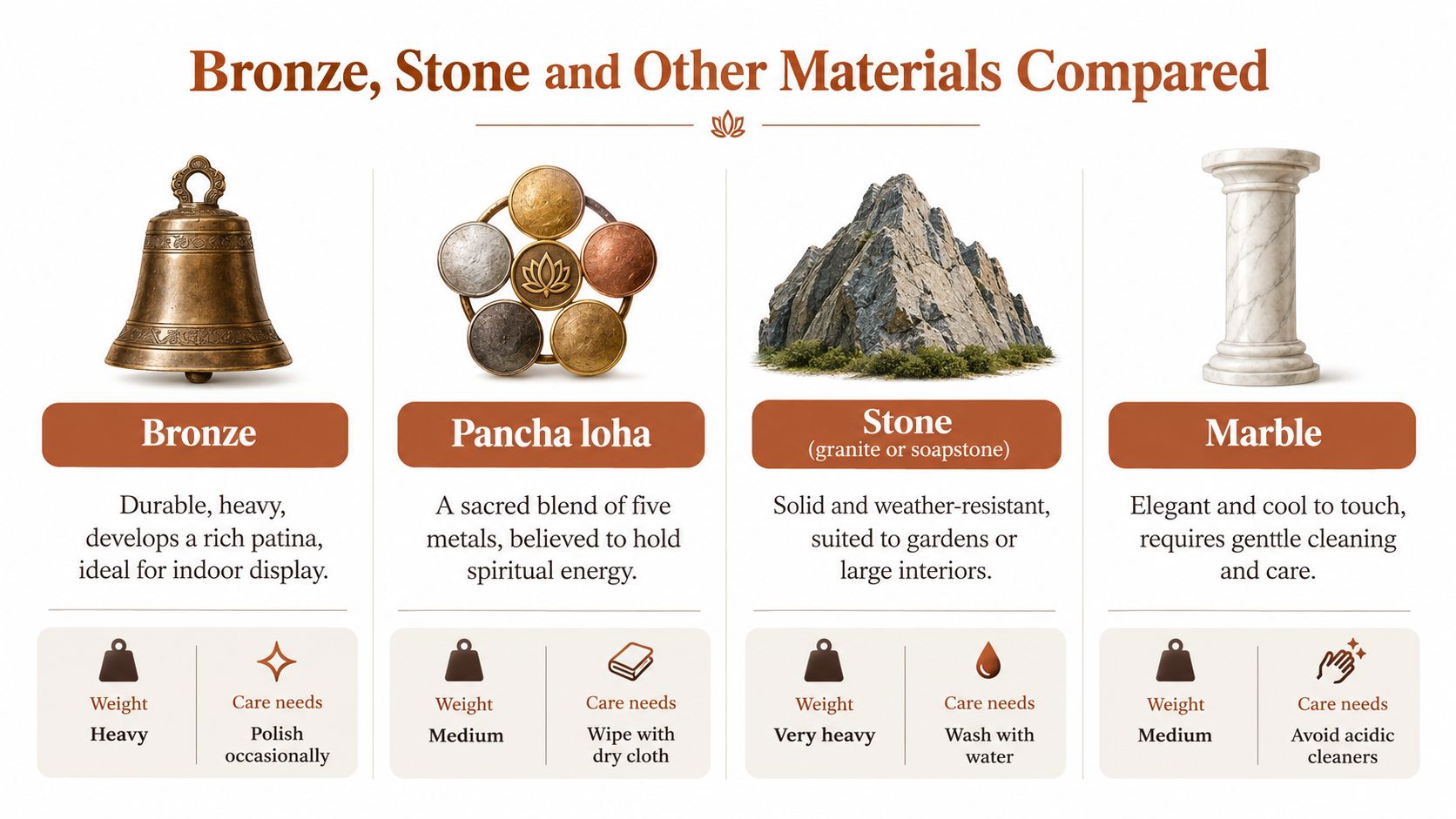
A statue's material determines its weight, surface and care needs. Choose bronze or another metal for a sculptural presence that is generally easier to place on a suitable shelf; choose stone when you want a substantial, architectural object and can provide secure support. Neither choice is maintenance-free.
Match the material to the care you'll provide
Bronze and brass bring strong sculptural presence, but moisture combined with pollutants, dust or salts can corrode metal. Museums Galleries Scotland advises keeping relative humidity below 65% for mixed collections and notes that metals benefit from lower humidity. Keep metal figures away from bathrooms, kitchens, radiators and cold, poorly sealed windows. Museum records also caution against relying on broad labels: a V&A Shiva figure from the 1780s is identified as zinc alloy, cast and soldered. Ask what the statue is made from, not just whether it is “metal.”
Pancha loha is a traditional five-metal alloy. The British Museum identifies the material of its seated Shiva as pancha loha, a more specific description than a general sales label such as “bronze” (British Museum seated Shiva record). Ask the seller what supports the material identification.
Stone, including sandstone, is heavy, and porous surfaces need careful handling. UK museum lighting guidance classifies stone and many metals as relatively light-stable while advising control of visible light and heat. For these less light-sensitive materials, it commonly recommends about 200–250 lux. See the lighting guidance cited in the placement section. Keep stone away from direct sun and heat, especially if it has a coating or applied finish.
Marble, wood, and painted, gilded or lacquered surfaces each have particular vulnerabilities. A finish may be more sensitive than the material beneath it, so judge the care needs of the whole object rather than the base material alone.
For a room built around natural surfaces, warmth and texture ideas can help you assess how a statue will sit alongside furnishings. For worship, confirm that its finish can tolerate the offerings used in your household. For display, choose a stable object, support it properly and keep it in conditions you can maintain.
Regional Styles Worth Knowing
Regional style helps you assess more than appearance. It can point to a tradition, suggest how the object was made and give you a sharper vocabulary for discussing it with a dealer. But style alone doesn't prove age or origin. Treat it as a starting point for questions, not a substitute for provenance.
Compare documented examples, not sales labels
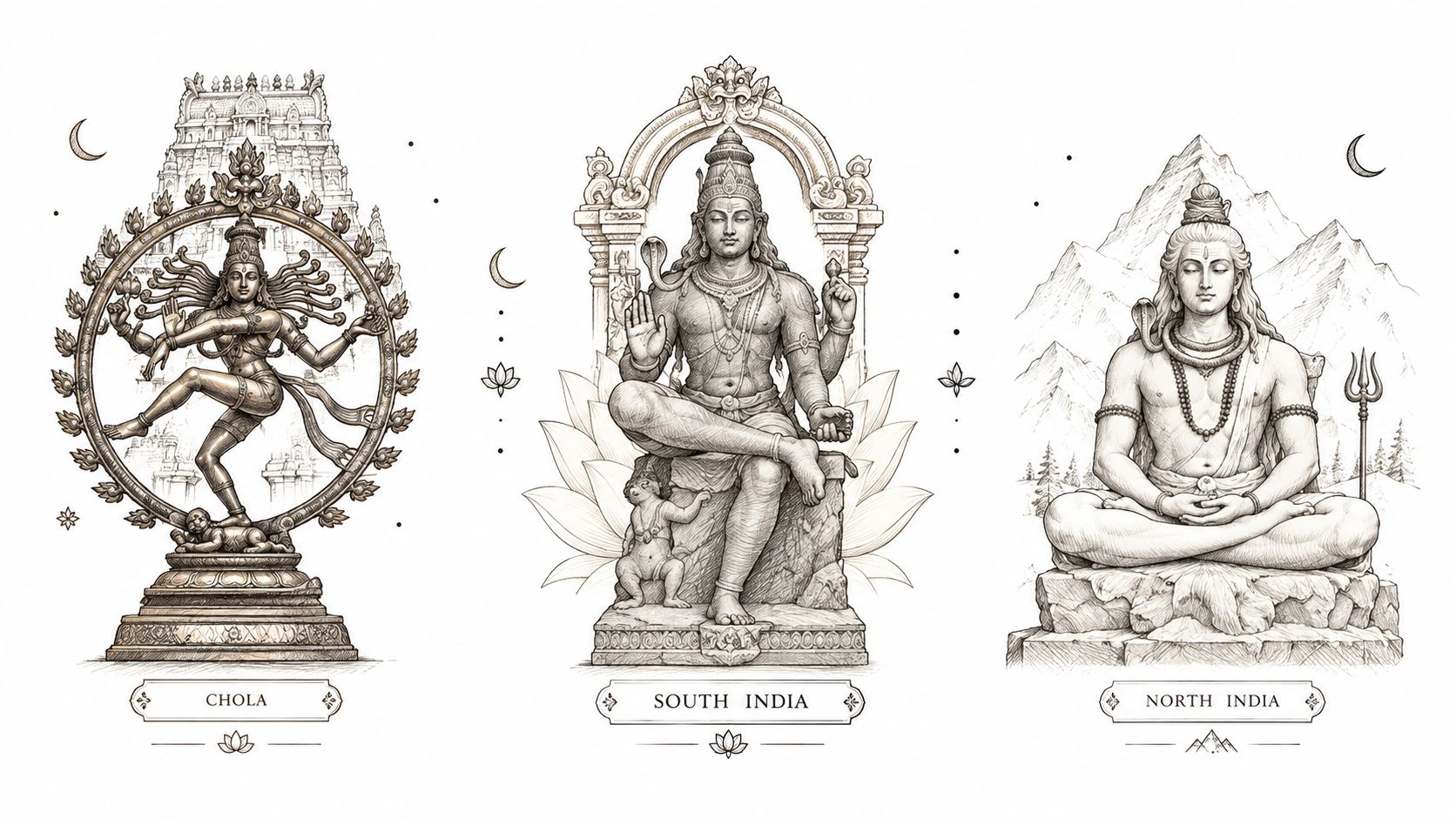
South Indian metalwork is a useful reference point for Nataraja and other cast Shiva figures. The V&A's South Indian copper-alloy Nataraja and the British Museum's seated pancha-loha Shiva show how museum catalogues describe material and subject rather than relying on broad labels. A British Museum Shiva figure kneeling on a bull provides another example of why details matter: it has ten arms carrying attributes, including a trident, a small Buddha figure on the headdress, and a narrative scene on the base. Pose, arm count, attributes and base decoration all help identify the image.
Mathura sandstone offers a different visual language. The V&A's Ardhanarishvara from Mathura is a sandstone figure from the Kushan period, with Shiva and Parvati represented as two halves of one body. Its documented features give collectors something specific to compare against a seller's description.
Tibetan and Nepalese metalwork, Khmer and Cham sculpture, and Burmese Shan-style figures also appear in specialist collections. Don't treat these traditions as interchangeable. Ask where the seller believes the piece was made, what features support that attribution, and whether the claim is based on documented provenance, expert opinion or visual comparison.
Dealer's advice: If a listing names a region but can't explain the identifying features, ask for photographs of the base, back, joins and any marks before you buy.
Style can affect availability, price and suitability, but no regional label tells you whether an object was made for ritual use. A serious seller should separate what is observed from what is inferred.
Sizing, Placement and Vastu in a UK Home
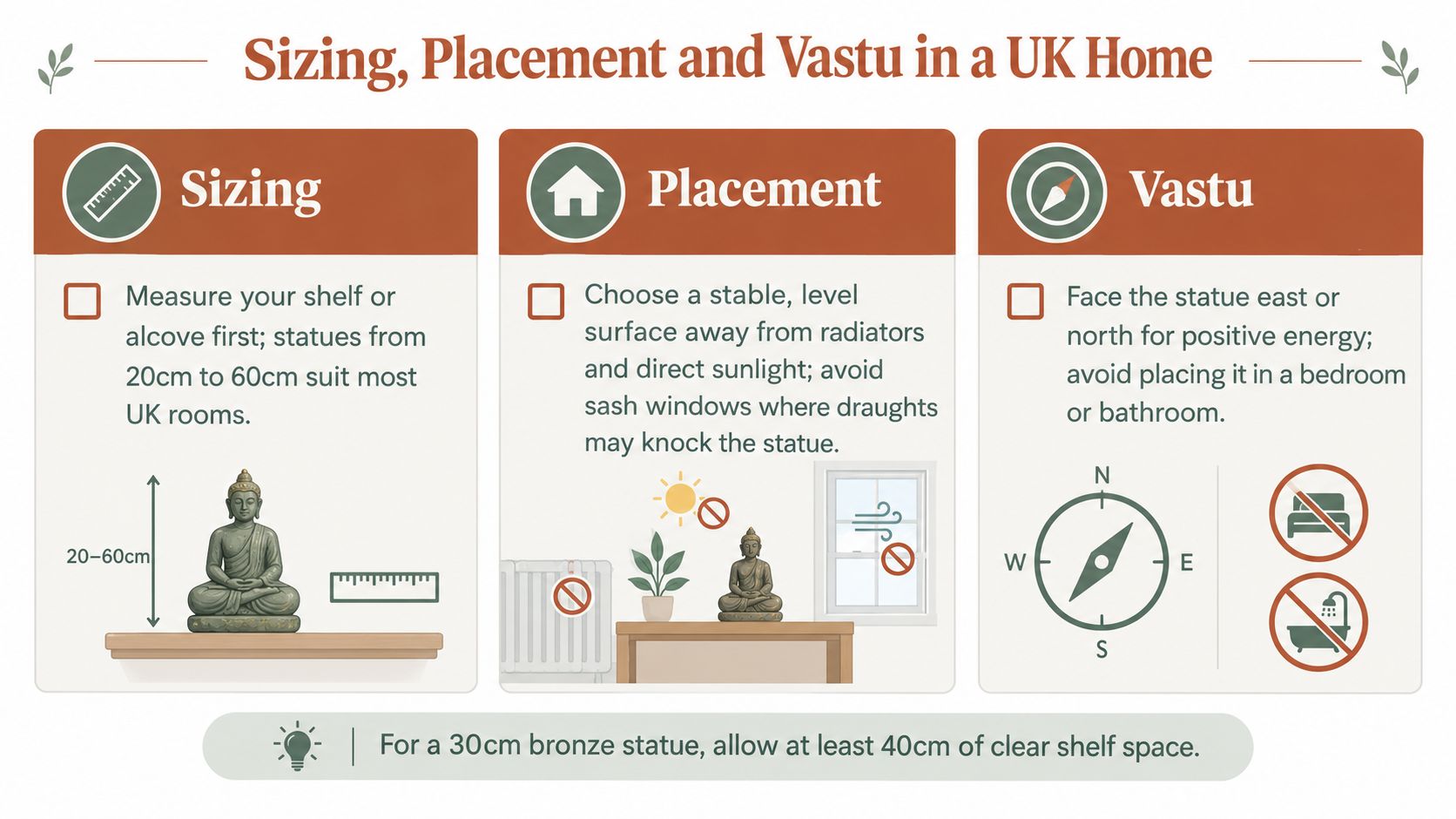
A statue that fits a showroom may overwhelm a UK flat or sit awkwardly in a shared room. Choose its position around the room's actual space, stability and environmental conditions, not a generic placement chart. Sash windows can bring direct sunlight, while central heating creates warm spots near radiators. Keep the statue secure, visible and away from avoidable heat and light.
Audit the spot before placing the statue
A mantelpiece suits a small display figure only if it is level, secure and away from excessive heat. A dedicated altar gives a worshipped murti a defined setting. A cabinet limits casual contact, but check that its lighting does not warm the space around the statue.
Keep metal and stone away from radiators and direct sun. Use low-heat LED lighting and illuminate the statue only as brightly as needed. A lux meter can check light levels at the object's surface. Follow the 200–250 lux limit noted earlier for stone and metal, and remember that lighting heat can change local temperature and humidity. If incense is part of your practice, ventilate the room and keep smoke away from painted or gilded surfaces.
| Location | Suitable For | Watch Out For |
|---|---|---|
| Stable wall shelf | Compact display or small shrine | Fixings, shelf depth and traffic nearby |
| Mantelpiece | A modest display figure | Heat, vibration and objects placed too close |
| Dedicated altar | Regular worship | Water, oil and incense affecting finishes |
| Meditation corner | Seated or contemplative forms | Direct sunlight and clutter |
| Display cabinet | Collection display | Case lighting, trapped heat and poor access |
Vastu matters to many households, but practices differ. Avoid treating a compass direction or bedroom rule as universal. In a shared room, agree on a position with the people who live there, then check that it preserves clear movement and useful sightlines. Advice on positioning couches and chairs properly can help you plan around a statue used as a focal point.
Murti or Decoration Understanding the Difference
A statue used as a murti isn't decorative. BBC religious-education material describes a murti as an image of a deity being worshipped, and explains that home puja can involve washing the murti's feet, offering flowers and food, lighting a lamp, using incense, and reciting hymns or mantras (BBC guide to home puja and murti worship). Those practices affect what material and finish will work in your home.
This distinction matters in a substantial UK Hindu community. The 2021 Census recorded 1,020,533 Hindus in England and Wales, or 1.7% of the population, compared with 816,633, or 1.5%, in 2011. The population change establishes the relevance of Hindu religious art in Britain, but it doesn't measure demand for Shiva statues specifically (Religion Media Centre summary of census data).
Choose for the practice, not just the photograph
If you plan to offer water or oil, ask whether the surface can tolerate it. Painted, gilded and lacquered finishes may be vulnerable to direct contact, so don't assume that a statue suitable for a display cabinet is also suited to every household ritual. In a flat, ventilate incense without placing the image in a draughty or exposed spot.
A worshipped murti also needs a respectful place in a shared home. Agree on a position that accommodates practice without turning a shared surface into an obstacle or putting the statue beside bins or everyday clutter. Household traditions differ, so there isn't one rule that applies to every family or sampradaya.
If a worshipped murti is damaged or no longer wanted, don't treat it as ordinary rubbish without first seeking guidance. Ask a local temple or knowledgeable Hindu practitioner about respectful options. A useful introduction to the distinction appears in this explanation of what murtis are.
Authentication and Provenance Checks
A convincing patina does not establish age, and a regional label does not prove origin. Before buying, ask the seller to separate documented facts from estimates and explain what evidence supports each claim.
Inspect the object and its paperwork
- Check the construction. Examine visible seams, joins and points where components meet. Ask the seller for photographs of casting seams, joins and any internal struts, then compare what you see with how the piece is described.
- Examine the surface. Look for signs of wear that differ from applied ageing. Ask whether the statue has been cleaned, coated or restored, and request details of any treatment.
- Assess balance and support. Check that the figure sits securely on its base. If it rocks or has an unstable attachment, require a clear explanation before you buy.
- Request provenance. Ask for invoices, collection history, condition reports and restoration records. A traceable donation or museum transfer carries more weight than a general claim that an object is “old”.
- Separate dating from attribution. A recorded date, an expert's stylistic estimate and a dealer's regional attribution are different kinds of claim. Ask which applies to each statement, and what evidence supports it.
Keep the answers in writing. A seller who can document the object's history and condition gives you more to assess than one relying on confident language. Treat gaps in the paperwork as uncertainty, not proof of wrongdoing, but price and buy accordingly.
For a valuable statue, fragile repairs or a significant age claim, commission an independent conservator's opinion before purchase. Their assessment can clarify condition and likely treatment needs. That is easier to weigh before you own the piece than after discovering it requires specialist care.
Care, Cleaning and Long-Term Display
A Shiva statue displayed beside a radiator, in direct sunlight or on a damp surface faces avoidable risks. Start with its location: choose a stable plinth or shelf, add a non-abrasive barrier, and keep the object away from heat, moisture and strong sun. Avoid routine cleaning that could alter the surface. Photograph a valuable or historically finished piece before display, so you have a record of its condition.
Material determines how you clean. Sandstone is porous, so do not treat it like sealed metal or assume water is harmless. Let the material and the surface condition guide each decision. For bronze or brass, gentle dry dusting is usually preferable to aggressive polishing, which can change the finish.
| Material | Light Limit | Humidity Limit | Routine Care |
|---|---|---|---|
| Bronze or brass | About 200–250 lux for display; avoid direct sun | Keep below 65% RH; lower is preferable for metals | Dust gently with a soft, dry cloth; inspect for corrosion |
| Pancha loha | About 200–250 lux for display; avoid heat from lighting | Keep below 65% RH; avoid damp and condensation | Use a dry, non-abrasive cloth; don't polish aggressively |
| Sandstone and other stone | About 200–250 lux for display; avoid direct sun | No universal figure; avoid damp and sharp fluctuations | Dry dust carefully; don't soak porous stone |
| Painted, gilded or lacquered surfaces | Keep illumination only as high as needed; use low-heat LEDs | Keep conditions stable; avoid condensation | Don't apply water, oil or polish without specialist advice |
Use a monitoring routine, not guesswork
Check light at the statue's surface with a lux meter. A combined temperature and relative-humidity data logger can show daily changes caused by heating, windows or display-case lights. Occasional spot readings may miss brief conditions that cause condensation, so monitor the display over time.
Inspect joints, recesses, undersides and gilded areas periodically. Powdery corrosion, lifting coatings or green deposits need attention, not vigorous cleaning. Photograph any changes, then consult a conservator before treating a valuable or historically finished object. Do not apply water, oil or polish to delicate finishes without specialist advice.
For practical guidance on metal care, read this guide to caring for bronze religious statues. Choose a statue whose material you can care for and whose scale suits the room. Its position should also reflect how you intend to use it.
HD Asian Art offers Hindu and Buddhist statues, including Shiva figures in bronze and stone, such as seated Shiva and Nataraja. Browse HD Asian Art to compare forms and materials, then ask the seller for provenance and condition details relevant to your intended use.
