



Lord Shiva and Parvati: Myths, Symbols and Sculpture
Lord Shiva and Parvati: Myths, Symbols and Sculpture
You're standing in front of a paired sculpture in a shop, a museum case or a photograph online, and you're not quite sure what you're looking at. Two figures sit close together. One holds something small in an upper hand. There's a bull at the base, perhaps a child between them, and the label gives you two names but no help with which figure is which. That's a common starting point with Lord Shiva and Parvati. You don't need to memorise a mythology library first. You need a simple relationship, a short checklist of visible clues, and a sense of why sculptors kept returning to this couple. Once you can read those clues, a confusing group becomes legible, and you can decide how you'd like to live with it.
Table of Contents
- Who Shiva and Parvati Are to Each Other
- Identifying Paired Sculptures by Their Attributes
- Myths That Explain the Couple's Story
- Regional Styles of Paired Sculpture Across India
- Displaying Shiva and Parvati at Home or in a Collection
- Choose a Matching Pair for Your Space
Who Shiva and Parvati Are to Each Other
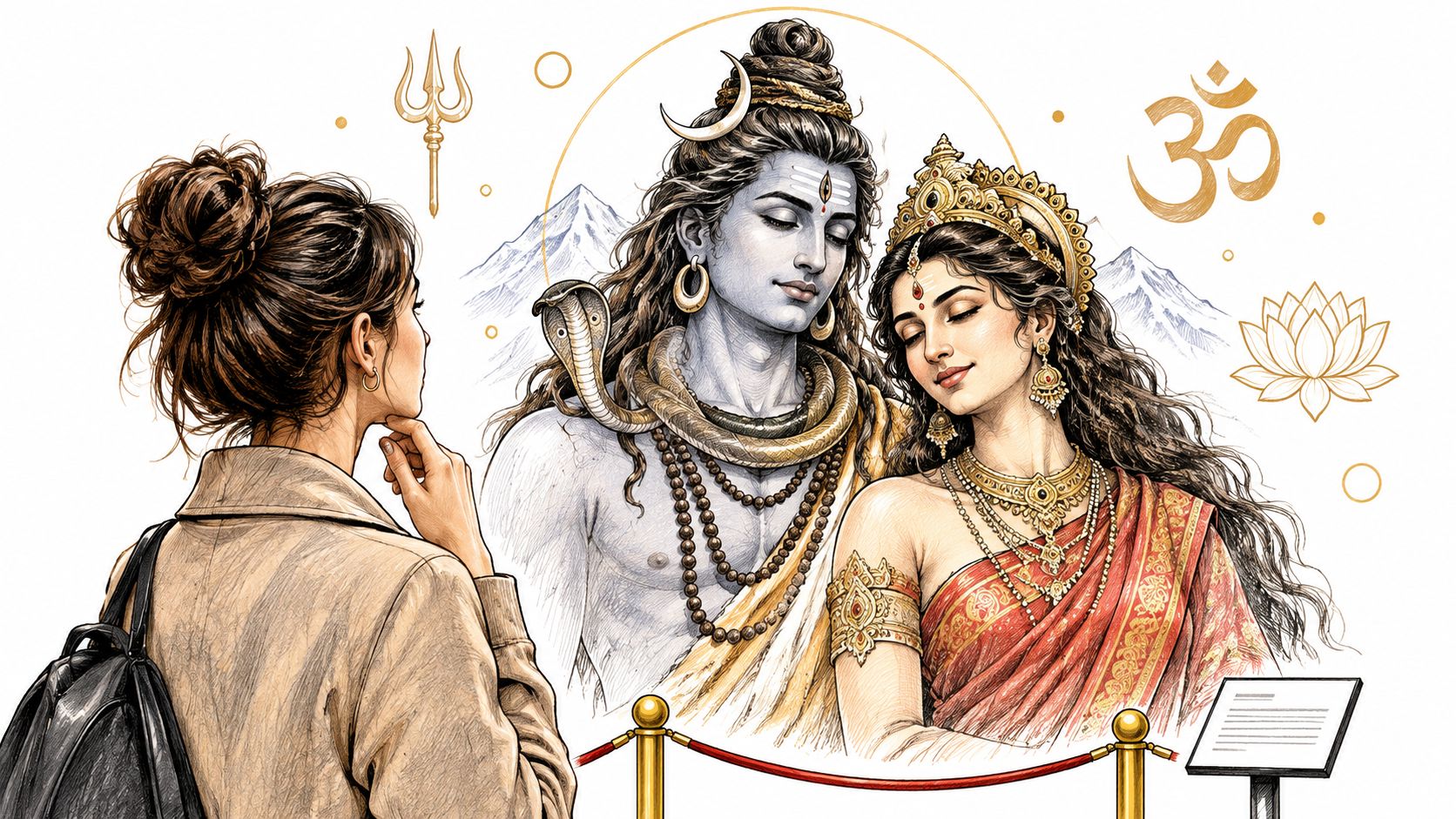
A visitor in a London gallery points at two seated figures and asks the most useful first question. Are they brother and sister, two separate gods placed together for decoration, or something closer? The one sentence answer is this. Shiva is the ascetic yogi associated with Mount Kailasa, and Parvati is his consort, understood as Shakti, the active power of the divine. If you remember only that sentence, you can already name the relationship in most paired images.
Parvati is also known as Uma or Gauri, and she's described as daughter of Himavat, the personified Himalayan mountain. Shiva, by contrast, is the figure who withdraws. He's the meditator in the mountains, smeared with ash, absorbed in stillness. That contrast is deliberate. Sculptors aren't just putting a husband beside a wife. They're putting stillness beside energy, and withdrawal beside engagement with the world.
A Lamp and Its Flame
Think of a lamp and its flame. You can point to the lamp as an object, and you can point to the flame as light and heat, but a lamp without a flame doesn't do what a lamp is for. The analogy helps because neither figure is fully understood alone. Shiva without Shakti is often explained as inert, present but not acting. Parvati as Shakti is the power through which the divine moves, creates, protects and transforms.
That idea becomes visual in Ardhanari, also called Ardhanarishvara, the single form in which male and female halves combine in one body. One side carries Shiva's features, the other carries Parvati's. It's not a costume or a puzzle. It's a statement in stone or bronze that the two principles belong together and can't be split into rival halves.
Read a paired image as a relationship first and a portrait second. Closeness, shared scale and a shared seat usually tell you more than facial expression.
More Than a Romance
It's tempting to reduce the pair to a love story, and many retail descriptions do exactly that. The marriage matters, but it doesn't exhaust the meaning. Different traditions weight the relationship differently, and those readings overlap in practice.
- Shaiva reading: Shiva is supreme, and Parvati is his inseparable energy rather than a separate assistant.
- Shakta reading: The goddess is highest reality. The saying that Shiva without Shakti is inert explains why her presence isn't optional.
- Vaishnava reading: Some texts show Shiva as a devotee of Vishnu, which places the couple inside a wider devotional world rather than at its sole centre.
- Family reading: The pair stresses protection, fertility, continuity and household life, especially when children appear with them.
A single sculpture rarely carries only one of those meanings. A wedding relief can be read devotionally by one family, philosophically by a student, and as a fine regional carving by a collector. Those readings don't cancel each other out. If you'd like the goddess side in more depth, our guide to Parvati as divine mother and consort of Shiva follows her names and roles step by step.
A Living UK Context
These aren't only historical images behind glass. The Office for National Statistics Census 2021 release for England and Wales recorded approximately 1.0 million people identifying as Hindu, representing 1.7% of the population, compared with about 818,000 people, or 1.5%, in 2011. Census religion data doesn't separately count devotees of Shiva or Parvati, so it can't tell you how many people worship this couple specifically. It does show the size of the living community within which their stories, festivals, household shrines and temple traditions continue in Britain. When you name Shiva the ascetic of Kailasa and Parvati his consort and Shakti, you've grasped the core relationship.
Identifying Paired Sculptures by Their Attributes
Start with the table, then learn how to use it. An attribute is a visible object, animal, gesture or mark that a sculptor gives a figure so you can identify them without a label.
Attributes that identify Shiva and Parvati in paired sculpture
| Attribute | Usually Identifies | Typical Context |
|---|---|---|
| Nandi the bull | Shiva | Umamaheshvara groups, Kashmir relief, Odisha slab |
| Lion | Parvati (in UK museum documentation) | Umamaheshvara compositions with attendants |
| Trident | Shiva | High-relief slabs and standing images |
| Axe in a rear hand | Shiva | Seated Shiva with Parvati, V&A object |
| Antelope in a hand | Shiva, recalling forest and ascetic identity | Somaskanda bronze and seated images |
| Lotus held by a figure | Parvati | Seated pairs with lotus bases |
| Abhaya mudra (raised palm) | Blessing figure, usually Shiva | Lower right hand in seated pairs |
| Halos | Divine status | Kashmir relief, Maheshvara images |
| Multiple heads | Maheshvara form of Shiva | Three-headed Kashmir relief |
| Small attendant sons | Ganesha and Karttikeya (Skanda) | Family-centred Kashmir relief and Somaskanda |
Combine Clues Before You Name a Figure
Identification works like reading clues in a detective story. One attribute on its own is weak evidence, because hands break, objects get lost, and later copies simplify details. Several attributes together are strong evidence. A male figure with a bull below him is suggestive. The same figure with a trident, an antelope in an upper hand and a female figure on his knee is much more secure.
Work from the base upwards. First look for animals, because sculptors often place them low where they're easy to carve in relief. Nandi the bull points to Shiva. A lion in this paired context points to Parvati. Then move to the hands. An axe and an antelope in rear hands point to Shiva's ascetic, forest dwelling identity. A lotus held delicately points to Parvati. A raised open palm is abhaya mudra, a gesture of protection and blessing. Halos don't name a specific deity, but they confirm you're looking at divine figures rather than royal donors.
A Worked Example Called Umamaheshvara
The type called Umamaheshvara, also catalogued as Hara-Parvati, gives you almost every clue at once. The British Museum record for its carved stone Hara-Parvati sculpture describes Shiva seated with Parvati on his knee, with Nandi, a lion, numerous attendants, musicians, garland-bearers, and ritual objects such as conch trumpets, a lamp, and a bell. That density turns a couple into a complete sacred environment.
Notice what each part does. Parvati on Shiva's knee makes their union the main visual device, so you don't need a caption to understand closeness. Nandi and the lion separate the identities at a glance. Attendants, musicians and ritual objects tell you this is a scene of worship, not a private domestic moment. A related museum description adds an axe and antelope in Shiva's rear hands, abhaya mudra in his lower right hand, and a lotus held by Parvati. Put together, those details let you name both figures with confidence.
Practical rule: If you can find three matching attributes, two for one figure and one for the other, you're usually on firm ground.
Scale, Damage and Honest Description
Scale is a quiet clue that many beginners miss. When the two main figures are roughly equal in size and turned towards each other, the image reads as partnership. When the female figure is much smaller, pushed to the edge or absent altogether, you're probably looking at a primarily solo Shiva image with attendants. Children, by contrast, are often deliberately smaller, which signals family hierarchy rather than lesser importance in every sense.
Damaged or later sculptures may retain only some attributes, so describe what you can see. Record posture, material, attributes and condition separately rather than relying on a seller's name alone. Write, for example, seated male figure, stone, bull at base, upper left hand missing, female figure holding a lotus. That plain record protects you as a buyer, helps a curator catalogue accurately, and stops a confident label from hiding uncertainty. Naming comes last, after the evidence.
Myths That Explain the Couple's Story
Why show this couple together at all? Sculptors had hundreds of deities to choose from, yet they returned to Shiva and Parvati sitting, marrying, travelling and parenting together. The myths answer that question in episodes. Think of the whole story as a long courtship serialised across many tellings, with each episode explaining one theme that a sculptor could later carve.
Sati and a Rebirth
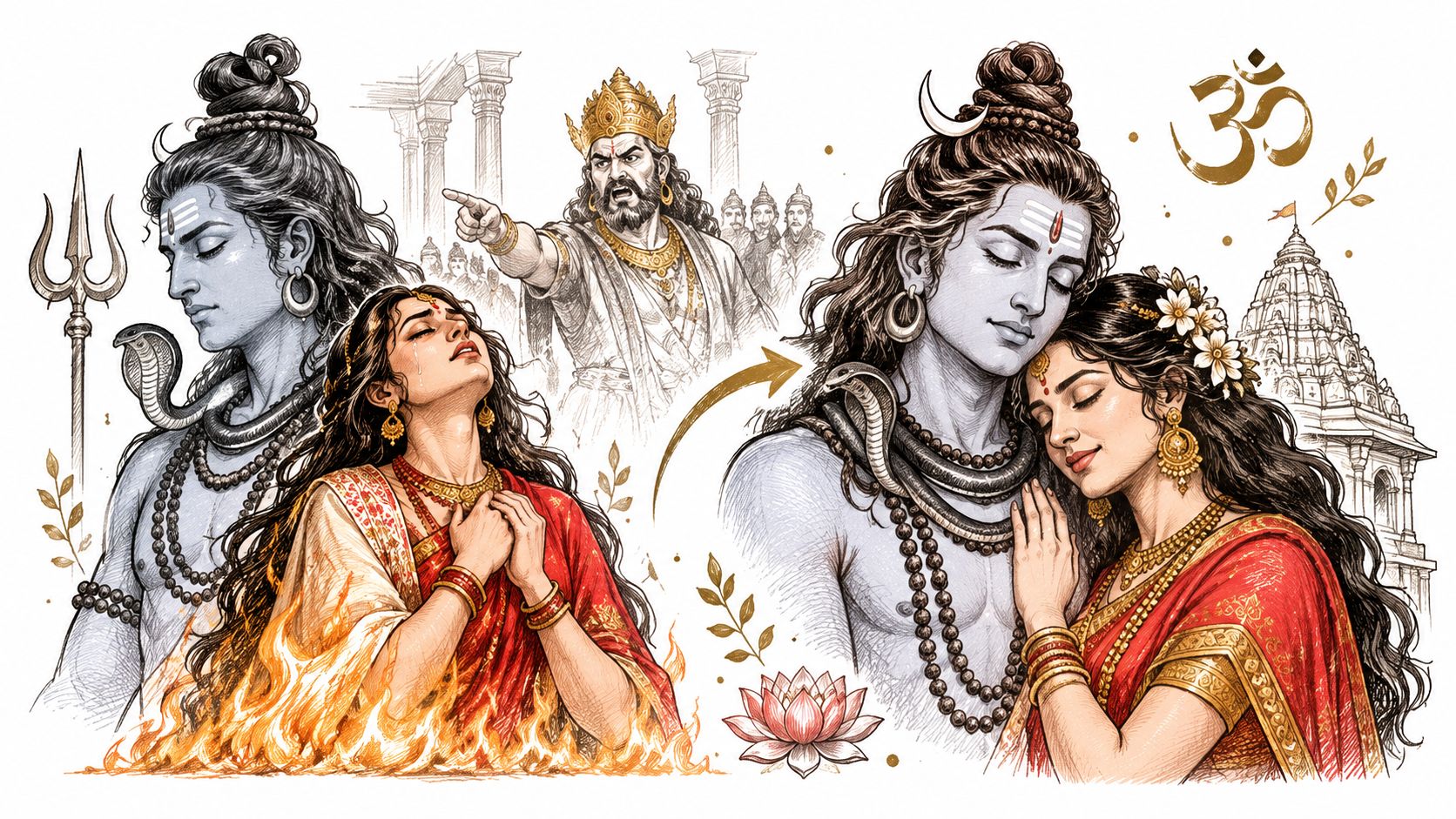
In one telling, the story begins before Parvati. Sati, daughter of Daksha, marries Shiva despite her father's hostility. Daksha later insults Shiva by excluding him from a great sacrifice, and Sati gives up her life in protest at the dishonour. Shiva withdraws in grief.
Sati is then reborn as Parvati, daughter of Himavat, the Himalayas. That rebirth matters for sculpture because Parvati isn't a replacement wife in a simple sense. She's understood as the same divine feminine returning in a new life, with a different task. Where Sati's episode stresses loyalty under insult, Parvati's stresses chosen devotion and endurance. Images of a calm goddess beside an ascetic god carry that earlier rupture behind them, even when the carving itself looks peaceful.
Tapas and the Divine Wedding
Shiva, absorbed in meditation, doesn't agree to marry again. Parvati undertakes tapas, austere penance and disciplined practice, to win his attention. She gives up comforts, endures heat and cold, and holds to her resolve when she's tested. The point isn't that suffering earns a prize in a crude transaction. It's that her inner discipline matches his, which makes the union one of equals in spiritual seriousness.
The marriage that follows is Kalyanasundara, the divine wedding. Temple reliefs love this subject because it allows crowds of gods, attendants, musicians and family members around a central couple. Shiva the renunciant becomes a householder without ceasing to be Shiva. For households, that wedding image carries auspiciousness and marital fidelity. For philosophers, it shows stillness entering the world rather than fleeing it.
Poetry and Children
Kalidasa's Kumarasambhava gives the courtship and marriage a literary shaping centred on the birth of Kumara, also called Skanda or Karttikeya. A son of Shiva and Parvati is needed, in the story, to defeat a demon whom others can't overcome. That explains why so many family groups place a small Skanda between his parents or on the same plinth. The child isn't decorative. He's the purpose toward which the marriage, in that narrative line, has been moving.
The Ganesha origin story adds tenderness and conflict. In one telling, Parvati shapes a boy from bathing paste, turmeric paste or clay, gives him life, and sets him to guard her door. Shiva returns, doesn't recognise the child, and a confrontation leads to the boy losing his head. To restore him and answer Parvati's grief and anger, Shiva has an elephant's head brought and fitted. Ganesha then becomes a beloved son of the household. A sculpture that includes an elephant headed child is therefore telling you, at a glance, that you are inside this family story.
Versions differ across the Puranas and regional traditions, sometimes in who acts first, sometimes in small details of material or motive. Saying in one telling is more accurate than presenting a single canonical plot. That habit also helps you in a gallery. If a relief shows a wedding, a child or a solitary goddess in penance, you can ask which episode the sculptor chose, rather than expecting every named Shiva and Parvati piece to illustrate the same moment.
Regional Styles of Paired Sculpture Across India
Use this table as a quick map before you judge a piece by style alone. Region and material often explain why one pair looks architectural and severe, while another looks portable, intimate or painterly.
Dated paired Shiva and Parvati sculptures by region
| Region and Date | Object Type | Distinctive Detail |
|---|---|---|
| Kashmir, around AD 800 (Karkota period) | Chlorite relief | Three-headed Maheshvara beside Parvati, halos, Nandi behind |
| Tamil Nadu, around AD 1100 | Bronze Somaskanda, about 48 cm high and 60.5 cm long | Shiva, Uma and Skanda on a plinth, antelope and axe |
| Odisha, twelfth or thirteenth century | Stone slab, about 180 cm high and 90 cm wide | Shiva with Parvati on his lap, originally at a temple entrance |
| Madurai, around 1766 CE (inscribed Samvat 1823) | Ivory relief | Kalyanasundara wedding; inscription may be a later addition |
| Madurai, around 1800 | Drawing | Pair seated in glory on a Himalayan mountain, surrounded by worshippers |
| Company painting, around 1820-1825 | Painting | Shiva and Parvati riding Nandi, made for British audiences in India |
| Mandi, northern India, around 1830-1840 | Painting | Shiva and Parvati on Mount Kailasa, tiger and cow below |
Early Stone and Bronze
Start in Kashmir. The British Museum chlorite relief of three-headed Maheshvara with Parvati dates to around AD 800, produced shortly after that date under the Karkota dynasty, with both figures wearing halos, Nandi behind them, and their sons Ganesha and Karttikeya at smaller scale on either side of Shiva. Here the couple stands as a formal, family centred presence. Multiple heads signal a grand form of Shiva rather than a simple portrait.
Tamil Nadu gives a different answer in bronze. The British Museum Somaskanda bronze from Tamil Nadu was made around AD 1100 and measures approximately 48 cm high and 60.5 cm long, showing Shiva, Uma and their child Skanda together on a plinth, with a leaping antelope in Shiva's upper left hand and a now broken axe originally in the other upper hand. Bronze suits processional use, because a strong, detailed image can be carried, bathed and dressed. For background on that southern bronze tradition, see our explanation of Chola bronze sculpture and South Indian masterworks.
Odisha, in the twelfth or thirteenth century, works at architectural scale in stone. A large slab showing Shiva with Parvati on his lap belongs at a temple threshold, where worshippers meet the couple before entering. Stone allows high relief and durability outdoors, but it doesn't invite handling. Size itself becomes part of the message.
Ivory, Drawing and Painting
Later objects shift towards courtly and paper based art. The Victoria and Albert Museum collection record for Shiva and Parvati material notes an ivory relief from Madurai portraying their marriage, inscribed Samvat 1823, corresponding to 1766 CE, although the V&A notes the date may have been added later and should not be regarded as definitive. That caution is useful. An inscription is evidence, but it isn't automatically contemporary with the carving.
The same museum holdings include a southern Indian drawing, probably Madurai, from around 1800, with the pair seated in glory on a Himalayan mountain surrounded by worshippers. A painting from around 1820 to 1825 shows them riding Nandi and forms part of a group of 100 Company paintings made for British audiences in India. A Mandi painting from northern India, dated approximately 1830 to 1840, places them on Mount Kailasa with a tiger and cow below. Painting can add scenery, crowds and narrative setting in a way a small stone relief can't.
Material therefore shapes meaning. Stone anchors a temple entrance. Bronze travels in procession and receives close worship. Ivory rewards close looking at fine wedding detail. Painting and drawing explain place, Mount Kailasa, the Himalayas, a court of worshippers. Before you judge origin, match your piece against these rows. Ask whether its material, scale and attributes fit a temple, a procession, a court album or a British collecting market. That question often narrows a date faster than style alone.
Displaying Shiva and Parvati at Home or in a Collection
Placement starts with a clear choice. Are you displaying a work of art in a collection, or are you setting up an image for worship in a home shrine? The two purposes overlap in respect, but they don't ask for identical arrangements. Deciding first prevents the common mistake of treating a sacred image as generic romantic décor while still expecting it to feel spiritually serious.
Collection Display
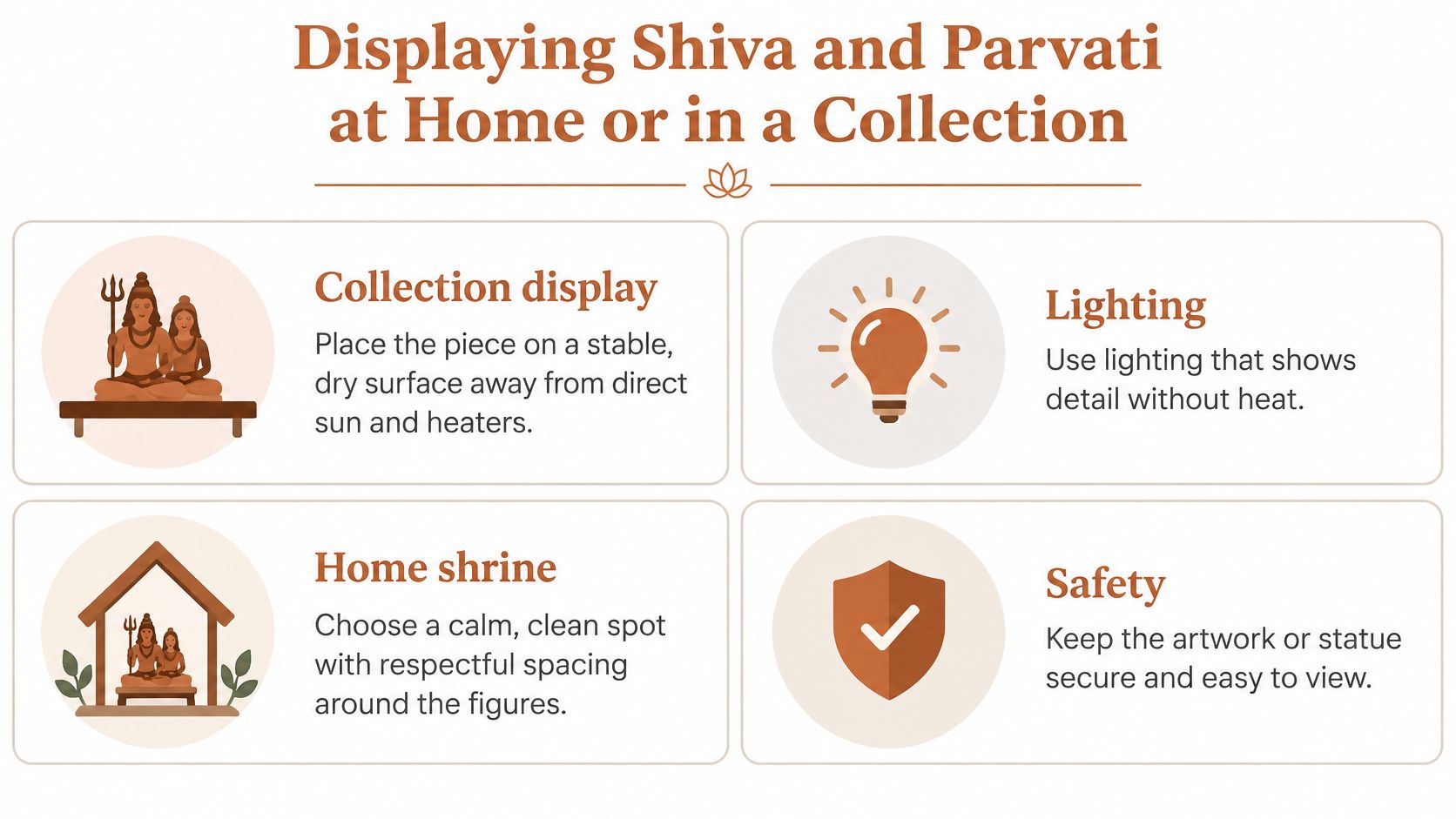
For a collection, choose a stable, dry surface away from direct sun and heaters. Heat and strong light can stress old surfaces, fade pigment and make bronze uncomfortable to handle. Use lighting that shows relief and hand details without generating heat, angled slightly from the side rather than flat from the front. Side light reveals a trident shaft, a lotus stem or a small attendant that front light washes out.
Add a label that states date, origin, material and visible attributes. A good label teaches a guest in twenty seconds. It might read, bronze Somaskanda type, Shiva with antelope, Uma and Skanda on a shared plinth. Keep a clear distinction in the room, and in your own notes, between decorative contemporary pieces and images that a family uses or has used in worship. General shelf decorating tips for Orlando homeowners can help with spacing, height and grouping on ordinary shelving, but sacred sculpture also needs breathing room so attributes aren't hidden behind books or vases.
Home Shrine Practice
For a home shrine, choose a clean, calm, raised surface. Don't place the figures on the floor, in a bathroom, or beside bins. Face them into the room so you meet the image rather than walking behind it. Common offerings include flowers, water, a lamp and incense, renewed regularly rather than left to decay. Our practical notes on setting up a Hindu home shrine cover the basic arrangement in more detail.
One specific convention is worth knowing. The BBC account of the Odisha Shiva and Parvati sculpture records that worshippers should respectfully approach Parvati before Shiva, and describes the pairing as representing the union of male and female principles and marital fidelity. That order reminds you not to treat Parvati as an accessory to a Shiva statue. Practices still vary by household, region and lineage, so ask a family priest, elder or teacher in your own tradition before fixing rules for consecration, bathing, food offerings or festival use.
Handle any sculpture with clean, dry hands, support it from the base, and never lift it by a trident, arm or child figure.
A Short Placement Checklist
- Surface: Raised, stable, dry and level, with enough depth for the base.
- Orientation: Figures facing the room, not a wall or a busy doorway.
- Cleanliness: Dust gently with a soft dry brush, and keep offerings fresh.
- Lighting: Cool, angled light for collection pieces, a safely placed lamp for a shrine.
- Labelling: Date, origin, material and attributes recorded where you can find them.
- Handling: Clean hands, two handed support, and no lifting by projecting details.
Work through that list before you drill a shelf or buy a cabinet. It takes minutes and saves awkward moves later.
Choose a Matching Pair for Your Space
Choose a pair whose attributes are clear, whose material suits the room, and whose purpose matches the space. That order matters. A beautiful carving that you can't identify, light properly or place respectfully will frustrate you, however good the photograph looked.
First, check identity. Can you find Nandi or a trident for Shiva, and a lotus or a lion for Parvati? Are the two figures matched in scale and style, or has a seller paired a tall, finely modelled Shiva with a much smaller goddess from a different workshop? Two single statues can work as a pair if height, base design, finish and posture sit comfortably together. If you're comparing unrelated modern décor, a matched product such as a Jillsen accent sculpture pair shows the basic visual principle, two objects designed to be read together rather than forced together afterwards. With sacred figures, iconography matters as well as proportion.
Second, compare material. Bronze Shiva sculptures have fine, crisp details and a warm metallic presence, which suits a shrine, cabinet or desk where you'll see small hands and attributes up close. Stone Shiva statues feel more architectural and grounded, which suits a larger room, a hallway plinth or, where the stone and finish are suitable, a garden setting. Bronze rewards close light. Stone needs space around it so its mass doesn't crowd a small shelf.
Third, match purpose to setting. A teaching piece for a study or classroom needs a clear label and attributes a visitor can find. A devotional piece needs a clean, calm setting with room for offerings. A decorative piece in a living room needs careful lighting and enough separation from everyday clutter to remain respectful. At HD Asian Art, we sell Hindu statues of Brahma, Devi, Durga, Ganesha, Hanuman, Krishna, Lakshmi, Murugan, Parvati, Shiva, Vishnu and Erawan, and our statues are suitable for home shrines, meditation rooms and puja spaces, as well as for home décor and collections.
Take one practical step today. Shortlist one Shiva and one Parvati of matching scale, measure the surface and check the light where they'll stand, then read each listing for attributes, date, origin and material before you buy. If a listing can't tell you what the figures hold or what animal sits at the base, ask before you commit.
Browse our Shiva and Parvati statues at HD Asian Art, where you'll find bronze and stone Hindu sculpture selected for home shrines, meditation rooms, puja spaces, décor and collections. Use the attribute checklist you've just learned to compare each pair by animal, hand-held emblem, scale and material, then choose the couple that fits your surface, light and purpose.
