






Krishna Sudarshan Chakra: Meaning, Myth and Iconography
Krishna Sudarshan Chakra: Meaning, Myth and Iconography
If a disc in a statue's hand tells you the figure is Krishna, what does the same disc mean when it sits on a shrine with no deity holding it? That question rarely gets asked, because the wheel gets treated as a logo: round, spoked, vaguely protective. That shortcut causes real mistakes in catalogues, in shop descriptions and on home altars, where a Sudarshana object worshipped in its own right gets labelled a spare part of a Krishna statue.
The disc is a readable sign, and it's read the way you'd read a hallmark: by where it sits, what it sits beside, and what kind of object carries it. A Krishna Sudarshan Chakra in a raised hand, a wheel carved on a temple arch and a fossil stone kept in a puja bowl are three different things, and the shape alone won't separate them.
Table of Contents
- What the Sudarshan Chakra Is and Its Link to Krishna
- How the Chakra Came to Be Linked With Krishna
- Vishnu's Attributes and What Each One Signifies
- How to Identify the Chakra in a Krishna or Vishnu Image
- Sudarshana as a Separate Deity and Common Misconceptions
- Choosing a Krishna Statue With the Chakra Right
What the Sudarshan Chakra Is and Its Link to Krishna
The Sudarshan Chakra is the discus of Vishnu, a spinning wheel the deity uses to restore cosmic order, and it turns up in Krishna imagery because Krishna is worshipped as one of Vishnu's avatars (an incarnation the deity takes on in the world). The name is usually rendered as the auspicious or beautiful discus, from su (auspicious), darshan (vision) and chakra (wheel or disc).
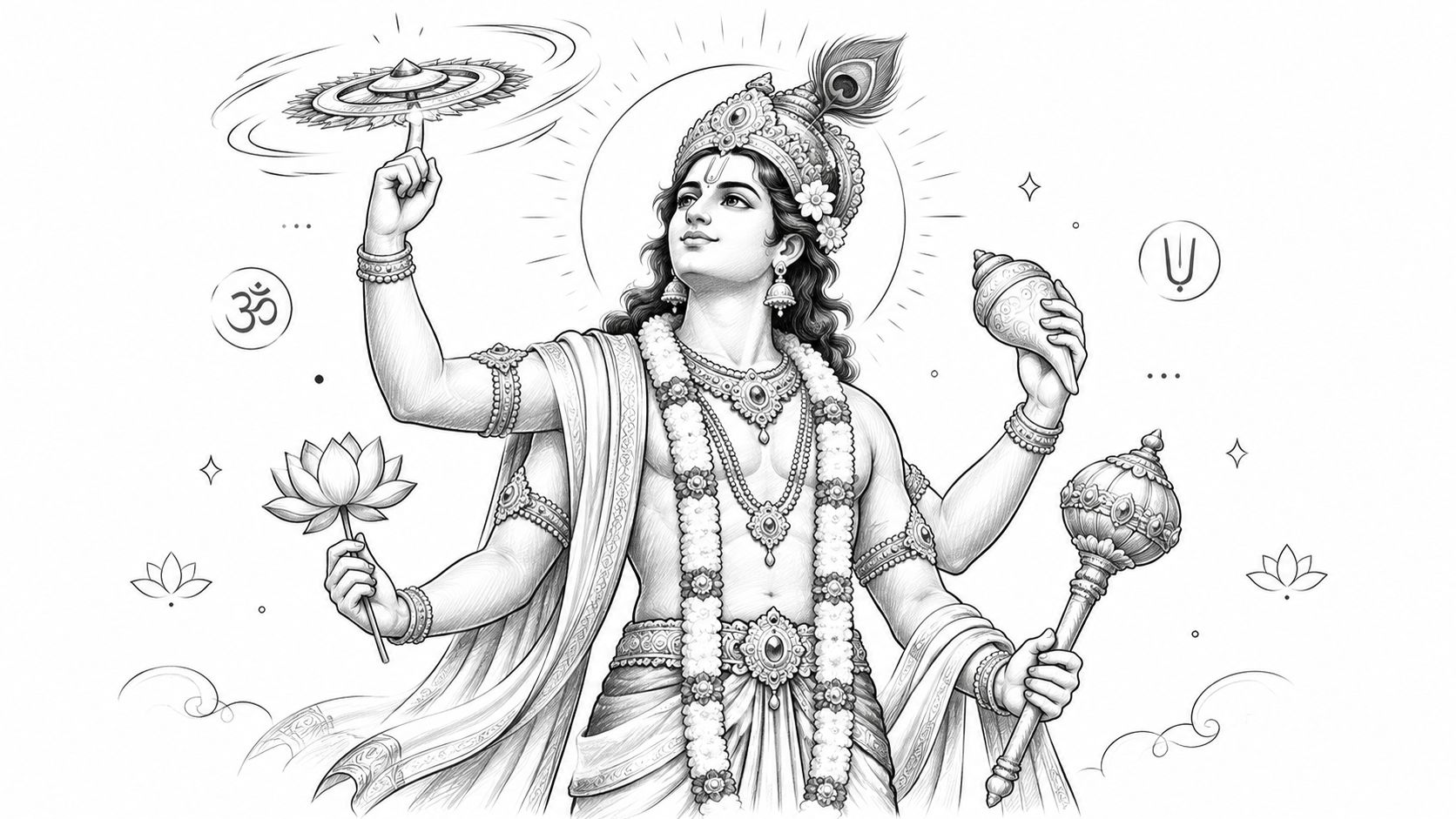
Think of a wax seal on a letter. The seal is a physical object you can hold, yet what it communicates is authority: this document comes from someone entitled to issue it. The chakra works the same way in sculpture. It's a tool in the story and a statement of standing in the image, and you can't read one half without the other.
The chakra is Vishnu's authority in disc form, so its meaning follows the hand that holds it and the company it keeps.
Who needs this distinction
Students learning South Asian iconography, collectors comparing bronzes, museum staff writing catalogue entries and gift buyers choosing a first statue all meet the same problem from different directions. Each needs to answer three questions: what the disc is, how it appears in an image, and what it means when Krishna is the one shown with it.
Position and context do the work here, not circularity. Plenty of objects are round, from halos and lotus bosses to shield rims and decorative medallions, and none of them are chakras. By the end you should be able to name the chakra in a sculpture, explain its myth in two sentences, and judge whether a piece suits your collection or your space.
How the Chakra Came to Be Linked With Krishna
The link isn't a single event. It's a sequence, and each stage leaves a trace you can still see in objects. The four steps below move from a regional clan deity to the wheel you'll find raised in a bronze hand today.
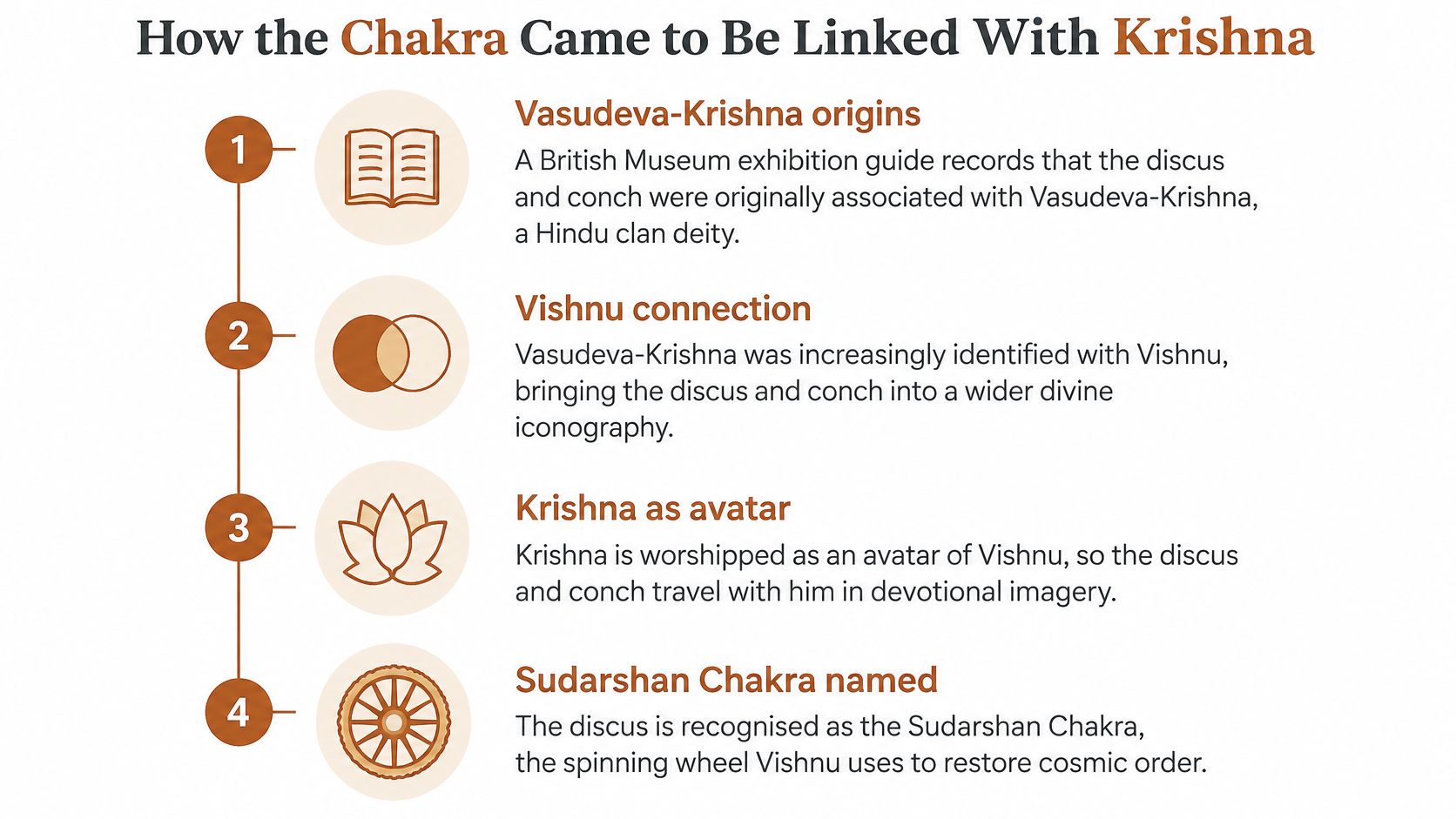
- A clan deity in Mathura. The British Museum's Ancient India exhibition guide records that the discus and conch were originally associated with Vasudeva-Krishna, a Hindu clan deity from the Mathura region of northern India. For reading images, that means the disc's earliest attachment is to a specific regional cult, not to a universal Hindu symbol.
- Two gods become linked. As Vasudeva-Krishna and Vishnu were increasingly identified with one another, those attributes were absorbed into Vishnu-related imagery, according to the same exhibition guide, which also describes Vishnu represented with a club, conch shell, discus and spherical earth. The disc therefore belongs to a defined group of divine attributes rather than floating free as decoration, and its presence can signal the historical overlap between the two traditions.
- The wheel acts. In the Samudramanthana narrative, the churning of the ocean for the nectar of immortality, Rahu slips into the gods' assembly to take amrita by deception, and Vishnu removes him with the discus. The lesson for a viewer is about function: this attribute exists to end an irregularity, which is why it reads as decisive rather than ornamental.
- Krishna stands inside the Vishnu tradition as an avatar, so the older clan attributes and Vishnu's cosmic role travel with him. A disc in a Krishna image can carry both histories at once.
A worked example
Say you're looking at a standing four-armed bronze labelled "Krishna". A disc sits in one raised hand, a conch in the other, and the figure wears a tall crown. The disc doesn't tell you the sculptor thought of Krishna the cowherd; it tells you the maker was working in a Vishnu-related idiom where those attributes belong together, and that the identification with Krishna comes from the wider tradition rather than from the wheel.
That mechanism explains why the chakra appears in Krishna art at all. It doesn't promise uniformity. Regional workshops, sect preferences and the intended setting all change how prominently the disc is shown, whether it's held edge-on as a thin rim or face-on as a spoked circle, and whether it's paired with the full attribute set or only part of it.
Vishnu's Attributes and What Each One Signifies
In Vaishnava iconography documented by the British Museum's Vishnu record, the Sudarshan Chakra is a discus or wheel held by Vishnu, including in depictions of Krishna as one of his avatars, and it represents speed and thought. The other standard attributes carry complementary functions rather than repeating the same idea.
| Attribute | Symbolic meaning |
|---|---|
| Chakra (discus) | Speed and thought |
| Shankha (conch) | Five existential elements |
| Padma (lotus) | Illusion |
| Gada (mace) | Power and knowledge |
How each attribute completes the disc
Read the four together and you get a working description of preservation. The shankha covers the material ground of existence, the five existential elements, so the world being protected is named. The padma stands for illusion, the condition that makes creatures misread that world. The gada supplies power and knowledge, the capacity to act and to know what action is warranted.
The chakra sits at the sharp end of that set. Speed and thought mean the response is immediate and discriminating: it arrives at the moment of transgression and it distinguishes the transgressor from everyone else present. That's why the discus is Vishnu's decisive weapon rather than a general emblem of force, and why the mace and the disc aren't interchangeable in a well-made image. For a fuller walk through the four hands, our guide to the symbolism of Vishnu's divine attributes sets out the same vocabulary in more detail.
A chakra in a sculpture is an anthropomorphic attribute, meaning an object given to a human-formed deity to hold, and the British Museum record notes it's commonly shown in one of Vishnu's raised hands, often paired with the conch in the opposite upper hand. That arrangement is a cataloguing criterion, not a stylistic flourish, and it lets you compare images across regional styles on the same terms.
So a correctly placed disc reads as rapid, discriminating divine action and cosmic preservation. When you meet a disc held by a deity, ask two things: which attribute pairs with it, and what order that pairing protects. If the other hands are empty, damaged or holding something outside the set, you've got a question to resolve before you write a label.
How to Identify the Chakra in a Krishna or Vishnu Image
How do you identify the chakra without letting the round shape do all the work? Start with the whole figure, then read each hand in order. Think of the process like checking a labelled toolbox: a wheel, a shell, a club and a lotus each have a place, and the arrangement helps confirm what you are seeing.
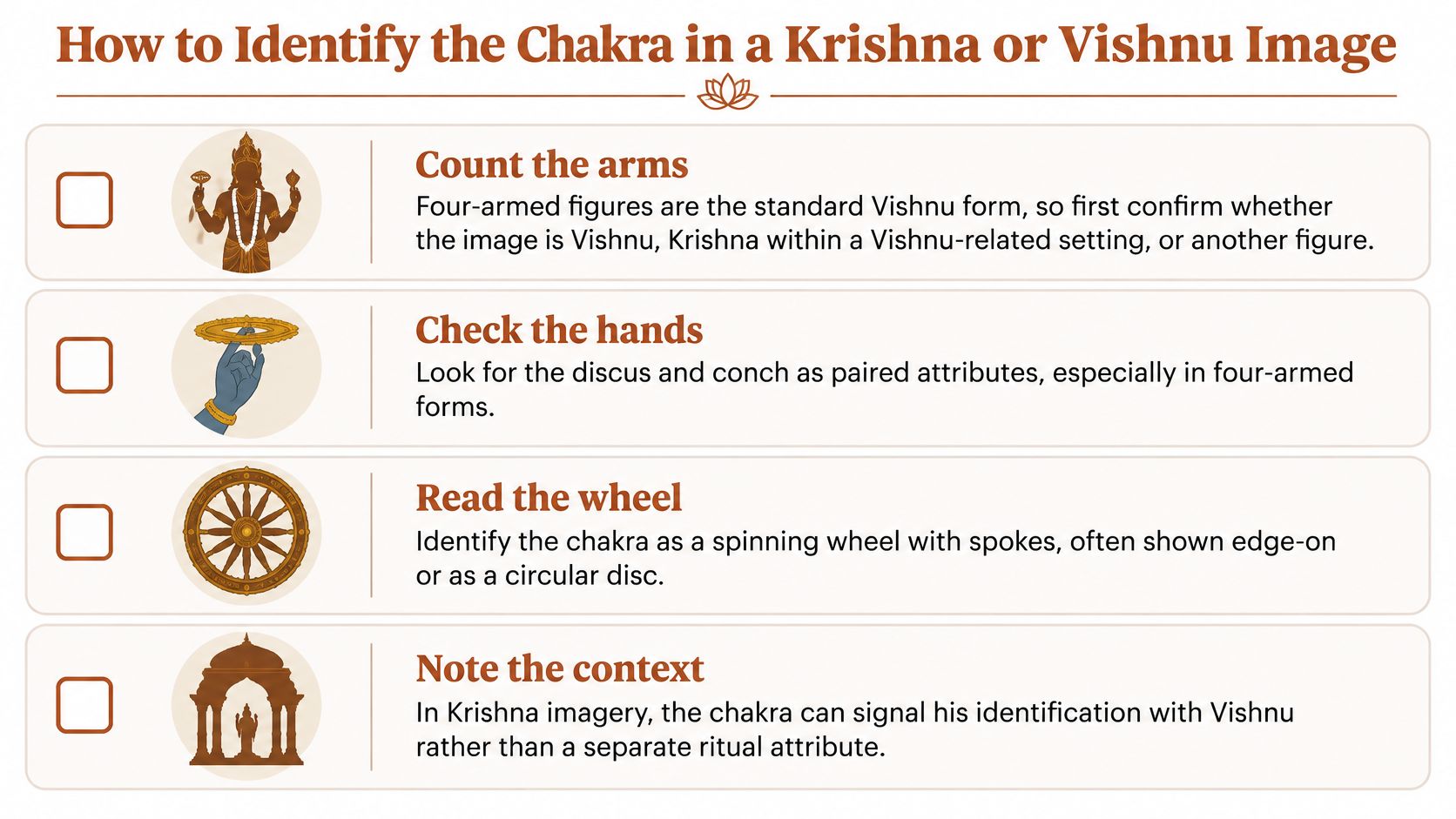
- Count the arms. Four arms are the standard Vishnu form, so begin by asking whether the figure is Vishnu, Krishna in a Vishnu-related form, or another deity altogether. Arm count narrows the field before you interpret any object. A disc in the hand of a four-armed figure invites one set of questions. A disc with a different arm count invites another.
- Locate the upper hands. The chakra is commonly held in an upper hand. In the painting described in the British Museum's collection entry for a four-armed Vishnu, Vishnu's upper right hand carries the chakra. This gives you a clear example of one documented placement, useful because the disc often sits in the region of the image associated with divine action.
- Check the opposite upper hand. In that same painting, the upper left hand holds the shankha, or conch. The pairing matters more than the outline of the object. A round form on its own could be a wheel, a shield, a decorative disk or a damaged surface. Disc plus conch gives the eye a stronger clue, like seeing two matching labels on the same drawer. In the British Museum painting, the chakra and conch occupy the paired upper hands, so the two objects should be read together.
- Read the lower hands. A mudra is a codified hand gesture, a set position with a recognized meaning rather than a casual pose. The painting's lower hands perform abhaya and varada mudras, signalling protection and generosity. Those hands are doing different work from the weapon-bearing upper hands, so their open palms should not be treated as empty spaces or missing attributes.
- Compare what you have found with the placements below, then look at material, casting style and condition before discussing age. Attribution and dating need more than a single bright object in a hand.
| Hand position | Object or gesture | What it signals |
|---|---|---|
| Upper right hand | Chakra (discus) | Shown in one recorded British Museum painting |
| Upper left hand | Shankha (conch) | Paired with the chakra in that painting |
| Lower hands | Abhaya and varada mudras | Protection and generosity, not weapons |
Where readers go wrong
Upper right and upper left are helpful guides, not universal rules. The British Museum painting gives one documented arrangement, and images can vary by region, period and workshop. Read the pairing first, then ask which hand holds which object.
The disc also cannot separate Vishnu from Krishna by itself. For that, look at the rest of the image: arm count, accompanying figures, crown, posture, and any inscription or existing catalogue entry. A chakra is one clue in a visual sentence. It makes better sense when you read the whole line.
A checklist you can keep on your phone:
- Arms first: four arms points to a Vishnu-related form.
- Pair, don't guess: disc plus conch in the upper hands is the reliable signal.
- Gesture check: open lower palms usually mean mudras, not lost objects.
- Age last: style and surface tell you nothing definite without documentation.
Sudarshana as a Separate Deity and Common Misconceptions
The assumption to drop is that every chakra image is a decorative attribute of Krishna. In specialist Pancharatra descriptions (the Vaishnava tradition governing temple ritual and the theology of divine forms), Sudarshana can be an independently personified deity associated with action, energy, intention and liberation, while popular web summaries compress all of that into one line about a weapon of Vishnu. In Vaishnava theology the disc can also stand for divine order, protection, time or liberating knowledge, and in temple practice Sudarshana may be worshipped through anthropomorphic or ritual forms rather than only depicted as a disc.
This isn't an abstract quibble. The Hindu population in England and Wales reached 1,032,775 people, or 1.7% of residents, in the 2021 Census, according to the Office for National Statistics bulletin on religion, so questions about home altars and correct form are live ones for a large readership, not just for specialists.
Two objects that look related and aren't
On a Krishna statue, the disc is an attribute held in a hand: it belongs to the figure and has no separate identity in the composition. A standalone Sudarshana image is worshipped as a form in its own right, with its own ritual context, and iconographic form varies by sect and ritual setting. Our article on Chakrapurusha, the personified attribute of Vishnu covers that personification directly.
Then there's the material misconception, which is that a chakra object must be a manufactured metal or stone disc. The British Museum's record of a shalagrama from Nepal documents shalagrama ammonite fossils as naturally occurring forms of Vishnu's cakra used in Vaishnava puja. A fossil isn't a sculptural attribute and isn't handled like one, so the two shouldn't be stored, cleaned or catalogued on the same assumptions.
Practical check: before you name a disc on a home shrine, ask what form the object takes. Held in a deity's hand, it's an attribute. Standing alone as a worshipped form, or present as a natural shalagrama, it's something else.
A disc on your shelf isn't automatically a Krishna attribute, and treating it as one can change what the object means to the person who worships it.
Choosing a Krishna Statue With the Chakra Right
Sort the object before you price it. Four categories cover most of what's on the UK market, and each carries different expectations:
- Ritual implement: made for use, so wear may be part of its life rather than a defect.
- Sculptural attribute: the disc belongs to a figure and is judged with the figure, not separately.
- Temple-style icon: made to a ritual specification, where form and completeness matter to worshippers.
- Modern decorative replica: honest ornament, which is fine as long as nobody sells it as an antique.
Visual antiquity is the trap. Patina, casting marks, repairs and a convincingly old surface can't establish historical authenticity on their own; attribution needs documented provenance, comparative study and appropriate conservation advice. A dark, rubbed surface can be produced deliberately, and a genuine old piece may have been cleaned until it looks new.
Religious value and market value also come apart. A damaged or incomplete chakra can remain ritually meaningful to the household that worships it, even where a dealer would discount the piece heavily. That matters across a UK readership that includes younger buyers as well as specialist antiquarians: 68.4% of Hindus in England and Wales were aged 16–64 in 2021, compared with 62.9% of the overall population, in the ONS analysis of religion by age and sex.
Placement and the questions to ask
Give the figure a clean, calm shelf or a dedicated puja space, off the floor, away from bins and shoes, and not in a spot where people step over it. Dust bronze with a soft dry brush rather than household polish, and leave any active corrosion to a conservator. For the wider choices around posture, material and scale, see our Krishna statues collecting guide.
We sell Hindu statues of Brahma, Devi, Durga, Ganesha, Hanuman, Krishna, Lakshmi, Murugan, Parvati, Shiva, Vishnu and Erawan, suited to home shrines, meditation rooms and puja spaces as well as to display and collections, so you can hold any of our listings against the criteria above.
Put three questions to any seller, including us:
- Where did the object come from, and what documents support that account?
- What's its condition, including repairs, replacements or missing parts?
- How is it intended to be displayed and used?
Buyer's rule: if a seller can't answer the provenance question, treat the piece as decorative and price it accordingly, whatever the disc looks like.
If you're choosing a Krishna or Vishnu figure and want the attributes to read correctly, our curated collection of Hindu and Buddhist sculpture lets you examine hand positions, pairing and material before you commit, with pieces suited to a home shrine, a meditation room or a display cabinet. Visit HD Asian Art to compare forms and read the accompanying notes on meaning and placement, then check your shortlist against the three seller questions above.
