



Statues de Krishna : formes, traditions et guide de collecte
Statues de Krishna : formes, traditions et guide de collecte
Un Statue de Krishna n'est pas simplement un objet de décoration. C'est une théologie compressée. Chaque posture, chaque attribut, chaque courbe de flûte ou levée de doigt code un épisode spécifique du Bhagavata Purana ou du Mahabharata, un registre émotionnel spécifique, et souvent une école régionale spécifique de sculpture qui s'étend sur plus de deux mille ans de développement artistique.
Pour les collectionneurs et les praticiens qui souhaitent acheter intelligemment, cette profondeur est à la fois un défi et une récompense. Ce guide parcourt les grandes formes iconographiques, les traditions artistiques qui les ont produites, les matériaux à comprendre et les questions pratiques à se poser avant d'acquérir une œuvre.
Table des matières
- Points à retenir
- Les origines et la logique de l'iconographie de Krishna
- Les principales formes iconographiques des statues de Krishna
- Traditions artistiques : styles régionaux et ce qu'ils produisent
- Matériaux, méthodes de coulée et indicateurs de qualité
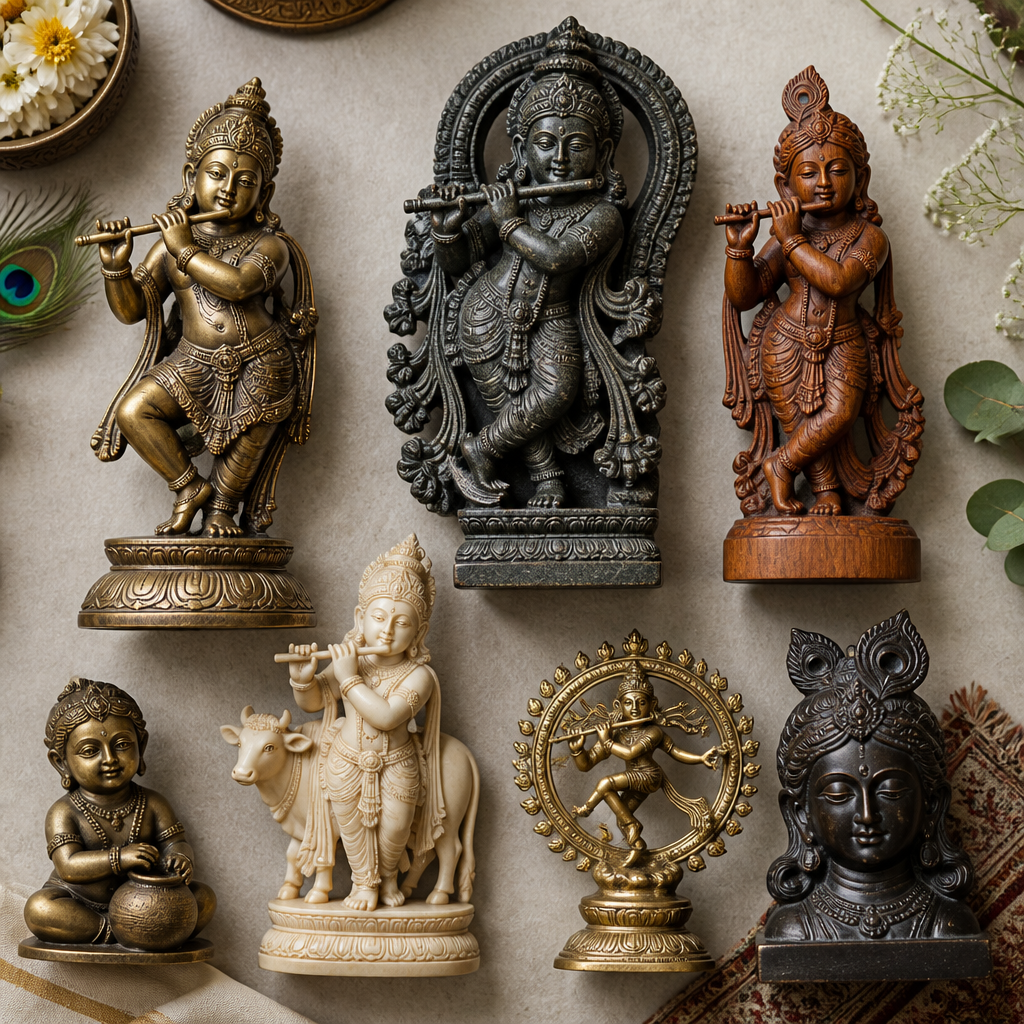
- Comparaison des principaux types de statues de Krishna pour les collectionneurs
- Que rechercher lors de l'achat d'une statue hindoue
- Placement, affichage et entretien
- Foire aux questions
- Références
Points à retenir
|
Aperçu clé |
Explication |
|---|---|
|
Venugopala est la forme déterminante |
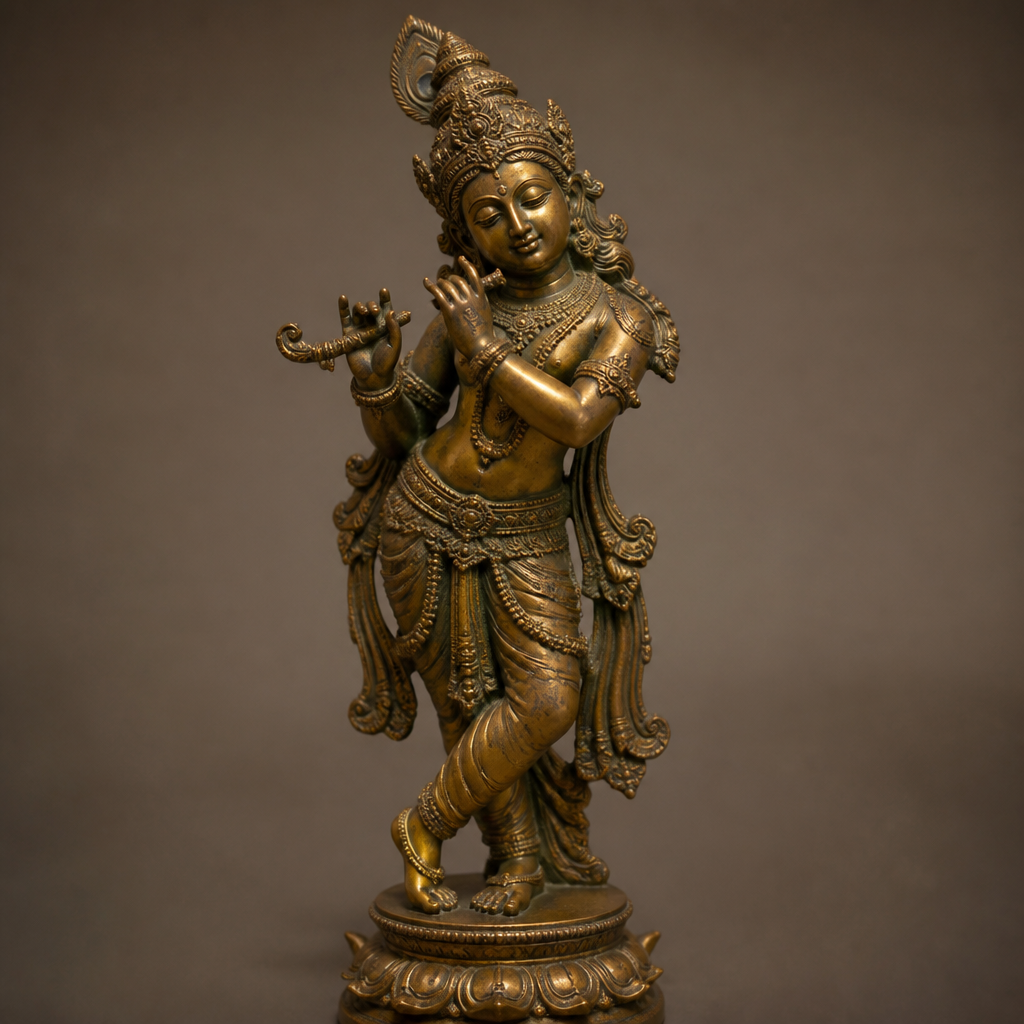
Le Krishna jouant de la flûte dans la pose tribhanga est la forme la plus largement collectionnée, identifiable par son corps triple fléchi, sa flûte tenue contre les lèvres et sa couronne de plumes de paon. |
|
La forme iconographique détermine le contexte de la valeur |
Chaque forme (Balakrishna, Govardhan, Kaliya Nartana, Radha-Krishna) a un marché de dévotion et de collectionneur distinct. Savoir quelle forme vous détenez est le point de départ d’une évaluation précise. |
|
Le bronze à la cire perdue est le matériau de référence |
Les véritables bronzes coulés à la cire perdue présentent de légères irrégularités de surface, des marques visibles de finition d'outil et un toucher dense. Les pièces en résine ou en sable semblent trop uniformes et pèsent nettement moins. |
|
Le style régional est aussi important que la divinité représentée |
Un Krishna de la tradition Chola du sud de l'Inde diffère d'une pièce de pierre de l'école Mathura par ses proportions, son ornementation et sa posture. Identifier la tradition vous donne la lignée artistique de la pièce. |
|
La patine est un signe d'authenticité, pas un défaut |
Sur les bronzes vieillis authentiques, la patine se développe de manière inégale, s'approfondissant dans les creux. La patine appliquée artificiellement a tendance à se déposer uniformément sur les surfaces et peut être détectée sous une lumière rasante. |
|
La vérification des attributs est essentielle |
Les attributs canoniques de Krishna, notamment la flûte (venu), la plume de paon, le vêtement jaune (pitambara) et le teint bleu ou foncé, doivent être iconographiquement cohérents avec la forme indiquée. |
|
La taille dicte le placement, et non l'inverse |
Décidez d'abord de l'emplacement : un autel de table a besoin d'une pièce de moins de 30 cm ; une niche dédiée ou un présentoir au sol accueille de 30 à 90 cm ; tout ce qui est plus grand nécessite une planification structurelle et un fret assuré. |
Les origines et la logique de l'iconographie de Krishna
La représentation sculpturale de Krishna a une histoire documentée remontant à la période Kushana, avec certaines des premières images identifiables datant du premier siècle de notre ère dans la région de Mathura. Des preuves épigraphiques antérieures suggèrent que la tradition iconographique a commencé à se former vers le deuxième siècle avant notre ère, bien que les sculptures physiques de cette période n'aient pas survécu dans un état reconnaissable. Il s’agit d’une longue tradition, et la comprendre vous empêche de traiter une pièce donnée comme un objet isolé.
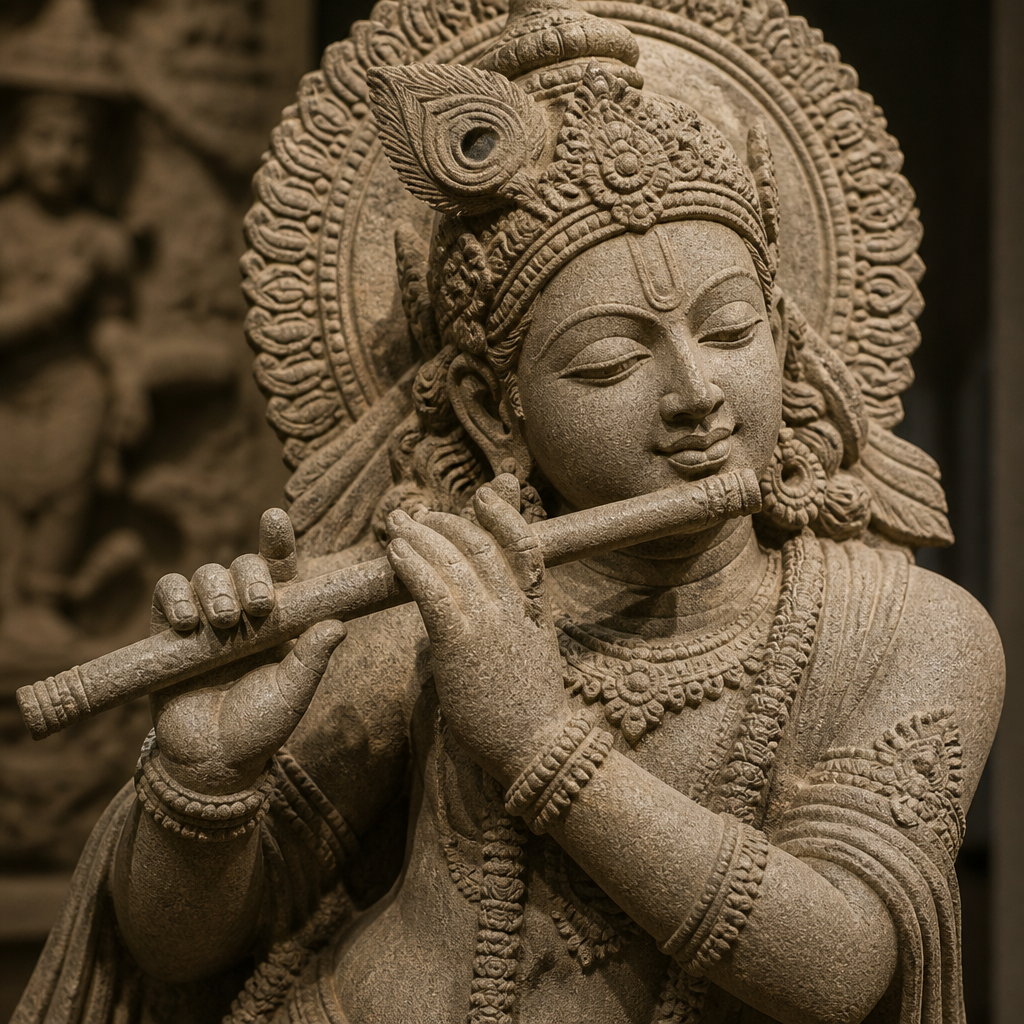
Ce qui unifie l'iconographie de Krishna à travers le temps et la région, c'est un ensemble cohérent de codes visuels : le teint bleu foncé ou noirâtre représentant l'infini, la plume de paon dans la couronne, la flûte comme instrument d'attraction divine et le pitambara (dhoti jaune) contrastant avec la peau. Ces éléments apparaissent dans les textes canoniques en langue sanskrite sur les arts des temples, notamment le Vishnu Dharmottara et le Brihat Samhita, qui fournissaient des lignes directrices aux sculpteurs travaillant à la fois sur les façades des temples et sur les images de culte portables.
Le programme visuel d'un Statue de divinité hindoue n’est jamais d’origine décorative. Chaque attribut est un argument théologique. Lorsqu’un collectionneur comprend la signification des attributs, il est également mieux équipé pour identifier les attributions erronées, les éléments restaurés ou les pièces composites assemblées à partir de sources multiples.
Les principales formes iconographiques des statues de Krishna
Venugopala : le vacher jouant de la flûte
Venugopala (Sanskrit : le vacher qui joue de la flûte venue) est la forme de Krishna la plus largement reproduite en sculpture. La figurine se tient en tribhanga, la posture à triple flexion dans laquelle le corps plie le cou, le torse et le genou dans des directions opposées, créant un contour en forme de S qui communique simultanément l'aisance, l'espièglerie divine et la grâce sensuelle. La jambe droite est généralement pliée et croisée devant la gauche, la flûte étant tenue contre les lèvres à deux mains.
Cette forme correspond aux années de Krishna à Vrindavana, le monde forestier de la région de Braj, avant son retour à Mathura pour accomplir sa destinée royale. La musique de flûte dans ces récits est comprise comme l’appel du divin à l’âme individuelle. Pour les collectionneurs, les pièces Venugopala apparaissent dans tous les matériaux et dans toutes les traditions régionales, ce qui fait de la qualité de l'exécution le principal différenciateur plutôt que de la rareté de la forme elle-même.
Balakrishna : l'enfant divin
La forme Balakrishna, parfois appelée Bal Gopal, représente Krishna comme un enfant rampant ou dansant, tenant souvent une boule de beurre (makhan) ou un laddu sucré. Il s’agit de l’une des formes de culte hindou les plus accessibles émotionnellement car elle s’adresse au dévot dans le rôle de parent aimant plutôt que de sujet d’adoration. Les petites figures de Balakrishna comptent parmi les pièces les plus courantes sur les autels domestiques du monde entier. Indie et la diaspora.
Une erreur courante parmi les nouveaux collectionneurs est de sous-évaluer les pièces de Balakrishna en raison de leur petite taille. Un Balakrishna bien exécuté en bronze à la cire perdue, avec des proportions potelées correctes, la boule de beurre caractéristique et une fine ciselure de surface, est une sculpture plus exigeante à exécuter qu'une figure debout, et les meilleurs exemples représentent un savoir-faire considérable.
Govardhan : le lève-montagne
Le Govardhana-dhari La forme montre Krishna tenant la colline de Govardhan en altitude sur le petit doigt de sa main gauche, abritant les habitants et les animaux de Vrindavana de la tempête courroucée d'Indra. Cette forme est iconographiquement dynamique : le bras est levé, le poids de la montagne impliquée est indiqué par la tension du corps et des figures de vaches et de villageois apparaissent souvent à la base. L'image Shrinathji à Nathdwara au Rajasthan, qui est l'image maîtresse de la tradition Vallabha Pushtimarga, est une forme cristallisée de Govardhana-dhari.
Pour un collectionneur, les pièces de Govardhan Krishna en pierre ou en bronze provenant des ateliers du sud de l'Inde ont tendance à être particulièrement abouties car cette forme nécessite une complexité de composition qui met en valeur toute la gamme d'un sculpteur.
Kaliya Nartana : Danser sur le Serpent
La forme Kaliya Nartana montre le jeune Krishna dansant triomphalement sur le capuchon du serpent à plusieurs têtes Kaliya, qu'il a vaincu et banni de la rivière Yamuna. Il s'agit de l'une des formes de Krishna les plus narrativement dramatiques, et elle produit des compositions visuellement saisissantes : les multiples capuchons du serpent se déploient comme un dais, le corps du cobra s'enroule sous les pieds de Krishna et la divinité danse dans une posture de joyeuse victoire.
Dans les traditions du bronze du sud de l'Inde, cette forme est produite avec un savoir-faire exceptionnel, chaque capuchon de serpent étant coulé individuellement et la surface des écailles nécessitant un travail fin et soutenu. C'est une forme qui mérite d'être recherchée auprès de fabricants spécialisés plutôt que dans des ateliers de décoration généraux.
Radha-Krishna : Le couple divin
Les sculptures jumelées Radha-Krishna représentent la tradition théologique du Vaishnava bhakti dans laquelle Radha incarne le désir de l'âme d'union avec le divin. Ces pièces nécessitent qu'un sculpteur équilibre deux figures de position et d'ornementation contrastées dans une composition cohérente, c'est pourquoi les meilleures paires Radha-Krishna comptent parmi les œuvres les plus ambitieuses de cette tradition. La proportion entre les deux figures, la qualité de chaque face et l'intégration du socle commun ou de la verrière sont les détails à examiner de près.
Conseil de pro : Sur une paire Radha-Krishna, vérifier que l'ornementation de Radha est cohérente avec la tradition régionale de la pièce, et non ajoutée à partir d'un vocabulaire iconographique différent. Une ornementation dépareillée est le signe soit d'une restauration, soit d'un assemblage composite.
Traditions artistiques : styles régionaux et ce qu'ils produisent
Le culte de Krishna et les traditions sculpturales qu'il a engendrées ne sont pas uniformes dans tout le sous-continent indien. Les grandes écoles régionales imposent chacune une esthétique distincte à une même divinité, et la reconnaissance de ces différences est essentielle pour identifier une pièce avec précision.
L'école Mathura et son héritage
Mathura, dans l'Uttar Pradesh, est le lieu de naissance mythologique de Krishna et l'un des premiers centres de sculpture hindoue. Les personnages de l'école Mathura tendent vers des formes plus complètes et plus arrondies avec une ornementation relativement sobre. La pierre, en particulier le grès rouge chamois distinctif de la région, était le matériau principal. Ces premières conventions ont établi le vocabulaire visuel de base de l’imagerie de Krishna que les traditions ultérieures ont adapté.
Traditions du bronze du sud de l'Inde
La tradition du bronze du sud de l'Inde, associée à la dynastie Chola et à ses successeurs, a produit certaines des sculptures en métal les plus techniquement et artistiquement accomplies au monde. La méthode de la cire perdue (Madhuchista Vidhana en sanskrit) était utilisée pour produire des bronzes rituels destinés aux processions des temples. Panchaloha, un alliage de cinq métaux combinant du cuivre, du laiton, du plomb, de l'étain et des traces d'argent ou d'or, était le matériau canonique des images sacrées. Les centres d'ateliers tels que Swamimalai au Tamil Nadu ont maintenu ces techniques avec une continuité significative.
Un bronze Krishna de la tradition Chola se caractérise par des proportions sinueuses, une surface complexe ciselée de bijoux et de vêtements, un prabhavali (auréole) en forme de flamme souvent inclus dans les pièces de procession et un traitement distinctif des pieds et des chevilles. Le style Hoysala, apparu au Karnataka, introduit une superposition de bijoux plus ornée et un poids figuratif un peu plus dense.
Terre cuite du Bengale et traditions de l'Inde du Nord
Au Bengale, l'iconographie de Krishna est devenue centrale dans la décoration des temples à partir du XVIIe siècle, avec de vastes panneaux en relief en terre cuite représentant des épisodes de Krishnalila sur les façades des temples. Cette tradition a produit un style narratif distinctif dans lequel les épisodes du Bhagavata Purana apparaissent dans des panneaux séquentiels plutôt que comme des représentations iconiques uniques. Les figures portables en bronze et en laiton du Bengale et d'Odisha présentent leur propre caractère régional, avec des visages qui diffèrent sensiblement des conventions du sud de l'Inde.
Les sculptures de Krishna en laiton et en pierre du nord de l'Inde, en particulier celles produites au Rajasthan et à Mathura pour le marché de la dévotion contemporaine, restent largement disponibles. La gamme de qualité ici est large : production en atelier pour le marché de pèlerinage dans l'extrémité inférieure et pièces soigneusement finies à la main par des sculpteurs établis dans l'extrémité supérieure. Pour Art religieux asiatique Pour les collectionneurs, apprendre à distinguer les deux nécessite de manipuler plusieurs exemples et de développer un point de référence pour la qualité de la surface.
Conseil de pro : Demandez la provenance de toute pièce identifiée comme étant du bronze du sud de l’Inde. Les pièces d'atelier authentiques de Swamimalai portent généralement des marques d'identification ou des documents. Si un vendeur ne peut pas indiquer l'atelier de moulage ou la région d'origine, considérez l'attribution comme non vérifiée.
Matériaux, méthodes de coulée et indicateurs de qualité
Le matériau d'une statue de Krishna détermine sa durabilité, son caractère esthétique et sa pertinence pour différents contextes de collectionneurs ou de praticiens. Il n’existe pas de meilleur matériau. Il existe cependant un ensemble d’indicateurs de qualité qui s’appliquent au sein de chaque catégorie.
Bronze à la cire perdue est la norme selon laquelle les images du culte hindou sont jugées depuis plus de mille ans. Dans le procédé à la cire perdue, un modèle en cire est recouvert d'argile, la cire est fondue et le métal en fusion est versé dans le vide. Chaque modèle en cire étant fabriqué individuellement, il n’existe pas deux pièces de cire perdue identiques. Les signes pratiques d'une véritable fonte à la cire perdue sont : de légères irrégularités de surface là où le métal en fusion s'est écoulé, des marques d'outils visibles dues à la finition et au ciselage à la main, un poids et une densité compatibles avec une fonte solide ou substantiellement solide, et une patine qui se développe de l'intérieur vers l'extérieur au fil du temps plutôt que de rester à la surface.
Les pièces moulées en sable ou en résine sont produites à partir de moules et ne présentent pas ces caractéristiques. Ils semblent plus légers, leurs surfaces sont trop uniformes et les détails dans de petites zones telles que les doigts, les ornements d'oreilles ou les guirlandes de perles ont tendance à être doux plutôt que nets. Une erreur courante parmi les nouveaux collectionneurs est de confondre vernis brillant et qualité. Dans la pratique, une pièce en laiton polie de manière agressive cache souvent des irrégularités de surface, sans mettre en valeur le savoir-faire.
La mesure d'un bronze bien fait n'est pas l'éclat de sa surface mais la netteté des détails dans les zones les plus difficiles : le bout des doigts, l'intérieur de la couronne, les pétales individuels de la base du lotus. Si ces zones sont molles ou floues, le reste de la pièce ne peut pas compenser.
Les morceaux de pierre, en particulier ceux en granit, en grès ou en schite chloritique foncé associé aux temples de Hoysala, sont essentiellement permanents dans de bonnes conditions. Ils nécessitent un montage sécurisé car leur poids est considérable, mais ils ne développent aucun problème de patine et tolèrent une plage d'humidité plus large que le bronze. Les statues de Krishna en marbre sont disponibles dans une large gamme de prix et conviennent à une utilisation sur l'autel, bien que le marbre soit plus mou que le granit et plus sensible aux dommages de surface.
Les pièces de Krishna en bois dur sculpté sont spécifiques à chaque région : certaines traditions du sud de l'Inde et du Népal produisent des images en bois finement sculptées qui ont une réelle valeur artistique. Le bois nécessite une humidité stable pour éviter les fissures et ne doit pas être exposé à la lumière directe du soleil ou à proximité de sources de chaleur. Ce n'est pas un matériau de moindre qualité que le bronze, mais il nécessite des soins différents que les collectionneurs doivent accepter avant d'acquérir une pièce.
Comparaison des principaux types de statues de Krishna pour les collectionneurs
|
Tapez |
Idéal pour |
Indicateurs clés de qualité |
|---|---|---|
|
Bronze à la cire perdue (tradition du sud de l'Inde) |
Collectionneurs sérieux, usage rituel, investissement à long terme |
Marques de finition à la main visibles, poids dense, patine se développant dans les creux, détails nets dans les extrémités |
|
Pierre taillée à la main (granit, grès, marbre) |
Présentoir d'autel, installation permanente, utilisation extérieure avec pierre naturelle |
Texture de surface conforme au type de pierre, profondeur de sculpture et contre-dépouille dans l'ornement, aucune réparation de remplissage visible |
|
Bois dur sculpté |
Autel de maison, présentoir décoratif, décors intérieurs chaleureux |
Grain visible et homogène, joints au niveau des coutures (le cas échéant) serrés et non remplis, finition de surface appliquée à la main plutôt que pulvérisée. |
Que rechercher lors de l'achat d'une statue hindoue
Le point de départ de toute acquisition est l’identification correcte de la forme. Avant d’évaluer la qualité, vous devez savoir ce que vous regardez. Est-ce un Venugopala ou un Govardhan ? Le personnage est-il debout en tribhanga ou dans une posture martiale ? La pièce inclut-elle Radha, et si oui, les deux personnages sont-ils intégrés dans la composition ou ont-ils été produits séparément et combinés ? Ces questions ne sont pas pédantes. Se tromper de formulaire signifie que vous ne pouvez pas évaluer avec précision si l'exécution est correcte pour ce formulaire.
Une fois la forme établie, examinez la cohérence iconographique des attributs. Pour Krishna, la liste de contrôle comprend : la flûte le cas échéant, la plume de paon dans la couronne, le pitambara (vêtement inférieur jaune), le teint bleu ou foncé en pièces peintes ou dorées et les gestes de la main corrects (mudras) pour la forme indiquée. Une pièce décrite comme Venugopala qui ne montre pas de flûte jouée, ou qui montre le corps dans un alignement non tribhanga, a été mal identifiée ou est un composite.
Ensuite, évaluez la qualité d’exécution dans les zones les plus exigeantes de la pièce. Pour une figure debout, cela signifie le visage, les mains, le traitement des pieds et la relation entre la figure et sa base. Une base bien faite, entièrement finie de tous les côtés et s'intégrant proportionnellement à la figurine est un bon signe. Une base plus rugueuse que la figure ci-dessus suggère que la pièce a été conçue pour être exposée sous un seul angle, ce qui est une convention de production en atelier plutôt qu'une convention des beaux-arts.
Pour les collectionneurs qui acquièrent des pièces via un canal en ligne plutôt qu'en personne, demandez plusieurs photographies, y compris des images à lumière rasante qui révèlent la texture de la surface, une indication de poids et une documentation claire sur l'origine et le matériau de la pièce. Un détaillant spécialisé dans les œuvres de qualité muséale fournira ces informations en standard, car ce sont les informations dont ont besoin les collectionneurs et les praticiens sérieux. HD Asian Artla collection de Statues de divinités hindoues présente chaque pièce avec des photographies individuelles et des informations sur l'approvisionnement pour exactement cette raison. Parcourez l'intégralité collection de sculptures religieuses asiatiques comparer les formes, les matériaux et les traditions côte à côte.
Placement, affichage et entretien
Le placement traditionnel d'une image de Krishna dans le contexte d'un autel domestique se fait dans une position élevée, face à l'est ou au nord-est, ce qui est l'orientation associée aux débuts propices dans la cosmologie hindoue. Pour les collectionneurs exposant des pièces dans un contexte non rituel, les priorités pratiques sont la protection contre la lumière directe du soleil (qui décolore la dorure et les surfaces peintes et déforme le bois), une humidité stable (importante pour la stabilité de la patine du bronze et des pièces en bois) et un montage sécurisé proportionné au poids de la pièce.
Les pièces en bronze bénéficient d'un léger nettoyage occasionnel avec un chiffon doux et sec pour éliminer la poussière des recoins. Évitez les vernis à base d'huile sur les bronzes antiques ou vieillis car ils peuvent ramollir et déloger la patine naturelle. Si une pièce présente une patine naturelle stable, verte ou brun foncé, cette patine fait partie de son caractère esthétique et historique et ne doit pas être enlevée. Une erreur courante et irréversible parmi les nouveaux collectionneurs consiste à polir de manière agressive un bronze vieilli pour lui redonner une finition brillante, éliminant ainsi des décennies de développement naturel de la surface.
Les morceaux de pierre nécessitent uniquement un dépoussiérage et, pour les installations extérieures, une inspection périodique pour détecter la croissance biologique dans les climats humides. Les morceaux de bois dur doivent être placés à l’écart des bouches de chauffage et des sorties de climatisation, qui créent des cycles d’humidité provoquant des fissures au fil du temps. Les petites figures Balakrishna en bronze ou en laiton qui sont utilisées pour le culte quotidien actif, par opposition à l'exposition, sont traditionnellement ointes d'offrandes dans le cadre de la puja, une pratique tout à fait compatible avec le matériau si l'excès de liquide est éliminé après le rituel.
Foire aux questions
Qu'est-ce que le tribhanga et pourquoi est-il important pour identifier une statue de Krishna ?
Tribhanga est la posture à triple flexion dans laquelle le corps se plie à trois endroits, au niveau du cou, du torse et du genou, dans des directions opposées. Il produit une courbe en S caractéristique. C'est la posture canonique de la forme Venugopala de Krishna et apparaît systématiquement dans les traditions régionales. Une figure décrite comme Venugopala qui se tient droite et symétrique a été mal identifiée ou est une variante non canonique. La reconnaissance du tribhanga est l'outil visuel le plus utile pour identifier rapidement la forme Venugopala.
Comment distinguer un bronze à la cire perdue d’une reproduction moulée au sable ou en résine ?
Les bronzes à la cire perdue présentent de légères irrégularités de surface, des marques d'outils visibles dues à la finition à la main et des détails nets dans les zones les plus complexes telles que les doigts, l'intérieur de la couronne et les perles de la guirlande. Ils semblent denses et lourds pour leur taille. Les pièces moulées au sable semblent plus uniformes et leurs détails dans les zones complexes sont plus doux et flous. Les pièces de résine sont immédiatement identifiables par leur légèreté, disproportionnée par rapport à leur taille apparente, et présentent souvent une ligne de couture sur les surfaces moins visibles.
Quelles sont les principales formes de statues de Krishna accessibles aux collectionneurs ?
Les principales formes rencontrées sur le marché sont Venugopala (jeu de flûte en tribhanga), Balakrishna (enfant divin avec une boule de beurre ou laddu), Govardhana-dhari (tenant la montagne sur un doigt), Kaliya Nartana (dansant sur le serpent Kaliya) et les paires Radha-Krishna. Chacun a ses propres exigences iconographiques, son registre émotionnel et sa gamme d'échelles typique. Il existe d'autres formes, notamment le Vishvarupa (forme cosmique présentée à Arjuna) et le Guruvayurappan (une forme de temple du sud de l'Inde), qui apparaissent moins fréquemment sur le marché des collectionneurs mais sont importantes dans des traditions régionales et dévotionnelles spécifiques.
Une statue de Krishna est-elle appropriée à la fois comme objet décoratif et comme objet de dévotion ?
Oui, et cette double fonction est historiquement normale plutôt qu’exceptionnelle. Les images de Krishna ont été utilisées simultanément comme objets de vénération rituelle et comme expressions de mécénat artistique tout au long de leur histoire. La tension entre la collection et l’usage dévotionnel est en grande partie une formulation occidentale. En pratique, une statue de Krishna bien faite, placée dans une maison avec soin et respect, remplit ces deux fonctions sans contradiction. L'essentiel est de traiter la pièce avec le sérieux approprié, ce qui signifie un placement correct, un nettoyage régulier et de ne pas la traiter comme un décor purement interchangeable.
Quelle taille de statue de Krishna est appropriée pour un autel domestique ?
Les pièces de 10 à 30 cm fonctionnent bien pour les autels de table et les étagères et peuvent être exposées avec d'autres objets dans un espace d'autel dédié. Les pièces de 30 à 60 cm conviennent aux niches dédiées ou aux plates-formes au niveau du sol et exigent généralement plus de présence en tant que points focaux. Les pièces de plus de 60 cm nécessitent une installation autonome avec une base sécurisée et, pour les pièces en bronze, doivent être manipulées avec un transport et une assurance appropriés compte tenu de leur poids. Le facteur décisif n’est pas l’esthétique mais les conditions physiques de l’espace que vous avez en tête, notamment la hauteur du plafond, le support structurel et l’éclairage disponible pour rendre justice à l’œuvre.
À quelle documentation dois-je m'attendre lors de l'achat d'une statue de divinité hindoue chez un revendeur spécialisé ?
Au minimum, vous devez vous attendre à une identification claire de la divinité et de la forme iconographique, du matériau et de la méthode de moulage ou de sculpture, de la région d'origine et de l'âge ou de la période approximatif de la pièce. Pour les pièces antiques, les documents de provenance et les dossiers de conformité des exportations sont essentiels. Un détaillant spécialisé axé sur les œuvres de qualité muséale fournira des photographies individuelles comprenant des images en lumière rasante, des données de poids et de dimensions, ainsi que des informations spécifiques sur l'approvisionnement. Les catalogues génériques sans documentation par pièce sont un signe d'avertissement indiquant que le détaillant vend du stock plutôt que des œuvres individuelles sélectionnées.
Si vous avez de l'expérience dans la collecte de statues de divinités hindoues ou si vous avez une question spécifique sur une forme de Krishna non couverte ici, partagez-la dans les commentaires ci-dessous. À chaque étape du processus, les collectionneurs bénéficient d'une discussion spécifique et fondée, et les détails de votre question aident souvent les autres qui prennent la même décision.
Références
