



How to Assess Condition in Antique Bronze and Stone Sculpture
How to Assess Condition in Antique Bronze and Stone Sculpture
You're standing in front of a sculpture you may already have decided to buy. The bronze has a handsome green surface, the stone retains its carved detail, and nothing obvious seems broken. A quick look feels reassuring, especially under gallery lighting or in the controlled setting of an auction room.
That confidence can be misleading. A sculpture may look sound while its base is moving, its coating is trapping moisture, or an internal armature is corroding out of sight. Learning how to assess condition in antique bronze and stone sculpture means treating the object as evidence, not decoration. The most reliable approach follows the structured survey principles used in UK heritage practice, where measurements, photographs, material observations, defects, previous repairs, and environmental risks are recorded before anyone decides whether cleaning or treatment is appropriate.
Table of Contents
- What a Visual Check Actually Misses
- Establishing a Structural Baseline
- Evaluating Bronze Surfaces and Hidden Armatures
- Reading Stone Weathering and Environmental Damage
- Documenting Findings for Future Care
- Planning Long-Term Maintenance Cycles
What a Visual Check Actually Misses
Under gallery lighting, a bronze may show an even green surface and a stone figure may retain sharp carved detail. A collector can still miss movement at the base, a weak fixing, moisture trapped beneath a coating, or an old repair that is beginning to fail. These defects often sit outside the first visual impression and may only become clear through close inspection of concealed areas, joints, and support points.
A professional condition survey separates observations into structural and surface findings, then records whether they are connected. Historic England's guidance on monument condition surveys calls for information on location, dimensions, monument type, construction materials, structural condition, surface condition, previous work, and any need for emergency stabilisation. That framework gives private collectors a disciplined record rather than a collection of impressions. It also makes clear which areas were inaccessible and which conclusions remain provisional.
A darkened lower section on a stone figure illustrates the point. The mark may be dirt, but it could also indicate rainwater flowing from a ledge, a failed joint at the plinth, or subsidence that has changed drainage across the base. Discolouration is evidence. It is not, by itself, an explanation.
Practical rule: Never describe a sculpture as “in good condition” without stating what you checked, what you could not inspect, and which observations support that judgement.
Bronze requires the same restraint. Green surface colour can indicate a stable, intentional patina, active corrosion, damaged lacquer, or moisture retained against the metal. A bright polished area may result from handling or cleaning, and may represent loss of an original finish rather than attractive variation. For a further comparison of recording methods, collectors can consult this guide to assessing Asian sculpture condition, while recognising that an online guide cannot replace direct examination.
Record the sculpture before transport, purchase, installation, cleaning, or restoration. Include dated photographs, measured observations, visible defects, inaccessible areas, and evidence of earlier intervention. A clear baseline protects the buyer from inheriting an unclear conservation history and gives a conservator a reliable point of comparison when the object is inspected again.
Establishing a Structural Baseline
Start at the ground, not at the carved face or the most attractive area of patina. The support system carries the sculpture's weight, controls water movement, and often reveals historical movement before the upper body shows a visible failure.
Historic England's survey form provides a practical UK baseline. It asks inspectors to measure objects in millimetres, describe construction details, note whether a foundation is visible, and record what that foundation is made from, such as brick or a stone slab. It also requires an inspection around all sides, including ground conditions and signs of instability such as visible subsidence, open joints, cracks, and foundation problems. The Historic England monument and memorial condition survey form is a useful model for private records, even when the object isn't a listed monument.

Inspect the support before the surface
Use a tape measure, a torch, a mirror for concealed areas, and a camera capable of recording close details. Don't force the sculpture, rock it, or dismantle a fixing just to see what lies beneath. A private collector's inspection should be non-invasive. If movement is suspected, stop and ask a conservator or appropriately qualified structural specialist to examine it.
Work around the object systematically:
- Record the overall dimensions. Measure height, width, depth, and the dimensions of the base or plinth in millimetres. Note whether the sculpture stands directly on the floor, on a separate slab, or on a concealed mounting system.
- Look at the contact points. Check for gaps, crushed packing, uneven bearing, loose plates, rust staining, or a change in the angle of the sculpture. On bronze, inspect joins between the cast body and base. On stone, examine the transition between the carved block, plinth, and foundation.
- Read the ground conditions. Indoors, note damp flooring, condensation, nearby heating, and vibration. Outdoors, record wet ground, pooling water, raised roots, soil movement, and vegetation pressing against the base.
- Walk around every side. A crack hidden behind the sculpture may be more significant than a visible mark on the front. Compare the direction of joints, staining, leaning, and surface loss from one elevation to the next.
Structural movement and weathering behave differently. A shallow loss of surface detail may be a long-term erosion problem, while an open joint, a newly widening crack, or a tilt can indicate movement that threatens stability. The two may coexist, but they shouldn't be collapsed into one vague description such as “weathered”.
Separate movement from appearance
Measure what you can, photograph the same points, and describe location precisely. “Crack on the back” isn't enough. “Diagonal crack extending from the left shoulder towards the rear base” gives a future inspector something to find and compare. Record whether the crack is open, whether fragments are loose, and whether adjacent surfaces sit at different levels.
The base deserves particular attention because water, stress, repairs, and changes in support often meet there. A visually attractive upper section doesn't compensate for an unstable foundation. If the sculpture is being considered for purchase, make structural uncertainty part of the acquisition decision rather than treating it as a cosmetic issue to solve later.
Evaluating Bronze Surfaces and Hidden Armatures
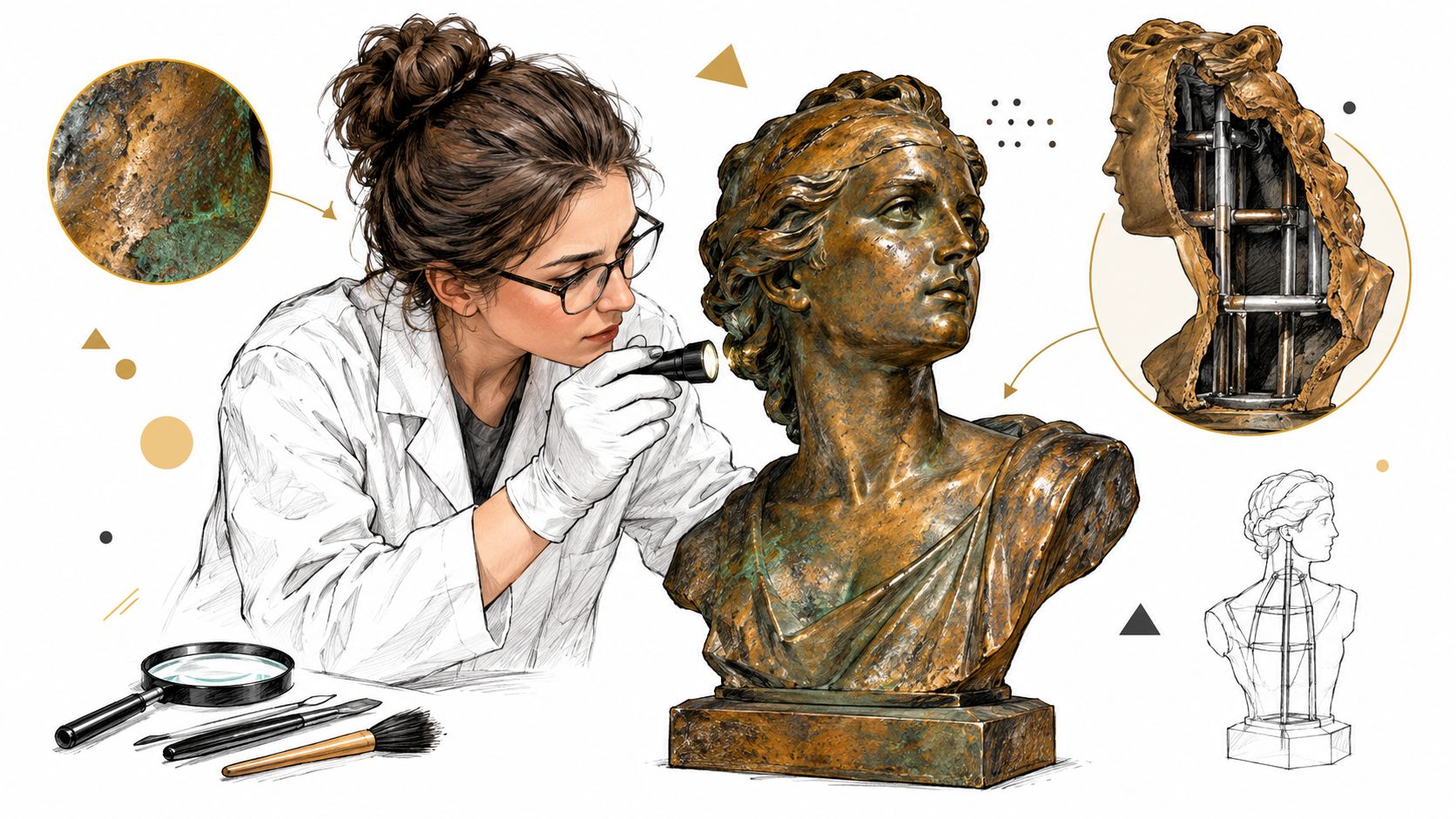
A bronze may look stable under gallery lighting while water sits behind a failed coating or corrodes an unseen armature. Surface colour alone cannot distinguish original patina from later wax, lacquer, paint, dirt, and active corrosion. Examine the object with a strong torch held at a shallow angle. Raking light can reveal blistering, lifting coatings, pitting, scratches, casting irregularities, dents, and changes in sheen that ordinary lighting conceals.
UK guidance for churchyards and burial grounds identifies bronze corrosion through paint blistering, pitted surfaces, missing sections, and rust staining in adjacent masonry. Green deposits require closer assessment. Verdigris is a weathering product that develops over time, but powdery growth around recesses, cracks, or coating failures can indicate active corrosion. Record its location, texture, colour, spread, and relationship to defects before disturbing it. Powdery green growth around recesses can indicate bronze disease. Consult this guide to bronze disease before deciding on treatment. Historic England's guidance on bronze statues explains why the original surface treatment must be identified before cleaning.
Preserve evidence before cleaning
Start by identifying the finish, not by trying to make the sculpture shine. Artificial patina, gilding, paint, and other coatings may form part of the intended appearance. Historic England recommends close inspection and discrete cleaning tests to identify such finishes. Active corrosion may need prompt treatment, while a failing coating can leave the metal exposed to further deterioration.
A degraded lacquer often produces a misleading surface. Instead of protecting the bronze evenly, it can trap or conceal patchy pale brown or green corrosion beneath the film. Removing or disturbing it without photographs and written records can erase evidence of the sculpture's history and remove original material. Abrasive pads, household metal polish, aggressive solvents, and untested acids do not provide a controlled assessment method.
Record the following:
- Surface finish: Note whether the surface appears waxed, lacquered, painted, gilded, artificially patinated, or bare. A consistent colour does not prove a consistent treatment.
- Corrosion pattern: Describe green deposits, powdery areas, pitting, blistering, staining, and active-looking growth around flaws or recesses.
- Physical loss: Record missing sections, thin edges, perforations, dents, and breaks. Photograph each area with a scale where possible.
- Previous intervention: Look for fills, joins, soldering, brazing, resin repairs, replacement components, and mismatched retouching.
- Water routes: Trace marks beneath openings, joints, undersides, and projecting forms where water may enter or remain.
Bronze chemistry continues to matter after the sculpture leaves the studio or gallery. Historic Environment Scotland describes copper-compound deposits, including carbonates and sulphates, that can produce verdigris. Its guidance also recommends regular re-waxing, with marine exposure and pollution increasing the need for maintenance. Historic Environment Scotland's bronze maintenance guidance supports a material-specific care plan rather than occasional dusting.
Investigate what the casing hides
Some bronze sculptures contain an iron armature. Water entering flaws can corrode that concealed iron, causing it to expand and force apart the surrounding bronze. A split, bulge, displaced section, or widening crack may therefore indicate internal failure rather than a simple casting defect. The Historic England war memorial conservation guide identifies rainwater run-off, condensation, pollution streaking, and chloride contamination as environmental factors to investigate alongside the sculpture's construction.
A clean-looking bronze can carry a serious internal problem. The absence of visible corrosion on the main surface does not prove that the armature or concealed fixing is sound.
Selecting a work surface for chemical exposure follows the same logic as selecting a conservation method. Match the material, chemical, and procedure before beginning. Comparisons such as epoxy vs phenolic lab worktops illustrate that principle. Bronze should never be tested with household solvents or acids.
A crack, bulge, loose element, or suspicious stain warrants specialist assessment. Do not inject resin or remove a section yourself. A conservator can determine whether non-invasive examination, endoscopic inspection, or carefully planned opening is justified, while preserving evidence for future treatment.
Reading Stone Weathering and Environmental Damage
A stone sculpture can look sound from across a room while water is weakening its surface, repairs are trapping moisture, or carved details are already disappearing. Assessment starts with the material and its setting, because limestone, marble, sandstone, and granite respond differently to wetting, drying, salts, frost, and pollution.
Record the stone type if it is known, together with the evidence supporting that identification. Examine grain, crystal structure, bedding, inclusions, tool marks, and the boundary between original material and repairs. Do not scrape an inconspicuous area as a test. A conservator may identify the stone from existing losses, broken edges, archival records, or non-invasive examination.
UK heritage survey practice treats the cause and pattern of deterioration as separate observations. Record both, using photographs and diagrams made in even, reliable light. Note where loss occurs, how far it extends, and whether it follows joints, recesses, deposits, repairs, or exposed edges. This record gives a private collector a more reliable baseline than colour alone.
Follow water, not just colour
Water movement often explains damage that first appears to be staining. A projecting ledge can direct moisture down one vertical track. A failed cap or blocked drain may concentrate it at a corner. Sheltered areas can remain damp through condensation, while dark deposits in channels and recesses may conceal granular loss.
Historic England's war memorial guidance groups the main environmental drivers as run-off, condensation, pollution deposits, and chloride attack. Stone responds to each differently from bronze. Moisture can carry contaminants into pores, while repeated wetting and drying, freezing, or salt crystallisation can enlarge existing weaknesses. A repair may also absorb or release water at a different rate from the original stone.
Make the environmental record practical:
- Observe the surroundings: Note roof edges, gutters, downpipes, paving, sprinklers, nearby roads, planting, and any source of salt or splash.
- Compare elevations: A sheltered back may retain deposits, while an exposed front may lose fine carving through repeated exposure and drying.
- Inspect recesses: Folds, lettering, undercuts, and joins may retain moisture long enough to support biological growth or produce granular loss before the broad face looks damaged.
- Check repairs: Hard cement repairs can retain moisture or create a sharp boundary where softer stone erodes around them.
The location of damage matters as much as its appearance. Map drip lines, sheltered zones, biological growth, open joints, and areas where deposits recur after cleaning. These patterns can point to a building defect or installation problem that surface treatment alone will not resolve.
Use legibility as a warning signal
Inscriptions provide a practical indicator of surface loss. Record whether the letters remain readable, whether their edges are shallow or rounded, and whether deposits fill the cuts. A sculpture may retain its overall silhouette while losing historical information from its inscription or fine carving.
Legibility is an observational measure, not a laboratory result. Photograph the inscription square-on, use consistent lighting, and identify the letters or words that are unclear. Later comparisons can show whether the condition is stable, linked to the environment, or worsening.
Cleaning may improve readability, but it can also remove fragile edges or expose porous stone to faster deterioration. Before commissioning stone and marble restoration services, ask how the provider will identify the material, test the proposed method, protect tool marks and surviving finish, and record the surface before and after treatment.
For a further practical reference, guidance on evaluating antique stone statues reinforces the need to distinguish appearance from condition. A cleaner sculpture is not automatically a healthier one. If staining, cracking, surface loss, or dampness has a recurring pattern, investigate the cause before authorising cleaning.
Documenting Findings for Future Care
A condition assessment has little value if its conclusions disappear into a conversation. The record should allow another person to understand what the sculpture looked like, where each defect occurred, what was uncertain, and what changed after handling or treatment.
Collections Trust guidance recommends recording condition before treatment, marking losses or cracks on sketches or diagrams, and consulting a conservator if the object differs from earlier checks or shows structural movement. The Collections Trust procedure for condition checking and technical assessment provides a practical foundation for private collectors as well as institutional teams.

Build a record someone else can use
Start with an object identity page. Include the artist or attribution if known, title or subject, material, dimensions, location, owner, date of inspection, and the name of the person who made the record. Add installation information, including whether the sculpture is indoors, outdoors, wall-mounted, floor-standing, or fixed to a plinth.
Then create a photographic sequence. Use good, even light for overall views and raking light for shallow losses or raised defects. Include the front, back, sides, top, underside where safely accessible, base, inscriptions, joins, repairs, and significant damage. A ruler or scale in close views helps communicate size, while a consistent camera position makes later comparisons more reliable.
Map condition instead of relying on adjectives
Words such as “minor”, “moderate”, and “severe” can mean different things to different readers. Pair them with location and description. Write “small loss to the proper left lower edge” rather than “some damage to the base”. For a bronze, distinguish a stable-looking surface variation from powdery corrosion, lifting coating, or a suspected active area. For stone, distinguish staining from granular disintegration, open cracking, biological growth, and loss of carved detail.
A simple diagram can show the object as elevations or zones. Mark each crack, loss, fill, join, stain, blister, and area of biological growth with a symbol or colour that is explained in a key. Keep the original photographs and diagrams together with invoices, treatment proposals, condition reports, transport records, and correspondence about repairs.
Record first, intervene second. Once cleaning changes the surface, the original evidence may no longer be recoverable.
Describe uncertainty plainly. “Base not visible because sculpture is fixed to plinth” is more useful than leaving the field blank. “Interior armature not inspected” tells the next conservator what remains unknown. A defensible record doesn't pretend to reveal everything. It makes the limits of the inspection visible.
Revisit the object after relocation, severe weather, a change in building conditions, or any treatment. Compare new photographs with the original baseline rather than relying on memory. That practice turns a one-off inspection into a traceable history of care.
Planning Long-Term Maintenance Cycles
Condition assessment should end with decisions, not just descriptions. A stable indoor stone figure may need careful dust control and environmental observation. An outdoor bronze may require attention to its wax or coating, water routes, pollution exposure, and concealed joints. The appropriate routine follows the material and setting, not the collector's preferred schedule.
Historic Environment Scotland's guidance specifies re-waxing bronze at least every five years and notes that harsher conditions, including marine exposure and pollution, increase risk. That doesn't mean every sculpture should receive the same treatment on the same date. It means the maintenance plan must account for exposure and the condition of the existing finish. Guidance on condition-based maintenance can help collectors think in terms of observed condition and planned intervention rather than waiting for visible failure.
Turn observations into actions
A useful care plan links each finding to an owner, action, and review point.
- Structural concern: Restrict handling or display until a conservator assesses the base, fixing, crack, or suspected armature.
- Surface concern: Preserve the current evidence, improve the environment, and obtain a tested treatment proposal before cleaning.
- Environmental concern: Redirect run-off, reduce condensation, review nearby pollution or salt sources, and keep the sculpture away from avoidable splash.
- Documentation concern: Update photographs and diagrams after any movement, repair, coating work, or change in display.
Routine maintenance usually costs less in disruption than emergency stabilisation, but the important advantage is control. Planned work gives the collector time to select a suitable conservator, preserve original finishes, and budget for access, transport, testing, and documentation. A rushed repair often begins after a crack has opened, a coating has failed, or a loose fragment has been lost.
The assessment also belongs in the acquisition decision. If a seller can provide detailed photographs, previous condition reports, treatment records, and clear images of the base, casting details, and patina, you can ask better questions before purchase. If those areas remain undocumented, price and display plans should reflect the uncertainty.
For collectors comparing objects, HD Asian Art provides detailed photographs on product pages and identifies significant wear, damage, or repair in listings. Customers can also request high-resolution images of particular areas, such as a base, casting detail, or patina. Those requests don't replace an independent conservation survey, but they help a buyer establish what can be assessed before committing to a purchase.
The strongest condition report does more than identify faults. It explains how the sculpture can remain stable, legible, and materially honest through future care.
HD Asian Art offers curated Buddhist, Hindu, and Southeast Asian sculptures with condition information, detailed photographs, and high-resolution image requests for specific areas. If you're assessing an antique sculpture before purchase, visit HD Asian Art to examine available pieces and ask focused questions about their bases, surfaces, repairs, and display history.
