



Comment disposer les idoles dans un petit appartement : notre guide
Comment disposer les idoles dans un petit appartement : notre guide
Table des matières
- Commencez par Vastu : la place des idoles dans un petit appartement
- Idées de conception de petites chambres Pooja qui conviennent à de vrais appartements
- La meilleure direction pour un temple à la maison (et que faire lorsque vous ne pouvez pas l'utiliser)
- Une configuration d'autel minimaliste : moins d'encombrement, plus de dévotion
- Choisir des tailles d'idoles adaptées à un petit appartement
- Des moyens économiques et économiques pour organiser les idoles
- Conclusion
- Foire aux questions
Commencez par Vastu : la place des idoles dans un petit appartement
Apprendre à disposer les idoles dans un petit appartement commence par un principe : le placement a autant de poids que les pièces elles-mêmes. Ce guide de HD Asian Art couvre les directives traditionnelles, les solutions de contournement pratiques et les choix de conception qui gardent un coin sacré intentionnel plutôt que bondé.
Vastu Shastra, le système indien classique d'aménagement du territoire, traite la maison comme une carte énergétique, et le coin nord-est jouit d'un statut particulier. De nombreux praticiens la considèrent comme la zone la plus propice pour un mandir ou une zone de prière, car elle est associée à la clarté, à la lumière et à la concentration spirituelle.
Cela dit, un petit appartement vous offre rarement un coin nord-est parfait. Vous travaillez peut-être avec une location, un studio ou un plan d'étage où le mur nord-est est une porte de placard. Vastu propose une orientation, pas un test rigide que vous réussissez ou échouez.
Le coin nord-est et pourquoi c'est important
Le coin nord-est est traditionnellement privilégié car il reçoit la lumière matinale la plus douce dans la plupart des maisons, alignant ainsi votre pratique sur le début tranquille de la journée. S’il n’est pas disponible, les murs est et nord sont les deuxièmes meilleures options. Évitez de placer un autel directement contre le mur d’une salle de bain ou sous un escalier, tous deux considérés comme peu propices dans la pratique traditionnelle.
Dans quelle direction les idoles devraient-elles se tourner ?
Les idoles font traditionnellement face à l’ouest ou à l’est, donc la personne qui prie fait face à la direction opposée. Faire face à l’est est la recommandation la plus courante, car elle aligne le fidèle avec le soleil levant. Dans un appartement compact, cela signifie souvent que l'autel est placé sur le mur ouest, de sorte que vous soyez face à l'est lorsque vous vous tenez devant lui. Si cela est impossible, privilégiez une direction qui vous permet de prier sans tourner le dos à l'entrée principale de la pièce.
Idées de conception de petites chambres Pooja qui conviennent à de vrais appartements
Une salle dédiée au Pooja est un luxe dans la plupart des appartements. L'alternative réalisable est une zone sacrée définie : une étagère, un dessus d'armoire ou un coin utilisé pour rien d'autre. Ce qui a tendance à fonctionner dans des mises en page compactes :
- Une étagère murale au niveau des yeux, assez large pour deux ou trois idoles et une petite diya
- Une niche bibliothèque aménagée, débarrassé de tout sauf des objets de culte
- Un autel armoire rabattable qui se ferme lorsqu'il n'est pas utilisé, utile en studio
- Une console d'angle avec un tabouret bas pour s'asseoir pendant la prière
Le fil conducteur est l’utilisation verticale. Les petits appartements ont plus d'espace mural que d'espace au sol, donc un autel qui s'élève plutôt que de s'étendre donne à la pièce une sensation d'ouverture.
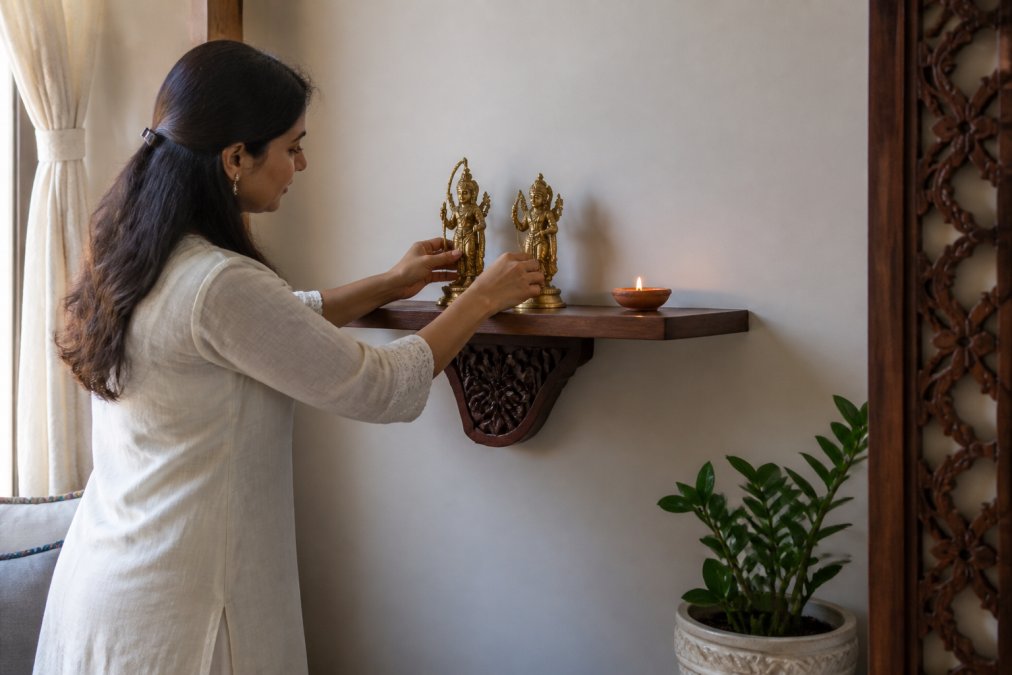
L'intégration de ces figures sacrées dans votre espace de vie nécessite un équilibre délicat entre échelle et poids visuel, tout comme les principes utilisés pour art de style dans les petits appartements pour garantir que chaque élément organisé semble intentionnel plutôt qu’encombré.
La meilleure direction pour un temple à la maison (et que faire lorsque vous ne pouvez pas l'utiliser)
La meilleure direction pour un temple domestique est le coin nord-est, avec les idoles tournées vers l’est ou l’ouest afin que le fidèle fasse face à la direction opposée pendant la prière. C’est la réponse classique, et la plupart des appartements ne peuvent pas l’adapter pleinement. Lorsque la direction idéale est bloquée, la pratique traditionnelle propose des solutions de repli plutôt que des absolus : un mur nord ou est fonctionne, et une armoire dédiée dans n'importe quelle pièce fonctionne si elle est maintenue propre et utilisée uniquement pour le culte. Ce qui compte le plus c'est la cohérence, un endroit fixe traité avec soin bat un coin techniquement parfait réaménagé tous les mois.
Une configuration d'autel minimaliste : moins d'encombrement, plus de dévotion
Une configuration d'autel minimaliste utilise moins d'objets, placés délibérément, de sorte que chacun ait un sens. Le but n’est pas de créer le vide en soi, mais de supprimer tout ce qui rivalise pour attirer l’attention avec la divinité au centre. Commencez par un point focal : une idole ou une image encadrée qui ancre l’arrangement. Un seul diya en laiton, un petit porte-encens et une fleur fraîche suffisent souvent. Les idoles en marbre et en cristal fonctionnent particulièrement bien car leurs surfaces reflètent la lumière sans ajouter de bruit visuel.
Le stockage compte autant que l’affichage. Un tiroir peu profond ou un plateau coulissant sous l'autel permet de garder les allumettes, l'encens et les mèches de rechange hors de vue. Les surfaces sans encombrement sont considérées comme un signe de respect ; une étagère bondée se lit comme un problème de stockage.
Choisir des tailles d'idoles adaptées à un petit appartement
La taille de l'idole doit suivre l'autel, et non l'inverse. Une erreur courante consiste à acheter d'abord une grande statue, puis à rechercher une surface suffisamment grande pour la contenir, alors mesurez l'étagère, le dessus de l'armoire ou la console avant de faire vos achats. Une règle empirique utile : l'idole la plus haute ne doit pas occuper plus d'environ les deux tiers de l'espace vertical entre la surface de l'étagère et l'étagère au-dessus, ou entre la surface et le plafond si l'autel est ouvert. Cela laisse une marge de manœuvre au-dessus de la divinité et empêche l'arrangement de paraître lourd dans un appartement au plafond bas.
Faites correspondre la taille de l'idole à la surface que vous avez réellement
La proportion bat la taille absolue
Quand vous possédez déjà une grande idole
Des moyens économiques et économiques pour organiser les idoles
Bases non permanentes qui supportent réellement le poids
Des astuces DIY qui ne coûtent presque rien
Foyers multiconfessionnels et partagés
Faire correspondre le correctif à la contrainte
| Contrainte | Solution pratique | Compromis |
|---|---|---|
| Aucun perçage autorisé | Étagère ou table d'appoint autoportante | Utilise environ un à deux pieds carrés de surface au sol |
| Chambre très petite | Etagère murale à hauteur des yeux | Nécessite un point d'ancrage ou une bande adhésive nominale |
| Maison partagée ou multiconfessionnelle | Etagère divisée avec zones séparées | Un peu moins de place par tradition |
| Climat humide | Armoire scellée avec des sachets de silice à proximité | Aération périodique de l'espace |
| Budget serré | Etagère en bois d'occasion, nettoyée et huilée | Temps passé à l'approvisionnement et à la finition |
| Déplacements fréquents | Coffret ou paravent recouvert de tissu | Moins de surface d'affichage qu'une étagère fixe |
Une note sur l'humidité et les matériaux
Foire aux questions
Quelle direction les idoles doivent-elles prendre à la maison ?
Placez les idoles face à l'ouest ou à l'est de manière à faire face à l'est ou au nord pendant la prière, ce que Vastu Shastra considère de bon augure. Les idoles elles-mêmes doivent être assises contre un mur du côté nord-est de la pièce, de sorte que votre champ de vision se dirige vers elles depuis le sud-ouest. Dans un petit appartement, le test pratique est simple : placez-vous là où vous allez prier et vérifiez que les idoles sont au niveau des yeux ou légèrement au-dessus et sont clairement visibles.
Combien d’idoles puis-je garder dans un petit appartement ?
Il n’y a pas de nombre fixe, mais un autel compact est plus joli avec une à trois divinités principales. Regroupez une figure centrale avec des assistants plus petits ou une seule diya en laiton pour maintenir l'équilibre visuel. Si vous suivez une tradition multi-divinités, disposez-les en rangées ou en arc de cercle plutôt que de les empiler, et gardez l'idole la plus haute au centre. Des morceaux moins nombreux et bien espacés se lisent comme de la dévotion ; les étagères bondées sont considérées comme du stockage.
Quelle est la taille idéale d’une idole pour un petit appartement ?
Pour la plupart des appartements, les idoles entre 4 et 8 pouces fonctionnent bien sur une étagère ou une console, tandis que 10 à 12 pouces conviennent à un mandir au sol ou à un coin dédié. Adaptez la hauteur à votre autel : l'idole la plus haute doit être placée en dessous du niveau de vos yeux lorsque vous vous levez pour prier. Une figurine en marbre ou en laiton de 12 pouces peut ancrer une petite pièce si elle dispose d'un espace de respiration autour d'elle.
Puis-je installer un petit autel si je loue et que je ne peux pas percer les murs ?
Oui. Utilisez des options autoportantes comme une console en bois, un mandir pliant ou une étagère murale qui ne nécessite aucun matériel. Un plateau coulissant à l'intérieur d'une armoire garde vos essentiels de Pooja cachés entre les prières et disparaît lors de la visite des invités. Les bandes de commande et les poteaux de tension peuvent contenir des étagères légères, et une simple table d'appoint recouverte de tissu fait office d'autel temporaire dans un studio.
HD Asian Art peut vous aider à trouver une pièce maîtresse qui correspond à l'espace dont vous disposez, qu'il s'agisse d'un autel à étagère compacte ou d'un coin de méditation dédié.
Notre collection comprend des statues bouddhistes et hindoues soigneusement sélectionnées, des pièces antiques et contemporaines triées sur le volet, ainsi qu'une spécialisation dans les sculptures khmères et d'Asie du Sud-Est, le tout avec livraison gratuite. Parcourez la collection et trouvez la pièce qui ancre votre sanctuaire.
