



Guide du collectionneur sur les statues de divinités hindoues
Guide du collectionneur sur les statues de divinités hindoues
Vous consultez une annonce provenant d'une salle de vente ou d'un revendeur en ligne au Royaume-Uni. Les photos montrent une rangée de bronzes et de figures en pierre étiquetées « Ganesha », « Shiva », peut-être « divinité indienne ». On a l’air calme et domestique. Un autre se sent cérémonial. Un troisième a tellement d’armes et d’attributs que vous ne savez même pas par où commencer.
Ce moment attire de nombreux primo-accédants. Statues de divinités hindoues ne peut pas être compris par la seule apparence. Un geste de la main, un animal à la base, la forme d'une couronne ou l'objet tenu dans une main peuvent changer complètement l'identité et la signification de la figure. Ce qui semble décoratif dans un catalogue peut être une image de dévotion ayant une fonction religieuse bien spécifique.
Le contexte britannique ajoute une autre couche. Au Royaume-Uni, les sculptures de divinités hindoues se trouvent à la fois dans les maisons, les temples, les salles de ventes aux enchères et les musées. L'exposition du British Museum Ancien Indie: Traditions vivantes affiché plus de 180 objets de sa collection sud-asiatique et des prêts de partenaires, montrant à quel point ces traditions sont visiblement présentées dans la vie publique britannique d'aujourd'hui (Détails de l'exposition du British Museum). Cette visibilité publique façonne la manière dont les collectionneurs apprennent, achètent, placent et prennent soin de ces œuvres.
Table des matières
- Entrer dans le monde des statues de divinités hindoues
- Comprendre le panthéon hindou et ses traditions sculpturales
- Lecture de l'iconographie des statues de divinités hindoues
- Matériaux utilisés pour sculpter et couler des statues de divinités hindoues
- Styles régionaux et savoir-faire en Asie
- Choisir une statue de divinité hindoue pour votre espace
- Provenance, soins et placement au Royaume-Uni
- Rassembler tout cela en tant que collectionneur ou dévot
Entrer dans le monde des statues de divinités hindoues
Un nouveau collectionneur commence souvent par son instinct. Vous voyez un bronze à l'équilibre élégant, ou un Ganesha en pierre avec une surface usée qui suggère l'âge, et vous y réagissez comme une sculpture. C’est un début judicieux, mais cela ne suffit pas à lui seul.
En pratique, la première question utile n’est pas « Est-ce que j’aime ça ? mais "Qu'est-ce que je regarde?" Une figure assise à tête d'éléphant peut être Ganesha, mais même dans ce cas, les détails comptent. L'image est-elle destinée à la dévotion à la maison, au rituel du temple ou à une exposition décorative ultérieure ? La pièce est-elle moulée dans un idiome du sud de l’Inde ou sculptée dans un style façonné ailleurs en Asie ? Une figure cataloguée comme Shiva peut apparaître comme un ascète, un chef de famille ou un danseur cosmique.
Pourquoi de simples étiquettes induisent en erreur
Les descriptions d’enchères aplatissent souvent le sens. « Bronze Shiva » peut cacher une forme spécifique telle que Nataraja. « Parvati » peut faire référence à une déesse mieux décrite dans une autre tradition régionale sous le nom d'Uma. Ce ne sont pas de petites différences. Ils affectent la façon dont vous identifiez l’objet, dont vous le comparez avec des exemples de musée et avec quel respect vous l’exposez chez vous.
Une habitude utile d'un collectionneur est de faire une pause avant d'acheter et d'identifier d'abord trois choses : la divinité, la forme et la fonction probable.
Le monde des musées britanniques offre un terrain d’entraînement pratique à cette façon de voir. L'Ashmolean note que son Indie et les avoirs en Asie du Sud-Est sont particulièrement solides dans Sculptures hindoues, bouddhistes et jaïns en pierre, terre cuite et bronze (Présentation de la collection Ashmolean). Ce type d’étiquetage institutionnel aide un débutant à faire la différence entre une catégorie matérielle, une identité religieuse et un type sculptural.
Le contexte britannique change les questions
Les collectionneurs britanniques sont également confrontés à des questions qui n'apparaissent pas toujours dans les conseils plus larges sur le marché de l'art. Une statue peut-elle être dévotionnelle dans un petit appartement ? Comment devrait-il être placé dans un foyer mixte ? Si une pièce est plus ancienne, à quelle provenance devez-vous vous attendre ? Ces questions deviennent plus urgentes si l’on se souvient que les statues de divinités hindoues détenues au Royaume-Uni vont des œuvres médiévales aux acquisitions de l’époque impériale.
Comprendre le panthéon hindou et ses traditions sculpturales
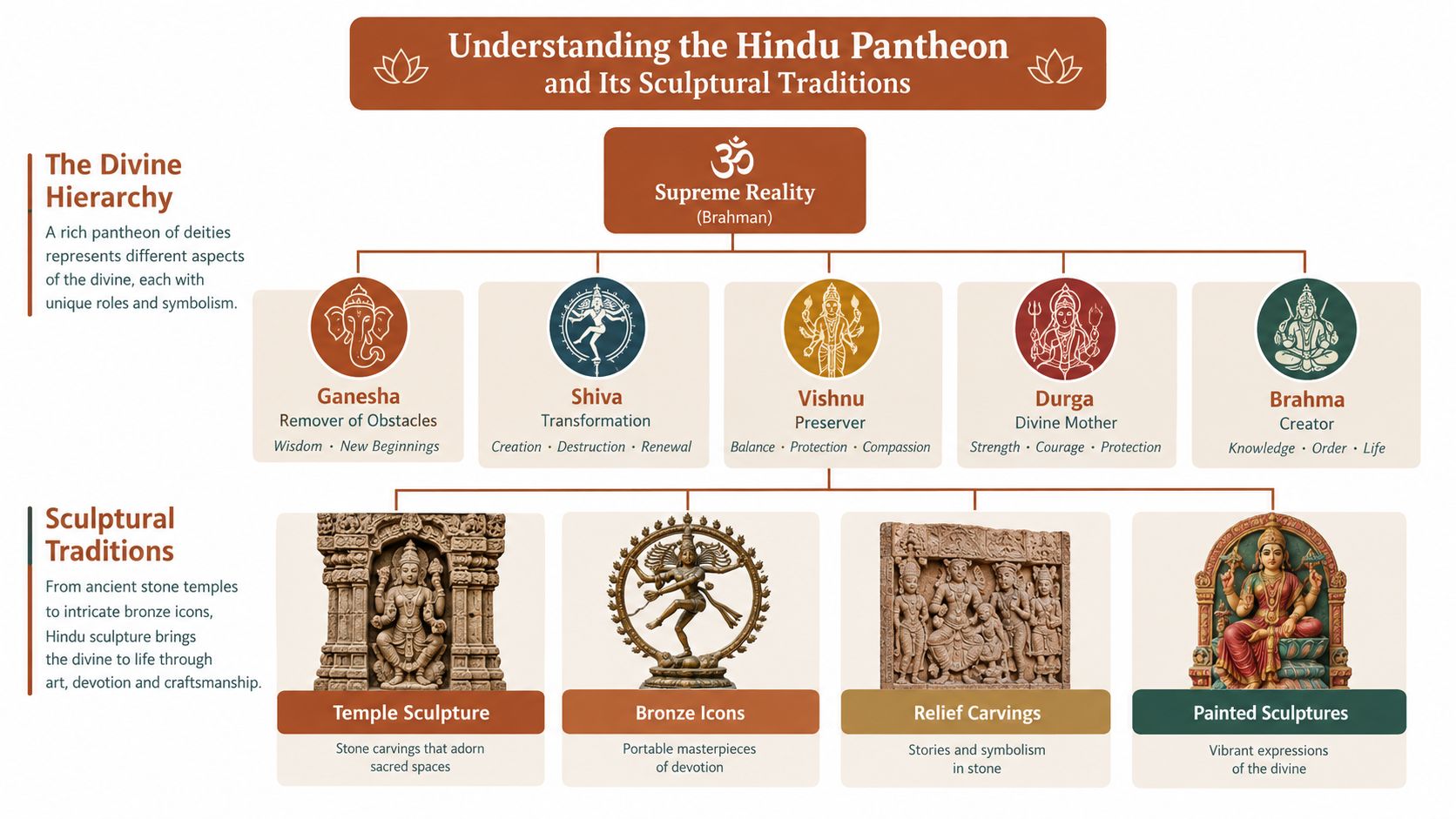
Avant de juger de la qualité ou de l’âge, il est utile de comprendre le cadre religieux derrière la sculpture. Dans la pratique hindoue, un murti n’est pas simplement une image au sens occidental du terme. Il peut être abordé comme une incarnation matérielle à travers laquelle le divin est adoré. C'est pourquoi un même objet peut être traité de manière très différente dans une galerie, un temple et une demeure privée.
Les principales familles de divinités
Les nouveaux collectionneurs entendent souvent parler du Trimurti d'abord. Cela fait référence à Brahma, Vishnu et Shiva. C'est utile, mais trop étroit si vous vous arrêtez là. La plupart des personnages les plus collectés et vénérés au Royaume-Uni sont Ganesha, Lakshmi, Durga, Krishna, Hanuman et des formes de Devi.
Voici la structure de travail la plus simple :
- Famille Shiva comprend Shiva, Parvati ou Uma, Ganesha et Karttikeya ou Murugan.
- Famille Vishnu comprend Vishnu et ses avatars tels que Krishna et Rama, avec Lakshmi étroitement associé.
- Traditions Devi inclure Durga, Kali, Parvati, Lakshmi et Saraswati dans différents rôles théologiques.
- Favoris de dévotion comme Hanuman apparaissent souvent dans les sanctuaires domestiques, indépendamment des strictes frontières sectaires.
Si vous souhaitez une orientation rapide sur les conventions de dénomination, ce guide pour Noms des dieux hindous est un compagnon pratique des catalogues de musées.
Pourquoi les noms changent selon les régions
Le langage des catalogues peut dérouter les débutants car une divinité peut apparaître sous plusieurs noms. Un bronze du sud de l'Inde identifié comme Ouma peut appartenir à la même identité de déesse plus large qu'un autre catalogue appelle Parvati. Krishna peut apparaître comme un enfant, un joueur de flûte ou un avatar princier. Shiva peut être nommé pour son action ou sa pose plutôt que par son simple nom seul.
C’est important car le style suit autant la région que la religion. Une déesse de pierre du nord de l'Inde peut avoir une silhouette très différente d'une déesse de bronze du sud de l'Inde, même lorsque les deux appartiennent à la même famille divine.
Les bases de données des musées récompensent la patience. Recherchez les noms alternatifs de la divinité, pas seulement la première étiquette que vous connaissez.
Utiliser les musées britanniques comme outils d’étude
Les musées britanniques ne se contentent pas de conserver ces œuvres. Ils enseignent également l’alphabétisation visuelle. Le British Museum regroupe le matériel sud-asiatique de manière à aider les lecteurs à relier les rituels, l'histoire et la tradition artistique. Le V&A fait quelque chose de similaire à travers l’interprétation des galeries et les enregistrements d’objets, en particulier lorsqu’il compare l’art sacré à l’histoire du design. Pour un collectionneur, ces catalogues visent moins à mémoriser des faits qu’à apprendre comment les institutions distinguent les divinités, les matériaux, les dates et les régions.
Lecture de l'iconographie des statues de divinités hindoues
Le moyen le plus rapide de se familiariser avec les statues de divinités hindoues est d’apprendre leur grammaire visuelle. L'iconographie semble technique, mais cela nécessite de lire les indices intégrés à la sculpture.
Commencez par les mains et ce qu'elles tiennent
Un attribut dans la main donne souvent l'identification la plus claire. Shiva peut tenir un trident. Vishnu est étroitement associé au disque. Lakshmi porte ou se tient généralement avec le lotus. La défense cassée, le bol de bonbons ou l'aiguillon d'éléphant de Ganesha peuvent aider à séparer une forme d'une autre.
Plusieurs bras ne signifient pas que le sculpteur était fantaisiste. Ils signalent des pouvoirs et des capacités au-delà de la forme humaine ordinaire. Plusieurs têtes peuvent indiquer l’omniscience, la multiplicité ou des aspects théologiques distincts.
Voici un tableau de référence rapide.
| Indice | Signification typique | Exemple de divinité |
|---|---|---|
| Trident | Pouvoir, force ascétique, identité Shiva | Shiva |
| Discus | Ordre divin, protection, identité Vishnu | Vishnu |
| Lotus | Pureté, bon augure, abondance | Lakshmi |
| Tête d'éléphant | Sagesse, seuils, suppression des obstacles | Ganesh |
| Masse | Force et autorité | Vishnu ou Hanuman sous certaines formes |
| Monture Lion | Pouvoir royal et énergie de la déesse martiale | Durga |
| Véhicule taureau | L'association de Shiva avec Nandi | Shiva |
| Caractéristiques du singe | Dévotion, service, force | Hanuman |
Une liste de contrôle d'attributs plus détaillée peut être trouvée dans cette liste de Attributs et symboles des divinités hindoues.
Lire le langage corporel
Les mains communiquent également à travers mudras, ou des gestes rituels. Deux des plus courants sont :
- Abhaya mudra suggère le réconfort ou la protection.
- Mudra Varada suggère de donner, de bénir ou de générosité.
La posture compte tout autant. Une divinité debout dans une courbe élégante peut projeter la grâce et l'équilibre divin. Une forme dansante crée une énergie très différente d’une forme méditative assise. Les couronnes, les bijoux et les proportions du corps vous aident également à distinguer une divinité royale d'une divinité ascétique.
Faites correspondre les indices, ne les isolez pas
Un collectionneur peut se tromper en se concentrant sur un seul détail. Un lotus à lui seul ne prouve pas automatiquement Lakshmi. Il doit être lu avec la posture, les figures associées, les gestes et le contexte général. La même chose s'applique à Shiva. Une figure debout avec des cheveux emmêlés, un trident et une référence à un taureau pointe dans un sens. Un anneau de flammes autour d'une silhouette dansante indique très clairement Nataraja, Shiva en tant que Seigneur de la Danse.
N'identifiez pas une statue à partir d'un seul symbole. Construisez le dossier à partir de plusieurs indices qui concordent les uns avec les autres.
Cette habitude est particulièrement importante lorsque les catalogues sont minces ou que les anciennes étiquettes sont imprécises.
Matériaux utilisés pour sculpter et couler des statues de divinités hindoues
Le matériel n’est jamais qu’une simple note technique. Il façonne l’apparence, l’utilisation rituelle, la durabilité et le type de soin dont une pièce a besoin dans une maison britannique.
Bronze et laiton
Pour de nombreux collectionneurs, le bronze est le matériau qui définit en premier lieu la sculpture sacrée indienne. Le bronze permet des détails nets, des silhouettes équilibrées et des surfaces qui récompensent une observation attentive. Dans la pratique muséale britannique, le bronze est également traité avec prudence. Les directives de conservation liées aux collections des musées britanniques indiquent que la corrosion du bronze est provoquée par l'humidité de l'air, c'est pourquoi les bronzes sont souvent conservés dans des vitrines scellées ou déshumidifiées pour ralentir les dommages et préserver les couches superficielles telles que la dorure, la peinture ou les résidus rituels (thèse de conservation sur l'entretien du bronze).
Le laiton est souvent rencontré dans les pièces de dévotion ultérieures à usage domestique. Il peut être visuellement chaleureux et pratique pour une manipulation quotidienne, mais il mérite néanmoins des soins doux.
Pierre, bois, terre cuite et marbre
La pierre porte une logique sculpturale différente. Le granit, le grès, le schiste et le marbre vieillissent tous différemment. Les bords s'adoucissent, le polissage change et les vieux éclats vous en disent souvent autant que les détails de la face avant. La pierre a également tendance à exiger une étagère ou un socle plus sécurisé, en particulier dans les petits intérieurs britanniques.
Le bois a de la chaleur et de l'intimité. Il réagit également plus visiblement aux variations d'humidité et au chauffage central. La terre cuite a souvent un caractère folklorique ou régional et peut être plus vulnérable aux chocs. Le marbre apporte luminosité et clarté, mais peut présenter rapidement des taches ou une usure de surface s'il est mal manipulé.
| Matériel | Origine typique | Caractéristiques visuelles | Remarque d'entretien |
|---|---|---|---|
| Bronze | Fortement associé à la sculpture rituelle sud-asiatique | Forme dense, détail moulé, patine sombre ou variée | Conserver à l'abri de l'humidité et éviter les nettoyages abrasifs |
| Laiton | Commun dans les figures de dévotion domestiques | Ton doré, reflets brillants, finition décorative | Dépoussiérez doucement et évitez de trop polir |
| Pierre | Trouvé dans de nombreuses traditions régionales | Poids, profondeur sculptée, bords patinés | Utilisez un support stable et évitez les impacts |
| Bois | Commun dans certains contextes régionaux et de sanctuaires | Grain chaud, masse visuelle plus légère | Protéger de la sécheresse, de l'humidité et du soleil direct |
| Terre cuite | Traditions folkloriques et régionales | Couleur terreuse, surface poreuse | Manipuler avec précaution et garder au sec |
| Marbre | Cadres de dévotion domestiques et formels | Surface pâle, sculpture nette | Évitez les taches et les produits agressifs |
Ce que les collections de musée enseignent
L'accent mis par l'Ashmolean sur la pierre, la terre cuite et le bronze est utile car il reflète les véritables catégories de collectionneurs en Grande-Bretagne. Apprenez à vous demander ce que le médium permet au sculpteur de faire. Le bronze privilégie la fluidité. La pierre privilégie la masse sculptée. Le bois récompense l’intimité de surface.
Styles régionaux et savoir-faire en Asie
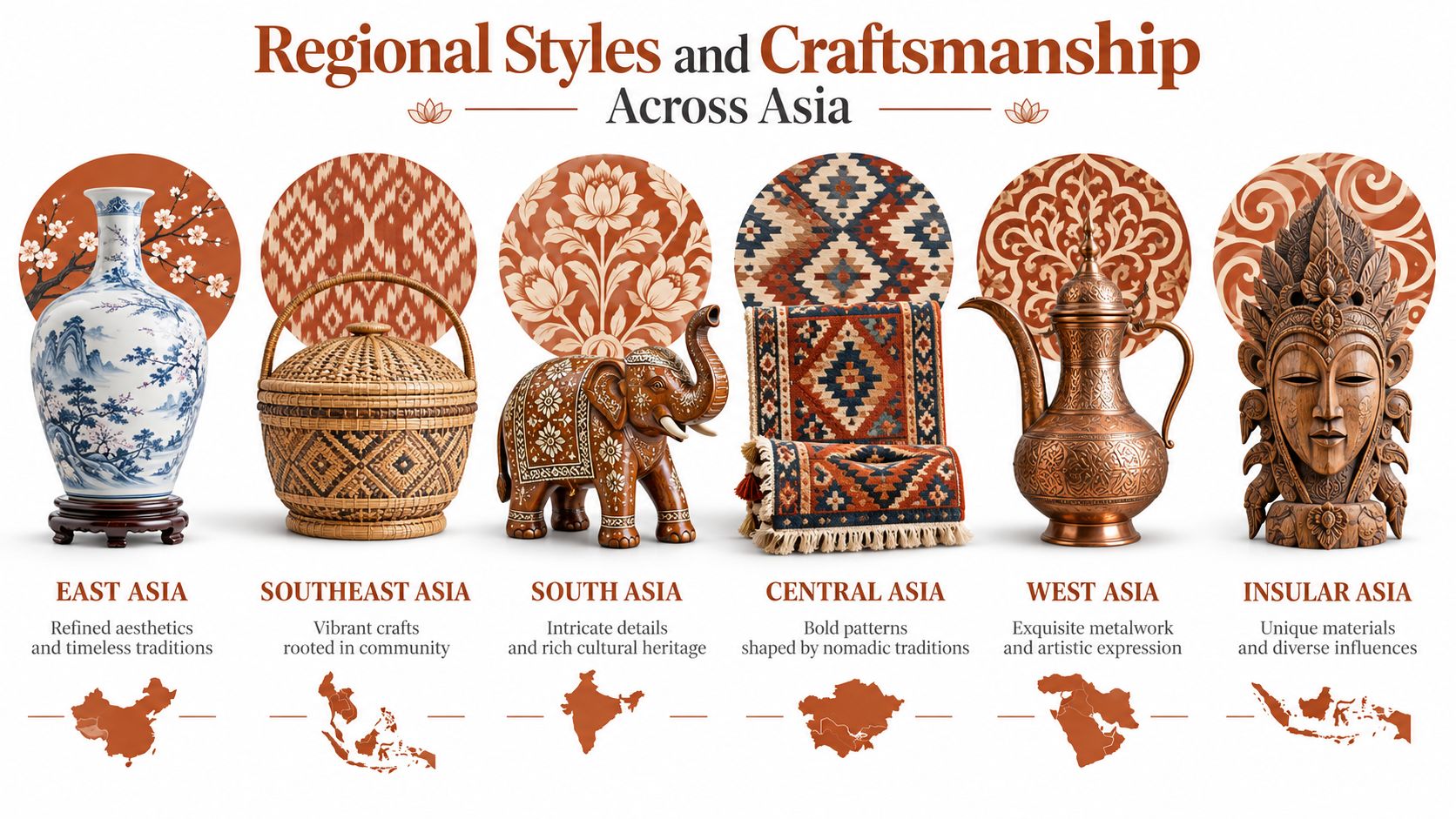
Une statue de divinité hindoue ne vous indique pas seulement quel dieu ou quelle déesse est représenté. Il vous indique souvent où un langage sculptural s'est développé et comment les artisans de cette région ont résolu la forme, l'équilibre et l'ornement.
Traditions du bronze du sud de l'Inde
Les bronzes du sud de l'Inde sont souvent la référence par rapport à laquelle de nombreux collectionneurs apprennent pour la première fois le raffinement. Un exemple documenté au Royaume-Uni est celui du British Museum. Thanjavur Shiva bronze, qui est entré dans la collection en 1970 et est identifié par le musée comme une sculpture en bronze du dieu hindou Śiva (Registre d'objet du British Museum). Dans cette tradition, le rythme compte. Les personnages peuvent se tenir sous une influence contrôlée, avec des membres et des ornements disposés pour donner l'impression d'être vivants plutôt que statiques.
La leçon pour un collectionneur est simple. Ne jugez pas uniquement sur les détails. Jugez par l’équilibre, la silhouette et la façon dont la figure occupe naturellement l’espace.
La sculpture sur pierre au-delà Indie
Les styles régionaux en Asie préservent souvent l’iconographie indienne tout en la remodelant. Les traditions khmères et associées peuvent donner à un Vishnu une impression plus architecturale en termes de masse et de lignes. Les œuvres de l'Inde orientale peuvent privilégier la pierre sombre et les contours sinueux. La sculpture népalaise pousse souvent l'ornement à un niveau plus élevé, avec des éléments de charpente denses et une surface plus stratifiée.
Recherchez les décisions du décideur
On apprend souvent plus de l’artisanat que des étiquettes :
- Finition superficielle peut montrer si une œuvre était destinée à un contact rituel répété ou à un affichage principalement visuel.
- Marques d'outils peut révéler si la sculpture était destinée au polissage ou à une articulation décorative plus nette.
- Proportion aide à distinguer un mode classique calme d’un idiome plus intense ou localisé.
- Densité d'ornement signale souvent le goût régional autant que la date.
Le style n’est pas une décoration ajoutée par dessus. C'est la façon dont le sculpteur organise le sens sacré sous une forme matérielle.
Plus vous comparez d’exemples, moins vous risquez de confondre région et âge ou ornement et qualité.
Choisir une statue de divinité hindoue pour votre espace
En Grande-Bretagne, un acheteur prend souvent cette décision dans une pièce très ordinaire. Le décor possible est une étagère dans un appartement londonien, une alcôve avec cheminée sur une terrasse victorienne ou un coin bureau tranquille à Manchester. La question n’est pas seulement de savoir quelle silhouette est la plus belle. Il s'agit de savoir quel type de présence vous souhaitez dans cet espace et si la statue sera traitée comme une œuvre d'art, un objet de dévotion, ou les deux.
Cette première distinction façonne tout ce qui suit.
Commencez par l'utilisation, puis évoluez
Une statue de divinité pour la puja quotidienne demande plus à son décor qu'une sculpture choisie principalement pour être exposée. Les directives britanniques sur le culte hindou indiquent qu'un sanctuaire domestique peut être une pièce séparée, un petit autel ou des images et des statues disposées pour la dévotion, tandis que le Aperçu de la BBC sur le culte hindou décrit le murti comme le centre du culte et mentionne des offrandes telles que la lumière, la nourriture et les cloches. En termes pratiques, cela signifie qu’une image de culte a besoin d’espace autour d’elle pour l’attention, le nettoyage et les offrandes. Une pièce d’exposition peut vivre plus confortablement dans un aménagement intérieur plus large.
Les collectionneurs comprennent souvent cela à l’envers. Ils commencent par les dimensions, puis demandent quelle divinité conviendra. Une meilleure méthode consiste à choisir d’abord le rôle, puis l’échelle qui le prend en charge.
Un petit Krishna sur une étagère dédiée peut sembler plus cohérent qu'un grand Shiva placé là où personne ne peut s'asseoir, faire une pause ou s'approcher de lui avec respect.
Faites correspondre la divinité à la fonction de la pièce
Les divinités portent différentes associations, et ces associations peuvent guider le placement sans transformer le processus en superstition. Ganesha convient aux seuils, aux études et aux lieux liés aux débuts ou à l'apprentissage. Lakshmi est souvent choisi pour une salle de réception ou un sanctuaire particulièrement propre et ordonné. Shiva, en particulier sous forme méditative, fonctionne mieux là où le bruit visuel est faible. Hanuman se sent souvent chez lui près d’une entrée ou dans un bureau car son iconographie parle de discipline, de protection et de service.
Les expositions dans les musées peuvent aider à entraîner l'œil ici. Au British Museum, à l'Ashmolean ou au V&A, les objets sont rarement placés au hasard. Les conservateurs prennent en compte les lignes de visibilité, les objets environnants et l'ambiance créée par l'échelle et l'espacement. Un environnement domestique bénéficie de la même discipline, même si l’espace disponible n’est large que d’une étagère.
Un guide pratique pour des choix communs
| Divinité | Raison courante pour le choisir | Médium qui convient à de nombreux foyers | Un placement qui fonctionne généralement bien |
|---|---|---|---|
| Ganesh | Débuts, étude, seuils | Laiton, bronze ou pierre | Table d'entrée, étagère d'étude ou autel de maison |
| Shiva | Méditation, concentration sur l'intérieur, transformation | Bronze ou pierre | Bureau calme, coin sanctuaire ou salle de méditation |
| Vishnu | Stabilité, ordre, préservation | Bronze ou pierre | Autel du salon ou étagère de dévotion formelle |
| Lakshmi | Bon augure, prospérité, grâce domestique | Laiton, bronze, marbre | Nettoyer l'autel, la salle de réception ou la zone d'exposition du festival |
| Durga | Protection, force, résolution | Bronze ou pierre | Sanctuaire dédié ou étagère sacrée clairement définie |
| Krishna | Dévotion, musique, affection | Bronze, marbre, métal peint | Autel de la maison, salon ou espace de musique |
| Hanuman | Courage, service, protection | Laiton, bronze, pierre | Bureau, étagère adjacente à l'entrée ou sanctuaire |
Utilisez ce tableau comme point de départ et non comme livre de règles. Une tradition familiale peut placer Krishna dans la zone de prière principale, tandis qu'un autre foyer peut garder un petit Ganesha dans l'espace d'étude d'un enfant pour une bénédiction éducative. Les deux choix peuvent être judicieux si le cadre reflète l’intention.
Placement dans des maisons britanniques modernes
De nombreux acheteurs britanniques vivent sans salle de puja séparée, le placement doit donc être réaliste. Gardez une image de dévotion au-dessus du niveau du sol. Donnez-lui une surface propre. Gardez-le loin des chaussures, des piles de linge et des salles de bain. Si la figure est vénérée, évitez de la mélanger avec désinvolture avec des ornements sans rapport, des souvenirs fantaisie ou du fouillis de stockage.
Les conseils Vastu sont souvent répétés sous une forme simplifiée en ligne, mais le principe utile est simple. L’ordre soutient l’attention. Dans un appartement compact, une étagère soigneusement entretenue avec un tissu, de la place pour une lampe et une séparation visuelle des objets du quotidien seront généralement plus utiles qu'une grande statue coincée dans un coin inadapté.
La hauteur compte aussi. Un spectateur assis doit pouvoir rencontrer l’image confortablement, en particulier dans le cadre d’un sanctuaire. Si la statue est purement sculpturale, la ligne de vue compte plus que l'accessibilité rituelle, donc une niche ou une cheminée peuvent bien fonctionner.
Posez trois questions avant d'acheter
Avant de choisir, réfléchissez à trois questions pratiques.
Cette image sera-t-elle vénérée, admirée, ou les deux ?
La pièce soutient-elle l’ambiance associée à la divinité ?
Pouvez-vous entretenir correctement le matériau à cet endroit, en particulier dans une maison britannique où l'humidité, la chaleur des radiateurs et la suie des cheminées peuvent toutes affecter le métal ou la pierre au fil du temps ?
Ces questions conduisent généralement à de meilleures décisions que le seul style. Une statue de divinité bien choisie doit se sentir bien installée dans son environnement, de la même manière qu'un objet soigneusement placé dans une galerie de musée semble inévitable une fois que vous l'y voyez.
Provenance, soins et placement au Royaume-Uni
Une statue peut être belle, correctement identifiée, mais néanmoins problématique à l'achat. C’est dans la provenance que la collection devient sérieuse.
Ce que signifie la provenance en termes réels
Pour un acheteur britannique, la provenance est l’historique documenté de la propriété et du mouvement de l’objet. Cela peut inclure des factures, des étiquettes de collection, des documents d’exportation, un historique de publication ou des photographies plus anciennes. Sans cette chaîne, l’âge et la qualité ne suffiront pas à répondre à la question éthique.
La question n'est pas abstraite. Le British Museum déclare que certains objets de sa collection sont sujets à des questions de retour, et sa discussion sur les objets contestés montre clairement que les collections de musées s'inscrivent dans des débats actifs sur la propriété et la restitution (British Museum sur les objets contestés). Son histoire de collecte de Tantra fait également état d'une série de sculptures de dieux et de déesses hindous rassemblées dans le 18ème siècle par le major-général Charles Stuart de l'Est Indie L'armée de la compagnie, un rappel direct que la sculpture de divinités hindoues est entrée dans les collections britanniques par les canaux de l'époque coloniale (Le British Museum Tantra collecte des histoires).
Pour les acheteurs privés, cela signifie que vous devez demander les documents le plus tôt possible. Un point de départ pratique est de comprendre les bases de recherche de provenance pour la sculpture antique asiatique.
Soins quotidiens dans des conditions britanniques
Une fois qu’une pièce est à la maison, l’environnement compte. Le chauffage central, la condensation et une humidité ambiante inégale peuvent tous affecter les vieux matériaux.
Une base de référence solide ressemble à ceci :
- Pour le bronze et le laiton utilisez un chiffon doux et sec. N'utilisez pas de vernis chimiques sur les vieilles surfaces patinées.
- Pour la pierre supportez correctement le poids et vérifiez la stabilité des étagères.
- Pour le bois et la terre cuite évitez les radiateurs, les coins humides et la lumière directe du soleil.
- Pour les images de dévotion séparez le dépoussiérage de routine du nettoyage rituel et ne présumez pas que toutes les vieilles surfaces veulent être rendues brillantes.
Règle pratique : Si vous ne savez pas si une surface est originale, vieillie, rituellement accumulée ou récemment polie, laissez-la tranquille jusqu'à ce qu'un restaurateur ou un spécialiste expérimenté l'ait vue.
Les collectionneurs britanniques qui ont besoin de conseils sur l'état peuvent se tourner vers les services d'enquête sur la conservation des musées ou vers des restaurateurs indépendants accrédités. Pour les pièces de plus grande valeur, un rapport d’état professionnel et une assurance appropriée sont judicieux, mais pas excessifs.
Placement respectueux à domicile
Un cadre respectueux ne nécessite pas une grande maison. Cela nécessite une intention. Gardez les statues de dévotion propres, droites et visiblement entretenues. Si l’œuvre est destinée au culte, de nombreuses personnes préfèrent un autel stable ou une étagère à la hauteur des yeux. S'il s'agit avant tout d'un objet d'art, il mérite néanmoins un placement qui reconnaisse son sujet sacré.
Rassembler tout cela en tant que collectionneur ou dévot
Une bonne collection commence par une recherche plus lente. Une fois que vous pouvez identifier la divinité, lire les principaux signes iconographiques et reconnaître le matériau, une entrée de catalogue devient beaucoup plus facile à tester. Vous arrêtez d’acheter uniquement avec l’œil et commencez à acheter avec jugement.
Trois décisions comptent le plus. Tout d’abord, choisissez une divinité dont la forme correspond à votre objectif dévotionnel ou esthétique. Deuxièmement, choisissez un style moyen et régional qui convient à votre pièce, à votre budget et au niveau de soins que vous pouvez raisonnablement apporter. Troisièmement, vérifiez la provenance et l’état avant que l’argent ne change de mains.
Développer des connaissances en personne
Les musées britanniques restent l’une des meilleures salles de classe pour ce sujet. Les expositions publiques du British Museum montrent comment la sculpture hindoue s'inscrit dans l'histoire plus large de l'Asie du Sud. Un reportage de la BBC sur le Musée d'Oxford décrit un Statue de Ganesha vieille de 800 ans prêté par le British Museum comme pièce maîtresse d'une exposition locale, qui est un exemple frappant de la façon dont les divinités hindoues nommées circulent dans l'exposition institutionnelle britannique (Reportage de la BBC sur l'écran d'Oxford).
Ce genre de rencontre vous aide à remarquer l'échelle, la surface et la présence d'une manière que les photographies ne peuvent pas.
Collectez avec concentration
Un petit groupe réfléchi d’œuvres enseigne généralement plus qu’un assortiment dispersé. Tenez un journal d’acquisition simple. Enregistrez la divinité, le matériau, l'origine probable, le vendeur et la date d'achat. Si l’image est dévotionnelle, notez comment vous comptez l’héberger et en prendre soin. S'il s'agit d'une collection d'œuvres d'art, enregistrez la trace de provenance avec le même soin.
Les statues de divinités hindoues peuvent être magnifiquement installées dans un appartement londonien, sur une terrasse de banlieue ou dans une salle dédiée au sanctuaire. Ce qui compte c'est que vous les traitiez comme les deux objets culturels et images sacrées, car dans de nombreux cas, ils sont les deux à la fois.
Si vous comparez les formes, les matériaux et les styles régionaux, HD Asian Art propose une sélection de statues hindoues basée au Royaume-Uni ainsi que des ressources pédagogiques qui peuvent vous aider à identifier les divinités et à réfléchir à leur placement. C'est un endroit pratique pour parcourir des personnages nommés tels que Shiva, Vishnu, Ganesha, Lakshmi, Durga, Krishna, Hanuman et Parvati tout en appliquant les principes de collecte que vous venez de lire.
