



Statue de Durga : origines, iconographie et conseils de collection
Statue de Durga : origines, iconographie et conseils de collection
La plupart des gens rencontrant un Statue de Durga pour la première fois, voyez une femme à plusieurs bras montée sur un lion et supposez que l'imagerie est décorative. Ce n'est pas. Chaque arme qu'elle tient, chaque position de ses mains qu'elle affiche et chaque créature sous ses pieds code une déclaration théologique spécifique sur la nature du pouvoir divin dans la pensée hindoue.
Si vous collectionnez sérieusement des statues de déesses hindoues ou si vous sélectionnez une pièce pour un autel de maison, comprenez que le langage iconographique est ce qui sépare une acquisition significative d'un ornement coûteux. Ce guide couvre les origines de Durga, ses attributs sous forme sculpturale, les différences de style régional à travers l'Asie et les décisions pratiques qui comptent lors de votre achat.
Table des matières
- Points à retenir
- Les origines de Durga : une déesse forgée dans la crise
- Lecture de l'iconographie de Durga : les armes, les armes et la monture
- Mahishasuramardini : Le récit central de la sculpture Devi
- Styles régionaux à travers l'Asie : du bronze Chola à la pierre khmère
- Comparaison des matériaux et des traditions de la statue de Durga
- Collectionner des statues de Durga : ce qui compte réellement
- Construire une collection cohérente de déesses hindoues
- Foire aux questions
- Références
Points à retenir
|
Aperçu clé |
Explication |
|---|---|
|
Le nom de Durga signifie « fort » ou « forteresse invincible ». |
Sa racine sanscrite signale sa fonction théologique en tant que frontière infranchissable entre l'ordre cosmique et le chaos, et non simplement en tant que figure martiale. |
|
Chaque arme qu'elle détient a été offerte par une divinité masculine |
Le trident vient de Shiva, le disque de Vishnu, etc. Une statue dépourvue d'armes clés représente une forme régionale spécifique ou est iconographiquement incomplète. |
|
Le nombre d’armes signale la tradition, pas l’exhaustivité |
Les formes Durga à quatre, huit et dix bras sont toutes canoniques. Moins d’armes ne signifie pas une pièce moindre ou endommagée ; cela signifie une tradition textuelle ou régionale différente. |
|
La monture lion ou tigre n'est jamais une décoration interchangeable |
Le vahana prédateur signale une énergie divine active et martiale. Cela marque immédiatement Durga comme une déesse du combat et de la protection, la distinguant d'un seul coup d'œil de Saraswati ou de Lakshmi. |
|
Son expression faciale est le test le plus important du savoir-faire |
Un sculpteur talentueux restitue le visage de Durga dans une sérénité absolue, même en pleine bataille. Si la sérénité se lit sans autre contexte, l'artisan a compris la tradition. |
|
Les bronzes Chola établissent la référence technique pour la sculpture Devi |
Les bronzes du sud de l'Inde coulés à la cire perdue restent la référence en matière de qualité de ce matériau. La posture tribhanga leur donne un mouvement dynamique même dans un objet statique. |
|
Le style régional est un indicateur principal de la provenance et de la période |
La pierre du nord de l'Inde, le bronze du sud de l'Inde, la procession bengali, la ferronnerie népalaise et la pierre khmère diffèrent toutes de manière significative. Les traiter comme une seule catégorie passe à côté de la partie la plus intéressante du domaine. |
Les origines de Durga : une déesse forgée dans la crise
Durga n'est pas une divinité née pour le pouvoir. Elle a été créée en réponse directe à une crise qu’aucune divinité du panthéon hindou ne pouvait résoudre seule. Lorsque les dieux mâles ne purent vaincre le démon buffle déchaîné Mahisha, ils unirent leurs forces combinées et créèrent la déesse guerrière Durga. Chaque dieu lui donna alors sa propre arme, et elle seule put tuer le démon après une gigantesque bataille. Cette histoire d’origine est à la base de tout ce qui suit dans l’iconographie de Durga.
Cette origine explique pourquoi sa forme iconographique est si délibérément composite. Elle porte simultanément les armes de Shiva, Vishnu, Indra, Yama et d'autres, ce qui en fait la seule divinité de la tradition qui concentre tout cet arsenal en une seule figure. Dans le shaktisme, l'une des traditions majeures de l'hindouisme, Durga est considérée comme une forme de l'être suprême, Para Brahman, non seulement une divinité puissante mais la réalité ultime elle-même. Cette position théologique l’élève bien au-dessus de l’étiquette de « déesse guerrière », ce qui, bien qu’exact, sous-estime considérablement sa profondeur.
Les preuves du culte de la déesse mère dans le sous-continent indien remontent à la civilisation de la vallée de l'Indus, avec des indications archéologiques d'une telle pratique datées d'environ 3 500 à 1 500 avant JC. La forme Devi connue aujourd’hui n’est pas apparue d’un seul coup. Il s'est développé au fil des siècles, absorbant les anciennes traditions des déesses et se consolidant progressivement dans le standard iconographique que la sculpture des temples et des ménages à travers l'Asie suivrait pendant plus d'un millénaire.
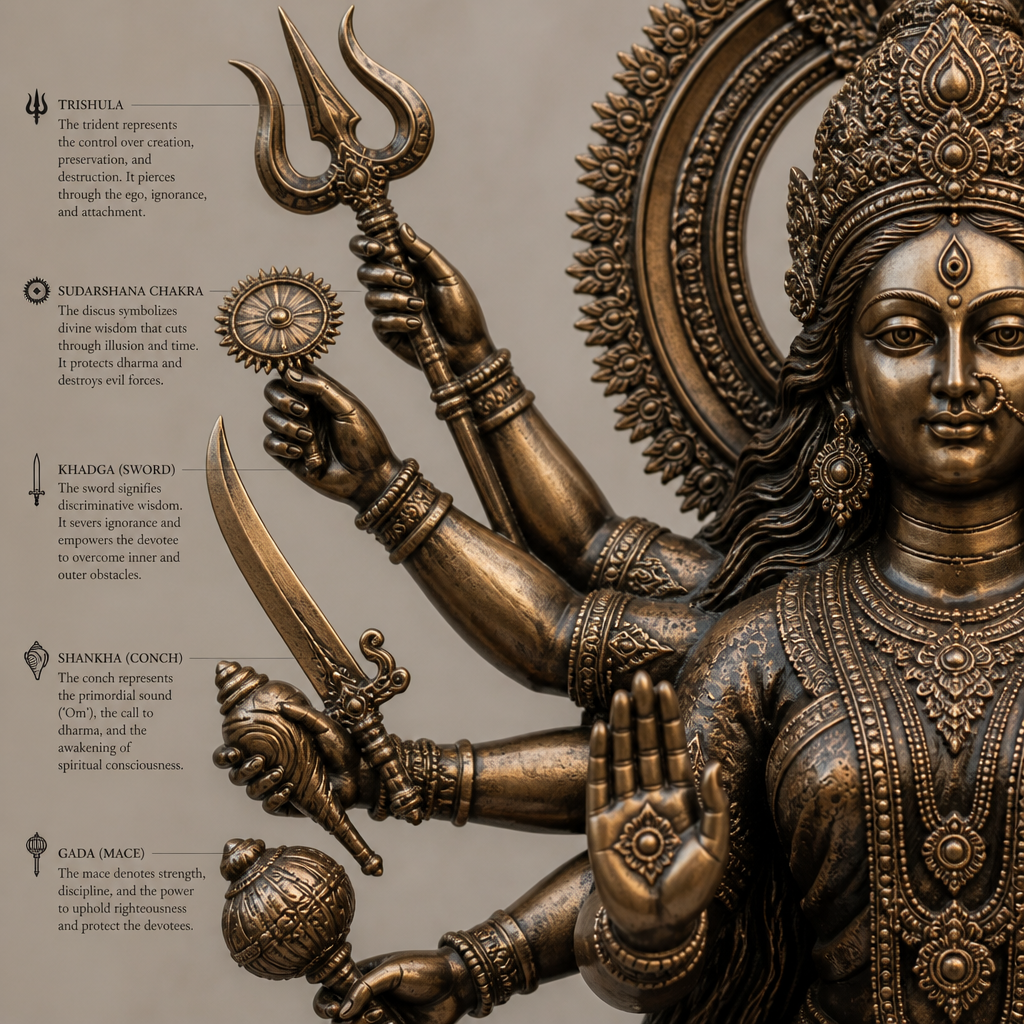
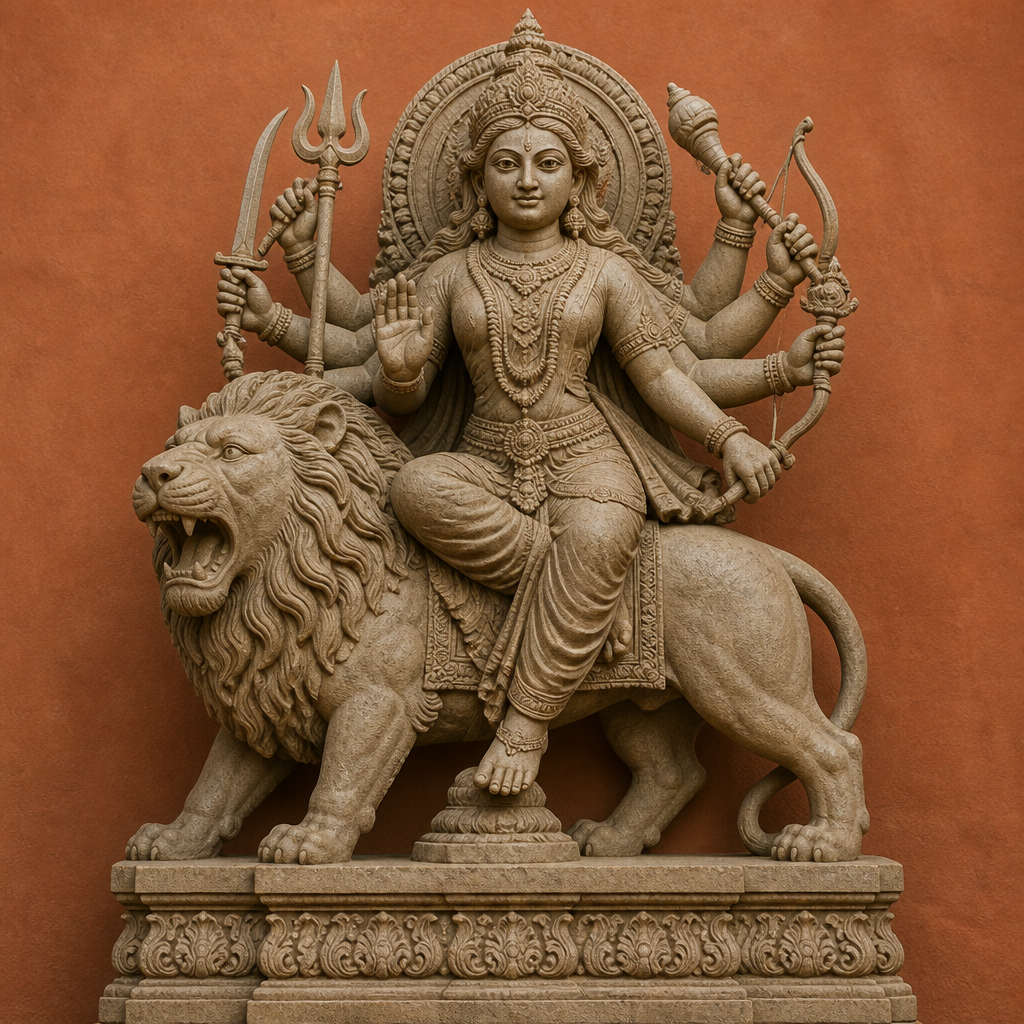
"Le Devi Mahatmya présente Durga non pas comme une épouse ou une dépendante des dieux mâles mais comme la réalité suprême dont les dieux eux-mêmes tirent leur pouvoir."
Le Devi Mahatmya, texte fondateur de la tradition Shakta, a cristallisé la forme narrative et iconographique de Durga d'une manière qui a façonné chaque sculpteur travaillant dans cette tradition depuis sa composition. Comprendre que le fondement textuel change votre relation avec toute pièce que vous acquérez. Ce n’est pas une décoration d’ambiance. C’est une représentation de l’autorité cosmique unifiée dans son mode le plus actif, protecteur et féroce.
Lecture de l'iconographie de Durga : les armes, les armes et la monture
La lecture d'une sculpture de Durga est une compétence qui s'apprend et qui porte ses fruits pour chaque pièce que vous rencontrerez. Les attributs ne sont pas décoratifs. Il s’agit d’un langage visuel développé au fil des siècles, et chaque élément se connecte à un point doctrinal ou narratif spécifique.
L’importance des armes multiples
Durga est presque toujours représentée avec plusieurs bras, généralement huit ou dix, chacun tenant une arme qui lui a été offerte par une divinité masculine différente. Le chiffre huit n’est pas arbitraire. Chaque bras représente l'autorité divine concentrée d'un dieu spécifique. Une erreur courante des collectionneurs est de supposer qu’une pièce est incomplète si elle comporte moins de dix bras. Les traditions régionales, en particulier celles de certaines périodes de sculpture des temples du sud de l'Inde, ont produit des formes Durga à quatre ou huit bras entièrement canoniques. Le nombre d'armes signale la tradition textuelle ou régionale spécifique, et non la qualité ou l'exhaustivité de la pièce.
Armes et positions des mains
Parmi les armes que vous rencontrerez dans la sculpture Devi figurent un trident (de Shiva), un disque (de Vishnu), une épée, un arc, des flèches et une conque. Une statue dépourvue d’armes clés représente soit une forme spécifique moins connue, soit est iconographiquement incomplète. Les positions des mains, appelées mudras, comptent autant que les armes elles-mêmes. Un abhaya mudra, avec la paume tournée vers l’extérieur, signale protection et réconfort. Un varada mudra, avec la paume tournée vers le bas et les doigts étendus, signale l'octroi de bénédictions. Les deux peuvent apparaître simultanément sur différentes paires de mains dans une seule sculpture.
Le Vahana : Lion ou Tigre
La monture de Durga est toujours un lion ou un tigre. Ce n’est pas une décoration interchangeable. Le vahana prédateur signale une énergie divine active et martiale. En revanche, Saraswati chevauche un cygne et Lakshmi est associée au lotus, deux images d'un pouvoir réceptif et plus doux. La monture de Durga la marque immédiatement comme une déesse du combat et de la protection. Sa position au-dessus de l'animal est une déclaration visuelle directe selon laquelle elle commande les forces par lesquelles la plupart des êtres sont commandés.
Conseil de pro : Sur n'importe quelle sculpture Durga que vous envisagez, couvrez les armes et la monture avec votre main et regardez uniquement le visage. Si la sérénité se lit clairement sans autre contexte, le sculpteur a compris la tradition. S'il ne se lit correctement que lorsqu'il est encadré par la composition complète, l'artiste a travaillé mécaniquement plutôt que par une véritable compréhension.
Mahishasuramardini : Le récit central de la sculpture Devi
La scène narrative la plus courante dans la sculpture Devi en Asie du Sud et du Sud-Est est Mahishasuramardini, qui se traduit par « celle qui a tué le démon buffle Mahisha ». Cette scène représente Durga en combat direct avec ou immédiatement après la défaite de Mahisha. Sous la forme à huit bras la plus souvent représentée en pierre et en bronze, Durga brandit au-dessus de sa tête une large épée avec laquelle elle a décapité le buffle, dont la tête coupée repose à ses pieds, tandis que ses mains restantes tiennent les autres armes qui lui ont été données par les dieux mâles. Suivant le texte de Devi Mahatmya, cette image code l’histoire complète de l’ordre cosmique restauré grâce au pouvoir divin féminin.
Les images de Mahishasuramardini apparaissent dans certains des complexes de temples et de grottes les plus importants du pays. Indie, y compris Mahabalipuram et les grottes d'Ellora, et la scène s'est répandue dans toute l'Asie du Sud-Est alors que l'hindouisme voyageait à travers les réseaux commerciaux et de patronage royal. La sculpture des temples khmers à Angkor et ailleurs comprend d'importantes représentations de Mahishasuramardini, et la forme est apparue dans Cambodge dès la période préangkorienne.
Conseil de pro : Si vous évaluez une sculpture de Mahishasuramardini, regardez le traitement du visage du démon buffle. Dans des pièces habiles, même la figure vaincue est rendue avec soin et intention anatomique. Les reproductions mal moulées ou mal sculptées réduisent souvent le démon à une masse informe, ce qui laisse penser que l'artisan copiait un modèle sans le comprendre.
Styles régionaux à travers l'Asie : du bronze Chola à la pierre khmère
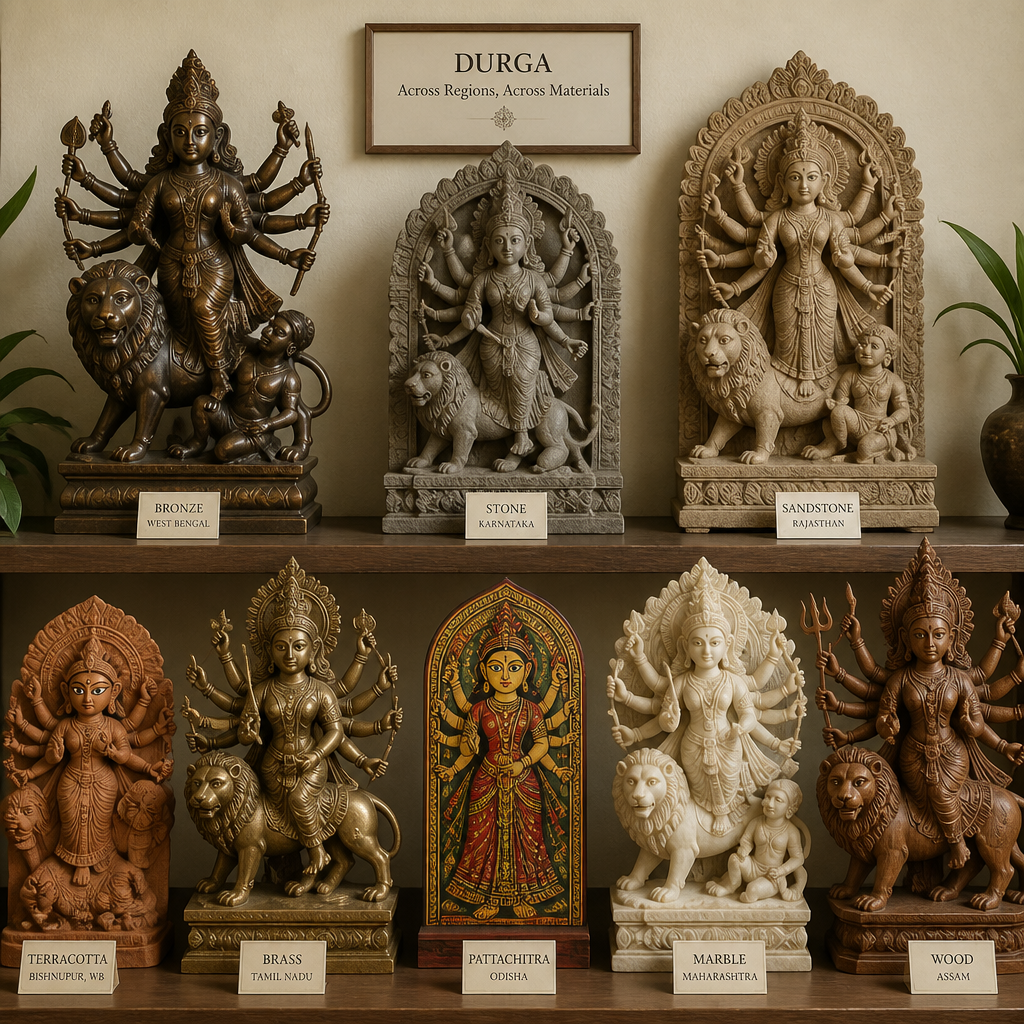
La déesse hindoue Durga était vénérée dans une vaste étendue géographique, et les traditions sculpturales qui se sont développées pour la représenter diffèrent considérablement selon la région, la période et le matériau. Comprendre ces différences est essentiel pour tout collectionneur sérieux, car le style régional est l'un des principaux indicateurs de provenance et d'époque. Traiter toutes les sculptures de déesses hindoues comme une seule catégorie manque la partie la plus intéressante du domaine.
Bronze du sud de l'Inde : la référence Chola
Sud Indie, en particulier les traditions associées au Tamil Nadu et à la période Chola (environ du IXe au XIIIe siècle de notre ère) ont produit certaines des sculptures hindoues les plus raffinées techniquement jamais réalisées. La coulée du bronze selon la méthode de la cire perdue, dite cire perdue, a atteint un niveau extraordinaire. La position des figures Durga de la tradition Chola a tendance à être dynamique, la posture tribhanga ou triple flexion créant une sensation de mouvement même dans un objet statique. Les détails de la surface des bijoux raffinés, des couronnes et des rendus de tissus sont un indicateur direct d'un atelier qualifié opérant dans le cadre de cette tradition. Les artisans contemporains de l'Inde du Sud perpétuent cette tradition et les meilleurs bronzes modernes suivent directement ces normes proportionnelles et techniques.
La pierre de l'Inde du Nord et la tradition du Bengale
La sculpture sur pierre de l'Inde du Nord, en particulier celle de la période médiévale, présente des différences distinctes en termes de proportions et de types de visages par rapport aux œuvres du Sud. La tradition du Bengale a donné naissance aux formes élaborées de Durga Puja, où la déesse est souvent représentée avec son groupe familial complet, flanqué de Lakshmi, Saraswati, Karttikeya et Ganesha. Cette forme a un caractère plus narratif et festif que les formes singulières et armées du Sud. Indie.
Travail du métal népalais
Le travail du métal népalais dans les traditions du repoussé et de la cire perdue a produit des images Durga qui mélangent le vocabulaire esthétique hindou et bouddhiste Vajrayana. Ces pièces présentent souvent une plus grande densité de détails décoratifs sur la surface et un traitement distinctif de la couronne et des bijoux. Pour les collectionneurs intéressés par le point de rencontre des traditions artistiques hindoues et bouddhistes, la sculpture népalaise Durga est un domaine particulièrement enrichissant à explorer.
Traditions khmères et asiatiques du Sud-Est
L'hindouisme s'est répandu dans toute l'Asie du Sud-Est avec un essor significatif entre le Ve et le XIIIe siècle de notre ère. Shiva était la divinité dominante du premier culte royal khmer, et les représentations de Mahishasuramardini apparaissent largement dans la sculpture des temples khmers aux côtés de Vishnu et de ses avatars. Sculptures Durga de Cambodge, Java et Bali reflètent cette diffusion. La sculpture hindoue cambodgienne et la sculpture bouddhiste étaient souvent produites simultanément au sein des mêmes complexes de temples, par des ateliers qui comprenaient les deux traditions de l'intérieur. Certaines des plus anciennes sculptures brahmaniques découvertes à Cambodge représentent Durga sous une forme bénigne à quatre bras, identifiable par des attributs survivants spécifiques plutôt que par la scène de bataille complète.
Comparaison des matériaux et des traditions de la statue de Durga
|
Tradition / Matière |
Caractéristiques clés |
Idéal pour |
|---|---|---|
|
Bronze à la cire perdue du sud de l'Inde (tradition Chola) |
Posture tribhanga sinueuse, détails de surface fins dans les bijoux et la couronne, développe une riche patine au fil du temps, processus de moulage techniquement exigeant |
Autels domestiques, collections sérieuses, usage rituel. La référence de qualité pour la sculpture Devi en métal. |
|
Pierre de l'Inde du Nord et du Bengale (grès, granit, pierre noire) |
Plus lourdes et moins portables, adaptées à une installation permanente, les formes Devi les plus anciennes survivantes sont en pierre, les conventions de proportions faciales sont différentes de celles du travail de l'Inde du Sud. |
Espaces d'autel fixes, sanctuaires de jardin, décors architecturaux. Le poids de Stone ancre un espace de dévotion permanent. |
|
Pierre khmère et d’Asie du Sud-Est (cambodgienne, javanaise, balinaise) |
Conventions faciales et styles de couronne distincts, mélange de vocabulaire esthétique hindou et bouddhiste à certaines périodes, production répartie du Ve au XIIIe siècle de notre ère. |
Les collectionneurs se sont concentrés sur le croisement culturel hindou-bouddhiste, les collections spécialisées en Asie du Sud-Est, celles attirées par le vocabulaire esthétique d'Angkor. |
Collectionner des statues de Durga : ce qui compte réellement
La plupart des collectionneurs qui achètent une statue de Durga pour la première fois en choisissent une uniquement en fonction de son esthétique, puis passent des années à souhaiter avoir compris ce qu'ils regardaient avant de l'acheter. Durga n’est pas simplement « une déesse aux nombreux bras ». Il s’agit d’une déclaration théologique précisément codée rendue dans la pierre, le bronze ou le bois, et chaque arme, chaque posture et chaque monture animale est un choix délibéré qui change complètement le sens de la pièce.
L’exhaustivité iconographique d’abord
Avant d'évaluer le matériau ou le prix, évaluez si la pièce est cohérente sur le plan iconographique. Les armes sont-elles adaptées à la forme représentée ? Le montage est-il correctement rendu ? Le nombre d’armes est-il cohérent avec la tradition textuelle que la pièce prétend représenter ? Une pièce avec une belle fonte mais une iconographie confuse est un objet décoratif, pas une statue Durga au sens plein du terme. Les vendeurs qui ne peuvent pas expliquer ce qui est représenté ou où les attributs sont clairement erronés doivent être traités avec scepticisme, quelle que soit l'apparence de la pièce.
Qualité des matériaux et authenticité
Bronze développe une patine au fil du temps qui ajoute à sa profondeur visuelle. Le laiton est légèrement plus abordable et conserve bien les détails fins. Les deux conviennent à un usage rituel et sont faciles à entretenir. Lors de l’évaluation du bronze, le métal véritable est visiblement dense et lourd pour sa taille. Si une pièce est froide au toucher, a une surface qui semble appliquée plutôt que développée et qui semble plus légère que prévu, traitez cette combinaison avec scepticisme. Sculptures en pierre, qu'il s'agisse de grès, de granit ou de pierre noire, ont l'avantage de la continuité historique : les plus anciennes sculptures Devi survivantes sont en pierre sculptée, et les pièces de pierre sont mieux adaptées à une installation permanente qu'à une exposition qui nécessite de les déplacer.
Éclairage et affichage
Dans un contexte de collection laïque, l’éclairage est la variable la plus importante dans la lecture d’une statue de Durga. Les pièces sculpturales à l'iconographie complexe nécessitent une lumière directionnelle qui crée de l'ombre et révèle la profondeur. Un éclairage zénithal plat détruit la dimensionnalité qui fait qu'une Durga en bronze ou en pierre bien faite vaut la peine d'être regardée. Une seule source de lumière focalisée positionnée à environ 45 degrés au-dessus et sur un côté de la pièce fera plus pour une bonne sculpture que n'importe quel effort de présentation supplémentaire.
Vous pouvez explorer HD Asian ArtLa sélection organisée de statues de Durga, provenant de Indie et dans toute l'Asie du Sud-Est, pour comparer les styles régionaux, les matériaux et les considérations d'affichage côte à côte plutôt que d'évaluer les pièces isolément. Examiner plusieurs pièces ensemble est toujours le moyen le plus rapide de développer un œil fiable sur la qualité.
Construire une collection cohérente de déesses hindoues
Une collection soigneusement construite autour de la tradition divine féminine de l'hindouisme pourrait inclure une Durga dans la pose de Mahishasuramardini, une Parvati dans une forme debout sereine et un Kali dans une composition debout ou dansante. Ensemble, ces trois pièces racontent l’histoire complète de la tradition Devi : pouvoir protecteur, amour nourricier et fureur transformatrice. Cette cohérence narrative est ce qui distingue une collection d’une accumulation.
Lorsque vous associez une statue Durga à d'autres Statues de divinités hindoues sur le même autel ou surface d'exposition, faites correspondre la tradition sculpturale régionale lorsque cela est possible. Une Durga en bronze du sud de l'Inde aux côtés d'une Parvati en pierre du nord de l'Inde crée une dissonance esthétique qui nuit aux deux pièces. La cohérence du style régional crée une harmonie visuelle et théologique. Le plus large gamme de statues de dieux et déesses hindous dans toute collection spécialisée vous donne des points de référence pour effectuer ces comparaisons avec précision.
Pour les collectionneurs intéressés par la façon dont l'iconographie de Durga se connecte à la tradition plus large de l'art religieux asiatique, il vaut la peine de comprendre comment son image a voyagé aux côtés du syncrétisme hindou-bouddhiste. Cambodge, Java et Bali. Le Tradition sculpturale khmère est un domaine particulièrement riche pour les collectionneurs qui souhaitent explorer le point de rencontre de ces deux grands vocabulaires artistiques.
Foire aux questions
Que représente une statue de Durga dans la tradition hindoue ?
Durga représente la puissance divine concentrée de tout le panthéon hindou dirigée vers la protection de l'ordre cosmique. Elle a été créée alors qu'aucun dieu mâle ne pouvait vaincre le démon buffle Mahisha, faisant d'elle l'incarnation de l'autorité divine unifiée. Dans la tradition Shakta, elle occupe la position de réalité suprême, Para Brahman, et pas seulement une puissante figure guerrière. Sa statue est une déclaration théologique codée dans la pierre ou le métal, représentant la force inviolable qui maintient la frontière entre l'ordre et le chaos.
Comment identifier une statue de Durga par rapport à d'autres figures de déesses hindoues ?
Les identifiants visuels les plus rapides sont la combinaison de plusieurs bras (généralement huit ou dix) tenant des armes, un lion ou un tigre comme monture (vahana) et, dans les scènes narratives, le démon buffle sous ses pieds. Un trident et un disque maintenus ensemble sous une forme à plusieurs bras indiquent fortement Durga. Comparez cela avec Saraswati, qui chevauche un cygne et tient un veena, ou avec Lakshmi, qui est associé aux pièces d'or et aux éléphants qui le flanquent. La monture et les armes rendent Durga unique une fois que vous savez quoi chercher.
Quel est le meilleur matériau pour une statue Durga destinée à un autel domestique ?
Le bronze et le laiton sont les matériaux dominants pour les sculptures Devi de haute qualité destinées aux autels domestiques. Le bronze développe une riche patine au fil du temps qui ajoute de la profondeur visuelle, tandis que le laiton est légèrement plus abordable et conserve bien les détails fins de la surface. Les deux conviennent à un usage rituel et sont faciles à entretenir. Les bronzes coulés à la cire perdue, issus des ateliers traditionnels du sud de l'Inde, constituent la référence technique en la matière. La pierre est un excellent choix pour une installation fixe permanente, et les plus anciennes sculptures de Durga survivantes sont en pierre, ce qui revêt une signification particulière pour les collectionneurs.
Qu'est-ce que Mahishasuramardini et pourquoi apparaît-il si souvent dans la sculpture de Durga ?
Mahishasuramardini signifie « celle qui a tué le démon buffle Mahisha » et fait référence au récit central du Devi Mahatmya, le texte fondateur de la tradition Shakta. Il s'agit de la scène narrative la plus courante dans la sculpture Devi en Asie du Sud et du Sud-Est, car elle représente le moment déterminant de l'existence de Durga : la bataille qui justifie son iconographie composite. Les sculptures la montrant dans cette pose codent l’histoire complète du pouvoir divin mobilisé contre le mal et de l’ordre cosmique restauré. La scène apparaît dans les principaux complexes de temples à travers Indie et s'est répandu dans toute l'Asie du Sud-Est à mesure que l'hindouisme voyageait dans la région.
Comment évaluer la qualité d'une statue Durga avant de l'acheter ?
Commencez par la cohérence iconographique : les armes sont-elles appropriées, la monture est-elle correctement rendue, le décompte des armes correspond-il à une tradition textuelle connue ? Alors regardez le visage. Un sculpteur habile rend l'expression de Durga complètement sereine, même dans le contexte d'une bataille cosmique. Si vous couvrez les armes et la monture et que la sérénité est toujours claire, l'artisan a compris la tradition. Pour les pièces en bronze, le métal véritable est sensiblement lourd et dense pour sa taille. Demandez au vendeur d'expliquer ce qui est représenté. Un spécialiste qui comprend la pièce doit être capable d'en décrire les détails iconographiques sans hésitation.
Une statue de Durga à quatre bras est-elle incomplète ou de moindre importance ?
Non. Une erreur courante consiste à supposer que moins d’armes signifie une pièce incomplète ou de qualité inférieure. Les formes Durga à quatre et huit bras sont toutes deux entièrement canoniques, selon la tradition régionale et textuelle suivie par la sculpture. Le nombre de bras indique à quelle tradition spécifique appartient la pièce, et non la qualité du travail. Certaines des sculptures Devi les plus raffinées jamais produites ont quatre bras. Évaluez la pièce sur sa cohérence iconographique, la qualité de ses matériaux et son savoir-faire, et non uniquement sur le compte des bras.
Si vous avez de l'expérience dans la sélection ou l'exposition de statues de déesses hindoues, que ce soit pour une pratique de dévotion, un autel domestique ou une collection sérieuse, nous serions ravis de savoir ce que vous avez remarqué sur la façon dont la précision iconographique façonne votre relation avec une pièce.
Références
-
Iconographie, mythologie et collection de la statue de Durga : un guide détaillé de HD Asian Art
-
La divinité hindoue Durga : enregistrement d'objets de la collection du Musée d'art asiatique
-
Mahishasura : contexte iconographique et narratif dans la tradition hindoue
