



3 chèques soutenus par un conservateur pour distinguer Bouddha du bodhisattva pour les collectionneurs
3 chèques soutenus par un conservateur pour distinguer Bouddha du bodhisattva pour les collectionneurs
Regardez d'abord l'ornementation. Un personnage vêtu de simples robes monastiques et sans bijoux est presque toujours un Bouddha ; un personnage portant une couronne, un collier ou des brassards est presque toujours un bodhisattva.
Cette règle unique trie correctement à vue la plupart des sculptures bouddhistes asiatiques, mais la confirme par trois vérifications rapides : le geste de la main, la posture assise ou debout et tout objet tenu dans les mains.
Principales caractéristiques :
- L'ornementation est le principal repère visuel, avec des bouddhas apparaissant dans des robes simples et des bodhisattvas ornés de couronnes, de bijoux et de vêtements princiers.
- La vérification en trois parties du mudra, de l'asana et des attributs doit être utilisée ensemble pour confirmer l'identité lorsque l'ornementation est ambiguë.
- Les différences de style régional, telles que les draperies et les traits du visage, peuvent influencer l'apparence mais ne remplacent pas les principaux marqueurs iconographiques.
- Les problèmes d'état tels que les réparations ou les incrustations modernes peuvent obscurcir l'identification et doivent être soigneusement examinés avant l'étiquetage.
- Une attribution précise repose sur des vérifications approfondies de l'ornementation, de la pose, des gestes de la main, des attributs et des détails de base pour éviter toute erreur de classification.
Table des matières
- Différence entre les statues de Bouddha et de Bodhisattva : la règle de l'ornement
- Mudra, Asana et attributs : la vérification en trois parties
- Les styles régionaux changent-ils les règles ?
- Comment devez-vous sous-titrer et signaler les problèmes de condition ?
- Une liste de contrôle du presse-papiers pour les acheteurs et les conservateurs
- D’où vient la distinction entre Bouddha et Bodhisattva ?
- Qu’est-ce qui différencie l’iconographie du Bouddha et du Bodhisattva ?
- Les bouddhas et les bodhisattvas sont-ils physiquement différents ?
- Pourquoi les deux figures sont-elles importantes dans l’art et la pratique bouddhistes ?
- Comment James applique ces règles à HD Asian Art
- Prêt à examiner une pièce vous-même ?
- Sources
- FAQ
Différence entre les statues de Bouddha et de Bodhisattva : la règle de l'ornement
Le moyen le plus rapide de classer une sculpture dans une catégorie ou dans l’autre dépend de ce que porte la figurine. Les bouddhas apparaissent sous l’apparence d’un moine renonçant : épaules nues ou simple robe drapée sur une épaule, pas de couronne, pas de collier, pas de boucles d’oreilles au-delà des lobes d’oreilles allongés laissés par la jeunesse princière du Bouddha terrestre. Les bodhisattvas, en revanche, sont mis en scène comme des rois célestes. Ils portent les atours d'un prince parce que dans la cosmologie bouddhiste, un bodhisattva se déplace toujours à travers le monde, retardant son retrait complet pour aider les autres en cours de route, et les sculpteurs ont signalé ce lien mondain avec les atours du monde depuis près de deux mille ans.
Au-delà du nu par rapport aux bijoux, recherchez ces marqueurs :
- Marqueurs Bouddha : robe unie (sanghati), l'ushnisha (une bosse crânienne signifiant la sagesse), l'urna (un point ou une boucle entre les sourcils) et les mains placées dans l'un des rares mudras reconnus.
- Marqueurs bodhisattva : une grande couronne ou un diadème, des colliers, des brassards et des bracelets à plusieurs brins, une ceinture décorative sur un vêtement inférieur de style paréo et des cheveux longs portés lâches ou empilés dans un chignon orné de bijoux.
- Détail de la couronne : de nombreuses images de bodhisattva, en particulier les figures de Maitreya et d'Avalokiteśvara, portent un petit Bouddha assis gravé dans la couronne elle-même, un détail qui confirme l'identification lorsque les bijoux seuls laissent place au doute.
L’ornementation est un signal fort mais pas absolu. Certaines traditions ont produit des images de Bouddha « royal » ou « couronné », en particulier dans les cours ultérieures d'Asie du Sud-Est, où un Bouddha porte une couronne pour représenter son apprivoisement d'un fier roi. Sources encyclopédiques sur iconographie des bodhisattvas notez les cas où les inscriptions remplacent entièrement l'attente visuelle, qualifiant une figure simplement habillée de bodhisattva. Considérez l’ornement comme votre coup d’ouverture, et non comme votre verdict final.
Conseil de pro : Si une pièce montre une couronne sur un visage et une posture semblables à ceux d'un Bouddha, vérifiez la base ou toute inscription avant de supposer qu'il s'agit d'un bodhisattva. Les images royalisées de Bouddha existent et peuvent être collectionnées à part entière.
Mudra, Asana et attributs : la vérification en trois parties
Lorsque l’ornementation à elle seule ne règle pas la question, effectuez trois vérifications supplémentaires successivement. Ensemble, les mudra, les asanas et les attributs portatifs forment la méthode d'identification qui références muséales sur l'art bouddhiste traiter comme une pratique courante.
- Mudra (geste de la main). Bhumisparsha (doigts touchant le sol) marque le moment d’illumination du Bouddha historique et apparaît presque exclusivement sur les images de Bouddha. Dhyana (mains posées sur les genoux, paumes vers le haut) signale la méditation. Abhaya (paume levée tournée vers l’extérieur) signale une protection ou un réconfort, et bien que les bouddhas l’affichent le plus souvent, certains bodhisattvas l’utilisent également.
- Asanas (postures). Les postures assises, jambes croisées, dominent l’imagerie de Bouddha. Les bodhisattvas privilégient une gamme plus large : la pose assise dite « européenne » avec les deux pieds au sol (commune dans les images de Maitreya), les poses debout avec une légère courbure des hanches, et lalitasana ou « aisance royale », une jambe pendante, une pliée, associée aux figures d'Avalokiteśvara et de Tara.
- Attributs. Une bouteille d’eau désigne généralement Maitreya, le futur Bouddha, qui n’affiche pas encore de bhumisparsha parce que son illumination n’a pas eu lieu. Une tige de lotus pointe vers Avalokiteśvara ou Padmapani. Une combinaison d’épée et de livre pointe vers Mandjoushri. Un vajra désigne Vajrapani. Guide Smarthistory sur l’iconographie des bodhisattva parcourt plusieurs de ces associations avec des exemples photographiés.
Aucun composant ne garantit à lui seul une identification. Un personnage sans ornement mais tenant une gourde d'eau et assis dans la pose européenne est un candidat sérieux pour Maitreya en attente de sa propre bouddhéité. Pesez les trois contrôles ensemble avant de confier une étiquette à une fiche de catalogue.
Les styles régionaux changent-ils les règles ?
Oui, et c’est là que se produisent de nombreuses erreurs d’attribution. La sculpture gandharienne, façonnée par les contacts hellénistiques le long des routes commerciales vers ce qui est aujourd'hui le Pakistan et l'Afghanistan, donne aux bouddhas des cheveux ondulés et des draperies plus lourdes, semblables à celles d'une toge, qui peuvent paraître presque romaines. Ce style de draperie n’a rien à voir avec le rang ; c’est une mode régionale, pas un marqueur de bodhisattva.
La sculpture indienne de l'ère Gupta (environ du 4e au 6e siècle) tend vers une simplicité sereine, même dans les figures de bodhisattva, avec des ornements plus fins que ceux que l'on retrouve dans les cours ultérieures d'Asie du Sud-Est. Un étude historique des écoles de sculpture indiennes retrace comment les ateliers de Sarnath, Gupta et plus tard Pala ont chacun traité les draperies et les ornements différemment, ce qui est important lorsque vous essayez de dater une pièce uniquement par style.
Bronzes d'Asie du Sud-Est de Thaïlande, Cambodge, et Birmanie montrent souvent des vêtements royaux beaucoup plus élaborés sur les bouddhas et les bodhisattvas que les prototypes indiens, reflétant les traditions royales locales superposées à l'iconographie bouddhiste. Utilisez ces indices secondaires avec l’ornement et le mudra :
- Le traitement des draperies (plis collants ou plis sculptés en bloc) restreint souvent une pièce à une école spécifique avant même que vous ne regardiez les mains.
- Le type de visage (lobes d’oreilles allongés, forme des sourcils, courbure de la bouche) varie selon les régions et les périodes.
- Le traitement des cheveux (boucles serrées, ushnisha lisse ou couronne ornée de bijoux) est l'un des indicateurs secondaires les plus fiables une fois l'ornement évalué.
Comment devez-vous sous-titrer et signaler les problèmes de condition ?
Une légende de catalogue utile indique, dans l'ordre : le type de sujet (Bouddha ou bodhisattva), l'identité spécifique probable si les attributs en soutiennent un, le matériau, la région et la période approximatives, et une note sur la fiabilité de la provenance. Quelque chose comme « Bodhisattva, probablement Avalokiteśvara, bronze, cambodgien, période d'Angkor, provenance documentée d'une collection privée » donne à un acheteur ou à un visiteur de musée tout ce dont il a besoin en une seule ligne. Notre propre guide sur identifier les statues antiques de Bouddha parcourt la construction de ce genre de déclaration de confiance pièce par pièce.
Les problèmes de condition peuvent discrètement compromettre une identification. Surveillez :
- Éléments de bijoux fixés avec de l'adhésif moderne ou du métal dépareillé, ce qui peut indiquer une « mise à niveau » ultérieure d'une figure simple à un faux bodhisattva.
- Réparations anachroniques des mains ou des attributs, puisqu'une main remplacée peut modifier toute la lecture du mudra.
- Un nettoyage excessif qui a décapé la patine de manière inégale, souvent le signe d'une restauration agressive destinée à masquer les dommages.
- Des yeux incrustés ou des pierres précieuses qui ne correspondent pas à la période de moulage, un signe courant sur les reproductions modernes déguisées en antiquités.
Guide de collection Christie's pour la sculpture bouddhiste distingue les mains, les pieds et les draperies comme les détails les plus difficiles à modéliser de manière convaincante, ce qui en fait les premiers forgerons à couper les coins ronds.
Conseil de pro : Rangez les figurines couronnées ou lourdement ornées de bijoux avec un rembourrage sous l'ornement, sans reposer à plat dessus. Les éléments de couronne et les brassards lâches sont les premiers éléments à se casser ou à disparaître pendant le transport.
Une liste de contrôle du presse-papiers pour les acheteurs et les conservateurs
Exécutez cette séquence lors d'une vente, en stock ou avant qu'une pièce ne soit exposée :
- Vérifiez d’abord l’ornementation : robe unie ou robe princière ?
- Vérifiez le mudra : le geste de la main correspond-il à une convention connue de Bouddha ou de bodhisattva ?
- Vérifiez les asanas : assis jambes croisées, pose européenne, debout ou aisance royale ?
- Vérifiez les attributs : existe-t-il un vase, un lotus, une épée, un livre ou un vajra, et correspond-il à une figure connue ?
- Demandez des photos de la base ou du dessous, ainsi que tout rapport d’état antérieur ou historique d’exposition.
- Examinez la cohérence des mains, des pieds et de la patine et demandez une radiographie ou une imagerie experte si la contrefaçon est un problème réel.
Trois contrôles, et non un, constituent la norme de travail parmi les références muséales sur ce sujet, selon le guide d'identification de Smarthistory. Si l’ornement, le mudra et les attributs pointent dans trois directions différentes, c’est votre signal pour suspendre la transaction et faire appel à un spécialiste extérieur plutôt que de deviner.
D’où vient la distinction entre Bouddha et Bodhisattva ?
La séparation entre les deux personnages remonte à la manière dont l’art bouddhiste primitif choisissait de représenter l’absence et la présence. Pendant plusieurs siècles après la mort du Bouddha historique, les sculpteurs indiens ont évité de le représenter sous forme humaine, utilisant à la place des symboles comme un trône vide ou une roue. Lorsque les images humaines de Bouddha sont finalement apparues, probablement influencées par les contacts gréco-bouddhiques au Gandhara et par les ateliers Mathura au Indie, les sculpteurs ont opté pour un langage visuel délibérément épuré : pas de bijoux, pas de couronne, rien qui suggère un rang mondain.
L’imagerie du bodhisattva s’est développée parallèlement à cela, s’appuyant sur la propre biographie historique du Bouddha en tant que prince avant son renoncement. Les sculpteurs ont emprunté le vocabulaire visuel de la royauté indienne (couronnes, bijoux, vêtements princiers) pour représenter des êtres toujours actifs dans le monde de la renaissance et des affaires du monde, même s'ils progressaient spirituellement. Un petit guide des conventions sculpturales bouddhistes de Qalam retrace comment l'ushnisha, l'urna et les lobes d'oreille allongés, les marques fondamentales d'un « grand être », se répercutent également sur les figures de bodhisattva, c'est pourquoi ces trois caractéristiques à elles seules ne permettent jamais une identification. L’ornement est resté le repère visuel décisif qui séparait les deux tout au long de la propagation de la tradition à travers l’Asie.
Qu’est-ce qui différencie l’iconographie du Bouddha et du Bodhisattva ?
Chaque élément d’une image de Bouddha pointe vers l’achèvement et l’immobilité. L'ushnisha suggère une sagesse déjà atteinte. L'urne suggère une perspicacité déjà ouverte. Le mudra, qu’il s’agisse du contact avec la terre ou de la méditation, représente un moment figé au sommet de la réalisation. Rien dans l’iconographie n’invite à une narration plus approfondie ; l'histoire, visuellement, est terminée.
L'iconographie du bodhisattva travaille dans la direction opposée, vers l'activité et la continuation. Un lotus tenu, une gourde d'eau, une main levée offrant une protection : ce sont des outils en cours d'utilisation, et non des symboles d'une réussite déjà scellée. La couronne elle-même a une signification au-delà de la décoration. Sur de nombreuses images d'Avalokiteśvara et de Maitreya, le petit Bouddha assis gravé dans la couronne identifie le Bouddha cosmique sous lequel le bodhisattva sert ou deviendra éventuellement, fonctionnant presque comme une signature.
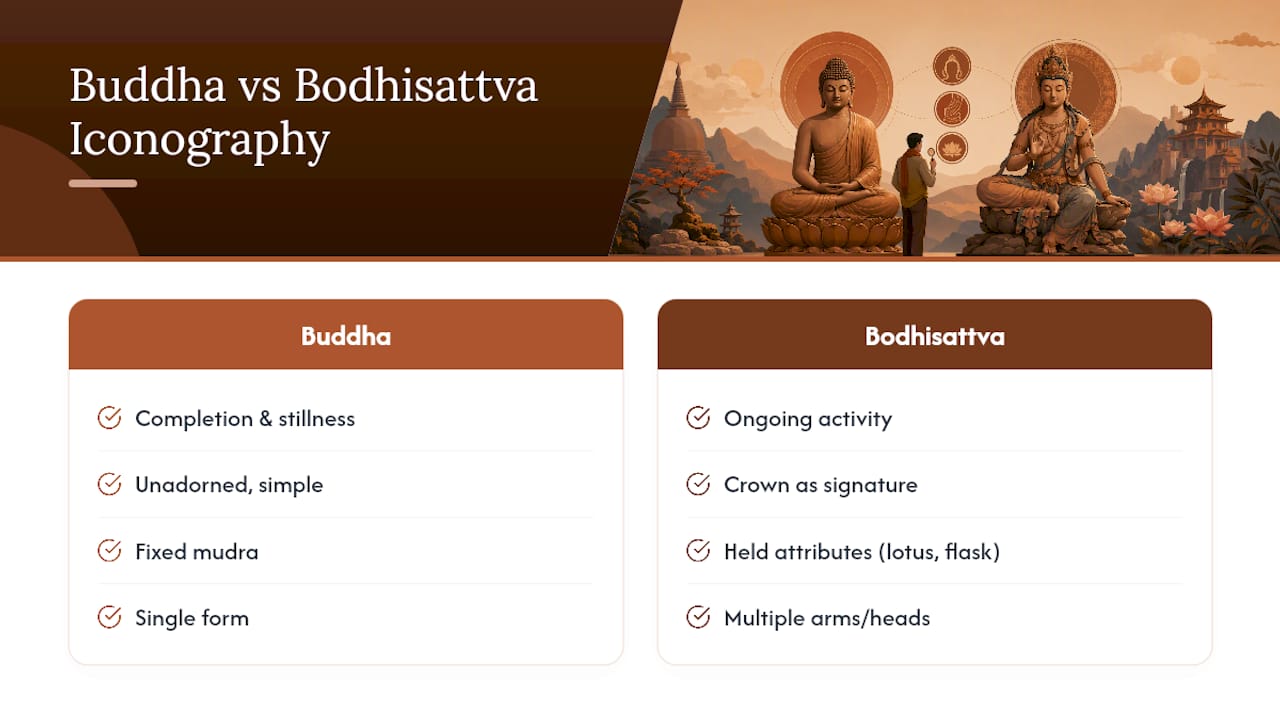
Les bras et les têtes multipliés, plus courants sur les formes ultérieures d'Avalokiteśvara du Népal, du Tibet et de certaines parties de l'Asie du Sud-Est, élargissent cette idée de capacité continue. Des mains supplémentaires signifient des moyens supplémentaires d’aider ; une image de Bouddha n’a jamais besoin de cet argument visuel car le travail, symboliquement, est déjà fait.
Les bouddhas et les bodhisattvas sont-ils physiquement différents ?
Le traitement du visage sur les images de Bouddha tend vers un détachement serein : yeux mi-clos ou baissés, sourire faible ou absent, front lisse et sans rides. Le corps tend également vers la simplicité monastique, des épaules larges et un torse calme, mais rien d'accentué pour un attrait sensuel ou mondain, puisque tout l'intérêt de la figure est le renoncement.
Les visages des bodhisattvas sont souvent plus animés. Les yeux sont plus fréquemment ouverts et engagés avec le spectateur, et un léger sourire ou une expression plus douce est courant, en particulier dans les traditions du bronze d'Asie du Sud-Est et de l'Himalaya. Les corps tendent vers un modelage plus doux, parfois presque féminin, sur les figures d'Avalokiteśvara de certaines périodes, un choix stylistique lié au rôle compatissant de la figure plutôt qu'à une quelconque affirmation doctrinale sur le genre. Le traitement capillaire offre à lui seul un effet physique rapide : les cheveux d'un bouddha reposent près de la tête en boucles serrées menant à l'ushnisha, tandis que les cheveux d'un bodhisattva sont souvent présentés longs, lâches ou minutieusement empilés sous une couronne.
Aucun de ces signaux faciaux ou corporels ne fonctionne seul de manière aussi fiable que la règle de l’ornement. Traitez-les comme des preuves à l’appui, le genre de détails qui confirment une lecture que vous avez déjà atteinte grâce au mudra, aux asanas et aux attributs.
Pourquoi les deux figures sont-elles importantes dans l’art et la pratique bouddhistes ?
Une image de Bouddha ancre un temple ou un sanctuaire comme une représentation d’un état déjà atteint, un point de calme vers lequel les fidèles orientent leur dévotion. Les images du bodhisattva remplissent une fonction différente à l’intérieur de ce même espace : elles représentent une aide accessible, des figures auxquelles un pratiquant peut faire appel pour un besoin spécifique, une protection, une sagesse ou une compassion, sans attendre le départ définitif de cet être du cycle des renaissances.
Cette division fonctionnelle apparaît clairement dans la façon dont les temples organisent la sculpture. Une image centrale de Bouddha ancre souvent la salle principale, tandis que des figures de bodhisattva la flanquent ou occupent des sanctuaires latéraux dédiés à des requêtes spécifiques, un chercheur de sagesse priant Mandjoushri, un voyageur invoquant Avalokiteśvara pour un passage sûr. Pour les collectionneurs et les conservateurs, ce contexte dévotionnel original façonne encore la façon dont une œuvre se lit aujourd’hui. Une figure de bodhisattva solitaire, autrefois la moitié d'une triade flanquant un Bouddha central, peut présenter des trous de montage ou des motifs d'usure asymétriques qui font allusion à son emplacement d'origine.
Reconnaître le rôle joué par un personnage ne se limite pas à l’étiquetage. Cela affecte la manière dont une pièce est exposée, les pièces qui l’accompagnent logiquement et la manière dont un musée ou une collection privée encadre l’objectif dévotionnel original de l’objet plutôt que de le traiter comme un objet d’art autonome.
Comment James applique ces règles à HD Asian Art
Un bronze assis qui avait perdu sa couronne ne présentait aucun indice ornemental. La pose assise de l'Européen et un fragment de bouteille d'eau indiquaient Maitreya, illustrant l'intérêt d'effectuer les trois contrôles pour une identification précise. Les annonces incluent généralement une attribution recherchée et des photographies détaillées avec expédition assurée.
—James, HDAsianArt.com
Prêt à examiner une pièce vous-même ?
HDAsianArt fonctionne selon la même discipline en trois parties décrite ci-dessus, appliquée à la main à chaque annonce plutôt que laissée à une description générique du produit. Les pièces de la collection sont présentées avec une attribution recherchée, une photographie sous plusieurs angles, des notes de provenance et une expédition assurée dans le monde entier pour aider les acheteurs à identifier avec précision les détails tels que les couronnes.
Parcourez le Collection de statues de Bouddha si vous recherchez des figures méditatives ou touchant la terre en robe simple, ou explorez Chefs-d'œuvre pour les bronzes de bodhisattva de calibre musée avec une ornementation plus complète et une provenance documentée. Si une annonce soulève une question à laquelle les photos ne répondent pas, demandez-nous des photos d'état supplémentaires, des documents de provenance ou une consultation directe du conservateur avant d'acheter.
Sources
- Bouddhas et bodhisattvas dans l'art — Wikipédia
- Comment reconnaître un bodhisattva — Smarthistory
- Guide de collection : Sculpture bouddhiste — Christie's
- Encyclopédie
FAQ
Quelle est la manière la plus rapide de distinguer un bouddha d’un bodhisattva ?
Vérifiez d'abord l'ornementation : des robes monastiques simples sans bijoux indiquent un Bouddha, tandis qu'une couronne, un collier ou des brassards indiquent un bodhisattva. Confirmez avec le mudra, l'asana et tout attribut portatif avant de finaliser une identification.
Une statue de Bouddha peut-elle porter une couronne ?
Oui. Certaines traditions d’Asie du Sud-Est ont produit des images de Bouddha « royalisées » ou « couronnées », donc une couronne à elle seule ne garantit pas l’identification d’un bodhisattva, surtout si le mudra et la sérénité du visage correspondent aux conventions standard du Bouddha.
Quel bodhisattva porte une gourde d'eau ?
Maitreya, le futur Bouddha, est le personnage le plus souvent représenté tenant une bouteille d’eau, souvent associé à la pose assise européenne puisque son moment d’illumination n’a pas encore eu lieu dans le récit.
HDAsianArt vérifie-t-il l'attribution de chaque pièce ?
Oui. Chaque liste sur HDAsianArt comprend une attribution recherchée individuellement, une photographie multi-angle détaillée et des notes de provenance, consultables dans les collections de statues de Bouddha et de chefs-d'œuvre.
Pourquoi certaines figures de bodhisattva ont-elles plusieurs bras ?
Les bras supplémentaires, courants sur les formes ultérieures d'Avalokiteśvara du Népal, du Tibet et de l'Asie du Sud-Est, symbolisent une capacité accrue d'aider, reflétant le rôle actif continu du bodhisattva plutôt que l'état achevé que représente une image de Bouddha.
