



Chinese Buddhist Sculpture: Tang, Song & Ming Styles
Chinese Buddhist Sculpture: Tang, Song & Ming Styles
Most collectors can spot a Buddha statue. Far fewer can tell you whether they are looking at a Tang dynasty figure carved from sandstone during China's cosmopolitan golden age, a Song dynasty masterwork in painted paulownia wood, or a Ming dynasty gilt bronze produced under strict imperial workshop supervision.
That gap in recognition is expensive. Chinese Buddhist sculpture spans nearly two millennia of stylistic evolution, and knowing how to read a figure's proportions, materials, mudras, and surface treatment is the difference between a confident acquisition and an uninformed one. This guide covers the three dynasties every serious collector must understand before spending real money.
Table of Contents
- Quick Takeaways
- Why Dynasty Matters for Collectors
- Tang Dynasty Buddhist Sculpture (618-907 CE)
- Song Dynasty Buddhist Sculpture (960-1279 CE)
- Ming Dynasty Buddhist Sculpture (1368-1644 CE)
- Comparing the Three Dynasties at a Glance
- Reading Iconography Across All Three Periods
- Building a Collection with Purpose
- Frequently Asked Questions
- References
Quick Takeaways
|
Key Insight |
Explanation |
|---|---|
|
Tang figures have full, rounded volumes and robust physiques |
Tang sculptors moved decisively away from the elongated, flat forms of earlier Northern Wei work, absorbing Indian Gupta ideals via Silk Road exchange to produce figures of naturalistic weight and presence. |
|
Song dynasty work shifted from stone to wood as the primary medium |
Wood allowed larger, more dynamically posed figures, and Song workshops mastered polychrome and gilded surfaces that made sculptures look more lifelike than stone could achieve. |
|
Ming gilt bronzes use mercury-amalgam gilding, producing a warm reddish-gold finish |
This high-temperature fire-gilding technique is distinct from later cold-gilding and is one of the most reliable period markers on Ming bronzes when the surface is intact. |
|
The Song Guanyin in "royal ease" pose (lalitasana) is among the most collectible subjects in Chinese religious art |
Seated with one leg pendant and one arm resting on a raised knee, this posture combined spiritual authority with human accessibility and became iconic during the Song period. |
|
Ming imperial bronzes follow standardised iconographic patterns set by court workshops |
Wheel-shaped earrings, beaded lotus pedestals, and specific necklace and dhoti patterns were codified under the Yongle and Xuande emperors and remain key attribution markers today. |
|
Material choice is the fastest single indicator of authenticity period |
Stone dominates Tang cave-temple sculpture; wood dominates Song; bronze (particularly gilt bronze) dominates Ming. Mismatches between claimed period and primary material are a serious red flag. |
|
Museum-quality pieces from all three periods reward close iconographic study, not just surface aesthetics |
Hair curl direction, ushnisha form, mudra type, and robe fold style all carry specific period information that surface condition and patina alone cannot supply. |
Why Dynasty Matters for Collectors
The phrase "Chinese religious art" covers roughly two thousand years of sculptural production across radically different political, economic, and spiritual climates. Treating it as a single category is like treating all European painting from 1300 to 1900 as interchangeable. Dynasty matters because it tells you who was commissioning the work, what theological programme was driving the iconography, which materials and techniques were available, and what ideals of the human form sculptors were trained to express.
For collectors of museum-quality Asian art, understanding dynasty is also a practical authentication tool. A figure whose proportions, medium, and surface treatment align with its claimed period is far more defensible than one where those elements conflict. The three dynasties covered here, Tang, Song, and Ming, are not the only periods of great Chinese Buddhist sculpture, but they are the periods most commonly encountered in the serious collector market, and each has a sharply distinctive visual language.
Pro tip: Before buying any piece described as "Chinese Buddhist sculpture," ask yourself three questions in sequence: What is the primary material? What are the proportions of the face and body? What does the surface treatment tell you? If the answers point toward the same period, you have a coherent starting point for further investigation.
Tang Dynasty Buddhist Sculpture (618-907 CE)
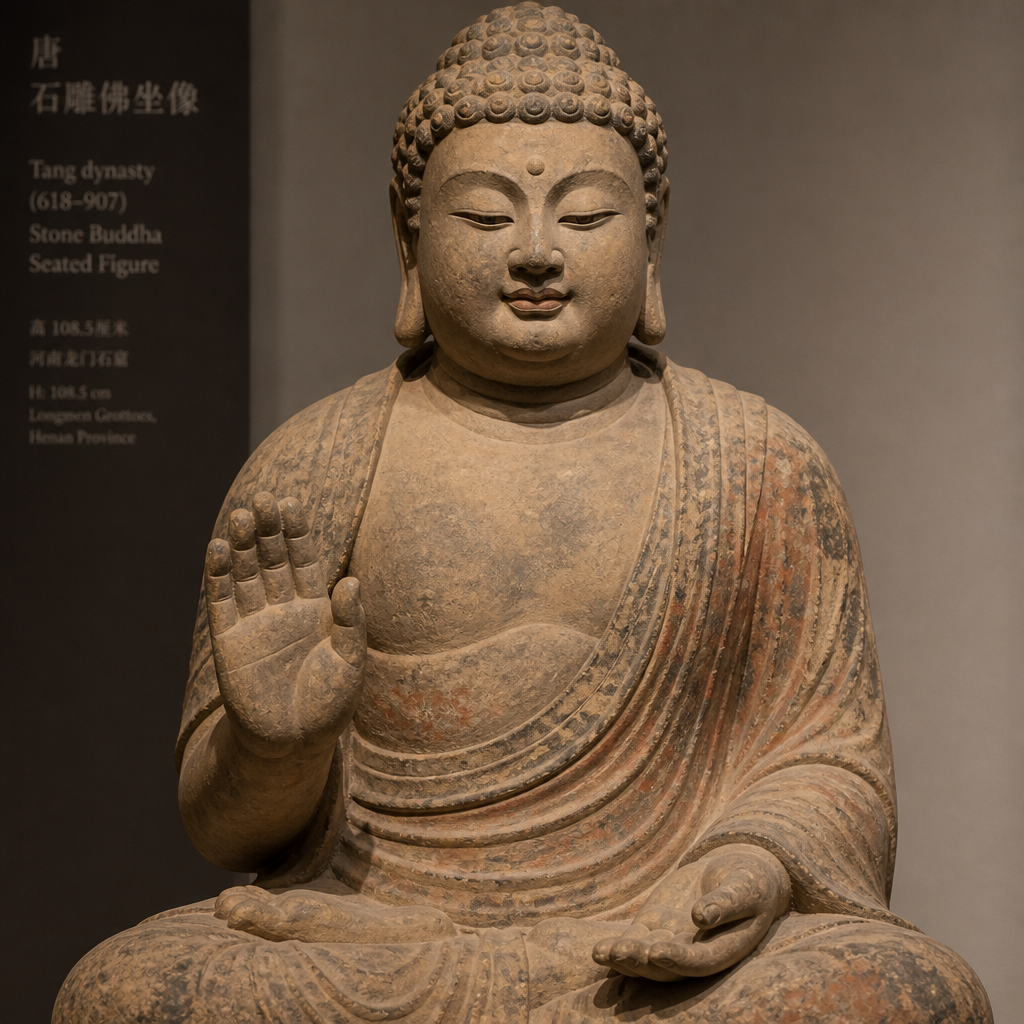
The Tang dynasty produced some of the most confidently sculptured Buddhist figures in Chinese history. Buddhism flourished under the powerfully cosmopolitan Tang court, and the dynasty's openness to foreign influences, sustained by renewed exchange with Indian culture along the Silk Road, pushed sculptors toward a markedly life-like expression that had no real precedent in earlier Chinese work.
Physical Characteristics of Tang Figures
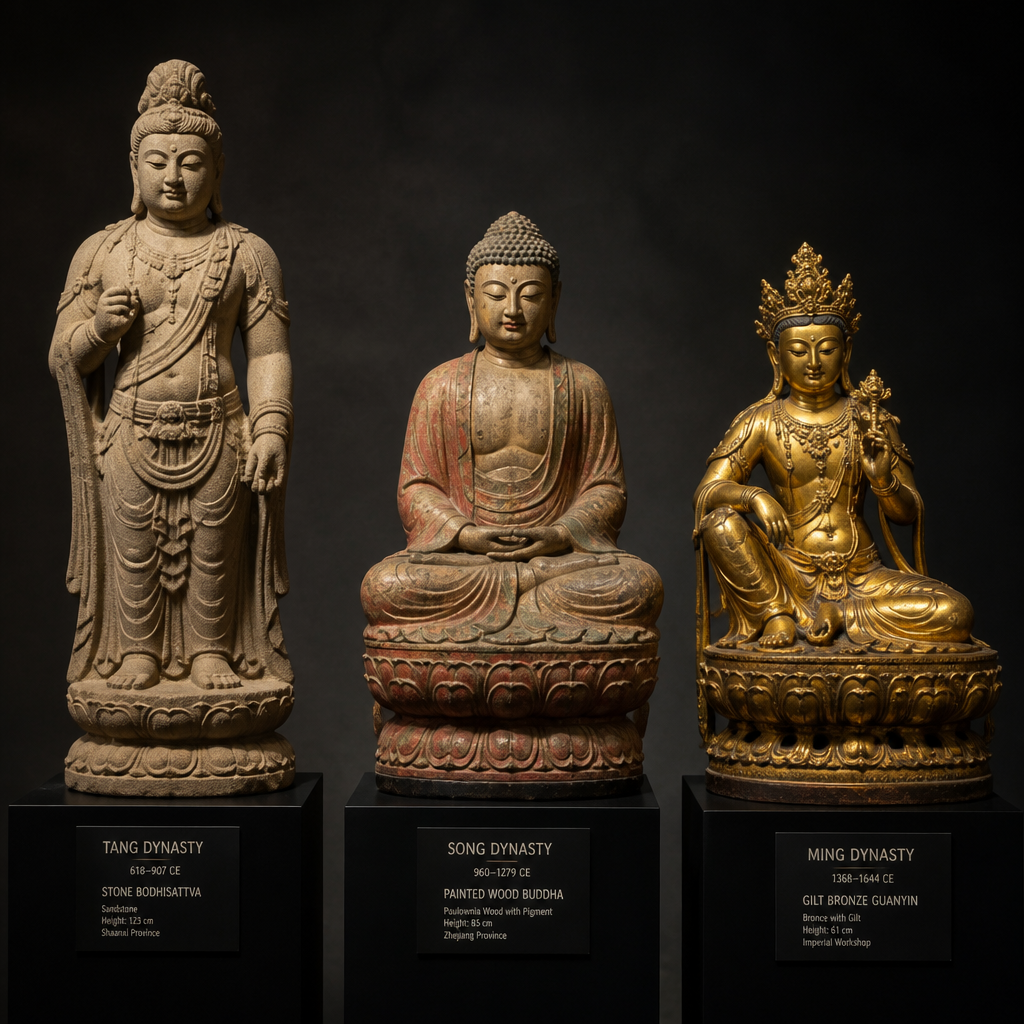
The most recognisable feature of a Tang dynasty Buddha is its robust, tapered physique. Where earlier Northern Wei and Eastern Wei figures had been elongated and schematic, Tang sculptors gave their Buddhas real physical weight: broad shoulders, a full torso, and rounded facial features that convey both authority and serenity. The cranial mound (ushnisha), symbolising enlightened wisdom, is clearly defined and sits naturally within the composition rather than appearing as an afterthought grafted onto the head.
The robe treatment in Tang sculpture is particularly instructive. Drapery folds are articulated and flowing, integrating what art historians describe as Indian sensuality with a distinctly Chinese sense of controlled elegance. The folds move around a body that you believe exists beneath the stone or bronze, rather than decorating a flat surface. This is the core achievement of Tang sculptural naturalism.
Common Tang Materials and Contexts
Tang Buddhist figures were produced in stone (particularly sandstone and limestone from cave-temple complexes in regions such as Sichuan and Shanxi), clay, bronze, and wood. Stone figures from cave temples are among the most architecturally integrated of any period in Chinese Buddhist art. Tang bronze casting is also technically accomplished, though Ming bronzes tend to dominate the auction market. Polychrome clay figures from the Tang period show extraordinary surface sophistication, but their fragility means that intact examples are rare.
The hair treatment on Tang Buddhas is a reliable secondary marker: short, tightly curled hair covering the skull and framing the ushnisha, with a forehead depression (urna) that originally held an inset stone or jewel to represent wisdom. If a piece described as Tang shows loose, flowing hair rather than tight curls, treat that as a significant inconsistency worth investigating.
Song Dynasty Buddhist Sculpture (960-1279 CE)
Song dynasty sculptors inherited the Tang achievement and redirected it. Where Tang figures project imperial confidence, Song figures project something more introspective. The period coincided with the rise of Chan (Zen) Buddhism and a broader cultural movement toward refined, emotionally subtle expression. The result is some of the most psychologically compelling sculpture in the entire Chinese Buddhist tradition.
The Turn to Wood and Polychrome
The most significant material shift in Song Buddhist sculpture was the widespread adoption of wood, particularly paulownia, as the primary medium. This is not simply a matter of material preference. Wood allowed workshops to produce larger figures, more dynamically posed compositions, and surfaces that accepted polychrome and gilding in ways that stone resists. The sensitive carving was enhanced by a layer of gesso and paint, which made surfaces look more lifelike than any stone finish could achieve. Song Guanyin figures in paulownia wood, with traces of their original polychrome and gilding intact, represent one of the high points of Chinese religious art.
Song artists continued the Tang tradition of full, rounded figures for Buddha and bodhisattva representations, but added increased attention to costume detail, jewellery, and textural contrast between flesh, fabric, and ornament. The "Tang ideal beauty," as it is sometimes described by museum curators, evolved during the Song period into something more courtly and more consciously elegant.
The Guanyin in Royal Ease
If you encounter one pose more than any other in Song dynasty Buddhist sculpture, it will be the Guanyin (Avalokiteshvara, Bodhisattva of Compassion) in the "royal ease" or lalitasana posture: one leg pendant, the other drawn up, one arm resting casually on a raised support. This posture combines spiritual authority with a quality of quiet, approachable contemplation. The bodhisattva is often shown gazing slightly downward, suggesting meditation or attentive compassion for the world below.
Song Guanyin figures are among the most desirable subjects in Chinese religious art for serious collectors. Their scale, their polychrome surfaces, and their iconographic richness reward sustained attention in a way that more schematic earlier figures do not. A common mistake is to focus entirely on whether the polychrome is well-preserved rather than reading the underlying carving structure, which is the real indicator of quality and period.
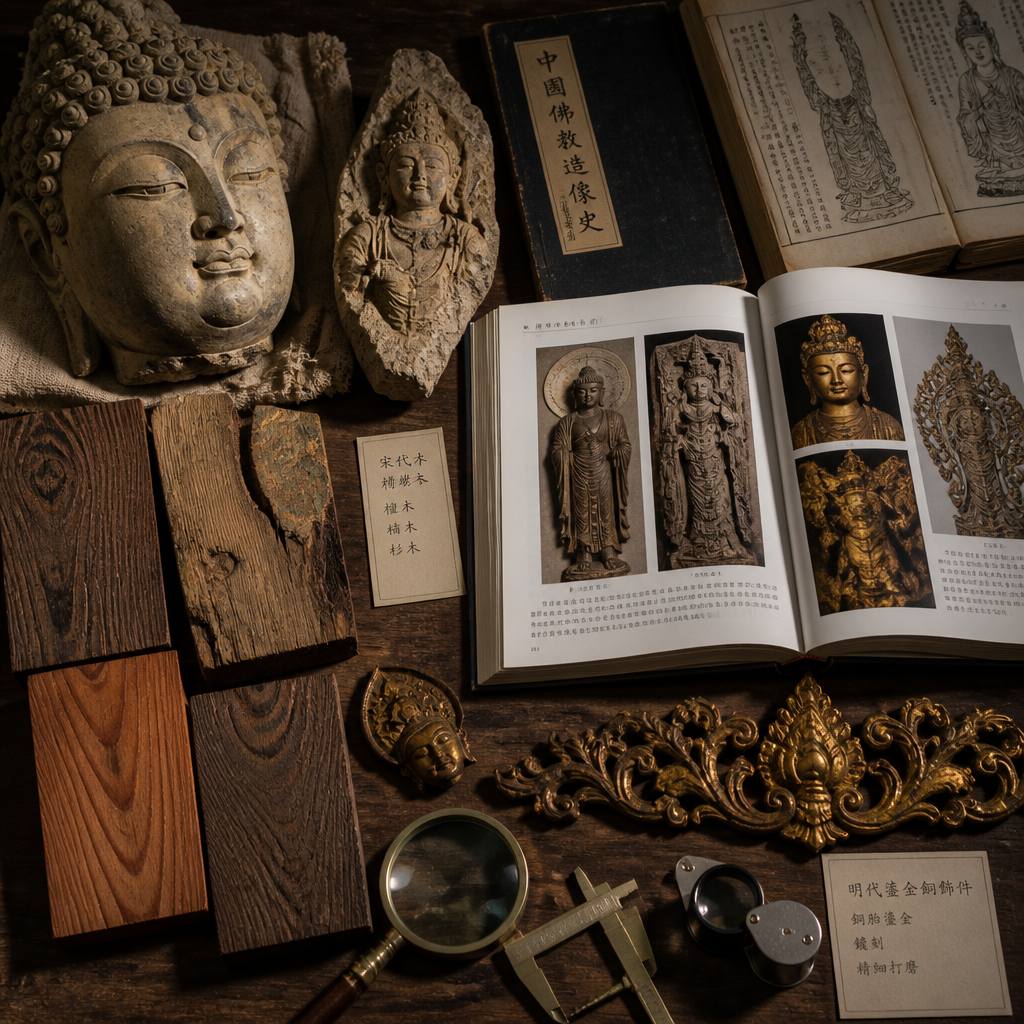
Pro tip: When examining a Song-period wood figure, pay close attention to the construction method. Major Song workshop pieces were often assembled from multiple wood sections joined at structurally sound points, rather than carved from a single block. Evidence of competent joinery in period-consistent locations supports authenticity; crude repairs or inexplicable joins do not.
Ming Dynasty Buddhist Sculpture (1368-1644 CE)
Ming dynasty Buddhist sculpture is where the collector market becomes most active and, frankly, most treacherous. Ming dynasty statues, particularly gilt bronzes, are among the most sought-after Chinese objects at auction globally. A Ming dynasty gilt-bronze seated Buddha sold at Sotheby's Hong Kong reached approximately $30 million, setting a world auction record for Chinese sculpture. That level of market attention creates intense pressure to misattribute later pieces as Ming, so the ability to read authentic Ming characteristics accurately is worth considerable effort.
Imperial Workshop Standards and Their Visual Signatures
The Yongle (1402-1424) and Xuande (1425-1435) reign periods within the Ming dynasty produced the most celebrated imperial bronzes, and their stylistic features were codified and repeated throughout the dynasty. The quintessential imperial Ming style includes wheel-shaped earrings, standardised necklace and ornamentation patterns, specific folds in the dhoti (lower garment), and a double lotus pedestal with round beaded borders. These are not decorative choices. They are a visual vocabulary that identified imperial patronage and workshop authority.
Ming imperial bronzes are almost always gilt. The material of gilt brass is characteristic of Ming imperial statues, and the gilding technique, a mercury-amalgam process fired at high temperature, produces a surface that is distinctly warmer and more reddish in tone than the cold-gilded or electroplated surfaces common on later reproductions. The gilt surface on Ming pieces is also typically delicate in the finest details, showing fine polished lines rather than blurred cast edges, because Ming workshop craftsmen finished their pieces with exceptional care.
What Ming Figures Borrow from Other Traditions
One aspect of Ming Buddhist sculpture that surprises many collectors is how much it absorbed from Nepalese and Tibetan artistic traditions. Ming imperial bronzes often show wide shoulders, a slender waist, and a supple posture that derives directly from Himalayan sculptural conventions rather than purely Chinese ones. This is historically well-documented: Yongle-era court workshops actively engaged Nepalese and Tibetan artists and iconographic programmes. The result is a hybrid aesthetic that is uniquely Ming, neither purely Chinese nor Himalayan, but combining Chinese gilding refinement with Himalayan body ideals.
Ming figures notably do not feature inset gemstones, distinguishing them from many Himalayan examples of similar date. If a bronze is presented as Ming imperial but features gem inlay in the forehead urna or crown, that is a point requiring very careful scrutiny.
Comparing the Three Dynasties at a Glance
|
Feature |
Tang Dynasty (618-907 CE) |
Song Dynasty (960-1279 CE) |
Ming Dynasty (1368-1644 CE) |
|---|---|---|---|
|
Primary material |
Stone (sandstone, limestone), clay, bronze |
Wood (paulownia), with polychrome and gilding |
Gilt bronze (brass alloy), lacquered wood |
|
Body proportions |
Robust, full, tapered physique; naturalistic weight |
Full-bodied, courtly elegance; more textile and jewellery detail |
Wide shoulders, slender waist, Himalayan-influenced posture |
|
Facial character |
Round, serene, life-like; distinctly human warmth |
Psychologically subtle; gentle downward gaze common |
Chubby, compassionate; slightly down-tilted; jewelled crown common on bodhisattvas |
|
Surface treatment |
Carved stone surface; polychrome on clay; bronze patina |
Gesso ground with polychrome and gilding; traces of original paint highly valued |
Mercury-amalgam fire gilding; warm reddish-gold tone; no gem inlay on imperial pieces |
|
Key iconographic marker |
Tight hair curls, clear ushnisha, urna inset, flowing robe folds around a real body |
Lalitasana (royal ease) pose; elaborate costume and jewellery detail; layered textiles |
Wheel earrings, beaded double lotus pedestal, standardised dhoti folds, no gem inlay |
|
Dominant subject |
Shakyamuni Buddha; cave-temple bodhisattvas |
Guanyin (Avalokiteshvara) in multiple forms |
Seated Shakyamuni; bodhisattvas including Wenshu (Manjushri) and Guanyin |
Reading Iconography Across All Three Periods
Dynasty-specific style is inseparable from iconographic convention. The same symbolic features appear across Tang, Song, and Ming work, but the way they are rendered changes dramatically, and those changes carry period information. Learning to read a few core elements accurately puts you miles ahead of buyers who approach Chinese Buddhist sculpture purely as aesthetic objects.
The Ushnisha and Hair
The ushnisha, the cranial protuberance above the skull, symbolises the expanded wisdom gained at enlightenment. In Tang figures it is clearly defined and anatomically integrated into the head. Song carvers sometimes made it more stylised. Ming bronzes tend to present it as a smooth, well-polished dome often topped by a small finial or gem-shaped element. The hair in all three periods follows the convention of tight curls covering the skull, but the depth and regularity of those curls differ: Tang curls are often deeply carved with real three-dimensionality, while Ming bronze curls are precisely cast and uniformly regular.
Mudras (Hand Gestures)
Hand gestures carry specific theological meanings and are one of the fastest ways to identify what type of figure you are looking at. The earth-touching gesture (bhumisparsha mudra), right hand extended toward the ground, identifies the moment of the Buddha's enlightenment. The meditation gesture (dhyana mudra), both hands resting in the lap one atop the other, signals contemplative state. The teaching gesture (dharmachakra mudra) signals the first sermon. These mudras appear across all three dynasties, but the precise rendering of the fingers and the weight distribution of the hands differ enough that a practised eye can use them as corroborating period evidence.
Lotus Pedestals
The lotus pedestal appears in all three periods but its form evolves. Tang pedestals tend to be relatively simple, with petal forms that follow a naturalistic botanical logic. Song pedestals become more elaborate, with multiple layers and jewel-like ornament. Ming imperial pedestals are among the most distinctive: the double lotus form with round beaded borders between the upper and lower registers is essentially a Ming signature, and its presence or absence is one of the first things specialists check when assessing a bronze claimed to be Ming imperial.
Building a Collection with Purpose
Most collectors make one of two mistakes: they either pursue only the most prestigious and expensive period attributions without the knowledge to evaluate them properly, or they collect aesthetically without any historical framework at all. Neither approach builds a coherent or satisfying collection over time.
Start with a Period, Not Just a Subject
Choosing to specialise in one dynasty, at least initially, has real advantages. It narrows the range of materials, proportions, and iconographic conventions you need to hold in your head simultaneously. A collector who understands Tang sculpture well will make better Tang acquisitions than a generalist who spreads attention across six periods. Once that core knowledge is solid, expanding into adjacent periods, say from Tang into the transitional Sui period, or from Ming into early Qing production in the Ming style, becomes a natural extension rather than a bewildering leap.
Museum-Quality Standards in Practice
The phrase "museum quality" is used loosely in the trade, but it has specific meaning when applied rigorously. A museum-quality piece of museum-quality Asian art is one where material, proportions, iconography, and surface treatment all cohere with the stated period and region of origin. It does not require that a piece be of exceptional monetary value. A modest but iconographically consistent Tang stone head with a well-documented provenance is museum quality. An expensive and superficially impressive Ming-style bronze where the gilding technique, lotus pedestal form, and mudra rendering all point to the eighteenth century rather than the fifteenth is not.
The most revealing question to ask of any Chinese Buddhist sculpture is not "is it beautiful?" but "does every element of this piece point toward the same time and place?" When the answer is consistently yes, you have something worth owning.
Provenance and Documentation
For Tang and Song pieces in particular, documented collection history matters enormously. Genuine Tang stone sculpture from cave-temple complexes was largely removed and dispersed in the early twentieth century, and pieces with recorded collection histories from that period are more traceable and more defensible. Ming bronzes, being more recent, sometimes carry more detailed trade records. In all cases, provenance does not replace connoisseurship, but it adds a meaningful layer of confidence alongside close visual analysis.
At HD Asian Art, every piece in the collection is selected against these criteria: material coherence, iconographic integrity, and surface authenticity. The aim is to offer collectors access to genuine examples of the sculptural traditions described in this guide, from Tang-influenced forms through to the Ming aesthetic, across the full range of Asian Buddhist art traditions.
Pro tip: When comparing two pieces in the same price range, always favour the one with stronger iconographic coherence over the one with a more impressive surface. A consistent mudra, a period-correct pedestal, and anatomically logical proportions are evidence of authentic production intent. A spectacular gilded surface on an otherwise inconsistent piece is evidence of someone's investment in appearance, not in authenticity.
Frequently Asked Questions
How do I tell a Tang dynasty Buddha from a Ming dynasty Buddha at first glance?
The fastest single indicator is material. Tang monumental sculpture is predominantly stone or clay; Ming collector-market pieces are predominantly gilt bronze. If the material is correct for the claimed period, look next at the proportions: Tang figures are robustly built with flowing, naturalistic robe folds around a convincing body mass, while Ming figures show the influence of Himalayan conventions, including a wider shoulder-to-waist ratio and a more formalised decorative programme on the pedestal and ornaments.
Why is the Song dynasty Guanyin so significant in the collector market?
Song dynasty Guanyin figures, particularly large polychrome wood examples in the royal ease posture, represent one of the technical and spiritual high points of Chinese Buddhist sculpture. Wood allowed Song carvers to achieve dynamic poses and lifelike surfaces that stone resists, and the combination of sensitive carving, gesso ground, and original polychrome produces objects with a psychological presence that is genuinely rare. Intact polychrome on Song wood sculpture is exceptionally fragile, which makes well-preserved examples correspondingly scarce and valued.
What makes Ming imperial bronzes different from Ming workshop bronzes?
Imperial bronzes produced under Yongle and Xuande court patronage follow a codified visual programme: specific earring forms, beaded double lotus pedestals, standardised dhoti folds, and a mercury-amalgam gilding that produces a distinctively warm, reddish-gold surface. Workshop bronzes of the same period show more variation in these elements and sometimes lower casting precision. The distinction matters enormously for attribution and value, but it requires hands-on familiarity with confirmed imperial examples to assess reliably.
Is it possible to collect authentic Chinese Buddhist sculpture on a moderate budget?
Yes, but it requires redirecting focus. Genuine Tang stone heads with documented provenance, smaller Song-period wooden figures with less polychrome intact, and Ming workshop bronzes that do not carry imperial attribution are all more accessible than headline auction prices suggest. Later Qing dynasty bronzes produced in the Ming style are also a legitimate entry point: they are authentic period objects with their own historical interest, and they are priced accordingly. The key is to buy what you can genuinely evaluate rather than speculating on periods you cannot yet read confidently.
What are the most common authentication mistakes collectors make with Chinese Buddhist sculpture?
Three errors come up repeatedly. First, focusing on patina and surface condition rather than underlying iconographic coherence. A convincing patina on a piece with the wrong mudra, wrong pedestal form, or wrong body proportions for its claimed period is a warning sign, not reassurance. Second, equating impressive scale with authenticity. Large pieces are not inherently more genuine than smaller ones, and large reproductions are commercially motivated by the same logic. Third, overlooking material inconsistencies. If a piece is described as Tang but the primary material is gilt bronze rather than stone or clay, that warrants serious scrutiny of every other element before proceeding.
How does Chinese Buddhist sculpture differ from Thai, Burmese, or Cambodian Buddhist sculpture in terms of collecting considerations?
Each Southeast Asian tradition has its own iconographic conventions, material preferences, and period markers. Chinese sculpture, particularly across the Tang, Song, and Ming dynasties, shows a consistent tension between imported Indian iconographic forms and native Chinese aesthetic ideals of refinement, moral gravity, and courtly elegance. Thai, Burmese, and Cambodian traditions each resolve that tension differently and on different timescales. For a collector, this means that expertise in one national tradition does not transfer automatically to another. The underlying methodology, read material, proportions, iconography, and surface together, does transfer, but the specific visual vocabulary needs to be learned separately for each tradition.
Have you encountered a Chinese Buddhist sculpture that puzzled you in terms of period attribution? Share your experience or questions in the comments below.
References
-
Overview of Buddhist art history across China's major dynasties, from New World Encyclopedia
-
Art Institute of Chicago collection entry on a Tang dynasty Buddha with iconographic analysis
-
Asian Art Museum collection entry on a Song dynasty paulownia wood Guanyin
-
Rubin Museum essay on Ming imperial gilt bronze iconography and workshop standards
-
Curator's analysis of Song dynasty Guanyin sculpture and the Tang ideal of beauty
