



Cambodian Devata Sculptures: The Divine Feminine in Khmer Art
Cambodian Devata Sculptures: The Divine Feminine in Khmer Art
Walk the sandstone corridors of any major Khmer temple and you encounter them at every turn: serene, frontal, adorned, watchful. Cambodian devata sculpture is one of the most distinctive achievements in all of Asian religious art, yet collectors and enthusiasts frequently confuse devatas with apsaras, misread their iconographic language, or underestimate how deeply this tradition connects Hindu and Buddhist cosmology with Khmer political power.
Understanding what these figures actually are, what they guarded, and what makes a well-carved example exceptional, changes the way you see every piece in your collection.
Table of Contents
- Quick Takeaways
- What Is a Devata? Defining the Divine Feminine in Khmer Context
- Devata vs. Apsara: A Distinction Every Collector Must Know
- Iconography and Symbolism: Reading a Devata Sculpture
- The Great Temple Programs: Where Devatas Lived and Why
- Collecting Cambodian Devata Sculpture: What Quality Actually Looks Like
- Frequently Asked Questions
- References
Quick Takeaways
|
Key Insight |
Explanation |
|---|---|
|
Devatas are standing guardian figures, not dancers |
They face forward in a still, frontal pose that signals a custodial, protective role within the temple architecture. Dancing female figures are apsaras, a separate category entirely. |
|
Angkor Wat alone contains close to 1,800 devata carvings |
No two are identical. Their individuality, expressed through distinct jewelry, hairstyles, and expressions, was a deliberate artistic choice, not a production shortcut. |
|
Devatas embody cosmic guardianship and divine femininity simultaneously |
Their placement at doorways and key architectural thresholds signalled control over access between the mundane world and the sacred interior of the temple. |
|
Banteay Srei's red sandstone devatas are the finest surviving examples of intricate carving |
The 10th-century temple, dedicated to Shiva and Parvati, shows a level of detail rarely matched elsewhere in the Khmer canon, partly because of the fine-grained quality of the stone. |
|
The Khmer Empire blended Hindu and Buddhist iconography throughout devata imagery |
Individual temples could shift emphasis, but devatas persisted across both religious programs, adapting their symbolic roles to the prevailing cosmology of each reign. |
|
Crown and jewelry type identify period and regional workshop style |
The form of a devata's tiered crown, the treatment of her earrings, and the geometry of her sampot border are reliable period markers for experienced collectors. |
|
A contemporary reproduction can be judged by the same iconographic principles as an antique |
Quality carvings, whether antique or newly made in the tradition, should maintain the frontal stance, serene expression, correct adornment hierarchy, and proportional refinement of the classical canon. |
What Is a Devata? Defining the Divine Feminine in Khmer Context
The Sanskrit root is straightforward: deva means divine being, and devata extends that to denote a celestial figure, a deity of secondary rank who serves the great gods and maintains cosmic balance. In Hindu and Buddhist cosmology, devatas occupy the sacred middle ground between fully transcendent divinity and the human world. They are attendants, guardians, and embodiments of divine virtue rather than supreme gods in their own right.
In Khmer temple architecture, that cosmological role became architectural function. Devatas were carved at key structural points, beside doorways, at pilaster junctions, along gallery walls, precisely where the boundary between profane and sacred space required marking and protecting. Their serene, forward-facing stance was not passive. It was the visual language of guardianship, a signal that this threshold was watched over.
The Khmer Empire, which governed a vast territory centred on modern Cambodia from roughly 802 to 1431 CE, placed devata imagery at the heart of its temple-building program. The scale is almost impossible to absorb without standing inside the corridors of Angkor Wat and walking its full circuit. Devatas appeared in their thousands, each one a separate portrait, a separate presence, within a unified architectural system designed to represent the cosmos in stone.
These figures are not repeated decorative templates. Their distinct adornment and facial character create a rhythm of variation across the temple's sandstone surfaces, and that individuality tells us something fundamental about Khmer artistic priorities: precision and repetition mattered, but so did difference within order.
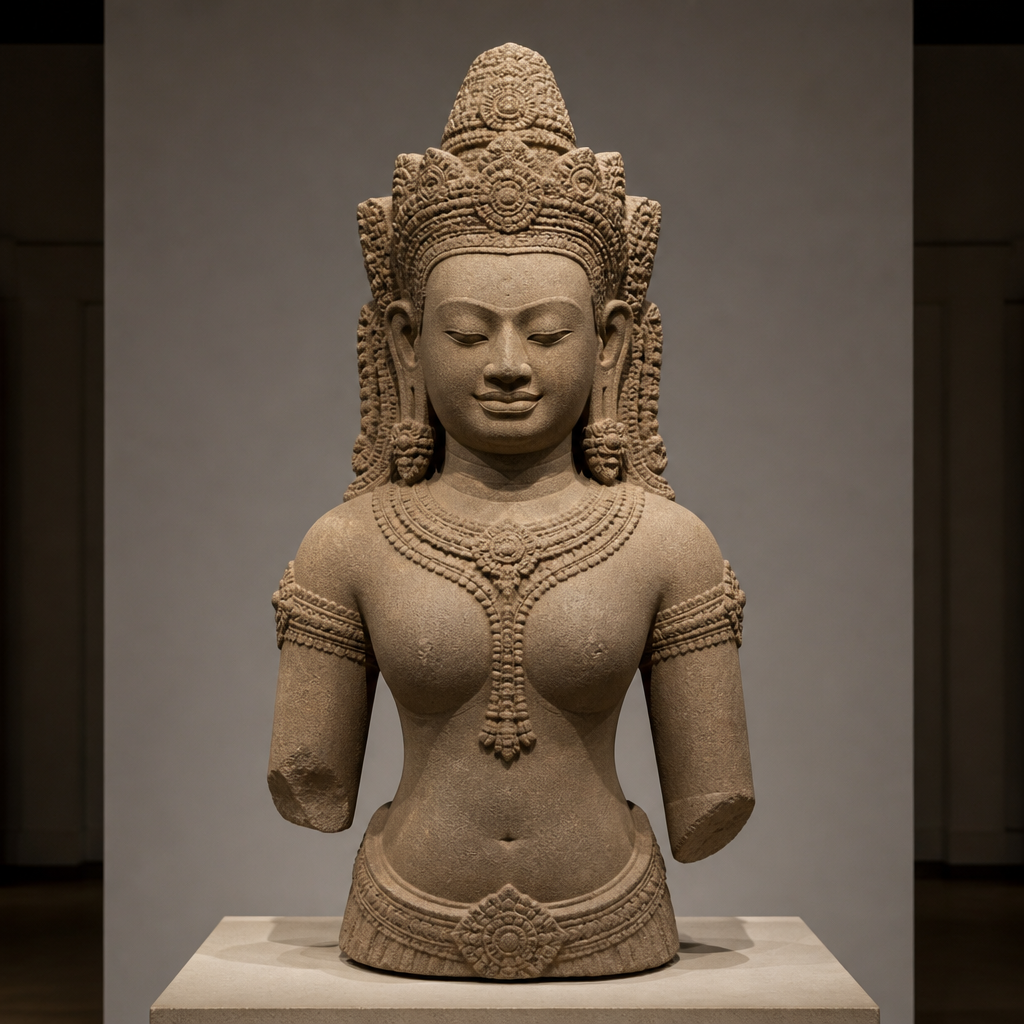
For the collector of Asian religious art, this is the first and most important point: a devata is never purely ornamental. Every formal decision, the angle of the hands, the layering of the crown, the geometry of the sampot, carries symbolic weight that the original temple-builders calibrated with care.
Devata vs. Apsara: A Distinction Every Collector Must Know
The confusion between devatas and apsaras is the single most common error in popular writing about Khmer temple art. It matters because the two figures carry different iconographic meanings, occupy different positions within the temple program, and represent distinct aspects of the Khmer divine feminine.
The Apsara: Celestial Dancer in Motion
Apsaras are ethereal beings associated with movement, performance, and the celestial realm. In Indian cosmological tradition, which the Khmer absorbed and adapted, apsaras danced in the palaces of the gods. Their carved representations show them in motion or poised to move: bent knees, turned torso, arms in dance gesture. They are dancers, and their dynamism is the point.
In Khmer religious thinking, apsaras were connected to the souls of the dead on the battlefield, guiding them to the supernatural world. This funerary-cosmological role gave them specific placement within temple relief programs, particularly in narrative galleries depicting warfare and divine intervention.
The Devata: Guardian Fixed at the Threshold
Devatas stand still. That stillness is definitional. Female figures depicted individually or in small groups, facing forward in the manner of temple guardians or custodians, are devatas. The frontal, static pose signals not passivity but authority. They are positioned to monitor access, to mark the boundary between the mundane and the sacred, and in some interpretations to represent actual members of the royal Khmer court as idealized divine women.
A common mistake among newer collectors is to use both terms interchangeably in auction descriptions and exhibition labels. The practical consequence is that iconographic detail gets lost. When acquiring a piece described as either figure type, look first at the pose. Motion signals apsara; stillness signals devata. Everything else, crown, jewelry, hand gesture, attribute, builds from that fundamental distinction.
Pro tip: When evaluating a Khmer female figure, check the knees first. Bent, asymmetric knees in a dancing posture identify an apsara. Straight, aligned, forward-facing legs are the devata's signature. This single visual test will resolve the majority of misidentified pieces you encounter.
Iconography and Symbolism: Reading a Devata Sculpture
A Cambodian devata sculpture is a layered visual text. Each element of dress, crown, gesture, and expression connects to a specific meaning within the broader program of Khmer temple iconography. Knowing how to read that text transforms a beautiful object into a legible one.
The Tiered Crown
The mukuta, or tiered crown, is the single most important dating marker on a devata figure. Crown forms evolved across the major Khmer artistic periods. The relatively restrained, conical crowns of early Khmer periods gave way to increasingly elaborate, multi-tiered structures in the Angkor Wat and Bayon periods. The geometry of the crown's tiers, whether cylindrical, foliate, or flame-shaped at the apex, connects a figure to a specific workshop tradition and chronological window. Experienced collectors in Asian religious art treat the crown as the equivalent of a hallmark.
Jewelry and Garments
Devatas wear substantial jewelry: earrings, multiple necklaces, armlets, bracelets, and anklets. The treatment of each element tells you about the period and regional workshop. Banteay Srei devatas from the 10th century show jewelry of exceptional intricacy, with each element individually modeled in fine relief. Later Angkor-period devatas, working in harder stone at greater scale, sometimes simplify these details while maintaining compositional grandeur. The sampot, the wrapped lower garment, appears in distinct regional variants, and the treatment of its folded border and central panel is a reliable stylistic marker.
Hand Gesture and Held Attributes
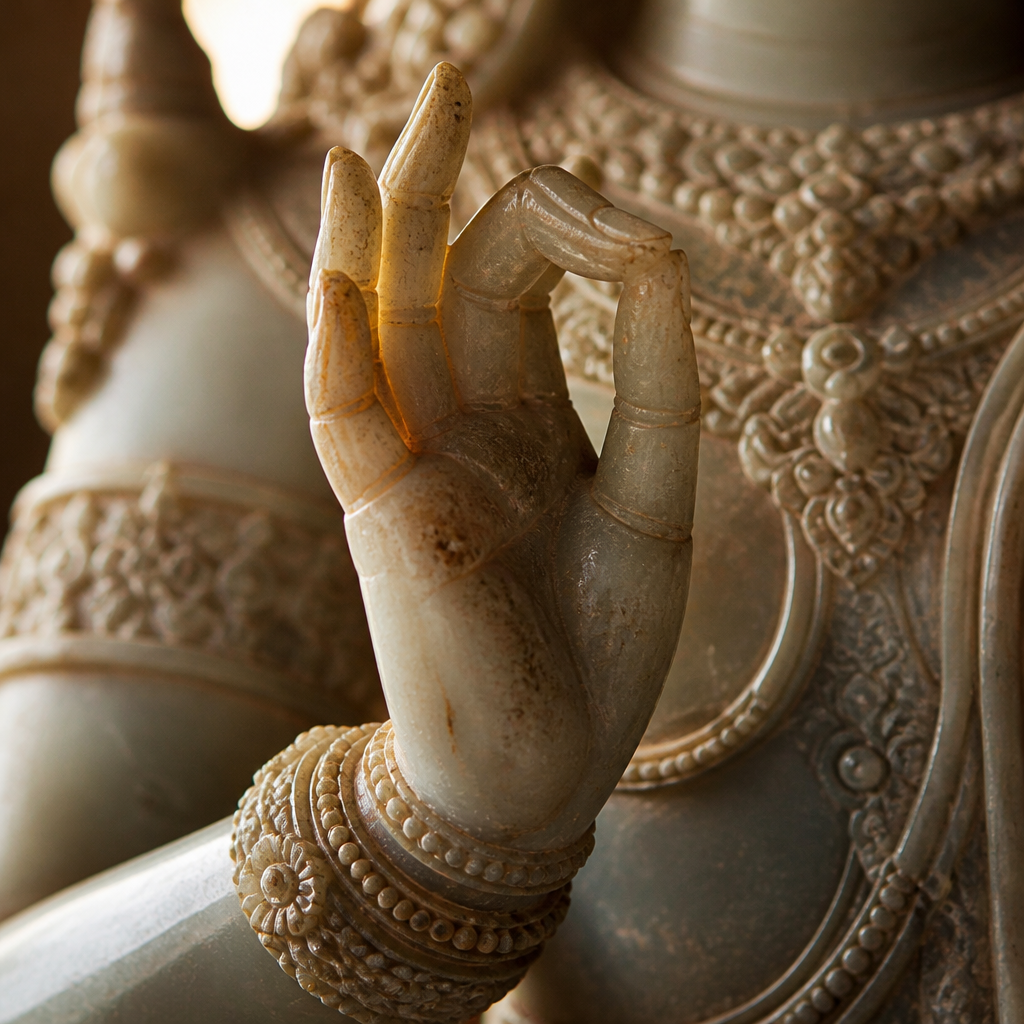
Many devatas hold an attribute in one hand: a flower, a lotus bud, or a small bird. Others simply hold their hands in a relaxed position at the sides or slightly raised. Unlike the elaborate mudra system governing Buddhist deity images, devata hand gestures are not strictly codified across the tradition. They vary by temple program and period. What matters is the quality of the hand carving itself: elongated, tapered fingers with gently curved nails are a mark of refined execution and a feature worth examining closely on any piece.
The Serene Expression
Across all periods and all temples, the devata's face maintains a controlled serenity. The lips carry a subtle, closed smile. The eyes are wide, slightly downward-cast, and elongated toward the temples. This expression is not emotionally neutral: it communicates a specific quality of divine composure, an awareness that is present without being reactive. When a carving fails at this, the piece loses its essential character regardless of how well the jewelry or crown is handled.
The Great Temple Programs: Where Devatas Lived and Why
The devata tradition reached its fullest expression across several of the Khmer Empire's great temple-building campaigns. Each site developed the form in response to its specific dedicatory purpose, materials, and the religious priorities of the king who commissioned it.
Angkor Wat: The Devata at Scale
Built in the 12th century by King Suryavarman II as a state temple and royal mausoleum, Angkor Wat houses the largest single collection of devata imagery in the world. Close to 1,800 devata figures have been documented across its walls, galleries, and tower structures. The overall layout of Angkor Wat represents Mount Meru, the cosmological axis shared by Hindu and Buddhist tradition, and the devatas positioned throughout that layout reinforce the temple's function as a sacred universe in miniature.
What distinguishes Angkor Wat's devata program is its insistence on individuality within a standardized pose. Scholars have noted that the women depicted may represent actual members of the royal Khmer court, their portraits serving both religious and commemorative functions within the temple's larger iconographic system. Whether or not each figure is a specific portrait, the carving quality, especially in protected gallery areas where fine surface detail has survived, remains among the finest produced in the Khmer tradition.
Banteay Srei: The Jewel of Devata Carving
Banteay Srei, located approximately 25 kilometres northeast of the main Angkor temple group, was completed around 967 CE and dedicated to the Hindu gods Shiva and Parvati. It is built primarily from red sandstone, a fine-grained stone that allowed carvers to achieve a level of detail impossible in the coarser grey sandstone used at larger temple sites. The result is devata figures of extraordinary refinement, with jewelry elements, textile patterns, and facial features rendered at a precision that has led many art historians to consider Banteay Srei the benchmark for Khmer figural carving quality.
The name Banteay Srei itself means "Citadel of Women" in Khmer, a name that acknowledges the temple's exceptional female imagery. Its devatas represent an artistic achievement that subsequent builders referenced throughout the later history of the tradition.
Ta Som and Preah Khan: Devatas Under Jayavarman VII
King Jayavarman VII, who ruled in the late 12th century, built Ta Som and oversaw the construction of Preah Khan as part of an enormous building program that shifted the empire's official religion toward Buddhism while retaining much of the visual vocabulary developed under the earlier Hindu program. Devatas at both temples show the transition: the figures maintain the frontal guardian stance and elaborate adornment of the classical devata type, but the surrounding iconographic program incorporates Buddhist imagery and cosmology.
At Preah Khan, scholars have estimated that as many as 100,000 people once lived, worshiped, and studied at what functioned as a major Buddhist university. The devatas embedded throughout Preah Khan's walls served as guardians of a sacred learning institution, not merely a royal mausoleum or state temple. That functional context is preserved in the figures themselves.
Pro tip: When researching a Cambodian devata piece, identify which temple program or period tradition it references before assessing the quality of the carving. Banteay Srei-style figures will prioritize surface detail and jewelry precision. Angkor Wat-style figures will prioritize compositional grandeur and the subtle modeling of the face. Judging one by the standards of the other produces consistently wrong conclusions.
Collecting Cambodian Devata Sculpture: What Quality Actually Looks Like
For collectors of Khmer temple art and Asian religious art, the devata figure presents a specific evaluative challenge. The iconographic tradition is highly developed, the formal requirements are precise, and quality execution depends on the carver understanding all of it, not just the surface appearance.
The Comparison: Key Approaches to Acquiring Devata Sculptures
|
Approach |
Strengths |
What to Watch For |
|---|---|---|
|
Museum-quality reproductions in traditional materials |
Full iconographic fidelity, archival stability, no provenance complications, displays the tradition at its best |
Confirm the carver worked within an authentic regional tradition and not from simplified photographic reference alone |
|
Antique Khmer stone or bronze fragments |
Historical authenticity, direct connection to the original temple program |
Provenance documentation is essential; the market for unprovenanced Khmer antiquities carries serious legal and ethical risks |
|
Contemporary studio bronzes in Khmer style |
Allows for full-figure representation, controlled finish, and integration with home altar or collector display contexts |
Verify that mudra, crown form, and compositional hierarchy match the historical canon rather than a simplified or hybrid interpretation |
In practice, the most reliable indicator of quality in any devata figure, antique or contemporary, is the face. The carved Khmer face demands that a carver work at an almost meditative level of precision with very limited margin for correction. A face that achieves the classical devata expression, composed, wide-eyed, serenely smiling, with correctly proportioned features, signals that the carver understood the tradition from within, not just from the outside. A face that misses this quality, regardless of how elaborate the crown or jewelry may be, will not satisfy an experienced collector.
The second test is proportional coherence. Devata figures in the classical tradition show a specific ratio between head size, torso length, and the treatment of the lower body. The figure should feel grounded and authoritative, not attenuated or top-heavy. When these proportions are wrong, no amount of surface detail compensates.
For collectors building a home altar or a dedicated collection of Khmer divine feminine imagery, a well-selected devata figure does work that purely abstract devotional objects cannot. It places the viewer in relation to a specific cosmological tradition, one in which the divine feminine was understood as a guardian of sacred boundaries, a keeper of cosmic order, and a figure of genuine spiritual power within the religious life of one of Southeast Asia's greatest civilizations.
Frequently Asked Questions
What is the difference between a devata and an apsara in Khmer sculpture?
The key distinction is posture and function. Devatas stand still in a frontal, guardian pose and were positioned at temple thresholds to protect sacred space. Apsaras are shown in motion or dancing posture and are associated with celestial performance and, in some contexts, the souls of the dead. If a female figure is dancing or appears to be in movement, it is an apsara. If she stands still, facing forward, in a custodial pose, she is a devata.
Why do Khmer devata figures all look slightly different from one another?
The individuality of devata figures at major temples like Angkor Wat was deliberate. No two share exactly the same crown, jewelry configuration, or expression. Scholars have proposed that many devata figures represent actual women of the royal Khmer court, serving both religious and commemorative functions. Whether or not each is a specific portrait, the insistence on visual variation within a standardized pose reflects a Khmer artistic philosophy that valued difference within order, not mechanical repetition.
Which Khmer temples are most important for understanding the devata tradition?
Angkor Wat is the most important for sheer scale: close to 1,800 devata figures make it the largest single corpus of this imagery anywhere. Banteay Srei, the 10th-century temple dedicated to Shiva and Parvati, is the most important for carving quality, with its fine red sandstone allowing levels of detail that define the tradition's upper limit. Preah Khan and Ta Som, both associated with King Jayavarman VII, show how the devata form adapted to Buddhist temple programs in the late 12th century.
What should a collector look for when assessing the quality of a Cambodian devata sculpture?
Start with the face. The classical Khmer devata expression requires a very specific combination of wide eyes, subtle downward gaze, elongated features, and a composed, closed-mouth smile. This is the hardest element to achieve and the most revealing test of a carver's mastery. After the face, assess proportional coherence between head, torso, and lower body, and then examine the treatment of the crown and jewelry for period consistency and carving precision. Surface detail that looks elaborate but sits over incorrect proportions or a failed face is a warning sign, not a selling point.
Is it appropriate to display a Cambodian devata sculpture in a home altar or spiritual practice space?
Yes, and historically devatas were never purely decorative objects. Their role as guardians of sacred space makes them entirely appropriate as focal points in a home altar, meditation room, or collection dedicated to Southeast Asian spiritual traditions. The devata's original function, marking and protecting a sacred threshold, translates naturally to a personal practice context. Placing a devata figure at the entrance to a meditation space or alongside primary Buddhist or Hindu deity images reflects the same iconographic logic the Khmer builders applied at Angkor.
How does the Khmer devata tradition relate to Hindu goddess imagery more broadly?
Khmer devatas are connected to the broader Hindu tradition of divine feminine figures, including Lakshmi, Parvati, and Saraswati, but they are not direct representations of named goddesses. They occupy a middle register in the divine hierarchy: more powerful and sacred than human figures, but subordinate to the principal deities the temple was built to honor. Their role was to embody and transmit the divine qualities of beauty, virtue, cosmic order, and protective power within the temple's architectural system, functioning as the living presence of the sacred feminine throughout the building rather than as individually named deity images.
If you are building a collection of Khmer or broader Asian religious art, or if a devata figure has deepened your appreciation of the divine feminine in Southeast Asian sculpture, we would love to hear what draws you to this tradition and what questions remain unanswered for you.
References
