



Buddha Statue for Home: Room-by-Room Placement Guide
Buddha Statue for Home: Room-by-Room Placement Guide
Most people who buy a Buddha statue for home spend the most time choosing the piece itself and almost no time thinking about where it will actually go. Then they place it on the nearest empty shelf, feel vaguely unsatisfied, and wonder why the statue never quite transforms the space the way they imagined.
The problem is almost never the statue. It is placement, scale, and pose working against each other. This guide walks through every major room in the home, tells you which poses and materials belong where, and explains the reasoning behind each recommendation so you can make confident decisions rather than just follow rules you do not understand.
Table of Contents
- Quick Takeaways
- Understanding Pose Before Placement
- Room-by-Room Placement Guide
- Choosing the Right Material for Each Space
- Regional Style and What It Changes
- Comparing Placement Approaches
- Common Placement Mistakes to Avoid
- Frequently Asked Questions
- References
Quick Takeaways
|
Key Insight |
Explanation |
|---|---|
|
Pose dictates room suitability |
A meditating Buddha belongs in quiet spaces; a protection or teaching Buddha works at entrances and living areas where energy is more active. |
|
Height matters as much as location |
Place statues at eye level or slightly above. Never on the floor. Low placement diminishes both the visual effect and the sense of reverence. |
|
Material shapes the mood of a room |
Bronze adds permanence and formality; wood adds warmth and intimacy; stone adds groundedness best suited to stable, dry spaces. |
|
Facing direction is not decorative preference |
Statues facing inward toward a room, or toward the main entrance, anchor a space. A statue facing a wall or corner loses its focal power entirely. |
|
Regional origin changes the visual character significantly |
A Burmese Buddha and a Japanese Buddha can share the same mudra but look entirely different. Match regional style to your interior aesthetic deliberately. |
|
Avoid bathrooms and kitchens without exception |
These are high-activity, utilitarian spaces unsuitable for sacred objects, regardless of available shelf space. |
|
Scale must be proportional to the surface and room |
A 10 cm statue on a large sideboard disappears. A 60 cm statue on a small bedside table overwhelms. Measure the space before selecting. |
Understanding Pose Before Placement
Before thinking about any specific room, you need to understand what the statue is actually doing. Each mudra, or hand gesture, tells a specific story about the moment it represents on the path to enlightenment. Placing a statue without understanding its pose is like hanging a painting without noticing the subject matter: the result may be pleasant, but it is not intentional.
The most common poses you will encounter when looking to buy a Buddha statue are the Dhyana mudra (deep meditation, both hands resting in the lap), the Abhaya mudra (protection, right hand raised with palm facing outward), the Bhumisparsha mudra (earth-touching, right hand reaching toward the ground), the Vitarka mudra (teaching, thumb and index finger forming a circle), and the reclining pose representing the moment of parinirvana. Each has a natural home in the house, and none of them is interchangeable.
The Laughing Buddha warrants a separate note because it is culturally distinct. Originating from Chinese folk tradition rather than Theravada or Mahayana Buddhist iconography, it represents abundance and good fortune, and it has its own placement logic, particularly suited to entranceways and living areas rather than meditation corners.
A Buddha statue placed without understanding its pose is a decoration. A Buddha statue placed with intention is a practice. The difference is not in the object, but in the attention brought to choosing it.
The five poses most collectors encounter
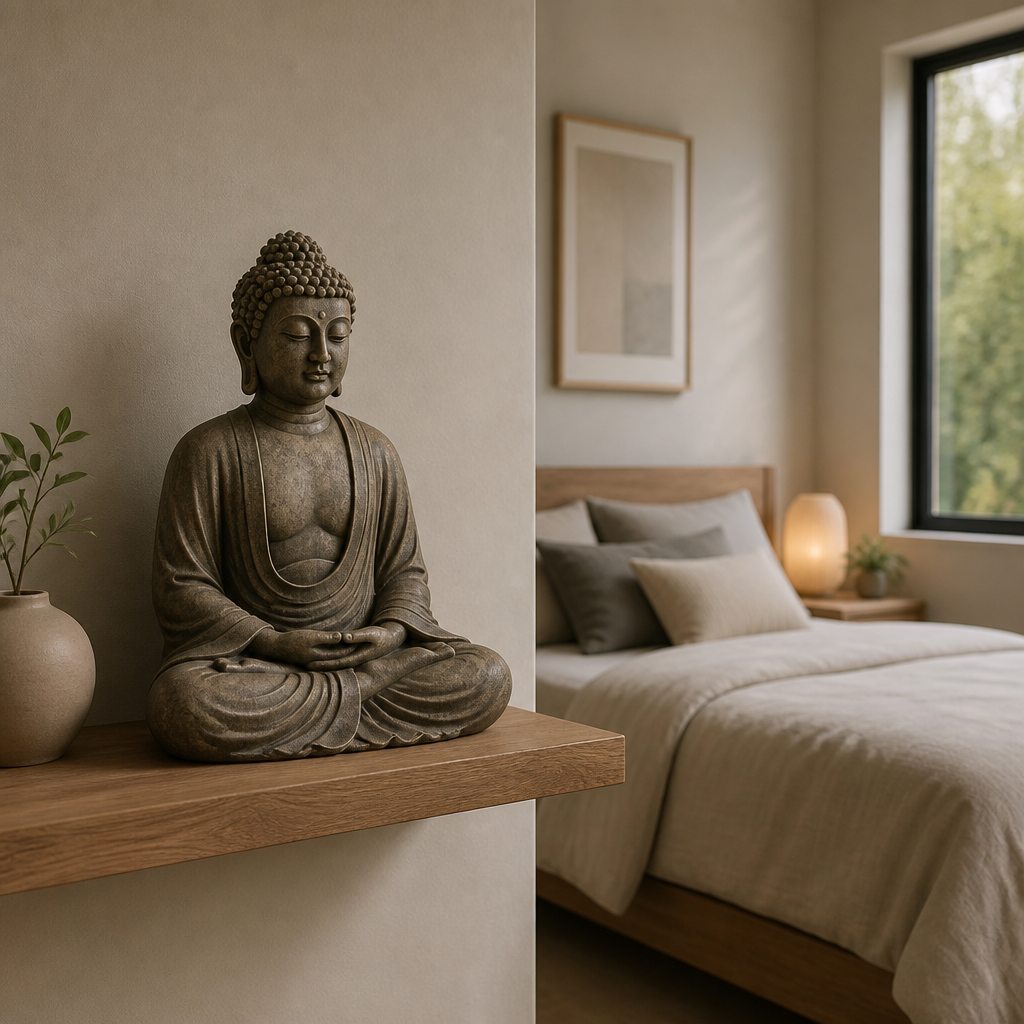
The meditating Buddha is the most widely available and the most misplaced. It belongs in genuinely quiet spaces: a dedicated meditation room, a reading nook, a bedroom if the bedroom is used for reflective rest rather than high activity. The reclining Buddha, showing the Buddha at the moment of final nirvana, projects calm and acceptance. It works well horizontally in living spaces where the scale allows it to be read properly.
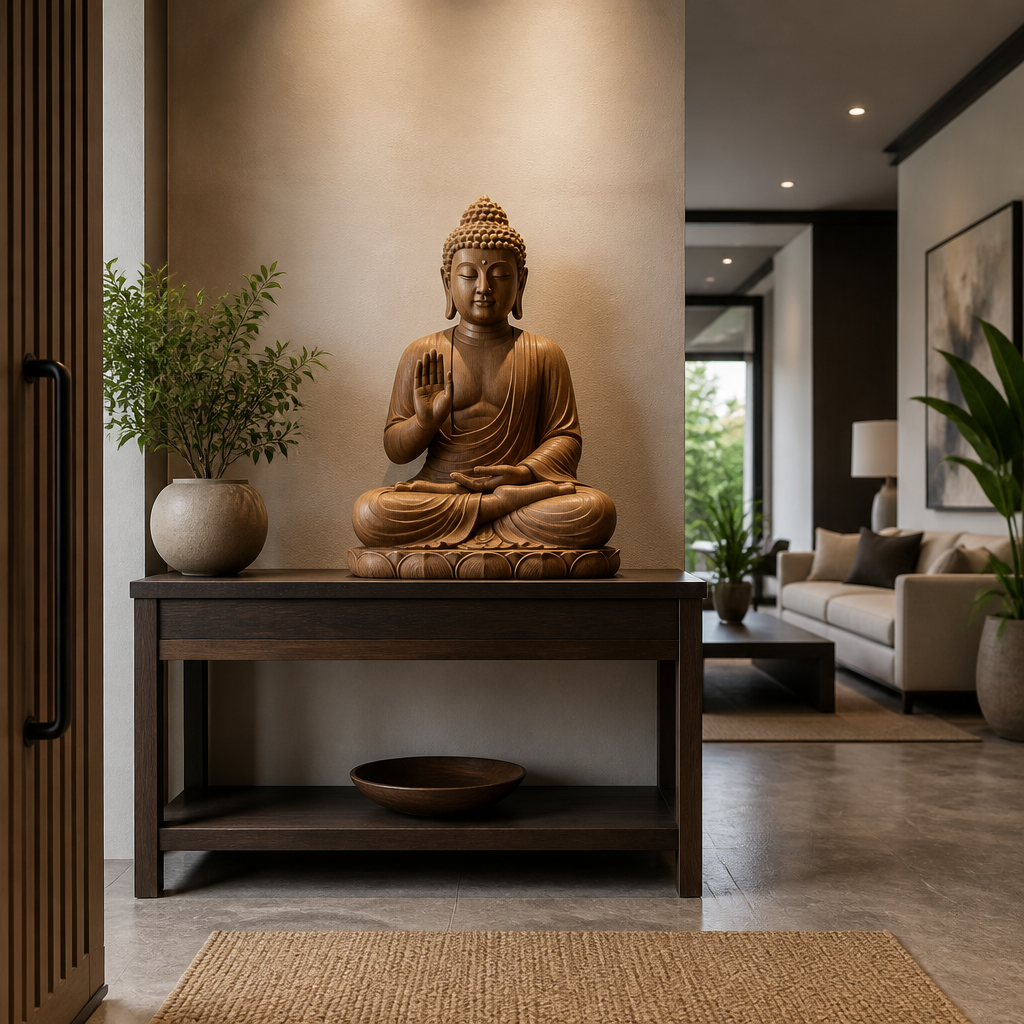
The protection pose (Abhaya mudra) is active and outward-facing, which is exactly why it suits entranceways and living rooms rather than contemplative corners. The teaching Buddha (Vitarka or Dharma Chakra mudra) communicates, which makes it appropriate in study spaces, home offices, and rooms where conversation or learning happens. The earth-touching pose (Bhumisparsha) represents the moment of enlightenment itself, the most pivotal in the Buddha's story, and carries enough narrative weight to serve as the centrepiece of a dedicated altar or spiritual corner.
Room-by-Room Placement Guide
Room function should drive statue choice. When you reverse that logic and choose a statue first and then try to find it a home, you almost always end up with a mismatch that leaves the piece feeling decorative at best and awkward at worst.
Entrance and hallway
The entrance is the most natural location for a Buddha statue for home use, and the most commonly underused. A statue here creates an immediate transition from the outside world into the interior atmosphere of the home. The protection pose (Abhaya mudra) or a Laughing Buddha positioned facing inward toward the house works best here. Both are actively welcoming rather than inwardly contemplative.
Keep scale modest in narrow hallways. A statue between 20 and 40 cm in height, placed on a console table or dedicated plinth, works well without crowding the space. Avoid the common mistake of placing the statue on the floor to fill a corner: the floor is the wrong height and the wrong context for any sacred object.
Pro tip: In a hallway with limited surface space, a wall-mounted bracket at eye level solves the problem cleanly. A bronze or brass statue with a warm patina catches incidental light from a ceiling fixture and creates exactly the kind of threshold moment the entrance deserves.
Living room
The living room is where most collectors place their best piece, and it is a reasonable instinct. This is where guests spend time, where the household gathers, and where the aesthetic character of the home is most legible. The meditating Buddha, the teaching Buddha, and the reclining Buddha all work here, each in different ways.
A meditating Buddha on a fireplace mantle or dedicated shelf creates a calm anchor for the room without dominating it. A teaching Buddha on a console table or bookcase shelf communicates engagement. A reclining Buddha needs horizontal space to read correctly: a long low credenza or media unit is ideal, not a narrow shelf.
Position the statue so that it faces into the room or toward the main entrance. A statue facing a wall or tucked into a corner loses its visual and spatial logic entirely. Keep the surface it sits on uncluttered: one or two complementary objects at most, such as a small incense holder or a single stone, rather than surrounding it with unrelated objects.
Meditation room or dedicated spiritual corner
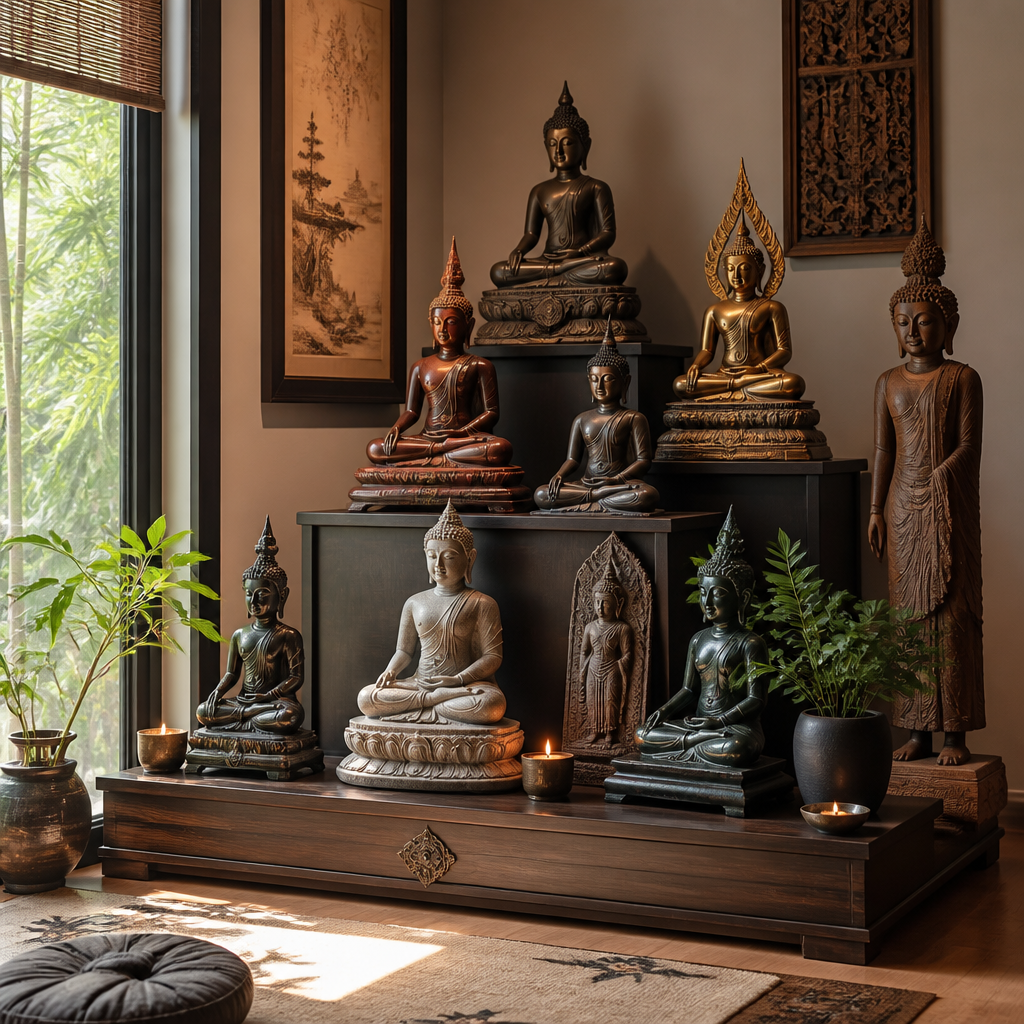
This is the most purposeful placement and the one where the choice of pose matters most. The meditating Buddha or the earth-touching pose belongs here. Both support the intention of the space directly rather than ornamentally.
Position the statue at eye level when seated, roughly three to six feet away from where you sit. This creates a natural focal point for the gaze during practice without requiring you to strain upward or downward. The statue should be the primary visual object in this space: resist the temptation to surround it with too many competing objects, however meaningful each one is individually.
Pro tip: A dedicated altar with a single large meditating Buddha in bronze or stone is more effective than five small statues arranged together. Single-point focus during meditation is not a preference, it is a practice principle.
Study and home office
This is an underused location that rewards thoughtful placement. The teaching Buddha is the obvious choice, but a meditating Buddha also works well here as a prompt toward focus rather than as a strictly religious object. Keep the statue to the side of your workspace rather than directly in your sightline when working, where it can serve as an anchor without becoming a distraction.
Scale should be modest in a work environment: a statue between 15 and 30 cm is sufficient. Larger pieces compete with the functional demands of the space. A brass or bronze statue works particularly well on a desk or bookshelf because its surface handles the variable humidity and temperature of a frequently used room without the sensitivity of wood.
Bedroom
The bedroom is a genuinely contested placement in both Vastu and general Buddhist interior practice. Many traditional guidelines advise against placing sacred statues in bedrooms on the grounds that the bedroom combines rest, intimacy, and high personal activity in ways that sit uneasily with devotional objects. That is a position worth taking seriously rather than dismissing as superstition.
If you do place a statue in a bedroom, restrict it to a small meditating Buddha in a dedicated corner that is visually separated from the sleeping area, ideally with its own small surface or shelf. Avoid placing a statue directly beside or facing the bed. A statue integrated into a small meditation corner within a large bedroom can work well without the placement feeling forced.
Garden and outdoor spaces
Outdoor placement has its own logic. Stone statues are the obvious choice for gardens because stone weathers predictably and gracefully. Bronze also works outdoors in temperate climates, developing a natural patina over time that many collectors prefer to the polished original surface. Wood does not belong outdoors unless it is specifically sealed for exterior use, and even then, the seasonal humidity fluctuations of most UK gardens make wood a poor long-term choice for exterior display.
A garden Buddha benefits from natural framing: set within low planting, beside a water feature, or under a tree canopy. Placing a statue on bare paving without any surrounding context makes it look isolated rather than integrated. The meditating pose works particularly well outdoors because the stillness of the pose reads against the movement of planting and weather in a visually compelling way.
Choosing the Right Material for Each Space
Material is not purely an aesthetic decision. It is also a practical one driven by the environment of the room where the statue will live. The two decisions should be made together, not sequentially.
Bronze and brass
Bronze and brass are the most durable choices for indoor placement across all room types. They handle variable humidity, moderate temperature changes, and the general conditions of inhabited rooms without deterioration. Bronze in particular develops a patina over time that deepens its visual character rather than diminishing it. This makes bronze well suited to living rooms, studies, and entrance halls where the statue will be seen frequently and potentially touched.
Brass has a warmer, more luminous surface than bronze and catches available light more readily. In a room that relies on warm incandescent or candlelight, brass statues have a quality that bronze, with its cooler undertone, does not quite match.
Stone
Stone reads as grounded and ancient in a way that metal does not. It works best on stable, weight-bearing surfaces and in rooms where permanence is part of the intended atmosphere: a dedicated altar, a meditation room, or a garden. Stone does not belong on glass shelving or lightweight furniture, both because of the physical weight and because the visual heaviness of stone reads awkwardly on delicate surfaces.
Wood
Wood is the warmest material and the most environmentally sensitive. It brings intimacy and a sense of organic craft that suits study rooms, reading corners, and spaces designed for quiet personal use rather than communal activity. Keep wooden statues away from kitchens, bathrooms, and anywhere with significant humidity fluctuation. Direct sunlight will bleach and crack the surface over time. For a UK home with central heating that creates very dry winter interiors, wood requires more environmental management than bronze or stone.
Regional Style and What It Changes
A common mistake among first-time collectors is treating all Buddha statues as stylistically interchangeable and choosing purely on the basis of pose and size. In practice, a Thai Buddha and a Japanese Buddha and a Cambodian Buddha can share the same mudra and look so different from each other that they belong in entirely different interiors. Regional origin shapes proportion, facial character, surface finish, and the overall visual temperature of the piece.
Southeast Asian traditions: Burma, Thailand, Cambodia, Laos
Southeast Asian Buddha statues tend toward elongated, sinuous forms with highly stylised facial features and elaborate crown or ushnisha treatments. Thai bronze statues in particular are often gilded or lacquered, giving them a richness of surface that reads strongly in both traditional and contemporary interiors. Burmese statues frequently feature distinctive lacquerwork and glass inlay details that require a similarly layered interior context to avoid looking incongruous.
Cambodian and Khmer-tradition statues are among the most architecturally composed in all of Asian sculpture. The broad face, strong jaw, and serene expression of Khmer Buddha images have a monumentality that works at larger scales in living rooms and entrance halls rather than on small shelves.
South Asian traditions: India and Sri Lanka
Indian Buddhist sculpture, particularly from the Gandharan and Gupta periods, has a more naturalistic quality influenced by Hellenistic artistic contact. Sri Lankan statues often follow a slightly different formal language with softer features and a distinctive treatment of the robe. Both traditions suit collectors who prefer a less ornate aesthetic and want the statue to integrate with a more restrained interior palette.
East Asian traditions: China and Japan
Chinese Buddhist statues, particularly those depicting Guanyin or the Laughing Buddha alongside Shakyamuni, have a decorative richness and formal completeness that makes them natural centrepieces. Japanese Buddhist sculpture tends to be more austere, with a refinement of surface and proportion that suits modern interiors particularly well. A Japanese wooden statue in a contemporary home can bridge traditional craft and modern spatial design in a way that few other objects achieve.
Comparing Placement Approaches
There are broadly three frameworks people use when deciding how to place a Buddha statue for home display: traditional spiritual guidelines (Vastu Shastra or Feng Shui principles), purely aesthetic interior design logic, and a hybrid approach that takes traditional intent seriously without treating every guideline as absolute. Understanding where each approach succeeds and where it falls short helps you make a more confident decision.
|
Approach |
Strengths |
Limitations |
|---|---|---|
|
Traditional spiritual placement (Vastu/Feng Shui) |
Provides clear directional guidance; respects cultural context; avoids placement errors that diminish the statue's meaning |
Rules vary between traditions and can conflict; does not account for the practical constraints of modern Western homes |
|
Pure interior design logic |
Integrates the statue naturally into the room's aesthetic; ensures visual coherence with existing furniture and palette |
Risks treating a culturally significant object as pure decoration, which can produce placements that feel superficial |
|
Hybrid approach (intentional placement) |
Balances cultural respect with practical reality; uses traditional principles as guidelines rather than rigid rules; produces placements that feel both authentic and liveable |
Requires more knowledge and judgment than either pure approach; no checklist can substitute for understanding the meaning of the piece |
The hybrid approach is the most realistic and, in practice, the most satisfying. It acknowledges that most people placing a Buddha statue for home use are not practising Buddhists following a complete traditional framework, but they are also not simply buying a decorative object. Taking the cultural context seriously enough to understand the pose, respect the appropriate placement spaces, and avoid obvious errors (floor placement, bathroom placement, statue facing a wall) is sufficient to honour the piece without requiring expertise in Vastu or Feng Shui.
Common Placement Mistakes to Avoid
The mistakes people make when placing a Buddha statue for home display are remarkably consistent. Knowing them in advance saves you from discovering them after the piece is already in the wrong place.
Placing the statue on the floor
This is the single most common mistake and the easiest to avoid. Floor placement reads as disrespectful in every Buddhist tradition and looks visually wrong in any interior context. If you have no available surface at the right height, a dedicated plinth or a low table resolves the problem immediately.
Grouping too many statues without visual logic
A cluster of five small Buddha statues on a shelf looks like a collection of objects rather than a considered placement. If you have multiple pieces, give each one its own defined space or create a structured altar arrangement with a clear hierarchy rather than distributing statues randomly across every available surface.
Ignoring scale
A small statue on a very large surface disappears. A large statue on a very small surface overwhelms both the piece and the furniture. Measure your intended surface before selecting the statue, not after. As a general principle, the statue should occupy roughly one third of the surface width to read with visual confidence without dominating.
Surrounding the statue with unrelated objects
A Buddha statue placed between a stack of paperbacks, a house plant, and a half-empty candle holder is visually lost. Give the statue a clean context: a minimal surface, perhaps one complementary object such as a small incense holder or a smooth stone, and enough clear space around it that the eye can actually rest on the piece.
Pro tip: If you are placing a Buddha statue for the first time and are uncertain about the right location, start with the living room on an elevated, uncluttered shelf. This gives you time to observe how the piece works in the space before committing to a more permanent placement in a dedicated meditation corner or entrance hall.
Frequently Asked Questions
Which Buddha statue pose is best for a living room?
The meditating Buddha (Dhyana mudra), the teaching Buddha (Vitarka mudra), and the reclining Buddha all suit the living room, each in a different way. The meditating pose creates calm; the teaching pose suggests engagement and active wisdom; the reclining pose works on larger horizontal surfaces and projects ease and acceptance. Avoid the earth-touching pose for purely decorative living room placement: its iconographic weight is better suited to a dedicated altar or meditation corner where its specific meaning can be honoured.
Can I place a Buddha statue in my bedroom?
Traditional Vastu and Buddhist placement guidelines generally advise against it, primarily because the bedroom combines functions that sit uneasily with a devotional object. If you want a statue in the bedroom, place a small meditating Buddha in a dedicated corner visually separate from the sleeping area, rather than on a bedside table or directly facing the bed. If you are using the bedroom as a combined sleeping and meditation space, a small dedicated altar corner works well and resolves the tension between the two functions.
Does it matter which direction a Buddha statue faces?
It matters more than most guides acknowledge. A statue should face into the room or toward the main entrance of the space it occupies. A statue facing a wall or tucked into a corner loses its visual and spatial logic entirely. Traditional Vastu guidance generally recommends east or northeast as the ideal direction for a statue to face, though in practice this should be balanced against the practical layout of the room. What matters most is that the statue faces outward into an inhabited space rather than toward a surface.
What material should I choose for a Buddha statue in a UK home?
For most UK homes with central heating, bronze or brass is the most practical choice across all indoor rooms. These materials handle the dry winter air that central heating creates and the fluctuating humidity of a typically used space without deterioration. Stone is excellent for outdoor gardens and dedicated indoor altars on stable, weight-bearing surfaces. Wood is beautiful but requires environmental stability: keep it away from radiators, kitchens, and windows exposed to direct sunlight. Resin is lightweight and resistant to humidity but lacks the material depth and collectible quality of bronze, stone, or wood.
How large should a Buddha statue be for a home display?
Scale is relative to the surface and the room, not an absolute size. A statue between 15 and 30 cm is appropriate for a desk, bedside table, or small shelf. Between 30 and 60 cm suits a console table, fireplace mantle, or dedicated altar. Above 60 cm belongs in an entrance hall, meditation room, or garden where the surrounding space is generous enough to read the piece at its full scale. As a practical rule, the statue should occupy roughly one third of the surface width: enough to be visually confident, not so large that it overwhelms the surface it sits on.
Is it respectful for non-Buddhists to display Buddha statues at home?
This is a question that deserves a direct answer rather than a diplomatic one. Displaying a Buddha statue with genuine appreciation for its cultural and artistic significance, placed thoughtfully and treated with care, is a form of respect rather than appropriation. What is not respectful is placing a Buddha statue in a bathroom, on the floor, or entirely surrounded by unrelated clutter in a way that communicates no awareness of the object's meaning. The difference between the two approaches is not religious practice; it is attention and intention.
How do I choose between a Thai, Japanese, or Indian Buddha statue for my home?
Let your interior's existing aesthetic character lead the decision. Thai and Burmese statues, with their elaborate surface treatments, gilding, and lacquerwork, suit richer, warmer interiors with layered textiles and warm lighting. Japanese Buddhist sculpture, typically more austere in surface and proportion, integrates well with modern or Japandi-influenced interiors. Indian and Sri Lankan statues suit collectors drawn to a more naturalistic figurative tradition and work well against stone, plaster, or raw wood surfaces. If your interior is relatively neutral, a bronze Cambodian or Thai statue is the most versatile starting point.
Share your own experience in the comments: which room in your home has your Buddha statue found its best placement, and what made the difference?
References
-
HD Asian Art guide to Buddha statue poses and their meanings for home decor
-
HD Asian Art placement and benefits guide for Buddha statues at home
-
Vastu guidelines and room-by-room placement tips for Buddha statues at home
-
How material choice affects Buddha statue meaning, mood, and long-term care
