



Signification d'Ashtamangala pour les collectionneurs : détails d'icônes qui révèlent l'origine
Signification d'Ashtamangala pour les collectionneurs : détails d'icônes qui révèlent l'origine
Ashtamangala signifie « huit signes de bon augure » (aṣṭa = huit, maṅgala = de bon augure), un ensemble de huit images symboliques partagées entre les traditions hindoues, bouddhistes et jaïns. Les huit comprennent généralement la conque, le nœud sans fin, la paire de poissons dorés, le lotus, le parasol, le vase au trésor, le dharmachakra et la bannière de la victoire, bien que les listes exactes changent selon la lignée.
Ensemble, ils marquent des occasions propices et codent des enseignements sur la protection, la sagesse et les qualités éveillées plutôt que de fonctionner comme de simples charmes.
Principales caractéristiques :
- Les huit symboles varient selon la tradition, le bouddhisme tibétain mettant l'accent sur la protection, la sagesse et la souveraineté spirituelle, tandis que les listes hindoues et jaïns se concentrent sur des occasions rituelles telles que les consécrations et les investitures.
- Reconnaître des détails iconographiques subtils, tels que le nombre de pétales de lotus ou la pose du poisson, permet d'identifier l'origine régionale, le but rituel et l'âge d'une pièce.
- Les symboles sont utilisés dans des contextes cérémoniaux, architecturaux, textiles et domestiques, où le placement et le savoir-faire transmettent leur signification spirituelle ou rituelle.
- La liste exacte des symboles peut changer en fonction de la lignée et de l'occasion, donc comprendre leur provenance clarifie leur signification rituelle ou culturelle spécifique.
- Les collectionneurs et les érudits devraient se concentrer sur les détails iconographiques et le placement contextuel, plutôt que de traiter les symboles comme de simples porte-bonheur ou des motifs décoratifs.
Table des matières
- Qu’est-ce que l’Ashtamangala ? Origines et étymologie
- Les huit symboles de bon augure et leurs significations
- Pourquoi les huit symboles diffèrent selon les traditions
- Ashtamangala dans le rituel, l'art et la vie quotidienne
- Ashtamangala comme outil pédagogique : ce que les collectionneurs doivent savoir
- Une approche éditoriale sur la collecte et l'étude des symboles Ashtamangala
- Apportez une pièce authentique dans votre propre collection
- Sources
- FAQ
Qu’est-ce que l’Ashtamangala ? Origines et étymologie
Le mot se décompose clairement : « ashta » vaut huit, « mangala » est de bon augure, et le composé circule dans le vocabulaire rituel sanskrit et pali depuis des siècles. L'ensemble des symboles est apparu historiquement lors des investitures, des couronnements royaux et des rites de consécration, où un dirigeant ou une image du temple était rituellement marqué comme sanctifié ou protégé.
Dans les contextes bouddhistes, les huit symboles sont largement interprétés comme des représentations des offrandes présentées au Bouddha immédiatement après son illumination, selon Entrée de Wikipédia sur Ashtamangala. Ce cadrage est important car il déplace les symboles du motif décoratif vers le témoignage de dévotion. Ils ne sont pas seulement jolis. Ils marquent un moment spécifique de la cosmologie bouddhiste, et ce contexte façonne la façon dont chaque image est peinte, sculptée ou tissée en tissu.
Les sources hindoues et jaïns traitent différemment le même concept numérique. Le shastra classique et les textes liturgiques documentent plusieurs listes de variantes liées à différents contextes rituels, selon Définition Ashtamangala de WisdomLib. Une liste de consécration d'un temple n'est pas toujours la même qu'une liste de mariage, et une énumération jaïn n'est pas toujours la même qu'une liste bouddhiste. Cette variation n’est pas une contradiction. Il reflète un vocabulaire rituel vivant adapté à différentes occasions dans une gamme géographique et historique très large.
Les huit symboles de bon augure et leurs significations
Chaque symbole possède sa propre grammaire visuelle, et reconnaître les détails vous aide à lire les sculptures, les textiles et l'architecture des temples avec plus de précision qu'un simple coup d'œil ne le permet.
-
Parasol (chattra) : Le parasol symbolise la protection et la dignité royale, protégeant tout ce qu'il recouvre du mal et de la chaleur de l'affliction. Dans l’art bouddhiste tibétain, il apparaît souvent au-dessus de la tête d’une divinité, doré ou richement orné de motifs, marquant la souveraineté spirituelle plutôt que l’ombre littérale. Sur les plafonds des temples et les bannières de procession d’Asie du Sud-Est, des parasols à plusieurs niveaux indiquent le rang, tandis que davantage de niveaux signalent un statut plus élevé.
-
Paire de poissons dorés (matsya) : Deux poissons, généralement représentés nageant côte à côte ou en miroir, représentent l'intrépidité et la liberté de mouvement dans l'eau, une métaphore traditionnelle de la libération de la souffrance. L’association elle-même est significative : elle évoque le bon augure des fleuves Gange et Yamuna dans l’iconographie hindoue et, dans les contextes bouddhistes, la fertilité et l’abondance. Vous les trouverez gravés sur les seuils des temples et peints sur des textiles de cérémonie en Asie du Sud et du Sud-Est.
-
Coquille de conque (shankha) : Une conque blanche, souvent en spirale vers la droite, fait entendre le son de l'enseignement du Dharma qui atteint toutes les directions, réveillant les êtres de l'ignorance. Des sources de référence décrivent la conque comme l'un des marqueurs rituels les plus clairs de proclamation et d'éveil, selon Entrée de Britannica sur Astamangala. Les conques en bronze coulé apparaissent comme des objets rituels autonomes et comme des reliefs sculptés sur les linteaux des temples dans toute l'Asie du Sud-Est.
-
Lotus (padma) : Le lotus s’élève proprement de l’eau boueuse, et ce seul fait porte toute la signification du symbole : la pureté du corps, de la parole et de l’esprit, intacts des difficultés de l’existence ordinaire. Le nombre et la couleur des pétales varient selon la tradition et l'association des divinités, et la fleur apparaît presque partout, depuis les piédestaux des trônes sous les bouddhas assis jusqu'aux gestes des mains dans la statuaire hindoue. Un examen plus approfondi la signification de la fleur de lotus dans le bouddhisme montre à quel point cette image unique est profondément ancrée dans le langage visuel bouddhiste.
-
Vase au trésor (kalasha) : Le vase contient une richesse et une sagesse inépuisables, et peu importe la quantité versée, le vase lui-même ne se vide jamais. Cette inépuisabilité est tout le problème. Les représentations varient d'un simple pot arrondi à un récipient élaboré surmonté de bijoux ou d'un arbre exauçant les vœux, et il apparaît fréquemment à la base des stupas et comme objet rituel autonome placé sur les autels.
-
Noeud sans fin (shrivatsa) : Également appelé nœud éternel, ce motif géométrique entrelacé n'a ni début ni fin, et les sources tibétaines le décrivent comme dénotant l'interdépendance et l'union de la sagesse et de la méthode, selon le Encyclopédie bouddhiste tibétaine. Vous le verrez sculpté dans les cadres de portes, tissé en brocart et peint sur les panneaux de plafond, presque toujours sous la forme d'une ligne continue et ininterrompue.
-
Dharmachakra (roue) : La roue à huit rayons représente l’enseignement du Bouddha mis en mouvement, les rayons étant généralement liés au noble chemin octuple. Il apparaît au sommet des portes des temples, sur les drapeaux et gravé dans la pierre sur les sites marquant le premier sermon du Bouddha, et il reste l’un des emblèmes bouddhistes les plus immédiatement reconnaissables au monde.
-
Bannière de victoire (dhvaja) : La bannière marque le triomphe de la sagesse sur l’ignorance et les habitudes destructrices, historiquement hissée après une victoire spirituelle ou martiale. Les versions cylindriques couronnent les toits des temples et les flèches des stupas, souvent recouvertes de tentures en soie, et l'image apparaît également en miniature sur les instruments rituels et les bijoux.
Pourquoi les huit symboles diffèrent selon les traditions
Si vous avez comparé deux sources sur Ashtamangala et trouvé des listes différentes, vous ne l’imaginez pas. L’ensemble varie véritablement selon la lignée, et savoir pourquoi vous évite de supposer qu’une liste est « correcte » et qu’une autre est fausse.
- Commande bouddhiste tibétaine fixe généralement les huit comme parasol, poisson doré, conque, lotus, vase, nœud sans fin, roue et bannière, chacun étant lié à une qualité d'éveil spécifique et souvent peint ensemble comme un ensemble assorti sur les thangkas et les peintures murales des temples.
- Groupements dérivés du couronnement hindou historiquement tiré des rites d'investiture, où les listes échangent parfois des objets comme un lion, un taureau ou un pot d'eau plein en fonction de la coutume régionale et de la cérémonie spécifique en cours.
- Énumérations jaïns se connectent à la consécration du temple, ou pratishtha, aux rites et aux textes classiques de style Pancaratra enregistrent des listes qui diffèrent des groupements de couronnement tibétains et hindous, selon WisdomLib.
Une roue absente d'une liste de cérémonies hindoues, ou un lion apparaissant là où vous attendiez un poisson, reflètent généralement une pratique rituelle régionale plutôt qu'un désaccord doctrinal. Lorsque vous recherchez une œuvre d’art ou un texte spécifique, vérifiez d’abord sa lignée et sa provenance. Cette seule étape vous indique quelle variante vous regardez et vous empêche de forcer une lecture tibétaine sur un objet Jain.
Ashtamangala dans le rituel, l'art et la vie quotidienne
Les huit symboles se déplacent de manière fluide entre la cérémonie formelle et la dévotion domestique, et reconnaître où ils apparaissent vous aide à comprendre à quoi sert réellement un objet donné.
- Usage cérémonial. Les rituels Puja, les mariages, les couronnements et les rites d'initiation ont historiquement incorporé l'Ashtamangala comme marqueur de sanctification, une pratique enracinée dans les anciennes cérémonies d'investiture, selon Wikipédia.
- Placement architectural. Les bannières du toit des temples, les linteaux de portes sculptés, les panneaux de plafond peints et les reliefs des socles sont des espaces communs pour l'ensemble complet ou pour des symboles individuels choisis en fonction de la dédicace du bâtiment.
- Textiles et arts appliqués. Les tentures en brocart, les foulards de cérémonie et les thangkas peints regroupent souvent les huit ensemble comme un programme de bon augure unifié plutôt que des motifs isolés.
- Affichage domestique. Conservez une image ou un objet Ashtamangala sur une surface propre et surélevée, idéalement au niveau ou au-dessus du niveau des yeux, loin de la circulation piétonnière et de l'encombrement de la maison, et traitez-le de la même manière que vous traiteriez n'importe quel objet de dévotion consacré plutôt qu'un bibelot décoratif.
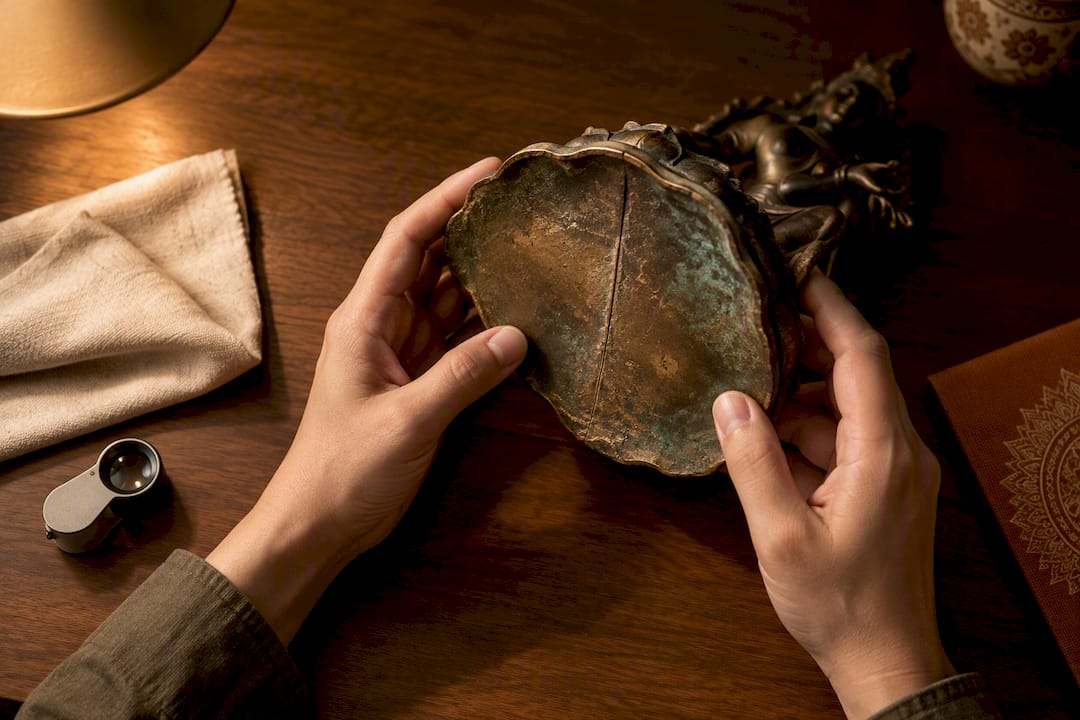
Les matériaux et le savoir-faire en disent long sur l’authenticité. Le bronze coulé à la main avec des marques d'outils visibles, une patine naturellement vieillie et une symétrie légèrement irrégulière indiquent généralement une production en atelier plus ancienne ou plus traditionnelle, tandis que le moulage uniforme à la machine et la patine appliquée artificiellement sont des signes courants de reproduction moderne.
Conseil de pro : Avant d'acheter une pièce antique présentant des motifs Ashtamangala, demandez des photos en gros plan du revers et de la base. Les coutures moulées, les motifs d'usure et la couleur du métal sur des surfaces invisibles sont plus difficiles à simuler que les détails de la face avant.
Ashtamangala comme outil pédagogique : ce que les collectionneurs doivent savoir
La tradition bouddhiste considère les huit symboles comme bien plus qu'un simple décor. Ils fonctionnent comme des dispositifs d'enseignement yidam adjacents, décrits dans les sources de référence comme des « chaktsen », des attributs symboliques qui ornent le guna, ou qualités, d'un courant mental éclairé, selon Wikipédia. Ce cadrage est appelé « investiture », l’idée selon laquelle un objet ou une image devient un récipient porteur d’une qualité spécifique une fois que le symbole correct est placé dessus ou autour.
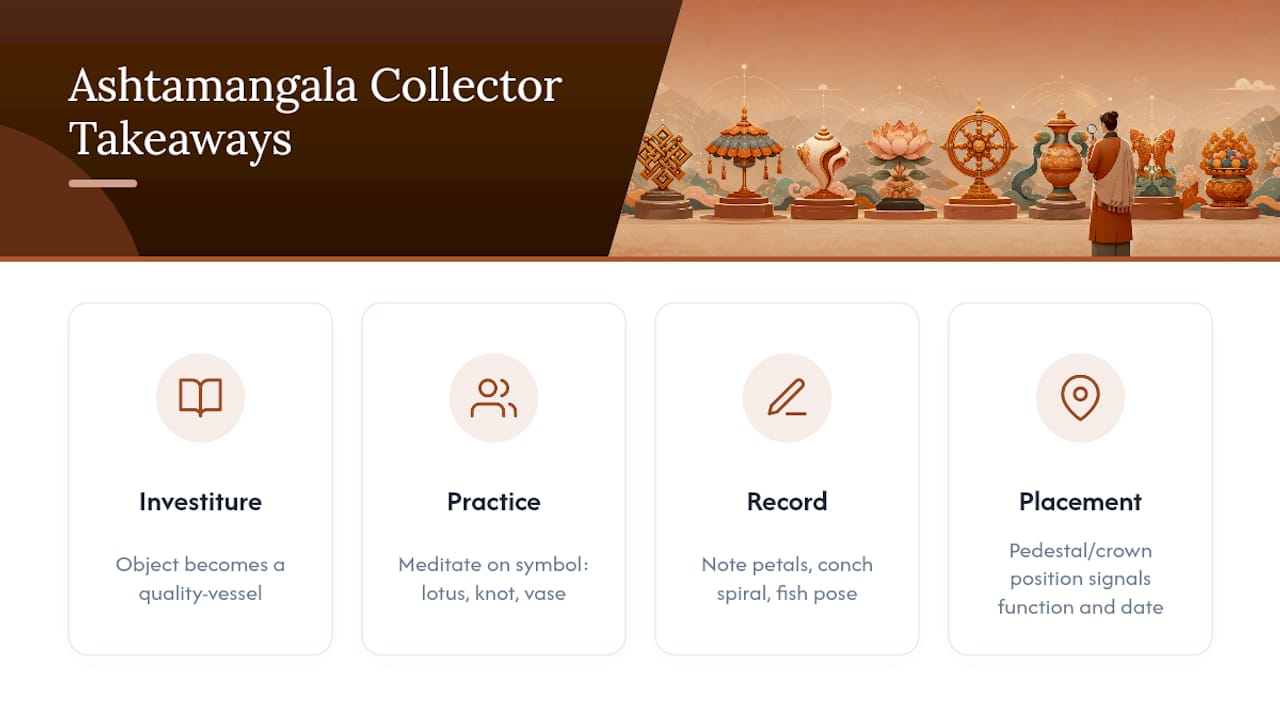
Les pratiquants méditent parfois sur un seul symbole pour cultiver la qualité qui lui est associée : le lotus pour la pureté de la parole et de l'esprit, le nœud sans fin pour la reconnaissance de l'interdépendance, le vase pour la générosité qui ne se tarit jamais. La pratique recommandée varie considérablement selon l’enseignant et la lignée, alors considérez n’importe quelle méthode comme une option parmi plusieurs plutôt que comme une règle fixe.
Pour les collectionneurs, l’avantage pratique réside dans les détails. De petits éléments formels, le nombre de pétales de lotus, la direction de la spirale d'une conque, la façon dont une paire de poissons est posée, agissent comme des signaux fiables pour la datation et l'attribution régionale lorsqu'ils sont associés à une analyse matérielle, basée sur une étude iconographique de HD Asian ArtLe guide de l'iconographie bouddhiste tantrique. Une approche conservatrice enregistre l’iconographie exacte de l’artefact et la compare aux modèles régionaux connus plutôt que de supposer que chaque pièce suit une liste universelle.
Un symbole Ashtamangala placé sur un piédestal ou une couronne est rarement accidentel. Sa position dans le programme iconographique plus large indique souvent la fonction rituelle prévue de l’objet, et ce placement est l’un des indices les plus clairs disponibles pour dater une pièce et retracer son probable atelier d’origine.
Une approche éditoriale sur la collecte et l'étude des symboles Ashtamangala
La plupart des explications informelles aplatissent l'Ashtamangala en un ensemble de porte-bonheur, et cette lecture sous-estime ce que font les symboles. Une conque sur le linteau d’un temple et une conque imprimée sur un foulard touristique ont la même forme mais pas le même poids. Le contexte, le matériau et l’emplacement changent ce qu’un symbole communique, et traiter chaque apparence comme une décoration interchangeable passe complètement à côté de l’essentiel.
Si vous constituez une collection ou étudiez sérieusement ces symboles, ralentissez au niveau iconographique. Regardez comment le lotus est sculpté par rapport à la figure qu'il soutient. Vérifiez si le nœud sans fin d'un textile est continu ou brisé par le tissage. Ces détails ne sont pas anodins. Ils constituent le signal le plus clair de l’origine régionale et de l’intention rituelle.
Pour quiconque rassemble une collection autour de ces motifs, parcourez HD Asian Artles statues de Bouddha de ou Statues hindoues est un moyen pratique de voir comment les huit symboles sont intégrés dans des socles, des couronnes et des auréoles dans différents styles régionaux. Découvrez les pièces associées sur Symbolisme khmer Ganesha pour un autre angle sur la manière dont les programmes iconographiques portent un sens en sculpture.
—James, HDAsianArt.com
Apportez une pièce authentique dans votre propre collection
La galerie présente des statues antiques et traditionnelles, des sculptures et des œuvres d'art de temples de diverses régions asiatiques, chaque pièce étant étudiée et photographiée pour mettre en valeur les détails iconographiques pertinents au symbolisme d'Ashtamangala. Si vous êtes attiré par les objets où ces huit symboles apparaissent sur des socles, des couronnes ou des auréoles, la collection de statues de Bouddha et le Collection de chefs-d'œuvre tous deux présentent des pièces de bronze, de pierre et de bois de qualité musée dont la provenance est documentée. Chaque achat est expédié dans le monde entier avec une livraison DHL assurée, et les cartes-cadeaux sont disponibles directement via HD Asian Art pour quiconque constitue une collection au fil du temps.
Sources
- Ashtamangala — Wikipédia
- Définition d'Ashtamangala — WisdomLib
- Astamangala — Britannica
- Ashtamangala - Encyclopédie bouddhiste tibétaine
FAQ
Où conserver les symboles Ashtamangala à la maison ?
Placez une image ou un objet Ashtamangala sur une surface propre au niveau ou au-dessus du niveau des yeux, loin de l'encombrement et de la circulation piétonnière, de la même manière que vous traiteriez tout objet de dévotion consacré. Évitez les affichages occasionnels ou commerciaux, tels que l'impression des symboles sur des articles jetables, car cette utilisation va à l'encontre de leur origine rituelle.
L'Astamangala peut-elle être utilisée pour porter chance ?
Les huit symboles sont souvent associés au bon augure, mais les sources de référence mettent en garde contre leur lecture comme de simples porte-bonheur, car ils fonctionnent principalement comme des dispositifs rituels et pédagogiques, selon Wikipédia. Les traiter avec le même soin qu’un objet de dévotion respecte cette fonction plus profonde tout en honorant leurs associations de bon augure.
Quels sont les huit signes de chance à Ashtamangala ?
Les huit couramment cités sont le parasol, la paire de poissons dorés, la conque, le lotus, le vase au trésor, le nœud sans fin, le dharmachakra et la bannière de la victoire. La liste exacte et l'ordre changent selon que la source est bouddhiste tibétaine, hindoue ou jaïn, vérifiez donc toujours la tradition derrière une liste donnée.
Quels sont les huit membres du Noble Octuple Sentier ?
Il s’agit d’un cadre bouddhiste distinct de l’Ashtamangala, bien que les deux soient parfois confondus car tous deux impliquent le chiffre huit. Le Noble Octuple Sentier décrit un ensemble de pratiques éthiques et méditatives pour atteindre la libération, tandis que l'Ashtamangala est un ensemble de symboles visuels, et ils ne constituent pas la même liste malgré le chiffre commun.
L’Ashtamangala signifie-t-il la même chose dans le bouddhisme et l’hindouisme ?
Pas exactement. Les sources bouddhistes ont tendance à relier les huit symboles aux offrandes faites après l’illumination du Bouddha, tandis que les sources hindoues et jaïns associent le même groupe numérique aux rites de couronnement et de consécration du temple, selon WisdomLib. L’idée centrale de bon augure se retrouve dans les trois traditions, mais la liste spécifique et son contexte rituel peuvent différer.
Recommandé
- Identifier les dix avatars de Vishnu : indices iconographiques de musée pour les collectionneurs
- 4 signes symboliques Garuda que tout collectionneur et chercheur devrait connaître
- Caractéristiques d'identification de la statue de la déesse hindoue : guide du collectionneur
- 3 chèques soutenus par un conservateur pour distinguer Bouddha du bodhisattva pour les collectionneurs
