



Sri Lankan Buddha Statue: The Sinhalese Tradition
Sri Lankan Buddha Statue: The Sinhalese Tradition
Most collectors can name the canonical Thai Buddha postures or the elaborate Khmer crown styles in their sleep. But ask them to describe what makes a Sri Lankan Buddha statue distinctly Sinhalese, and they often pause. That pause is the gap this article fills. Sri Lanka has maintained one of the longest unbroken Theravada Buddhist traditions on earth, and its sculptural output reflects something rare: a civilisation that developed its own visual grammar of enlightenment, shaped by Indian roots but hardened into a singular, austere identity across more than two millennia of royal patronage. If you collect or worship with Asian Buddhist sculpture, understanding this tradition changes how you look at every piece from the island.
Table of Contents
- Quick Takeaways
- What Makes Sinhalese Buddhist Art Distinct
- The Three Great Sculptural Periods
- Iconographic Signatures of a Ceylon Buddhist Sculpture
- Comparing Sinhalese, Thai, and Khmer Buddha Statues
- Collecting a Sri Lankan Buddha Statue: What to Look For
- Placing a Sri Lankan Buddha Statue in a Home or Altar
- Frequently Asked Questions
- References
Quick Takeaways
| Key Insight | Explanation |
|---|---|
| Amaravati tradition is the earliest influence | Almost all surviving Sri Lankan Buddhist art from around the first century CE shows the strong impact of the Amaravati school from the Andhra region of India, making this the foundational layer of Sinhalese sculpture. |
| The robe style is a reliable identifier | Sinhalese Buddhas typically wear the robe draped over the left shoulder, leaving the right shoulder bare, with the fabric carved as smooth and close-fitting with subtle vertical folds rather than heavy decorative drapery. |
| Calm, introspective faces are a hallmark | Oval or slightly elongated faces, smooth planes, downcast eyes, and a very gentle expression with lips lightly curved distinguish Sinhalese Buddhas from the more ornate Thai or Khmer expressions. |
| Kandyan period brought two distinct influences | The Kandyan era combined the older Sinhalese tradition of a broad-bodied Buddha wrapped in a pleated robe with a South Indian Nayak influence, producing a more abstracted figurative style in gilt copper alloy. |
| Theravada restraint governs the aesthetic | Unlike Mahayana traditions that favour elaborate crowns and jewellery, Sinhalese statues reflect the Spartan code of Theravada Buddhism: no crowns, minimal ornamentation, and an emphasis on serene dignity. |
| The ushnisha is modest and proportional | Sri Lankan Buddhas typically feature small, neat curls or tight knobs with a modest ushnisha and usually no tall flame finial, which is a contrast to the elongated flame tops common in Thai sculpture. |
| Stone is the primary material of the great works | The most iconic Sinhalese Buddhas, from the Avukana to the Gal Vihara series, are carved directly from granite rock faces, a technique that influenced the monumental scale and simplified planes of all later Sri Lankan sculpture. |
What Makes Sinhalese Buddhist Art Distinct
The word that comes up again and again when specialists describe Sinhalese sculpture is restraint. Where Thai Buddhist art rewards you with gilded surfaces and elaborate flame ushnishas, and Khmer sculpture draws the eye with intricate jewelled regalia, the Sinhalese tradition does something harder: it asks the stone itself to carry the spiritual weight. The result is a sculptural language that is spare, self-contained, and quietly commanding.
This aesthetic was not an accident or a limitation of resources. It was a direct expression of Theravada Buddhism, the school that Sri Lanka adopted from India and has preserved with remarkable continuity. Theravada theology emphasises the historical, human Buddha rather than cosmic bodhisattvas and heavenly realms, and its art reflects that focus. You get a figure of embodied stillness, not a celestial being draped in divine regalia.
The Indian inheritance was real and significant. Early Sinhalese artists were influenced by three main traditions: the Amaravati school from the Andhra region, the Gupta tradition, and the Pallava style. Amaravati was the earliest and most pervasive, shaping almost all surviving Sri Lankan art from around the first century CE. Gupta and Pallava influences arrived later, in the fifth through seventh centuries. But in each case, Sinhalese sculptors absorbed these influences and fused them into something distinctly their own, rather than simply replicating Indian models.
The practical effect for a collector is significant. A Sri Lankan Buddha statue brings a different energy into a collection or a space. Where a Burmese Mandalay Buddha tends toward warmth and gilded richness, and a Cambodian Khmer piece carries an architectural gravity, a Sinhalese piece offers something closer to pure, distilled calm. If you already collect Thai or Southeast Asian work through a gallery like HD Asian Art's Sri Lanka collection, adding a Sinhalese piece provides an austere counterpoint that changes the whole conversation of a room.
The Three Great Sculptural Periods
Sri Lankan Buddhist sculpture does not move in one continuous arc. It clusters around three distinct royal periods, each with identifiable characteristics that a trained eye can read in a piece even without a provenance document.
The Anuradhapura Period (circa 3rd century BCE to 10th century CE)
This is the foundational era, and it produced some of the most enduring images in all of Asian Buddhist art. The royal capital at Anuradhapura was a major centre of Buddhist learning and patronage for more than a millennium. Sculpture from this period is defined by its close relationship to the Amaravati tradition: smooth, rounded forms, relatively simple robe treatment, and a composure that reads as monumental even at modest scale.
The Samadhi Buddha at Anuradhapura, a seated figure in dhyana mudra sculpted from dolomite marble and standing roughly 7 feet 3 inches high, is widely regarded as a masterpiece of this period and of Sinhalese sculpture overall. Its classical simplicity and purity of line reflect the Theravada ideal with exceptional directness. The Avukana Buddha, a standing figure carved directly from a granite rock face in the North Central Province, represents the colossal ambition of this same school: its robe is draped over the left shoulder with single grooves falling to the ankle, the right shoulder left bare, and its face projects what sources describe as an aura of spiritual supremacy.
The Polonnaruwa Period (circa 10th to 13th century CE)
When the capital shifted to Polonnaruwa, Sinhalese sculpture entered one of its most confident phases. The rock-cut temple complex of Gal Vihara, carved during the 12th century under King Parakramabahu I, contains four Buddha images cut into a single large granite rock face and is considered among the finest examples of ancient Sinhalese sculpting. The group includes a large seated figure, a smaller seated figure inside an artificial cave, a standing figure, and a reclining figure depicting the parinirvana. The largest, the reclining Buddha, reaches 46 feet. These pieces demonstrate the full maturity of the Sinhalese sculptural tradition: confident in scale, precise in anatomy, and luminously still in expression.
The Kandyan Period (circa 16th to 19th century CE)
The Kingdom of Kandy became the dominant Sinhalese political and Buddhist authority by the 17th century. Its sculpture reflects two converging forces: the continuation of the older Sinhalese tradition, with its broad-bodied Buddha wrapped in a pleated robe, and the influence of South Indian Nayak princes who brought their own dynastic artistic patronage when they assumed Kandy's throne. The result is a more abstracted figurative style, often rendered in gilt copper alloy with a partial black coating, and notable for what specialists describe as a "highly abstracted" handling of form compared to the naturalistic ambitions of the Anuradhapura period.
Iconographic Signatures of a Ceylon Buddhist Sculpture
Knowing the historical periods is the framework. What actually helps you identify and evaluate a Ceylon Buddhist sculpture is understanding its specific iconographic vocabulary. These are the visual details that separate a genuine Sinhalese piece from a generic "Asian Buddha" mislabelled for search traffic.
The Ushnisha and Head Treatment
Sinhalese Buddhas characteristically feature small, neat curls or tight knobs rather than the elongated flames of Thai sculpture. The ushnisha, the cranial protuberance symbolising enlightened wisdom, is present but modest and proportional to the head. There is usually no tall decorative flame finial. The sirasapata, the halo or flame nimbus behind the head, is an important iconographic marker in major works like the Avukana, where it contributes to the identification of the piece within the Anuradhapura school of art.
Robe Drapery and the Right Bare Shoulder
The robe treatment is one of the most reliable identifiers of Sinhalese sculpture. The monastic robe is typically worn over the left shoulder, leaving the right shoulder bare. At its finest, as in the Avukana Buddha, the carving reveals the underlying body form through delicate, close-fitting folds. This is not the thick, schematic drapery of some Gandharan work, nor the smoothly abstracted robe of later Chinese Buddhist sculpture. It occupies a middle ground: disciplined and faithful to the monastic form, but sensitively carved to suggest living presence beneath.
Facial Expression and the Sinhalese Emotional Register
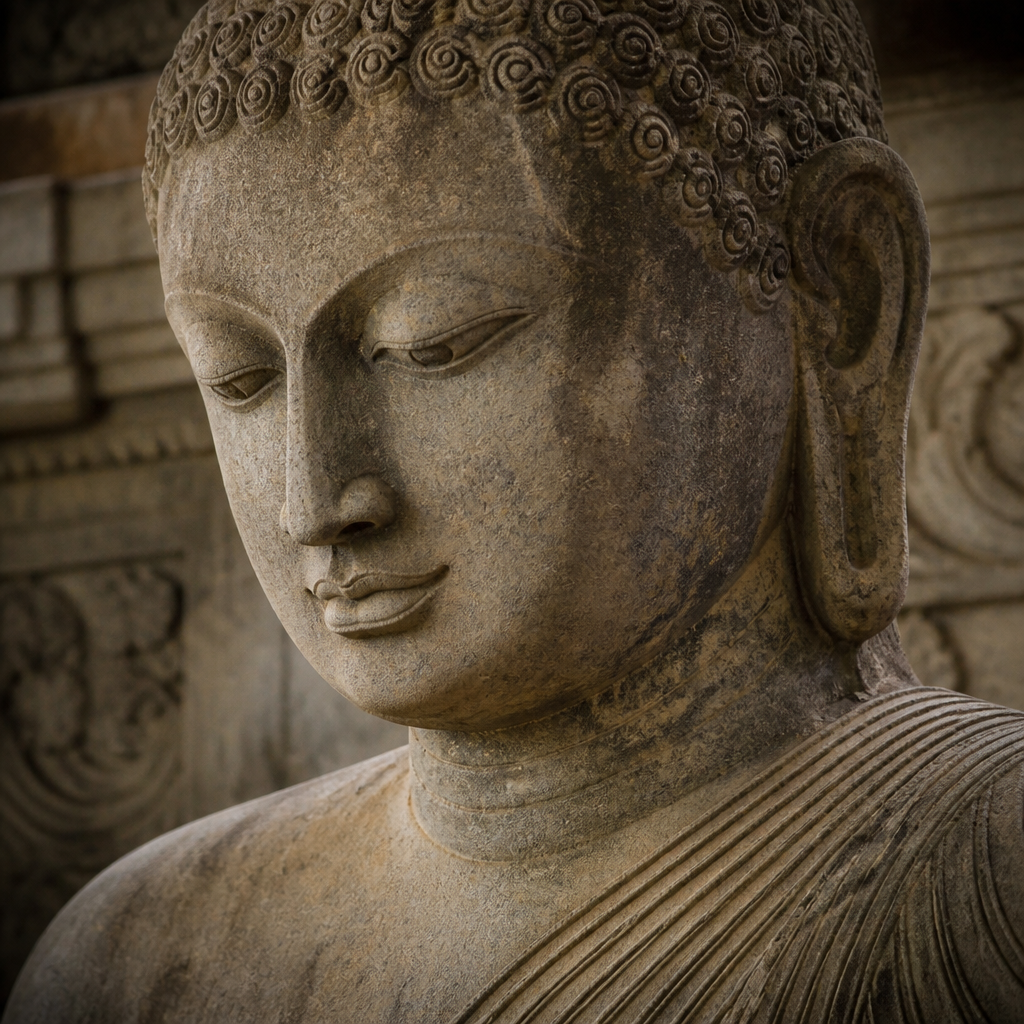
The face of a Sinhalese Buddha is oval or slightly elongated, with smooth planes and downcast eyes suggesting deep inward absorption. The lips are lightly curved, never exaggerated. A common mistake is to confuse this emotional restraint with a lack of artistry. In practice, it is exactly the opposite. Achieving a face that conveys profound peace without tipping into blankness or sentimentality requires extraordinary sculptural skill. The Samadhi Buddha at Anuradhapura is the supreme example of this balance: centuries of visitors have described it as expressing an inner life of uncommon depth.
The delicate and skillful carving of the Buddha's robe humanises and chastely reveals the underlying form of his body, while the face's impassive expression projects an aura of spiritual supremacy.
Mudras Common in Sinhalese Sculpture
The dhyana mudra (meditation gesture, hands resting in the lap) appears prominently in seated Sinhalese Buddhas, as in the Samadhi figure. The abhaya mudra (right hand raised, palm outward, offering reassurance) is characteristic of major standing works, including the Avukana, where it is described as the Ashiva or blessing gesture. The vitarka mudra (preaching gesture) appears in earlier bronze work such as the Badulla Preaching Buddha, a 6th-century hollow-cast bronze now held at the Colombo National Museum. Seated pieces in virasana posture with the vitarka mudra form a small but significant sub-category of Anuradhapura period bronze work.
Pro tip: When evaluating a Sri Lankan Buddha statue for purchase, check the robe treatment before anything else. If the right shoulder is bare and the fabric folds are subtle and body-revealing rather than decorative, you are in the right territory. Then examine the ushnisha. If it carries an elaborate flame or a pointed crown, the piece is almost certainly Thai or generic Southeast Asian rather than genuinely Sinhalese in origin.
Comparing Sinhalese, Thai, and Khmer Buddha Statues
For collectors who are weighing where a Sri Lankan piece fits alongside other regional traditions, a direct comparison is more useful than general description. The table below focuses on the specific visual and material features that distinguish these three major Buddhist sculptural traditions.
| Feature | Sinhalese (Sri Lanka) | Thai | Khmer (Cambodia) |
|---|---|---|---|
| Ushnisha style | Small, neat curls or knobs; modest; no tall flame finial in classical works | Tall, tapering flame finial (especially Sukhothai and later periods) | Lotus bud or conical form; often smooth without curls |
| Robe treatment | Over left shoulder; right shoulder bare; close-fitting with subtle folds | Varies by period; often thin double-pointed lapel; body largely covered | Minimal robe; often bare upper body or thin pleated samot |
| Facial expression | Oval face; downcast eyes; restrained, introspective calm | Elongated oval; curved brows meeting at tip of nose; gentle smile | Broad face; slight Angkor smile; eyes often half-open |
| Ornamentation | None in Theravada works; gilt copper alloy in Kandyan period pieces | Often gilded; jewelled crowns on royal or Mahayana-influenced pieces | Jewelled crowns and regalia common; especially in Bayon-period works |
| Primary material (historic) | Granite, dolomite marble, bronze (Anuradhapura); gilt copper alloy (Kandyan) | Bronze, gilt bronze, stucco over brick | Sandstone, bronze |
| Emotional register | Austere, monastic, inward-focused; maximum dignity, minimum display | Benevolent, approachable; sense of warm spiritual presence | Powerful, divine, slightly remote; cosmic authority |
This comparison matters practically. If you already own Thai or Khmer pieces, a Sinhalese Buddha is not a duplication. It is a deliberate tonal shift within a collection, the piece that brings the energy back to earth and into the body rather than upward into celestial realms.
Collecting a Sri Lankan Buddha Statue: What to Look For
The market for Sri Lankan Buddha statues carries specific pitfalls that collectors of Thai or Burmese work may not immediately anticipate. The style is less widely reproduced in mass-market decorative goods than Thai designs, which means genuinely high-quality pieces exist, but also that mislabelling is common. A Thai or generic "Asian" Buddha is sometimes tagged as Sri Lanka style in online listings purely for search traffic, with no actual Sinhalese iconographic features.
Assessing Craftsmanship
Authentic Sinhalese-tradition pieces exhibit meticulous carving or casting. Look for clean, confident lines in the facial planes, not rough approximations. The robe folds should have intentionality behind them. The proportions of the ushnisha relative to the head should feel harmonious and considered. Mass-produced decorative items tend to have shallow surface detail, shiny uniform finishes, and proportions that feel off when placed next to a museum-quality reference image.
Pro tip: Study images of the Samadhi Buddha at Anuradhapura and the Gal Vihara seated figure before you buy anything described as Sinhalese style. These are the canonical proportional references for the tradition. If a piece claiming to be Sri Lankan looks nothing like either of them in terms of facial structure and robe treatment, treat that as a red flag rather than an interesting variant.
Ethical Sourcing and Provenance
Sri Lanka has a living Buddhist culture in which temple images remain objects of active veneration. Responsible buying means insisting on pieces obtained through transparent, legal channels, with documentation of origin where available. Reputable specialist galleries will describe any visible restoration clearly, discuss the known history of a piece, and avoid trade in recently stripped temple images. This is not merely an ethical preference. It is also a practical collecting principle: pieces with traceable, legitimate provenance hold their value and their cultural meaning far more reliably than those of uncertain origin.
For buyers who prefer a specialist curated by regional expertise, HD Asian Art's Sri Lanka collection offers museum-quality pieces sourced with that level of care, with detailed descriptions that go beyond generic catalogue copy to address iconography, condition, and stylistic period.
Scale and Material in Modern Reproductions
Contemporary Sri Lankan workshops continue to produce statues in the Sinhalese tradition using granite, bronze, and resin composites. Quality varies enormously. At the top end, skilled artisans working from classical models produce pieces of genuine sculptural merit. At the lower end, you get decorative approximations that lose the proportional discipline and restrained facial expression that define the tradition. When evaluating a contemporary piece, the face is always the first test. If the expression reads as generic or slightly saccharine rather than genuinely still and inward-focused, the piece has not captured the Sinhalese aesthetic at its most important point.
Placing a Sri Lankan Buddha Statue in a Home or Altar
The restraint of Sinhalese Buddhist sculpture makes it unusually versatile in domestic settings. Unlike highly gilded Burmese Mandalay pieces or intricately adorned Khmer figures, a well-chosen Sri Lankan Buddha statue does not compete for attention. It settles into a space and holds it.
For Meditation and Altar Use
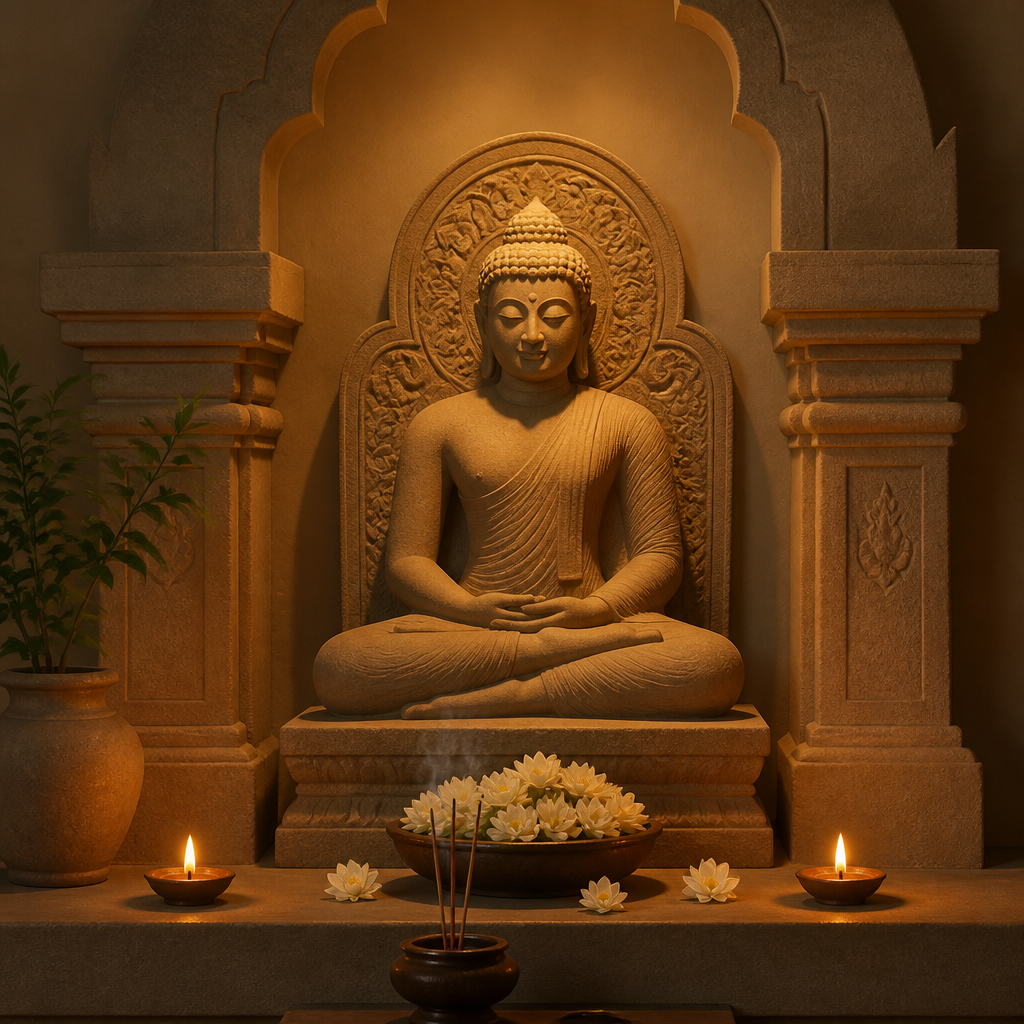
Seated Sinhalese Buddhas in dhyana mudra are natural choices for a meditation altar. The inward quality of the expression supports contemplative practice in a way that more extroverted or ceremonially adorned figures sometimes do not. Keep the setting simple: a clean surface, perhaps a single offering bowl, and minimal decorative distraction around the piece. The Sinhalese aesthetic rewards simplicity. Crowding the altar with objects works against everything the statue itself is doing.
For Interior and Collection Display
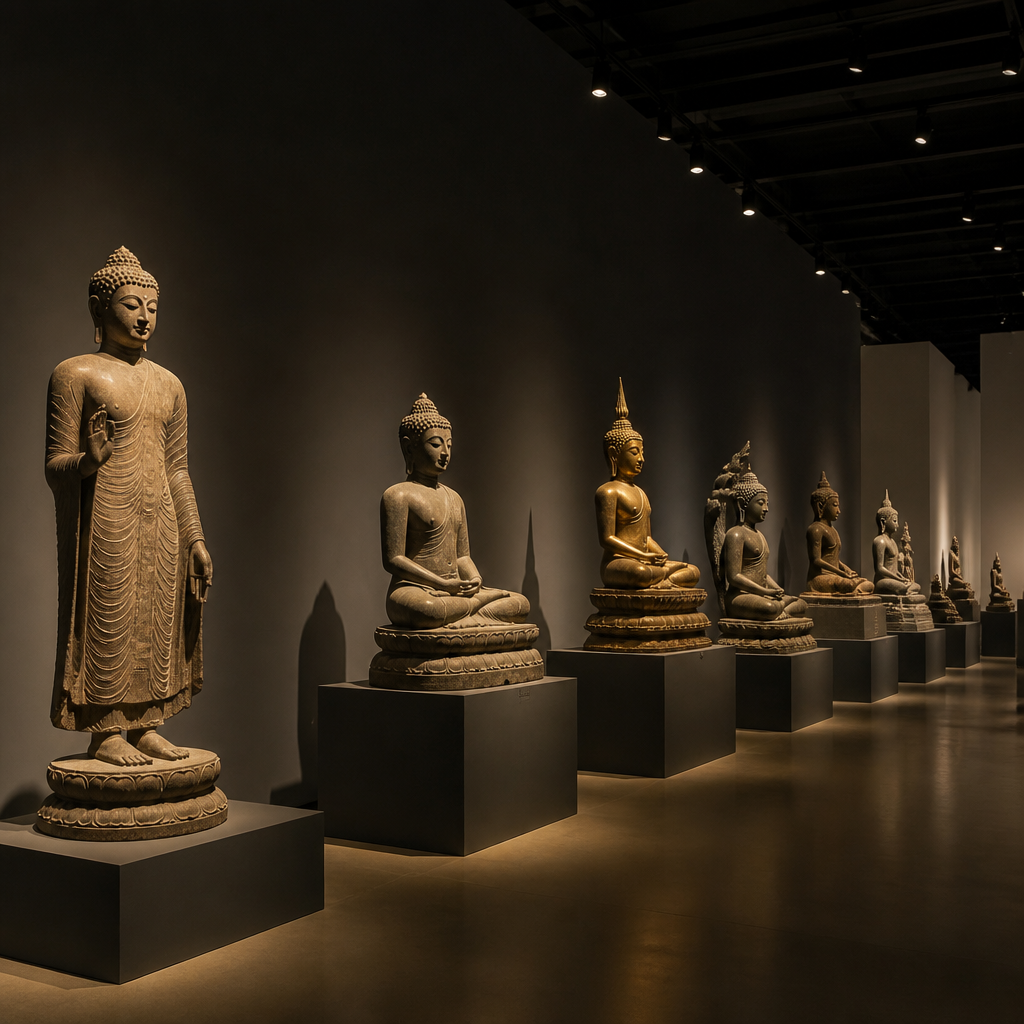
A standing Sinhalese Buddha in abhaya mudra works well as a focal point in a corridor or entrance, where its gesture of reassurance has both spiritual meaning and a welcoming spatial quality. In a collection of Asian sculpture from multiple traditions, placing a Sinhalese piece alongside Thai or Cambodian work highlights the breadth of Buddhist artistic expression. The contrast is illuminating rather than jarring: each tradition's choices become more visible when held against the choices of another.
Collectors who work with HD Asian Art for Sri Lankan pieces can also explore the broader collection for Cambodian and Thai Buddha statues, making it practical to build a multi-regional display from a single trusted source.
Frequently Asked Questions
What makes a Sri Lankan Buddha statue different from a Thai Buddha statue?
The most immediate visual differences are the robe treatment and the ushnisha. Sinhalese Buddhas typically wear the robe over the left shoulder with the right shoulder bare, and feature a modest ushnisha without a tall flame finial. Thai Buddhas, particularly from the Sukhothai period onward, often have an elongated flame at the crown and a more elaborate robe with a characteristic double-pointed lapel. The facial expression also differs: Sinhalese faces are more austere and inwardly focused, while Thai expressions tend toward a warmer, more openly benevolent quality.
Which are the most famous examples of Sinhalese Buddhist sculpture?
The most cited examples are the Avukana Buddha, a standing granite figure in the North Central Province carved between the 5th and 8th centuries CE and standing roughly 11.36 metres high; the Samadhi Buddha at Anuradhapura, a 4th-century seated figure in dolomite marble widely regarded as the finest example of Sinhalese sculpture; and the four rock-cut figures of Gal Vihara at Polonnaruwa, carved in the 12th century under King Parakramabahu I. These three monuments represent the full range of scale and emotional register in the Sinhalese tradition.
What does the bare right shoulder on a Sri Lankan Buddha signify?
The bare right shoulder indicates the standard monastic robe position of Theravada Buddhism, in which the uttarasanga (upper robe) is draped over the left side and the right side of the body is left uncovered. This is both a practical reference to the actual monastic dress code and a marker of the historical, human Buddha rather than a celestially adorned bodhisattva. In Sinhalese sculpture it becomes an aesthetic choice as much as an iconographic one, since the bare right shoulder reinforces the sculptural emphasis on the body's natural form beneath the cloth.
How do I identify a Kandyan period Sri Lankan Buddha statue?
Kandyan period pieces, typically dating from the 17th to 19th centuries, are most commonly rendered in gilt copper alloy with a partial black coating. The figural style is more abstracted than earlier Anuradhapura or Polonnaruwa work, with less naturalistic proportions. You may also notice the influence of South Indian Nayak artistic conventions, which entered the Kandyan tradition after Nayak princes assumed the Kandyan throne from the mid-18th century onward. A Kandyan Buddha still maintains the broad-body type wrapped in a pleated robe that characterises older Sinhalese tradition, but the handling of form is noticeably more stylised.
Is it appropriate to display a Sri Lankan Buddha statue in a home if you are not Buddhist?
Yes, provided the piece is displayed with basic respect: positioned at an appropriate height (not on the floor), kept clean, and not placed in a bathroom or similar context. Sri Lankan Buddhist tradition itself places great importance on the respectful treatment of Buddha images, and that principle applies regardless of the owner's religion. Many non-Buddhist collectors and interior designers choose Sinhalese Buddha statues specifically for their serene aesthetic presence. The key is to approach acquisition thoughtfully, through ethical sources, and to display the piece in a way that reflects its cultural and spiritual significance rather than treating it as generic decorative filler.
What materials are most common in antique Sri Lankan Buddha statues?
Granite and dolomite marble dominate the monumental works of the Anuradhapura period, since the island's geology made fine-grained stone readily available and durable in the tropical climate. Bronze was used for smaller works, including important hollow-cast pieces such as the 6th-century Badulla Preaching Buddha. The Kandyan period shifted significantly toward gilt copper alloy, producing smaller but elaborate devotional objects intended for temple and domestic use. Contemporary reproduction pieces use a wider range of materials including resin composites, but the quality standards of the traditional stone and metal work remain the benchmark.
If you own or are considering a Sri Lankan Buddha statue, we would love to hear what drew you to the Sinhalese tradition and how you have chosen to display it.
We would love your feedback and any insights you would share with others. What perspective would you add?
References
- Overview of Sri Lankan Buddhist art history and Indian influences at Encyclopedia.com
- Research article on the Avukana Buddha statue, its iconography and archaeological context at Asia Research News
- Analysis of Kandyan period Sinhalese Buddhist sculpture and Nayak artistic influences at The Value
- Detailed guide to the Aukana Buddha statue, its drapery style and Anuradhapura school iconography at Lakpura
- Pilgrimage site description of Gal Vihara and its four rock-cut Buddha images at Nekhor
