



Signification de la fleur de lotus dans les statues hindoues : un guide complet
Signification de la fleur de lotus dans les statues hindoues : un guide complet
Table des matières
La fleur de lotus dans le symbolisme hindou et la tradition spirituelle
La fleur de lotus a une signification profonde dans la spiritualité hindoue, apparaissant dans les textes anciens, l'architecture des temples et la statuaire sacrée comme symbole de transcendance, de pureté et de conscience divine.
À HD Asian Art, nous reconnaissons que le lotus est bien plus qu'un symbolisme décoratif, c'est un langage visuel exprimant les aspirations spirituelles les plus profondes de la philosophie hindoue.
La pureté émergeant des eaux boueuses
Le lotus commence dans des eaux troubles et boueuses, mais en ressort vierge et sans tache. Ce voyage constitue la pierre angulaire de la signification spirituelle du lotus dans la pensée hindoue. L'attachement matériel et l'enchevêtrement matériel sont des eaux boueuses ; le détachement et l’éveil spirituel sont les pétales qui se déploient. Les eaux boueuses représentent également le samsara, le cycle sans fin de la naissance, de la mort et de la renaissance. Le lotus s'élevant au-dessus de ces eaux symbolise la libération de ce cycle, l'accomplissement du moksha ou la réalisation de soi. Lorsqu’une divinité est assise sur un lotus dans une statue hindoue, cette position indique que le divin a entièrement transcendé les limitations matérielles.
Le voyage vers l’illumination et la réalisation de soi
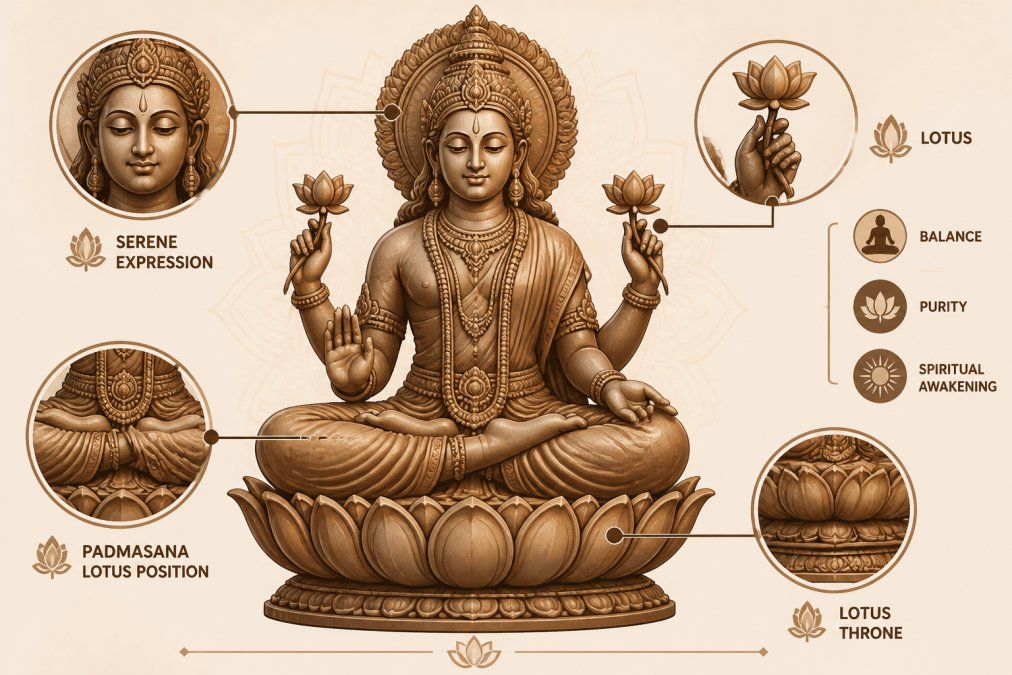
La philosophie hindoue reconnaît l’illumination comme un développement progressif, un peu comme le lotus ouvrant ses pétales vers le soleil. La tige du lotus, enracinée dans la boue mais s'étendant vers le haut dans l'eau pour atteindre l'air et la lumière du soleil, représente le voyage lui-même. Les racines symbolisent l’ancrage dans le dharma (devoir et droiture). L'eau représente le domaine émotionnel et mental. L’émergence dans l’air et la lumière représente l’accomplissement de la conscience divine. Lorsqu'il est représenté dans Statues hindoues, en particulier dans les représentations de Brahma, Vishnu et d'autres divinités cosmiques, le lotus apparaît souvent comme le siège ou le trône, signalant que la divinité existe au sommet du voyage spirituel.
Padmasana : la signification de la position du lotus dans les statues de divinités
Padmasana, la position du lotus, représente bien plus dans l'iconographie hindoue qu'une posture assise confortable. Le terme lui-même, padma signifiant lotus et asana signifiant siège ou posture, indique que cette position établit une personne sur le lotus, revendiquant l'état transcendant que représente la fleur.
Comment les divinités sont assises sur le siège du lotus
Dans la statuaire hindoue, les divinités occupent des trônes qui les élèvent au-dessus du monde ordinaire. Lorsqu'une divinité est assise en padmasana sur un trône de lotus, la statue communique que cet être existe dans un état de parfaite réalisation spirituelle et de conscience cosmique. Le positionnement physique du corps en padmasana, jambes croisées, pieds posés sur les cuisses opposées, colonne vertébrale dressée, crée une forme stable et autonome qui symbolise la stabilité interne et la collecte d'énergie spirituelle. En plaçant la divinité au-dessus du niveau des yeux du spectateur, le sculpteur crée une hiérarchie visuelle qui renforce la nature transcendante de la divinité.
Placement des mudras et du lotus dans l'iconographie sacrée
Les mains d'une divinité dans une statue hindoue, leur position et leur geste, constituent un langage appelé mudras. Le lotus apparaît fréquemment dans ces mudras, tenu dans les mains de la divinité ou positionné à proximité d'elles. Lorsqu’une divinité tient un lotus dans une main, ce geste revêt une signification particulière. Un lotus tenu dans une paume ouverte suggère d’offrir ou d’accorder la grâce. Un lotus tenu au niveau de la poitrine communique une connexion intime avec le cœur et la conscience spirituelle. La couleur du lotus tenu, rouge, blanc, rose ou bleu, précise davantage la nature de cette bénédiction. Les motifs de lotus entourent souvent le halo ou l'auréole derrière la tête de la divinité, créant un cadre de pétales déployés qui suggèrent que la conscience de la divinité rayonne vers l'extérieur.
Le lotus comme siège divin dans la mythologie hindoue
Le lotus joue un rôle central dans la mythologie que représentent les statues hindoues. Comprendre ces récits explique pourquoi les sculpteurs ont systématiquement choisi cette fleur comme symbole principal de la transcendance divine.
Brahma émergeant du Lotus Cosmique
Dans la cosmologie hindoue, la création elle-même commence par un lotus. Selon la littérature puranique, l'univers émerge lorsque Brahma, la divinité créatrice, surgit d'un lotus doré qui pousse du nombril de Vishnu. Cette image établit le lotus comme symbole primordial de la création et de la manifestation. Le lotus cosmique lui-même est souvent représenté avec plusieurs couches de pétales, représentant les possibilités infinies de création et les innombrables univers qui émanent de la source divine.
Lakshmi, la prospérité et la fleur de lotus
Lakshmi, la déesse de la richesse, de la fortune et de l'abondance, entretient peut-être la relation la plus intime avec le lotus. Divinité hindoue. Elle est souvent représentée debout ou assise sur un lotus, tenant parfois plusieurs fleurs de lotus dans ses mains. Lakshmi est parfois appelé Padma, le lotus lui-même. Ce lien révèle une compréhension sophistiquée de la prospérité dans la pensée hindoue : la prospérité n’est pas simplement une accumulation matérielle mais aussi une abondance spirituelle, l’épanouissement du potentiel humain, l’épanouissement de la conscience. Lorsque Lakshmi tient des lotus dans ses mains, elle les offre en cadeau à ses fidèles, communiquant que la véritable richesse consiste en l'éveil spirituel et la transcendance de l'attachement matériel.
Vishnu et le Lotus éternel
Vishnu, le conservateur et le soutien du cosmos, maintient une connexion éternelle avec le lotus à travers les eaux cosmiques. Dans de nombreuses statues hindoues, Vishnu est représenté avec un lotus dans une main, souvent tenu près du cœur. Ce placement suggère que le rôle de conservateur de Vishnu découle de la conscience divine elle-même. A la fin de chaque âge cosmique, Vishnu repose sur les eaux cosmiques, d'où émerge un lotus portant Brahma, qui créera le prochain univers. Le lotus devient un symbole du cycle éternel de création, de maintien et de dissolution.
Placement de la statue de la divinité pour la maison : honorer le lotus sacré
Pour ceux qui cherchent à introduire des statues de divinités hindoues chez eux, comprendre le bon placement honore à la fois la signification spirituelle du lotus et la nature sacrée de la statue elle-même.
Créer un espace de méditation avec l'iconographie Lotus
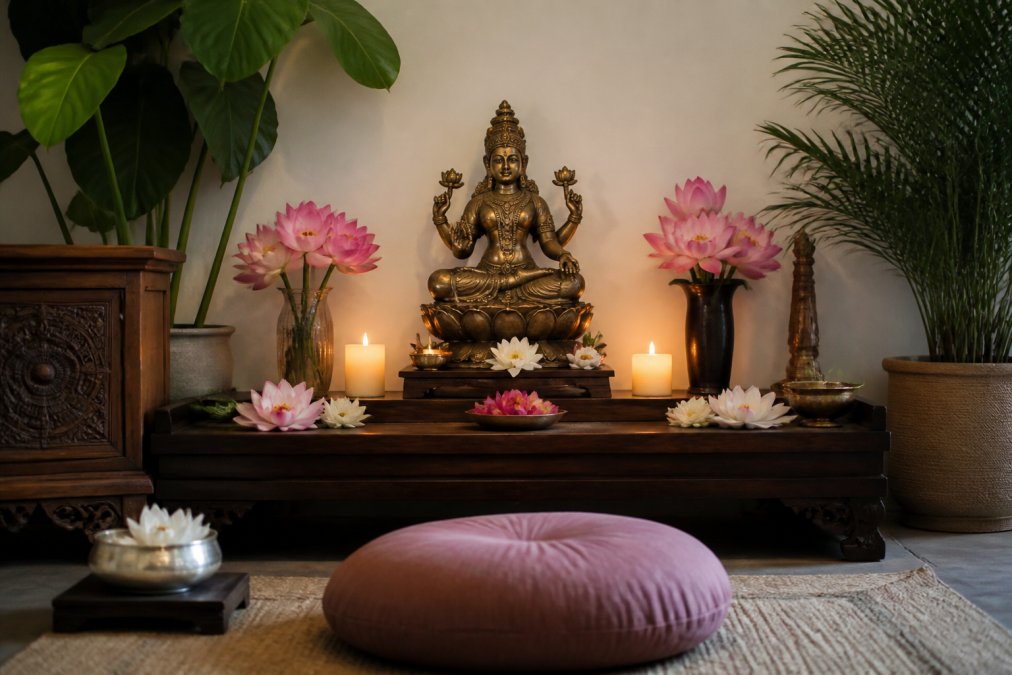
Un espace de méditation centré sur une statue de divinité hindoue devient un sanctuaire pour la pratique spirituelle. L'imagerie du lotus dans la statue crée un centre visuel qui soutient et approfondit la méditation. Idéalement, la statue doit être placée au niveau des yeux ou légèrement au-dessus lorsque vous êtes assis en posture de méditation. De nombreux praticiens placent des fleurs fraîches, en particulier des fleurs de lotus lorsqu'elles sont disponibles, près de la statue, créant ainsi un lien vivant entre l'espace de méditation et le monde naturel. Un éclairage doux et indirect permet aux motifs de lotus sculptés dans la statue de créer des ombres subtiles qui se déplacent selon les changements de lumière.
Orientation et intention spirituelle
La direction dans laquelle la statue est tournée a une signification dans de nombreuses traditions hindoues. Les statues orientées vers l’est honorent le soleil levant et la direction d’un nouveau départ et de l’illumination. Les statues orientées vers le nord s'alignent dans la direction traditionnellement associée à la sagesse et à la demeure des dieux. L’intention que vous établissez en plaçant la statue compte autant que le positionnement physique. La relation entre la statue et le reste de votre espace de vie doit être harmonieuse.
L'évolution des motifs de lotus à travers les traditions artistiques hindoues
Le lotus est apparu dans l’art hindou depuis des milliers d’années, mais sa représentation a considérablement évolué au fil des périodes, des régions et des traditions artistiques.
De l’art védique ancien à la sculpture Murti contemporaine
Les premières apparitions de l’imagerie du lotus dans l’art hindou remontent à la période védique. À l'époque classique de la sculpture hindoue, vers 1000-1500 de notre ère, le lotus était devenu le symbole dominant de la statuaire des divinités. Les variations régionales dans la représentation du lotus reflètent différentes traditions artistiques et accents spirituels. Dans la sculpture du sud de l’Inde, les trônes de lotus comportent souvent des pétales élaborés et densément sculptés disposés sur plusieurs niveaux. Dans les traditions de l’Inde du Nord, l’imagerie du lotus apparaît parfois plus minimaliste, avec des formes simplifiées qui mettent l’accent sur la géométrie essentielle. Les sculpteurs hindous contemporains continuent de travailler avec des images de lotus, utilisant parfois des techniques et des matériaux de sculpture traditionnels, parfois des méthodes modernes. Ce qui reste constant, c'est le rôle du lotus en tant que symbole principal reliant la statue matérielle à la réalité spirituelle qu'elle représente.
Expression matérielle et savoir-faire sacré
Les matériaux utilisés pour créer des statues de divinités hindoues, pierre, bronze, bois ou autres substances, interagissent de manière significative avec l'imagerie du lotus. La pierre, étant éternelle et immuable, suggère la nature permanente et transcendante de la conscience divine. Le bronze, qui nécessite d'être chauffé et coulé pour être créé, incarne la transformation, le processus même que représente le lotus. Le savoir-faire impliqué dans la création de ces statues mérite d'être reconnu. Chaque pétale sculpté est un acte d'intention spirituelle.
Iconographie du lotus à travers différentes divinités hindoues
Même si le lotus apparaît dans l'iconographie de nombreuses divinités hindoues, la relation de chaque divinité avec la fleur revêt une signification spécifique.
Tenu entre des mains divines : le lotus comme attribut sacré
De nombreuses divinités hindoues tiennent les fleurs de lotus comme attributs, symboles de leur domaine particulier, de leur bénédiction ou de leur fonction spirituelle. Saraswati, la déesse de la connaissance et des arts, tient un lotus dans une main tout en tenant un instrument à cordes dans l'autre, représentant l'épanouissement de la sagesse et de l'expression artistique. Ganesha, celui qui élimine les obstacles, apparaît parfois avec un lotus dans sa trompe ou à ses côtés, suggérant que la suppression des obstacles permet à la conscience de s'épanouir et de se développer. Durga, la déesse guerrière qui vainc l'ignorance et le mal, peut tenir un lotus dans une main tout en brandissant des armes dans l'autre, communiquant que la victoire spirituelle conduit à l'épanouissement de la conscience. La position spécifique de la main est importante : un lotus tenu au niveau de la poitrine suggère une connexion intime à la conscience spirituelle, tandis qu'un lotus tenu en l'air suggère la transcendance et l'élévation de la conscience.
Variations de couleurs et leurs significations spirituelles
La tradition hindoue associe différentes couleurs de fleurs de lotus à différentes qualités spirituelles. Le lotus blanc représente la pureté et l'éveil spirituel. Le lotus rouge symbolise la compassion, l'amour et le cœur émotionnel. Le lotus rose représente l'état spirituel le plus élevé, l'union de l'amour du cœur et de la sagesse de l'esprit. Le lotus bleu est associé à la sagesse, à la connaissance et à l'intellect. Le lotus doré ou jaune représente le principe solaire, la conscience divine, l’illumination et la source de toute vie. Ces associations de couleurs communiquent une signification spirituelle à ceux qui comprennent la tradition.
Transcendance, détachement et éveil spirituel
La signification la plus profonde du lotus dans les statues hindoues pointe vers le but ultime de la pratique spirituelle hindoue, la transcendance de la conscience matérielle et l'éveil à la conscience divine. Le lotus incarne cette aspiration dans sa forme même. La transcendance ne signifie pas échapper au monde matériel mais atteindre un état de conscience qui reste intact par l'attachement matériel même s'il existe en son sein. Le lotus, enraciné dans la boue mais produisant des pétales immaculés, exprime parfaitement ce paradoxe. Le détachement, l'une des principales disciplines spirituelles de la pratique hindoue, trouve son symbole visuel dans le lotus. L’éveil spirituel, but ultime vers lequel pointe le lotus, implique la reconnaissance de sa vraie nature en tant que conscience divine.
La signification de la fleur de lotus dans les statues hindoues s’étend bien au-delà du symbolisme décoratif. Chaque pétale, chaque geste, chaque placement communique la vérité spirituelle sur la nature de la conscience et le chemin vers l'illumination. Que vous soyez attiré par ces statues en tant qu'objets de beauté, outils de méditation ou expressions d'aspiration spirituelle, comprendre la signification du lotus approfondit votre appréciation de la profonde sagesse qu'elles incarnent.
À HD Asian Art, nous organisons des statues qui honorent ces traditions avec un savoir-faire authentique et une véritable intention spirituelle. Nos pièces soigneusement sélectionnées apportent ce symbolisme sacré dans votre maison, créant un espace où l'enseignement du lotus peut soutenir votre propre voyage spirituel. Parcourez notre collection de statues hindoues et découvrez comment le lotus peut devenir une présence vivante dans votre espace de méditation et votre pratique spirituelle quotidienne.
Foire aux questions
Que symbolise la fleur de lotus dans les statues hindoues ?
La fleur de lotus représente la pureté spirituelle, l’illumination et la transcendance dans l’iconographie hindoue. Il symbolise le voyage de l'âme depuis l'attachement matériel (les eaux boueuses) jusqu'à la conscience divine et la réalisation de soi. Les pétales déployés du lotus représentent l’éveil spirituel, tandis que sa capacité à rester insensible à l’eau incarne le détachement des préoccupations du monde. Dans les sculptures murti, le lotus sert de siège sacré (padmasana) aux divinités, les élevant au-dessus du royaume matériel et soulignant leur nature divine.
Pourquoi les divinités hindoues tiennent-elles ou s’assoient-elles sur des fleurs de lotus dans des statues ?
Les divinités sont représentées avec le lotus pour souligner leur nature transcendante et leur lien avec la création cosmique. S'asseoir sur un trône de lotus (padmasana) place les divinités au-dessus de l'existence matérielle, tandis que tenir un lotus dans leurs mains représente leur rôle dans l'octroi de bénédictions, de prospérité et de guidance spirituelle. Lakshmi tient des fleurs de lotus symbolisant l'abondance et la pureté ; Le lotus de Vishnu représente l'ordre cosmique éternel ; et Brahma émerge du lotus cosmique lors de la création. Cette iconographie communique la divinité et l'autorité spirituelle à travers la géométrie sacrée et le placement symbolique.
Comment dois-je placer une statue de divinité hindoue avec le symbolisme du lotus dans ma maison ?
Placez votre statue de divinité dans un espace surélevé et propre dédié à la méditation ou à la pratique spirituelle, face à l'est ou au nord pour une énergie spirituelle optimale. Assurez-vous que la statue repose sur un autel ou une étagère stable, sans être dérangée par la circulation piétonnière, et entourez-la avec intention. Si le murti présente une iconographie de lotus, honorez ce motif sacré en gardant l'espace épuré et paisible. De nombreux pratiquants placent des fleurs fraîches à proximité et entretiennent la zone comme un sanctuaire pour la prière ou la pleine conscience. Le placement doit refléter le respect de la divinité et soutenir votre pratique spirituelle personnelle.
Quelle est la signification de la position du lotus padmasana chez les divinités hindoues ?
Padmasana, la position du lotus, est la posture assise la plus propice de la tradition hindoue, symbolisant la stabilité, la discipline spirituelle et la connexion à la conscience divine. Lorsque les divinités sont sculptées en padmasana, cela traduit leur maîtrise des royaumes matériels et spirituels. Cette posture apparaît dans la tradition védique comme une position de méditation et dans l'art religieux comme l'expression ultime de l'ascétisme et de l'illumination. La position des jambes croisées, combinée au siège du lotus sous la divinité, crée un symbole complet de transcendance spirituelle et d'ordre cosmique dans le design du murti.
