



Sculptures hindoues pour le bien-être : un guide spirituel
Sculptures hindoues pour le bien-être : un guide spirituel
Table des matières
Comment les sculptures hindoues soutiennent le bien-être et la croissance spirituelle
Les sculptures hindoues servent de points focaux pour la pratique spirituelle et le bien-être, fonctionnant comme des points d'ancrage pour la méditation, la contemplation et la paix intérieure. Lorsqu’ils sont judicieusement intégrés à votre maison, ces objets sacrés créent un environnement où l’énergie positive circule naturellement, favorisant la clarté mentale et l’équilibre émotionnel. La présence de sculptures de divinités aide à concentrer l’esprit, à réduire le bavardage mental et à cultiver un ancrage qui persiste tout au long de la journée.
À HD Asian Art, nous comprenons que les sculptures hindoues authentiques constituent des outils puissants de transformation personnelle. Notre collection soigneusement organisée de statues bouddhistes et hindoues est conçue pour ceux qui cherchent à approfondir leur pratique spirituelle et à créer des sanctuaires domestiques raffinés. Que vous soyez novice dans ces traditions ou praticien expérimenté, la bonne sculpture peut devenir la pièce maîtresse de votre parcours de bien-être.
Imagerie sacrée et rôle de la divinité dans la guérison
L'imagerie sacrée fonctionne comme un pont entre le monde matériel et le royaume de la divinité. Les sculptures hindoues incarnent des qualités divines et des énergies archétypales reconnues au fil des siècles de pratique spirituelle. Lorsque vous contemplez une image sacrée, vous vous engagez dans un symbolisme spirituel concentré conçu pour élever la conscience et promouvoir la guérison enracinée dans la sagesse ancienne.
L'iconographie des sculptures hindoues communique des vérités spirituelles à travers une forme visuelle. Chaque geste, posture et attribut porte une signification spécifique. La position des mains d'une divinité (mudra), les objets qu'elle tient et sa posture assise ou debout transmettent tous des énergies et des bénédictions particulières. Ce langage visuel permet à l'esprit d'absorber les enseignements spirituels sans nécessiter d'analyse intellectuelle.
La recherche sur les pratiques contemplatives montre qu'une attention concentrée sur l'imagerie sacrée active les zones du cerveau associées à la paix et au bien-être. En méditant sur une divinité associée à la compassion, à la guérison ou à la sagesse, vous activez ces qualités en vous. Ce mécanisme psychologique et spirituel s’est avéré efficace à travers les cultures et les siècles.
Divinités hindoues associées à la guérison et à la vitalité
Certaines divinités du panthéon hindou portent des associations particulières avec la santé, la guérison et le bien-être.
Statue Dhanvantari pour la guérison et le bien-être
Dhanvantari représente le médecin divin et est la divinité la plus directement associée à la guérison et à la vitalité. Souvent représenté tenant des herbes médicinales, un récipient de nectar curatif (amrita) et une conque, Dhanvantari incarne à la fois la guérison physique et spirituelle. Une statue Dhanvantari pour la guérison et le bien-être rappelle avec force que la véritable santé englobe le corps, l'esprit et l'esprit.
Lorsque vous placez une statue Dhanvantari dans votre maison, vous invitez l'énergie de guérison dans votre espace. De nombreux praticiens trouvent que méditer sur Dhanvantari avant de prendre des médicaments ou de commencer un programme de bien-être améliore leurs efforts. La statue devient le point central de votre intention de rétablir l’équilibre et la vitalité.
Autres divinités curatives et leur signification
Au-delà de Dhanvantari, plusieurs autres divinités sont fortement associées à la guérison et au bien-être. Lakshmi soutient le bien-être qui vient de la sécurité matérielle et de la nourriture. Saraswati, associé à la connaissance et à la clarté, favorise la santé mentale et la sagesse nécessaire à des décisions judicieuses en matière de santé. Shiva, sous sa forme Mahakal, représente la transformation et la dissolution des obstacles au bien-être. Ganesha, celui qui élimine les obstacles, revêt une importance particulière pour quiconque entame un voyage de bien-être. Votre choix de sculpture avec laquelle travailler peut être intuitif, car vous pouvez vous sentir attiré par une forme particulière dont vous avez le plus besoin de cultiver l'énergie.
Comment aménager un espace Puja à la maison pour le bien-être
La création d'un espace dédié à la puja transforme votre maison en un sanctuaire pour la pratique spirituelle. Cela établit un emplacement physique où vous dirigez intentionnellement votre attention vers le bien-être et la croissance spirituelle.
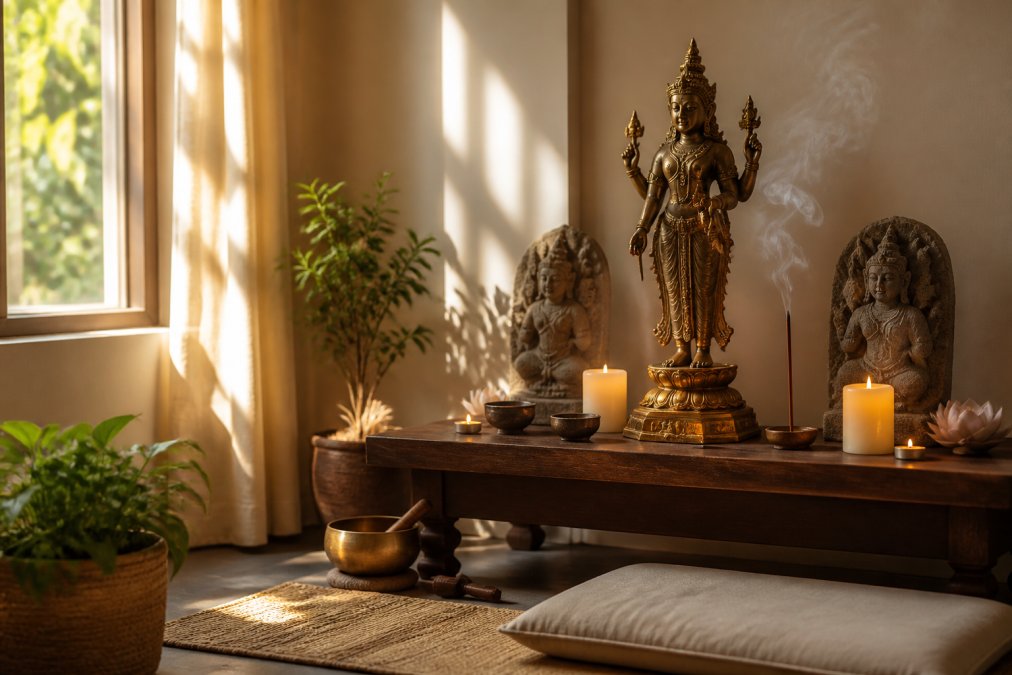
Commencez par sélectionner un coin calme de votre maison, une chambre, un bureau ou une alcôve de salon fonctionneront bien. Même un espace dédié de 2 pieds sur 2 pieds est suffisant pour créer une pratique spirituelle significative. La pièce maîtresse devrait être une sculpture hindoue qui résonne avec vos intentions de bien-être. Entourez-le d'éléments qui soutiennent la contemplation : une bougie pour la lumière et la transformation, de l'encens pour la purification, et peut-être une petite cloche ou un bol chantant pour marquer les transitions dans votre pratique.
Placement et alignement Vastu Shastra
Vastu Shastra, l'ancien système d'harmonie spatiale, offre des conseils spécifiques pour aménager votre espace puja. Selon les principes Vastu, le coin nord-est de votre maison est considéré comme le plus propice à la pratique spirituelle. Si vous n'êtes pas disponible, faites face à votre sculpture vers le nord-est lorsque vous vous entraînez.
Placez les statues de divinité au niveau des yeux ou légèrement au-dessus lorsque vous êtes assis en méditation. Cela crée un point focal naturel qui soutient un sentiment d’aspiration et d’élévation. L’effet psychologique est significatif : regarder légèrement vers le haut vers le divin soutient la connexion spirituelle.
Créer un espace sacré pour les rituels quotidiens
Votre espace puja devient puissant grâce à une utilisation cohérente. De nombreux pratiquants commencent leur journée en allumant une bougie devant leur sculpture, en prenant trois respirations conscientes et en fixant une intention. Cinq à dix minutes d’attention ciblée suffisent pour créer un changement significatif. La cohérence compte plus que la durée.
Pensez à ajouter des matériaux naturels à votre espace : une petite pierre ou un cristal, un socle en bois pour votre sculpture ou un tissu tissé à partir de fibres naturelles. Ces éléments tactiles ancrent votre pratique dans le monde physique tout en maintenant le lien avec le sacré.
La signification spirituelle des matériaux naturels
Les matériaux utilisés pour créer des sculptures hindoues ont une signification spirituelle. Les sculptures en bronze possèdent une chaleur et une conductivité qui, selon de nombreux praticiens, améliorent leur expérience de méditation. On pense que la réactivité du métal à l’environnement amplifie la fréquence vibratoire de la divinité représentée.
La pierre transporte l’énergie fondamentale de la terre elle-même. Une sculpture en pierre enracine votre pratique dans la stabilité et la permanence, se révélant particulièrement précieuse en période de bouleversement personnel. Le bois, étant organique et réactif aux changements environnementaux, conserve une qualité vivante idéale pour les sculptures représentant des divinités de guérison et de renouveau.
Les matériaux naturels soutiennent l’état méditatif en engageant vos sens dans une expérience authentique et fondée. En revanche, les matériaux synthétiques semblent souvent inertes sur le plan énergétique.
Rituels quotidiens et pratiques de méditation avec des sculptures
L'intégration de vos sculptures hindoues dans les pratiques de bien-être quotidiennes amplifie leurs bienfaits.
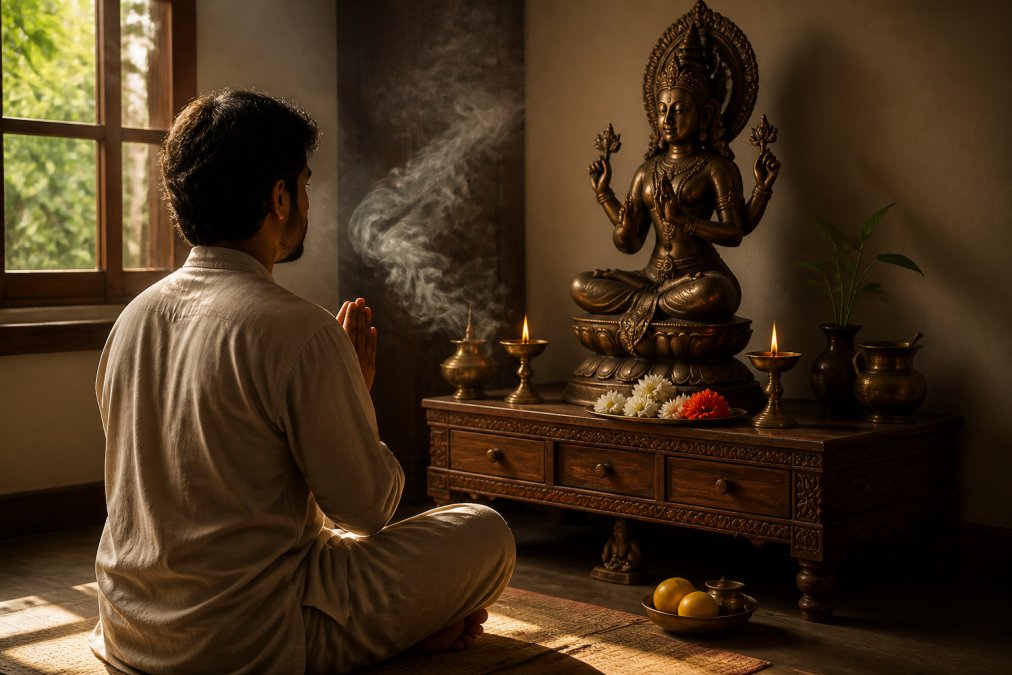
Commencez par un simple rituel matinal. Passez cinq minutes assis devant votre sculpture. Allumez de l’encens ou une bougie, prenez trois respirations profondes et observez la forme devant vous. Cette pratique, répétée quotidiennement, crée un chemin neuronal qui devient plus facile d’accès avec le temps.
La respiration (pranayama) pratiquée avant votre sculpture approfondit l'expérience de méditation. La respiration narine alternative équilibre le système nerveux et prépare l’esprit à une conscience plus profonde. De nombreux pratiquants intègrent des mudras, des gestes de la main censés canaliser des énergies particulières. Le mudra Anjali (mains serrées au centre du cœur) exprime la gratitude et le dévouement. Le Dhyana mudra (pouce et index se touchant, paumes vers le haut) favorise la méditation et la paix intérieure.
La récitation de mantra offre une autre méthode d’intégration puissante. Chanter un mantra associé à la divinité de votre choix tout en regardant sa sculpture crée une expérience spirituelle multisensorielle. La répétition du son, combinée à la concentration et à l’intention visuelles, génère une énergie transformatrice que les praticiens considèrent comme profondément apaisante.
La clé d’une pratique efficace est la cohérence plutôt que l’intensité. Une brève pratique quotidienne s’avère bien plus efficace que de longues séances occasionnelles.
Le lien entre spiritualité et santé holistique
La recherche moderne sur la méditation et la pratique contemplative démontre des effets mesurables sur des marqueurs de santé, notamment la tension artérielle, la variabilité de la fréquence cardiaque, la fonction immunitaire et les marqueurs inflammatoires. Lorsque vous vous engagez dans une pratique spirituelle devant une sculpture sacrée, vous activez de véritables changements physiologiques. Le système nerveux parasympathique, responsable du repos et de la récupération, devient plus dominant. Les hormones du stress diminuent et le flux sanguin vers le cortex préfrontal augmente, favorisant ainsi la pensée rationnelle et la régulation émotionnelle.
La philosophie hindoue reconnaît depuis longtemps cette intégration. Le concept de vie « sattvique », caractérisé par la pureté, la clarté et l'harmonie, englobe la santé physique, la clarté mentale et l'alignement spirituel. En créant un espace de bien-être avec des sculptures hindoues et en vous engageant dans une pratique quotidienne, vous revenez à une manière d'être plus intégrée que votre système nerveux reconnaît naturellement comme saine.
La présence d'images sacrées soutient cette intégration. Votre cerveau traite les informations visuelles à un niveau profond. S'entourer de représentations de divinité, de guérison et de paix envoie des signaux constants à votre inconscient sur ce que vous appréciez et l'état que vous cultivez.
L'entretien comme pratique méditative
Le soin que vous apportez à vos sculptures devient partie intégrante de votre pratique spirituelle. Épousseter consciencieusement une sculpture en bronze ou en pierre, polir sa surface ou observer comment la lumière joue sur sa forme transforme l'entretien en méditation. Cet engagement tactile crée une qualité de connexion différente de celle de la visualisation à distance.
De nombreux praticiens trouvent que prendre soin de leurs sculptures génère un sentiment de responsabilité et un engagement envers leur pratique du bien-être. La sculpture devient un participant actif dans votre vie quotidienne, approfondissant le pouvoir transformateur de votre pratique.
L'intégration de sculptures hindoues dans votre maison crée une base pour un bien-être et une croissance spirituelle durables. Que vous soyez attiré par une statue de Dhanvantari pour la guérison et le bien-être, une sculpture de Ganesha pour éliminer les obstacles ou une autre divinité dont les qualités vous appellent, la clé est un engagement cohérent et conscient. À HD Asian Art, notre collection soigneusement organisée d'authentiques bouddhistes et Statues hindoues propose des pièces raffinées qui soutiennent ce voyage. Chaque sculpture est sélectionnée à la fois pour son excellence artistique et sa puissance spirituelle, garantissant que votre espace bien-être reflète une tradition et un savoir-faire authentiques. Commencez votre pratique dès aujourd’hui en sélectionnant une sculpture qui correspond à vos intentions et permettez-lui de devenir le point d’ancrage de votre engagement quotidien en faveur du bien-être holistique. Parcourez notre collection pour trouver la pièce parfaite pour votre sanctuaire personnel.
Foire aux questions
Quelle divinité hindoue est la plus associée à la guérison et au bien-être ?
Dhanvantari, le dieu hindou de la médecine et de la guérison, est la principale divinité invoquée pour le bien-être et la vitalité. Représenté tenant des herbes médicinales et un pot de nectar curatif, Dhanvantari représente à la fois la santé physique et la préservation de la vie. Une statue Dhanvantari destinée à la guérison sert de point focal aux pratiques de dévotion visant à restaurer la santé. De nombreux praticiens honorent également Durga pour son énergie protectrice et Lakshmi pour son bien-être et sa prospérité en général.
Comment les sculptures hindoues aident-elles à la méditation et à la pleine conscience ?
Les sculptures hindoues servent de points d'ancrage à la contemplation et à la paix intérieure. La représentation anthropomorphique des divinités fournit une focalisation visuelle qui approfondit la pratique de la méditation, permettant à l'esprit de se concentrer sur le symbolisme sacré et le pouvoir spirituel. La qualité tactile de toucher ou de contempler une statue, qu'elle soit sculptée dans du bronze, de la pierre ou du bois, crée un effet d'ancrage qui améliore la pleine conscience. L'interaction quotidienne avec une sculpture la transforme en un outil d'énergie transformatrice et de conscience accrue.
Quelle est la meilleure façon d’aménager un espace puja à la maison avec des sculptures ?
Commencez par choisir un coin calme et propre de votre maison dédié à la pratique spirituelle. Positionnez votre statue de divinité au niveau des yeux ou légèrement au-dessus, face à l'est ou au nord selon les principes de Vastu Shastra pour un alignement cosmique optimal. Entourez-le de matériaux naturels comme des éléments en pierre ou en bronze, des fleurs fraîches et de l'encens. Entretenez l'espace quotidiennement dans le cadre de votre pratique rituelle, cet entretien lui-même devient une activité méditative et ancrée. Assurez un éclairage adéquat et un minimum de distractions pour créer un sanctuaire qui soutient la paix, la prospérité et la croissance spirituelle.
Une sculpture hindoue peut-elle vraiment améliorer mon bien-être, ou s’agit-il simplement de décoration ?
Les sculptures hindoues fonctionnent à la fois comme outils d’art et de bien-être. Les bienfaits psychologiques de l’interaction tactile, du contact avec la sculpture, de la contemplation d’images sacrées et de la participation à des rituels quotidiens activent des réponses parasympathiques qui réduisent le stress et favorisent la paix intérieure. Le symbolisme intégré dans les postures et l'iconographie des divinités vous connecte à des millénaires de méthodologies de guérison et de tradition spirituelle. Bien qu'il ne s'agisse pas d'un traitement médical, les pratiques contemplatives et dévotionnelles centrées sur une sculpture soutiennent la santé holistique, la clarté mentale et le bien-être émotionnel grâce à des cadres rituels et de pleine conscience établis.
