



Disposer plusieurs statues hindoues sur une étagère : un guide étape par étape
Disposer plusieurs statues hindoues sur une étagère : un guide étape par étape
Table des matières
Comment disposer plusieurs statues hindoues sur une étagère : fondations essentielles
Disposer plusieurs statues hindoues sur une étagère nécessite d'équilibrer les principes spirituels et la conception pratique. Qu'il s'agisse de créer un Mandir à la maison dans une salle dédiée au pooja ou dans un coin de méditation de votre appartement, un agencement approprié honore la nature sacrée de votre murtis tout en créant une harmonie visuelle. À HD Asian Art, nous avons guidé d'innombrables pratiquants à travers ce processus. Les principes fondamentaux restent cohérents : l’alignement directionnel, le placement hiérarchique, la stabilité structurelle et l’équilibre esthétique travaillent ensemble pour créer un espace spirituellement ancré et soigneusement conçu.
Ce guide vous guide tout au long du processus, depuis l'évaluation de la capacité structurelle de votre étagère jusqu'au positionnement des statues selon les principes Vastu Shastra. Ci-dessous, nous vous montrerons exactement comment créer un autel sacré qui servira à la fois à votre pratique spirituelle et à la décoration intérieure de votre maison.
Comprendre les principes de placement des idoles Vastu Shastra
Vastu Shastra, l'ancienne science indienne de l'agencement spatial, fournit des lignes directrices fondamentales pour l'agencement de plusieurs Statues hindoues sur une étagère. Ces principes sont basés sur le flux d'énergie directionnel, la hiérarchie des formes divines et la signification spirituelle de chaque divinité. Comprendre ces concepts fondamentaux transforme votre étagère d'une collection de beaux objets en un espace sacré intentionnel.
Selon les enseignements traditionnels documentés dans les principes architecturaux Vastu Shastra, le coin nord-est de n'importe quelle pièce représente la direction la plus propice à la pratique spirituelle et à la méditation. Le nord-est reçoit la lumière du soleil le matin et est considéré comme la porte d’entrée du flux d’énergie positive dans votre maison.
Votre arrangement doit refléter le concept de « Brahma Muhurta », le moment propice du petit matin où l'énergie spirituelle est la plus forte. Lorsque vos statues font face au nord-est ou sont positionnées de manière à ce que vous soyez face au nord-est pendant le culte, vous alignez votre pratique sur ces rythmes naturels. Les divinités secondaires devraient rayonner vers l'extérieur à partir de ce point focal principal, créant une hiérarchie visuelle qui reflète la hiérarchie spirituelle de la cosmologie hindoue.
Direction des idoles divines hindoues : positionnement au nord-est et au-delà
Le coin nord-est sert de zone de placement principale pour votre divinité principale. Si votre étagère n'occupe pas le coin nord-est de votre pièce, positionnez les statues de manière à ce que la divinité principale soit tournée vers le nord-est, ou disposez-les de manière à ce que vous soyez naturellement face au nord-est pendant la puja quotidienne ou la pratique de méditation.
Les divinités secondaires suivent une hiérarchie spatiale logique rayonnant à partir de ce point central. Si votre divinité principale est Ganesha, placez-le légèrement en hauteur et au centre. Lakshmi et les divinités liées à la richesse peuvent occuper le côté droit, tandis que les divinités protectrices comme Hanuman peuvent occuper des positions à gauche. Cet arrangement reflète la structure traditionnelle du mandala où la forme suprême occupe le centre et les énergies de soutien s'organisent dans des positions complémentaires.
Pour les praticiens disposant d’un espace limité, les principes directionnels peuvent être adaptés. Si votre étagère est orientée au sud ou à l'ouest, placez-vous face au nord-est pendant l'entraînement. L’intention et la conscience que vous apportez à l’arrangement comptent autant que le positionnement physique. De nombreux habitants d’appartements trouvent que placer un petit miroir incliné peut symboliquement rediriger l’énergie vers le nord-est.
Processus étape par étape : Comment disposer plusieurs statues hindoues sur une étagère
L'agencement de vos statues est un processus délibéré qui nécessite une attention particulière à la sécurité structurelle, à l'équilibre visuel et à l'alignement spirituel.
Étape 1 : Évaluez votre espace de stockage et votre capacité structurelle
Avant de placer des statues, évaluez la capacité de charge de votre étagère. Les murtis en pierre et en marbre sont nettement plus lourds que les alternatives en laiton ou en bois, une statue en marbre de taille moyenne peut peser entre 15 et 25 livres, tandis qu'une pièce en laiton comparable peut peser entre 8 et 12 livres. Si vous utilisez une étagère murale, vérifiez qu'elle est correctement ancrée avec des supports conçus pour supporter au moins deux fois le poids total de toutes les statues combinées.
Mesurez votre espace d'étagère disponible en trois dimensions : largeur, profondeur et hauteur. Tenez compte de 3 à 6 pouces entre les murtis pour une séparation visuelle appropriée. Calculez l'empreinte totale de toutes vos statues, puis ajoutez 20 à 30 % d'espace supplémentaire pour respirer. Vérifiez la stabilité et la planéité de la surface de l'étagère. En cas d'inégalité, utilisez des cales ou des supports réglables avant de placer un murtis.
Étape 2 : Déterminez votre divinité principale
Votre divinité principale devient le point d’ancrage de tout l’arrangement. Il s’agit généralement de la divinité de votre famille (Ishta Devata) ou de la divinité la plus centrale de votre pratique spirituelle. Ganesha, Lakshmi, Shiva, Krishna et Durga sont des choix courants.
Placez ce murti primaire légèrement surélevé et central sur votre étagère. Si votre étagère comporte plusieurs niveaux, la divinité principale doit occuper le niveau supérieur ou intermédiaire, jamais la position la plus basse. L'élévation doit être subtile, une différence de 2 à 4 pouces est suffisante pour établir une hiérarchie sans créer de déséquilibre visuel. Votre murti principale doit être sensiblement plus grande que les statues qui la soutiennent, généralement 1,5 à 2 fois la hauteur des divinités secondaires.
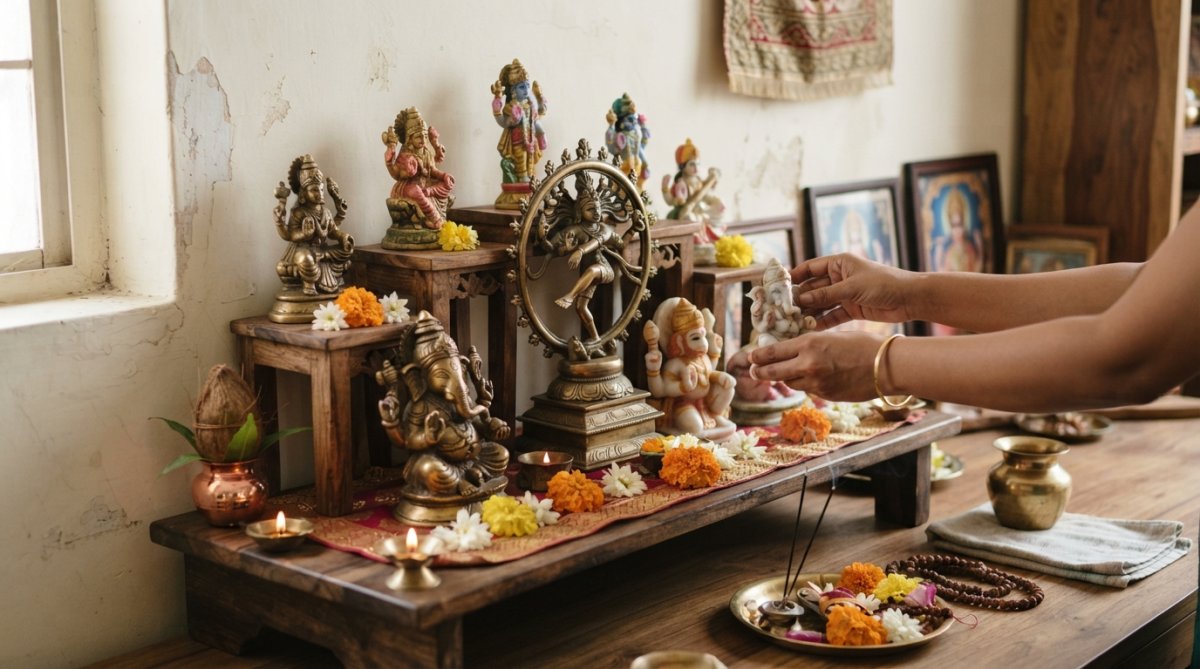
Étape 3 : Positionner les statues par hauteur et équilibre visuel
Créez un dégradé de hauteur sur votre étagère plutôt que de disposer toutes les statues au même niveau. La divinité principale occupe la position la plus élevée ou la plus importante. Les divinités secondaires descendent en hauteur à mesure qu'elles s'éloignent du centre, créant une structure visuelle en forme de pyramide.
Pour trois statues, disposez-les en formation triangulaire : la plus haute au centre, de hauteur moyenne d’un côté, plus petite de l’autre. Pour cinq statues ou plus, créez un motif de vagues douces : hautes au centre, légèrement plus courtes sur les côtés immédiats, puis augmentant progressivement la hauteur vers les bords. Tenez compte des proportions de votre étagère : une étagère étroite fonctionne mieux avec moins de statues plus hautes et bien disposées, tandis qu'une étagère large peut accueillir plus de statues avec un plus grand espacement.
Étape 4 : Créer une symétrie et un espacement entre Murtis
La symétrie dans la disposition des autels reflète l'équilibre des forces cosmiques. Cependant, une symétrie parfaite peut sembler statique ; considérons plutôt un équilibre asymétrique. Si votre divinité principale est centrée, placez un murti secondaire plus grand d'un côté et une pièce complémentaire plus petite de l'autre.
Maintenez un espacement constant entre les statues, environ 3 à 4 pouces fonctionne bien. Cela crée du rythme et empêche les statues de sembler fusionner visuellement. Alignez au maximum les bases de vos statues. Décalez les hauteurs des statues elles-mêmes, et non leurs bases, pour clarifier quelle divinité occupe quelle position.
Étape 5 : Sécuriser et stabiliser chaque idole
Une fois positionnée, assurez-vous que chaque statue est sécurisée et ne bougera pas en raison des vibrations ou d'un contact accidentel. Pour les statues légères, du mastic de musée ou un revêtement d'étagère antidérapant sous la base offre une sécurité adéquate. Pour les pièces plus lourdes, pensez à de petits blocs de laiton ou de bois qui surélèvent la statue tout en fournissant une base stable.
N’utilisez jamais de méthodes de fixation adhésives ou permanentes sur des murtis précieux ou antiques. Fiez-vous plutôt à la répartition du poids et au positionnement stratégique. Placez les statues plus lourdes vers l'arrière de l'étagère et les pièces plus légères vers l'avant. Testez la stabilité de votre arrangement en appuyant doucement sur chaque statue sous différents angles. Il ne doit pas bouger, vaciller ou basculer.
Signification spirituelle de la disposition des idoles dans votre mandir domestique
La disposition physique de vos statues a une profonde signification spirituelle au-delà de l’esthétique. Chaque décision de placement affecte la qualité énergétique de votre espace de pratique et l'efficacité de votre culte.
La consécration et le Prana Pratishtha, l'infusion rituelle de la présence divine dans une murti, établissent le fondement spirituel de votre autel. Selon les pratiques rituelles hindoues et la consécration murti, cette cérémonie invoque la présence de la divinité et établit un lien vivant entre la statue physique et la forme divine qu'elle représente. Lorsque vous disposez vos statues de manière réfléchie, vous honorez cette consécration et créez les conditions nécessaires à l’épanouissement de votre pratique spirituelle.
Le point focal de votre arrangement devient le centre de votre énergie dévotionnelle. Vos yeux, votre attention et votre intention se dirigent naturellement vers la divinité primaire. Cette concentration amplifie la puissance spirituelle de votre pratique. Les divinités secondaires fournissent un contexte et une complétude à votre culte, Lakshmi soutient le bien-être matériel, Saraswati soutient la sagesse, Ganesha supprime les obstacles.
Créer un point focal pour la dévotion établit un ancrage psychologique. Votre esprit reconnaît l'autel comme un espace sacré distinct, séparé de la vie quotidienne. Au fil du temps, votre système nerveux apprend à passer à un état réceptif et méditatif lorsque vous vous approchez de votre autel.
Entretenir un mandir à domicile : protocoles de nettoyage et d'entretien
L'entretien régulier de vos murtis et de vos étagères est à la fois une nécessité pratique et une discipline spirituelle. Prendre soin de vos statues est une forme de service (seva) rendu au divin.
Le nettoyage quotidien doit être simple et respectueux. Utilisez un chiffon doux et sec pour épousseter délicatement chaque murti, en vous déplaçant de haut en bas. Pour les statues comportant des zones détaillées, utilisez une brosse à poils doux avec des mouvements circulaires doux.
Le nettoyage hebdomadaire peut être plus approfondi. Pour statues en laiton, utilisez un chiffon doux légèrement imbibé d'eau et de savon doux, puis séchez immédiatement. Pour les murtis en marbre ou en pierre, utilisez uniquement de l'eau et un chiffon doux, jamais de produits chimiques agressifs. Les statues en bois nécessitent un contact minimal avec l'eau ; un chiffon à peine humide suivi d'un séchage immédiat suffit.
Le laiton développe avec le temps une patine naturelle que de nombreux praticiens apprécient. Si vous préférez conserver la finition brillante, un polissage doux du laiton fonctionne bien. Le marbre et la pierre bénéficient d’un scellement occasionnel (tous les 2-3 ans) avec un scellant pénétrant pour pierre conçu pour un usage intérieur.
Évitez de placer les statues à la lumière directe du soleil, à proximité de sources de chaleur ou dans des environnements humides. Dans les climats humides, placez de petits sachets de gel de silice près de vos statues pour éviter la croissance de moisissures sur les pièces de bois.
Design et esthétique : créer un espace d'autel sacré
La dimension esthétique de votre autel compte autant que sa fonction spirituelle. Un mandir soigneusement conçu invite à la pratique et crée un environnement dans lequel votre esprit s'installe naturellement dans la méditation.
Le choix des étagères doit refléter des considérations à la fois pratiques et esthétiques. Une armoire murale dédiée crée un espace sacré défini et clos. Les armoires vitrées protègent les statues de la poussière tout en permettant leur exposition. Les armoires en bois avec étagères ouvertes créent une esthétique plus chaleureuse.
L’éclairage affecte considérablement l’apparence de vos statues et la sensation énergétique de l’espace. L'éclairage doux et chaleureux d'une lampe à huile en laiton (diya) crée une atmosphère intime et spirituelle et est traditionnel dans la pratique hindoue. Si vous utilisez un éclairage électrique, des ampoules aux tons chauds (température de couleur de 2 700 K) reproduisent la lumière des bougies. Placez les lumières légèrement au-dessus ou sur le côté de vos statues pour créer des ombres douces qui ajoutent de la dimension.
Des éléments décoratifs complètent le design esthétique et fonctionnel. Des fleurs fraîches placées dans de petits récipients ajoutent de la couleur, du parfum et de la vitalité. Les soucis, les fleurs de lotus ou les roses sont des choix traditionnels. Des porte-encens, un petit récipient à eau ou une coquille de conque pour les offrandes rituelles, une cloche et un petit coussin pour s'asseoir complètent les éléments fonctionnels.
Considérez l’espace négatif autour de vos statues avec autant d’attention que les objets eux-mêmes. Un autel encombré submerge le point focal principal. Laissez une marge de manœuvre pour que l'œil passe naturellement de la divinité primaire aux statues secondaires et aux éléments décoratifs.
Solutions pour petits espaces : aménagements d'appartements et compacts
De nombreux pratiquants vivent dans des appartements ou des maisons avec un espace limité mais souhaitent conserver un autel significatif. L'empilage vertical des étagères et les présentoirs à plusieurs niveaux maximisent la superficie limitée. Utilisez deux ou trois étagères plus étroites empilées verticalement. La divinité principale occupe l'étagère du milieu, avec des statues de soutien sur les niveaux supérieurs et inférieurs.
Assurez-vous que le mur peut supporter le poids combiné de toutes les étagères et statues. Utilisez des supports robustes pouvant supporter au moins 50 livres par étagère. Répartissez le poids uniformément pour éviter qu'un côté ne supporte trop de charge. Dans les appartements où le perçage n'est pas autorisé, des étagères d'angle autoportantes ou des bibliothèques hautes et étroites offrent des alternatives. Fixez-les au mur avec des sangles de sécurité pour éviter tout basculement.
Pour des espaces vraiment minimes, envisagez une seule étagère haute et étroite. Disposez les statues dans une seule colonne, la plus grande en haut et les pièces de plus en plus petites en bas. Bien que cela s’écarte de la disposition horizontale traditionnelle, il maintient la hiérarchie et peut être visuellement frappant.
Même dans les petits appartements, conservez le principe d’alignement directionnel. Si votre étagère est orientée au sud ou à l'ouest, placez-vous face au nord-est pendant le culte. Utilisez un petit miroir incliné de manière appropriée pour rediriger symboliquement l’énergie. Votre intention et votre conscience comptent plus qu’un alignement physique parfait.
Créer un autel significatif avec plusieurs statues hindoues nécessite d'équilibrer les principes spirituels, les considérations pratiques et la sensibilité esthétique. HD Asian Art se spécialise dans les statues hindoues et bouddhistes soigneusement sélectionnées pour fonctionner à merveille sur les autels domestiques, des pièces antiques avec une profonde résonance spirituelle aux murtis contemporains fabriqués avec des détails authentiques. Notre collection comprend des statues en laiton, marbre et pierre, chacun choisi à la fois pour sa qualité artistique et sa présence spirituelle. Que vous disposiez trois statues dans le coin d'un appartement ou que vous créiez un mandir élaboré à plusieurs niveaux, HD Asian ArtLes pièces inspirées des temples de constituent la base d'un espace sacré qui soutient votre pratique et améliore l'atmosphère spirituelle de votre maison.
Foire aux questions
Quelle est la meilleure direction pour placer les idoles hindoues sur une étagère ?
Selon les principes du Vastu Shastra, le coin nord-est est considéré comme la direction la plus propice pour votre divinité principale ou votre statue de divinité familiale. On pense que cette direction attire l’énergie spirituelle positive. Si aucun coin nord-est n'est disponible, les murs orientés au nord ou à l'est sont des alternatives acceptables. Les divinités et sous-formes secondaires peuvent être positionnées sur les côtés ou devant l'idole principale, maintenant une hiérarchie claire tout en respectant les directives directionnelles de votre mandir d'origine.
Comment dois-je disposer les divinités hindoues masculines et féminines sur une étagère ?
Les directives traditionnelles du Vastu Shastra suggèrent de placer la divinité masculine principale au centre ou au point focal, avec des divinités féminines positionnées respectueusement à proximité, souvent légèrement en avant ou sur le côté plutôt que directement derrière. L'arrangement doit refléter la relation spirituelle entre les divinités tout en conservant la symétrie et l'équilibre visuel. Consultez les traditions spécifiques de l'hindouisme, car différentes familles honorent différentes hiérarchies de divinités. La clé est de créer un arrangement esthétique qui honore les deux personnages avec le même respect et un espacement approprié.
Quel espacement et quelle cohérence de hauteur dois-je maintenir entre plusieurs statues hindoues ?
Maintenez au moins 2 à 4 pouces d'espacement entre les murtis pour permettre le flux d'énergie et éviter l'encombrement visuel. La cohérence de la hauteur est importante pour l'équilibre : disposez les statues de manière à ce que la divinité principale soit au niveau des yeux ou légèrement au-dessus, les statues secondaires étant abaissées ou positionnées plus bas. Évitez de placer les statues directement les unes devant les autres. Utilisez la profondeur de l'étagère pour créer des couches, à l'avant, au milieu et à l'arrière, ce qui ajoute un intérêt visuel tout en respectant la hiérarchie des divinités et en garantissant que chaque statue reçoive l'attention et la dévotion appropriées de la part des fidèles.
Comment puis-je m'assurer que mon étagère peut supporter en toute sécurité le poids de plusieurs statues hindoues ?
Tout d’abord, vérifiez la capacité de poids de votre étagère, la plupart des étagères standard supportent entre 25 et 50 livres par section. Les murtis en pierre et en marbre sont plus lourds que les alternatives en laiton ou en résine. Répartissez le poids uniformément sur l'étagère plutôt que de regrouper de lourdes statues dans une seule zone. Utilisez des étagères murales avec des ancrages appropriés pour une stabilité maximale et évitez de placer toutes les grandes statues sur des étagères flottantes. Considérez le poids total combiné de toutes les statues, éléments décoratifs et offrandes. En cas de doute, consultez un professionnel du matériel ou envisagez une armoire de temple dédiée spécialement conçue pour les expositions sacrées.
