



10 symboles du Seigneur Ganesha dans l'art expliqués
10 symboles du Seigneur Ganesha dans l'art expliqués
Table des matières
Comprendre l'iconographie de Ganesha : le fondement des symboles sacrés
Les 10 symboles du Seigneur Ganesha dans l’art expliqués forment l’un des langages visuels les plus complexes de l’hindouisme. Chaque élément, de la tête d'éléphant au serpent, porte des couches de signification spirituelle qui transcendent la simple décoration. À HD Asian Art, nous reconnaissons que la compréhension de ces symboles transforme la façon dont les collectionneurs et les praticiens interagissent avec les statues de Ganesha, allant au-delà de l'appréciation esthétique vers une véritable connexion spirituelle.
L'iconographie de Ganesha représente un système sophistiqué de communication visuelle développé au fil des siècles. L’art hindou code les concepts philosophiques directement sous forme physique. Lorsque vous rencontrez une statue de Ganesha, vous regardez une carte de principes spirituels soigneusement construite. Le positionnement de chaque membre, la direction du tronc, les objets tenus dans chaque main sont des expressions intentionnelles d'attributs divins destinés à guider la méditation et la dévotion.
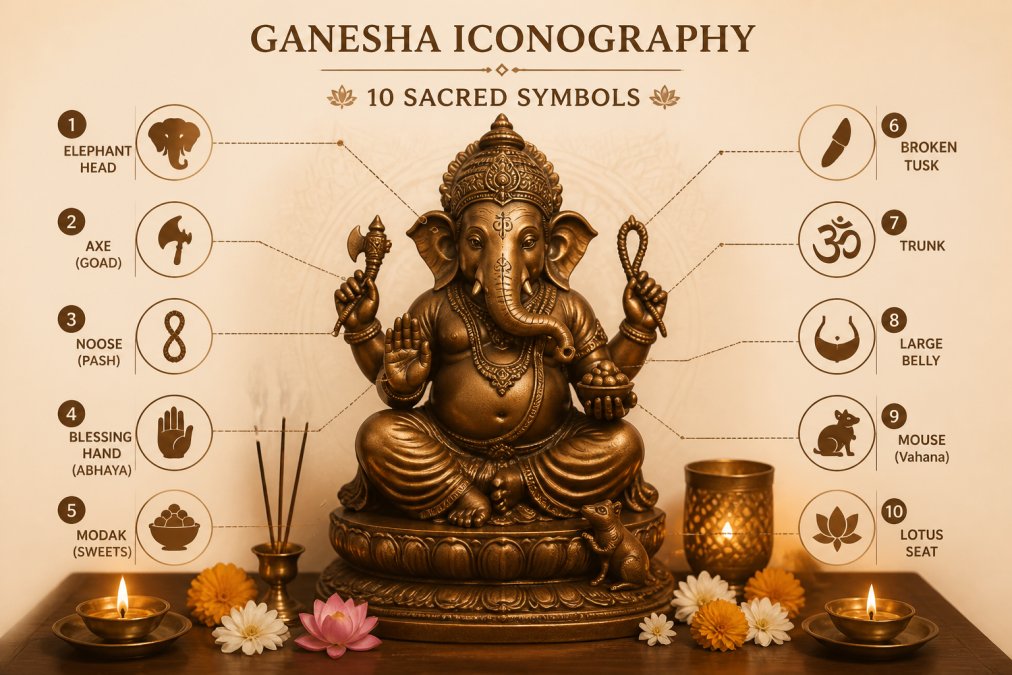
Ce guide explore les principaux éléments symboliques trouvés dans les représentations traditionnelles de Ganesha. Comprendre ces symboles vous aide à sélectionner des statues avec une intention plus profonde, que ce soit pour une pratique personnelle ou comme ajouts significatifs à votre espace de vie. Comme documenté dans Le livre de l'imagerie hindoue par Eva Rudy Jansen, Iconographie des divinités hindoues sert de système d’enseignement visuel où chaque détail contribue au message spirituel global.
La tête d'éléphant : sagesse et intelligence
La tête d'éléphant est au centre de l'identité de Ganesha, représentant les plus hautes capacités intellectuelles et spirituelles. Dans la philosophie hindoue, l’éléphant symbolise la sagesse en raison de son intelligence observée dans le monde naturel. Les éléphants font preuve d’une mémoire remarquable, d’une capacité à résoudre des problèmes et d’une complexité émotionnelle, qualités associées au buddhi ou intellect discriminatif.
Cet attribut répond à un défi humain fondamental : la capacité de discerner la vérité de l’illusion. La tête d'éléphant confère à Ganesha la capacité de voir à travers la confusion et la complexité. Lorsque les pratiquants méditent sur ce symbole, ils invoquent la même clarté pour leur propre prise de décision. La mobilité et la sensibilité de la trompe de l'éléphant représentent la capacité de l'intellect raffiné à naviguer dans les nuances et les subtilités, à se plier et à s'adapter tout en conservant les principes fondamentaux.
Les quatre bras et leur signification
Ganesha apparaît généralement avec quatre bras, chacun portant des objets symboliques qui révèlent différentes dimensions de son pouvoir et de son objectif. Les quatre bras représentent les quatre directions cardinales, les quatre Vedas et les quatre dimensions de l'expérience humaine : physique, émotionnelle, intellectuelle et spirituelle.
Le bras droit tient la hache (parasu), symbolisant la destruction de l’ego et de l’attachement. Cela élimine les illusions qui lient la conscience, laissant ainsi la place à une véritable croissance. L'avant-bras droit affiche le varada mudra, un geste de la main de bénédiction et de protection, étendant la compassion et la grâce.
Le bras gauche tient un modak (boulette sucrée), représentant les récompenses de la poursuite spirituelle et la douceur de la grâce divine. L'avant-bras gauche tient un serpent ou une corde (pacha), symbolisant le contrôle et la liaison des désirs. Ensemble, les quatre bras présentent une image complète : destruction de l'ego, bénédiction de la grâce, récompense de la pratique et contrôle des désirs.
La défense brisée : sacrifice et connaissance
La défense brisée (danta) constitue peut-être la caractéristique physique la plus distinctive de Ganesha. Selon la tradition, Ganesha a brisé sa propre défense en guise d'acte de sacrifice pour compléter un texte sacré. La défense brisée montre que l’acquisition de la vraie connaissance nécessite souvent des sacrifices personnels et la volonté de renoncer à quelque chose de valeur.
Ce symbole démontre qu’une véritable transformation exige souvent que nous nous débarrassions des attachements, des habitudes confortables ou des aspects de l’identité qui ne servent plus notre croissance. Le bris de la défense devient un signe d'engagement authentique plutôt qu'une marque de faiblesse. Dans les représentations artistiques, cette asymétrie visuelle empêche Ganesha d’apparaître comme une abstraction parfaitement équilibrée, ancrant la divinité dans une expérience réelle où la perfection n’existe que comme aspiration.
Les grandes oreilles : écoute et discernement
Les oreilles surdimensionnées de Ganesha représentent la capacité d'écoute profonde et de conscience réceptive. La capacité d’entendre véritablement, non seulement de traiter le son mais aussi de comprendre le sens des mots, distingue la véritable sagesse de la simple accumulation d’informations. Les oreilles représentent aussi le discernement, la capacité de distinguer ce qui est essentiel et ce qui est périphérique, ce qui est vrai et ce qui est trompeur.
La taille des oreilles dans les représentations artistiques dépasse souvent les proportions anatomiques, soulignant visuellement l'importance de l'écoute en tant que pratique spirituelle. En termes pratiques, le symbolisme de l'oreille répond à un défi contemporain : l'attention sélective dans un environnement saturé d'informations. Les grandes oreilles rappellent aux pratiquants d'écouter plus attentivement les autres, en entendant non seulement les mots mais aussi les émotions et les besoins sous-jacents.
Le tronc : efficacité, adaptabilité et signification de la direction du tronc de Ganesha
La trompe d'éléphant allie force et flexibilité, représentant l'efficacité et la capacité d'accomplir des tâches grâce à une adaptation intelligente plutôt qu'à la force brute. Le tronc peut soulever des poids massifs ou manipuler des objets délicats avec la même facilité, ce qui suggère que le véritable pouvoir réside dans une flexibilité intelligente.
La signification de la direction du tronc de Ganesha revêt une signification spécifique dans la tradition artistique. Lorsque le tronc s'incurve vers la droite, cela suggère l'activation de l'énergie solaire et les qualités d'action, de volonté et d'expression extérieure. Lorsque le tronc s'incurve vers la gauche, il représente l'énergie lunaire, la réceptivité et la contemplation intérieure. Les pratiquants sélectionnant une statue pour leur espace de méditation se demandent souvent s’ils doivent activer un engagement plus dynamique (tronc courbé vers la droite) ou cultiver une plus grande paix intérieure (tronc courbé vers la gauche).
L'adaptabilité du tronc symbolise la capacité à surmonter les obstacles avec créativité plutôt qu'avec confrontation. Cela représente l'intelligence pour trouver des solutions qui contournent le conflit direct, liée au concept d'action habile (karma yoga). La sensibilité du tronc met davantage l'accent sur le discernement, représentant la perception raffinée cultivée par la pratique spirituelle.
Le Modak, la hache, le gros ventre et le serpent : récompenses spirituelles et détachement de l'ego
Le modak (boulette sucrée) tenu dans le bras gauche de Ganesha représente les récompenses et la douceur qui proviennent d'une pratique spirituelle sincère. Ce n'est pas simplement un symbole d'indulgence, mais un rappel que le chemin spirituel procure une véritable satisfaction et une véritable joie. Le modak fonctionne également comme une offrande faite lors du culte de Ganesha, établissant une relation réciproque entre le dévot et la divinité.
La hache (parasu) dans le bras droit coupe l’ego, l’attachement et les illusions qui lient la conscience. Sa position surélevée suggère un engagement actif contre l’ignorance. Le gros estomac (udara) représente la capacité de digérer et d’assimiler toutes les expériences, tant agréables que désagréables, transformant les obstacles en sagesse.
Le serpent (naga) tenu dans l'avant-bras gauche symbolise l'énergie kundalini et le contrôle des désirs. La forme enroulée du serpent représente une puissance spirituelle latente attendant d'être éveillée par la pratique. Ensemble, ces quatre objets symboliques fonctionnent de concert : le modak promet de véritables récompenses, la hache supprime les obstacles, l'estomac digère l'expérience et le serpent contrôle et redirige l'énergie.
Symbolisme de la statue de Ganesha : comment sélectionner et placer des statues pour une énergie positive
Sélection d'un Statue de Ganesh s'étend au-delà de la préférence esthétique dans la pratique spirituelle intentionnelle. La représentation spécifique, les matériaux, la posture et les détails symboliques doivent correspondre à vos besoins spirituels et à votre espace de vie actuels.
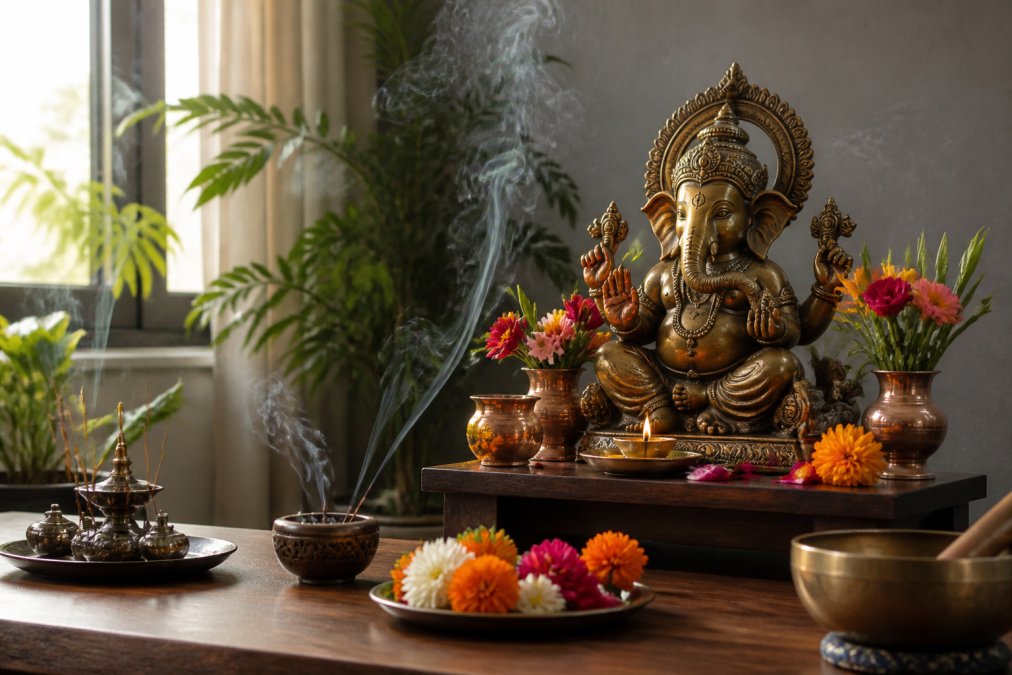
Le choix des matériaux est important. Les statues en bronze véhiculent durabilité et qualité intemporelle, souvent préférées des praticiens sérieux. Les statues de pierre représentent la permanence et la pureté. Les statues en bois créent de la chaleur et un lien avec les éléments naturels. Les statues en résine ou en argile offrent une accessibilité sans sacrifier la fonction spirituelle. HD Asian ArtLa collection organisée comprend des designs anciens et contemporains dans divers matériaux, chacun apportant des qualités énergétiques différentes.
La posture compte considérablement. Les statues de Ganesha assis transmettent stabilité, ancrage et calme méditatif, idéales pour les espaces d'autel. Ganesha debout représente un engagement actif et un mouvement à travers le monde. Dancing Ganesha incarne la joie, le dynamisme et la célébration de la pratique spirituelle. Tenez compte de vos circonstances de vie actuelles lors du choix de la posture.
Le placement dans votre maison mérite une attention particulière. Le coin nord-est reçoit traditionnellement des statues de Ganesha, car cette direction est associée à de nouveaux départs et à un flux d'énergie positif. La statue doit faire face à votre espace de vie plutôt qu'à un mur, permettant à son énergie de bénédiction de s'étendre dans tout votre espace. Évitez de placer des statues de Ganesha dans les salles de bains, les chambres ou les zones encombrées.
Gardez la statue propre et faites des offrandes régulières. Même de simples offrandes, des fleurs fraîches, de l'encens ou un modak, entretiennent une relation active avec la statue en tant qu'outil spirituel plutôt que simple décoration. La taille de votre statue doit correspondre à votre espace et à votre intention. Une petite statue (6 à 12 pouces) convient bien aux appartements ou aux autels personnels. Les statues de taille moyenne (12 à 24 pouces) servent de salles de méditation dédiées. Les statues plus grandes (24 pouces et plus) constituent des points focaux puissants dans des espaces importants. L'authenticité et le savoir-faire comptent plus que la taille.
Tenez compte du style artistique lors de la sélection. Les représentations traditionnelles mettent l'accent sur l'exactitude symbolique selon les principes iconographiques classiques. Les interprétations contemporaines peuvent prendre des libertés créatives tout en conservant les éléments symboliques fondamentaux. Les deux approches ont du mérite : les styles traditionnels vous connectent à des siècles de pratique, tandis que les pièces contemporaines s'intègrent plus naturellement dans les espaces de vie modernes.
Comprendre les 10 symboles du Seigneur Ganesha dans l’art expliqué ouvre la voie à une pratique spirituelle plus profonde et à une vie plus intentionnelle. Chaque symbole véhicule une sagesse pratique applicable aux défis quotidiens, de la clarté de la tête d'éléphant à l'adaptabilité de la trompe. Lorsque vous sélectionnez une statue de Ganesha pour votre espace, vous choisissez un ancrage visuel pour ces principes. HD Asian ArtLa collection de pièces anciennes et contemporaines triées sur le volet vous garantit de trouver une représentation qui résonne avec votre voyage spirituel. Parcourez notre sélection de statues de Ganesha pour découvrir la pièce qui apportera sagesse, clarté et énergie positive à votre espace de méditation.
Foire aux questions
Quels sont les 10 principaux symboles associés au Seigneur Ganesha dans l’art ?
Les dix symboles principaux comprennent la tête d'éléphant (sagesse), quatre bras (pouvoirs divins), la défense brisée (sacrifice), les grandes oreilles (écoute), la trompe (adaptabilité), le modak (récompense spirituelle), la hache (détachement), le gros estomac (digestion de l'expérience), le serpent (énergie kundalini) et la monture de la souris (humilité). Chaque symbole porte une signification spirituelle profonde et représente différents aspects de la divinité et de la conscience. Ces éléments iconographiques se combinent pour créer une représentation complète du rôle de Ganesha en tant qu'éliminateur d'obstacles et incarnation de l'intellect et de la sagesse dans l'art sacré hindou.
Que nous dit la direction du tronc de Ganesha sur l’emplacement de la statue ?
La direction du tronc de Ganesha revêt une signification importante dans la tradition hindoue. Un tronc élevé vers le haut symbolise les bénédictions, la prospérité et le flux d'énergie positive, ce qui le rend idéal pour les autels domestiques et les espaces de méditation. Un tronc courbé vers le bas ou sur le côté représente différents aspects spirituels et peut être préféré dans certains contextes. Lorsque vous placez des statues de Ganesha pour une énergie positive, comprendre la direction du tronc aide à aligner l'intention de la statue avec vos objectifs spirituels. La plupart des praticiens recommandent des malles orientées vers le haut pour les maisons en quête d’abondance et de protection spirituelle.
Comment le symbolisme de la statue de Ganesha influence-t-il la statue que je dois choisir pour mon espace ?
Le symbolisme de la statue de Ganesha englobe le matériau, la posture, le mudra (gestes de la main) et le style artistique. Les statues en bronze et en marbre portent des qualités énergétiques différentes ; le bronze est associé à la force et à la transformation, tandis que le marbre représente la pureté et la permanence. Ganesha assis transmet la stabilité et la méditation, tandis que Ganesha dansant incarne l'énergie dynamique et la joie. Comprendre ces couches symboliques vous aide à sélectionner une statue qui résonne avec votre pratique spirituelle et complète votre espace de méditation ou votre autel domestique. Tenez compte de votre intention, de l’espace disponible et de votre lien personnel avec la divinité lors du choix.
Pourquoi la souris est-elle représentée avec le Seigneur Ganesha dans les statues ?
La souris, appelée Mooshak en sanskrit, sert de monture à Ganesha et représente l'humilité, la petitesse et la capacité à franchir les obstacles. Bien qu’elle soit minuscule et apparemment insignifiante, la souris symbolise la façon dont même la plus petite créature peut surmonter les défis lorsqu’elle est guidée par la sagesse divine. La souris représente également la tendance de l'esprit à se disperser et à se déplacer rapidement, que Ganesha contrôle grâce à son intellect et sa maîtrise spirituelle. Ce symbole enseigne aux fidèles que les obstacles ne sont pas une question de taille ou de puissance mais de sagesse et de discernement pour les surmonter.
Quelle est la signification de la défense brisée dans l’iconographie de Ganesha ?
La défense brisée représente le sacrifice, l’altruisme et la volonté d’abandonner son ego pour une connaissance supérieure. Selon la mythologie hindoue, Ganesha a brisé sa propre défense pour écrire le Mahabharata, démontrant ainsi son engagement envers la sagesse et le service avant l'intégrité personnelle. Ce symbole enseigne que la véritable illumination nécessite parfois d’abandonner ce qui nous est cher. La défense brisée signifie également que Ganesha est accessible et compatissant, ni distant ni parfait, ce qui le rend accessible à ceux qui luttent contre leurs propres imperfections et limites.
