



How to Insure a Private Buddhist Art Collection
How to Insure a Private Buddhist Art Collection
Table of Contents
- Why Your Standard Homeowners Policy Falls Short
- Art Appraisal for Insurance Purposes: What You Need First
- How to Document a Private Art Collection
- The Scheduled Personal Property Endorsement Explained
- When to Buy Standalone Fine Art Insurance
- Storage, Display, and Security Requirements Insurers Look For
- Filing a Claim on Your Buddhist Art Collection
- Frequently Asked Questions
Why Your Standard Homeowners Policy Falls Short
A standard homeowners policy typically caps coverage for art, antiques, and collectibles at a fraction of what a serious Buddhist sculpture is worth, and that gap is where collectors get hurt. Most policies treat fine art as ordinary personal property subject to a sub-limit, and the Insurance Information Institute guide to homeowners coverage explains that valuable items usually need separate scheduling. This guide from HD Asian Art walks through how to insure a private Buddhist art collection properly, from appraisal to claim.
Here's the core problem: if a bronze Buddha figure is stolen or damaged, a standard policy may reimburse only a small percentage of its value, and you'll be the one proving what it was worth. Worse, many policies settle on actual cash value, which subtracts depreciation before paying out.
That's the tension running through this entire process. Insurers don't price objects they can't verify, and collectors rarely have documentation ready before they need it.
Art Appraisal for Insurance Purposes: What You Need First
An art appraisal for insurance purposes is a written, dated valuation of specific objects prepared by a qualified professional and formatted for an insurer's underwriting file. It is the foundation every policy, endorsement, and claim is built on.
Without it, you're asking an insurer to accept your word on value. They won't.
Choosing a Qualified Appraiser
Look for an appraiser with credentials from a recognized professional association, direct experience with Asian religious art, and a written scope of work that states the intended use is insurance. Ask three questions before hiring anyone:
- Do you hold a current credential from a professional appraiser association?
- Have you appraised Southeast Asian or Himalayan sculpture before?
- Will the report follow the Uniform Standards of Professional Appraisal Practice?
The last point matters. USPAP compliance is the standard insurers and courts recognize, and the Appraisal Foundation overview of USPAP documents what a compliant report must contain.
Agreed Value vs. Actual Cash Value
Agreed value means you and the insurer settle on a fixed dollar figure for a scheduled item before any loss, and that figure is paid without depreciation. Actual cash value pays replacement cost minus depreciation, which for a hand-carved sculpture can be a painful haircut.
For a private Buddhist art collection, agreed value is almost always the better structure. You know the number going in. There's no argument about what a 19th-century gilt bronze was worth on the day it was damaged.
How to Document a Private Art Collection
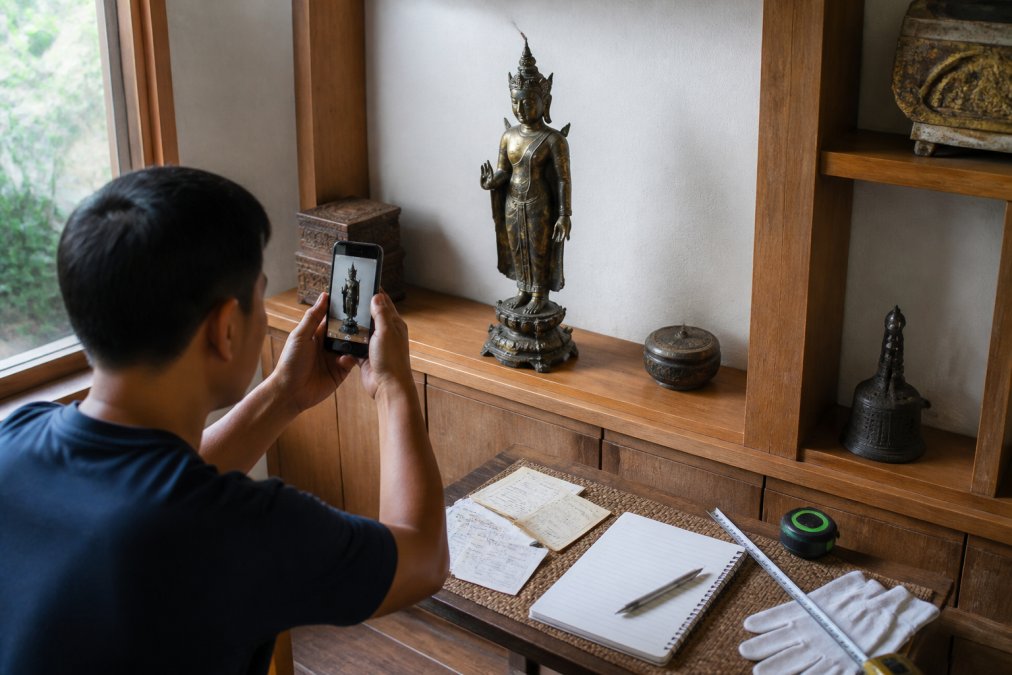
Knowing how to document a private art collection is what separates a smooth claim from a fight. Documentation is the evidence file your insurer prices against and your claim rests on.
Photographs, Receipts, and Condition Reports
Build one folder, digital and physical, containing:
- High-resolution photographs of each piece from front, back, base, and any signature or mark
- Purchase receipts, invoices, or auction records showing what you paid and when
- A condition report noting cracks, repairs, patina wear, or missing elements
- The appraiser's signed and dated valuation
- Any provenance documents you hold
Update the photographs every few years and after any restoration. A common mistake is photographing a piece once at purchase and never again, then discovering the images are too low-resolution to show a repair the insurer disputes. Detailed visual records also serve as a vital baseline for assessing condition changes during the process of transporting delicate antiques.
The Scheduled Personal Property Endorsement Explained
A scheduled personal property endorsement is an add-on to a homeowners or renters policy that lists specific high-value items individually, each with its own coverage limit, and typically removes the deductible for those items. Instead of a blanket sub-limit, each sculpture is named and insured at an agreed amount.
This is the middle path between a standard policy and a full standalone fine art policy. It works well when your collection is modest and stays in one home. It works poorly when values are high, when pieces travel, or when you lend to exhibitions.
| Coverage Approach | How It Values Items | Best For | Main Limitation |
|---|---|---|---|
| Standard homeowners | Actual cash value, sub-limited | Low-value decorative pieces | Caps payout, depreciates value |
| Scheduled endorsement | Agreed value per listed item | Modest collections in one home | Requires appraisal, item-by-item listing |
| Standalone fine art policy | Agreed value, broader perils | High-value or traveling collections | Separate premium, stricter security terms |
When to Buy Standalone Fine Art Insurance
Standalone fine art insurance makes sense once your collection's total value outgrows what an endorsement can comfortably cover, or once pieces leave your home for exhibitions, conservation, or transit. These policies are written specifically for art, which means broader peril coverage and fewer exclusions than a homeowners add-on.
Three signals it's time to move:
- Your insurer caps the scheduled endorsement below your collection's value
- You lend pieces to galleries or ship them for restoration
- You want coverage for accidental breakage, which many homeowners policies exclude
Ask each insurer directly how they handle transit, loaned works, and pairs or sets. A pair of matched figures damaged together may be valued as a set, and that distinction should be in writing.
Storage, Display, and Security Requirements Insurers Look For
Insurers price risk, and for a Buddhist art collection the risk is theft, fire, water, and accidental damage. Expect underwriting questions about where and how pieces are kept.
Common requirements include:
- Display away from direct sunlight and consistent humidity, since extremes crack wood and stress bronze
- Anchoring or securing freestanding pieces against tipping
- A monitored alarm or, for higher values, a safe for smaller items
- No display in basements prone to flooding
The National Fire Protection Association publishes guidance on protecting valuables from fire and water damage that underwriters often reference. Meet the requirements before you sign, not after, because a claim denied for a breached security condition is the worst outcome in this whole process.
Filing a Claim on Your Buddhist Art Collection
Report the loss promptly, in writing, and in the format your policy specifies. Then submit your documentation file: photographs, appraisal, receipts, and condition report. The insurer may send its own appraiser or adjuster to verify the claim.
Two things decide the outcome. First, whether your appraisal was current at the time of loss. Second, whether the damaged or stolen piece matches your documentation precisely. This is why the folder you built earlier matters more than anything else on this list.
Keep a copy of the file off-site or in cloud storage. If a fire takes the sculpture, it can take the paperwork too.
Insuring a private Buddhist art collection comes down to proving what you own and what it's worth before you ever need to. Start with a USPAP-compliant appraisal, document every piece thoroughly, then choose between a scheduled endorsement and standalone coverage based on value and whether pieces travel. At HD Asian Art, we help collectors build collections worth protecting, with carefully curated Buddhist and Hindu statues, handpicked antique and contemporary pieces, and Khmer and Southeast Asian sculptures backed by free shipping. Browse our collection and start your documentation file with pieces you'll be glad you insured properly.
Frequently Asked Questions
Does homeowners insurance cover high-value Buddhist art collections?
Standard homeowners policies usually cap coverage for art and collectibles at a low percentage of your dwelling limit, often far below what a serious Buddhist art collection is worth. Many also exclude breakage and mysteriously disappeared items. To close that gap, most collectors add a scheduled personal property endorsement or buy a standalone fine art policy. Review your current limits before assuming you are covered.
What is the difference between agreed value and actual cash value for art?
Agreed value pays the amount listed on your policy schedule when a covered loss happens, with no depreciation applied. Actual cash value pays replacement cost minus depreciation, which can leave a large shortfall on older or antique pieces. For a Buddhist art collection with hard-to-replace sculptures, agreed value is usually the safer choice because it locks in the number both you and the insurer accepted at underwriting.
Do I need a professional appraisal for my Buddhist art collection?
Most insurers require a professional appraisal for any piece valued above a threshold, often around $1,000 to $5,000 depending on the carrier. The appraisal should come from a qualified specialist who understands Southeast Asian Buddhist and Hindu sculpture, not a generalist. Keep the report current, since many carriers want updates every three to five years or after any major market shift.
What documentation is required to insure antique sculptures?
Expect to provide a written appraisal, dated purchase receipts, clear photographs of each piece from multiple angles, and a condition report noting chips, repairs, or patina loss. Provenance records such as prior sales or gallery paperwork strengthen the file. Store digital and physical copies, and update the inventory whenever you buy, sell, or move a piece, so your scheduled personal property endorsement stays accurate.
