



How to Choose a Buddhist Statue for Your Home
How to Choose a Buddhist Statue for Your Home
Quick Summary
To choose a buddhist statue for your home, match its size to the room first: pieces of 15 to 30 cm suit desks and small shelves, while 30 to 60 cm works on console tables and mantels. Then match posture and hand gesture to the mood you want the space to hold.
- Measure your surface before buying and leave breathing room on each side.
- A seated figure with Dhyana mudra is the most versatile, least clashing choice.
- Wood, bronze, and brass are the best materials for bedroom statues.
- Set the statue at seated eye level, facing the open room, away from heavy foot traffic.
- Check the hands first: soft, merged fingers signal a mold-poured copy.
Table of Contents
- Start with the Right Size and Scale for Your Space
- The Meaning of Buddha Statue Postures and Mudras
- Choosing the Right Material for Your Buddhist Statue
- Buddhist Altar Setup for Beginners: Placement and Orientation
- Authenticity and Craftsmanship: What to Look For
- Integrating a Buddhist Statue with Modern Interior Design
- Browse HD Asian Art's Curated Collection
- Frequently Asked Questions
Start with the Right Size and Scale for Your Space
The best way to choose a Buddhist statue for your home is to match its size to the room before anything else. A piece that fits its space feels calm and intentional. One that overwhelms a corner reads as clutter.
Size guides help here. Statues between 15 and 30 cm suit desks, bedside tables, or small shelves, while pieces from 30 to 60 cm work best on console tables or fireplace mantels, according to HD Asian Art's placement sizing guidelines. Measure your surface first, then leave breathing room on each side.
Small apartments are not a problem. A compact statue placed with care can anchor a meditation corner beautifully. For the full walkthrough on scale and placement, see our guide on how to choose a Buddha statue for your home altar.
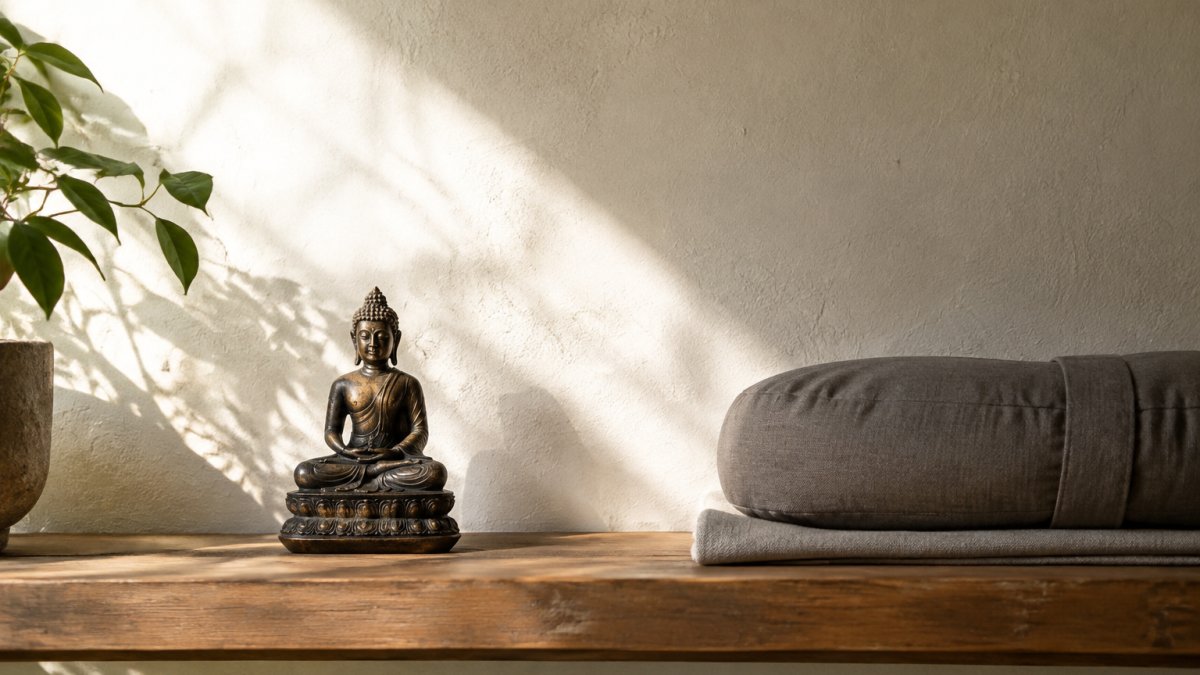
The Meaning of Buddha Statue Postures and Mudras
Posture and hand gesture are the two fastest ways to read what a statue is expressing. Before you fall for a finish or a price, learn to read the body language, it is the difference between a piece that fits your room's purpose and one that simply looks the part.
Postures and What They Signal
- Seated (cross-legged): meditation, inner quiet, and steady attention. The most common form for altars and quiet corners.
- Standing: compassion and readiness to help. A standing figure often carries a raised hand and reads as more active than a seated one.
- Reclining: passing into final peace. Best kept as a single focal piece rather than paired with busy decor.
- Walking: steady forward motion, often associated with the historical Buddha's teaching journeys. A good fit for hallways and entryways.
A seated figure suits a meditation corner or bedside table. A standing figure suits an entryway where you want a welcoming, outward-facing presence. A reclining figure works best as a single, calm anchor on a low console.
Mudras: Reading the Hands
Mudras are the hand gestures carved into a statue, and each one expresses a specific quality such as protection, generosity, or deep concentration. They are part of the statue's iconography, not decoration, so the gesture should match the mood you want the room to hold.
- Dhyana mudra: hands resting in the lap, palms up, often with a bowl. Linked to meditation and concentration.
- Bhumisparsha mudra: the right hand reaching down to touch the earth, marking the moment of enlightenment. A grounding gesture for a study or workspace.
- Abhaya mudra: open palm raised at shoulder height, offering protection and reassurance. Common on standing figures placed near entrances.
- Varada mudra: palm facing down and outward, standing for generosity and the granting of wishes.
- Vitarka mudra: thumb and forefinger touching in a circle, signaling teaching and discussion.
- Anjali mudra: palms pressed together at the chest, expressing greeting and reverence.
Matching Form to Room
A meditation space often calls for Dhyana. An entryway may suit Abhaya. A reading nook or desk pairs well with Bhumisparsha. If you are unsure, choose a seated figure with Dhyana mudra, it is the most versatile and the least likely to clash with a room's purpose.
A statue with mismatched posture and gesture may be a design that copied elements without fully reflecting their meaning, so treat that mismatch with caution.
For a deeper look at how these gestures are carved in different traditions, read our guide to mudras in Japanese Zen sculpture.
Each posture and hand gesture carries a specific meaning, so match the form to the mood you want the room to hold.
| Form | Meaning | Best placement |
|---|---|---|
| Seated (cross-legged) | Meditation, inner quiet, steady attention | Altars, meditation corners, bedside tables |
| Standing | Compassion and readiness to help | Entryways, welcoming outward-facing spots |
| Reclining | Passing into final peace | Single calm anchor on a low console |
| Walking | Steady forward motion, teaching journeys | Hallways and entryways |
| Dhyana mudra | Meditation and concentration | Meditation space; most versatile choice |
| Bhumisparsha mudra | Enlightenment, grounding | Study or workspace, reading nook, desk |
| Abhaya mudra | Protection and reassurance | Entrances, common on standing figures |
| Varada mudra | Generosity and granting of wishes | Rooms meant to feel open and giving |
Choosing the Right Material for Your Buddhist Statue
Material shapes how a statue ages and where it belongs. Wood brings warmth. Bronze holds fine detail and gains a rich patina over time. Stone feels grounded and permanent. Quality resin offers a clean finish.
Think about your real conditions first: humidity, direct sunlight, pets, children, and how often you will dust. Buyers are increasingly weighing durability against these factors, notes Butuzou's buyer's guide. A material that suits your room will look better for longer.
Wood, Bronze, and Brass for Bedrooms
Wood, bronze, and brass are the best materials for bedroom statues, with sealed stone and quality resin as solid alternatives, per HD Asian Art's bedroom materials guide. These materials feel warm and quiet, which suits a sleeping space. Our best materials for bedroom Buddha statues guide compares each option in detail.
Buddhist Altar Setup for Beginners: Placement and Orientation
A calm, uncluttered surface is the foundation of any altar. Choose a stable shelf or table at roughly eye level when seated. Keep the statue facing the room, and clear the space around it.
Follow these beginner steps:
- Pick a quiet spot away from heavy foot traffic
- Set the statue at seated eye level
- Face it toward the open room
- Add a small incense holder and a simple vase
- Keep the surface clean and minimal
Maintaining this sense of balance requires careful attention to the surrounding altar decor accessories, which can be further enhanced by incorporating a crystal moon to ground the energy of your sacred space.
Avoid placing a statue in a bathroom or directly above a doorway. For a full step-by-step, read how a beginner should arrange a Buddha statue altar.
Authenticity and Craftsmanship: What to Look For
Craftsmanship shows in the small details, and those details are also your best defense against a piece that looks right in a photo but feels hollow in person. The goal is not to become an appraiser, it is to tell a considered object from a rushed copy before you bring it home.
Read the Details in This Order
- The hands. Fingers should be distinct, evenly spaced, and cleanly separated. Soft, merged fingers are the first sign of a mold-poured copy.
- The face. Look for symmetry in the eyes and a calm, consistent expression. Hand-finished faces carry slight natural variation; machine copies look identical from every angle.
- The robe folds. Crisp edges and natural flow suggest carving. Rounded, uniform folds suggest casting.
- The base and back. Hand-carved pieces often show tool marks and a slightly uneven underside. A perfectly smooth, seam-lined base is a casting tell.
- The patina. Even, gradual patina that follows the high and low points of the carving reads as age. A flat, uniform coating reads as applied finish.
Questions to Ask a Seller
- Where was the piece made, and by whom?
- Is it hand-carved, cast, or molded resin?
- What material is it, and is the finish original or applied?
- Can you show detail photos of the hands, face, and base?
A seller who cannot answer these plainly is telling you something. A seller who can is usually proud of the piece.
Hand-Carved vs. Mass-Produced: The Trade-Off
Mass-produced resin and cast pieces have a real place, they are uniform and easy to place in a modern room. Hand-carved wood, bronze, and stone vary piece to piece, but they carry the small irregularities that make an object feel alive. Neither choice is wrong; the mistake is paying hand-carved attention to a mass-produced piece, or expecting a mass-produced piece to age like a carved one.
Cultural Appreciation, Not Appropriation
A Buddhist statue is religious iconography before it is decor. Treating it with respect, placing it at or above seated eye level, keeping it out of bathrooms and off the floor, and learning what its posture and gesture mean, is the difference between appreciation and appropriation. You do not need to be Buddhist to own one, but you should be able to explain what it represents.
Ask for close-ups before you commit, especially when a seller's origin story is vague.
For practical tips on evaluating older pieces, see our guide on how to spot fake antique Buddhist statues.
Integrating a Buddhist Statue with Modern Interior Design
Minimalist rooms and Buddhist statues pair well. Designers and collectors are favoring statues with clean lines and simple designs to suit modern settings, according to Original Buddhas' trend notes. A single refined piece often beats a crowded shelf.
Try these approaches:
- Let one statue anchor a quiet corner
- Pair bronze with warm wood and neutral walls
- Use soft, indirect lighting to bring out the patina
- Leave open space around the piece
The goal is harmony, not display. A calm statue invites steady attention, which is the point.
Browse HD Asian Art's Curated Collection
Finding a piece you can trust matters, and that is where HD Asian Art comes in.
At HD Asian Art, we offer a carefully curated collection of Buddhist and Hindu statues, with a focus on Khmer and Southeast Asian sculpture. Our selection is designed to enhance altars and meditation spaces. We offer free shipping.
Get started with HD Asian Art and find the statue that turns your corner into a sanctuary.
Frequently Asked Questions
Is it okay to have a Buddha statue in the house?
Yes, having a Buddhist statue in the home is common for both decor and spiritual practice. The key is to treat it with respect. Place it in a clean, elevated spot like a console table or dedicated altar, and avoid locations like the bathroom or floor. The best choice is a statue that feels visually calm and invites consistent, respectful attention.
Where should I place a Buddha statue at home?
For a Buddhist altar setup for beginners, choose a quiet, clean area like a living room corner or a dedicated meditation space. The statue should face the room's entrance or a window, but avoid placing it in a bathroom, directly on the floor, or in a cluttered area. Choose a size that suits the surface you have in mind.
What do the different hand gestures (mudras) of Buddha statues signify?
The meaning of Buddha statue postures is central to choosing one. A statue with hands resting in the lap (Dhyana mudra) symbolizes meditation and serenity, ideal for a meditation room. The earth-touching gesture (Bhumisparsha mudra) represents enlightenment. For a home, select a mudra that aligns with the mood you want to create, whether it's calm focus or grounded confidence.
How do I choose between different materials for a home statue?
The material dictates a statue's aging process and placement. For a bedroom, wood, bronze, and brass feel warm and quiet. Consider your home's conditions: humidity, direct sunlight, and pets. Sealed stone or quality resin are also options to consider. Each material brings a different presence, so choose one that fits your room's atmosphere and your willingness to maintain it.

