



Statue de Bouddha d'autel domestique : guide d'installation étape par étape
Statue de Bouddha d'autel domestique : guide d'installation étape par étape
La plupart des gens qui décident de créer un autel de maison avec une statue de Bouddha passer plus de temps à s'inquiéter qu'à construire. Ils remettent en question l'emplacement, se demandent si l'encens est « correct » et se retrouvent avec une étagère encombrée qui ne sert aucun objectif spirituel.
La vérité est que la mise en place d’un autel sacré significatif n’est pas compliquée, mais cela nécessite quelques choix délibérés faits dans le bon ordre. Que vous aménageiez un autel bouddhiste, un autel hindou avec des statues de divinités ou un espace contemplatif mêlant les traditions sculpturales asiatiques, ce guide vous guide à travers chaque étape sans haie ni remplissage.
Table des matières
Points à retenir
|
Aperçu clé |
Explication |
|---|---|
|
La statue centrale n'est pas une décoration |
La statue de Bouddha de votre autel ou murti hindou est le point d’ancrage de tout l’espace. Tous les autres éléments sont disposés par rapport à lui. Choisissez avec intention et non avec impulsion. |
|
L'emplacement bat la taille à chaque fois |
Un petit autel dans un coin calme et dédié surpasse un grand dans un couloir très fréquenté. Le placement sans distraction est le facteur le plus sous-estimé. |
|
Mudra détermine l'énergie de votre espace |
Le geste de la main (mudra) de votre statue de Bouddha n’est pas stylistique. Dhyana mudra cultive le calme, Bhumisparsha mudra ancre la résolution, Abhaya mudra dissipe la peur. Faites correspondre le mudra à votre intention de pratique. |
|
L'élévation n'est pas négociable |
Les traditions bouddhistes et hindoues exigent que la figure centrale soit élevée au-dessus du niveau du sol et des objets environnants. Un socle ou une étagère dédiée est essentiel et non facultatif. |
|
De nouvelles offres signalent une pratique active |
Des fleurs fanées, des bols d’eau vides et des bougies brûlées laissées pendant des jours témoignent d’une négligence. Un rafraîchissement quotidien d'au moins l'eau et l'encens maintient l'autel en vie. |
|
Une sculpture de qualité bat cinq sculptures médiocres |
Les pièces de qualité muséale issues de la bonne tradition régionale sont porteuses d'une cohérence visuelle et culturelle. Mélanger des objets sans rapport sape le but de l'autel et semble chaotique. |
|
La décoration de la sculpture asiatique et la pratique spirituelle ne sont pas en conflit |
Un autel bien disposé est intrinsèquement beau. Les mêmes principes qui le rendent spirituellement sain, un placement surélevé, des lignes de vue nettes, des matériaux de qualité, le rendent également esthétiquement convaincant. |
Pourquoi la sculpture centrale détermine tout
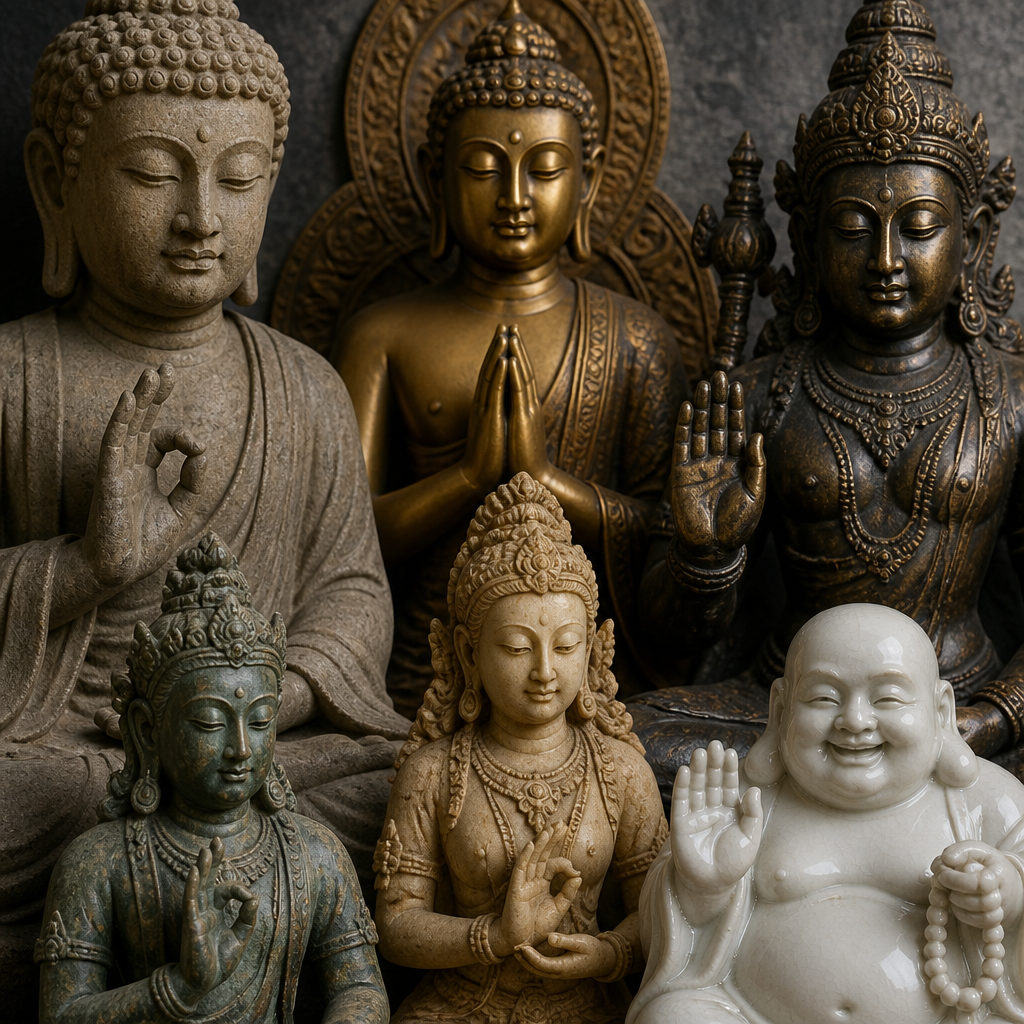
Avant d'acheter une étagère, de choisir un tissu ou d'allumer un seul bâton d'encens, vous devez identifier votre statue centrale. C’est la décision qui régit tout le reste. Un autel domestique construit autour d'un Bouddha d'albâtre birman assis dans le Dhyana mudra aura un caractère différent, des proportions différentes et des éléments de support différents de ceux construits autour d'un bronze thaïlandais debout dans l'Abhaya mudra. Les deux sont corrects. Mais mélanger les styles sans intention produit un espace confus qui ne sert ni l’esthétique ni la pratique.
Mudra est le point de départ le plus pratique pour la sélection. La position des mains d’une statue de Bouddha signale sa fonction spirituelle. Le Dhyana mudra, les deux mains posées sur les genoux tournées vers le haut, est idéal pour les autels axés sur la méditation car il inculque un calme et une concentration profonds. Le mudra Bhumisparsha, la main droite pointant vers la terre, représente le moment de l'illumination du Bouddha et exprime une détermination inébranlable. L'Abhaya mudra, une main levée avec la paume tournée vers l'extérieur, offre une protection et dissipe la peur. Choisir le mudra qui correspond à votre intention de pratique est plus important que de choisir uniquement en fonction du matériau ou de la taille.
La tradition régionale compte également. Si vous pratiquez le bouddhisme Theravada, une pièce d'albâtre birman ou un bronze doré thaïlandais semblera cohérent sur votre autel. Si votre pratique est mahayana ou mixte, le bronze de style khmer cambodgien, les figures chinoises de Guanyin ou la sculpture laquée japonaise apportent chacun leur propre vocabulaire iconographique. À HD Asian Art, la collection s'étend Birmanie, Cambodge, Chine, Japon, Thaïlande, et plusieurs autres traditions, ce qui signifie que vous pouvez sélectionner une pièce qui correspond à votre lignée plutôt que de vous contenter de ce qui est disponible localement.
Choisir votre emplacement
L’erreur la plus courante que commettent les débutants est de considérer le placement de l’autel comme une réflexion après coup. Ils installent d'abord la statue, puis cherchent un endroit pour la mettre. Cela ramène le processus exactement à l’envers.
Pièces qui fonctionnent et pièces qui ne fonctionnent pas
Le salon ou une salle de méditation dédiée sont les meilleurs choix pour un autel bouddhiste. Un coin chambre calme peut fonctionner si la pièce est utilisée principalement pour le repos et la contemplation, et non pour la télévision ou les réunions sociales. Les cuisines et les salles de bains sont exclues dans la tradition bouddhiste et hindoue. Un espace près de l’entrée principale peut être esthétique mais a tendance à être perturbé par la circulation piétonnière, le rangement des manteaux et le bruit général des arrivées et des départs.
Pour les autels hindous guidés par les principes Vastu Shastra, le coin nord-est de la maison est la recommandation traditionnelle. Les statues de divinités doivent être placées face à l’est ou au nord, au niveau des yeux ou légèrement au-dessus lorsqu’elles sont assises pour le culte. Il ne s’agit pas d’une superstition à rejeter ; il reflète des siècles de réflexion accumulée sur la manière dont l’orientation physique façonne l’attention contemplative.
Exigences pratiques pour tout espace sacré
Quelle que soit la pièce que vous choisissez, l'endroit a besoin de quatre choses : il doit être suffisamment calme pour pouvoir s'y asseoir sans interruption constante, il doit être propre et maintenu propre, il doit permettre à la statue d'être élevée au-dessus du niveau du sol et il ne doit pas être partagé avec un fouillis profane. Une étagère qui contient également des télécommandes de télévision, des câbles de chargement et du courrier aléatoire n'est pas un autel. C'est une étagère avec une statue dessus. Ce sont des choses différentes.
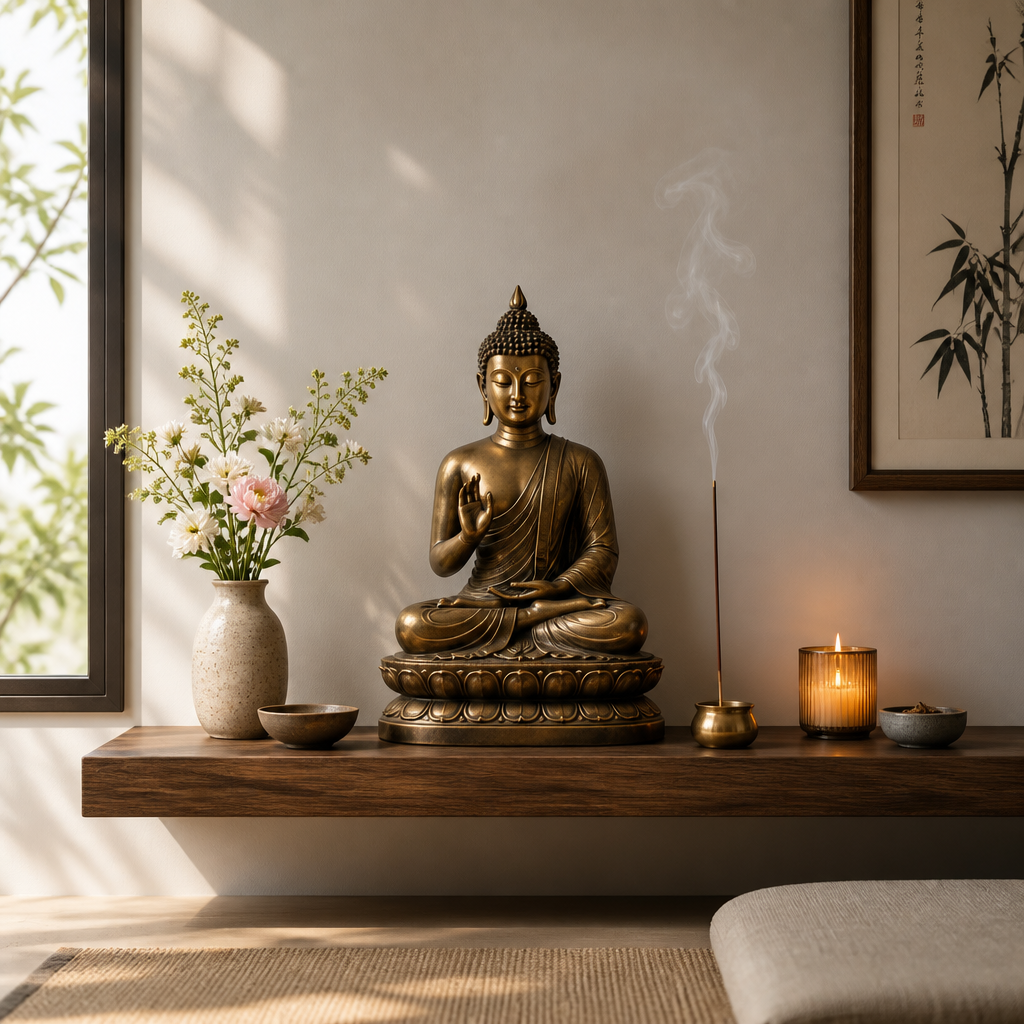
Conseil de pro : Si vous disposez d'un espace limité, une étagère murale dédiée à hauteur de poitrine dans un coin calme du salon crée un environnement d'autel approprié sans nécessiter une pièce séparée. Gardez la zone directement sous l’étagère dégagée.
Configuration de l'autel étape par étape
Étape 1 : Dégagez et consacrez l'espace
Avant de placer quoi que ce soit, nettoyez soigneusement la surface physique. Retirez la poussière, le désordre et tout objet sans rapport avec le but de l'autel. De nombreux pratiquants purifient ensuite l'espace avec de la fumée d'encens avant d'y placer le premier objet. Il ne s’agit pas d’une exigence rigide, mais l’acte de nettoyage délibéré, physique et intentionnel, marque la transition de l’espace ordinaire à l’espace sacré.
Étape 2 : Positionner la statue centrale
Placez la statue de Bouddha de l'autel de la maison ou la divinité primaire murti au centre arrière de la surface de l'autel, élevée si possible sur un petit piédestal. La statue doit être tournée vers l'extérieur, vers vous lorsque vous vous approchez. Si vous avez plusieurs statues, la figure principale occupe la position centrale et la plus haute. Les figures secondaires telles que Kuan Yin, Tara ou Ganesha doivent être flanquées à gauche et à droite et positionnées légèrement plus bas que la figure centrale. Ne placez jamais une statue sacrée sur le sol.
Étape 3 : Placer des textes du Dharma ou des éléments symboliques
Dans les traditions tibétaines et mahayana, les textes du Dharma sont placés à gauche de la statue de Bouddha et un stupa ou objet rituel symbolique est placé à droite. Le texte représente les enseignements du Bouddha ; le stupa représente l'esprit éclairé. Dans les configurations Theravada et d'Asie de l'Est, ces objets secondaires sont souvent remplacés simplement par des bougeoirs et un vase à fleurs, un de chaque côté de la figure centrale.
Étape 4 : Disposez les offrandes devant
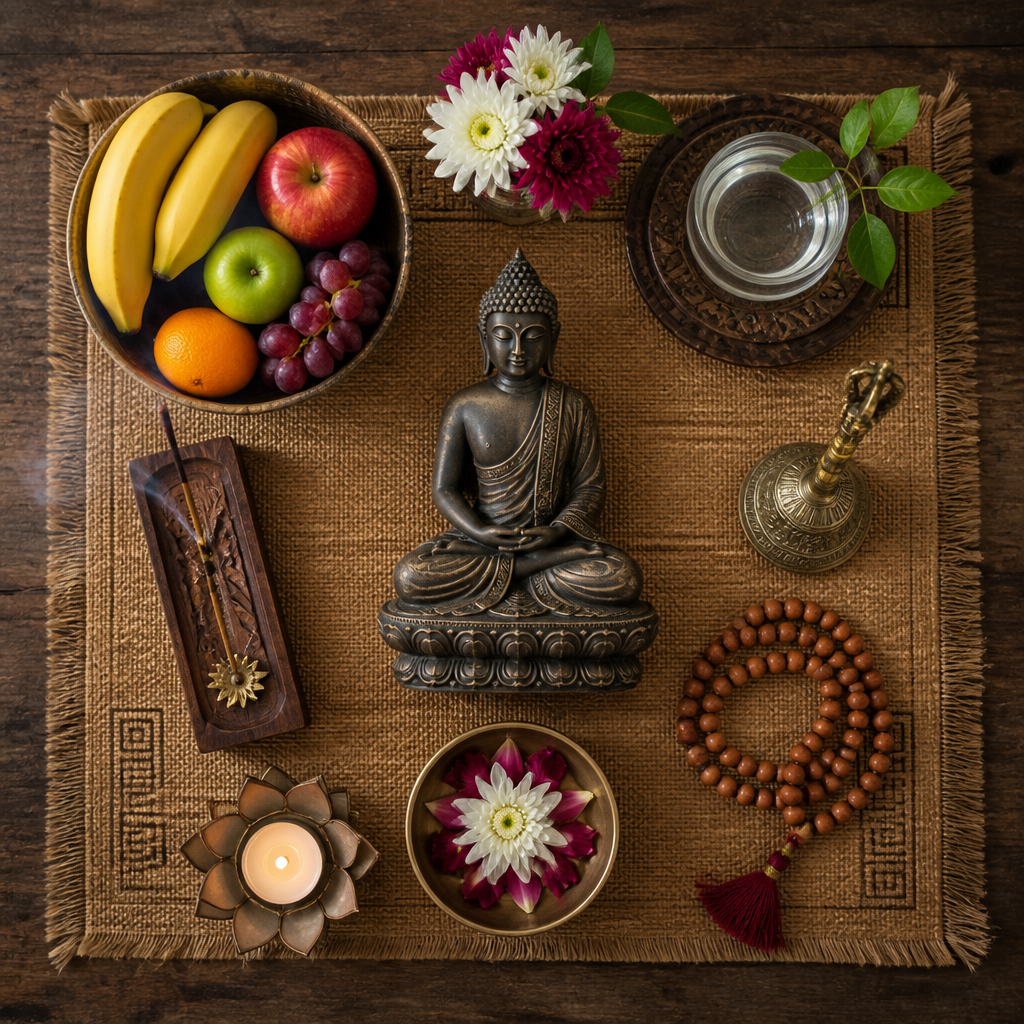
Les offrandes sont déposées devant la statue centrale, à un niveau inférieur. Les éléments de base sont l’eau, les fleurs, l’encens et une bougie ou une lampe. Dans le bouddhisme tibétain, sept bols d'eau sont disposés en rangée, chacun représentant une offrande distincte : eau potable, eau de lavage, fleurs, encens, lumière, parfum et nourriture. Dans les contextes Theravada et d'Asie de l'Est, la disposition est plus simple : un seul bol d'eau, un petit vase pour les fleurs, un porte-encens et une bougie.
Étape 5 : Établir la ligne de vue
Tenez-vous debout ou asseyez-vous à l’endroit où vous pratiquerez, devant l’autel. La statue centrale doit être au niveau de vos yeux ou légèrement au-dessus. Si la statue est positionnée trop bas, vous la regardez pendant la pratique, ce qui inverse la relation voulue entre le praticien et l'objet sacré. Ajustez la hauteur du socle jusqu’à ce que les proportions vous semblent correctes. Cette étape est presque toujours ignorée et est presque toujours importante.
Conseil de pro : Un petit morceau de soie, de brocart ou de lin uni sous la statue centrale rehausse considérablement la cohérence visuelle de l'autel et protège la surface. Évitez les tissus synthétiques ou les motifs imprimés chargés qui rivalisent visuellement avec la sculpture elle-même.
Offres essentielles et leur signification
Chaque offrande sur un autel sacré a un poids symbolique spécifique. Comprendre la signification empêche l’autel de devenir un objet décoratif et le maintient connecté à la pratique.
Eau est l’offre fondamentale car elle est universellement disponible, pure et sans attachement. Changez l’eau quotidiennement, dès le matin. Ce simple acte d’entretien quotidien fait plus pour la qualité de votre cabinet que n’importe quel arrangement élaboré que vous mettez en place une fois puis ignorez.
Les fleurs représentent l'impermanence. C’est précisément pourquoi les fleurs fraîches sont préférées aux fleurs artificielles. Un vase de fleurs en soie sur un autel communique, involontairement, une résistance à l’enseignement fondamental qu’il est censé honorer. Les fleurs fraîches qui se fanent et sont remplacées incarnent la leçon plus honnêtement que celles en plastique qui restent pour toujours.
L'encens purifie l'espace et les sens. Un seul bâton ou un petit cône suffit. Brûler trop d’encens dans une pièce fermée est plus une question d’atmosphère que de sincérité. Une bougie ou une lampe à huile représente la lumière de la sagesse dissipant l’ignorance. Les lampes LED sont utilisées par certains praticiens comme une alternative pratique, en particulier lorsque la sécurité incendie est une préoccupation, et il s'agit d'une adaptation légitime plutôt que d'un compromis.
Un autel de maison n’est pas une exposition de musée. C'est un espace de vie. La qualité de votre engagement quotidien avec elle, l'eau fraîche, les fleurs remplacées, la lampe allumée, vous en dit bien plus sur votre pratique que la qualité des objets sur l'étagère.
Comparaison des approches d'autel : bouddhiste, hindoue et mixte
|
Approche |
Idéal pour |
Considérations clés |
|---|---|---|
|
Autel bouddhiste minimaliste à statue unique |
Débutants, petits espaces, praticiens laïcs ou non sectaires |
Une statue de qualité, un porte-encens, une bougie ou une lampe LED. Facile à entretenir. Il n'a pas la profondeur iconographique d'un autel plus complet, mais il est de loin supérieur à une étagère encombrée d'objets mélangés. Idéal pour un Bouddha en albâtre birman ou une pièce en pierre khmère. |
|
Autel bouddhiste traditionnel Theravada |
Praticiens ayant un lien avec la lignée Theravada, les traditions thaïlandaises, birmanes, sri lankaises ou cambodgiennes |
Statue centrale de Bouddha à Bhumisparsha ou Abhaya mudra, flanquée de bougies et de fleurs, porte-encens devant. La photo d’un enseignant respecté peut être placée sur le côté. Nécessite une maintenance quotidienne des offres. Fonctionne à merveille avec les figures en bronze doré thaïlandais ou laquées birmanes. |
|
Autel hindou de puja avec plusieurs statues de divinités |
Passionnés hindous et collectionneurs de sculptures d’Asie du Sud ou du Sud-Est |
Ganesha est généralement placé au centre ou en avant, avec la divinité principale (Shiva, Vishnu, Lakshmi, Durga ou autre) élevée derrière. Les directives de placement Vastu Shastra s’appliquent. Plusieurs murtis nécessitent un arrangement cohérent, les divinités ne doivent pas se faire face directement. Un rituel quotidien de puja est attendu. |
Configuration de l'autel hindou : conseils spécifiques
Un autel hindou suit sa propre logique, et le regrouper dans des conseils génériques de « décor spirituel asiatique » produit des espaces mal agencés. Le Autel hindou la tradition se concentre sur la puja, un rituel de culte quotidien structuré qui implique de l'eau, des fleurs, de l'encens, de la lumière et des offrandes de nourriture présentées à la divinité. La murti n'est pas simplement symbolique ; dans cette tradition, la divinité est censée être présente dans l'image lorsqu'elle est correctement consacrée.
Quelle divinité placer au centre
Ganesha, celui qui élimine les obstacles, est traditionnellement placé devant ou au centre d'un autel multi-divinité car il est invoqué en premier dans tout culte. Derrière ou à côté de lui, la divinité principale de la dévotion de la maison occupe une position centrale élevée. Les choix courants incluent Lakshmi pour la prospérité et l'abondance, Shiva pour la transformation spirituelle, Vishnu pour la protection, Durga pour le courage et la force, ou Krishna pour la dévotion et la joie. À HD Asian Art, chacune de ces divinités est disponible dans plusieurs traditions sculpturales régionales, du bronze du sud de l'Inde à la pierre indonésienne.
Principes de placement Vastu Shastra
Les statues hindoues sont traditionnellement placées dans la direction nord-est ou nord de l'autel de la maison, élevées sur un piédestal propre. Évitez de placer les murtis dans les chambres, les salles de bains ou sous le niveau des yeux. L'autel doit faire face à l'est ou au nord. Les divinités ne doivent pas se faire face directement, car cela est considéré comme peu propice dans la tradition Vastu. Gardez les statues à l'écart du désordre et assurez-vous que l'espace sous la surface de l'autel reste dégagé. La lumière naturelle profite à l’environnement de l’autel, même si la lumière directe du soleil prolongée peut endommager certaines pierres ou matériaux laqués au fil du temps.
Consécration avant utilisation
De nombreux pratiquants hindous effectuent un bref rituel de consécration, connu sous le nom de prana pratishtha, avant de placer une nouvelle murti sur l'autel. Cela peut être aussi simple que de placer la statue dans de l'eau propre avec des fleurs et de définir une intention claire, ou aussi élaboré qu'une cérémonie complète avec un prêtre. Si vous êtes nouveau dans cette tradition, recherchez la pratique pertinente à la divinité que vous avez choisie plutôt que de supposer qu'une seule méthode universelle s'applique.
Entretenir votre autel au fil du temps
Un autel érigé une seule fois et laissé intact pendant des mois devient un objet de décoration. La différence entre un espace sacré et une étagère sur laquelle se trouvent des statues intéressantes est l’entretien. Non pas l’entretien comme une corvée, mais l’entretien comme la pratique elle-même.
La routine quotidienne minimale pour tout autel domestique est simple : rafraîchir l'offrande d'eau, retirer les fleurs fanées et allumer de l'encens ou simplement s'asseoir devant l'autel pendant quelques minutes avec intention. Cela prend moins de cinq minutes. L'autel doit être régulièrement épousseté et les statues nettoyées avec un chiffon doux et sec. Sculptures en pierre et en bronze de HD Asian Artla collection sont généralement robustes, mais évitez d'utiliser des nettoyants chimiques sur les finitions en bronze patiné ou laquées pigmentées. De l'eau et une brosse douce suffisent pour la plupart des matériaux.
Une erreur courante consiste à ajouter davantage d’objets à l’autel au fil du temps sans jamais rien supprimer. C’est ainsi que les autels deviennent encombrés. Fixez-vous dès le début une règle : rien de nouveau ne rejoint l'autel sans que quelque chose d'autre ne soit supprimé ou que la disposition ne soit délibérément reconsidérée. La qualité et la cohérence comptent plus que l’accumulation.
Si vous construisez une collection de sculptures asiatiques au fil du temps, les pièces en laque birmane en particulier constituent d'excellents éléments d'autel complémentaires. Ils apportent une chaleur visuelle et une spécificité régionale sans la complexité iconographique liée à l’ajout de figures de divinités supplémentaires. Le Collection de laques birmanes à HD Asian Art comprend des boîtes d'autel, des récipients à offrandes et des pièces décoratives qui côtoient naturellement la sculpture bouddhiste sans rivaliser avec la statue centrale.
Foire aux questions
Dans quelle direction ma statue de Bouddha d'autel domestique doit-elle être orientée ?
La statue de Bouddha doit être tournée vers l’extérieur de la pièce, vers vous lorsque vous vous approchez et vous asseyez pour pratiquer. C’est plus important que la direction de la boussole. Dans la pratique, de nombreuses traditions privilégient les autels orientés vers l'est lorsque cela est possible, car l'est est associé à la direction de l'aube et aux nouveaux départs, mais faire face à la statue vers un mur simplement pour obtenir la direction de la boussole est un pire résultat que de la placer confortablement face au praticien.
Puis-je mélanger des statues bouddhistes et hindoues sur le même autel ?
C’est plus courant que les puristes ne veulent l’admettre, en particulier dans les traditions d’Asie du Sud-Est où les iconographies bouddhiste et hindoue se mélangent depuis des siècles. Un autel khmer cambodgien, par exemple, combinait souvent les deux. Cela dit, un autel mixte fonctionne mieux lorsque les sculptures partagent une cohérence régionale ou stylistique plutôt que d'être un assortiment de traditions totalement différentes. Mélanger un Bouddha Amida laqué japonais avec un Nataraja en bronze du sud de l'Inde peut sembler décousu à moins que vous n'ayez une raison réfléchie pour l'association. Commencez par une tradition, familiarisez-vous avec sa logique et développez-la délibérément.
La taille de la statue de Bouddha est-elle importante pour un autel domestique ?
La taille compte par rapport à l’espace, pas en termes absolus. Une statue de 30 cm sur une petite étagère dédiée est plus efficace qu'une statue de 60 cm entassée sur une grande surface encombrée. La statue doit être le point d’ancrage visuel de l’autel, clairement dominant sur les objets environnants. Si les offrandes et les objets décoratifs qui l’entourent sont plus grands ou plus visibles que la statue, les proportions sont fausses.
Quel est le minimum dont un débutant a besoin pour démarrer un autel bouddhiste ?
Une statue de Bouddha de qualité, un porte-encens, un petit bol ou une tasse d'eau et une surface propre et dédiée surélevée au-dessus du niveau du sol. C'est tout. Tout le reste, bougies, bols à offrandes, figures secondaires, tissus, cloches, est un ajout qui peut venir plus tard une fois la pratique de base établie. Commencer simplement et l’entretenir de manière cohérente est bien plus efficace que d’assembler un autel élaboré et de le négliger ensuite.
Comment choisir entre une statue de Bouddha en bronze, en pierre ou en bois pour mon autel ?
Le choix des matériaux doit refléter à la fois la tradition régionale dans laquelle vous travaillez et l'environnement pratique de votre espace. Le bronze est durable, vieillit magnifiquement avec une patine naturelle et convient à la plupart des traditions bouddhistes. La pierre, en particulier les pièces khmères en grès ou en calcaire, porte une gravité tranquille adaptée aux espaces contemplatifs. Le bois est chaleureux et organique, particulièrement adapté aux traditions sculpturales birmanes et thaïlandaises. Évitez de placer les statues en bois dans des environnements très humides et gardez tout matériau à l’abri de la lumière directe du soleil pendant une période prolongée. Les trois matériaux sont représentés sous une forme de qualité muséale à HD Asian Art, provenant de leur pays d’origine.
Est-il approprié d’utiliser des sculptures asiatiques sur l’autel d’une maison si je ne suis ni bouddhiste ni hindou ?
Oui, à une condition : aborder les objets et l’espace dans un véritable respect de leur origine culturelle et religieuse. Une statue de Bouddha placée avec compréhension et intention dans un espace contemplatif est très différente d’une statue utilisée uniquement comme décoration tendance. De nombreux pratiquants occidentaux entretiennent des autels bouddhistes significatifs sans affiliation religieuse formelle. La clé est que l’autel remplit une véritable fonction réflexive ou spirituelle dans votre vie quotidienne, et non qu’il signale l’appartenance à une tradition formelle.
À quoi ressemble votre autel domestique et de quelle tradition sculpturale vous êtes-vous inspiré lors de sa construction ? Partagez votre expérience ci-dessous.
Références
