



Sculpture Cham : Un guide de l'art de la pierre sacrée de Champa
Sculpture Cham : Un guide de l'art de la pierre sacrée de Champa
La sculpture Cham est une tradition de pierre d'Asie du Sud-Est construite autour de l'imagerie hindoue et bouddhiste, sculptée principalement dans le grès et préférant le haut relief aux formes autoportantes. La plus grande collection publique se trouve au Musée de la sculpture Cham à Da Nang, au Vietnam. Des pièces individuelles importantes ont également été transférées dans des institutions occidentales, notamment le Metropolitan Museum of Art. Pour s’orienter rapidement, trois destinations comptent le plus :
- Musée de sculpture Cham (Da Nang) — la plus grande concentration d'œuvres survivantes, organisées par zone de recherche
- Mon fils — le complexe du temple sacré d'où proviennent bon nombre des plus beaux piédestaux et frontons
- Le Met (New York) - abrite un Shiva debout rare qui montre de près la physionomie Cham
Ce qui suit explique comment cette tradition s’est développée, de quoi elle est faite, où la voir et comment les collectionneurs évaluent son authenticité.
Points clés à retenir
La sculpture Cham est une tradition de haut-relief à dominante de grès enracinée dans l'imagerie hindoue et bouddhiste, mieux étudiée à travers la collection du musée de Da Nang, le contexte original de My Son et certaines collections occidentales comme le Shiva debout du Met.
| Point | Détails |
|---|---|
| Matériau et forme | Les sculpteurs Cham travaillaient presque exclusivement en grès, privilégiant le haut-relief aux figures autonomes. |
| Phases stylistiques clés | Mon Fils (7e au Xe siècles) est gracieux et retenu ; Thap Mam est dense et ornemental. |
| Collecte primaire | Le Musée de la sculpture Cham de Da Nang abrite le plus grand ensemble de ces œuvres au monde. |
| La provenance compte le plus | Les marques de joints architecturaux, les sites de découverte documentés et les dossiers d'exportation clairs séparent les pièces crédibles des suppositions. |
| Par où commencer à collectionner | HDAsianArt propose des pièces d'influence Cham et d'Asie du Sud-Est recherchées individuellement avec une provenance documentée et une expédition assurée dans le monde entier. |
Table des matières
Qu'est-ce que la sculpture Cham et d'où vient-elle ?
La sculpture Cham a émergé du Champa, un réseau de régimes politiques d'influence hindoue puis bouddhiste qui contrôlaient la côte de ce qui est aujourd'hui le centre et le sud du Vietnam à partir du IIe siècle jusqu'au XVIIe siècle environ. Le Champa n’était pas tant un empire unifié qu’une série de principautés changeantes liées entre elles par la langue, la religion et le contrôle des routes commerciales maritimes reliant les deux pays. Indie et Chine. Cette position commerciale comptait énormément pour l’art. Les dirigeants du Champa ont absorbé le vocabulaire religieux et artistique indien par le biais du commerce et du pèlerinage, puis l’ont transformé en quelque chose qui leur est propre.
Le centre spirituel et artistique du royaume était My Son, une vallée de tours de temple en brique située à environ 40 km de l'actuelle Da Nang. La construction s'est étalée sur des siècles, mais la période du VIIe au Xe siècle a produit un âge d'or très apprécié de la sculpture Cham. Les sculpteurs travaillant à My Son pendant cette vitrine ont développé un style marqué par un modelé fluide et une ornementation sobre, bien différent de ce qui s'est produit plus tard. Les rois ont parrainé ces tours avant tout comme des actes de dévotion envers Shiva, et les piédestaux, les linteaux et les figures de gardiens sculptés pour elles ont établi la grammaire visuelle que les ateliers Cham ultérieurs répéteraient, simplifieraient ou exagéreraient pendant encore 500 ans.
La fortune politique du Champa a changé à plusieurs reprises après le Xe siècle. La pression de l'empire khmer à l'ouest et des royaumes vietnamiens au nord a poussé le centre du pouvoir Cham vers le sud au fil du temps, et chaque déplacement a produit une variante régionale avec ses propres habitudes de sculpture. La période Dong Duong, centrée sur un complexe de monastères bouddhistes établi à la fin du IXe siècle, a introduit un style figuratif plus lourd et plus musclé lié au patronage bouddhiste Mahayana plutôt qu'à l'orientation shaivite antérieure. Plusieurs siècles plus tard, le style Thap Mam s’est superposé à une ornementation dense, presque surmenée, une direction stylistique que certains chercheurs décrivent comme la phase baroque de l’art Cham.
Une grande partie de cette histoire serait restée enfouie sans l’archéologie de l’ère coloniale. Des chercheurs français affiliés à l'École française d'Extrême-Orient ont commencé à étudier les sites Cham au début des années 1900 et, en 1902, ils avaient proposé un musée dédié pour abriter ce qu'ils déterraient. Cette institution, aujourd'hui le Musée de la sculpture Cham, a ouvert son premier bâtiment en 1919 et s'est agrandie dans les années 1930, puis à nouveau en 2002. Le moment est important pour les lecteurs qui tentent de comprendre pourquoi tant d'objets Cham se trouvent dans un musée construit à cet effet plutôt que disséminés dans les sites des temples : les fouilles de l'époque coloniale, combinées aux décennies de guerre et aux dommages causés aux tours en brique d'origine par les intempéries, ont déplacé la plupart des sculptures survivantes à l'intérieur bien avant que les normes de conservation modernes n'existent.
Quels matériaux et motifs définissent le style sculptural Cham ?
Le grès domine presque complètement le corpus Cham. Le bronze et d'autres objets rituels en métal survivent, mais ils constituent l'exception plutôt que la règle, et les sculptures en bois de cette période ont presque entièrement pourri à cause du climat tropical. Ce biais de survie est important dans la façon dont les érudits lisent la tradition : les archives en pierre durables surreprésentent probablement l’architecture des temples et sous-représentent tout art religieux domestique ou portable qui existait autrefois à ses côtés.
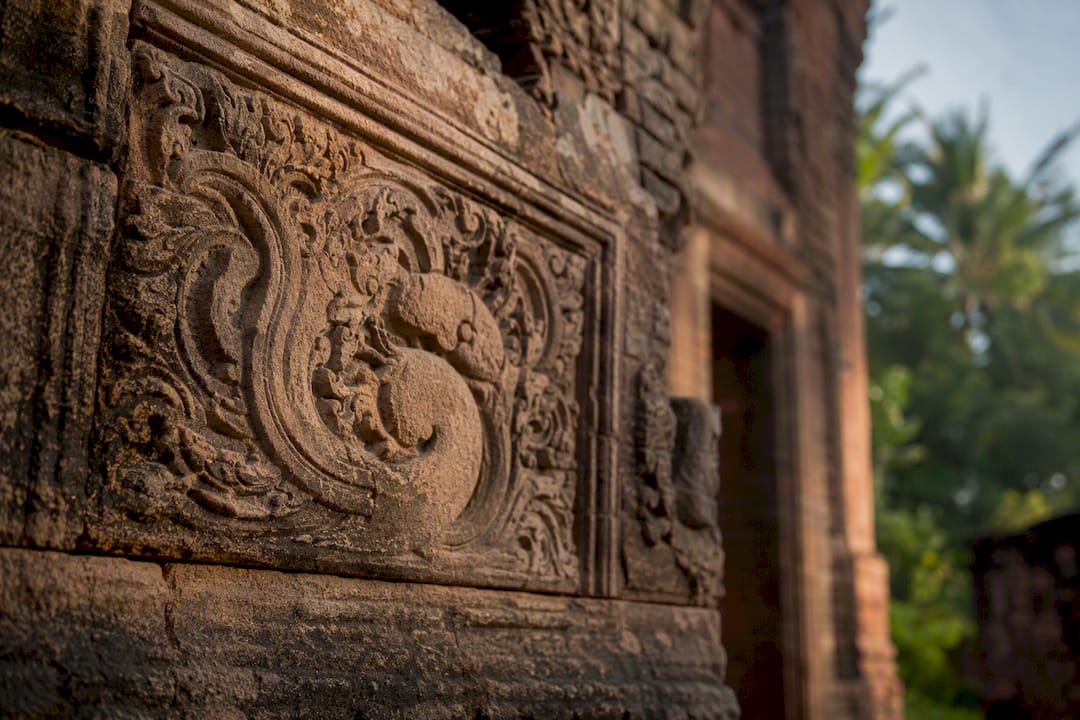
Une statistique qui vaut la peine d’être prise en compte : le Musée de Sculpture Cham possède la plus grande collection au monde de ce matériau, un fait qui n'a de sens que lorsque l'on réalise à quel point le contexte architectural d'origine, y compris les tours en briques, a été perdu au fil du temps et des conflits. Le musée n’est pas seulement une galerie. Il s’agit en fait des archives d’un environnement bâti qui n’existe plus intact.
Les sculpteurs cham préféraient le haut-relief à la sculpture en ronde-bosse, et ce choix se retrouve partout. Les figures émergent des frontons, des linteaux et des socles plutôt que de se libérer de leur cadre architectural, une préférence qui distingue le travail Cham des formes plus douces et plus rondes typiques de la sculpture khmère voisine. Les sujets récurrents reflètent les traditions hindoues et bouddhistes que les Cham ont absorbées et adaptées :
- Shiva, souvent représenté avec un couple linga-yoni représentant son pouvoir générateur
- Lokesvara, le bodhisattva compatissant au cœur du patronage bouddhiste Cham Mahayana
- Apsaras, les danseurs célestes sculptés dans des frises de piédestal avec des bijoux élaborés
- Makara, l'hybride poisson-crocodile, seuils de garde et sources d'eau
- Garuda, l'homme-oiseau mythique souvent représenté combattant des serpents
- Dvarapala, les gardiens musclés des temples positionnés pour repousser les intrus
Le style a sensiblement changé selon les périodes, et reconnaître ces changements est le moyen le plus rapide de dater une pièce à l’œil nu. Le travail de l’époque de Mon Fils, du VIIe au Xe siècle, se lit comme léger, gracieux, presque sobre. La sculpture Thap Mam de la période médiévale est allée dans la direction opposée, empilant des détails décoratifs jusqu'à ce que certains socles présentent des rangées de seins féminins stylisés entourant leur base, une densité ornementale que les chercheurs ont signalée comme une phase tardive distincte plutôt que comme un déclin des compétences.
Où pouvez-vous voir les principales collections de sculptures Cham ?
Trois destinations couvrent l'essentiel de ce qu'un étudiant sérieux en art Cham a besoin de voir, et chacune répond à un objectif différent.
-
Le Musée de Sculpture Cham, Da Nang. C'est l'arrêt incontournable. Historiquement, les conservateurs organisaient les galeries par zone de recherche plutôt que par chronologie, regroupant les œuvres de My Son, Trà Kiệu et Tháp Mẫm dans des salles séparées. Cette mise en page s'avère véritablement utile pour les visiteurs, car elle vous permet de comparer les ateliers régionaux côte à côte plutôt que de tracer un récit linéaire. Les pièces remarquables incluent plusieurs piédestaux récupérés sur My Son, un relief dynamique connu sous le nom de Flying Warrior et une figure saisissante de Garuda capturée en plein mouvement.
-
Mon Fils lui-même. Le complexe du temple reste un site archéologique actif à l’intérieur des terres de Da Nang, et il vaut la peine d’être visité même si la plupart des plus belles sculptures ont été transférées dans des galeries de musée pour être protégées. Voir les tours en brique dans leur emplacement d'origine dans la vallée, dont plusieurs portent encore les dégâts de guerre des années 1960, donne un contexte qu'aucune marque de galerie ne peut reproduire. Certains des socles les plus importants du musée portent la désignation de « trésor national » spécifiquement parce que les chercheurs peuvent les retracer jusqu'à ce site exact.
-
Fonds des musées occidentaux. Le Musée métropolitain d'art possède un Shiva debout, également catalogué comme gardien du temple ou dvarapala, daté d'environ le début du 10e siècle. Il s’agit d’un objet compact mais véritablement instructif : les traits du visage robustes et la carrure trapue exposés sont des caractéristiques qui distinguent la sculpture figurative Cham du style khmer plus allongé et serein que la plupart des visiteurs du musée connaissent déjà. Le musée Guimet à Paris a également joué un rôle majeur dans les études Cham, ayant organisé une grande exposition de prêt en 2005 et 2006 qui pièces dispersées réunies pour une étude comparative d’une manière qu’aucune collection permanente d’une institution ne pourrait réaliser seule.
Les entrées des catalogues de musées sont plus importantes que ne le suggère une simple navigation. Lorsqu’une pièce porte un numéro d’acquisition documenté, une plage de dates indiquée et une piste de provenance déclarée, comme le numéro d’objet du Met 1987.478 pour son Shiva permanent, ce document devient le point de référence auquel tout érudit, évaluateur ou collectionneur ultérieur cite. Recherche de provenance à HD Asian Art suit la même logique : la trace écrite d’un objet est ce qui transforme une sculpture saisissante en un morceau d’histoire documentée, un principe exploré plus en détail dans nos recherches sur une pierre ancienne Cham Ganesha.
Comment évaluez-vous la provenance et l’authenticité de la sculpture Cham ?
La provenance documentée sépare une sculpture Cham digne d'un musée d'une supposition décorative. L’élément de preuve le plus solide est un registre de fouille ou de propriété traçable, idéalement un document qui relie l’objet à un site connu comme My Son, Trà Kiệu ou Tháp Mẫm plutôt qu’une vague liste « Asie du Sud-Est, provenance inconnue ».
Au-delà de la paperasse, la pierre elle-même raconte une histoire qui mérite d’être lue attentivement :
- Recherchez les marques d'intégration architecturale : lignes de joint assorties, surfaces arrière abrasées ou restes de plâtre qui suggèrent que la pièce était autrefois placée dans un fronton, un linteau ou un piédestal plutôt que seule.
- Vérifiez les marques d'outils et les modèles d'usure par rapport à la période réclamée par le vendeur ; le grès s'érode et s'altère de manière assez constante au fil des siècles, et une usure incohérente est un signe d'avertissement.
- Demandez si une restauration a été divulguée. Les membres refixés, les éclats remplis et les consolidants de surface sont courants sur les pierres véritablement anciennes et ne sont pas disqualifiants, mais ils doivent être signalés dès le départ et ne pas être découverts plus tard.
- Demander une comparaison avec un exemple de musée publié dans la mesure du possible ; une pièce qui fait écho à un piédestal documenté de My Son ou à un objet du Met catalogué a plus de confiance qu'une pièce sans aucune ancre comparative.
Conseil de pro : Demandez à n’importe quel vendeur la chaîne complète de propriété de la pièce par écrit, et pas seulement une assurance verbale de « ancienne collection ». Un concessionnaire qui peut produire des factures datées, des dossiers d'enchères antérieures ou des documents d'exportation vous dit quelque chose de réel ; celui qui ne le peut pas devrait poser des questions plus difficiles avant de s'engager.
Les considérations juridiques et éthiques cohabitent avec les considérations matérielles. Les contrôles à l'exportation des antiquités du Vietnam et des pays voisins se sont considérablement renforcés depuis le milieu du XXe siècle, et des marchands et musées réputés documentent désormais une chaîne claire d'exportation légale antérieure à ces restrictions, ou d'acquisition après autorisation appropriée. C’est également la raison pour laquelle les registres de cessions de musées et les entrées de catalogue publiées ont un réel poids dans le commerce : ils établissent qu’un objet a quitté son pays d’origine par un canal documenté et légitime plutôt que par une porte dérobée discrète.
La valeur d’une pièce pour un collectionneur sérieux dépend moins de sa taille ou de son caractère dramatique que de la capacité de son histoire à résister à un examen minutieux. Des marques de joint architecturales, un site de découverte documenté et un dossier d'exportation propre font plus pour une collection à long terme qu'une photographie impressionnante ne le fera jamais.
En cas de doute, consultez un restaurateur expérimenté avec le grès tropical avant tout nettoyage ou réparation, et comparez l'objet avec les catalogues de musées publiés. Le nôtre recherche sur un Ganesha en bronze de style Cham suit exactement ce processus, en faisant correspondre les détails stylistiques aux ateliers régionaux connus avant qu'une pièce n'atteigne une liste.
Que faut-il voir lors d'une visite au musée de sculpture Cham ?
Fondé sur des propositions datant de 1902 et ouvert au public pour la première fois en 1919, le musée de la sculpture Cham s'est considérablement agrandi dans les années 1930, puis à nouveau en 2002, et il reste suffisamment compact pour être vu en profondeur en une seule visite ciblée. Voici comment prioriser votre temps :
- Commencez par la galerie My Son, qui abrite les premiers socles et reliefs les plus raffinés du musée.
- Déplacez-vous vers la salle Trà Kiệu pour découvrir le style régional plus léger et plus fluide de cette zone de découverte.
- Terminez dans la galerie Tháp Mẫm, où le style ornemental « baroque » tardif est pleinement exposé.
- Recherchez spécifiquement le relief du Flying Warrior et la figure de Garuda, tous deux fréquemment cités comme points forts des visiteurs.
- Photographiez respectueusement. La photographie au flash accélère l'usure de la surface du grès vieux de plusieurs siècles, alors vérifiez la signalisation actuelle de la galerie avant de prendre la photo.
- Si le temps le permet, associez votre visite du musée à une excursion d'une demi-journée à My Son même pour découvrir le contexte architectural d'origine.
Les matins de la semaine ont tendance à être plus calmes que les après-midi du week-end, et la présence numérique du musée sur Google Arts & Culture offre un aperçu utile de l'aménagement des galeries avant votre arrivée.
Pourquoi la sculpture Cham est-elle importante et en quoi diffère-t-elle de l'art khmer ?
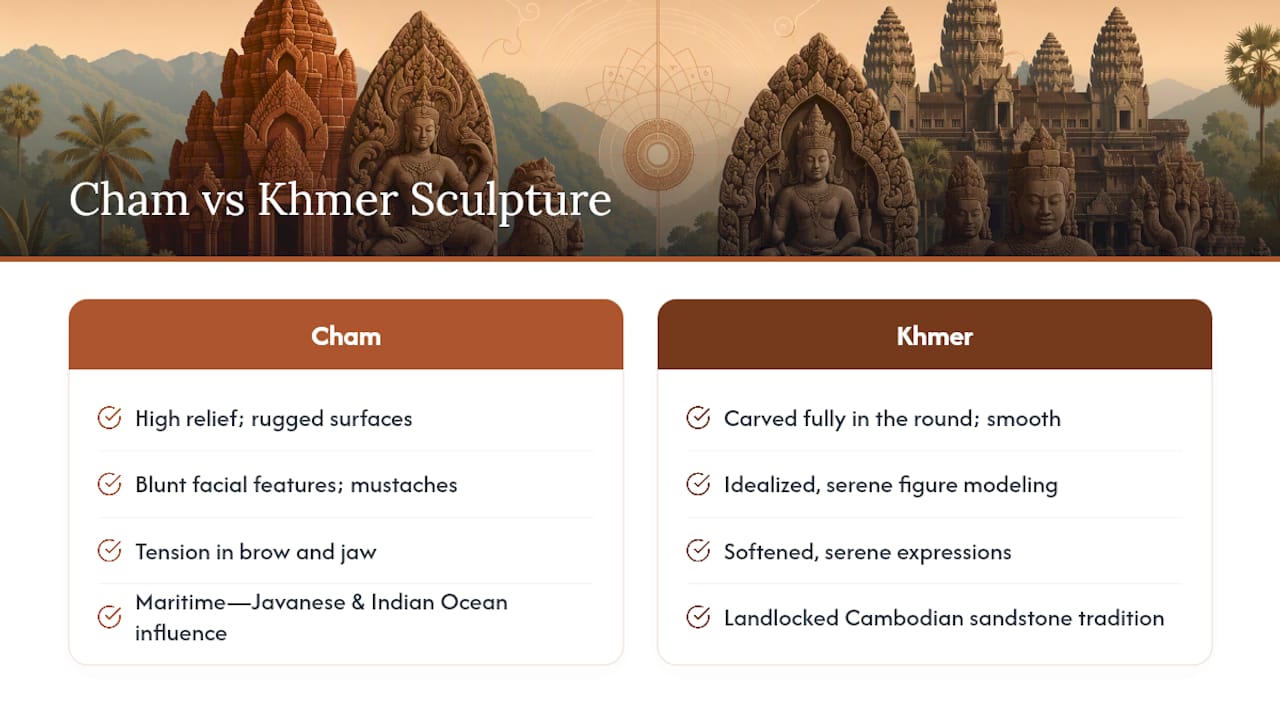
La sculpture Cham est importante car elle représente une réponse artistique distincte à la même source religieuse indienne qui a façonné les traditions khmères, javanaises et d’autres traditions d’Asie du Sud-Est, mais elle est parvenue à des conclusions étonnamment différentes. Alors que les sculpteurs khmers travaillant à l'époque d'Angkor préféraient des figures lisses, idéalisées, souvent sereines, sculptées entièrement en ronde-bosse, les sculpteurs Cham se penchaient sur le haut relief et une physionomie plus robuste et patinée, avec des moustaches proéminentes et des traits du visage émoussés qui se lisent comme plus ancrés et humains. Un lecteur comparant le Shiva debout du Met à un visage typique de Bouddha de la période Bayon d'Angkor remarquera immédiatement la différence : l'un s'adoucit vers la sérénité, l'autre maintient la tension dans le front et la mâchoire. Les lecteurs curieux de connaître ce contrepoint khmer peuvent approfondir leurs connaissances Traditions cambodgiennes de sculpture sur grès pour une comparaison plus complète.
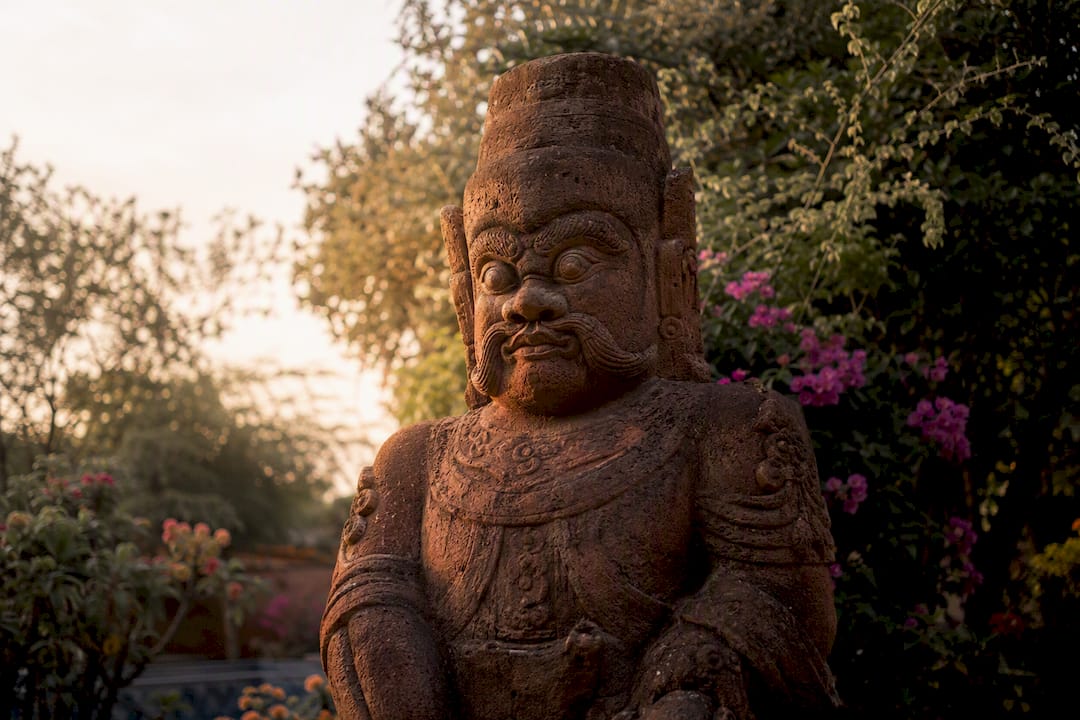
La position maritime du Champa a également façonné son art d’une manière qu’Angkor enclavée n’a jamais connue. Les routes commerciales côtières ont exposé les ateliers Cham aux courants artistiques javanais et plus larges de l'océan Indien, ainsi qu'au contenu religieux indien attendu, produisant une synthèse qui semble véritablement régionale plutôt que dérivée. Les expositions récentes, en particulier celle de Guimet en prêt de 2005 à 2006, ont réalisé un véritable travail pour rehausser la visibilité de l’art Cham auprès des chercheurs qui le considéraient auparavant comme une note de bas de page des études khmères. Cette réévaluation aurait dû être effectuée depuis longtemps. La sculpture Cham n’est pas une petite cousine de la production d’Angkor. C’est une tradition parallèle qui a résolu des problèmes religieux et artistiques similaires avec ses propres réponses visuelles distinctes.
Qu’est-ce qui attire l’œil d’un conservateur vers la sculpture Cham ?
La sculpture Cham récompense un examen attentif précisément parce qu'elle refuse le vernis qui rend tant d'art religieux d'Asie du Sud-Est interchangeables pour un spectateur occasionnel. Les visages accidentés, la tension architecturale entre la figure et la pierre, la grande variété entre un gracieux fronton My Son et un piédestal Thap Mam surchargé, tout cela vous dit qu'une culture travaillait sur ses propres questions artistiques plutôt que de copier un modèle.
Les recherches de provenance sur des pièces comme notre Ganesha de style Cham n'ont fait que renforcer ce point de vue. Chaque marque commune documentée ou enregistrement de site de découverte ajoute une autre couche à une histoire qui mérite d'être préservée.
—James, HDAsianArt.com
Où acheter une pièce authentifiée de cette tradition
La sculpture en pierre Cham offre quelque chose de plus en plus rare sur le marché des antiquités : un style documenté et référencé dans les musées avec des marqueurs stylistiques clairs qui rendent l'authentification véritablement réalisable plutôt qu'un jeu de devinettes. HDAsianArt organise des recherches individuelles sur des statues, des sculptures et des œuvres d'art de temples bouddhistes et hindous du Vietnam, Cambodge, Thaïlande, Indonésie, et Sri Lanka, chaque pièce est décrite avec le type de détails de provenance que cet article a parcouru : analyse des matériaux, datation stylistique et histoire documentée.
Si un gracieux relief de style My Son ou un bronze d'influence Cham vous séduisent après avoir lu ceci, parcourez le site actuel. HD Asian Art collecte pour voir ce qui est disponible maintenant, avec des rapports de condition détaillés et une expédition assurée dans le monde entier. Chaque annonce inclut la même rigueur de provenance décrite ci-dessus, afin que vous puissiez constituer une collection en toute confiance plutôt qu'avec espoir.
Sources
- Musée de sculpture Cham — Wikipédia
- Shiva debout ou gardien du temple (Dvarapala) - The Metropolitan Museum of Art
