



Statues bouddhistes de luxe pour la décoration intérieure : un guide organisé
Statues bouddhistes de luxe pour la décoration intérieure : un guide organisé
Lors de la sélection de statues bouddhistes de luxe pour la décoration intérieure, la différence entre une pièce significative et une pièce ornementale se résume à l'authenticité, au savoir-faire et au placement intentionnel.
À HD Asian Art, nous avons aidé les propriétaires et les designers à intégrer ces sculptures spirituelles dans des espaces modernes tout en préservant le respect culturel et la cohérence esthétique.
Table des matières
Ce guide couvre la sélection des matériaux, principes de placement, significations symboliques et authentification, tout ce dont vous avez besoin pour organiser une collection qui met en valeur à la fois votre espace et votre pratique.
Comprendre les statues bouddhistes de luxe pour la décoration intérieure
Ce qui différencie une statue bouddhiste de luxe d’une reproduction standard se résume à trois facteurs : qualité des matériaux, artisanat et authenticité culturelle. Les statues de luxe présentent des détails sculptés à la main, des finitions de qualité musée et des matériaux sélectionnés pour leur durabilité et leurs propriétés esthétiques. Les marqueurs artisanaux, la finition à la main, le développement de la patine, la répartition du poids et les détails de l'expression faciale distinguent les pièces créées par des artisans expérimentés des alternatives produites en série.
Une statue bouddhiste de luxe présente des proportions précises conformes aux normes iconographiques traditionnelles, des mudras authentiques et une intention sereine. Le matériau a du poids : pierre véritable, bronze avec une patine appropriée ou résine de haute qualité qui ne jaunit pas et ne se fissure pas avec le temps.
Appréciation culturelle vs appropriation dans la décoration intérieure
Afficher une statue bouddhiste dans votre maison est un acte d’appréciation culturelle lorsqu’il est fait avec connaissance et respect. Cela devient une appropriation lorsque la pièce est traitée comme une simple décoration, que sa signification spirituelle est ignorée ou que ses origines culturelles sont déformées.
Recherchez ce que vous affichez. Comprenez pourquoi un mudra particulier est important. Choisissez un emplacement qui reflète le respect plutôt que la commodité. Procurez-vous des pièces auprès de vendeurs qui peuvent retracer leur provenance et expliquer les antécédents de l'artisan.
Meilleurs matériaux pour les statues bouddhistes de luxe
Le matériau que vous choisissez détermine l'apparence, la longévité, les besoins d'entretien de la statue et la façon dont elle réagit à la lumière et aux ombres au fil des décennies.
Sculptures en pierre et en marbre
La pierre et le marbre représentent la référence en matière de statuaire bouddhiste de luxe. Ces matériaux sont utilisés depuis des siècles dans les traditions de sculpture des temples à travers l'Asie, et leur durabilité signifie qu'un Bouddha en pierre bien conçu peut survivre à de nombreuses tendances de conception. Le marbre, en particulier le marbre blanc provenant de carrières d’Inde et d’Asie du Sud-Est, offre une qualité lumineuse qui capte magnifiquement la lumière. La stéatite, couramment utilisée dans les traditions de sculpture khmères, est plus douce et plus facile à sculpter, ce qui permet un travail de détail complexe. Le granit offre une durabilité avec une esthétique plus dense et plus ancrée.
Le compromis avec la pierre est le poids et la fragilité. Un Bouddha en marbre suffisamment grand pour servir de point focal nécessite un placement stable et une installation professionnelle. Le placement en intérieur dans des environnements climatisés préserve indéfiniment la finition du marbre.
Options Liuli, résine et céramique
Le Liuli, une technique traditionnelle chinoise de moulage du verre produisant des statues translucides ressemblant à des bijoux, est devenue de plus en plus populaire dans la décoration intérieure de luxe. Les pièces Liuli capturent la lumière en interne, créant une qualité éthérée que la pierre ne peut égaler. Les statues en résine de qualité supérieure, lorsqu'elles sont correctement formulées, rivalisent en apparence avec la pierre tout en restant plus légères et plus abordables. La céramique et la porcelaine offrent une beauté délicate mais nécessitent une manipulation minutieuse et conviennent mieux aux petites statues ou aux pièces d'exposition conservées à l'écart des zones à fort trafic.
| Matériel | Durabilité | Poids | Entretien | Idéal pour |
|---|---|---|---|---|
| Marbre | 50+ ans | Lourd | Scellement annuel, nettoyage en douceur | Points focaux permanents, intérieurs haut de gamme |
| Grès | 50+ ans | Lourd | Minime | Des espaces au sol et contemporains |
| Liuli | 30+ ans | Moyen | Poussière uniquement | Zen moderne, éclairage d'accentuation |
| Résine de qualité supérieure | 20-30 ans | Lumière | Poussière, lavage doux occasionnel | Placement flexible, propriétés locatives |
| Céramique/Porcelaine | 10-20 ans | Lumière | Manipulation prudente uniquement | Présentoirs d'autel, étagères protégées |
Entretien et soin des matériaux haut de gamme
Les statues en marbre et en pierre bénéficient d'un scellement annuel avec un scellant pour pierre au pH neutre. Épousseter avec des chiffons doux en microfibres ; évitez les nettoyants acides qui peuvent attaquer la surface. Les pièces Liuli n’ont besoin que d’un époussetage régulier. Les statues en résine premium doivent être dépoussiérées régulièrement et essuyées avec un chiffon légèrement humide si nécessaire.
Règles de placement des statues de Bouddha pour l'harmonie de la maison
L’endroit où vous placez une statue bouddhiste compte autant que la statue que vous choisissez. Le placement affecte à la fois l'équilibre visuel de votre espace et la fonction symbolique de la statue au sein du flux énergétique de votre maison.
Principes du Feng Shui et du flux d'énergie
Dans la tradition du feng shui, les statues de Bouddha sont positionnées pour influencer le chi, le flux d'énergie à travers un espace. Une statue placée à l'entrée fait office de gardien, invitant à l'énergie protectrice. Placé dans le coin richesse (à l’extrême gauche de l’entrée), il amplifie les intentions de prospérité. Dans les espaces de méditation, une statue située directement devant votre zone de pratique sert de point focal qui ancre votre attention et votre intention.
Le principe clé est l’élévation et la ligne de visibilité. Une statue de Bouddha ne doit pas être placée au niveau du sol, où elle pourrait être enjambée ou traitée avec négligence. Idéalement, il est placé au niveau des yeux ou légèrement au-dessus, sur une étagère, un piédestal ou un autel. Évitez de placer des statues dans les salles de bains, les cuisines ou directement au-dessus des appareils électroménagers, car ces placements sont considérés comme irrespectueux dans la tradition bouddhiste.
Stratégies de placement dans le foyer et l'entrée
Le foyer est l’un des endroits les plus puissants pour une statue bouddhiste de luxe. Une statue de taille moyenne à grande, idéalement de 18 à 36 pouces de hauteur, convient mieux aux foyers dotés d'un espace mural adéquat ou d'une console dédiée. L’éclairage compte énormément ici. Un plafonnier encastré ou un éclairage sur rail à LED positionné au-dessus de la statue crée un jeu d'ombres qui donne vie à la pièce tout au long de la journée. Associez la statue à des œuvres d'art murales complémentaires, peut-être une peinture thangka encadrée ou un dessin au trait minimaliste, pour créer un équilibre visuel.
Intégration de l'espace de méditation et de yoga
Dans les espaces dédiés à la méditation ou au yoga, placez la statue directement devant l'endroit où vous êtes assis, à une distance de visualisation confortable de 4 à 8 pieds. La statue doit être l’élément visuel le plus haut de la pièce, soit surélevée sur une étagère, soit positionnée sur un mur plus haut. Entourez l'espace avec un encombrement visuel minimal, des murs neutres et un éclairage doux, de sorte que la statue reste le centre d'intérêt principal.
Idées de design d'intérieur zen modernes avec des statues bouddhistes
Luxe statues bouddhistes pour le design d'intérieur qui fonctionne à merveille dans les espaces contemporains lorsque le design environnant soutient plutôt que ne rivalise avec la pièce. L'esthétique zen moderne, le minimalisme, les matériaux naturels et l'espace négatif intentionnel fournissent le cadre parfait.
Créer un point focal serein avec l'éclairage et l'art mural
L'éclairage stratégique transforme une statue d'un objet statique en un élément dynamique qui change tout au long de la journée. Utilisez un éclairage d’accentuation LED chaud à une température de couleur de 2 700 K, positionné à 45 degrés de la statue pour créer un jeu d’ombres dimensionnel. L’art mural doit compléter sans rivaliser. Un grand mur blanc derrière la statue souligne sa présence ; une seule œuvre d’art abstrait ou minimaliste peut l’encadrer sans distraction. Les couleurs neutres des murs, les blancs doux, les gris chauds et les tons terre pâles permettent à la statue d’être le point d’ancrage visuel.
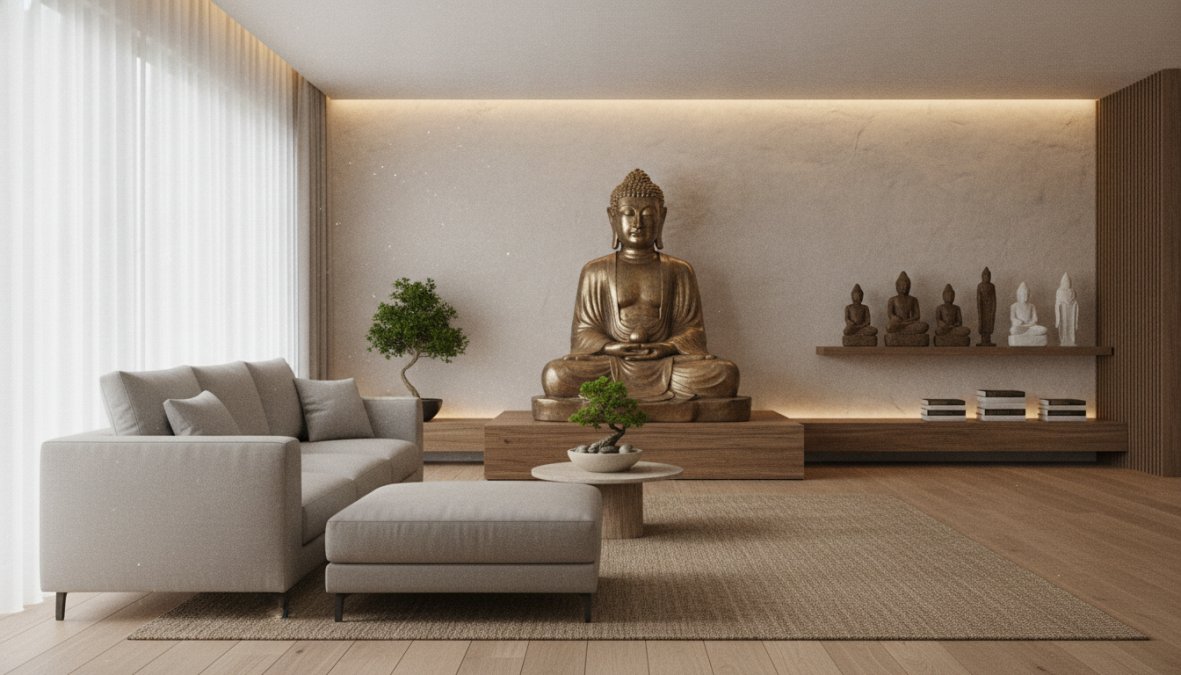
Mélange de pièces anciennes et contemporaines
Le mélange de statues anciennes et contemporaines crée une richesse visuelle et raconte une histoire plus profonde sur votre collection. Un Bouddha antique en pierre khmère associé à une pièce contemporaine de Liuli montre l'appréciation à la fois de la tradition et de l'innovation artisanale moderne. Donnez à chaque pièce de la place pour respirer. Variez leurs hauteurs et leurs matériaux ; une grande pièce de marbre associée à une plus petite statue en bronze ou en céramique crée un intérêt visuel.
Assortiment de styles : de l’esthétique minimaliste à l’esthétique luxueuse
Dans les intérieurs minimalistes, une seule statue bouddhiste de luxe devient l’élément décoratif principal. L’espace environnant doit être presque austère, avec des lignes épurées, des couleurs neutres et un maximum d’espace négatif. Dans les intérieurs de luxe transitionnels ou contemporains, la statue peut être l’une des nombreuses pièces soigneusement sélectionnées. Dans les espaces éclectiques, la statue ancre toujours la pièce mais partage son poids visuel avec d'autres pièces ; le positionnement et l’éclairage deviennent encore plus critiques.
Significations symboliques des mudras et des poses dans la décoration intérieure
Chaque statue de Bouddha communique des intentions spirituelles spécifiques à travers son mudra, le geste de la main et la pose. Comprendre ces significations vous permet de choisir des pièces qui correspondent à votre objectif intérieur et à votre pratique personnelle.
Mudras communs et leur signification
Le Abhaya mudra (main droite levée, paume vers l’avant) représente la protection et l’intrépidité. Les statues comportant ce geste fonctionnent à merveille dans les entrées et les espaces de méditation, créant un sentiment de sécurité et de tutelle spirituelle.
Le Dhyana mudra (les deux mains posées sur les genoux, paumes vers le haut) symbolise la méditation et la paix intérieure. Cette pose est idéale pour les salles de méditation dédiées ou les coins calmes où se déroule la pratique contemplative.
Le Mudra Varada (main droite tendue vers le bas, paume vers le haut) représente la compassion et l'exaucement des vœux. Ce geste fonctionne bien dans les espaces dédiés à la guérison, à la thérapie ou à la croissance personnelle.
Le Bhumisparsha mudra (main droite touchant la terre) symbolise l’illumination et l’ancrage. Cette pose est puissante dans les bureaux à domicile ou les espaces d’étude où vous recherchez clarté et ancrage.
Le Vitarka mudra (pouce et index formant un cercle) représente l'enseignement et la transmission de la sagesse. Ce geste convient aux espaces où se déroulent l’apprentissage, la créativité ou le travail intellectuel.
Choisir des poses qui correspondent à votre intention intérieure
La pose de votre statue doit correspondre à la fonction de la pièce et à votre intention pour cet espace. Une salle de méditation bénéficie d'un Bouddha assis en Dhyana mudra, la posture reflète votre propre position de méditation et crée un alignement énergétique. Une entrée reçoit le pouvoir d'un Bouddha debout avec Abhaya mudra, projetant une protection lorsque vous entrez.
Authentification et sélection de statues bouddhistes haut de gamme
L'authenticité est importante pour des raisons à la fois esthétiques et spirituelles. Une pièce authentique fabriquée par un artisan qualifié véhicule une intention et une énergie que les reproductions ne peuvent pas reproduire.
Marqueurs d'artisanat et indicateurs de qualité
Examinez attentivement la statue avant de l'acheter. Les pièces sculptées à la main montrent des traces de marques d'outils, non pas grossières ou bâclées, mais des preuves visibles du travail artisanal individuel. Le poids est un indicateur crucial. Une statue de marbre ou de pierre doit paraître substantielle ; les matériaux authentiques sont denses. Une pièce qui semble étonnamment légère pour sa taille est probablement de la résine ou du plâtre bon marché. Le bronze authentique développe une patine avec le temps ; le nouveau bronze doit avoir une couleur uniforme avec de légères variations suggérant une finition à la main.
Les proportions doivent suivre les normes iconographiques. Le visage du Bouddha doit être serein et symétrique ; le corps doit présenter des proportions anatomiques appropriées, même sous des formes stylisées. Le mudra doit être précis, les doigts dans la bonne position et les angles des mains précis.
Antique contre contemporain : trouver votre combinaison parfaite
Les statues antiques, datant de plus de 50 ans, ont une signification historique et présentent souvent une belle patine. Un véritable bouddha khmer ou thaïlandais antique du 19e ou du début du 20e siècle est un investissement de qualité musée qui prend de la valeur. Les pièces contemporaines d'artisans qualifiés offrent plusieurs avantages : elles sont plus abordables, disponibles dans une plus large gamme de styles et de tailles, et sont souvent accompagnées d'une documentation et d'une provenance de l'artiste.
Vérification de l'authenticité et de la provenance
Des vendeurs réputés fournissent de la documentation sur les origines, les matériaux et l’expérience artisanale d’une statue. À HD Asian Art, chaque pièce est accompagnée d'informations sur la tradition qu'elle représente, les matériaux utilisés et l'artisan ou la période d'origine. Posez des questions spécifiques : où cette pièce a-t-elle été sculptée ou coulée ? Quelle tradition représente-t-il ? Qui est l’artisan et quel est son parcours ? Un vendeur qui peut répondre à ces questions en toute confiance vend probablement des pièces authentiques.
Organiser votre collection de statues bouddhistes de luxe
Construire une collection significative demande du temps, de l'intention et une compréhension de la manière dont les pièces individuelles fonctionnent ensemble dans vos espaces.
Considérations budgétaires et valeur d’investissement
Le prix des statues bouddhistes de luxe varie considérablement. Une pièce contemporaine en résine de haute qualité coûte entre 300 et 800 $. Une statue en marbre sculptée à la main par un artisan qualifié coûte entre 1 500 et 5 000 $. Les pièces antiques authentiques peuvent coûter entre 3 000 et 15 000 $ ou plus selon l'âge, la rareté et l'état. Budgétisez stratégiquement. Investissez le plus massivement dans la pièce qui sera votre principal point focal. Les pièces secondaires peuvent être des œuvres contemporaines plus abordables qui soutiennent la pièce principale. Les pièces authentiques, notamment la statuaire antique et le marbre sculpté à la main, prennent de la valeur avec le temps.
Construire un intérieur cohérent et équilibré
Une collection réussie ne signifie pas posséder de nombreuses statues ; cela signifie posséder des pièces qui fonctionnent ensemble harmonieusement. Commencez par une statue à point focal unique qui résonne en vous spirituellement et esthétiquement. Lorsque vous ajoutez des pièces, réfléchissez à leur rapport avec la statue principale. Partagent-ils un matériel ? Est-ce qu'ils complètent les mudras et les poses de chacun ? Variez l’échelle et le matériau pour éviter la monotonie. Positionnez les pièces de manière à ce qu'elles soient visibles et intentionnelles. Chaque pièce doit bénéficier d'un éclairage adéquat, d'une ligne de vue dégagée et d'un espace autour d'elle afin qu'elle soit appréciée comme une œuvre singulière plutôt que comme faisant partie d'un arrangement encombré.
Choisir des statues bouddhistes de luxe pour la décoration intérieure consiste en fin de compte à créer des espaces qui soutiennent à la fois la beauté esthétique et la pratique spirituelle. La bonne pièce au bon endroit, choisie en comprenant sa signification, fabriquée avec un savoir-faire authentique et entretenue avec soin, transforme une pièce simplement décorée en une pièce véritablement sacrée. Que vous soyez attiré par la sculpture khmère antique, le marbre contemporain sculpté à la main ou les pièces lumineuses de Liuli, HD Asian ArtLa collection soigneusement organisée de propose des pièces qui honorent à la fois la tradition et le design d'intérieur moderne. Chaque statue est accompagnée d'une documentation sur ses origines, ses matériaux et son expérience artisanale, garantissant que vous investissez dans l'authenticité.
Foire aux questions
Où placer une statue de Bouddha dans votre maison pour une bonne énergie et un feng shui ?
Les statues de Bouddha doivent être placées dans des endroits élevés, propres et respectueux. Dans le feng shui, placer une statue dans votre foyer ou votre espace de méditation invite une énergie positive dans votre maison. Évitez de placer des statues dans les salles de bains ou face directement aux portes. Assurez-vous que la statue soit tournée vers l’intérieur pour répartir la tranquillité dans tout votre espace. L'emplacement dépend de l'agencement de votre maison et de la signification symbolique du mudra, les poses de méditation conviennent aux sanctuaires personnels, tandis que les poses accueillantes fonctionnent bien dans les entrées.
Quels matériaux conviennent le mieux aux statues bouddhistes de luxe utilisées en décoration d’intérieur ?
Les matériaux haut de gamme comprennent la pierre sculptée à la main, le marbre, le liuli (verre coloré), la résine et la céramique. La pierre et le marbre offrent une durabilité intemporelle et une esthétique authentique pour les espaces traditionnels. Liuli offre des couleurs vives et un attrait moderne. La résine fabriquée à la main permet un travail artistique détaillé à différents niveaux de prix. Chaque matériau nécessite des soins spécifiques, la pierre nécessite un dépoussiérage doux, le liuli bénéficie d'un polissage occasionnel et la résine nécessite une protection contre la lumière directe du soleil pour conserver sa finition et préserver son aspect luxueux.
Est-il irrespectueux d’utiliser des statues bouddhistes comme décoration intérieure ?
Utiliser les statues bouddhistes avec respect implique de comprendre l’appréciation culturelle par rapport à l’appropriation. Exposez les statues avec respect, en évitant de les placer dans des espaces inappropriés comme les salles de bains ou sous le niveau des pieds. Recherchez le mudra et posez des significations pour vous aligner sur votre intention. Positionnez les statues comme des points focaux artistiques plutôt que comme une simple décoration. Appréciez le contexte spirituel et historique plutôt que de les traiter comme des accessoires tendance. Des pièces authentiques et sélectionnées provenant de sources réputées honorent la tradition tout en améliorant l'atmosphère esthétique et spirituelle de votre maison.
Comment choisir une statue bouddhiste authentique et haut de gamme pour votre maison ?
Vérifiez l'authenticité en examinant les détails de l'artisanat : lignes de sculpture épurées, proportions appropriées et finitions de matériaux de qualité. Recherchez le sculpteur ou l'artiste si disponible. Comprenez si vous préférez les pièces antiques de provenance ou les statues contemporaines fabriquées à la main. Vérifiez la certification ou la documentation auprès de revendeurs réputés. Considérez la signification symbolique du mudra et la façon dont il s’aligne sur votre style de décoration intérieure et votre intention personnelle. Investissez dans des pièces provenant de collections spécialisées dans l’art bouddhiste et de l’Asie du Sud-Est plutôt que dans des articles produits en série pour garantir une qualité et une intégrité culturelle authentiques.
