



Thai vs Khmer Facial Features: Sculpture Guide
Thai vs Khmer Facial Features: Sculpture Guide
Table of Contents
- Thai vs Khmer Facial Features: Core Differences at a Glance
- Khmer Sculptural Style Characteristics
- Thai Buddhist Art Facial Features
- Identifying Southeast Asian Statue Origins
- Phenotype vs Ethnicity: What Facial Features Can and Cannot Tell You
- How Urbanization and Intermarriage Are Changing Regional Features
- Frequently Asked Questions
Thai vs Khmer Facial Features: Core Differences at a Glance
The differences between Thai and Khmer facial features come down to a handful of structural markers: nose profile, lip fullness, face shape, and eye formation. Khmer sculptural faces tend to be broader and more squared, with fuller lips and a straighter nasal root.
Thai faces, particularly in the Sukhothai and Ayutthaya traditions, lean narrower and more oval, with a sharper nose bridge and a more tapered chin. This guide breaks down those markers so collectors and enthusiasts can read a sculpture's origins with confidence.
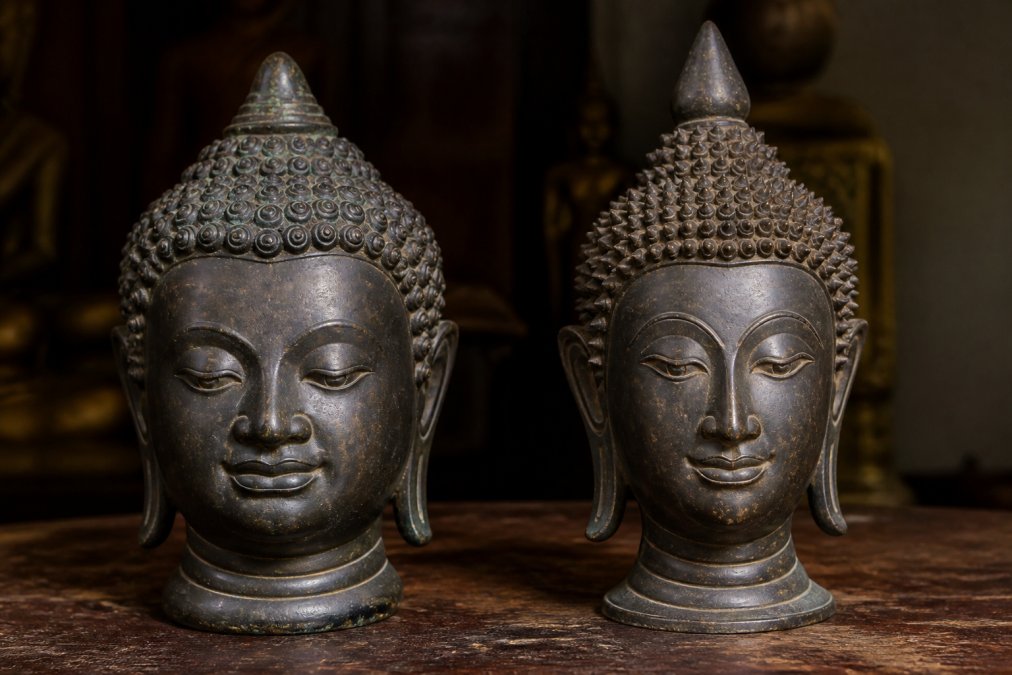
Here's what most guides get wrong: they treat these as fixed ethnic categories. They aren't. They are artistic conventions, shaped by centuries of regional trade, religious patronage, and available materials. A Khmer face carved in the 12th century and a Thai face carved in the 15th century reflect what each kingdom's sculptors were trained to idealize, not a photographic record of a population.
Below, we'll walk through the specific anatomical markers, the artistic traditions behind them, and how to use both when you're examining a piece.
| Feature | Khmer Sculptural Style | Thai Sculptural Style |
|---|---|---|
| Face shape | Broad, squared, brachycephalic | Narrower, oval, mesocephalic |
| Nasal root | Straight, wide alar width | Sharper, higher bridge |
| Lips | Fuller, thicker | Thinner, more defined |
| Eyes | Wide, heavy-lidded | Almond, pronounced epicanthic fold |
| Chin | Broad, less tapered | Tapered, pointed |
Khmer Sculptural Style Characteristics
Khmer sculptural style is defined by a broad facial architecture, full lips, and a straight nasal root that sits low on the face. The classic Angkor-period face, seen on temple reliefs and bronze figures, carries a sense of mass and stillness.
Sculptors working in the Khmer tradition built up the cheeks and jaw to create a squared silhouette. The columella, the strip of tissue between the nostrils, is typically wide, and the alar width is generous. This gives the nose a flatter, more grounded appearance than Thai work.
The lips are one of the clearest tells. Khmer carvings often show a fuller upper lip with a distinct, almost carved-in philtrum. The eyes are wide-set with heavy lids, sometimes with a faint epicanthic fold, but rarely as pronounced as in Thai pieces.
A common mistake among newer collectors is assuming every broad-faced bronze is Khmer. Plenty of later Thai pieces imitate Khmer proportions as a deliberate archaizing choice. Look at the lips and the nasal root together before you commit.
Thai Buddhist Art Facial Features
Thai Buddhist art facial features center on refinement: an oval face, a high and narrow nasal bridge, thinner lips, and almond-shaped eyes with a marked epicanthic fold. The Sukhothai period set the template, and later Ayutthaya and Rattanakosin work built on it.
The Thai ideal is slender and serene. The chin tapers. The forehead is often broader than the jaw. Facial indices in Thai sculpture skew toward a longer, narrower proportion than Khmer work, which is why the two read so differently even at a glance.
The eyes carry the most weight. Thai sculptors carved a pronounced epicanthic fold and a downward-curving upper lid, producing the famous "lotus bud" or "downcast" gaze. That single feature does more to signal Thai origin than almost anything else.
What most guides miss is how much regional variation exists inside Thailand itself. Northern Thai work, influenced by earlier Mon and Burmese traditions, can look rounder and softer than the sharp Sukhothai canon.
Identifying Southeast Asian Statue Origins
Identifying Southeast Asian statue origins means reading several features together, not one in isolation. The nose, lips, face shape, eyes, and the overall cranial breadth form a cluster. No single marker is decisive.
Start with the silhouette. Khmer work tends toward a brachycephalic, or broad, head shape. Thai work is more mesocephalic, longer front to back. Then move to the nose: wide root and generous alar width point Khmer; a high, sharp bridge points Thai.
Next, the mouth. Fuller lips with a strong philtrum lean Khmer. Thinner, more crisply defined lips lean Thai. Finally, the eyes. A heavy, pronounced epicanthic fold and an almond shape lean Thai. Wider, heavier-lidded eyes lean Khmer.
For deeper background, the Metropolitan Museum of Art's Southeast Asian collection essays are a solid starting point, and peer-reviewed morphology research is archived openly through PubMed Central.
| Marker | Points to Khmer | Points to Thai |
|---|---|---|
| Nasal root | Low, wide | High, narrow |
| Lips | Full, strong philtrum | Thin, crisp |
| Eyes | Wide, heavy-lidded | Almond, strong fold |
| Chin | Broad | Tapered |
| Head shape | Broad (brachycephalic) | Long (mesocephalic) |
Phenotype vs Ethnicity: What Facial Features Can and Cannot Tell You
Phenotype is the observable expression of a person's genetic makeup, including facial structure, skin tone, and pigmentation. Ethnicity is a social and cultural category. The two overlap, but they are not the same thing, and conflating them is the single biggest error in this field.
A sculpture's facial morphology tells you what a workshop chose to carve. It does not tell you the sculptor's ancestry, the patron's ethnicity, or the population's genetic makeup. Khmer and Thai kingdoms traded, intermarried, and shared religious iconography for centuries. Genetic admixture along the border regions was continuous.
The mechanism behind this is clinal variation. A cline is a gradual change in a trait across geography, and facial features in Southeast Asia follow clines rather than sharp national boundaries. Nose width, for example, tends to track latitude and humidity gradients across the region, not the political line between modern Cambodia and Thailand. Skin pigmentation follows a similar gradient shaped by ultraviolet exposure.
Three forces drive the pattern:
- Continuous gene flow. Populations along the Khorat Plateau and the Cardamom range have exchanged people through trade, marriage, and labor migration for well over a thousand years. There is no natural barrier sharp enough to isolate one population from the other.
- Shared source populations. Both regions drew from overlapping waves of migration out of southern China and, earlier, from Austroasiatic and Tai-Kadai speaking groups. The genetic distance between them is smaller than the distance between either and, say, populations in Northeast Asia.
- Selection on a gradient, not a switch. Traits like eyelid formation and nasal breadth respond to climate and are distributed continuously. A person in Surin and a person in Sisaket can look more alike than two people from opposite ends of Thailand.
How Urbanization and Intermarriage Are Changing Regional Features
Urbanization and intermarriage are blurring the regional distinctions that older anthropometric studies once treated as stable. As people move into Bangkok, Phnom Penh, and other regional centers, and as families form across former borders, the old clinal patterns are mixing faster than at any point in recorded history.
Three drivers accelerate the process:
- Labor migration. Cross-border labor movement between the two countries has been substantial for decades, with workers moving in both directions for agriculture, construction, and manufacturing. Migrant communities form, settle, and intermarry.
- Urban growth. The Bangkok metropolitan area and Phnom Penh have both absorbed large inflows from rural provinces. Urban marriage markets mix regional phenotypes that would have remained separate a century ago.
- Cross-border commerce and education. Border trade towns and shared university networks create sustained contact between populations that older studies treated as geographically distinct.
Frequently Asked Questions
What are the typical facial features in Thai Buddhist sculpture?
Thai Buddhist art facial features typically include an oval or rounded face, a subtle smile, arched eyebrows, and a nose with a well-defined bridge. The eyes often have an epicanthic fold and a downward gaze suggesting serenity. The overall morphology is refined and smooth, influenced by Sukhothai and Ayutthaya artistic conventions. In practice, Thai sculptural faces tend to look more elongated and symmetrical than Khmer ones.
Who are Khmer people genetically closest to?
Genetic studies suggest Khmer populations share ancestry primarily with other Southeast Asian groups, including Thai, Vietnamese, and Mon people, with additional Indian influence from historical trade and cultural exchange. This genetic admixture is reflected in the clinal variation of facial features across the region. However, phenotype does not map neatly onto genetics, and facial morphology varies widely within any single population.
What is the difference between Thai and Cambodian sculptural styles?
Khmer sculptural style characteristics include a broader, more rounded face, fuller lips, a flatter nasal root, and prominent almond-shaped eyes with heavy eyelids. Thai Buddhist art facial features tend to be more oval, with a sharper nose bridge, thinner lips, and a gentler brow curve. Thai statues also often show a flame-like finial on the head, while Khmer pieces emphasize a conical crown or bare head with tight curls.
How do historical artistic influences shape Khmer facial representation?
Khmer facial representation in sculpture evolved through Indian influence, indigenous Khmer aesthetics, and later Theravada Buddhist conventions. Early Angkorian pieces show strong Indian-derived nasal roots and facial protrusion, while later works emphasize indigenous features like fuller lips and a rounder face. These shifts reflect both religious change and the growing confidence of local artistic traditions, making identifying Southeast Asian statue origins a matter of comparing these layered influences.
