



Picture of Lakshmi: 8 Styles, Symbols and Display Tips
Picture of Lakshmi: 8 Styles, Symbols and Display Tips
When you look at a picture of Laxmi, what are you seeing? A graceful figure in jewellery, or a set of signs that name the form, the region, and the job the maker gave her?
Lakshmi, also spelt Laxmi, isn't one fixed portrait. She turns up in temple reliefs, painted panels, lost-wax bronzes, and printed sheets. Each form carries its own symbols. The lotus stands for growth from mud into light. Water pots and poured water stand for renewal. Open palms and raised hands read as gestures of blessing, not as decoration you can swap at will.
A picture of Laxmi can show her alone, flanked by elephants, or seated with Vishnu. The same goddess can look courtly in a miniature and luminous on gold foil. Match only the face and you'll miss the document in front of you.
People in Britain often meet these images in two places at once. One is a home shrine prepared for a festival evening. The other is a living room where the same face is treated as décor. Those uses aren't the same. A museum label can date an object. It can't tell you whether your household treats that form as the one for the altar.
That's the gap. A conventional gallery lists "a picture of Laxmi" as if every lotus and every crown were interchangeable. They aren't. The eight styles below are a short tour. Iconography comes first, then region and medium, then how to display the piece and what to check before you reproduce or license it.
Table of Contents
- 1. Gajalakshmi (Lakshmi Flanked by Elephants)
- 2. Lakshmi Paintings by Raja Ravi Varma
- 3. Lakshmi Narayana (Lakshmi Seated Beside Vishnu)
- 4. Chola Bronze Images of Lakshmi
- 5. Ashta Lakshmi (The Eight Forms of Lakshmi)
- 6. Mahalakshmi of Kolhapur
- 7. Lakshmi in Pahari and Rajput Miniature Painting
- 8. Thanjavur Painting of Lakshmi
- How the eight picture of Laxmi types compare
- Choosing and Displaying Your Own Lakshmi Image
1. Gajalakshmi (Lakshmi Flanked by Elephants)
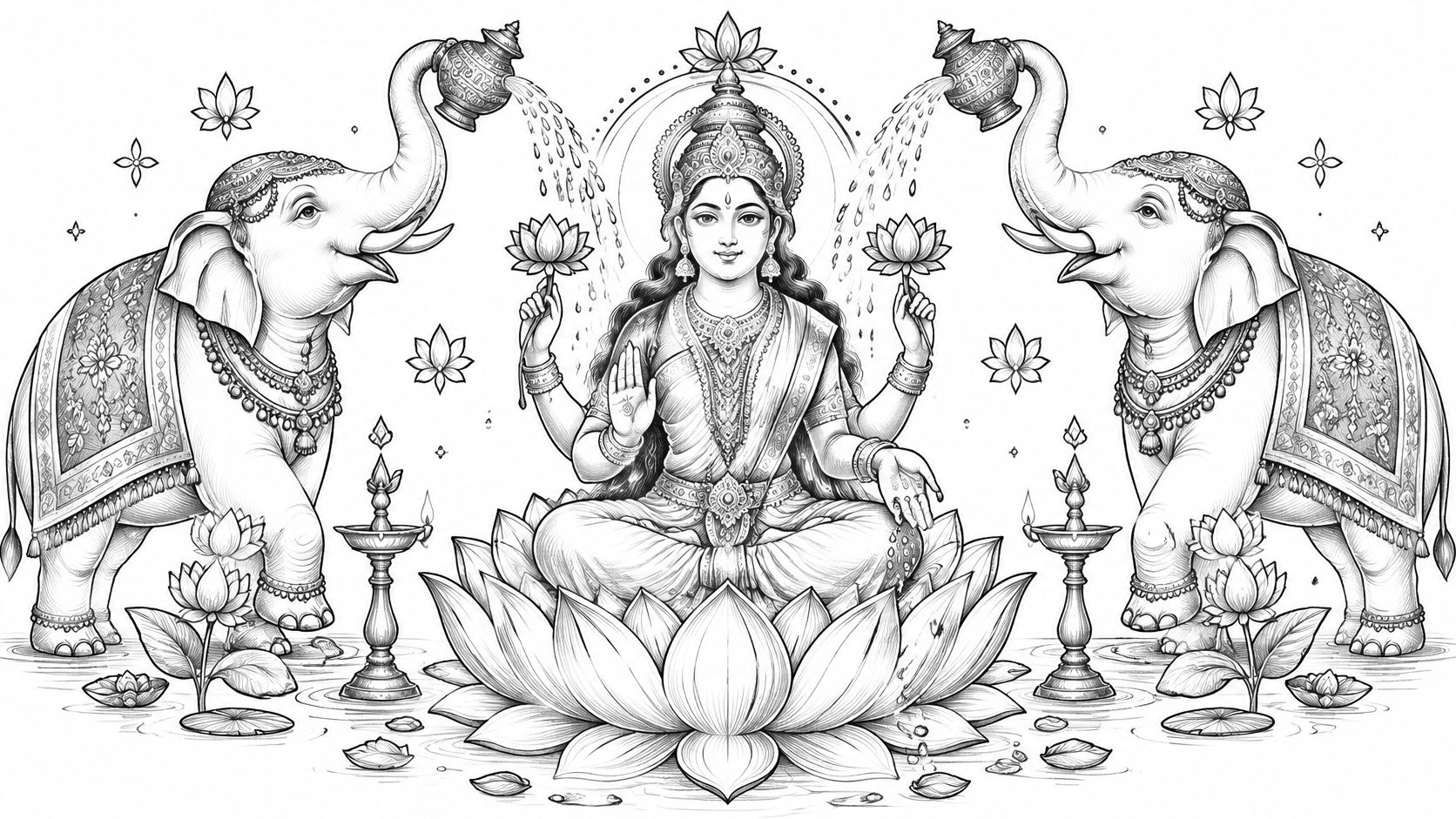
Gajalakshmi is the picture many people mean when they say a picture of Laxmi and then point at elephants. She sits or stands on a lotus. Two elephants, sometimes more, tip pots of water over her. The scene is abundance, royal care, and prosperity renewed, not a random animal border.
The British Museum's Ancient India large-print guide reads the elephants' dark bodies as monsoon clouds carrying rain, and the pouring as fertility and abundance. In one painting she holds a lotus in her lower-right hand, wrings wet hair with her upper pair of hands, and rests her lower-left hand on her lap, with two further elephants in a lotus-filled pool below.
What to check in the composition
Say you're comparing a modern print with a temple panel. Don't stop at "two elephants".
- Water flow: The stream should belong to the original design, not a later painted-on flourish.
- Lotus and jewellery: Fine petal edges and crisp ornaments usually mark a more careful hand.
- Arm count: Four arms with a clear job for each hand are easier to read than a muddled extra limb.
Practical rule: Hang or stand the image at eye level on a stable base so the lotus and the water line stay readable from the doorway.
Stone reliefs on early and medieval temples, and painted Gajalakshmi panels in shrine decoration, are the references worth keeping in mind. For a licence, ask whether the file is a new drawing or a photograph of an old panel, and get that answer in writing before you print it on a card.
2. Lakshmi Paintings by Raja Ravi Varma
Raja Ravi Varma (1848–1906), a painter from Kerala, changed how a wide public pictured Hindu deities. He joined European academic realism to Indian subjects, so Lakshmi gained a human, graceful presence in rich silks and jewellery. Chromolithographs from his press carried those faces into homes across India. They're still among the most recognised modern pictures of her.
A different painted tradition sits in the V&A's Kalighat record: opaque watercolour on paper, about 446 mm by 275 mm, around 1885, showing Lakshmi lustrated by elephants. Another sheet, around 1890, shows her with her owl at about 440 by 274 mm. Elephants and the owl aren't interchangeable stickers. One stresses ritual bathing and prosperity. The other belongs to a separate image type.
Prints, oils, and how they age
An oleograph isn't an oil painting that happens to be flat.
- Surface: Look for printing marks, paper tone, and a printed, not brushed, skin.
- Light: Acid-free mounts and no direct sun slow the fade on cheap inks.
- Pairing: A Ravi Varma print beside a small sculpted Lakshmi gives you history and devotion without pretending they're the same object.
Say a framed oleograph is offered as "original Ravi Varma". Ask which press, which paper, and whether it's a later reprint. Museum and collection holdings in India remain the benchmark for his oils. If you want to reproduce the image, confirm image rights separately from the frame you bought. Owning a print doesn't give you the right to scan it onto merchandise.
3. Lakshmi Narayana (Lakshmi Seated Beside Vishnu)
Picture two figures on one lotus, not one goddess with a spare crown. Lakshmi Narayana places Lakshmi beside Vishnu, or on his lap, as divine prosperity joined to preservation. It's one of the most common pairings in sculpture, painted panels, and temple sets. For a collector it shows Lakshmi as consort and as part of cosmic order, not as a standalone wealth charm.
The V&A's Lakshminarayana figure group shows Vishnu with Lakshmi seated on his right knee and Garuda below. That arrangement is a useful test. If Garuda is missing, or Vishnu's attributes are muddled, you may be looking at a generic couple rather than this form.
Attributes that place the piece
South Indian temple bronzes and stone images, and painted Vaishnava panels of the divine couple, are the usual homes for this iconography. Our guide to Lakshmi and Vishnu walks through how the pairing is read.
- Vishnu's emblems: Conch, discus, and posture help you name the form and often the region.
- Scale: Pairs and groupings eat wall and shelf space. Measure the niche before you fall for a large panel.
- Home altar: A smaller bronze or a painted version is easier to place, dust, and move at festival time.
A museum record can date and attribute an object. It doesn't decide whether that image is the one your practice uses. Ask the seller for dimensions and a clear photograph of both faces before you treat a download as accurate enough to reprint.
4. Chola Bronze Images of Lakshmi
The British Museum's Chola-period bronze of Sridevi, also called Shri Lakshmi, is dated to about 1000 CE, made in Tamil Nadu, and stands 13.87 inches high. The museum acquired it in 1965. It identifies her with good fortune, beauty, and prosperity, and with Vishnu and royal responsibility. Crop and animal fertility, and so the prosperity of the population, were tied to a ruler's moral and ritual duties. That's a useful correction if you've only met her as personal wealth.
Chola bronzes from roughly the ninth to the thirteenth centuries were cast by the lost-wax method. Collectors prize the tribhanga sway, smooth modelling, and fine jewellery. A picture of Laxmi in this tradition is often a photograph of metal, so the photo has to show casting, not just a pretty silhouette.
What a serious buyer asks
Genuine wear and a modern chemical patina don't tell the same story. Seams, rubbing on high points, and corrosion in recesses should agree with each other.
- Provenance: Request a history of ownership and any expert or laboratory note before you pay a Chola price.
- Storage: Keep bronze dry and stable. Damp corners bloom corrosion that a photograph will hide until it's too late.
- Reproduction: A snapshot of a museum piece isn't yours to print. Our notes on Lakshmi statue iconography and regional styles help you name what you're seeing before you license a file.
Groupings in South Indian and international museums are the comparison set. If a seller won't show the back and the base, walk away.
5. Ashta Lakshmi (The Eight Forms of Lakshmi)
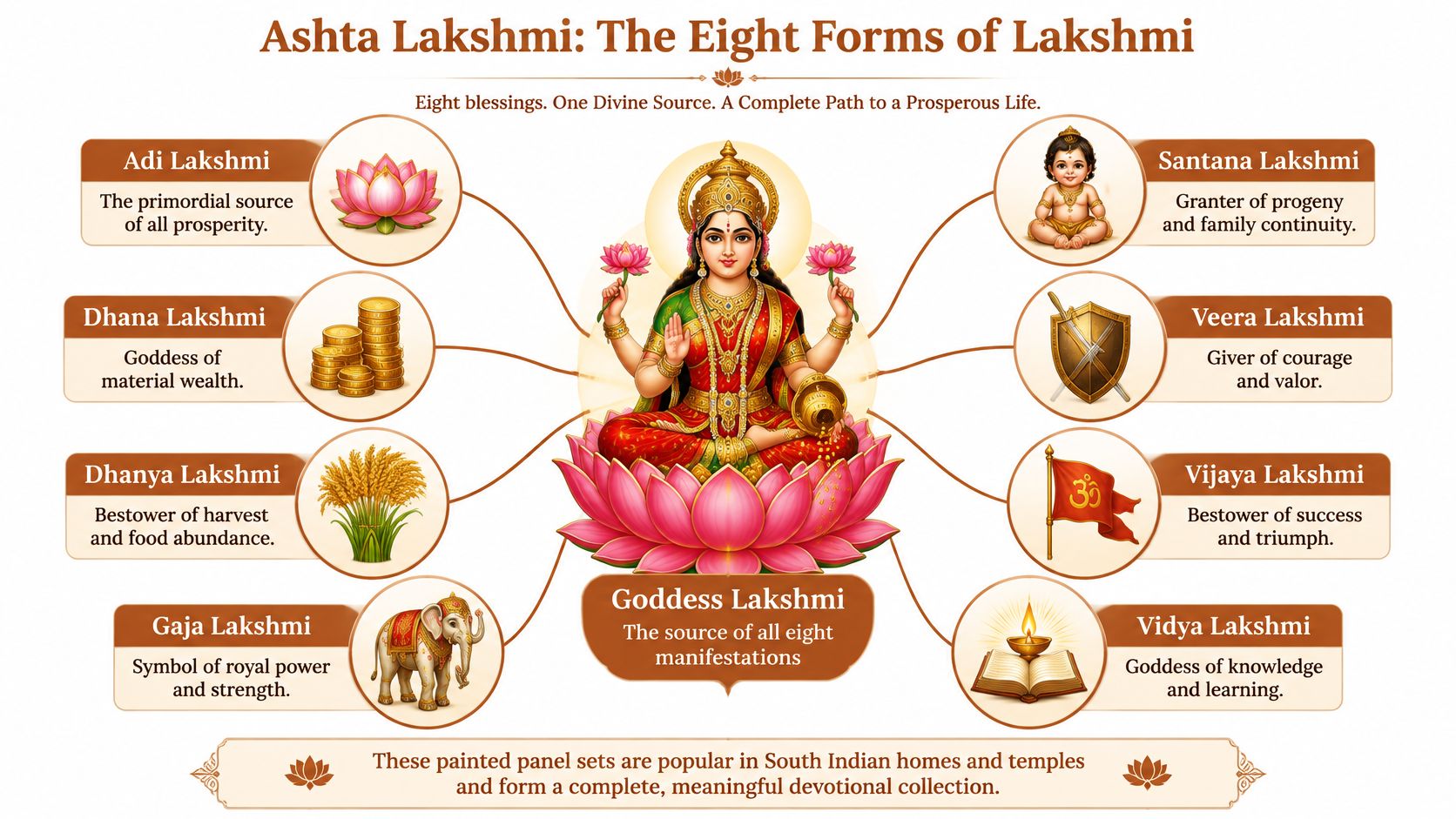
Ashta Lakshmi means eight manifestations, each tied to a different face of prosperity. Wealth, courage, knowledge, grain, and victory are among them. Painted sets and paired images are common in South Indian homes and temples. A set gives you one iconographic idea instead of eight unrelated posters.
Sorting eight forms from one generic face
The British Museum's Kashmir sculpture, carved in grey chlorite, is a stern reminder that attributes do real work. Lakshmi sits in pralambapadasana on a lion throne, with a three-crescent diadem, halo, lotus, attendants, and a purnaghata, an abundance pot the museum treats as a major symbol of her link with prosperity. Use that kind of checklist on a printed eight-fold set too.
- Order: Follow a traditional sequence so the wall reads as one thought, not a scramble.
- Start small: One form, such as Dhana Lakshmi for wealth, can grow into the full set.
- Names: Match each panel to a named form before you frame them. The Ashta Lakshmi stotram guide is a clear place to check the eight.
Say you buy a digital pack labelled "eight Lakshmis". Open every file. If two panels share the same hands and the same animal, you've bought duplicates with new captions. For print or web use, licence each image, not just the cover thumbnail.
6. Mahalakshmi of Kolhapur
The Mahalakshmi image at the Karveer temple in Kolhapur, Maharashtra, is one of India's major pilgrimage images of Lakshmi. The principal figure is typically dark stone, crowned, with a lotus and a fixed set of symbolic attributes. Painted, printed, and small devotional copies travel far beyond the temple, which is why regional collectors treat this face as its own type.
In Britain that regional face still meets a festival calendar. The National Academy's Diwali lesson, drawing on the 2021 UK Census, notes about 1.7% of the UK population as Hindu, around one million people, and a similar estimate for people who celebrate Diwali. Diwali isn't a UK public holiday. Lakshmi worship is especially tied to the festival's main evening, with cleaning, lamps, and doors opened to welcome her. Census religion and festival attendance aren't the same count, so treat the overlap as approximate.
Choosing a Kolhapur-style picture
A Maharashtrian household print and a vague "Indian goddess" poster shouldn't share a caption.
- Iconography: Crown, lotus, and the Kolhapur attribute set should match traditional versions, not a generic four-armed template.
- Place: A clean shelf or altar at a comfortable viewing height is enough. You don't need a theatrical niche.
- Material: Cheap resin often loses the stone image's crisp edges. Look at the finish in daylight before you buy.
If you photograph your own shrine copy for a website, you still need the rights in the underlying print. A temple visit doesn't transfer copyright in a publisher's oleograph.
7. Lakshmi in Pahari and Rajput Miniature Painting
Say you're handed a painting the size of a large postcard, with a decorated border and mineral colour that still looks wet. That scale is the first clue you're in Rajput or Pahari miniature country, roughly the seventeenth to nineteenth centuries. Lakshmi appears in courtly rooms and devotional gatherings, drawn with a fine line rather than a poster outline.
The British Museum's Feminine Power guide ties her to abundance and to the fertilisation of the earth, and notes worship in western India at Diwali, when offerings invite prosperity for the year ahead. Visually, she may rise from the ocean while winged elephants shower her, a return that renews fertility. The same guide records her paired with Vishnu in Nepalese art, sometimes as one composite body. On a small sheet, count the figures before you catalogue "Lakshmi alone".
Light, mounts, and paperwork
These paintings fade. A bright hallway will do it.
- Light: Low, indirect light, and a rotation off the wall, slows pigment loss.
- Glazing: Conservation-grade mounts and glass, or acrylic, keep dust and fingers off the surface.
- Paper trail: Ask for a condition report and provenance before an "antique miniature" price.
Museum holdings in India and abroad are the comparison, not a stock photo with a gold border added in software. If you scan a miniature for study, keep the file private unless the rights owner has agreed to publication. A private purchase rarely includes those rights.
8. Thanjavur Painting of Lakshmi
Thanjavur painting, often called Tanjore painting, is a Tamil Nadu tradition built on gold foil, raised gesso, and strong colour. Lakshmi is a favourite subject. She usually sits on a lotus, with a flowing mantle, heavy jewellery, and a halo. The surface is half picture, half low relief. That's why these panels suit a shrine and a carefully chosen interior wall.
Traditional workshops in Tamil Nadu still produce them, and you'll see panels in South Indian homes and temples. A picture of Laxmi in this medium should show the gold as metal leaf and paste, not as yellow paint pretending to be leaf.
Foil, humidity, and gifts
Hang the panel away from direct sun, steamy kitchens, and heaters. Gold foil and gesso move when the room does.
- Cleaning: A soft, dry brush only. Liquids lift leaf and stain the ground.
- Gifts: Hand-finished detail beats a mass-moulded copy if you're giving the panel to mark a housewarming or a festival.
- Licensing: Workshop pieces are still someone's design. Ask before you photograph the whole panel for a product listing or a social advert.
If the gold looks printed in a flat grid, you're probably looking at a poster of a Thanjavur painting, not the painting. That's fine for a temporary display. It isn't the same object, and it shouldn't carry the same price.
How the eight picture of Laxmi types compare
| Item | Main Medium | Region or Tradition | Best For |
|---|---|---|---|
| Gajalakshmi (Lakshmi Flanked by Elephants) | Stone reliefs, bronzes, and painted panels | Indian temple art | Recognisable imagery symbolising abundance |
| Lakshmi Paintings by Raja Ravi Varma | Oil paintings and chromolithographic prints | Kerala; modern Indian art | Accessible devotional and historical display |
| Lakshmi Narayana (Lakshmi Seated Beside Vishnu) | Bronze, stone, and painted images | Vaishnava traditions, especially South India | Collectors of devotional art and Vishnu imagery |
| Chola Bronze Images of Lakshmi | Lost-wax cast bronze | Chola-period South India | Collectors of classical Indian sculpture |
| Ashta Lakshmi (The Eight Forms of Lakshmi) | Painted panels, prints, and sculptures | Tamil and South Indian devotional traditions | A meaningful themed set for an altar or display |
| Mahalakshmi of Kolhapur | Dark stone originals; bronze and painted reproductions | Kolhapur, Maharashtra | Regional devotional display |
| Lakshmi in Pahari and Rajput Miniature Painting | Small paintings with fine brushwork and pigments | Pahari and Rajput schools | Collectors of miniature art and Indian court culture |
| Thanjavur Painting of Lakshmi | Gold foil and raised gesso on wood panel | Thanjavur, Tamil Nadu | Decorative devotional spaces and feature walls |
Choosing and Displaying Your Own Lakshmi Image
You now have eight ways to read a picture of Laxmi. The practical part is narrower: name the form, check what it is made from, place it safely, then confirm the rights before you reproduce it.
Start with the clearest symbol. Elephants pouring water point to Gajalakshmi. A seat shared with Vishnu points to Lakshmi Narayana. Eight named panels are Ashta Lakshmi, with each form carrying its own emphasis. A dark crowned image tied to Kolhapur reads as a regional pilgrimage type. Gold relief points to Thanjavur. Fine brushwork on a small sheet suggests a miniature tradition, while silk-like realism in a popular print may descend from Ravi Varma or a later reprint.
Materials decide the care. Paper, bronze, stone, resin and gesso age differently, so ask what the surface is before you judge the colour. For antiques, ask who owned the piece and how it reached the market. For anything described as handmade, ask which stages were done by hand. For a photograph of a museum object, do not republish it unless a licence allows that use.
Display is conservation as much as devotion. Keep paint, foil and paper away from direct sun and damp. Give bronze a dry, steady position where hands will not polish the high points by accident. A stable eye-level shelf lets you read the lotus rather than stare at the frame. For a heavy framed panel, find the right picture placement so the fixing, height and sightline suit the room before you mark the wall.
Many buyers choose Lakshmi where abundance is the intended mood, whether that is an altar or a living room that should feel calm rather than crowded. That is a preference, not a rule for every Hindu household. In the 2021 Census, 1,020,533 people in England and Wales identified as Hindu, up 25% from 2011 and 86% from 2001, according to a NATRE summary of the figures. The same summary passes on the ONS warning that census religion records affiliation rather than belief or active practice. A growing community keeps these images current; it still leaves room for different forms, rooms and reasons.
HD Asian Art offers Lakshmi sculptures for collectors and home shrines, with lotus seats, traditional gestures and regional styles that can be compared before buying, and its News guides explain meanings and placement. If you are unsure, list the symbols you can see and match them to one of the eight styles above. A clear form, an honest material, a safe wall and a licence you hold will serve the image better than a costly frame.
Visit HD Asian Art to compare Lakshmi pieces alongside the placement notes.
