



3 Signs to Read a Lakshmi Statue, Museum Evidence and Collector Steps
3 Signs to Read a Lakshmi Statue, Museum Evidence and Collector Steps
A Lakshmi statue primarily symbolizes abundant life: purity, fertility, and prosperity rather than mere cash. Three visual signals carry that message across almost every regional tradition: the lotus she stands or sits on, her four arms tied to the four aims of life, and the elephants of Gaja-Lakshmi pouring water over her.
The sections below unpack each symbol, the regional variations that change her form, the historical record behind the imagery, and the practical checklist HDAsianArt uses to read an individual piece.
Key Features:
- Lakshmi statues primarily symbolize abundance, encompassing wealth, fertility, purity, and spiritual well-being, with water, lotuses, and elephants emphasizing ecological and regenerative themes.
- The Gaja-Lakshmi motif, dating back to the 1st century BCE, features elephants pouring water and pairs with regional variations like the eight forms of Ashta-Lakshmi, which emphasize different aspects of prosperity.
- Regional adaptations often simplify or alter attributes such as arms, attendants, and throne type, so classification depends on arm count, throne style, and regional sculptural features rather than iconography alone.
- Proper interpretation requires thorough recording of physical details, context, and regional typologies, as missing attributes are common and do not necessarily indicate inauthenticity.
- Placement rituals and colors like red and gold reinforce her symbolic themes, with cleanliness and respectful positioning aligning with devotional customs rather than material wealth guarantees.
Table of Contents
- Lakshmi Symbolism and Statue Iconography Explained
- Gaja-Lakshmi, Ashta-Lakshmi, and Other Statue Types
- How Do You Read the Symbols on a Lakshmi Statue?
- When Did Lakshmi Iconography Take Its Current Form?
- Placement and Devotional Customs Associated With Lakshmi
- A Collector’s Checklist for Reading a Lakshmi Statue
- What Do the Colors on a Lakshmi Statue Mean?
- What Do Lakshmi’s Clothing and Jewelry Represent?
- An Editor’s Note on Reading Lakshmi Sculptures
- Explore Authenticated Lakshmi and Hindu Statuary
- Sources
- FAQ
Lakshmi Symbolism and Statue Iconography Explained
Every element on a Lakshmi statue does double duty. It reads as decoration to a casual viewer and as theology to anyone who knows the visual vocabulary. The Metropolitan Museum of Art frames Lakshmi as a goddess of abundance in the fullest sense: wealth, fertility, beauty, well-being, and the life-giving power of water and plant growth, not a narrow promise of cash. That distinction shapes how you should read every attribute below.
The lotus. Nothing in Lakshmi iconography matters more than the lotus she stands on, sits on, or holds. Its roots sit in mud while its flower opens clean above the water line, which is why the American Institute of Indian Studies describes it as a metaphor for spiritual elevation amid worldly conditions. A lotus throne signals purity and auspiciousness before you even look at her hands. Readers who want the fuller history of this motif in sculpture can check HDAsianArt’s guide to the Indian lotus flower, which traces the same symbol across Buddhist and Hindu traditions.
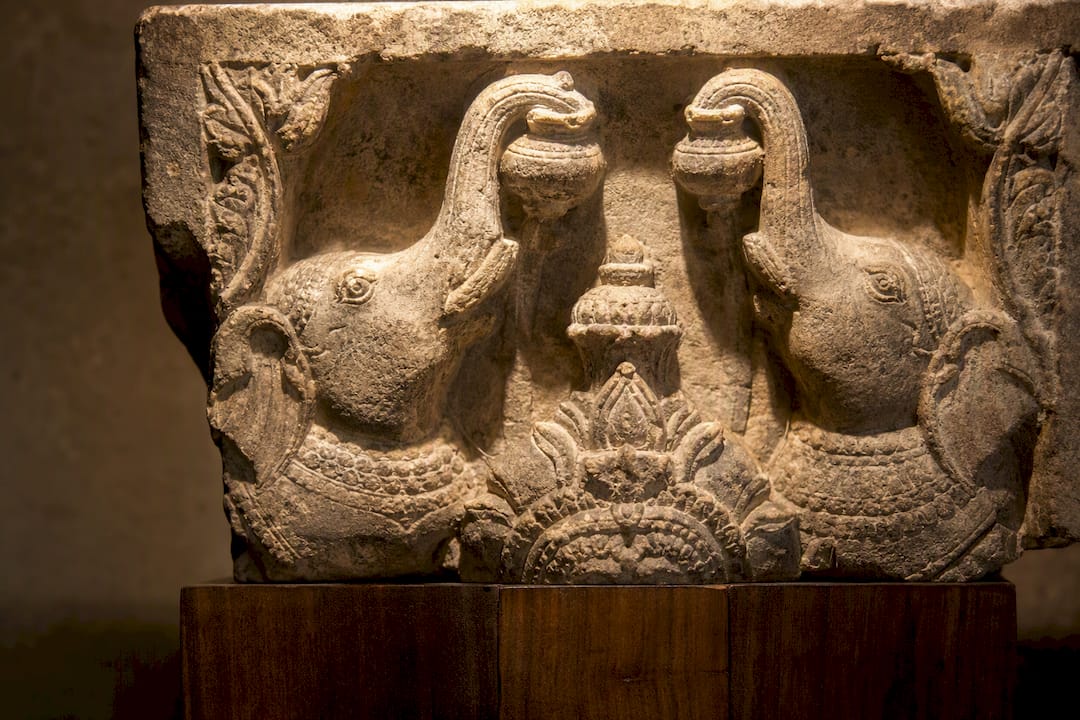
The elephants of Gaja-Lakshmi. When elephants flank the goddess and pour water from raised trunks, you are looking at the Gaja-Lakshmi motif, one of the oldest and most stable images in Indian art. The Met’s Gaja-Lakshmi sculpture is dated to the 6th century, though the motif itself appears as early as the 1st century BCE. The elephants tie Lakshmi to monsoon rain, fertility, and royal legitimacy. Kings used her image on coins and temple gates precisely because rain and royal authority were, in an agrarian economy, the same problem.
Coins and the flow of wealth. A stream of coins falling from an open palm looks like a straightforward wealth symbol, and it is, but not in the way modern viewers assume. The four arms of Lakshmi ground this gesture in the four puruṣārthas: dharma, artha, kama, and moksha, meaning duty, prosperity, desire, and liberation. Coins arriving through a hand tied to that framework are read as stewardship and generosity, a reminder that prosperity only counts within an ethical structure. A statue promising unrestrained personal riches misreads the iconography.
Mudras. The varada mudra, palm turned outward and slightly downward, signals boon giving and generosity. The abhaya mudra, palm raised and facing forward, signals protection and reassurance. A four-armed Lakshmi typically combines one or both of these gestures with a lotus and a pot or coin stream, and the combination changes the emotional register of the whole piece: a statue emphasizing abhaya reads as protective, while one emphasizing varada reads as actively generous.
Lesser-seen attributes. A short list of secondary elements rounds out the iconography:
- The owl, seen more often on statues of Alakshmi (Lakshmi’s shadow or “misfortune” counterpart) or in later folk and regional traditions, marks vigilance in darkness and, in some regional readings, the discernment needed to keep wealth from turning destructive.
- The lion, occasionally substituted for the more common owl or elephant pairing in certain South Indian and folk contexts, signals royal power and protection.
- Rice or grain, held in the hand in some Southeast Asian forms, ties Lakshmi directly to agricultural abundance rather than abstract wealth.
- The conch, appearing in Cham and some South Indian iconography, links her to Vishnu’s own attributes and to purifying, life-sustaining water.
- The water pot (kalasha), often shown at her feet or held in a lower hand, repeats the water and fertility theme found in the elephants and the lotus.
Pro Tip: Don’t read any single attribute in isolation. Museum curators increasingly treat lotus, water, and elephant imagery as one interconnected fertility system rather than three separate decorations, and reading them together gives a far more accurate picture than reading them one at a time.
Gaja-Lakshmi, Ashta-Lakshmi, and Other Statue Types
Classifying a Lakshmi statue starts with recognizing which canonical type it belongs to, since the type determines which attributes should logically appear.
Gaja-Lakshmi shows the goddess flanked by two elephants raising water pots or trunks above her head. This is the type with the deepest archaeological record. The motif’s presence by the 1st century BCE makes it one of the oldest fixed compositions in Indian religious art, predating much of the developed Puranic mythology around Lakshmi as Vishnu’s consort.
Ashta-Lakshmi refers to a set of eight forms, each emphasizing a different kind of abundance: courage, patience, health, victory, grain, wealth, progeny, and knowledge, among the common groupings. A statue or relief panel depicting Ashta-Lakshmi rarely shows all eight in equal detail; usually one or two dominate the composition while the others appear as smaller attendant figures or symbolic objects.
Standing versus seated forms split largely along regional lines. The classic Indian four-armed image, whether standing on a lotus or seated in lalitasana with one leg pendant, tends toward a fuller iconographic program: multiple arms, mudras, coins, a water pot. Southeast Asian traditions frequently simplify this:
- Cambodian (Khmer) Lakshmi statues often show a standing figure with a tiara and a lotus bud rather than a full bloom, a stylistic shorthand distinct from Indian conventions.
- Cham sculpture from central Vietnam favors seated forms holding a conch, reflecting closer visual ties to Vishnu iconography in that tradition.
- Javanese representations sometimes place a single grain of rice in her hand instead of coins, tying her directly to rice cultivation rather than abstract currency.
These regional shifts aren’t decorative accidents. They reflect distinct local sculptural vocabularies that adapted a shared Indian template to local material culture and belief. HDAsianArt’s guide to Khmer Lakshmi imagery covers how Cambodian carving traditions handled this figure across several centuries. A practical rule for classification: count the arms first, then check the throne, then check the attendant animals. Four arms plus elephants plus a full lotus points toward the Indian devotional mainstream. Two arms plus a simplified lotus bud plus regional headgear points toward Southeast Asian adaptation.
How Do You Read the Symbols on a Lakshmi Statue?
Reading a Lakshmi statue well is a sequence, not a glance. Skipping steps is how casual viewers and even some sellers arrive at inflated or flatly wrong claims about a piece.
- Record everything before interpreting anything. Note the posture (standing, seated, lalitasana), count the arms, list every handheld object, note any flanking animals, and check the base and reverse for marks, inscriptions, or repair. This documentation step matters because reverse and base details often carry symbolic information that changes how the front should be read.
- Read each hand and object on its own terms. A lotus signals purity and elevation. A coin stream signals stewardship within the four puruṣārthas, not a literal wealth guarantee. A water pot repeats the fertility theme found in the lotus and the elephants. A varada mudra signals active generosity; an abhaya mudra signals protection.
- Place the attributes in regional and historical context before finalizing the interpretation. A simplified two-armed standing figure with a lotus bud is not a “lesser” or incomplete Lakshmi. It’s a Khmer or Javanese adaptation following its own regional grammar, and judging it against an Indian four-armed template will lead you to the wrong conclusion.
The most common misread among newer collectors is treating coins as a literal promise: buy this statue, receive this money. That is not what the iconography claims. Coins function as a theological reminder about generosity and right use of prosperity, tied to dharma and artha rather than to the collector’s bank balance.
Pro Tip: If a statue is missing an attribute you expected, don’t assume it’s incomplete or inauthentic. Regional workshops routinely dropped or substituted attributes, and the absence of an expected element rarely signals a problem on its own once you’ve confirmed the piece against the right regional typology.
When Did Lakshmi Iconography Take Its Current Form?
Lakshmi’s visual language did not arrive fully formed. It built up over roughly two thousand years, moving from a localized fertility figure into the fully developed consort of Vishnu shown in most temple sculpture today.
The earliest solid evidence points to coin imagery and relief carving from the centuries before the common era, where a goddess flanked by elephants and holding lotuses already appears as a recognizable type. This early Gaja-Lakshmi motif, present by the 1st century BCE, predates the fully articulated Puranic literature that would later formalize her as Vishnu’s wife and assign her the four-armed form tied to the puruṣārthas.
Museum collections give this evolution a physical timeline you can trace object by object:
- The Met’s Gaja-Lakshmi sculpture, dated to the 6th century, shows the elephant-and-water composition already stabilized into the form still used today.
- The Met’s broader Lakshmi holdings emphasize her ecological and generative dimensions, treating water, lotuses, and plant growth as core to her identity rather than secondary decoration.
- The British Museum’s South Asian collections hold comparable examples that let researchers cross-check regional variation in the same period, useful for anyone trying to date an undocumented piece by comparing carving style and proportion.
Puranic literature, composed and compiled over centuries following the early imagery, gave Lakshmi her fixed narrative role as Vishnu’s consort and formalized the four-armed image tied to dharma, artha, kama, and moksha. This textual layer didn’t invent the lotus or the elephants. It absorbed older fertility and water symbolism into a new, more systematized theology, which is why the oldest Gaja-Lakshmi reliefs can look visually similar to much later four-armed temple statues while carrying a somewhat different theological weight. For collectors, this means provenance and base details aren’t just paperwork. They’re often the only reliable anchor for placing an individual object correctly within this long development.
Placement and Devotional Customs Associated With Lakshmi
Lakshmi’s association with prosperity has shaped a set of household customs that treat her presence as something invited through behavior, not guaranteed through ownership. Diwali cleaning and lighting rituals are the clearest example: households scrub, declutter, and illuminate the home in the days before the festival, a practice documented in museum catalog notes on Lakshmi Puja as a long-standing devotional custom tied directly to her worship.
The underlying logic is consistent across regions even when the specific rituals vary: cleanliness, order, light, hospitality, and generosity are treated as conditions that invite her presence, while clutter, darkness, and stinginess are treated as conditions that repel her. A few practical, respectful placement guidelines follow from that logic:
- Keep the area around the statue clean and free of clutter rather than crowding it among unrelated objects.
- Place her at a respectful height, generally at or above eye level rather than on the floor or in a low cabinet.
- If the statue is oriented on a lotus base, let that base be visible rather than obscured by other decor.
- Avoid placing her near a bathroom, under a staircase, or in any spot associated with waste or disrespect in the home’s overall layout.
Pro Tip: Treat these customs as devotional practice, not a transaction. Nothing in the historical or museum record supports reading a Lakshmi statue as a literal wealth guarantee tied to its placement; the ritual value lies in the discipline and intention behind the practice, not the object’s position alone.
A Collector’s Checklist for Reading a Lakshmi Statue
Interpreting a specific Lakshmi statue, rather than the iconography in general, calls for the same documentation discipline a museum registrar would use before a piece ever gets a wall label. A version of this process is applied to Hindu statues sold by galleries.
- Photograph every side, including the base. Front-only photography misses the reverse and base marks that often carry symbolic scenes or inscriptions changing how the front should be read.
- Record exact measurements. Height, width, depth, and weight where possible. Dimensions help cross-reference a piece against published museum examples of the same regional type.
- Note mounts and repairs. A later base, a replaced arm, or a filled crack all affect both interpretation and value, and should be documented rather than hidden.
- Examine material clues closely. Bronze pieces often show casting seams or file marks that hint at workshop practice and period. Wood pieces show joins and tool marks that vary by regional carving tradition. Patina, whether a deep even oxidation or a patchy modern application, offers a rough read on age and handling history.
- Compare against museum typologies before drawing conclusions. A statue’s arm count, throne type, and attendant animals should be checked against catalog examples from institutions like the Met or the British Museum, not assumed from memory.
Material and construction clues matter because they narrow down region and period faster than iconography alone. A casting seam pattern typical of a particular workshop tradition, a joinery style specific to a regional wood-carving school, or an inscription in a specific script can settle a question that visual symbolism alone leaves open. Provenance records, when they exist, do similar work: a documented chain of ownership or a prior exhibition history lets a specialist match a piece against known typologies with far more confidence than surface examination alone provides.
Readers working through their own Lakshmi piece, or a related Hindu goddess figure, can find additional material markers in HDAsianArt’s guide to identifying Hindu goddess statue features. When a piece raises real questions about age, region, or authenticity, that’s the point to bring in a specialist condition or provenance report rather than relying on visual impression alone.
What Do the Colors on a Lakshmi Statue Mean?
Painted or gilded Lakshmi statues lean heavily on two colors: red and gold, each carrying its own layer of meaning on top of the pose and attributes already discussed.
Red appears most often in her garments and in bindi or tilaka marks on the forehead. Across Hindu iconography broadly, red signals auspiciousness, fertility, and marital or ritual purity, the same association that makes red central to Hindu wedding attire. On a Lakshmi statue, red clothing reinforces the fertility and life-giving themes already carried by the lotus and the water imagery, rather than introducing a separate meaning.
Gold, whether through gilding, gold leaf, or a painted gold finish, ties directly to her role as goddess of prosperity. This is the most literal color symbol on a Lakshmi statue: gold represents material wealth and radiance, and a heavily gilded piece is making a visual argument about abundance before you even look at her hands or throne.
A decorative Lakshmi statue finished in red and gold together, still the most common color pairing in both temple and home shrine statuary, is deliberately doubling up: red for fertility and auspicious beginnings, gold for prosperity and radiance. White or pale tones appear less often but, when present, usually shift emphasis toward purity, echoing the lotus rather than the wealth themes carried by gold. Reading statue color alongside pose and attributes, rather than in isolation, gives a fuller and more accurate picture of what a particular piece is emphasizing.
What Do Lakshmi’s Clothing and Jewelry Represent?
Lakshmi is rarely shown in plain dress. Her clothing and ornamentation are themselves iconographic statements, not just period costume.
The sari or draped garment, typically rendered in red or gold tones as discussed above, marks her as a married, auspicious female figure within Hindu visual convention. This connects her directly to household and marital prosperity, one reason her image appears so often near entrances and in domestic shrines rather than only in temple sanctums.
Heavy jewelry, crowns, necklaces, armlets, anklets, and layered earrings, functions as a direct visual shorthand for abundance. A statue’s ornamentation is one of the fastest ways sculptors communicated wealth to viewers who might not read Sanskrit inscriptions or recognize subtler iconographic cues. The heavier and more elaborate the jewelry, the more directly the piece is emphasizing material prosperity over other themes like purity or fertility.
The crown or tiara, seen across Indian and Southeast Asian traditions alike, including the distinct Cambodian tiara style noted earlier in the regional variants, signals her royal and divine status simultaneously. This is not a secular fashion detail. It positions her above ordinary devotional figures, closer in rank to the great gods she attends and, in some traditions, marries.
Taken together, garment color, jewelry density, and crown style form a secondary symbolic layer running alongside the lotus, elephants, and hand gestures. A restrained, lightly ornamented Lakshmi in plain drapery emphasizes spiritual purity. A heavily jeweled, gilded, crowned Lakshmi emphasizes material abundance and royal favor. Both are legitimate, historically grounded readings of the same goddess, and the difference tells you something real about what a particular sculptural tradition or workshop chose to emphasize.
An Editor’s Note on Reading Lakshmi Sculptures
Interpreting a Lakshmi statue well means resisting the urge to force every piece into one template. Professional research processes treat each statue as an individual object first: full-sided photography, careful measurement, material inspection, and a comparison against known regional and period typologies before any symbolic reading gets written down. That order matters. Skip straight to interpretation and you’ll misread a simplified Khmer form as an incomplete Indian one, or mistake a later repair for an original attribute. The gallery’s descriptions exist to give collectors and researchers both the cultural context and the physical documentation a piece deserves, because a Lakshmi statue’s real value, spiritual and material, only shows up when both are done properly.
— James, HDAsianArt.com
Explore Authenticated Lakshmi and Hindu Statuary
If the symbolism in this guide has you looking at your own piece differently, or looking for one to add to a collection, Certain galleries curate and research Hindu statuary using full documentation, material analysis, and typology comparison before anything goes up for sale.
The gallery’s Hindu Statues collection includes authenticated Lakshmi pieces alongside other deities from Cambodia, Thailand, Indonesia, and beyond, each with individual research notes rather than a generic template description. Collectors looking specifically for museum-quality, high-value pieces can browse the Masterpieces collection, curated for buyers who want the strongest documented examples available. If you’re weighing a specific statue and want more detail on its condition, materials, or provenance before you commit, reach out through HDAsianArt directly. A member of the research team can walk you through what’s documented on a given piece and what a condition or provenance report would involve.
Sources
For readers who want to compare examples directly, the Metropolitan Museum of Art’s Lakshmi and Gaja-Lakshmi collection pages and the American Institute of Indian Studies’ overview via Google Arts & Culture offer the strongest publicly accessible catalog entries. The British Museum’s South Asian holdings provide useful cross-regional comparison. Consulting catalog object pages directly, rather than relying on secondhand summaries, remains the most reliable way to check a piece’s visual details against confirmed examples.
- Goddess of abundance, Sri Lakshmi — The Metropolitan Museum of Art
- Sri Lakshmi: The Goddess of Fortune and Prosperity — American Institute of Indian Studies (Google Arts & Culture)
FAQ
What does a Lakshmi statue symbolize?
A Lakshmi statue symbolizes abundance in the broadest sense: wealth, fertility, purity, beauty, and spiritual well-being, not simply money. The Metropolitan Museum of Art frames her explicitly around this fuller idea of abundance, tying her imagery to water and plant life as much as to material prosperity.
Where should I place a Lakshmi statue in my home?
Place her at or above eye level in a clean, uncluttered spot, ideally where her lotus base remains visible, and avoid bathrooms, stairwells, or other spots associated with waste. These placement habits echo the cleaning and lighting customs tied to Lakshmi Puja traditions, which treat order and light as conditions that invite her presence rather than guarantees of wealth.
What symbols represent Lakshmi?
Her core symbols are the lotus (purity and spiritual elevation), four arms tied to the puruṣārthas of dharma, artha, kama, and moksha, and the Gaja-Lakshmi elephants representing rain, fertility, and royal authority. Secondary symbols include coins, a water pot, varada and abhaya mudras, and, in some regional traditions, an owl, lion, conch, or grain of rice.
What attracts Goddess Lakshmi, according to tradition?
Cultural and devotional practice associates cleanliness, order, light, hospitality, and generosity with inviting Lakshmi’s presence, most visibly during Diwali cleaning and lighting rituals. These are described as devotional customs rather than material guarantees, so the practice is understood as cultivating the right conditions, not purchasing an outcome.
Does a missing attribute mean a Lakshmi statue is inauthentic?
No. Attributes vary meaningfully by region and period, and absence of an expected element like a full four arms or elephants doesn’t on its own indicate a problem. A simplified Khmer or Javanese form should be compared against its own regional typology rather than judged against the standard Indian four-armed template.
