



Seven Flowers for Daily Hindu Altar Worship
Seven Flowers for Daily Hindu Altar Worship
Quick Summary
The best flowers for a daily Hindu altar are fresh, fragrant, unbroken blossoms that suit the deity you honor. Jasmine and marigold are popular everyday choices because they hold up well and fill the room with scent. For a multi-deity altar, use a shared base of neutral fragrant flowers and add one small deity-specific accent.
- Choose fresh, unbroken blossoms that are open but not yet fading.
- Marigold is practical for daily puja and lasts a day or two on the altar.
- Use a neutral shared base of jasmine, marigold, or rose on a multi-deity altar.
- Red flowers are common for Devi and Ganesha but are avoided for Shiva in many households.
- Replace marigolds every one to two days to keep the offering fresh.
Table of Contents
- How to Choose Flowers for Your Daily Hindu Altar
- Flowers Offered to Hindu Gods and Goddesses
- Marigold Flowers for Puja and Everyday Offerings
- Hindu Flower Symbolism and Spiritual Meaning
- Step-by-Step Method for a Daily Puja Flower Offering
- Flowers to Avoid and Tradition-Specific Exceptions
- Caring for, Replacing and Disposing of Altar Flowers
- Setting Up Your Own Daily Altar Flower Routine
- Frequently Asked Questions
How to Choose Flowers for Your Daily Hindu Altar
Choosing flowers for a daily Hindu altar starts with three questions: is the flower fresh, is it fragrant, and is it suitable for the deity you honor. Many households keep it simple and use whatever fresh blossoms they can find each morning.
Look for flowers that are unbroken, unwilted, and free of insects. Fragrant blossoms like jasmine and marigold are popular because they fill a small room with scent. Choose flowers you can replace often, since daily worship works best with fresh material.
- Pick blossoms that are open but not yet fading
- Favor local or seasonal flowers that are easy to buy
- Keep a small mix of two or three types for variety
- Avoid flowers with thorns or sharp edges near the statue
Flowers Offered to Hindu Gods and Goddesses
Most ranking articles list a flower next to a deity and stop there. That is fine for a temple with one shrine, but most home altars hold several deities at once, and the practical question is which flowers can sit on the same tray without breaking tradition. The associations below are the widely shared ones; treat them as a starting map, not a rulebook, because family and regional custom often adds or overrides a detail.
- Lakshmi: lotus, white jasmine, and white or pale pink lotus-adjacent blossoms. Lotus is the signature offering because it is tied to her iconography.
- Vishnu: tulsi leaves are the customary offering, along with white flowers such as jasmine and tuberose.
- Shiva: bilva (bel) leaves, white flowers, jasmine, and dhatura where it is available. Red flowers are generally avoided for Shiva in many households.
- Ganesha: red flowers, durva grass, marigold, and hibiscus. Red is the dominant color association.
- Devi, Durga, and Kali: red hibiscus, red rose, and red lotus. Red carries the strongest association across goddess traditions.
- Hanuman: red flowers, particularly hibiscus and marigold.
- Krishna: tulsi, and fragrant flowers such as jasmine and champaca.
For a multi-deity altar, the simplest workable pattern most practitioners settle into is a two-tier tray: a shared base of neutral, fragrant flowers (jasmine, marigold, or rose) that is acceptable across the whole altar, plus one small deity-specific accent, bilva leaves at Shiva's spot, a red hibiscus at the Devi's spot, durva grass at Ganesha's. This keeps the offering unified without forcing you to source five separate flower types every morning.
Watch out: a flower that is standard for one deity can be discouraged for another in the same household. Red flowers are common for Devi and Ganesha but are avoided for Shiva in many traditions, so a single all-red bouquet is not a safe universal choice. When two household traditions conflict, follow the elder or lineage whose practice the altar was established under, and keep the shared base neutral.
If you are unsure which association applies, a clean, fragrant, unbroken flower offered with attention is accepted across traditions. The mapping matters for tradition, not for validity.
Marigold Flowers for Puja and Everyday Offerings
Marigold is one of the most practical choices for daily puja. Its bright orange and yellow blossoms are easy to find at most flower markets, and they hold up well for a day or two on a home altar. Many families use marigold garlands or loose petals in everyday worship.
Marigold is also a good everyday flower. Snip the stems short and float a few blossoms in a shallow bowl of water. This keeps the altar looking fresh between offerings.
- Use loose petals for quick daily offerings
- String a short garland for weekly or festival worship
- Replace marigolds every one to two days for freshness
Hindu Flower Symbolism and Spiritual Meaning
Flowers in Hindu worship carry meaning beyond their beauty. Lotus stands for purity and rising above difficulty. Jasmine is linked to devotion and the simple joy of offering. Marigold symbolizes auspiciousness and is common at celebrations.
Understanding these meanings can deepen your daily practice. You do not need to memorize every symbol. Start with the flowers that speak to you and learn their stories over time.
- Lotus: purity, spiritual awakening
- Jasmine: devotion, sweetness
- Marigold: auspiciousness, celebration
- Hibiscus: strength and energy
Step-by-Step Method for a Daily Puja Flower Offering
A simple routine keeps your altar offering consistent. Start by cleaning the altar area and removing yesterday's flowers. Next, rinse your hands and place fresh blossoms in a clean bowl or on a tray.
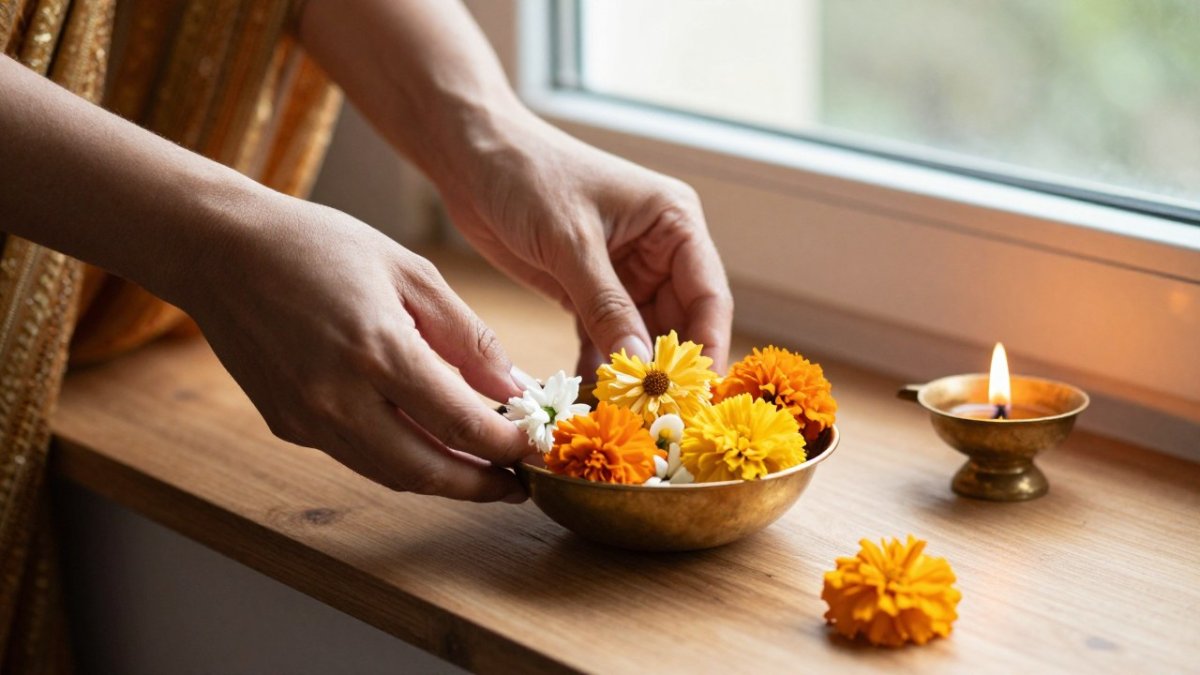
Offer the flowers while saying a short prayer or mantra. Before your first daily offering, you can consecrate a new setup with a Buddha statue blessing ceremony. Many people place them at the feet of the deity or beside the statue. End the ritual by lighting a lamp or incense if that is part of your practice.
- Clean the altar and remove old flowers
- Wash your hands and prepare fresh blossoms
- Place the flowers near the deity with a prayer
- Light a lamp or incense if you use them
- Note when to replace the flowers next
Flowers to Avoid and Tradition-Specific Exceptions
This is the section most guides skip, and it is where home practitioners actually get stuck. The cautions below are the ones that come up most often, but every one of them is tradition-dependent, the same flower avoided in one household is offered in another. Read them as questions to ask your own lineage, not as universal bans.
- Fallen flowers. Blossoms that have dropped to the ground on their own are widely not offered; they are considered already given up. Pick or buy flowers rather than gathering fallen ones.
- Wilted, damaged, or insect-harboring blossoms. Universally discouraged. An offering should be fresh and intact.
- Dhatura and certain strong-scented or mildly toxic flowers. Offered to Shiva in many traditions but avoided for other deities and kept away from children and pets. Handle with care and wash hands after.
- Red flowers for Shiva. Avoided in many households even though red is standard for Devi and Ganesha. This is the most common cross-deity conflict on a shared altar.
- Tulsi for certain deities. Tulsi is central to Vishnu and Krishna worship but is discouraged for Ganesha in some traditions and for Shiva in others. Check before adding it to a shared tray.
- Thorny stems and sharp-edged foliage. Not a scriptural ban so much as a practical one, thorns near a statue or near hands during offering invite injury and damage.
- Flowers with a heavy, cloying scent in a small closed room. A practical caution rather than a ritual one; strong scent can overwhelm a small altar space.
- Non-vegetarian or animal-derived offerings. Never appropriate; keep the tray plant-based.
Scriptural and customary sources differ on several of these, which is why the honest answer is that restrictions are local. The Manusmriti and various Puranic passages discuss which flowers are fit for worship, but household practice, regional custom, and the specific deity's tradition usually decide what actually applies in your home. A family that has offered red hibiscus to Shiva for generations is not doing it wrong; a family that avoids it is not doing it wrong either.
Watch out: do not treat a general article, including this one, as authority over your family's established practice. When a guide and a lineage elder disagree, the lineage wins. If you are starting a new altar with no inherited tradition, choose the neutral shared base described above and add deity-specific accents only after confirming them with a local priest or the elder who guides your practice.
A useful rule of thumb: if you cannot confirm whether a flower is acceptable for a given deity in your tradition, offer a neutral fragrant flower instead. Sincerity of offering is not diminished by choosing the safe option.
Caring for, Replacing and Disposing of Altar Flowers
Fresh flowers last longest when kept cool and out of direct sun. Change the water in your altar bowl daily, and trim the stems at a slant. Remove any blossoms that look brown or limp.
When flowers are spent, dispose of them respectfully. Many families return them to running water or compost them in a garden. Avoid throwing offerings in the regular trash.
- Trim stems and refresh water daily
- Remove wilted petals promptly
- Dispose of flowers in moving water or a compost pile
Setting Up Your Own Daily Altar Flower Routine
Start small. Choose one or two flowers you can buy easily each week, and set a fixed time each morning for your offering. To size a Ganesha figure to your available space, read Ganesha statue size for small spaces. For a full walkthrough of arranging the altar space, see the complete altar setup guide. A small tray, a clean bowl, and a fresh supply of blossoms are all you need. For compact layouts that fit a small corner, see minimalist pooja corner ideas.
You can visit our collection to browse pieces for your altar.
- Set one fixed time each day for your offering
- Keep a small supply of fresh flowers on hand
- Choose a statue that suits your available space
Frequently Asked Questions
What flowers are good for a Hindu altar?
Marigolds, jasmine, lotus, roses and hibiscus are among the most widely used flowers on a Hindu home altar. Marigolds are common because they are widely available. Jasmine offers fragrance, and lotus is associated with purity and many deities. Choose fresh, unblemished blooms and avoid any flower that is wilted or damaged, since offering fresh flowers is central to daily puja. Many families keep a short list of two or three flowers they can reliably buy each week.
Which flower is sacred in Hinduism?
The lotus is among the most widely recognized sacred flowers in Hinduism, linked with purity, creation and several goddesses, including Lakshmi. Tulsi, the holy basil, is also revered and is offered daily in many households, though it is a plant leaf rather than a blossom. Traditions differ by region and family, so the flower most important to you may be the one tied to your household's chosen deity. Checking with a family elder or local temple is a reliable way to confirm customs.
Do different Hindu deities have preferred flowers?
Yes, many traditions associate particular flowers with particular deities. Red hibiscus and red roses are often offered to Kali and Durga, while white jasmine and lotus are common for Lakshmi and Saraswati. Marigolds are widely used across deities. Practices vary by community, so treat these associations as common guidance rather than fixed rules. When in doubt, a fresh, clean flower offered with devotion is considered appropriate.
What can you use for puja when fresh flowers are unavailable?
When fresh flowers are not available, many practitioners offer clean silk or artificial flowers, or simply offer water, rice, or a leaf such as tulsi. The intention and cleanliness of the offering matter more than the specific material in most household traditions. Avoid offering flowers that are rotting or dirty. If you rely on artificial flowers regularly, wash them periodically and keep them separate from fresh offerings to keep the altar clean.

