



Indonesian Buddhist Art: Java, Bali and the Sculptural Legacy
Indonesian Buddhist Art: Java, Bali and the Sculptural Legacy
Few artistic traditions have produced a sculptural output as ambitious, spiritually layered, or formally refined as that of Java and Bali. Between the 8th and 15th centuries, Javanese civilisation built the world's largest Buddhist temple, erected a rival Hindu complex of extraordinary scale, and then, through the Majapahit empire, fused both traditions into a visual language that still defines Indonesian religious art today.
For collectors and practitioners seeking Indonesian Buddhist art, understanding the chain that runs from Borobudur to Prambanan to Majapahit and finally to Bali is not optional background reading. It is the essential framework for reading what a sculpture actually is, where it comes from, and why it looks the way it does.
Table of Contents
- Quick Takeaways
- Borobudur: The Summit of Javanese Buddhist Sculpture
- Prambanan and the Shiva Tradition in Java
- Majapahit: The Empire That Synthesised Everything
- The Balinese Inheritance: A Living Sculptural Tradition
- Comparing the Three Great Sculptural Traditions of Java and Bali
- How to Read Indonesian Sculpture as a Collector
- Frequently Asked Questions
- References
Quick Takeaways
|
Key Insight |
Explanation |
|---|---|
|
Borobudur is the world's largest Buddhist temple |
Built by the Sailendra dynasty and completed around 825 CE, it features 504 Buddha statues and 2,672 relief panels carved in Mahayana Buddhist iconographic programmes across 9 stacked platforms. |
|
Prambanan introduced a distinctly Javanese Shaiva aesthetic |
Completed in 856 CE, Prambanan blends Indian Gupta and Shrivijaya-era stylistic elements, with Ramayana relief cycles that became a template for Hindu sculptural programmes across Java. |
|
Majapahit sculpture is identifiable by specific proportional markers |
The East Javanese style features elongated bodies, unusually tall headgear, and densely arranged ornaments. Andesite volcanic stone and dark bronze are its primary media. |
|
Balinese art is a direct continuation of Majapahit aesthetics |
When Majapahit aristocrats and priests relocated to Bali in the late 14th century, they carried an entire visual tradition with them. Balinese Hindu sculpture has evolved from this foundation ever since. |
|
The kala-makara motif is a diagnostic marker of Indonesian origin |
The demon face (kala) above temple doorways and the makara sea creature flanking stairways are recurring elements that distinguish Indonesian religious sculpture from Cambodian or Thai work. |
|
Bronze casting used the lost-wax method with gilding for prestige pieces |
Major ritual bronzes, particularly representations of Avalokiteshvara and Shiva, were cast using the cire perdue technique and then gilded, a practice consistent from Srivijayan to Majapahit workshops. |
|
Javanese stone sculpture uses andesite, not sandstone |
Volcanic andesite gives Central and East Javanese sculpture a dense, dark surface quality that immediately separates it from Cambodian sandstone or Indian granite work. This is the first visual clue of Indonesian origin. |
Borobudur: The Summit of Javanese Buddhist Sculpture
Construction of Borobudur began around 760 CE and was completed during the reign of Samaratungga around 825 CE, under the Buddhist Sailendra dynasty who ruled Sumatra and Java. The monument sits in Magelang, Central Java, and is built from approximately 55,000 cubic metres of stone drawn from neighbouring rivers. Nothing else on the planet matches its scale as a Buddhist monument, and its sculptural programme is equally without equal.
The structure rises across nine stacked platforms, six square and three circular, topped by a central dome. The four walled galleries that make up the middle section contain the most celebrated reliefs: 1,460 narrative panels that guide pilgrims through the entirety of Mahayana Buddhist doctrine. Above them, on the three circular terraces, 72 Buddha statues sit inside perforated bell-shaped stupas, each in a specific mudra corresponding to a cardinal or zenith direction. The total Buddha statue count across the monument reaches 504, making Borobudur not just an architectural achievement but one of the largest organised sculptural commissions in human history.
The Sculptural Iconography of Borobudur
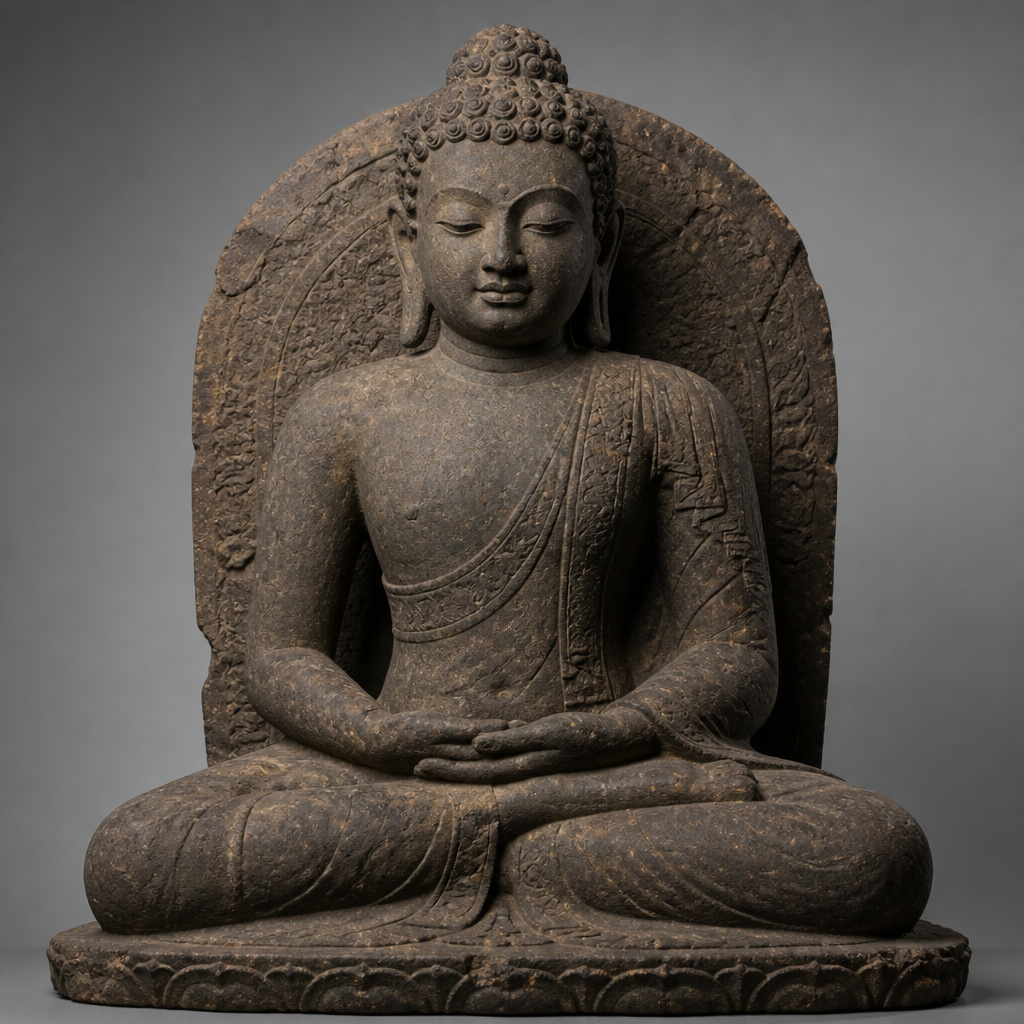
Every Buddha figure at Borobudur is individualised through hand gesture (mudra) and throne form rather than facial variation. The serene, slightly smiling expression that characterises these figures became the defining standard for Javanese sculpture in the Buddhist tradition: composed, inward-looking, and formally precise. The nearby Mendut temple, part of the same ritual complex, holds a celebrated triad of Vairocana flanked by Padmapani and Vajrapani, demonstrating how the Sailendra workshops handled large-scale multi-figure compositions with the same disciplined quality seen in the reliefs.
The relief panels themselves draw from Indian Mahayana texts, with scholars noting strong visual parallels to patterns from Nalanda and Bengal, combined with a distinctly Javanese framework of ancestor veneration. Borobudur also served as a royal tomb complex: the ashes of multiple Sailendra rulers were deposited within the structure, layering its religious function with dynastic memorial purpose.
Borobudur is not simply a temple. It is a three-dimensional mandala in stone, designed so that the act of walking around and upward through its levels enacts the Buddhist path from the world of desire to the realm of formlessness. The sculpture is not decoration. It is the doctrine.
Pro tip: When examining a Buddha statue said to be in the Javanese or Sailendra style, check the mudra first. The five Dhyani Buddhas of the Borobudur tradition each carry a distinct hand gesture tied to a directional compass point. A figure with the bhumisparsha mudra (earth-touching gesture) corresponds to Akshobhya and the east. Misidentification of mudra is one of the most common errors in Indonesian Buddhist art attribution.
Prambanan and the Shiva Tradition in Java
Prambanan was completed in 856 CE, just thirty years after Borobudur, on a plain in Central Java near what is now Yogyakarta. Where Borobudur represents the fullest expression of Buddhist visual thought in Java, Prambanan does the same for the Hindu Shaiva tradition. The complex includes a central Shiva temple of dramatic verticality, at least 200 subsidiary temples and stupas, and a sculptural programme centred on the Ramayana epic.
The stylistic identity of Prambanan sculpture is a deliberate synthesis. Scholars identify a combination of the Shrivijaya Kingdom style evident at Borobudur and elements that reach back further to the Indian Gupta period (320 to 647 CE). In practice, this means the figures at Prambanan carry a more energetic surface quality than the Borobudur Buddhas: the jewellery is more elaborate, the postures occasionally more dynamic, and the narrative compositions on the relief bands more densely populated.
Ramayana Reliefs and the Hindu Narrative Tradition
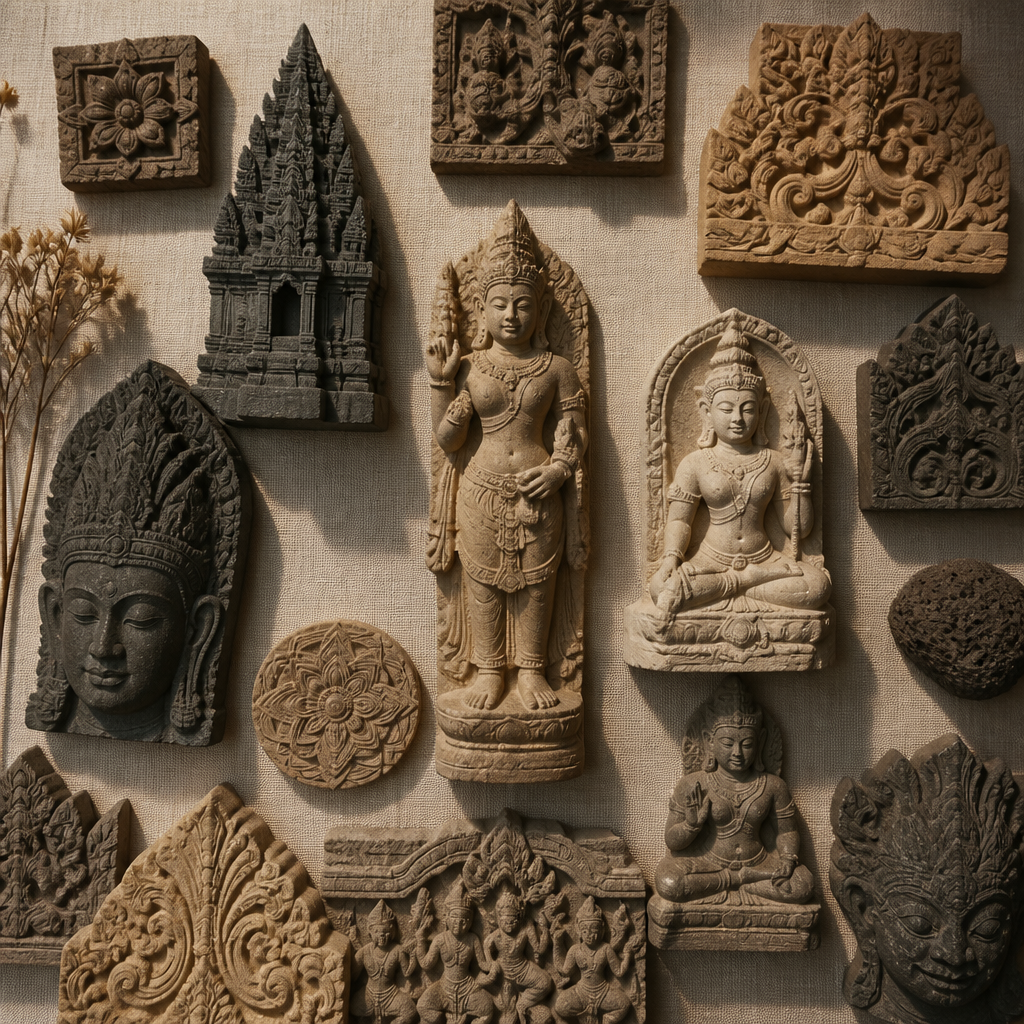
The reliefs running around the pedestal platform of the Shiva temple illustrate scenes from the Ramayana interspersed with niches containing sacred deity figures. This combination of narrative relief with devotional sculpture in niches became the standard template for Hindu religious architecture and sculpture across Java, and its influence reached Bali directly through Majapahit intermediaries. Collectors examining Balinese Hindu art that depicts episodes from the Ramayana are looking at a tradition whose Javanese roots go back to the Prambanan workshops of the 9th century.
The Dravidian-influenced tower form of the central Shiva temple, with its pyramidal stacking and extensive sculptural elaboration on every surface, also signals how Java functioned as a creative translator of Indian religious architecture rather than a passive recipient. Javanese temple builders took Indian structural models and pushed them toward greater density and complexity, a tendency that defines Javanese sculpture throughout its history.
Majapahit: The Empire That Synthesised Everything
The Majapahit empire ran from approximately 1293 CE to the early 16th century. Its capital was centred in East Java, in the area now associated with Trowulan, and at its height it controlled a maritime realm that extended across much of Southeast Asia. The empire's religion was not simply Hindu or Buddhist: it was a syncretic fusion of both, and this syncretism is the key to reading Majapahit sculpture correctly.
Majapahit sculptors worked in three main media: volcanic andesite stone for larger devotional images, bronze cast using the lost-wax method for ritual bronzes, and terracotta for an extraordinary range of objects from architectural ornament to figurines. The bronze tradition continued the gilding practices of earlier Srivijayan workshops, with the most important images of Shiva, Vishnu, Durga, and Buddhist figures such as Avalokiteshvara receiving gilded surfaces that elevated them to prestige objects within temple ritual.
The East Java Style: How to Recognise It
The shift from Central Javanese to East Javanese style is visible and learnable. A collector encountering an East Javanese piece first notices proportion: the body is often elongated compared to earlier Central Javanese work, the headgear or crown is unusually tall, and the ornamental vocabulary is denser and more layered. The surface of volcanic andesite gives the work a dark, almost matte quality that distinguishes it immediately from Cambodian sandstone or Thai limestone pieces.
Posture in East Javanese figurative composition also carries a specific signature. Figures in narrative or processional contexts often appear with the body fully frontal, the face turned to three-quarter view, and the legs in profile, a convention documented in Majapahit terracotta panels from Trowulan and related directly to the carved stone reliefs of Central Javanese temples including Borobudur.
Majapahit Terracotta: The Overlooked Medium
Terracotta from the Trowulan region is the most accessible point of entry into Majapahit material culture. Excavations at the former capital site have produced animal figures, architectural bricks with carved narrative scenes, ritual vessels, and a class of figurines that include the famous pig-shaped savings containers (a form now associated globally with Majapahit culture). Nandi bull figures, domestic animal representations, birds, and elephants also appear, giving terracotta a documentary role that stone and bronze sculpture, focused on deity images, does not serve. For collectors working with a considered budget, museum quality Asian art in terracotta from this tradition offers a direct material connection to the Majapahit world at a different price point than major stone pieces.
Pro tip: The kala-makara pairing is one of the most reliable diagnostic elements for distinguishing Indonesian religious sculpture from Southeast Asian neighbours. Kala (the demon face, usually rendered above doorways) and makara (the hybrid sea creature at stairway bases) appear consistently across Javanese and Balinese temple architecture from Prambanan onward. If a piece carries decorative framing elements or architectural fragments incorporating these motifs, its Indonesian origin is strongly supported.
The Balinese Inheritance: A Living Sculptural Tradition
When the Majapahit kingdom contracted in the face of Islamisation across Java in the late 14th and early 15th centuries, its aristocracy, priests, and artisans did not simply disappear. Many relocated to Bali, carrying with them the visual language, ritual practices, and craft knowledge of the Majapahit tradition. Balinese Hindu art is, at its foundation, this relocated and then continuously developed East Javanese aesthetic applied to a living religious culture that has never been interrupted.
The classical centre of Balinese art from the 16th through the 20th centuries was Kamasan, in the Klungkung regency of East Bali. Today, the craft village of Batubulan is recognised for stone carving, while Mas maintains a tradition of woodcarving that draws on the same devotional iconographic vocabulary. Ubud and its surrounding villages have become the contemporary centre of Balinese visual art production, developing the tradition further while remaining grounded in its Hindu religious context.
The Living Function of Balinese Sculpture
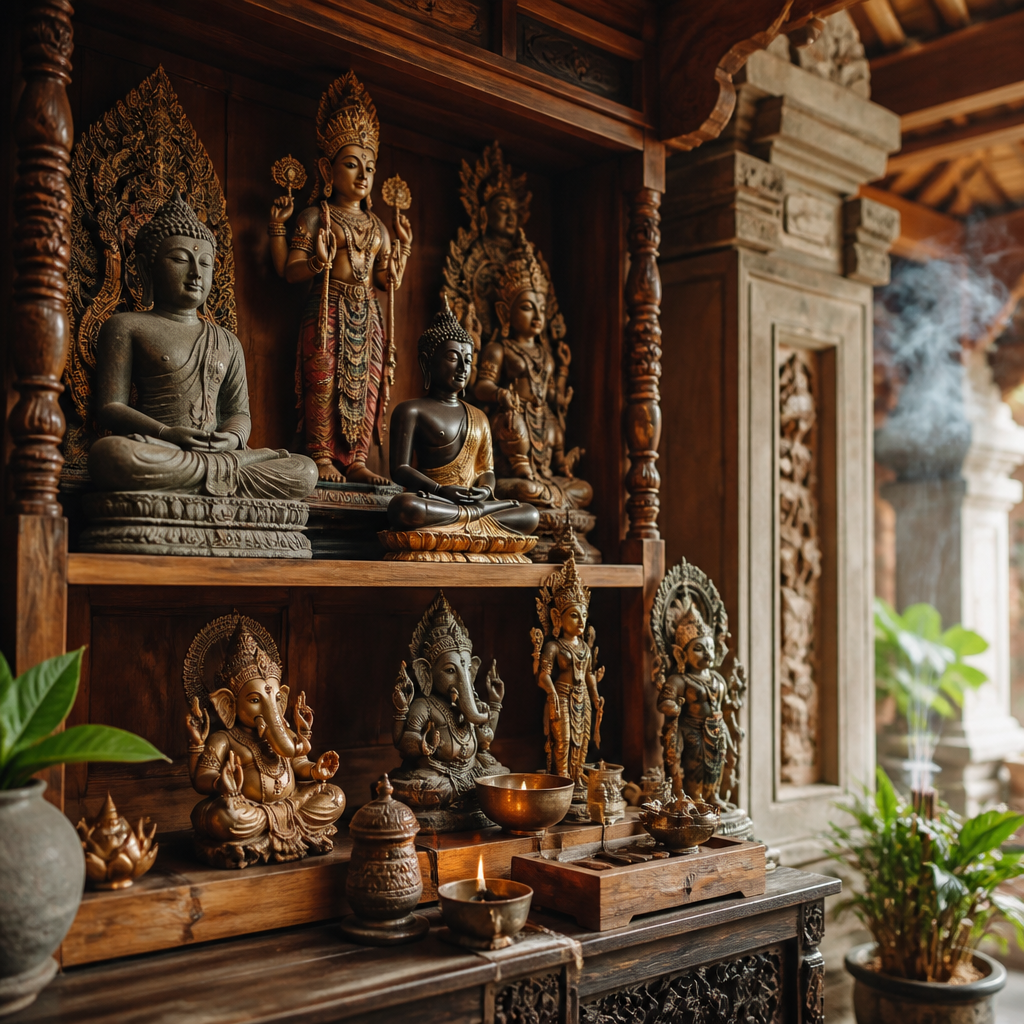
Unlike the archaeological sculpture of Central Java, Balinese religious sculpture has never left active ritual use. Stone guardian figures at temple gates, carved wooden panels inside ceremonial pavilions, and bronze deity images used in procession are not museum pieces. They are functioning components of a religious practice that involves daily offerings, festival cycles, and community ritual. This distinction matters for collectors: Balinese sculpture in active temple use is not the same category as antique or museum-quality replica sculpture produced for the collector market, and conflating them is a common and serious error.
For practitioners seeking to establish a home altar with authentic Balinese Hindu art, the iconographic vocabulary that runs from Majapahit through to contemporary Balinese production provides a coherent, spiritually grounded visual language. Ganesh, Shiva, Vishnu, Saraswati, and guardian figures (dvarapala) all carry iconographic specificity that connects them to this thousand-year tradition. HD Asian Art's Indonesian collection draws directly on this lineage, offering pieces that carry the formal rigour of the tradition rather than simplified tourist-market approximations.
Comparing the Three Great Sculptural Traditions of Java and Bali
|
Tradition |
Primary Medium and Period |
Key Iconographic Markers |
|---|---|---|
|
Central Javanese Buddhist (Sailendra / Borobudur) |
Volcanic andesite stone, 8th to 9th century CE. Relief carving on a monumental scale, alongside large free-standing Buddha figures in specific mudra sequences. |
Serene facial expression, defined mudra tied to directional Dhyani Buddha system, narrative Mahayana relief panels, perforated stupa housing for circular terrace figures. |
|
East Javanese Hindu-Buddhist (Singhasari and Majapahit) |
Andesite stone, bronze (lost-wax, gilded), and terracotta. 11th to early 16th century CE. Both freestanding deity images and architectural/terracotta pieces from capital sites. |
Elongated body, tall crown, dense ornamentation, frontal body with three-quarter face and profile legs in narrative contexts, kala-makara framing elements, syncretic Hindu-Buddhist deity programme. |
|
Balinese Hindu-Javanese (Kamasan to Contemporary) |
Stone (particularly at Batubulan), wood (Mas), and bronze. Late 14th century to present. Continuous living tradition rather than archaeological category. |
Direct continuity with Majapahit iconography, applied to active ritual context. Guardian figures, Shaiva deities, narrative Ramayana and Mahabharata scenes, strong local stylistic development over six centuries. |
How to Read Indonesian Sculpture as a Collector
The most persistent mistake collectors make with Indonesian religious sculpture is treating it as a generic subcategory of Southeast Asian Buddhist art. It is not. Indonesian Buddhist art, particularly from the Javanese tradition, has a specific iconographic logic, a specific material palette, and a specific relationship to Indian source traditions that separates it from Cambodian, Thai, or Burmese work at every level.
Start with material. Volcanic andesite is the defining stone of Central and East Javanese sculpture. It is dark, dense, and carries tool marks differently from sandstone. A piece claiming Javanese origin but showing the warm orange or red tones of sandstone should be examined carefully. Bronze Javanese and Balinese pieces frequently carry a dense, layered ornamental programme, particularly in the crown and jewelry elements, that distinguishes them from the more restrained surfaces of Burmese or Sri Lankan bronzes.
Reading the Iconographic Programme
Indonesian Shaiva sculpture follows Indian iconographic conventions but adapts them consistently. Shiva in the Javanese tradition often appears as Mahaguru (the supreme teacher), depicted seated with specific attributes including the trident, water vessel, and rosary. Durga appears in her demon-slaying form, consistent with her role at Prambanan. Vishnu carries the chakra (discus) and conch as in Indian convention, but the crown form, facial treatment, and body proportion are distinctly Javanese.
Buddhist figures in the Indonesian tradition carry the same core iconographic system as Indian and other Southeast Asian schools, but the Javanese adaptation introduces local elements: the ushnisha (cranial protuberance) tends to be lower and broader than in Burmese work, the facial expression more contained, and the robe treatment flatter and less elaborate. These are not deficiencies. They are the signatures of a mature local tradition that processed Indian sources with full creative confidence.
Authenticity, Quality, and the Museum Standard
The term "museum quality" carries real meaning in Indonesian Buddhist and Hindu sculpture. It refers to accuracy of iconographic detail, quality of material and finish, and formal coherence between the piece and its identified tradition. A museum-quality Majapahit-style Shiva statue will show the correct crown form, the correct attribute objects, the correct proportional language of East Javanese sculpture, and a surface quality consistent with the identified medium. Pieces that satisfy these criteria, whether antique originals or high-quality traditional replicas, serve both the serious collector and the practitioner creating a meaningful home altar.
HD Asian Art sources museum quality Asian art in the Indonesian tradition with this standard in mind. The Indonesian collection includes bronze Javanese Majapahit-style Shiva statues, pieces that reference the specific proportional and ornamental vocabulary of East Javanese sculpture rather than generalised South Asian conventions. Collectors approaching this category for the first time are encouraged to use the iconographic markers above as a basic literacy framework before making acquisitions.
Pro tip: Compare the crown. Crown form is one of the most reliable discriminators between Indonesian and other Southeast Asian sculptural traditions. Javanese and Balinese crowns are typically more architecturally complex, with stacked registers and pierced decorative elements that reflect both the tiered structure of Borobudur and the elaborate surface treatment of Prambanan's deity niches. A crown that reads as simplified or generic is often an indicator that a piece is working from a generalised Asian religious art vocabulary rather than from direct engagement with the Indonesian tradition.
Frequently Asked Questions
What makes Indonesian Buddhist art different from other Southeast Asian Buddhist art traditions?
Indonesian Buddhist art, particularly from Java, developed through the Sailendra dynasty's engagement with Mahayana Buddhist doctrine drawn from Indian centres such as Nalanda and Bengal. The result is a tradition focused on narrative relief sculpture at monumental scale and on a Dhyani Buddha system organised around directional compass points and specific mudra sequences, neither of which appears in the same structural form in Thai, Burmese, or Cambodian work. The material base of volcanic andesite also creates a distinctive surface quality that separates Javanese work visually from all other regional traditions.
Is Balinese Hindu art the same as Javanese Hindu art?
No, though they share a common root. Balinese Hindu art descended directly from Majapahit East Javanese aesthetic conventions when Majapahit aristocrats and artisans relocated to Bali in the late 14th century. Over the following six centuries, Balinese artists developed this inheritance in their own direction, producing a visual tradition that is now distinct in many surface respects while remaining continuous with its Javanese foundation. The iconographic vocabulary is largely shared, but the stylistic expression, particularly in woodcarving and stone carving, has become recognisably Balinese.
What were the main religious influences on Majapahit sculpture?
Majapahit sculpture reflects a deliberate religious synthesis. The empire's court practice blended Shaivite Hinduism and Mahayana Buddhism, with Shiva-Buddha syncretism appearing in literary and visual form throughout the period. In practice this means a single sculptural workshop might produce Shiva images, Vishnu images, Durga figures, and Buddhist deity images, often with shared compositional conventions. The Majapahit art tradition is therefore neither straightforwardly Hindu nor straightforwardly Buddhist, and any collection approach that separates the two traditions artificially will produce an incomplete picture.
How do I identify genuine Javanese or Majapahit-style sculpture versus generic Asian religious art?
Start with material and proportion. Genuine Javanese volcanic andesite is dark and dense, not warm-toned sandstone. Bronze pieces in the East Javanese tradition carry elongated body proportions, tall architecturally complex crowns, and densely layered jewellery. The kala-makara decorative pairing appears on framing elements. In narrative contexts the specific body posture convention (frontal torso, three-quarter face, profile legs) is a strong indicator. Pieces that show generic South Asian proportions without these specific markers are likely drawing on a generalised Asian religious art vocabulary rather than the Javanese tradition specifically.
What is the relationship between Borobudur and Prambanan, and why does it matter for understanding Indonesian art?
Borobudur and Prambanan were built within thirty years of each other in Central Java, one under a Buddhist dynasty and one under Hindu patronage. Their coexistence demonstrates that Java in the 9th century was capable of sustaining two major world-class religious visual programmes simultaneously and that the line between Buddhist and Hindu patronage was permeable rather than competitive. This is the historical ground for Majapahit's later synthesis: the capacity for religious pluralism within a single political and artistic culture had deep roots. For collectors, it means Indonesian religious sculpture exists within a tradition where Buddhist and Hindu iconographic traditions have always been in dialogue, which is part of what makes it distinctive.
Are Borobudur-style Buddha statues still produced as museum-quality pieces today?
Yes. The Javanese Buddhist sculptural vocabulary, particularly the serene expression, specific mudra sequences, and formal compositional discipline of the Sailendra tradition, continues to inform traditional sculpture production in Indonesia. Museum-quality pieces in this tradition are distinguished by iconographic accuracy (correct mudra, correct robe treatment, correct ushnisha form) and material quality, whether bronze, stone, or other media. These pieces serve both serious collectors and spiritual practitioners building home altars with a grounding in the authentic Javanese Buddhist visual tradition.
What aspects of Indonesian Hindu-Buddhist art are you most drawn to, and how has this tradition influenced the way you think about your own collection or practice? Share your perspective in the comments below.
References
