



Cómo identificar las estatuas de bronce tailandesas del período Ayutthaya
Cómo identificar las estatuas de bronce tailandesas del período Ayutthaya
Las estatuas de Buda de bronce tailandesas del período Ayutthaya llevan varios marcadores inconfundibles. La forma más confiable de identificar el bronce tailandés del período Ayutthaya es examinar las siguientes características juntas, no de forma aislada:
- Mudra de doble gesto: Ambas manos levantadas en gestos idénticos de abhaya (protección) o vitarka (enseñanza) simultáneamente. esto mudra de doble gesto está ausente en la escultura budista india y en la mayoría de las demás tradiciones del sudeste asiático.
- Diadema coronada: Una corona decorativa que reemplaza la simple ushnisha de bronces de Sukhothai anteriores, y que a menudo incorpora un adorno escalonado en forma de cono que se asemeja a paraguas ceremoniales tailandeses apilados.
- Línea de cabello demarcada: Un límite claramente definido entre la frente y el cabello o la coronilla, más pronunciado que en los predecesores de Sukhothai o Lopburi.
- Elaborada ornamentación: Detalles de joyas, fajines y túnicas fundidos directamente en la superficie de bronce, reflejando la iconografía real.
- Pátina y evidencia de fundición: Las piezas genuinas suelen mostrar una pátina verde o marrón en capas consistente con siglos de oxidación, junto con costuras visibles de fundición a la cera perdida y una textura de superficie de aleación.
- Variedad de postura: Aparecen posturas de pie, sentado y caminando, siendo particularmente característica de la época la figura coronada de pie.
Ninguna característica es concluyente por sí sola. La autenticación requiere leer todos estos marcadores juntos, junto con la documentación de procedencia y, cuando sea posible, el análisis metalúrgico.
Tabla de contenidos
Cómo el período Ayutthaya dio forma al arte del bronce tailandés
El período Ayutthaya duró de 1350 a 1767. Durante esos cuatro siglos, el reino absorbió el debilitado estado de Sukhothai y consolidó su autoridad política en toda la llanura central de Tailandia, creando las condiciones que permitieron que la producción de bronce patrocinada por la corte floreciera a gran escala.
Las redes comerciales que conectaban Ayutthaya con China, India, Persia y Europa aportaron nuevos materiales, ideas iconográficas y conocimientos técnicos a los talleres. La estabilidad política de los siglos XV y XVI, en particular, dio a los mecenas reales los recursos para encargar grandes bronces para templos con una ornamentación cada vez más compleja. El resultado fue un alejamiento gradual del ideal sereno y sin adornos de Sukhothai hacia una imagen más regia y enjoyada del Buda como rey cósmico.
El arte de Lopburi, que es anterior y se superpone parcialmente al período de Ayutthaya, contribuyó con tipos faciales y estructuras de corona con influencia jemer. Los escultores de Ayutthaya absorbieron estos elementos y los reelaboraron dentro de un marco budista Theravada, produciendo un estilo híbrido que es claramente tailandés pero visualmente más elaborado que cualquier cosa anterior. Comprender esta herencia en capas es el punto de partida para cualquier ejercicio serio de identificación del bronce tailandés.
| Periodo | Fechas | Cambio artístico clave |
|---|---|---|
| Lop Buri | — | Tipos faciales jemeres, primeras formas de corona |
| Sukhothai | — | Llama ushnisha, túnicas sin adornos |
| Ayuthaya | 1350–1767 | Diadema coronada, mudra de doble gesto, ornamentación con joyas. |
| Rattanakosina | 1782-presente | Detalle facial refinado, continuación de las convenciones de coronas y mudras. |
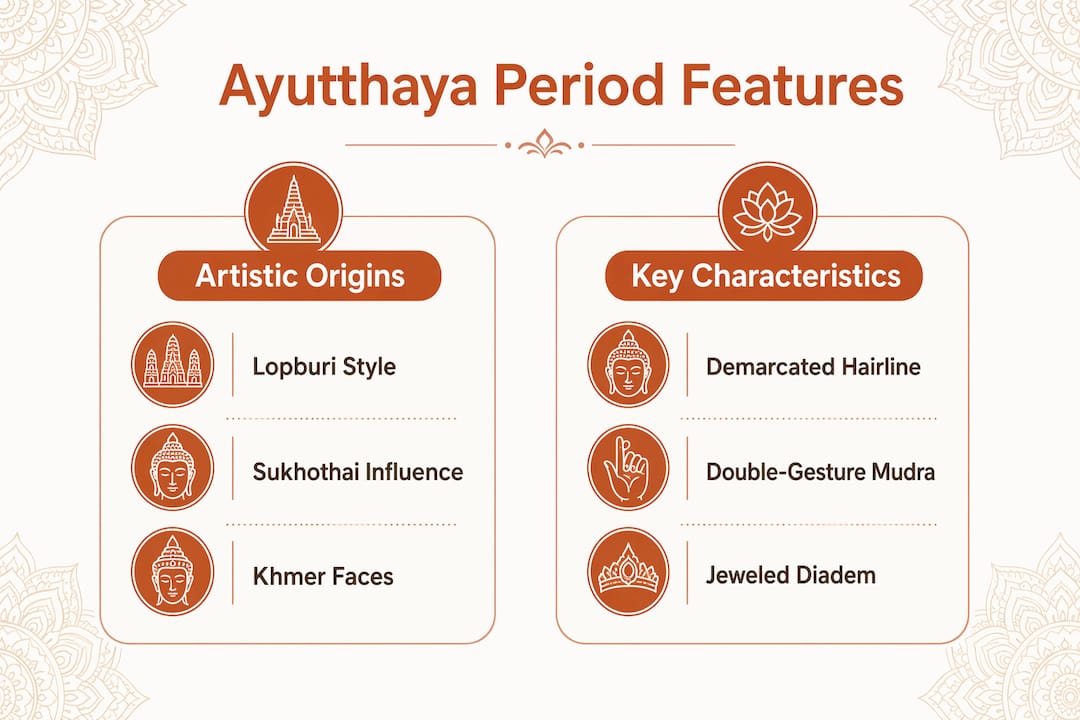
Rasgos artísticos distintivos de las estatuas de Buda de Ayutthaya
La línea de nacimiento del cabello demarcada es uno de los marcadores visuales más consistentes. En los bronces de Ayutthaya, el límite entre la piel de la frente y el cabello o la base de la corona está claramente definido, a menudo mediante una cresta elevada o una banda decorativa. Los bronces de Sukhothai, por el contrario, tienden a integrar la línea del cabello más suavemente en el plano facial general.
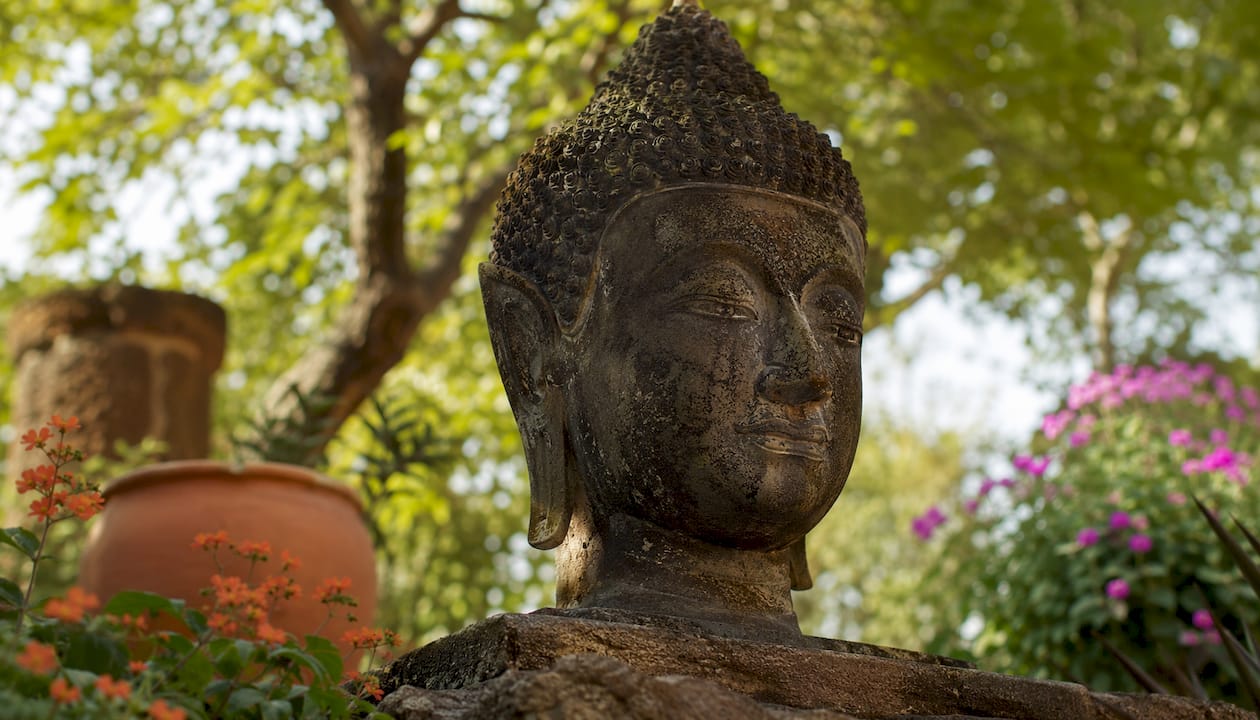
La expresión facial es otro punto de diagnóstico, aunque contraintuitivo. A medida que avanzaba el período de Ayutthaya, los rasgos faciales se volvieron menos individualizados y más estilizados. Los ojos suelen estar bajos y con forma almendrada, la nariz ancha y suavemente acampanada y los labios con una ligera curva hacia arriba. El efecto general es sereno pero impersonal, muy diferente de los rostros más naturalistas de los bronces anteriores de Lopburi.
Características artísticas clave para examinar:
- Tipo de corona: Diadema escalonada, en forma de llama o cónica con bandas en capas e incrustaciones de joyas fundidas en relieve.
- Joyería: Collares, brazaletes y tobilleras elaborados con finos detalles fundidos, a veces con rastros de dorado.
- Tratamiento de bata: La túnica (sanghati) se muestra típicamente como una prenda delgada y ceñida con un borde decorativo en el dobladillo, en lugar de la tela gruesa y drapeada de las piezas de Sukhothai.
- Forma ushnisha: La protuberancia craneal es alargada y rematada por un remate de llama o loto, a menudo integrado en la estructura de la corona.
- Calidad de fundición: Fundición a la cera perdida produjo detalles superficiales finos; busque paredes delgadas, relieves ornamentales precisos y canales de fundición en la base o la parte posterior.
- Color de aleación: Los bronces de Ayutthaya tienden a tener un cálido tono marrón rojizo en el metal base, lo que refleja una composición de aleación rica en cobre.
La producción de bronce en este período implicó colaboración entre metalúrgicos, conservadores e historiadores del arte para comprender la composición de las aleaciones y los métodos de fundición, un estándar que aún sigue la autenticación moderna.
Significados simbólicos en la iconografía del período Ayutthaya
Cada elemento de un bronce de Ayutthaya conlleva un contenido espiritual deliberado. El mudra de doble gesto transmite simultáneamente protección y transmisión de sabiduría, presentando al Buda como guardián y maestro. Este doble papel refleja la comprensión Theravada del Buda como un ser que permanece accesible a los devotos incluso después del parinirvana.
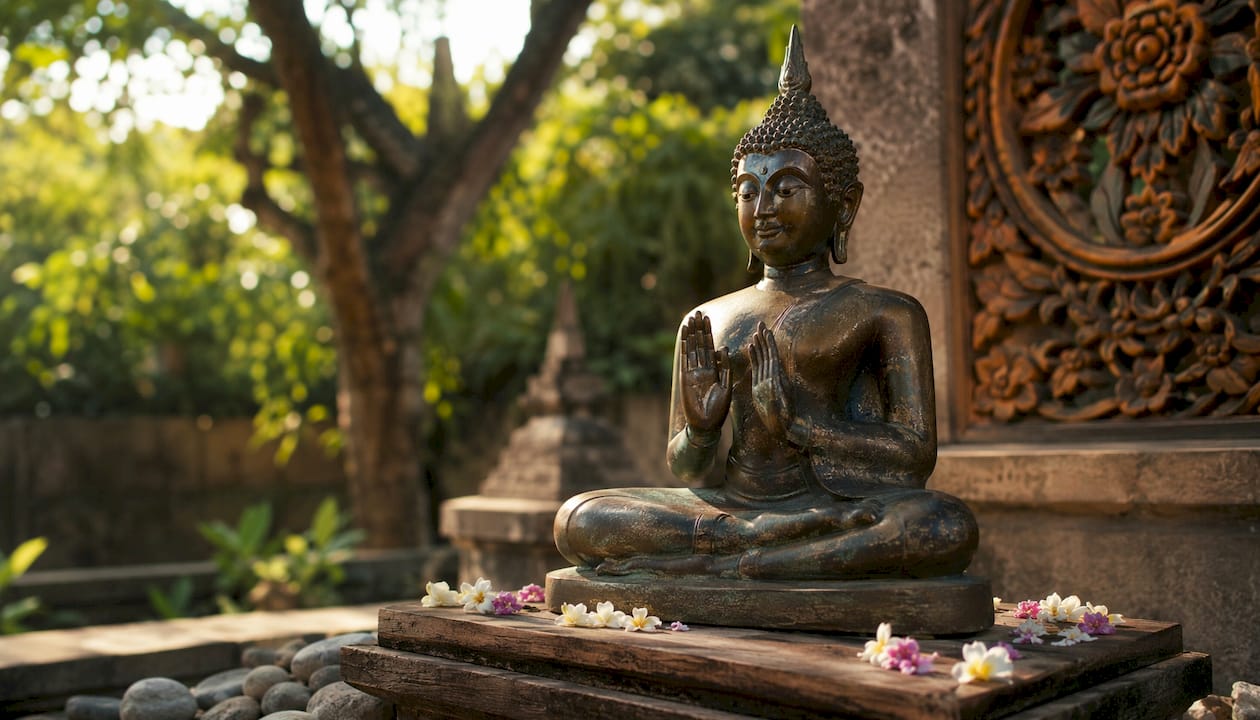
La corona y las joyas reales no son adiciones decorativas. Identifican a Buda como un chakravartin, un monarca universal que hace girar la rueda, un concepto extraído tanto de la cosmología india como de la teología política de la corte de Ayutthaya. Al llevar la corona, la imagen de Buda servía como símbolo legitimador del rey, cuya autoridad se entendía como inseparable del dharma budista.
Principales elementos simbólicos y sus significados:
- Abhaya mudra (mano levantada, palma hacia afuera): Protección, disipando el miedo.
- Vitarka mudra (mano levantada, pulgar e índice tocándose): Enseñanza, transmisión del dharma.
- Corona y diadema: Soberanía real, el Buda como monarca universal.
- Remate ushnisha de llama: Iluminación, el resplandor de la sabiduría despierta.
- Ojos bajos: Interioridad meditativa, conciencia compasiva del mundo de abajo.
- Lóbulos de las orejas alargados: Un recordatorio del origen principesco de Buda, cuando llevaba pesados pendientes antes de su renuncia.
el Escultura budista Theravada La tradición que dio forma a estas convenciones entendía cada atributo físico como una referencia codificada a un hecho doctrinal o biográfico específico, no como una elección estética únicamente.
Cómo llegó el estilo Ayutthaya al período Rattanakosin
Cuando Ayutthaya cayó ante las fuerzas birmanas en 1767, la corte superviviente se trasladó primero a Thonburi y luego, en 1782, estableció Bangkok como capital del nuevo reino de Rattanakosin. Siguieron talleres de bronce y con ellos llegó el vocabulario iconográfico establecido de Ayutthaya.
Los bronces del período Rattanakosin conservaron la diadema coronada, la ornamentación con joyas y las convenciones centrales del mudra de sus predecesores de Ayutthaya. El cambio más visible se produjo en el tratamiento facial: los escultores de Rattanakosin introdujeron rasgos faciales más refinados e individualizados, a menudo con pómulos más altos y una sonrisa más pronunciada, reflejando tanto la influencia estética china como los gustos personales de los mecenas reales. Los detalles de las batas también se volvieron más elaborados, con patrones textiles fundidos más finos.
Para los coleccionistas, esta continuidad crea un verdadero desafío de identificación. Un bronce coronado de doble gesto podría datar de finales del período Ayutthaya o de la producción temprana de Rattanakosin. La distinción suele reducirse a la técnica de fundición, la composición de la aleación y las convenciones proporcionales específicas de la corona. Las coronas de Rattanakosin tienden a ser más altas y arquitectónicamente más complejas que sus contrapartes de Ayutthaya, y los planos faciales están modelados con mayor precisión. Consultando el Tradición del bronce del sudeste asiático La literatura junto con el examen físico es el enfoque más confiable.
El mudra del doble gesto como seña de identidad de la iconografía de Ayutthaya
El mudra de doble gesto es el rasgo iconográfico más distintivo de la escultura de bronce de Ayutthaya. Sus orígenes se encuentran en el arte Mon-Dvaravati de los siglos VI al IX, donde las figuras de Buda de pie ocasionalmente levantaban ambas manos en gestos simétricos. Los escultores de Ayutthaya adoptaron y sistematizaron esta convención, convirtiéndola en una característica definitoria de los Budas coronados de pie de la época.
El mudra de doble gesto, con ambas manos levantadas en posiciones idénticas de abhaya o vitarka, es desconocido en la escultura budista india y no tiene paralelo en la diáspora budista en general. Su presencia en un bronce coronado de pie es un fuerte indicador del origen del sudeste asiático, y específicamente tailandés, dentro de la tradición de Ayutthaya.
Lo que hace que esta característica sea tan útil para la identificación del bronce tailandés es su especificidad. Ninguna otra tradición escultórica budista importante utiliza el doble gesto simétrico como tipo iconográfico estándar. Cuando ambas manos se levantan en gestos coincidentes sobre una figura coronada de pie, es casi seguro que la pieza se origina en la esfera de influencia de Ayutthaya.
| Característica | bronce de ayuthaya | Escultura budista india | Otro sudeste asiático |
|---|---|---|---|
| mudra de doble gesto | Estándar en figuras coronadas de pie | ausente | Raro, no sistemático |
| diadema coronada | Característica | Ocasional (período Pala) | Varía según la región |
| Remate ushnisha escalonado | Forma distintiva de cono/paraguas | Llama o loto | Varía |
| ornamentación enjoyada | Totalmente integrado en el elenco | Mínimo o pintado | Varía |
Puntos clave para la autenticación mediante el mudra de doble gesto:
- Ambas manos deben estar levantadas aproximadamente a la altura del pecho o de los hombros.
- Las palmas miran hacia afuera (abhaya) o los dedos apuntan hacia arriba con el contacto pulgar-índice (vitarka).
- El gesto debe ser simétrico: una mano en posición diferente descalifica la clasificación de doble gesto.
- La figura debe estar de pie y coronada para que la identificación soporte el máximo peso.
Investigación de procedencia de los bronces de Ayutthaya
La procedencia es la historia documentada de la propiedad y ubicación de un objeto desde su creación hasta el presente. En el caso de los bronces de Ayutthaya, una cadena de procedencia creíble suele hacer referencia a colecciones de templos o palacios en Tailandia, seguidas de la adquisición por parte de un coleccionista o institución occidental en el siglo XIX o principios del XX, y registros posteriores de subasta o comerciante.
Los documentos de procedencia más confiables incluyen inventarios de templos, licencias de exportación de la época colonial, registros de casas de subastas de casas establecidas y registros de baja de museos. Las lagunas en la cadena son comunes y no indican automáticamente un problema, pero cualquier pieza sin documentación anterior a 1970 merece un escrutinio cuidadoso según la Convención de la UNESCO de 1970 sobre los medios para prohibir y prevenir la importación, exportación y transferencia de propiedad ilícitas de bienes culturales, que Estados Unidos ratificó.
Pasos prácticos para la investigación de procedencia:
- Solicite toda la documentación disponible al vendedor antes de la compra.
- Haga una referencia cruzada de la pieza con el Registro de Pérdidas de Arte y la base de datos de Obras de Arte de Interpol.
- Consulte los registros de subastas de Christie's, Sotheby's y Bonhams para conocer piezas comparables e historiales de propiedad.
- Póngase en contacto con el Smithsonian Museo Nacional de Arte Asiático para obtener orientación curatorial sobre los estándares de procedencia del bronce tailandés.
- Para piezas adquiridas después de 1970, verifique que la documentación de exportación de Tailandia esté presente y sea legítima.
Falsificaciones comunes y cómo distinguirlas
El mercado de bronces de Ayutthaya atrae falsificaciones de todos los precios. El tipo más común es una reproducción en molde tailandesa o china moderna envejecida artificialmente para simular la pátina. Estas piezas generalmente se funden en moldes tomados de originales genuinos, por lo que la iconografía puede ser precisa mientras se fabrica la evidencia física de la edad.
Autenticando bronces de Ayutthaya Implica examinar juntos la pátina, los patrones de desgaste, las marcas de fundición, la composición de la aleación y la procedencia. Ninguna prueba es definitiva.
Indicadores de falsificación específicos a comprobar:
- Pátina artificial: Aplicada químicamente o con ácido, la pátina artificial tiende a tener un color uniforme y se asienta en la superficie en lugar de penetrar el metal. La pátina genuina tiene capas, varía en profundidad a lo largo de la superficie y, a menudo, muestra una coloración diferencial en las áreas rebajadas.
- Costuras de fundición: Las reproducciones modernas fundidas en arena o en molde muestran patrones de costura diferentes a los originales a la cera perdida. Las piezas de cera perdida tienen superficies irregulares acabadas a mano; Las piezas moldeadas muestran líneas de costura simétricas.
- Peso y aleación: Los bronces genuinos de Ayutthaya tienen un peso específico debido a su aleación rica en cobre. Las reproducciones fundidas en aleaciones de menor calidad o con paredes más gruesas se sienten notablemente diferentes. El análisis XRF (fluorescencia de rayos X) puede confirmar la composición de la aleación sin dañar la pieza.
- Patrones de uso: El desgaste auténtico se concentra en los puntos altos, los bordes de la base y las áreas de contacto regular. Las piezas envejecidas artificialmente a menudo muestran un desgaste distribuido de manera demasiado uniforme o en lugares que no recibirían manipulación.
- Errores iconográficos: Los falsificadores que trabajan a partir de fotografías a veces malinterpretan las posiciones de los mudras o los detalles de la corona. Un mudra de doble gesto en el que las manos no son realmente simétricas, o una corona con elementos decorativos anacrónicos, señalan una reproducción.
Consejo profesional: Solicite datación por termoluminiscencia (TL) para el material del núcleo cerámico que a veces se retiene dentro de bronces fundidos huecos. Una pieza genuina de Ayutthaya devolverá una fecha consistente con el rango de los siglos XIV al XVIII. Esta prueba está disponible a través de laboratorios de conservación especializados en los Estados Unidos, incluidos aquellos afiliados a museos de arte universitarios.
HDAsianArt: bronces autenticados de Ayutthaya y el Sudeste Asiático
Los coleccionistas y académicos que han trabajado con los criterios de identificación anteriores saben que rara vez una pieza los cumple todos. Fuentes, investigaciones y presentaciones de HDAsianArt estatuas de bronce antiguas con calidad de museo individualmente, con fotografía experta y descripciones iconográficas detalladas de cada obra. Se evalúa la autenticidad de cada pieza de la colección antes de incluirla en la lista, prestando atención a la misma pátina, fundición y marcadores de procedencia que cubre este artículo.
El inventario de la galería abarca Tailandia, Camboya, Indonesia, Sri Lanka y Vietnam, con envío asegurado por DHL a todo el mundo. Para los coleccionistas que crean una colección específica de bronce histórico tailandés, el HDAsianArt galería Es una ruta directa a piezas autenticadas con investigaciones documentadas detrás de cada una. Explore la colección actual para encontrar obras que cumplan con los estándares descritos aquí.
Conclusiones clave
Las estatuas de bronce tailandesas genuinas del período Ayutthaya se identifican por la combinación del mudra de doble gesto, la diadema coronada, la línea del cabello demarcada y la pátina en capas consistente con la fundición a la cera perdida de los siglos XIV al XVIII.
| Punto | Detalles |
|---|---|
| mudra de doble gesto | Ambas manos levantadas en gestos idénticos de abhaya o vitarka; ausente en la escultura budista india. |
| diadema coronada | El adorno ushnisha escalonado y en forma de cono distingue los bronces de Ayutthaya de las piezas de Sukhothai y Lopburi. |
| Pátina y fundición | La pátina diferencial en capas y los patrones de costura a la cera perdida confirman la edad; La pátina uniforme indica envejecimiento artificial. |
| Continuidad de rattanakosina | Posteriormente, los bronces de Rattanakosin conservaron las convenciones de la corona y el mudra de Ayutthaya, pero agregaron detalles faciales más refinados. |
| HDAsiáticoArte | Ofrece bronces del sudeste asiático autenticados y investigados individualmente con documentación iconográfica experta. |
Recomendado
- Cómo fechar imágenes antiguas de Buda tailandés: guía del coleccionista – Arte asiático HD
- Cómo autenticar estatuas antiguas de Buda de bronce – Arte asiático HD
- ¿Cómo identifico una estatua de Buda? – Arte asiático HD
- Explicación de los estilos de Buda tailandés: una guía para coleccionistas – Arte asiático en alta definición
