



Identificar las características del Buda Gandhara: Seis pruebas curatoriales para museos
Identificar las características del Buda Gandhara: Seis pruebas curatoriales para museos
Un Buda de Gandhara muestra ojos almendrados y bajos, una urna entre las cejas, un pesado moño que disfraza la ushnīśa, lóbulos de las orejas alargados y pliegues de ropa de estilo romano sobre un rostro juvenil parecido a Apolo, a menudo combinado con el abhaya o mudrā de enseñanza.
Estas características provienen de la región de Gandhara, a caballo entre el noroeste de Pakistán y el este de Afganistán, donde el estilo floreció aproximadamente entre el siglo I a. C. y el siglo VII d. C., alcanzando su punto máximo bajo el Imperio Kushan entre los siglos I y III d. C. El aspecto característico es una fusión deliberada: lenguaje escultórico grecorromano envuelto en temas budistas.
Características clave:
- Los primeros Budas de Gandhara muestran un pesado moño que oculta la ushnīśa, con una urna tallada entre las cejas, lo que indica un origen de la era Kushan.
- Las cortinas naturalistas con escote hacia atrás, pliegues de inspiración romana y una postura de contrapposto ayudan a distinguir las esculturas de Gandharan de las variantes posteriores o regionales.
- Las esculturas fueron originalmente pintadas y doradas, con rastros de pigmento que a menudo se encuentran en los pliegues profundos de las cortinas y detrás de las orejas, ahora perdidos en gran parte debido a la intemperie.
- Los bigotes en los primeros ejemplos sirven como marcador de citas, ya que desaparecen en estilos posteriores que se centran en rasgos faciales más suaves y simbólicos.
- Confirmar una pieza de Gandhara implica examinar el medio, los marcadores faciales, las cortinas, los mudrās, los rastros de pigmento y la procedencia, no solo la apariencia general.
Tabla de contenidos
- ¿Cuáles son las características del diagnóstico del Buda Gandhara?
- El drapeado y la técnica escultórica grecorromana
- ¿Qué posturas y mudrās aparecen con más frecuencia?
- ¿Cómo eran originalmente los budas de Gandhara?
- ¿Cómo cambian las características de Gandhara con el tiempo?
- ¿Cómo se identifica un objeto del Buda Gandhara?
- El peso cultural detrás del estilo
- Dónde ver y estudiar budas de estilo Gandhara
- Fuentes
- Preguntas frecuentes
¿Cuáles son las características del diagnóstico del Buda Gandhara?
La identificación de un Buda Gandhara comienza con la cara. Los ojos tienen forma de almendra y están dirigidos hacia abajo, una convención destinada a indicar una meditación interior en lugar de un compromiso directo con el espectador. Entre las cejas se encuentra el urna, una pequeña marca elevada o incisa que representa un mechón de cabello y que representa una visión espiritual. Es un pequeño detalle, pero su ubicación constante a lo largo de siglos de producción lo convierte en uno de los marcadores de atribución más confiables.
Por encima de la frente, el cabello se recoge en un pesado moño que oculta la ushnīśa, la protuberancia craneal que denota la sabiduría iluminada del Buda. Ésta es una solución claramente gandharana. Las tradiciones budistas posteriores presentan el ushnīśa como una protuberancia abstracta con poca ornamentación, por lo que un moño completamente modelado, casi peinado, es una fuerte pista de que estás viendo una pieza temprana o del período Kushan en lugar de una variante regional posterior.
Otros marcadores que vale la pena comprobar:
- Lóbulos de las orejas alargados, en referencia a los pendientes principescos que llevaba Siddhartha antes de su renuncia.
- Un bigote en algunas de las primeras figuras, un detalle que el arte budista posterior abandona casi universalmente.
- Un borde de halo dentado o festoneado en muchos ejemplos de bronce y piedra.
- Una mandíbula y una frente redondeadas y suavemente modeladas que recuerdan más el retrato helenístico que la tradición escultórica del sur de Asia.
Un punto de referencia útil: un bronce de Gandhara de principios del siglo II en el Cumplió muestra el abhaya mudrā, un halo dentado, un peinado de influencia romana y pliegues de cortinas naturalistas, con un bigote tenue aún visible en el labio superior. Esa combinación de rasgos, catalogada por el equipo curatorial del museo, es lo más parecido a un ejemplo de libro de texto que ofrece el género.
El drapeado y la técnica escultórica grecorromana
Las túnicas de Gandhara a menudo se comparan con la toga romana, y la comparación se sostiene mejor que la mayoría de las analogías estilísticas. el pliegues pesados y plisados cubra de manera naturalista los hombros y brazos, siguiendo los contornos reales del cuerpo en lugar de aplanarse en un patrón decorativo. Los escultores claramente tomaron prestados de los estudios de figuras helenísticas: posturas de contrapposto, musculatura idealizada debajo de la tela y una sensación de peso y gravedad que no se ve en trabajos de socorro anteriores del sur de Asia.
Donde la comparación con la toga falla es en la función. La túnica de Gandhara es una prenda monástica, no cívica romana, y su distintivo escote "hacia atrás" (donde la tela se enrolla sobre el hombro izquierdo y se frunce en la mano) no tiene un equivalente mediterráneo real. el Museo Británico Las notas curatoriales sobre su figura de Buda de pie describen en detalle este esquema de retroceso, junto con las marcas de los puntales que alguna vez sostuvieron un brazo que ahora falta.
- Cortinas naturalistas: tomadas directamente de la escultura helenística
- Escote hacia atrás: una invención de Gandhara superpuesta a esa técnica prestada
- Anatomía idealizada: visible bajo la bata, haciéndose eco de los estudios clásicos del desnudo.
- Contrapposto: raro en figuras de pie, más común en relieves de bodhisattvas.
Consejo profesional: Al examinar las cortinas, observe primero el patrón de pliegues cerca del antebrazo izquierdo. Por lo general, ahí es donde el retroceso es más visible y es un diagnóstico más rápido que tratar de datar una pieza únicamente a partir de la cara.
¿Qué posturas y mudrās aparecen con más frecuencia?
La mayoría de los budas de Gandhara repiten un pequeño conjunto de posturas, lo que las hace más fáciles de leer una vez que conoces el patrón:
- Abhaya mudra (mano derecha levantada, palma hacia afuera) indica tranquilidad y aparece tanto en figuras de pie como sentadas.
- Dhyana mudra (manos apoyadas en el regazo, palmas hacia arriba) marca la meditación sentada y generalmente se combina con las piernas cruzadas y una composición frontal e inmóvil.
- Vitarka mudra, el gesto de enseñanza, aparece sobre todo en ciclos en relieve que representan los sermones del Buda, a menudo junto a los bodhisattvas que lo acompañan.
Las manos faltantes son comunes en los relieves de piedra. Los curadores reconstruyen el gesto original a partir de las muescas de los puntales y la dirección del pliegue de la túnica, ya que esas pistas apuntan hacia el lugar donde una vez estuvo unida una mano ahora perdida.
¿Cómo eran originalmente los budas de Gandhara?
El esquisto gris erosionado es la imagen que la mayoría de la gente lleva en la cabeza, pero se trata de un accidente de preservación, no de la intención original. Los escultores gandharanos trabajaron en esquisto y otras piedras locales, bronce fundido y estuco modelado, y La evidencia curatorial y arqueológica apunta a superficies pintadas y doradas. en una gran parte de estas obras. Las piezas de estuco, en particular, retenían bien el pigmento, ya que el material absorbe la pintura más fácilmente que la piedra densa.
La brecha entre la piedra superviviente y la apariencia original es significativa. Las etiquetas de los museos ahora lo señalan rutinariamente, porque un Buda gris monocromático de pie en una vitrina da a los visitantes una falsa impresión de moderación que el objeto original nunca tuvo. El dorado y la policromía tenían un propósito ritual en los contextos de los templos: una imagen pintada con reflejos dorados se leía luminosa y viva bajo la luz de una lámpara, no como una escultura austera. Los conservadores a veces encuentran rastros de pigmento escondidos en profundos pliegues de las cortinas o detrás de las orejas, áreas que escaparon a siglos de manipulación y desgaste.
- Esquisto y piedra gris: medio más común, muy erosionado de la pintura original.
- Estuco: tomó bien el pigmento, a menudo se conserva mejor en nichos protegidos.
- Bronce: a veces conserva rastros de dorado alrededor de la cara y las manos.
¿Cómo cambian las características de Gandhara con el tiempo?
La escultura de Gandhara abarca aproximadamente siete siglos y el estilo cambia notablemente dentro de esa ventana. El pico Kushan de los siglos I al III d.C. produjo el trabajo naturalista más clásico: cortinas impecables, musculatura completamente modelada y bigotes ocasionales tomados de las convenciones del retrato helenístico. Entre los siglos V y VII, el estilo se había suavizado considerablemente, con formas que tendían a ser más simbólicas y menos anatómicamente precisas.
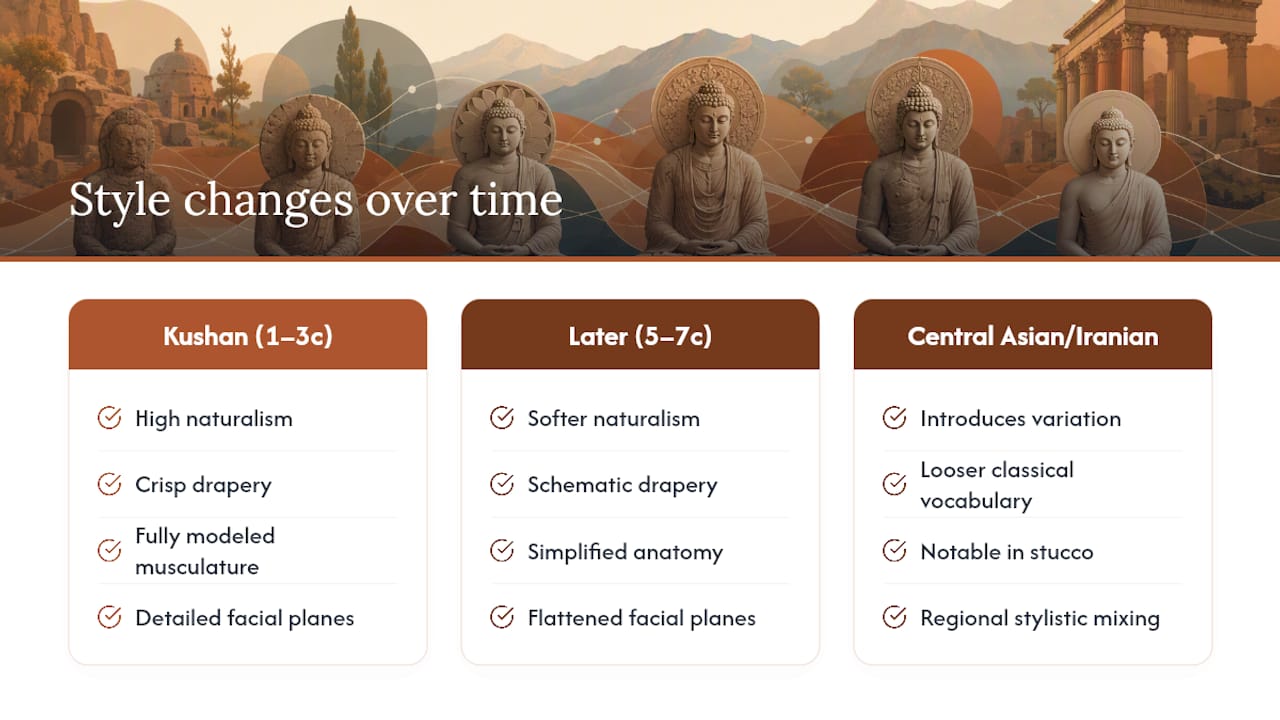
Un bigote combinado con un alto naturalismo generalmente indica una fecha anterior. Modelados más suaves, ropajes más esquemáticos y planos faciales simplificados suelen indicar una fase posterior, más cercana al declive de la tradición. El contacto con Asia central e Irán a lo largo de las rutas comerciales regionales introdujo una variación adicional, particularmente en el trabajo de estuco de sitios más al este, donde el vocabulario clásico se relaja aún más. Para obtener detalles tipológicos más allá de las citas generales, el trabajo de Juhyung Rhi en Archivos de arte asiático mapea varios tipos visuales distintos y rastrea sus fuentes a través de las tradiciones griega, iraní y de Asia central.
¿Cómo se identifica un objeto del Buda Gandhara?
Trabajar en una pieza desconocida se beneficia de una secuencia consistente en lugar de saltar directamente a un veredicto:
- Identificar el medio (esquisto, bronce o estuco), ya que cada uno presenta patrones de conservación diferentes.
- Comprueba los marcadores faciales: forma de los ojos, colocación de la urna, tratamiento del moño, longitud del lóbulo de la oreja y cualquier rastro de bigote.
- leer las cortinas: busque el escote hacia atrás y la dirección naturalista del pliegue.
- Localizar mudrā y evidencia de puntal: observe la posición de la mano o, si falta, dónde una mortaja de puntal sugiere el gesto original.
- Busca restos de policromía: revise los pliegues profundos, detrás de las orejas y las áreas socavadas en busca de residuos de pigmento o dorado.
- Revisar la procedencia y el historial de conservación.: La propiedad documentada y el trabajo de restauración previo son tan importantes como el análisis visual.
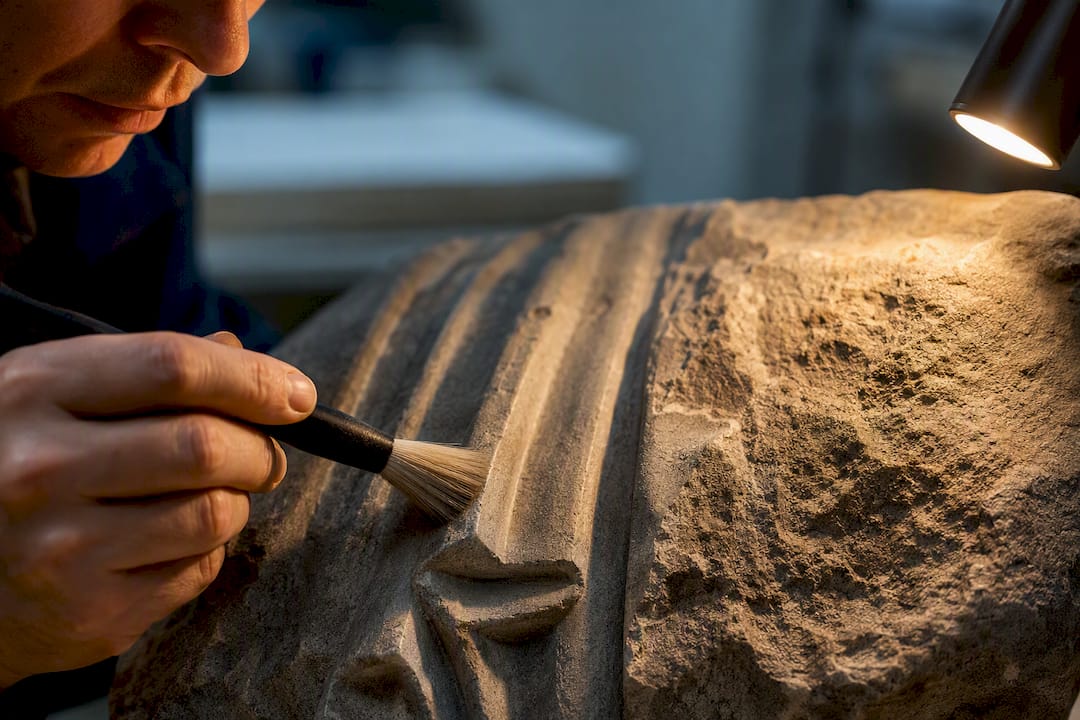
Fotografíe todos los ángulos con luz uniforme y rasante para revelar marcas de herramientas y reparaciones antiguas, y registre las medidas con precisión. Los procesos de catalogación tratan estos pasos como una práctica estándar para cada pieza que ingresa a la galería, no como una ocurrencia tardía reservada para objetos de alto valor.
Consejo profesional: Los bordes afilados y no desgastados en los pliegues de las cortinas combinados con una pátina uniformemente oscura son una señal de alerta común para los recortes modernos o la restauración excesiva. La edad genuina rara vez se desgasta de manera tan uniforme.
El peso cultural detrás del estilo
Los motivos grecorromanos dieron al budismo temprano un lenguaje visual cosmopolita, permitiendo que la tradición viajara a lo largo de las rutas comerciales sin perder legibilidad. La tensión interpretativa es que estas figuras se leen simultáneamente como principescas y monásticas, una imagen construida tanto para el ritual del templo como para una exhibición artística.
- James, HDAsianArt.com
Dónde ver y estudiar budas de estilo Gandhara
El estudio de fotografías sólo te lleva hasta cierto punto en la escultura, que depende tanto del detalle de la superficie como de la proporción. Investigadores y curadores de arte asiático en HD estatuas antiguas de buda basándose en las mismas tradiciones regionales y linajes estilísticos discutidos aquí, cada pieza documentada con fotografías detalladas, notas de condición e investigación de procedencia antes de ponerse a la venta.
Para coleccionistas e instituciones que buscan ejemplos con calidad de museo y con documentación completa, el Obras maestras La colección presenta piezas de alto nivel examinadas con el mismo rigor curatorial. Si su interés va más allá de las estatuas budistas, la galería también ofrece estatuas hindúes y tradicional Laca birmana de toda la región. Una galería como HD Asian Art es la primera parada adecuada cuando desea una pieza autenticada y lista para exhibir con envío asegurado a todo el mundo; un especialista en museos se vuelve esencial cuando se necesita una atribución académica formal o una datación científica para una publicación académica. Explore la colección actual para ver qué piezas tienen las características de diagnóstico cubiertas anteriormente, o comuníquese con el sitio para preguntar sobre un objeto específico.
Fuentes
- Arte de Gandhara | Británica
- Budismo de Gandhara (Centro Americano Asiático Pacífico Smithsonian / Archivos Freer|Sackler)
- Buda sentado - Pakistán (antigua región de Gandhara) | El Museo Metropolitano de Arte
- El Buda | Colección del Museo Británico
Preguntas frecuentes
¿Qué define a un Buda Gandhara?
Un Buda de Gandhara combina ojos almendrados y bajos, una urna, una ushnīśa estilo moño, lóbulos de las orejas alargados y cortinas de influencia romana en un rostro juvenil. El estilo surgió de la fusión de la técnica escultórica grecorromana y la iconografía budista en la región de Gandhara.
¿Cuándo estuvo el estilo Gandhara en su apogeo?
El arte de Gandhara floreció aproximadamente desde el siglo I a. C. hasta el siglo VII d. C., y su fase naturalista más fuerte ocurrió bajo el Imperio Kushan entre los siglos I y III d. C. Los siglos posteriores muestran un cambio hacia modelos más suaves y simbólicos.
¿Se pintaron originalmente las estatuas del Buda Gandhara?
Sí. La evidencia curatorial y arqueológica indica que muchas esculturas de Gandhara fueron originalmente pintadas y doradas, y la simple piedra gris que se ve hoy en los museos refleja siglos de pérdida superficial en lugar del acabado original.
¿Qué significa el bigote de algunos budas de Gandhara?
Un bigote aparece principalmente en las primeras figuras de Gandhara y normalmente apunta a una fecha anterior dentro de la tradición. Desaparece casi por completo de la escultura budista posterior, lo que la convierte en una pista de datación útil, aunque no absoluta, junto con el estilo de las cortinas y el modelado facial.
¿HD Asian Art vende auténticas estatuas de Buda de estilo Gandhara?
HD Asian Art selecciona estatuas budistas e hindúes antiguas de todo el sur y sudeste de Asia, con una investigación detallada y la procedencia detrás de cada pieza. Las piezas actuales y los precios se enumeran en la Colección de estatuas de Buda página.
