



Buddha Statues Outdoor: A Complete UK Guide
Buddha Statues Outdoor: A Complete UK Guide
A statue labelled “weatherproof” isn't automatically suitable for a British garden. That description often says little about porosity, freeze-thaw resistance, drainage, anchoring or the conditions at your particular site. The main risks are freeze-thaw cycling, persistent damp and standing water, and ground movement beneath a heavy sculpture.
I've seen the familiar failure pattern in UK show gardens and reclamation yards. Resin develops spalling and brittle cracks after repeated exposure, limestone loses its surface in a sugary layer, cast stone cracks along mould seams where moisture has wicked in, and bronze develops pitting and green corrosion where water collects. The symbolic mark or serene expression matters far less than the material specification and installation detail.
For serious buyers, outdoor Buddha statues are a materials-and-planning decision first. Choose the right substance, raise it above wet ground, check permissions, and establish a care routine before delivery. A beautiful figure that cracks, tilts or becomes impossible to insure is not a successful garden purchase.
Table of Contents
- Why Most Outdoor Buddha Statues Fail in a British Garden
- Choosing the Right Material for UK Weather
- Siting the Statue in Your Garden or Grounds
- Anchoring, Plinths and Base Drainage
- Seasonal Care and Weatherproofing Routine
- Planning Permission, Landowner Consent and Conservation Areas
- Quick-Reference Checklist and Common Questions
Why Most Outdoor Buddha Statues Fail in a British Garden
The popular advice is simple, buy a garden-safe statue, place it among planting and leave it alone. That advice is inadequate for the UK. A statue can cope with rain yet fail when water enters a pore, freezes, expands and then repeats the process through changing winter temperatures.
The three problems that matter
Freeze-thaw cycling is the major threat to porous stone. UK outdoor sculpture guidance identifies trapped moisture and freezing as a serious cause of cracking and shattering, particularly during severe cold (English Heritage-related frost protection guidance). A statue standing directly on wet soil is exposed from below as well as above.
Standing water creates a second route to failure. Water collects in folded robes, hollow sections, plinth joints and poorly drained patios. It leaves stone saturated, accelerates corrosion on bronze and reaches mould seams in cast materials. Persistent damp also encourages algae and lichen, which conceal early damage.
Ground movement is less dramatic but just as destructive. A heavy figure on saturated clay can settle unevenly, leaving the plinth tilted and the sculpture unstable. A statue that looks perfectly secure in dry weather may shift after prolonged rain.
Material labels don't replace inspection
Treat resin and low-density cast products with suspicion unless the maker provides clear outdoor specifications. Lightweight materials may suit a sheltered courtyard, but they're a poor choice for an exposed lawn, a frost pocket or a site where replacement would be difficult.
Bronze is more forgiving outdoors because it's comparatively resistant to corrosion, but it still suffers where water remains trapped. Historic England recommends regular inspection, gentle cleaning and renewed protective wax, while warning that the patina forms part of the sculpture's protective and aesthetic layer and shouldn't be stripped during routine cleaning (Historic England bronze statue guidance).
Practical rule: Ignore the word “weatherproof” until you know the material, drainage detail, fixing method and maintenance requirement.
The right question isn't whether a Buddha statue can technically stay outdoors. Ask whether this material, on this base, in this microclimate, with this level of care can remain stable and attractive.
Choosing the Right Material for UK Weather
Material choice determines whether your purchase becomes a durable garden landmark or a seasonal ornament. There's no universal outdoor Buddha material, but there is a clear hierarchy for British conditions.
Bronze is my first choice for coastal gardens, wet sites and exposed positions when the budget allows. It tolerates outdoor exposure comparatively well and develops a natural patina, but poor drainage can still cause pitting and verdigris. Keep the finish intact and maintain the wax rather than polishing the surface back to bright metal.
Granite and basalt are the strongest stone options for exposed gardens. UK ornament guidance indicates that granite can tolerate conditions around -25°C and below, while remaining suitable for long service when installed with proper drainage (UK sculpture care guidance). Dense stone is heavy and difficult to move, but that weight is an advantage where wind and accidental knocks are concerns.
Cast stone offers a sensible middle ground. A well-made, sealed mix can perform well, particularly on a raised, drained base. It's still more vulnerable at mould seams, hairline joints and damaged surfaces than dense granite, so inspect the product rather than assuming every cast stone figure has the same resistance.
Limestone and sandstone can look superb, but they demand more discipline. UK guidance treats limestone and sandstone as materials suited to roughly -10°C to -15°C, with annual sealing and protection from standing water (Fennelly sculpture care guidance). I wouldn't choose them for a permanently saturated site or an exposed frost pocket.
Resin and fibre cement are false economies for an important centrepiece. Resin can crack in cold conditions, with UK guidance identifying failure below approximately -5°C for some products, while fibre cement is particularly vulnerable where water enters seams or thin sections (UK winter garden ornament guidance). They can work under cover, but don't confuse light weight with resilience.
Outdoor Buddha statue materials compared for UK weather
| Material | Frost resistance | Typical weight for a 60cm seated figure | Verdict for UK gardens | Key weakness |
|---|---|---|---|---|
| Bronze | Good with maintained protection | Varies substantially by construction | Strong choice for wet and coastal sites | Pitting where water collects |
| Granite | Very high, around -25°C and below | Heavy | Best for exposed locations | Difficult to move and install |
| Basalt | Generally high when dense and sound | Heavy | Good for exposed gardens | Quality and porosity vary |
| Cast stone | Commonly around -15°C to -20°C depending on mix | Medium to heavy | Good value when sealed and drained | Cracks at seams and damaged areas |
| Limestone or sandstone | Treat as around -10°C to -15°C | Medium to heavy | Attractive, but needs careful protection | Porosity and freeze-thaw damage |
| Resin | Some products can fail below -5°C | Light | Sheltered use only | Brittleness, seams and UV wear |
Don't confuse steeping jade with a reliable outdoor material specification. Jade is a colour or stone reference in many sales descriptions, not a substitute for confirmed frost performance, density and installation advice.
For a deeper material comparison before you buy, use this guide to the best materials for outdoor Buddha garden statues. My rule is straightforward: granite or bronze for exposed and wet sites, sealed cast stone for value, and limestone only where drainage and maintenance are excellent.
Siting the Statue in Your Garden or Grounds
A good location protects the material and gives the sculpture authority. Don't choose a position just because an empty corner needs filling. Study water, wind, sun, access and sightlines before the statue arrives.
Start with a raised plinth. It should lift the base above the worst splash zone and above the snow line that affects your site. A plinth also creates a visual boundary between the statue and the garden, which is more respectful and makes maintenance easier.
Keep the figure clear of roof and tree drip lines. As a practical guide, the clearance from a house wall should be at least as great as the eaves overhang, so rainwater doesn't repeatedly fall onto the sculpture or stain the wall behind it. Avoid the base of north-facing walls where cold, shade and damp can combine to create a frost pocket.
Read the garden as a microclimate
Stand in the proposed position at different times of day. Check whether the statue is visible from the main room, whether its face is obscured from the approach, and whether winter shadows leave it wet for long periods. Summer sun can make a location look ideal while revealing nothing about winter moisture.
Before finalising the position, test drainage with a small percolation hole. If water remains in the hole, don't place a heavy sculpture there without improving the base. Saturated clay can allow a large statue to sink and tilt, particularly where the foundation is narrow or uneven.
A visual planning tool such as garden AI design can help you test sightlines and planting relationships, but it can't replace a physical drainage check or a structural assessment.
Five checks to take outside
- View: Can you see the face from the main room and from the garden approach?
- Water: Is the statue outside roof, gutter and tree drip lines?
- Ground: Does the proposed area drain instead of holding water?
- Frost: Is it away from a shaded frost pocket and persistent winter damp?
- Base: Is there room for a raised plinth, drainage collar and secure fixing?
For additional placement guidance, consult this resource on where to put your Buddha statue. The right position should be calm and visible, but it must also be dry, stable and serviceable.
Anchoring, Plinths and Base Drainage
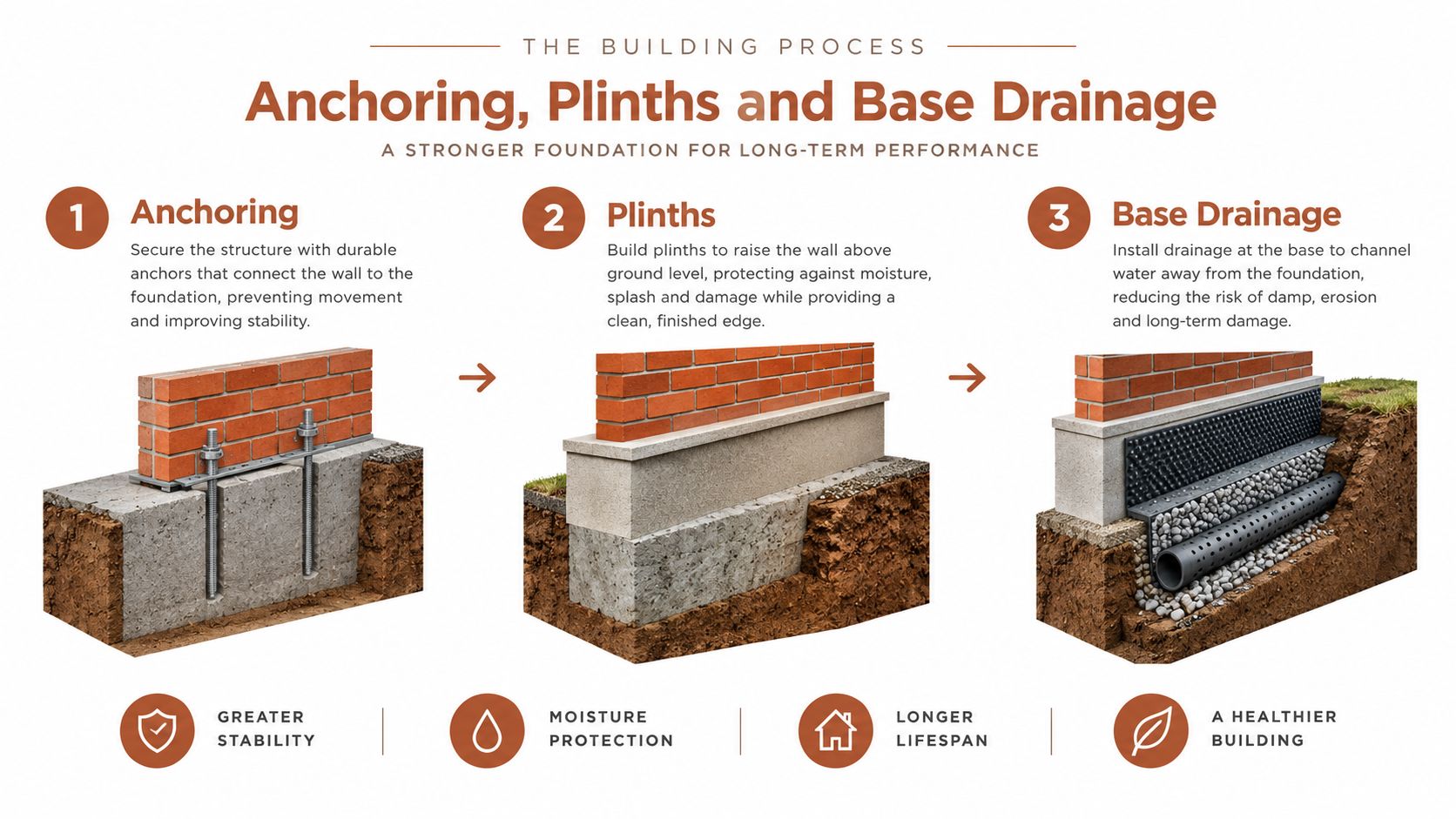
A plinth is not decoration. It's the structural interface between the sculpture and the ground, and it determines whether rainwater drains away or remains trapped beneath the base.
Match the fixing method to the statue's weight and the substrate. Smaller pieces can use brass or stainless anchors into sound stone. Medium-weight statues are better secured with chemical-resin studs into a properly prepared concrete pad. Heavier sculptures need through-bolted steel dowels set into a reinforced concrete raft, designed by someone who understands the load and the ground conditions.
Use frost-resistant mortar, not builders' sand alone. A 1:3 mortar mix with sulphate-resistant cement is an appropriate benchmark for a solid bed where the substrate and project conditions support it. Keep the statue fully supported, rather than resting it on isolated blobs that create stress points.
Keep water away from the joint
The plinth should sit on a complete damp-proof course, never directly on bare soil. Add a 25 to 40mm gravel collar around the plinth to disperse water and prevent wet soil from sitting against the base. The surrounding paving or hardstanding should fall away from the statue, not towards it.
Patio installations need particular care. Use anti-slip rubber matting beneath the plinth where appropriate, and make sure the surface is level before drilling or bonding. A heavy statue still benefits from mechanical fixing because wind, impact and gradual movement can work against an apparently stable base.
A statue heavier than a small child needs mechanical fixing. Lighter pieces benefit from it too, especially in an exposed garden.
If the sculpture forms part of a larger architectural scheme, look at specialist information on weathering marble cladding facades to understand how stone finishes, water movement and exterior interfaces are managed. The same principle applies here: keep vulnerable joints dry and give every material a clear path for drainage.
Seasonal Care and Weatherproofing Routine
Outdoor care should follow the British weather calendar, not a vague annual reminder. October is the decisive month because leaves, rain and falling temperatures combine to hold moisture against the sculpture.
For bronze, wipe the surface gently and renew a microcrystalline or beeswax-based paste in March, July and November. Don't use silicone polish. Clean with water or a mild detergent, never high pressure, and leave an established patina in place. Historic England advises that wax is generally renewed annually, although some monuments may suit a longer two to three-year interval depending on exposure (Historic England bronze maintenance guidance).
For stone, wash with a pH-neutral product in early spring. Use a breathable silane or siloxane sealer on porous granite and limestone where appropriate, commonly on a three to five-year cycle, but don't seal hard granite merely out of habit. Resin needs a UV-protective top-up and a close check for hairline cracks before the first serious frost.
Seasonal care by material
| Material | Spring | Summer | Autumn | Winter |
|---|---|---|---|---|
| Bronze | Gentle wash and wax | Inspect patina and trapped water | Renew protection before colder weather | Reduce water ingress |
| Granite | Remove algae and stains gently | Check joints and base | Clear leaves and gutters nearby | Usually needs little intervention |
| Limestone or sandstone | pH-neutral wash and inspect | Check breathable seal | Remove debris from folds | Protect from standing water and severe exposure |
| Cast stone | Inspect seams and chips | Check drainage and fixings | Clear leaves from the plinth | Cover only with breathable protection where needed |
| Resin | Check hairline cracks and UV finish | Inspect fading and movement | Move from saturated soil if possible | Protect from severe frost or bring under cover |
Lift ornaments off saturated soil in October, clear leaf debris from folds and cavities, and drain internal hollows where possible. From November through January, the priority is reducing water ingress. February is the inspection month for frost-spalled chips, loose joints and movement at the base.
| Problem | Correct response |
|---|---|
| Algae | Use a gentle pH-neutral wash and soft brush |
| Lichen | Loosen carefully and avoid aggressive scraping into stone |
| Rust bleed | Identify the metal source, remove contamination carefully and repair the cause |
| Efflorescence | Brush off dry deposits, then investigate moisture moving through the base |
A practical maintenance guide for caring for bronze and stone Asian sculptures is useful when you're setting up a written inspection routine. Keep dated photographs so you can distinguish natural patina from a new defect.
Planning Permission, Landowner Consent and Conservation Areas
Paperwork can decide whether a statue belongs on your site at all. Don't order first and investigate later, particularly if the piece will be visible from a public route or installed near a historic building.
In England, an ornamental statue in an ordinary domestic garden will often fall within permitted development. That assumption changes where the property is listed, where a conservation area has an Article 4 direction removing permitted development rights, or where the setting lies within a registered park or garden. National guidance confirms that outdoor statues, memorials and monuments can require permission depending on duration and conservation status (UK planning permission guidance).
Wales and Scotland have their own planning systems and should be checked through the relevant local authority. Don't rely on an English garden forum for a Scottish or Welsh property.
Consent belongs to the landowner
For leased land, allotments, commons, churchyards and other non-domestic settings, obtain written landowner consent before delivery. A burial ground may also require a faculty. Public-art guidance stresses that ownership, maintenance, insurance and decommissioning responsibilities must be agreed before installation, rather than assumed to transfer to the landowner (UK public-art responsibilities guidance).
A short pre-application enquiry should include:
- Site details: Address, ownership and a location plan.
- Design information: Dimensions, material, finish and proposed pose.
- Visibility: Photographs showing views from neighbours, roads and public paths.
- Foundation: Plinth, anchoring and drainage details.
- Duration: Whether the display is temporary or permanent.
A temporary display can still create a planning issue. Even a garden sculpture intended to remain for 28 days in a front garden may attract enforcement attention if it breaches local rules or materially changes the appearance of the property. Check the local planning portal and ask the planning authority in writing where the setting is sensitive.
Keep the receipt, provenance information, consent letter and installation photographs together. Historic England-linked public-art guidance also emphasises regular condition checks and clear responsibility for ongoing care (outdoor sculpture ownership guidance). That file helps with maintenance, insurance and any future sale.
Quick-Reference Checklist and Common Questions
A serious buyer should be able to make the first decision on the same day. You don't need to finalise the pose or planting before you've confirmed the material, base, drainage and permissions.
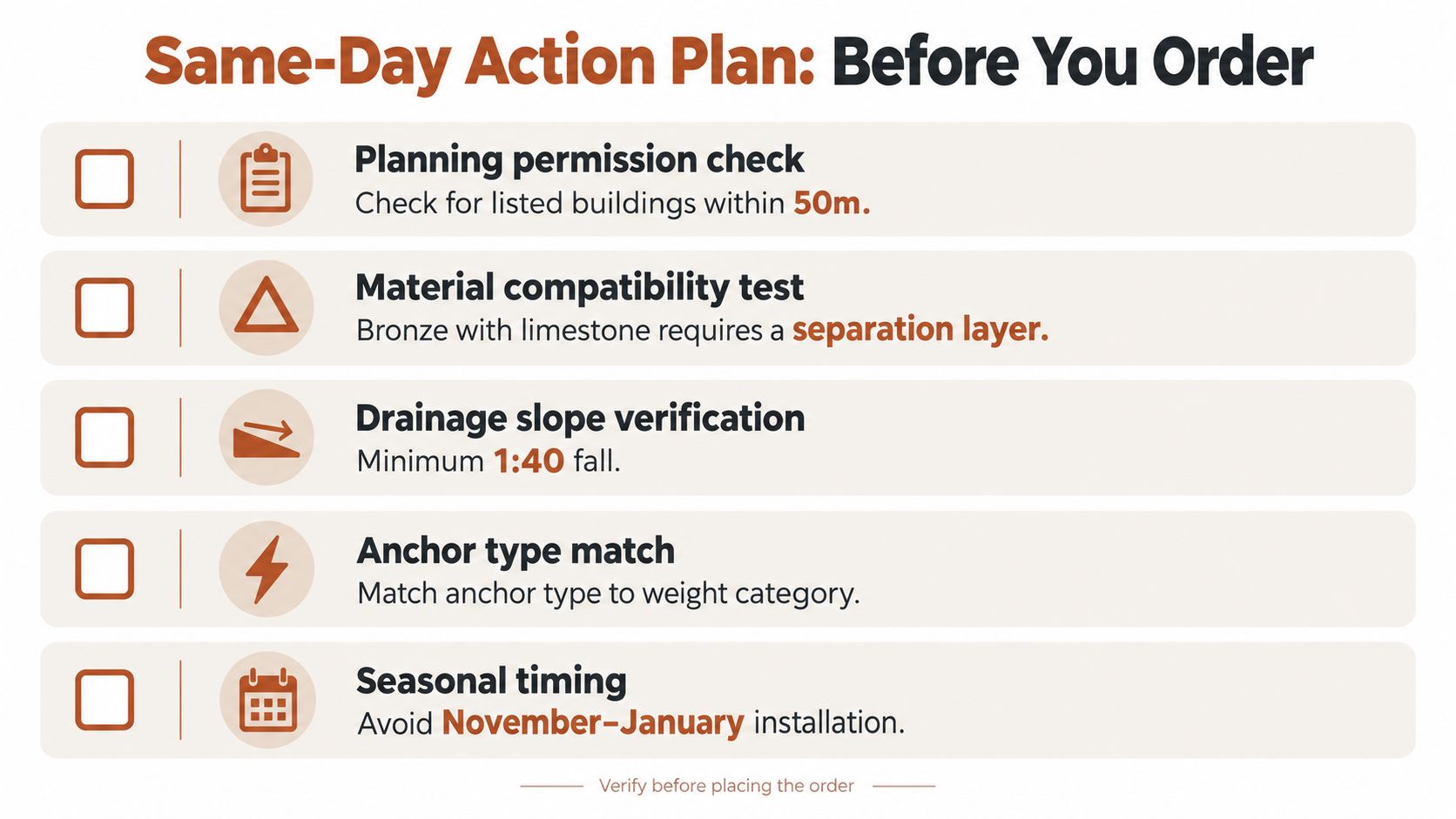
Same-day buying checklist
- Material: Choose bronze or dense granite for exposed sites, sealed cast stone for value, and porous limestone only where drainage and maintenance are controlled.
- Frost: Confirm the supplier's frost specification rather than accepting “outdoor-safe” as proof.
- Siting: Keep the statue clear of roof and tree drip lines, away from frost pockets and visible from the intended approach.
- Drainage: Provide a raised plinth, complete damp-proof course and gravel collar. Standing water is unacceptable.
- Anchoring: Specify fixings rated above the statue's weight and use frost-resistant mortar.
- Permissions: Confirm whether the property is listed, within a conservation area or subject to an Article 4 direction.
- Ownership: Get written consent for leased, shared, public or institutional land.
- Records: Keep the receipt, provenance, permissions and installation photographs for insurance and future maintenance.
Questions buyers ask
Will a resin Buddha survive frost?
Some may cope in sheltered conditions, but resin is the material I'd reject for an exposed, permanent centrepiece. It can become brittle, crack at seams and suffer UV wear. Move lightweight pieces under cover where severe frost is expected.
Will bronze develop an attractive patina?
Yes, bronze can develop a natural patina outdoors, and that patina is part of the sculpture's appearance and protective layer. Don't strip it with abrasive cleaning. Maintain the surface with gentle washing and suitable wax.
Does a heavy statue need planning consent?
Weight alone doesn't decide the planning position. Location, duration, visibility, listed status, conservation-area controls and land ownership matter. Check before delivery.
How should I treat lichen and blackspot on stone?
Use a gentle, pH-neutral cleaning approach and a soft brush. Don't pressure-wash porous stone or scrape aggressively, because you can remove the weathered surface along with the growth.
What should I keep for insurance?
Retain the purchase receipt, provenance details, photographs showing condition at installation, material information, fixing details and any planning or landowner consent. Clear ownership and maintenance records are particularly important for public or shared sites.
The dependable outdoor Buddha isn't chosen by appearance alone. It's selected by material density, frost resistance, drainage, fixing and permission. Get those decisions right and the sculpture can become a durable, respectful focal point rather than another failed ornament in the reclamation yard.
HD Asian Art offers curated Buddhist and Southeast Asian sculptures, with listings that identify whether individual stone or bronze pieces are suitable for garden or outdoor settings. Review the available pieces and their material information at HD Asian Art, then confirm the installation requirements before ordering.
