



Vishnu Statue: The Preserver God in Hindu Art
Vishnu Statue: The Preserver God in Hindu Art
Few figures in Hindu sculptural art carry as much visual complexity as Vishnu. A collector encountering their first Vishnu statue is immediately confronted with four arms, a blue-skinned serene form, a spinning discus, a conch shell, and a lotus, each element loaded with precise theological meaning. Without understanding the iconographic grammar, you are simply looking at a beautiful object.
With it, you are reading a sophisticated cosmological text rendered in stone, bronze, or gilded wood. This guide unpacks that grammar, from Vishnu's core attributes to the avatar iconography that makes his sculptural tradition one of the richest in all of Asian religious art.
Table of Contents
Quick Takeaways
|
Key Insight |
Explanation |
|---|---|
|
Four arms are non-negotiable in authentic Vishnu iconography |
Each arm holds one of four principal attributes: the Sudarshana Chakra (discus), Panchajanya (conch), Kaumodaki (mace), and a lotus. A statue missing these in recognizable form is either an avatar depiction or a regional deviation worth investigating before purchasing. |
|
Blue skin carries specific cosmological meaning |
The blue complexion represents Vishnu's all-pervading, infinite nature, evoking the depth of the ocean and the expanse of the sky. It is not decorative but theologically precise. |
|
Avatar sculptures follow their own distinct iconographic rules |
A Narasimha statue looks nothing like a Rama statue. Each of the ten Dashavatara forms has its own posture, weapons, and companion figures. Knowing which avatar you are looking at is fundamental to evaluating the piece correctly. |
|
Regional style dramatically affects sculptural form |
A South Indian bronze Vishnu and a Cambodian stone Vishnu share theological content but differ enormously in posture, facial treatment, and decorative vocabulary. Neither is more authentic than the other. |
|
Garuda and Shesha are not decorative extras |
Vishnu's vehicle (vahana) is Garuda, the eagle. His resting place is Shesha, the cosmic serpent. When either appears in a sculpture, it signals a specific cosmological narrative, not just stylistic flair. |
|
Lakshmi's presence changes the reading of the piece entirely |
A sculpture showing Vishnu with Lakshmi at his side is a depiction of divine union and cosmic balance, not simply a paired figure. Such pieces carry different ritual significance than a standing Vishnu alone. |
|
Material choice is part of the iconographic language |
Bronze statues from South India were designed to be carried in procession. Stone sculptures were fixed in temple niches. Understanding original function helps collectors make better-informed choices about display and context. |
Who Is Vishnu: The Preserver in the Hindu Trimurti
Vishnu is one of the three principal deities of Hinduism, forming part of the Trimurti alongside Brahma (the creator) and Shiva (the destroyer). His role is preservation, specifically the sustaining of dharma and cosmic order across successive cycles of time. Within Vaishnavism, one of the major traditions in contemporary Hinduism, Vishnu is understood not merely as a member of a divine trio but as the Supreme Being, the source and sustainer of everything that exists.
He is also known by the names Narayana, Hari, and Madhava, among many others. The text known as the Vishnu Sahasranama lists a thousand names of the deity, each describing a different aspect of his nature. This theological richness is precisely what makes Hindu god Vishnu sculpture such a rewarding area for serious collectors. Every formal choice, from posture to weapon to mount, is a deliberate theological statement, not an aesthetic whim.
His abode is described as Vaikuntha, a celestial realm, and he is often depicted resting on the cosmic serpent Shesha upon the primordial ocean. His consort is Lakshmi, the goddess of wealth and auspiciousness. His vehicle is Garuda, the divine eagle. These associations appear repeatedly in sculptural art and give collectors the visual vocabulary to identify and correctly interpret a piece.
Vishnu's calm demeanor and stable posture are not passive qualities. They are the visual embodiment of the cosmic function of preservation, the force that holds creation together between its moments of origin and dissolution.
Reading a Vishnu Statue: Symbols, Attributes, and Their Meanings
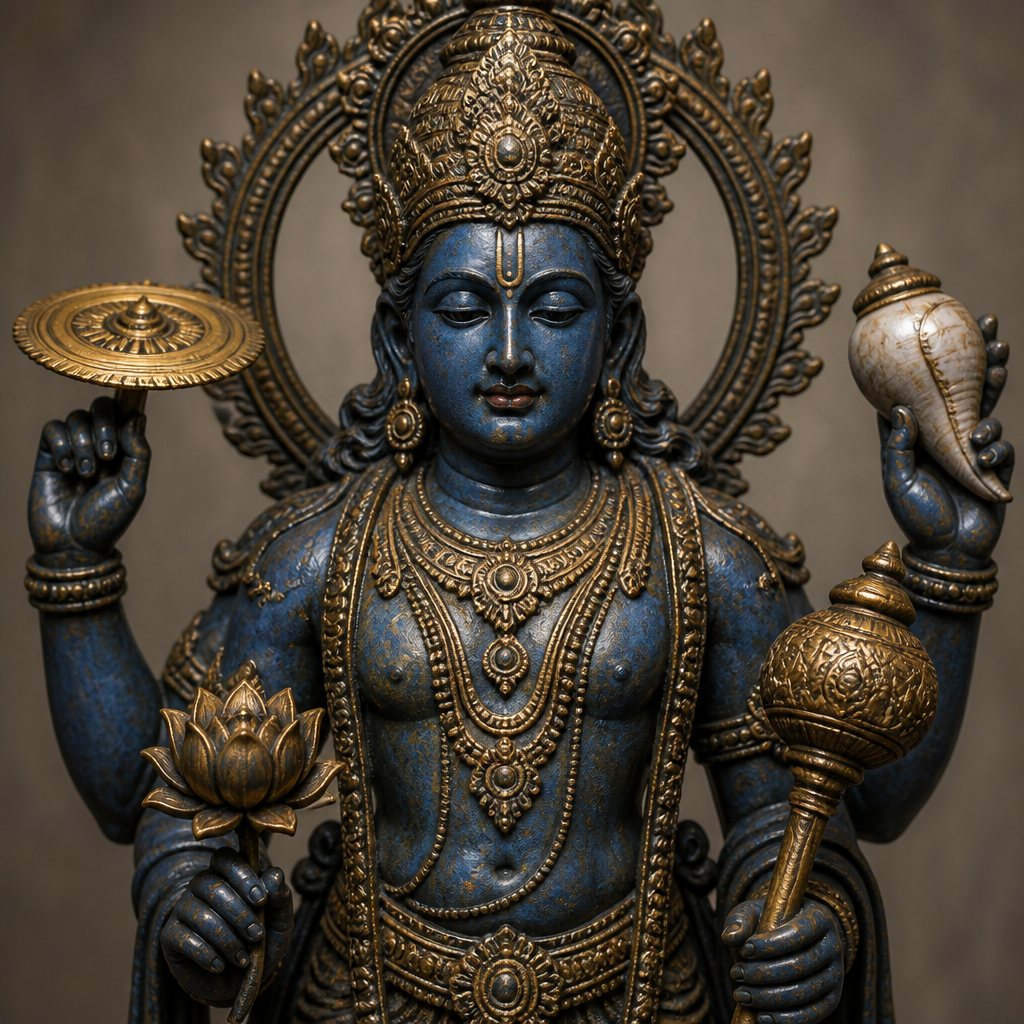
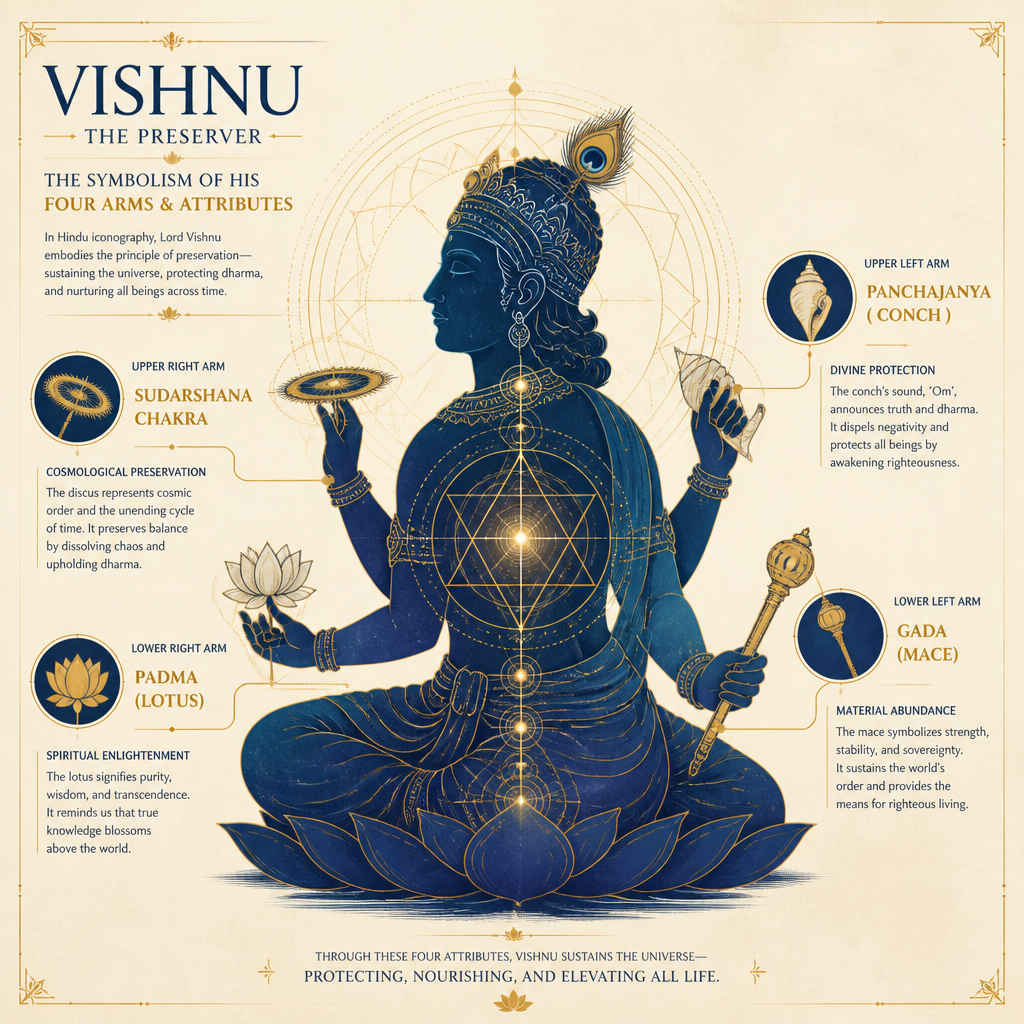
The iconographic language of a Vishnu statue is precise. Once you understand it, ambiguous identifications become straightforward. The single most important feature is the four arms, each carrying one of four objects that together define Vishnu's cosmic functions.
The Four Principal Attributes
The Sudarshana Chakra (discus) is typically held in the upper right hand. It represents the mind's power to cut through illusion and the force that destroys negativity. The Panchajanya (conch shell) is held in the upper left and, when blown, produces the primordial sound of creation. The Kaumodaki (mace) represents the power of knowledge and time. The lotus (padma) symbolizes purity, spiritual liberation, and the unfolding of the universe.
In practice, the arrangement of these four attributes across the four arms follows established canonical positions, though regional variations exist. A common mistake among new collectors is assuming that any multi-armed male figure holding a discus must be Vishnu. Shiva also appears with multiple arms in certain forms. The combination of all four specific attributes, particularly the conch and the lotus together, is the reliable identifier.
Posture, Color, and the Trimark
Vishnu's blue complexion, as discussed in authentic iconographic sources, represents his all-pervading, transcendent nature, encompassing the infinite sky and the ocean's depths. His demeanor in sculpture is characteristically serene and upright, conveying stability rather than the dynamic energy often associated with Shiva's dancing forms.
The Vaishnavite tilaka, a vertical mark on the forehead, appears on many Vishnu statues and on the foreheads of devotees. In sculptural terms, this mark, along with the Shrivatsa symbol (a particular mark on the chest) and the Kaustubha gem worn around the neck, are additional identifiers used in finely detailed stone and bronze work.
Pro tip: When evaluating a Vishnu statue for your collection or altar, examine the upper hands first. If you can identify the discus (a flat, circular weapon with a serrated edge) and the conch (a spiral shell form), you have confirmed the deity. The lower hands typically display the abhaya mudra (gesture of protection) and the varada mudra (gesture of giving), further confirming a benevolent, protective iconographic program.
Garuda and Shesha as Compositional Elements
In larger sculptural programs, Vishnu may be shown standing on or flanked by Garuda, his eagle vehicle, or reclining on the coils of Shesha, the thousand-headed cosmic serpent. The reclining form, known as Anantashayana or Vishnu Sheshashayi, is one of the most complex and narratively rich compositions in Hindu art, often showing the god in deep cosmic sleep with Brahma emerging from a lotus growing from his navel. This form appears in relief sculpture from across South and Southeast Asia and represents the interval between cosmic cycles.
The Dashavatara: Avatar Iconography in Hindu Sculptural Art
The concept of the avatar (divine descent) is among Vishnu's most distinctive theological contributions to Hinduism. The Dashavatara, or ten principal avatars, each represent a specific divine intervention to restore dharma at a moment of cosmic crisis. For collectors and practitioners, understanding avatar iconography is not optional background knowledge. It is the foundation for correctly identifying a very large category of Hindu sculptures.
The Ten Avatars and Their Sculptural Identifiers
The traditional list of the Dashavatara includes Matsya (the fish), Kurma (the tortoise), Varaha (the boar), Narasimha (the man-lion), Vamana (the dwarf), Parashurama (the warrior sage), Rama, Krishna, Buddha, and Kalki. Each form has distinct sculptural characteristics that trained collectors learn to identify immediately.
Narasimha is depicted with a lion's head on a human body, often in the act of destroying the demon Hiranyakashipu. The violence of the scene is iconographically deliberate and contrasts sharply with Vishnu's usual serenity. Varaha shows Vishnu with a boar's head, frequently depicted lifting the earth goddess Bhudevi on his tusks, a composition that appears in magnificent relief carvings across South Indian temple traditions. Krishna as an avatar appears in such an enormous range of sculptural forms, from the infant Krishna stealing butter to the divine charioteer of the Bhagavad Gita, that he constitutes an entire sub-field of Hindu deity statues in his own right.
One persistent misconception worth addressing directly: the inclusion of the Buddha as Vishnu's ninth avatar is a theological position found in certain Hindu texts, not a statement about Buddhist doctrine. Buddhist tradition does not recognize this framing. Collectors dealing with art from regions where Hinduism and Buddhism historically overlapped, such as Java or Cambodia, will sometimes encounter sculptural programs that reflect this syncretic context.
Pro tip: Avatar sculptures from Southeast Asia, particularly Khmer examples from Cambodia and Javanese examples from Indonesia, often follow regional iconographic programs that differ from North or South Indian conventions. A Cambodian Vishnu may have a more serene facial treatment and simplified crown compared to the elaborate ornamentation of a South Indian bronze. Do not assume a Southeast Asian avatar sculpture is iconographically "incorrect" because it diverges from Indian norms. It is operating within a different, equally valid regional tradition.
Regional Sculptural Traditions: How Geography Shapes the Form
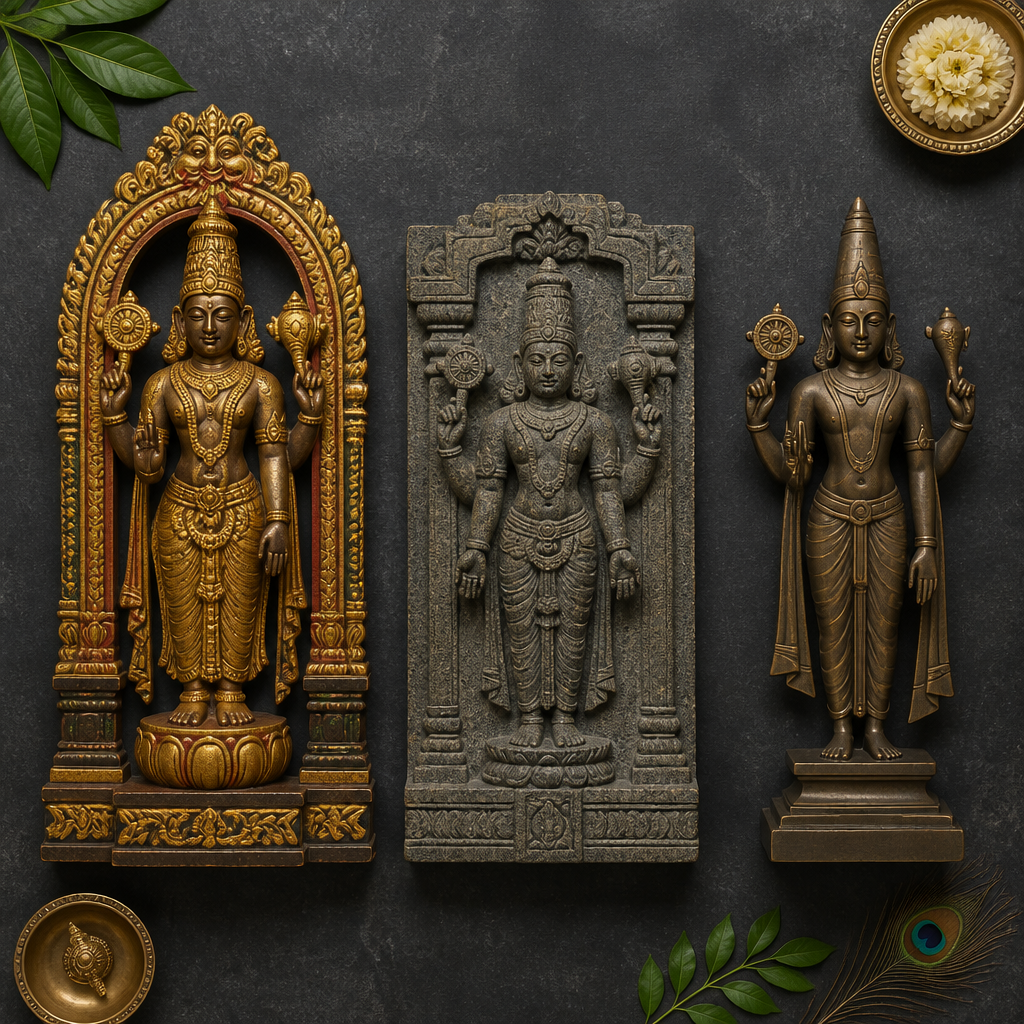
Vishnu sculpture does not look the same across Asia, and that diversity is precisely what makes building a collection interesting. The theological content remains consistent, but the artistic vocabulary shifts dramatically depending on whether the piece originates in South India, North India, Cambodia, Java, or elsewhere.
South Indian Bronze Tradition
The Chola bronze tradition of South India, produced roughly between the 9th and 13th centuries, represents one of the high points of Vishnu sculptural art anywhere in the world. These bronzes were cast using the lost-wax process and designed to be carried in temple processions. They typically show Vishnu in a tall, elegant standing posture with fine jewelry, a cylindrical crown (kirita-mukuta), and a characteristic facial serenity. The quality of surface detail, particularly in the rendering of jewelry and the treatment of the skin, is exceptional.
North Indian Stone Traditions
North Indian Vishnu sculpture in stone tends toward greater volumetric mass and is often integrated into larger temple relief programs. The Pala period (roughly 8th to 12th centuries) produced distinctive black stone Vishnu images from the Bengal and Bihar regions, characterized by a central standing figure flanked by smaller attendant figures and avatar depictions arranged in registers around the main image.
Southeast Asian Vishnu Sculpture
Cambodia, Java, and Bali each produced Vishnu imagery that draws on Indian iconographic sources while developing its own regional character. Khmer Vishnu sculptures often show the deity in a frontal standing posture with a characteristic Khmer smile and simplified, towering crown. Javanese Vishnu images, produced under Hindu-Buddhist kingdoms, sometimes show a more compact form with highly stylized ornamental detail. For buyers interested in HD Asian Art's collection, Southeast Asian Vishnu pieces represent a particularly compelling intersection of Indian theological content and indigenous artistic genius.
Choosing a Vishnu Statue: What Collectors and Practitioners Should Know
The decision to acquire a Vishnu statue depends on whether you are approaching it as a collector, a spiritual practitioner, or both. These are not mutually exclusive categories, but they do produce different priorities when evaluating a piece.
For Spiritual Practitioners and Home Altar Use
If your primary purpose is devotional, the posture and expression of the statue matter enormously. A standing Vishnu (Sthanaka) in the abhaya mudra is a natural choice for a protective altar piece. A seated Vishnu on Shesha, in deep contemplation, suits a meditation space better. The material also carries meaning: brass and bronze are traditional for home worship, while resin or composite pieces work well for practitioners who want a durable, lower-cost alternative for everyday use.
Size relative to your altar space is a practical consideration that dealers often overlook. A statue that towers over an altar feels imposing rather than inviting. A piece that is too small loses its visual authority. In practice, a statue between 20 and 40 centimeters tall works well for most domestic altar configurations, though this is genuinely a matter of spatial judgment rather than canonical rule.
For Art Collectors and Antiquities Enthusiasts
Collectors should focus first on iconographic completeness. All four attributes present and correctly rendered, clear identification of posture and avatar form if applicable, and legible facial expression are baseline requirements for a piece of serious quality. Surface condition matters, but signs of age and use are not flaws in antique and vintage pieces. They are part of the object's biography.
A common mistake is paying a premium for excessive gilding or ornamentation without checking the underlying sculptural quality. Some heavily decorated pieces conceal mediocre carving beneath their surface treatment. Strip away the decoration mentally and ask whether the underlying form is well-conceived and skillfully executed. That is what holds its value and its visual power over time.
Pro tip: HD Asian Art sources sculptures from across the major Vishnu-worshipping traditions, including India, Cambodia, and Indonesia. When browsing their collection, use avatar iconography as your primary sorting tool. Decide first whether you want a canonical four-armed Vishnu or a specific avatar form, then evaluate individual pieces within that category. This narrows the field immediately and makes comparison far more productive.
Comparison of Vishnu Sculpture Styles
|
Style / Tradition |
Key Visual Characteristics |
Best Suited For |
|---|---|---|
|
South Indian Bronze (Chola-influenced) |
Tall, slender standing form; cylindrical kirita-mukuta crown; fine jewelry detail; lost-wax casting; warm golden-brown patina; processional design intent |
Collectors focused on classical Indian sculptural tradition; practitioners wanting a piece aligned with South Indian Vaishnava devotional context |
|
Khmer / Cambodian Stone or Bronze |
Frontal posture; characteristic Khmer smile with broad face; simplified towering crown; often shown with multiple heads in certain forms; calm, hieratic quality |
Collectors interested in Southeast Asian art history; buyers who appreciate the meeting point of Indian iconography and Khmer artistic identity |
|
North Indian Stone (Pala-style) |
Dense black stone; central Vishnu flanked by avatar registers; elaborate torana (arch) framework; stronger volumetric mass; complex multi-figure compositions |
Collectors building a scholarly collection; those interested in the narrative complexity of avatar iconography within a single sculptural program |
Frequently Asked Questions
What are the four objects held by Vishnu in most statues?
The four principal attributes are the Sudarshana Chakra (a spinning discus representing the power to destroy ignorance and evil), the Panchajanya (a conch shell symbolizing the primordial sound of creation), the Kaumodaki (a mace representing the power of time and knowledge), and the padma (lotus), which symbolizes purity and spiritual liberation. These four objects are held across Vishnu's four arms and are the primary means of identifying a canonical Vishnu statue as opposed to a depiction of one of his avatars.
How do I tell which avatar of Vishnu a sculpture depicts?
Each avatar has distinct physical markers. Matsya is fish-bodied, Kurma is tortoise-bodied, Varaha has a boar's head and often holds or rescues a small female figure (Bhudevi), Narasimha has a lion's head on a human body and is frequently shown in an agitated pose, Vamana is a dwarf in brahmin garb, Parashurama carries an axe, Rama holds a bow, Krishna appears in a wide range of narrative scenes, and the Buddha avatar is depicted in typical meditative Buddhist iconography. When the figure does not match any of these profiles and has four arms with all canonical attributes, you are most likely looking at the primary form of Vishnu rather than an avatar.
Why is Vishnu depicted with blue skin in Hindu sculptural art?
The blue complexion is a consistent theological marker rather than an artistic preference. It represents Vishnu's all-pervading, transcendent nature, specifically the association with the infinite sky above and the boundless ocean below. Both are vast, encompassing, and beyond full human comprehension. In sculptural terms, the blue is sometimes indicated through pigment on stone or the use of blue-black stone itself. In gilded bronze, the blue is often implied through convention rather than color application, and devotees familiar with the tradition read the form correctly regardless.
What is the difference between a Vishnu statue designed for temple use and one designed for home worship?
Sculptures designed for fixed temple installation, particularly large stone carvings, were set into niches and conceived as part of an architectural program. They were never meant to move. South Indian bronzes, by contrast, were created specifically to be carried in procession during festivals, which is why they are fully finished on all sides and have integral base rings for carrying poles. A home worship statue sits somewhere between these functions, needing to be visually effective from the front, stable on a domestic altar surface, and scaled appropriately for an intimate devotional space rather than a monumental temple setting.
Is it appropriate to display a Vishnu statue purely as art rather than for religious purposes?
This is a question that serious collectors encounter regularly, and the honest answer is that it depends on your own values and the values of the tradition you are engaging with. Hindu sculptural art was created within a specific religious and ritual context, and many practitioners consider respectful display, even in a secular setting, to be appropriate as long as the object is treated with dignity. Placing a Vishnu statue on the floor, using it as a bookend, or treating it as generic decorative clutter are widely considered disrespectful. Elevated display, thoughtful lighting, and genuine engagement with the iconographic tradition are the markers of respectful secular collecting.
What should I look for to assess the quality of a Vishnu statue before buying?
Start with iconographic completeness: are all four attributes present and correctly rendered? Then examine the quality of the face, specifically the balance of features and the clarity of expression. Vishnu's face should convey serenity and authority, not blankness. Check the hands for proportion and the quality of the mudras. Look at the base or throne treatment, which in high-quality pieces will show lotus petal carving or a throne form appropriate to the deity. Finally, assess the overall compositional balance. A well-made Vishnu statue has a visual center of gravity that draws the eye to the face and then guides it through the four arms in a coherent visual rhythm.
If you have a Vishnu statue in your own collection or on your altar, share what drew you to that particular form or regional tradition. The community of collectors and practitioners around South and Southeast Asian religious art is small enough that specific knowledge and personal experience genuinely adds to the collective understanding.
References
-
Vishnu iconography in Indian art: a detailed guide to symbols, attributes, and the Dashavatara
-
Vishnu on Wikipedia: overview of the deity's theology, names, weapons, and iconographic tradition
-
Explained iconography of Vishnu: the meaning of blue skin, four arms, and divine attributes
