



Thai Buddha Styles Explained: A Collector's Guide
Thai Buddha Styles Explained: A Collector's Guide
Not all Buddha statues look alike. If you have spent any time studying Thai Buddha art styles, you already know that posture, hand gestures, facial features, and ornamentation vary dramatically from piece to piece. What most people miss is that these differences are not random. Every element communicates theology, history, and cultural identity. Thai buddha styles explained properly require understanding at least three layers: the historical period that shaped the form, the posture and mudra that define the spiritual message, and the materials and setting that complete the meaning.
Table of Contents
Key takeaways
| Point | Details |
|---|---|
| Style reflects history | Each major Thai period produced a distinct visual language tied to political and religious priorities. |
| Posture and mudra combine | Body position and hand gesture together identify the spiritual moment or teaching a statue depicts. |
| Materials carry meaning | Gold leaf, glass mosaic, and scale are not decorative choices but theological statements. |
| Context changes everything | Thai Buddha statues function as part of a total temple environment, not as isolated sculptures. |
| Identification takes practice | Visual cues like facial shape, finial type, and ornamentation level reliably distinguish major styles. |
Thai Buddha styles explained through history
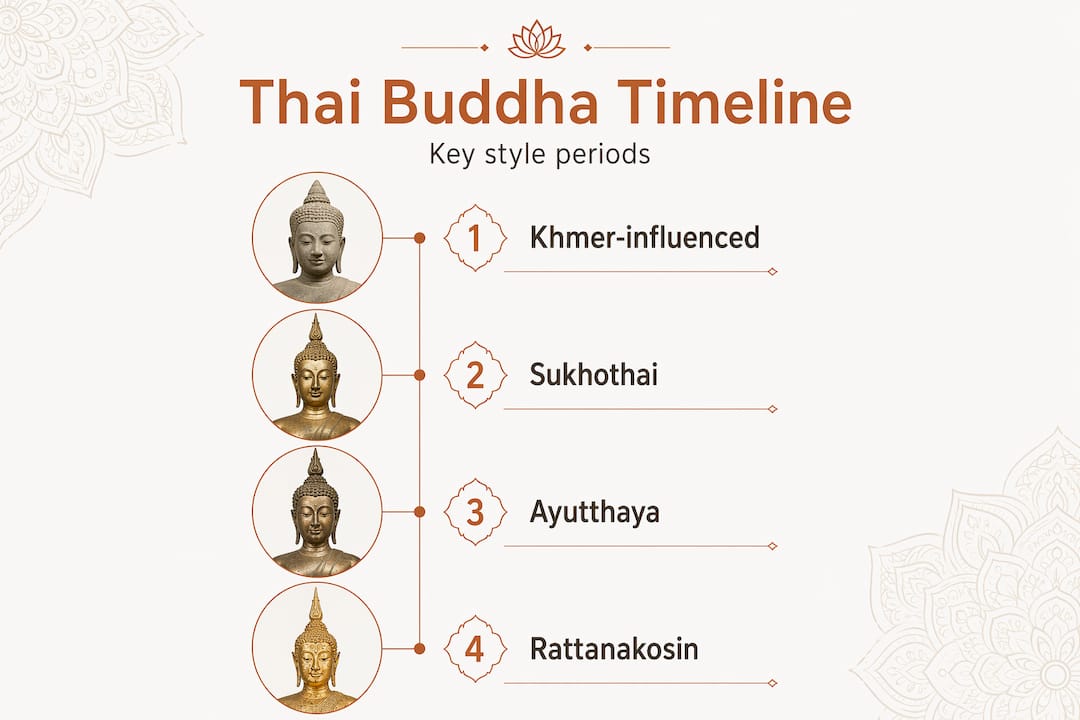
The story of Thai Buddhist art styles begins before Thailand existed as a unified kingdom. Early Buddha images in the region carried strong Khmer and Mon influences. Khmer sculpture emphasized angular power, with broad shoulders, geometric facial features, and a sense of physical authority. Mon art, by contrast, leaned toward softer forms and a more meditative quality. Both traditions left visible marks on what would become distinctly Thai imagery.
The Sukhothai period, roughly the 13th to 15th centuries, represents the first major break toward a uniquely Thai aesthetic. Sukhothai sculptures introduced an egg-shaped face, soft flowing lines, a subtle S-shaped body curve, and flame-like head finials symbolizing spiritual radiance. The walking Buddha, a form rarely seen in other Buddhist traditions, became a Sukhothai signature. That posture communicates both movement and serenity simultaneously, a theological statement about the Buddha’s active compassion in the world.
The shift from Khmer angularity to Sukhothai fluidity was not accidental. It reflected a deliberate promotion of Theravada Buddhist ideals by Thai rulers who used art to emphasize compassion and serenity over power and authority.
The Ayutthaya period, spanning the 14th through 18th centuries, brought a return to greater formality and detail. Faces became more symmetrical and refined. Crowns and royal ornamentation appeared more frequently. Statues grew heavier and more architecturally imposing. The Rattanakosin era, which began in the late 18th century and continues today, pushed scale and decoration to their limits. The Reclining Buddha at Wat Pho measures approximately 151 feet long and 49 feet high, with dense glass mosaic inlays and abundant gold leaf covering every surface.
| Period | Approximate dates | Key visual features |
|---|---|---|
| Khmer-influenced | Pre-13th century | Angular, powerful, geometric facial structure |
| Sukhothai | 13th to 15th century | Fluid, flame finial, walking Buddha form |
| Ayutthaya | 14th to 18th century | Robust, formal, royal ornamentation |
| Rattanakosin | Late 18th century to present | Monumental, lavish mosaic and gold decoration |
Posture and mudra in Thai Buddha statues
Posture and hand gesture are the two primary codes in Buddhist art Thailand uses to communicate spiritual meaning. Once you learn to read them, every statue tells a specific story.
The four main postures in Thai Buddhist art are seated, standing, walking, and reclining. Each corresponds to a moment or quality in the Buddha’s spiritual life.
-
Seated. The most common posture. Typically depicts meditation, teaching, or the moment of enlightenment. The crossed-leg position signals withdrawal from the physical world and deep inner focus.
-
Standing. Associated with blessing and active compassion. The Buddha is present in the world, available to those who seek guidance.
-
Walking. Characteristic of Sukhothai art. Represents the Buddha returning from heaven after teaching his mother, or more broadly, the active spread of the Dharma.
-
Reclining. Depicts the Buddha’s Parinirvana, the moment of final passing into complete liberation. The scale of the Wat Pho Reclining Buddha amplifies the gravity of this moment.
Mudras are equally codified, and the combination of posture and mudra together identifies the spiritual teaching depicted. The Bhumisparsha mudra, where the right hand touches the earth, marks the moment of enlightenment. The Dhyana mudra, both hands resting in the lap, signals deep meditation. The Abhaya mudra, right hand raised with palm facing outward, means protection and reassurance. The Dharmachakra mudra, both hands raised with fingers forming a wheel, represents the first teaching.
Pro Tip: When examining a Thai Buddha statue, look at the right hand first. Its position almost always identifies the primary spiritual message of the piece, even before you consider posture or period.
Materials, ornamentation, and temple context
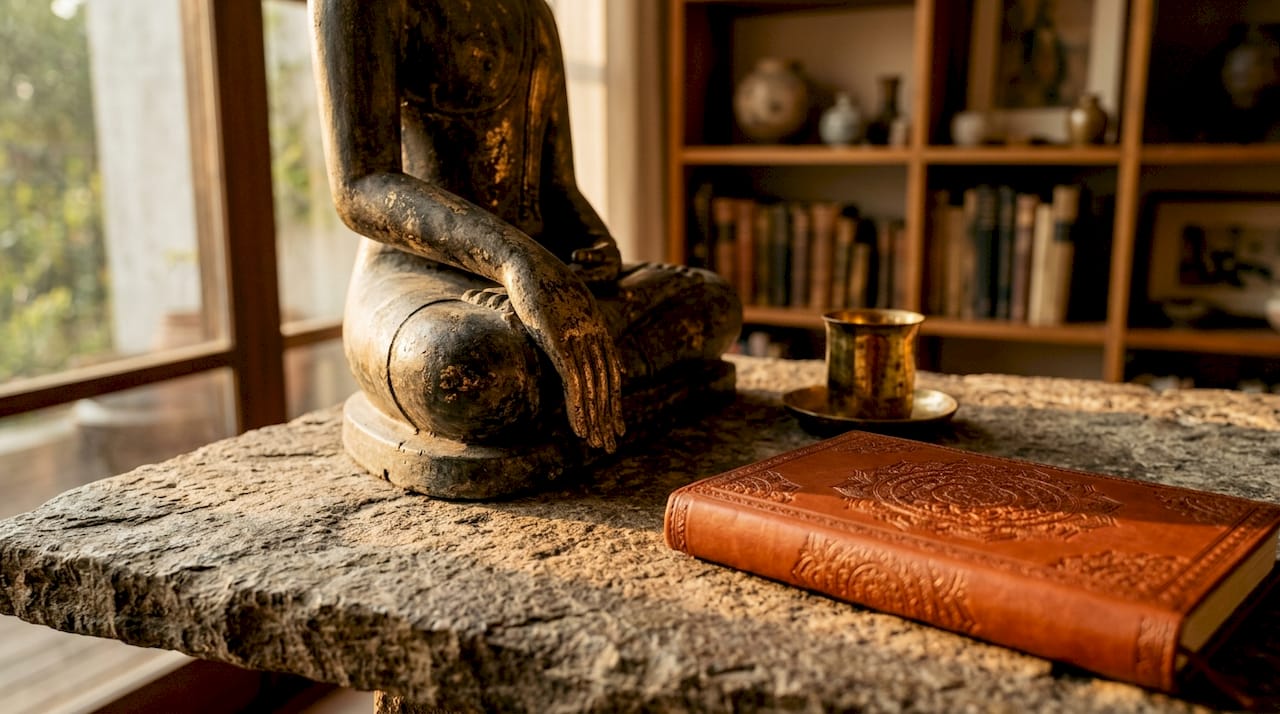
Understanding Thai Buddha statues as isolated objects misses most of what makes them significant. Sculpture, painting, gilding, and architecture create a total environment in Thai temples that shapes the spiritual experience of every visitor. At Wat Pho, the golden Buddha’s surface corresponds with richly ornamented ceilings and walls, forming a single cohesive decorative system rather than a statue placed in a room.
Gold leaf is the most visible material in Thai Buddhist art, and its purpose goes well beyond aesthetics. The golden surface reflects, absorbs, and diffuses temple light, making statues appear simultaneously solid and immaterial. That quality is intentional. Gold in Thai Buddhism represents purity, transcendence, and the luminous quality of enlightened mind. When you see a gold-covered statue glowing in candlelight, you are experiencing a carefully constructed theological statement.
Glass mosaic inlays, common in Rattanakosin-era work, serve a similar function. They catch and scatter light in ways that plain stone or bronze cannot. The Emerald Buddha at Wat Phra Kaeo sits within a chapel where reflective glass mosaics and gilded reliefs create an environment of concentrated sacred energy. The statue itself is relatively small. The environment around it does most of the spiritual work.
“A Thai Buddha statue removed from its temple setting loses approximately half its meaning. The light, scale, and surrounding imagery are not background. They are part of the artwork.” — Hdasianart
Pro Tip: When visiting Thai temples or studying temple photography, pay attention to the ceiling and wall decoration immediately surrounding a major statue. The relationship between statue and setting reveals the full artistic and spiritual intent of the commission.
Identifying Thai Buddha styles as a collector
Practical identification of different Buddha styles in Thailand comes down to a set of reliable visual signatures. These are the details that separate a trained eye from a casual observer.
-
Check the head finial. Sukhothai statues typically feature a flame-shaped finial called the ushnisha, rising sharply from the crown of the head. Ayutthaya work often shows a more conical or jeweled finial. Rattanakosin examples may include elaborate crowns or tiered decorative elements.
-
Read the face shape. Sukhothai faces are oval and serene, with arched brows that meet in a continuous line and a subtle smile. Ayutthaya faces are more symmetrical and formal. Khmer-influenced pieces show broader, more angular facial geometry.
-
Assess the ornamentation level. Minimal ornamentation with emphasis on body form points toward Sukhothai. Increasing jewelry, robes, and architectural detail suggest Ayutthaya or later periods. Heavy mosaic and gold work almost always signals Rattanakosin.
-
Identify crowned figures carefully. Statues with crowns and ornate jewelry typically represent bodhisattvas or protective figures rather than the historical Buddha. This distinction matters significantly for collectors and for accurate cultural understanding.
-
Consider material and technique. Bronze was used across all periods but with different casting techniques. Stone is more common in early Khmer-influenced work. Wood carvings appear frequently in northern Thai regional styles. The patina and casting quality of bronze pieces often helps establish approximate age and origin.
Collectors sometimes confuse Thai pieces with Burmese examples. For anyone who wants burmese buddha styles explained alongside Thai ones, the key distinction is that Burmese work tends toward more elaborate facial ornamentation, heavier robes with detailed folds, and a different treatment of the ushnisha. Thai pieces, particularly Sukhothai, emphasize the body’s overall line and spiritual expression over surface detail.
Cultural importance of Thai Buddha styles today
Thai Buddha statues are not museum artifacts in Thailand. They are active participants in daily religious life, national identity, and community practice. The Emerald Buddha at Wat Phra Kaeo embodies national identity, royalty, and devotion simultaneously. The King of Thailand changes its ceremonial costume three times a year to mark the seasons, a practice that connects contemporary Thai society directly to centuries of royal and religious tradition.
Understanding Thai Buddha statues means recognizing that the artistic legacy and the living religious practice are inseparable. Visitors to Thai temples must follow specific etiquette including removing shoes, dressing modestly, and never pointing feet toward a Buddha image. These are not tourist guidelines. They reflect a deeply held cultural understanding that these artworks are sacred presences, not decorative objects.
| Style period | Signature feature | Cultural role today |
|---|---|---|
| Sukhothai | Walking Buddha, flame finial | Widely reproduced as national symbol |
| Ayutthaya | Royal ornamentation, formal symmetry | Central to temple heritage tourism |
| Rattanakosin | Monumental scale, glass mosaic | Active worship sites, national identity |
For collectors and enthusiasts, engaging with Buddhist art in Thailand means going beyond aesthetics. Each piece carries a specific theological message, a historical context, and a cultural weight that informs its value and meaning.
My perspective on seeing these statues clearly
I have stood in front of the Reclining Buddha at Wat Pho, and my first reaction was scale. Pure, overwhelming scale. But what stayed with me was not the size. It was the feet. The soles are inlaid with 108 auspicious symbols in mother of pearl, each one a complete cosmological map. Most visitors photograph the length of the statue and move on. They miss the most detailed and theologically dense part of the entire work.
That experience shaped how I think about Thai Buddhist art. The assumption that bigger or more ornate means more important leads people past the most interesting details. Sukhothai walking Buddhas are relatively modest in size. Their power comes from proportion and line, from the way the body communicates movement and stillness at the same time. That is a harder artistic achievement than scale.
I also think the decorative object framing does genuine damage to how people engage with these pieces. When a Thai Buddha statue sits on a shelf as decor, it has been removed from the total environment that gives it meaning. That does not mean collecting is wrong. It means collectors have a responsibility to understand what they have and to communicate that context. The pieces in the Hdasianart collection come with exactly that kind of contextual grounding, and that makes a real difference to how you experience them over time.
The most useful thing you can do before buying or studying any Thai Buddha statue is learn to read the mudra first. Everything else follows from that.
— James, HDAsianArt.com
Explore authentic Thai Buddha statues at Hdasianart
Hdasianart specializes in museum-quality antique Thai Buddha statues and broader Asian Buddhist art, with each piece individually researched, photographed, and described by experts. The collection covers major Thai style periods including Sukhothai, Ayutthaya, and Rattanakosin, alongside pieces from Cambodia, Burma, Sri Lanka, and beyond. Every statue ships worldwide via insured DHL delivery. Whether you are building a serious collection or seeking a single significant piece, HDAsianArt provides the cultural context and provenance research that separates genuine collecting from casual acquisition. Browse the full collection at HDAsianArt.com and find pieces that carry the full weight of their history.
FAQ
What are the main Thai Buddha styles?
The four primary Thai Buddha art styles correspond to historical periods: Khmer-influenced, Sukhothai, Ayutthaya, and Rattanakosin. Each carries distinct visual signatures in facial form, ornamentation, and posture.
How do I identify a Sukhothai Buddha statue?
Sukhothai Buddhas feature an oval face, flame-shaped head finial, soft S-curved body, and are the only tradition to depict the walking Buddha posture as a major iconographic form.
What do Buddha hand gestures mean in Thai art?
Mudras communicate specific spiritual teachings: the earth-touching gesture marks enlightenment, raised palm signals protection, hands in the lap indicate meditation, and raised hands forming a wheel represent the first teaching.
How is a Thai Buddha different from a Burmese Buddha?
Thai Buddhas, especially Sukhothai examples, emphasize overall body line and serene facial expression. Burmese Buddha styles tend toward more elaborate robe folds, heavier facial ornamentation, and a different treatment of the crown finial.
Is it respectful to collect Thai Buddha statues?
Collecting is widely practiced and accepted when approached with cultural knowledge and respect. Understanding the statue’s period, iconography, and spiritual significance honors the tradition rather than reducing the piece to a decorative object.
