



Tara Statue Guide: Green Tara, White Tara & More
Tara Statue Guide: Green Tara, White Tara & More
Most people who buy a Tara statue know they want one before they fully understand why. There is something immediate and arresting about her presence, whether she appears in rich emerald green or luminous white, seated on a lotus with an expression that is simultaneously calm and fiercely attentive. But once you move past first impressions, the iconography of Tara rewards close attention.
Green Tara and White Tara are not interchangeable. They embody distinct qualities, serve different devotional purposes, and carry specific visual codes in their posture, hand gestures, and attributes. This guide unpacks all of it, practically and without mystification, so you can choose, display, and appreciate a Tara sculpture with genuine understanding.
Table of Contents
Quick Takeaways
|
Key Insight |
Explanation |
|---|---|
|
Tara is a fully enlightened bodhisattva |
She is not a minor deity or symbolic figure. In Tibetan Buddhism she is regarded as a complete, enlightened being who actively intervenes in the suffering of beings. |
|
Green Tara embodies swift, active compassion |
Her posture, with one leg extended and ready to rise, signals immediate response. She is associated with protection from fear and obstacles. |
|
White Tara is associated with longevity and healing |
She is depicted with seven eyes, including eyes on her palms, soles of her feet, and forehead, representing omniscient awareness of suffering across all realms. |
|
Twenty-one distinct forms of Tara exist in the Tibetan tradition |
Each form has a specific color, posture, attribute, and mantra. Green and White Tara are simply the two most widely venerated. |
|
Tara's origins span both Hindu and Buddhist traditions |
She appears as a goddess in the Hindu Shakta tradition before her adoption into Buddhism, which facilitated her spread across both religious frameworks. |
|
The Pala Empire was central to Tara iconography's development |
The 8th-century Pala rulers of Bengal and Bihar commissioned major Tara sculptures, cementing the visual conventions still used by craftspeople today. |
|
Material and craftsmanship quality matter for serious collectors |
Museum-quality Tara statues are typically cast in bronze or copper, often with fine gilding. The studios of Patan, Nepal, remain a benchmark for this craft. |
Who Is Tara? Origins of the Tibetan Buddhist Goddess
The name Tara comes from a Sanskrit root meaning "she who carries across" or "star," the idea being that she guides beings safely through difficulty the way a star guides a navigator through darkness. In the Tibetan Buddhist tradition, she is considered a fully enlightened bodhisattva: a being who has achieved the capacity for complete awakening and chooses to remain actively engaged in the world out of boundless compassion for all suffering beings.
The most widely told origin story in Tibetan Buddhism describes Tara as born from a tear shed by Avalokiteshvara, the bodhisattva of compassion. Avalokiteshvara had been contemplating the suffering of beings across countless worlds and wept. From that tear, a lotus arose from a lake, and from the lotus emerged Tara. The story is not merely poetic. It positions compassion as generative: grief powerful enough to produce an active, capable helper.
The first textual appearance of Tara as a distinct bodhisattva is connected to the Prajnaparamita Sutra, the great scripture of perfected wisdom, where the essence of Tara coincides with the rapidly evolving Mahayana Buddhist tradition. It was during the rise of the Pala Empire in 8th-century India, the last great Buddhist dynasty of the subcontinent, that her iconography became formally elaborated. Pala rulers commissioned significant Tara sculptures for temples and monasteries across Bengal and Bihar. The visual conventions established in that period, the lotus throne, the jeweled crown, the specific mudras and attributes, remain the foundation of the craftwork produced in Nepal, Tibet, and beyond today.
Tara also has a documented presence in the Hindu Shakta tradition, where she appears as one of the ten Mahavidyas, the great wisdom goddesses. Scholars note that this prior existence in Hindu devotional practice helped ease her acceptance across religious boundaries as Buddhism spread. For collectors and spiritual practitioners today, this layered history is part of what makes a Tara statue genuinely meaningful rather than merely decorative.
Tara is compassion made active, a quality so powerful that even its grief produces life and help. She does not merely feel for suffering beings. She moves toward them.
Green Tara Sculpture: Swift Action and Active Compassion
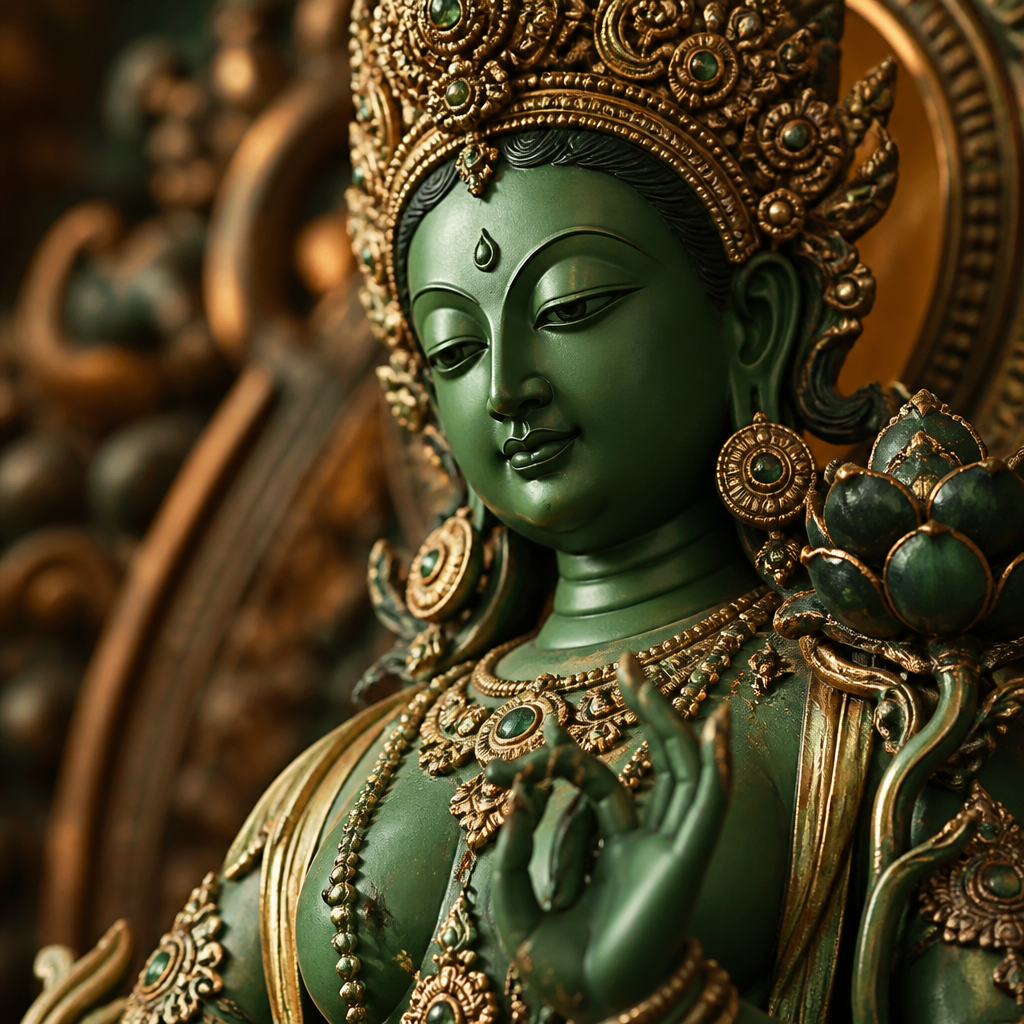
Of all the forms of Tara, Green Tara is the most immediately recognizable and the most widely reproduced in sculpture. Her defining characteristic is readiness. While most Buddhist figures in sculpture are seated in full lotus with both legs crossed, Green Tara sits with her right leg extended downward toward the viewer, her foot resting on a small lotus, as if she is already in the process of rising. This posture is not incidental. It is a deliberate iconographic statement: she is about to stand, about to move, available at the moment you call.
Green Tara's Color and What It Communicates
Her green color is associated with the wind element and with swift, unobstructed action. In the Tibetan system of color symbolism, green connects to the activity of enlightened beings, their capacity to respond quickly and without friction. A well-made Green Tara sculpture achieves this through both pose and finish: the figure should read as dynamic even in stillness.
What Green Tara Protects Against
Green Tara is specifically associated with protection from what the tradition calls the Eight Fears, a classical list of dangers that includes fire, flood, lions, elephants, snakes, thieves, imprisonment, and evil spirits. These are understood both literally and metaphorically: the fear of fire, for instance, also maps to the inner obstacle of anger. For practitioners who work with Green Tara through mantra and visualization, the protection being sought is as much internal as external.
Her mantra, Om Tare Tuttare Ture Svaha, is one of the most recited mantras in all of Tibetan Buddhism. The three syllables Tare, Tuttare, and Ture correspond respectively to liberation from samsara, liberation from the Eight Fears (both inner and outer), and liberation from delusion. Collectors who place a Green Tara statue on a meditation altar are typically aware of this mantra relationship, even if they do not use the mantra in formal practice.
Pro tip: When evaluating a Green Tara sculpture, look specifically at the right leg. It should extend downward with the foot resting on a lotus, not tucked inward. If both legs are crossed in full lotus, the figure may have been labeled incorrectly or represents a different form of Tara entirely.
White Tara Statue: Longevity, Healing, and the Seven Eyes
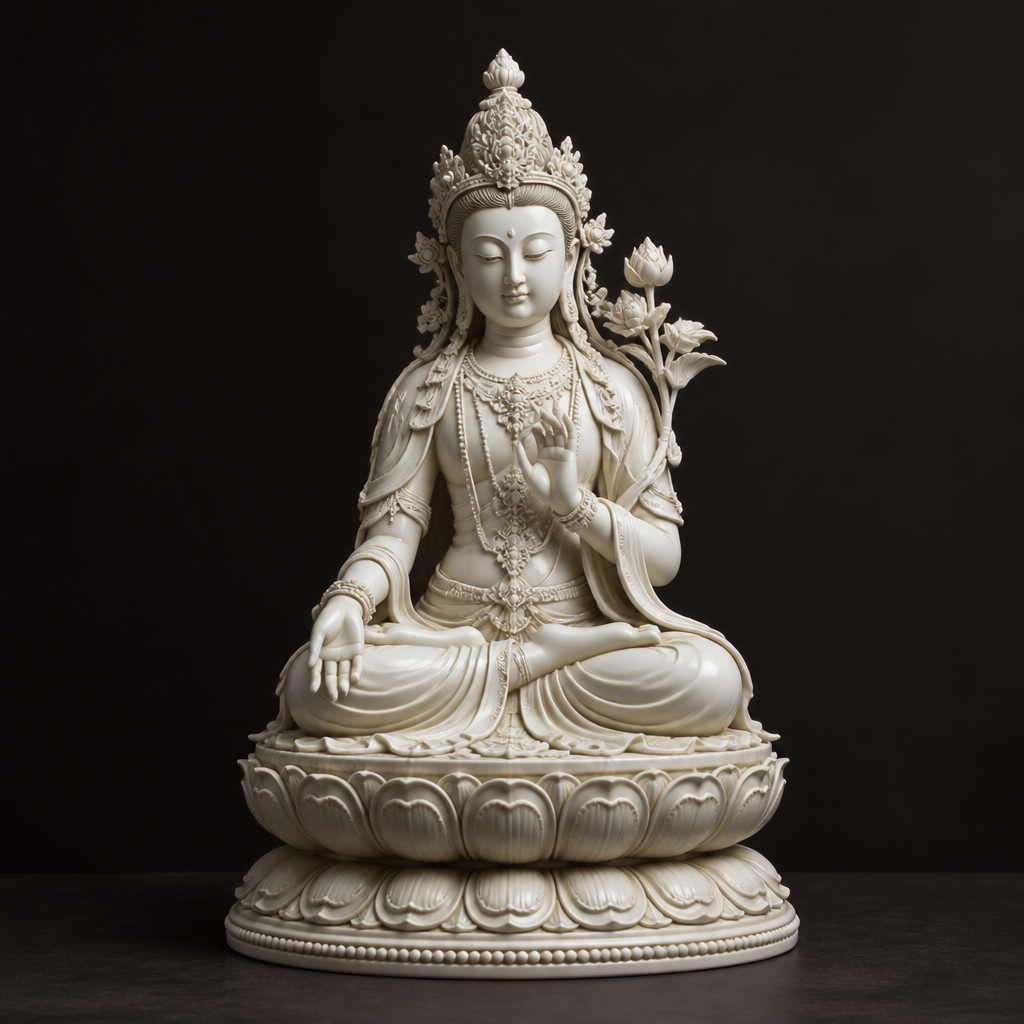
Where Green Tara leans forward in readiness, White Tara sits in full lotus, both legs crossed, perfectly upright. Her posture communicates a different quality: serene, pervasive awareness rather than imminent movement. She is associated with longevity, healing, and the removal of illness and obstacles to a long life. In Tibetan ritual practice, White Tara is specifically invoked in long-life ceremonies conducted for teachers, elders, and practitioners facing serious illness.
The Seven Eyes: What They Mean and How to Identify Them
White Tara's most distinctive iconographic feature is her seven eyes. In addition to the two eyes in her face, she has a third eye on her forehead, an eye on each of her two palms, and an eye on each of the soles of her feet. This is not decorative invention. The seven eyes represent omniscient awareness: the capacity to perceive suffering in every realm of existence simultaneously, with nothing hidden or overlooked. A Tara statue identified as White Tara but lacking the palm eyes is either poorly crafted or mislabeled. This is one of the clearest quality and authenticity checks available to a buyer.
White Tara's Color Symbolism
White in the Tibetan color system is associated with purity, the purification of obscurations, and the lunar quality of reflected wisdom light. White Tara's luminous white complexion signals that she works at the level of purification, clearing away the karmic and physical conditions that shorten life and produce illness. For collectors placing a White Tara on a home altar, this makes her the natural choice for a space oriented toward healing or honoring the health of family members.
Pro tip: Look for the third eye on White Tara's forehead before you look at anything else. Skilled sculptors mark it clearly, often with a slightly raised or inlaid dot. If it is absent, the figure has been simplified to the point of losing the iconographic meaning that distinguishes White Tara from other seated bodhisattva figures.
Green Tara vs. White Tara: A Direct Comparison
Collectors and practitioners frequently ask which form of Tara to choose. The honest answer is that the choice depends on what you are drawn to and what purpose the statue will serve, but there are clear differences that should inform that decision rather than be glossed over.
|
Feature |
Green Tara |
White Tara |
|---|---|---|
|
Primary quality |
Swift, active compassion and protection |
Longevity, healing, and purification |
|
Posture |
Right leg extended downward, left leg tucked in (lalitasana) |
Full lotus, both legs crossed (vajrasana) |
|
Color symbolism |
Green: wind element, enlightened activity, swift response |
White: purity, lunar wisdom, purification of obscurations |
|
Distinctive iconographic marker |
Right foot resting on a lotus, ready to rise |
Seven eyes: two facial, one forehead, two palms, two soles |
|
Associated ritual use |
Protection from the Eight Fears, clearing obstacles |
Long-life ceremonies, healing practice, illness prevention |
|
Mantra |
Om Tare Tuttare Ture Svaha |
Om Tare Tuttare Ture Mama Ayuh Punya Jnana Pustim Kuru Svaha |
|
Right hand gesture |
Varada mudra (gift-giving, palm outward and down) |
Varada mudra, sometimes combined with holding a lotus stem |
In practice, many collectors eventually acquire both forms. They are complementary rather than redundant: Green Tara for active protection and momentum, White Tara for the quieter, sustained work of healing and longevity.
The 21 Forms of Tara and What They Mean for Collectors
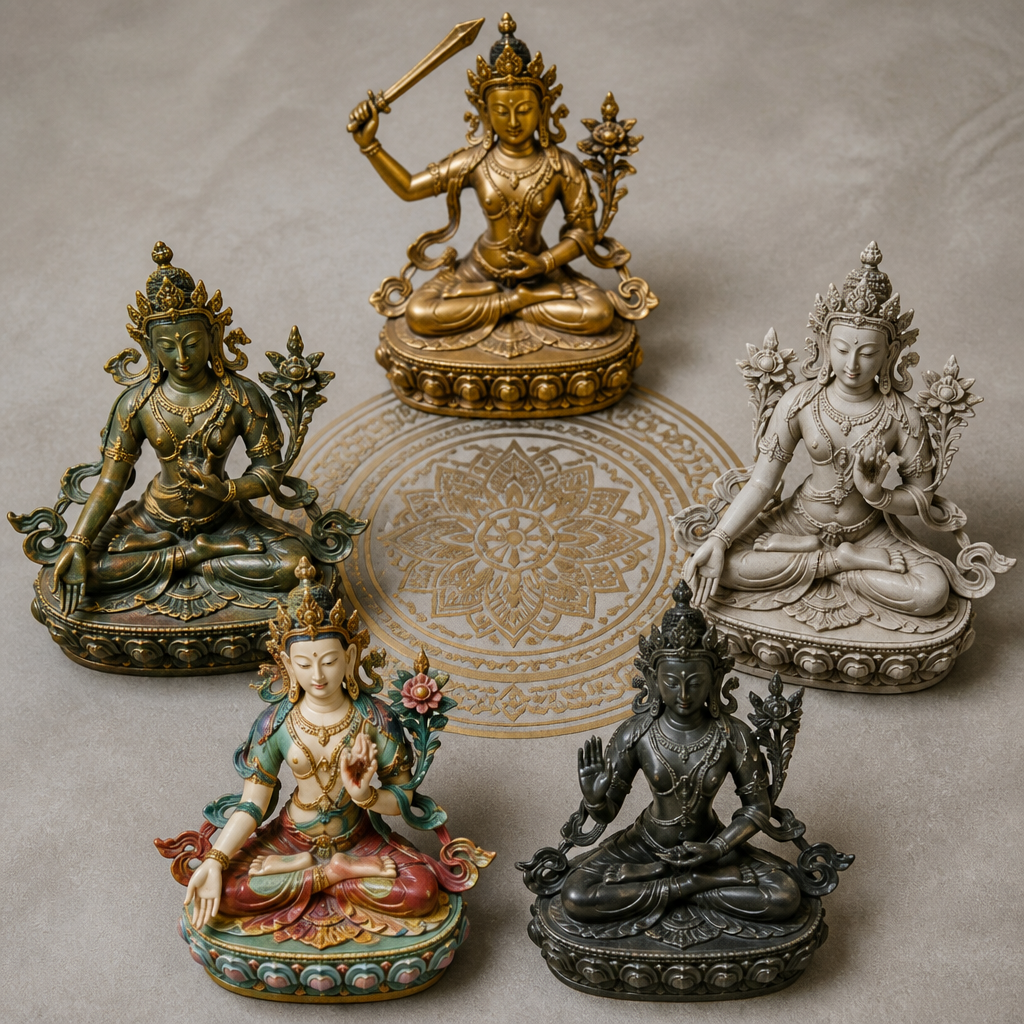
The Tibetan tradition formally recognizes 21 forms of Tara, each with a distinct color, posture, attribute set, and mantra. The 21 Taras are encoded in a prayer text, the Praises to the Twenty-One Taras, which remains one of the most recited liturgical texts in Tibetan Buddhism. Green Tara and White Tara are the two most widely venerated, but serious collectors and advanced practitioners often work with other forms as well.
Red Tara (Kurukulla): Magnetizing Power
Red Tara, known as Kurukulla, is the third most commonly represented form in sculpture after Green and White Tara. She is associated with magnetizing power: the capacity to attract favorable conditions, resources, and relationships. In iconography she is typically shown in a more dynamic, dancing posture, often holding a bow and arrow made of flowers. Red Tara statues appear frequently on altars oriented toward career, relationship, or creative work.
Other Named Forms
The remaining 18 forms range from the peaceful to the wrathful, including blue, yellow, and black manifestations of Tara. Each has specific ritual applications in Tibetan practice. For most collectors, green and white are the accessible entry points. But knowing that these two are part of a much larger mandala of 21 forms adds depth to how you understand any Tara piece, and it is worth asking a specialist retailer which form a particular sculpture actually represents before purchasing.
A common mistake is assuming that any seated female figure in Buddhist art is a Tara. In practice, she can be confused with Prajnaparamita (the goddess of wisdom), Vasudhara (a bodhisattva associated with abundance), or even certain forms of Guanyin. The posture, color, and hand gestures are the reliable distinguishing markers.
Choosing a Tara Statue: Material, Posture, and Placement
Buying a Tara statue is not the same as buying a decorative figurine. Even if you are approaching it purely as a collector rather than a practitioner, the iconographic accuracy, material quality, and craft tradition behind the piece determine its long-term value, both aesthetically and in terms of what it actually represents.
Material and Craft Tradition
Museum-quality Tara statues are typically cast in bronze or copper, often with cold-gold or fire-gilding. The studios of Patan in Nepal have been producing Buddhist metalwork for centuries and remain the benchmark for this craft internationally. Statues produced there by skilled artisans follow iconometric guidelines, the traditional proportional canons that govern everything from the height of the ushnisha (the cranial protuberance on the crown) to the width of the shoulders relative to the face. These proportions are not aesthetic preferences. They are technical specifications encoded in traditional texts, and their presence or absence is one of the clearest markers of quality.
Posture as Authenticity Check
As covered above, posture is the single quickest authenticity check. Green Tara should have one leg extended. White Tara should sit in full lotus with visible eye markings on the palms and forehead. If a piece is labeled as a specific form of Tara but the posture contradicts the label, either the labeling is wrong or the sculptor was working without reference to the tradition. Neither is a good sign for a serious purchase.
Placement on a Home Altar
Tara statues are traditionally placed at the center or to the left of center on a Buddhist altar, often at eye level when the practitioner is seated. For home decorators without a formal practice context, the key consideration is simply that the figure faces outward into the room rather than toward a wall. Tara's compassion, as the tradition frames it, is directed toward beings. A sculpture that faces outward honors that iconographic meaning even in a secular setting.
At HD Asian Art, the collection spans Buddhist sculpture from across Asia, including Tibetan-influenced pieces alongside statues from Burma, Cambodia, Thailand, and beyond. Browsing across these traditions side by side is one of the most effective ways to develop an eye for what distinguishes high-quality Buddhist sculpture from mass-produced replicas.
Frequently Asked Questions
What is the difference between Green Tara and White Tara in simple terms?
Green Tara is associated with swift, active protection and the removal of immediate obstacles. She sits with one leg extended, ready to act. White Tara is associated with longevity, healing, and purification. She sits in full lotus and is identified by her seven eyes. Both are fully enlightened bodhisattvas in the Tibetan Buddhist tradition, but they represent different expressions of compassion in action.
Is Tara a Hindu or Buddhist goddess?
Tara has a presence in both traditions. In Hinduism she is one of the ten Mahavidyas, the great wisdom goddesses of the Shakta tradition. In Buddhism, particularly Tibetan Buddhism, she is a fully developed bodhisattva with an extensive tradition of practice, iconography, and mantra. Scholars note that her prior existence in Hindu devotional practice helped facilitate her acceptance as Buddhism spread across South and Central Asia. The Buddhist and Hindu versions of Tara are related but distinct figures with different attributes and roles.
How do I identify a Green Tara statue correctly?
Look first at the posture. Green Tara should be seated with her right leg extended downward, resting on a small lotus, and her left leg folded inward. Her right hand rests on her right knee in the varada mudra, palm facing outward and down in a gesture of giving. Her left hand is raised at chest height, holding the stem of a blue lotus. Her color is green. If any of these markers are absent, confirm with the seller which specific form the statue represents.
What does the Green Tara mantra mean?
The Green Tara mantra is Om Tare Tuttare Ture Svaha. The three main syllables carry distinct meanings: Tare refers to liberation from samsara, the cycle of conditioned existence. Tuttare refers to liberation from the Eight Fears, both external dangers and their inner equivalents such as anger, ignorance, and pride. Ture refers to liberation from delusion at the subtlest level. Svaha is a closing syllable of affirmation used in many Sanskrit mantras. Together, the mantra invokes Tara's capacity to free beings across all three dimensions of suffering.
Can I place a Tara statue in my home if I am not a Buddhist practitioner?
Yes. Many collectors and home decorators place Tara statues for their aesthetic and cultural significance without maintaining a formal Buddhist practice. If you choose to do this, the main practical consideration is placement: the figure should face outward into the room, and the space around it should be reasonably clean and respectful. You do not need to maintain a formal altar or recite mantras for the statue to be a meaningful and well-placed object in a home. That said, understanding the iconographic meaning behind the piece deepens your appreciation of it and helps you choose the right form for the context.
How many forms of Tara are there, and which should a beginner collect first?
The Tibetan tradition formally recognizes 21 forms of Tara, each with distinct colors, postures, attributes, and mantras. For a first purchase, Green Tara is the most practical starting point. She is the most widely recognized form, has the clearest iconographic markers for verifying authenticity, and her association with swift protection and obstacle removal resonates with a wide range of spiritual and personal contexts. White Tara is a natural second choice, particularly if healing or longevity is a meaningful focus. From there, Red Tara (Kurukulla) and other forms can deepen a collection.
What materials are used in high-quality Tara statues?
The highest quality Tara statues are cast in bronze or copper, frequently with cold-gold or fire-gilding applied to the surface. Patan, Nepal, is historically the most significant center for this craft, and skilled Patan artisans follow traditional iconometric proportional guidelines encoded in Tibetan Buddhist texts. Stone sculptures in schist or sandstone, produced in the Pala period and earlier, represent an older tradition and are significant as antiques. For a collector entering the market today, bronze or copper with accurate iconography and fine surface finishing is the benchmark for a museum-quality piece.
If you have experience choosing or displaying a Tara statue, whether as a collector, a practitioner, or simply someone drawn to the art, share what guided your decision in the comments below.
We would love your feedback and any insights you would share with others. What perspective would you add?
References
