



Sukhothai Buddha Style Characteristics: Collector's Guide
Sukhothai Buddha Style Characteristics: Collector's Guide
The Sukhothai Buddha style is defined by sinuous curves and cylindrical forms that create a boneless, weightless elegance unlike any other regional tradition in Southeast Asian art. Produced during the first major Tai kingdom from the 13th to 15th centuries, these sculptures draw body proportions from natural analogies: shoulders shaped like an elephant’s trunk, a torso modeled on a lion, and a nose curved like a parrot’s beak.
For collectors and art enthusiasts, understanding the Sukhothai buddha style characteristics means reading a visual language built from Theravada Buddhist symbolism, Khmer architectural influence, and Sri Lankan spiritual iconography. This guide breaks down every defining feature, from posture to patina.
1. What are the core sukhothai buddha style characteristics?
The Sukhothai style, known formally in Thai art history as the Sukhothai school, produces figures that appear to float rather than stand. Sinuous curves replace rigid geometry, giving each statue a fluid, almost liquid quality that no earlier Thai tradition achieved. This effect is deliberate. Sculptors working under Theravada Buddhist doctrine used idealized, non-anatomical forms to signal transcendence over the physical body.
The body proportions follow a set of nature-based analogies that scholars have documented consistently across surviving pieces. Shoulders taper like an elephant’s trunk. The chest broadens like a lion’s torso. The nose curves downward like a parrot’s beak. These are not decorative choices. They are codified references to the 32 physical marks of a Buddha described in Pali canonical texts.
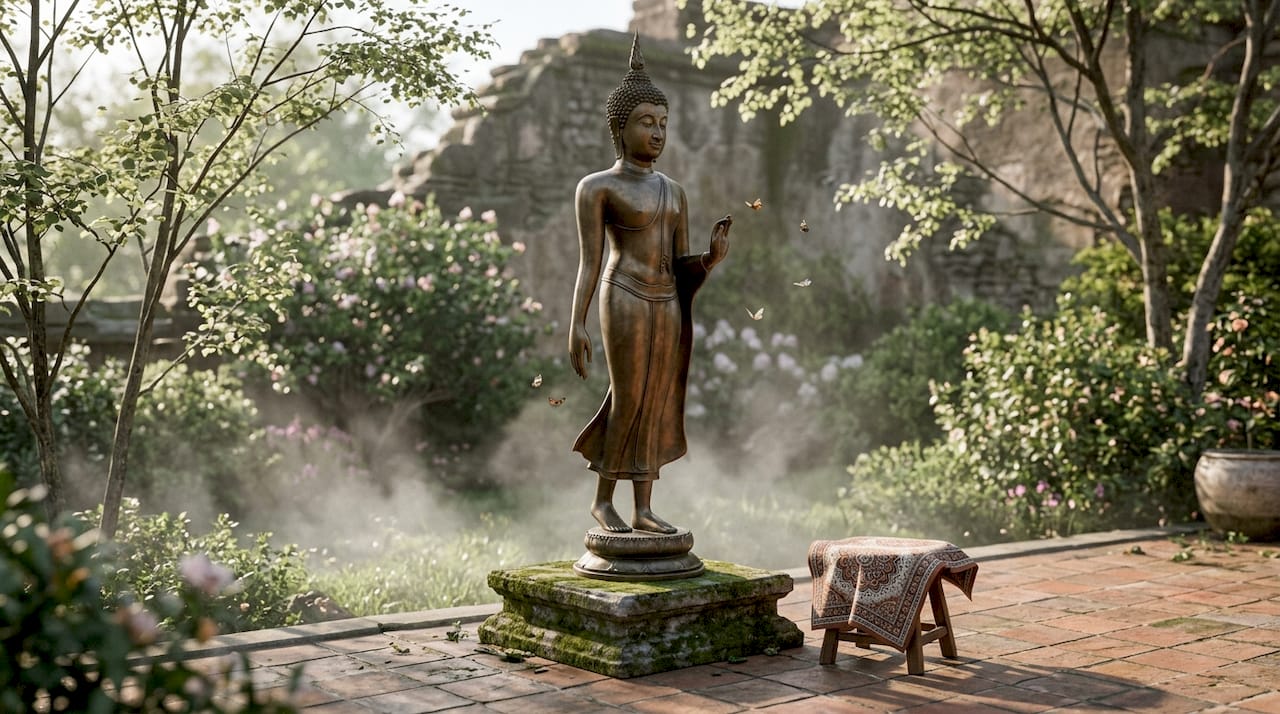
Pro Tip: When examining a Sukhothai statue for the first time, trace the silhouette from head to toe. A genuine Sukhothai piece produces a continuous, unbroken S-curve. Any angular interruption suggests a later Ayutthaya or Bangkok period piece.
2. Flame-shaped ushnisha and the head’s symbolic crown
The flame-shaped finial above the ushnisha) is the single most recognizable feature of Sukhothai Buddha statues. The ushnisha is the cranial protuberance that marks a Buddha’s enlightened wisdom. In Sukhothai sculpture, this protuberance terminates in a pointed flame, inherited directly from Sri Lankan Buddhist art traditions. The flame symbolizes the light of spiritual knowledge radiating outward.
Earlier Khmer-influenced Thai statues used a conical or lotus-bud finial instead. The shift to a flame form marks a clear stylistic break and a conscious theological statement. Collectors use this feature as a primary dating indicator when assessing a piece’s period and origin.
3. Facial expression and the language of serenity
The facial expression in Sukhothai Buddha art is designed to evoke calm, gentle strength. Soft features, slightly downcast eyes, and a subtle upward curve at the corners of the mouth produce what art historians call the “inner smile.” This expression does not depict happiness. It depicts the state of equanimity that follows enlightenment.
The face is typically oval, with a broad forehead, arched brows that meet at the bridge of the nose, and elongated earlobes. The elongated earlobes reference the heavy gold earrings worn by the historical Siddhartha Gautama before renunciation. Each facial element carries doctrinal weight, not merely aesthetic preference.
4. Historical and cultural influences shaping the style
Sukhothai art blends Khmer rigidity with Sri Lankan Buddhist fluidity, producing a horizontally expansive, serene aesthetic that became foundational for all subsequent Thai art. The Sukhothai kingdom, established in the mid-13th century in what is now north-central Thailand, inherited Khmer temple architecture and iconographic conventions. Local Thai artists then absorbed Sri Lankan Theravada Buddhist models arriving via trade and religious exchange with Lanka.
The synthesis produced something genuinely new. Khmer forms supplied structural discipline. Sri Lankan models supplied the flame ushnisha, the walking Buddha posture, and a preference for spiritual grace over physical power. Theravada doctrine shaped the iconographic program, linking every gesture, proportion, and motif to specific teachings. The Sukhothai Historical Park), a UNESCO World Heritage site, preserves the temples and statues where this synthesis is most visible.
The numbered sequence below traces the key cultural inputs that shaped the style:
- Khmer influence supplied architectural framing, early iconographic conventions, and frontal compositional discipline.
- Sri Lankan (Singhalese) Buddhist models introduced the flame ushnisha, the walking posture, and a preference for serene, non-confrontational expression.
- Theravada Buddhist doctrine linked every formal element to the 32 marks of a great being and to specific hand gestures (mudras) with doctrinal meaning.
- Local Thai innovation produced the fully fluid, boneless body type and the distinctive oval face that no imported model fully anticipated.
- Regional trade networks carried bronze-casting techniques and iconographic manuscripts that standardized the style across the kingdom’s workshops.
5. Distinctive postures and mudras of Sukhothai sculptures
Sukhothai statues often portray walking postures unique among Thai Buddhist styles. The walking Buddha, with one foot raised and the body in mid-stride, embodies the Buddhist teaching path and spiritual progress. No other major Thai school produced this posture with the same frequency or refinement.
The key postures and gestures found in Sukhothai period sculptures include:
- Walking Buddha (pang lila): The figure strides forward with the right hand raised in the abhaya mudra, the gesture of reassurance and protection. The body sways slightly, conveying movement without tension.
- Seated Buddha in meditation (dhyana mudra): Both hands rest in the lap, palms upward. This posture appears frequently at Wat Si Chum, where a massive seated figure occupies an open-topped square structure.
- Abhaya mudra (right hand raised): The right hand lifts with palm facing outward. This gesture signals the dispelling of fear and the granting of protection to devotees.
- Subduing Mara (bhumisparsha mudra): The right hand reaches downward to touch the earth, calling the earth goddess to witness the moment of enlightenment. This is the most common seated posture across all Thai styles, including Sukhothai.
Theravada Buddhist symbolism) links each mudra to a specific episode in the Buddha’s life or a specific teaching. Collectors who recognize these gestures can identify not just the style but the precise doctrinal context the sculptor intended.
6. How Sukhothai style compares to other Thai and regional styles
Sukhothai statues contrast sharply with Khmer art, which favors rigid, frontal representations with a powerful, almost confrontational physical presence. The table below maps the key differences across four major traditions.
| Feature | Sukhothai | Khmer | Mon | Ayutthaya |
|---|---|---|---|---|
| Body form | Fluid, boneless curves | Rigid, muscular | Naturalistic, grounded | More geometric, ornate |
| Facial expression | Inner smile, serene | Stern, powerful | Gentle, realistic | Formal, regal |
| Ushnisha finial | Flame-shaped | Lotus bud or conical | Rounded or absent | Jeweled crown or flame |
| Walking posture | Common and refined | Rare | Rare | Uncommon |
| Primary material | Bronze, stucco | Sandstone, bronze | Stone, terracotta | Bronze, gilded bronze |
| Dominant influence | Sri Lanka, Khmer | Hindu-Buddhist synthesis | Indian Gupta tradition | Sukhothai, Khmer |
The Ayutthaya style, which succeeded Sukhothai after the 15th century, retained the flame ushnisha but added royal regalia, jeweled crowns, and more formal proportions. The Mon style, centered in lower Burma and the Chao Phraya basin, favored a more grounded, realistic body type closer to Indian Gupta models. Sukhothai sits between these traditions as the most spiritually abstract and formally elegant of the group.
7. How to identify authentic Sukhothai Buddha statues
Collectors value authentic Sukhothai statues for their smooth surface, serene facial expression, and proportional balance. Recognizing these features is the first step in differentiating genuine pieces from later reproductions.
Key indicators of an authentic Sukhothai period piece include:
- Surface texture: Original bronze pieces show a fine, even patina with green or brown oxidation consistent with centuries of exposure. Stucco originals show layered mineral deposits.
- Proportional balance: The head-to-body ratio follows the canonical seven-to-one proportion. Reproductions frequently compress the torso or enlarge the head.
- Flame ushnisha: The flame should taper to a sharp, organic point. Machine-cast reproductions produce a symmetrical, overly regular flame that lacks the slight asymmetry of hand-finished originals.
- Facial refinement: The serene facial expression on genuine pieces shows subtle modeling around the eyes and mouth. Reproductions tend to flatten these transitions.
- Casting seams: Authentic bronze pieces show evidence of hand-finishing where casting seams were worked down. Modern reproductions leave cleaner, more uniform seams.
Pro Tip: Request thermoluminescence (TL) testing or X-ray fluorescence (XRF) analysis for any significant acquisition. These tests date the firing of ceramic cores in bronze casting and identify alloy compositions consistent with historical Sukhothai workshops.
For collectors building a serious collection, the dating guide for antique Thai Buddha images at HDAsianArt provides period-specific markers that go beyond visual inspection.
Key takeaways
The Sukhothai Buddha style is the most spiritually abstract and formally distinctive school in Thai Buddhist art, defined by fluid curves, flame-shaped ushnisha, and nature-based body proportions rooted in Theravada doctrine.
| Point | Details |
|---|---|
| Boneless, fluid body form | Sinuous curves and cylindrical proportions create a weightless, transcendent appearance unique to Sukhothai. |
| Flame ushnisha as dating marker | The flame-shaped finial above the cranial protuberance distinguishes Sukhothai from Khmer and Mon period pieces. |
| Walking Buddha posture | The pang lila walking posture is rare in other Thai styles and serves as a primary identification feature. |
| Sri Lankan and Khmer synthesis | The style fuses Sri Lankan spiritual fluidity with Khmer structural discipline, producing a new Thai aesthetic. |
| Collector authentication focus | Smooth patina, proportional balance, and hand-finished casting seams are the three primary authenticity indicators. |
What 20 years with Sukhothai sculpture taught me
The first time I held a genuine Sukhothai bronze, I expected to feel the weight of history. What I actually felt was how light it seemed, not physically, but visually. The figure appeared to hover above my hands. That quality, the sense that the sculptor was trying to depict something beyond physical matter, is what separates Sukhothai work from every other regional tradition I have studied.
Most collectors come to Sukhothai through the walking Buddha. It is the obvious entry point, the posture no other school mastered. But the real depth of the style lives in the face. The inner smile and downcast eyes are not decorative. They are a theological argument rendered in bronze. The sculptor is saying: this being has moved beyond desire, beyond fear, beyond the need to engage with the world on the world’s terms.
What I find collectors consistently underestimate is the Sri Lankan connection. Most people know Khmer art shaped early Thai sculpture. Far fewer recognize how deeply the Sri Lankan Buddhist art tradition shaped the Sukhothai school’s spiritual vocabulary. The flame ushnisha, the walking posture, the emphasis on serenity over power: all of these trace back to Lanka, not to Angkor.
The challenge with collecting Sukhothai pieces today is the reproduction market. The style is so visually compelling that it has been copied continuously since the Ayutthaya period. Authentic pieces require patience, provenance research, and ideally scientific testing. The reward is a work of art that has not aged in any meaningful sense. A Sukhothai Buddha from the 14th century looks as alive today as it did when it left the workshop.
— James, HDAsianArt.com
Authentic Thai Buddhist statues at HDAsianArt
HDAsianArt specializes in museum-quality Buddhist and Hindu sculptures from Thailand, Cambodia, Indonesia, Sri Lanka, and beyond. Each piece in the collection is individually researched, photographed, and described by specialists with direct knowledge of regional styles and periods.
Collectors interested in traditional Thai Buddhist art will find pieces that reflect the formal vocabulary discussed in this guide, including statues in the teaching mudra that demonstrate the proportional discipline central to the Thai sculptural tradition. The large antique Thai Buddha in teaching mudra is one example of the quality and scale available. Every acquisition ships worldwide via insured DHL, with full documentation supporting provenance and authenticity.
FAQ
What makes Sukhothai Buddha style unique among Thai art styles?
The Sukhothai style is unique for its fluid, boneless body form, flame-shaped ushnisha, and the walking Buddha posture. These features reflect a deliberate synthesis of Sri Lankan and Khmer influences filtered through Theravada Buddhist iconographic doctrine.
How do I identify a Sukhothai Buddha statue?
Look for a continuous S-curve silhouette, an oval face with a subtle inner smile, a flame-shaped finial above the cranial protuberance, and a smooth, even surface patina. The walking posture is also a strong Sukhothai identifier not common in other Thai schools.
What materials were used in Sukhothai period sculptures?
Sukhothai sculptors worked primarily in bronze and stucco, with some stone examples. Bronze pieces were cast using the lost-wax method and hand-finished to achieve the smooth surface texture that collectors prize for authenticity.
How does Sukhothai style differ from Khmer Buddhist art?
Khmer art favors rigid, frontal, muscular figures with a powerful presence. Sukhothai art produces fluid, serene figures with a weightless quality. The Sukhothai flame ushnisha also replaces the Khmer lotus-bud finial, marking a clear theological and stylistic departure.
Where can I see original Sukhothai Buddha statues?
The Sukhothai Historical Park) in north-central Thailand, a UNESCO World Heritage site, preserves the most significant surviving examples. The Bangkok National Museum also holds a major collection of Sukhothai period bronzes and stucco works.
