



Sri Lankan Buddha Statues: Gandharan Influence and Kandyan Style
Sri Lankan Buddha Statues: Gandharan Influence and Kandyan Style
Most collectors who seek a Sri Lankan Buddha statue already know they want something different from Thai or Cambodian sculpture, but few can articulate exactly why Sri Lankan pieces carry such a distinct visual authority. The answer lies in a layered history stretching from the ancient Gandharan workshops of northwestern South Asia through to the refined Kandyan court ateliers of the seventeenth and eighteenth centuries.
Understanding that history is not academic luxury. It is the difference between recognising a genuinely significant piece and paying collector prices for a reproduction with no cultural depth behind it.
Table of Contents
Quick Takeaways
|
Key Insight |
Explanation |
|---|---|
|
Gandharan influence shaped early iconography |
Sri Lankan sculptors inherited the urna, ushnisha, and elongated earlobes directly from Gandharan conventions transmitted via Indian Amaravati workshops. |
|
The Kandyan style is uniquely Sri Lankan |
Developed under the Kandyan Kingdom (1469-1815 CE), it features a flame-shaped ushnisha, jewelled ornamentation, and a seated posture with rigid symmetry not found in mainland Asian traditions. |
|
Gilded lacquer is a signature Kandyan material |
Kandyan statues are frequently finished in thick lacquer and gold leaf, a technique borrowed from Burma but applied with a distinctively Sinhalese decorative vocabulary. |
|
Ceylon Buddhist sculpture often depicts Samadhi posture |
The meditation pose with both hands resting in the lap is the dominant Kandyan posture, reflecting the Theravada emphasis on meditative practice over active gesture. |
|
Iconographic rigidity distinguishes Kandyan from Thai work |
Unlike Thai Buddha images which show regional stylistic variation across kingdoms, Kandyan iconography was tightly regulated by royal patronage, producing a more uniform canon. |
|
Wood is the primary medium, not bronze |
Kandyan sculptors preferred jak wood and other tropical hardwoods over bronze, which distinguishes Sri Lankan pieces from the metal-dominated traditions of Thailand and Burma. |
|
Flame ushnisha signals Kandyan provenance |
A pointed, tapering flame finial atop the head is the single most reliable visual marker of authentic Kandyan-period workmanship. |
The Gandharan Roots of Sri Lankan Buddhist Sculpture
Buddhism reached Sri Lanka, according to Pali chronicles, in the third century BCE during the reign of King Devanampiya Tissa, transmitted by Mahinda, a monk identified in tradition as the son of the Indian emperor Ashoka. What arrived was not yet a sculptural tradition. The earliest Theravada Buddhism resisted anthropomorphic representation of the Buddha, using footprints, empty thrones, and the Bodhi tree as symbolic stand-ins instead.
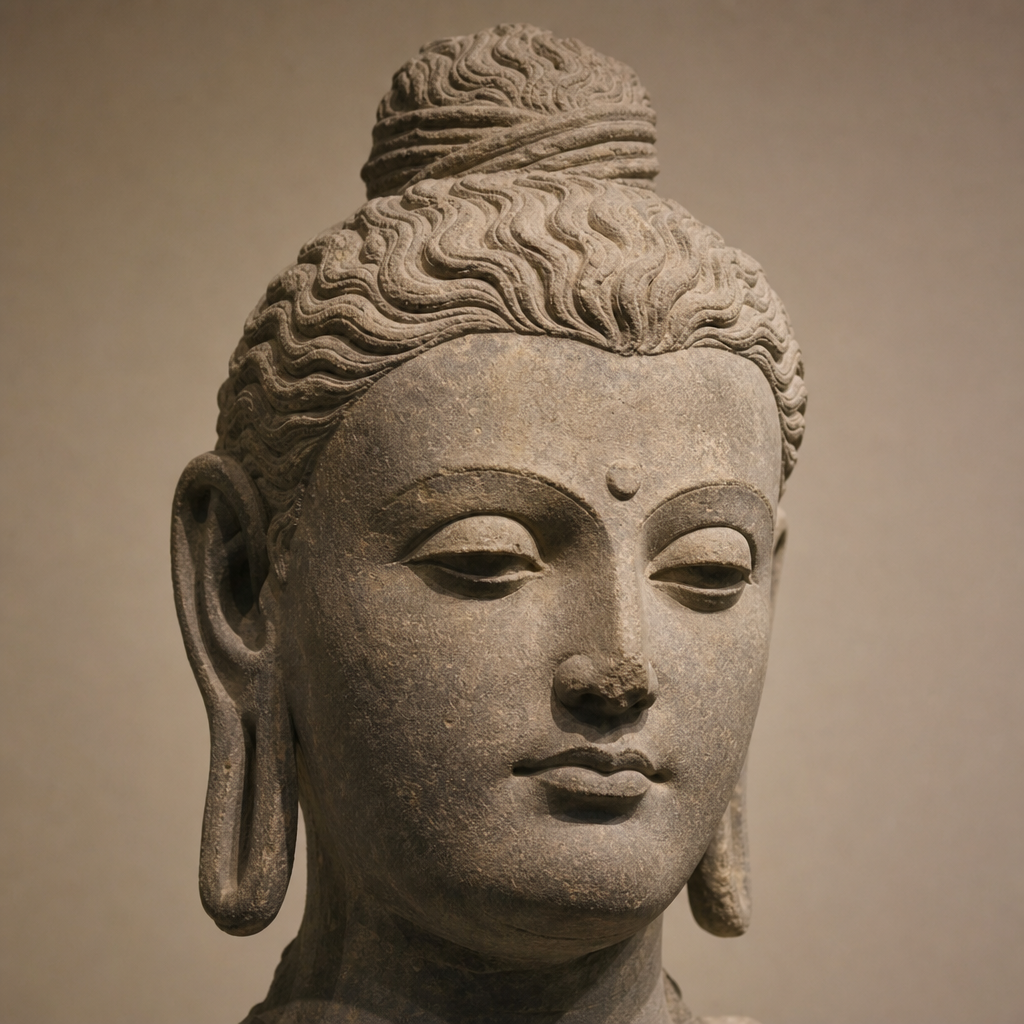
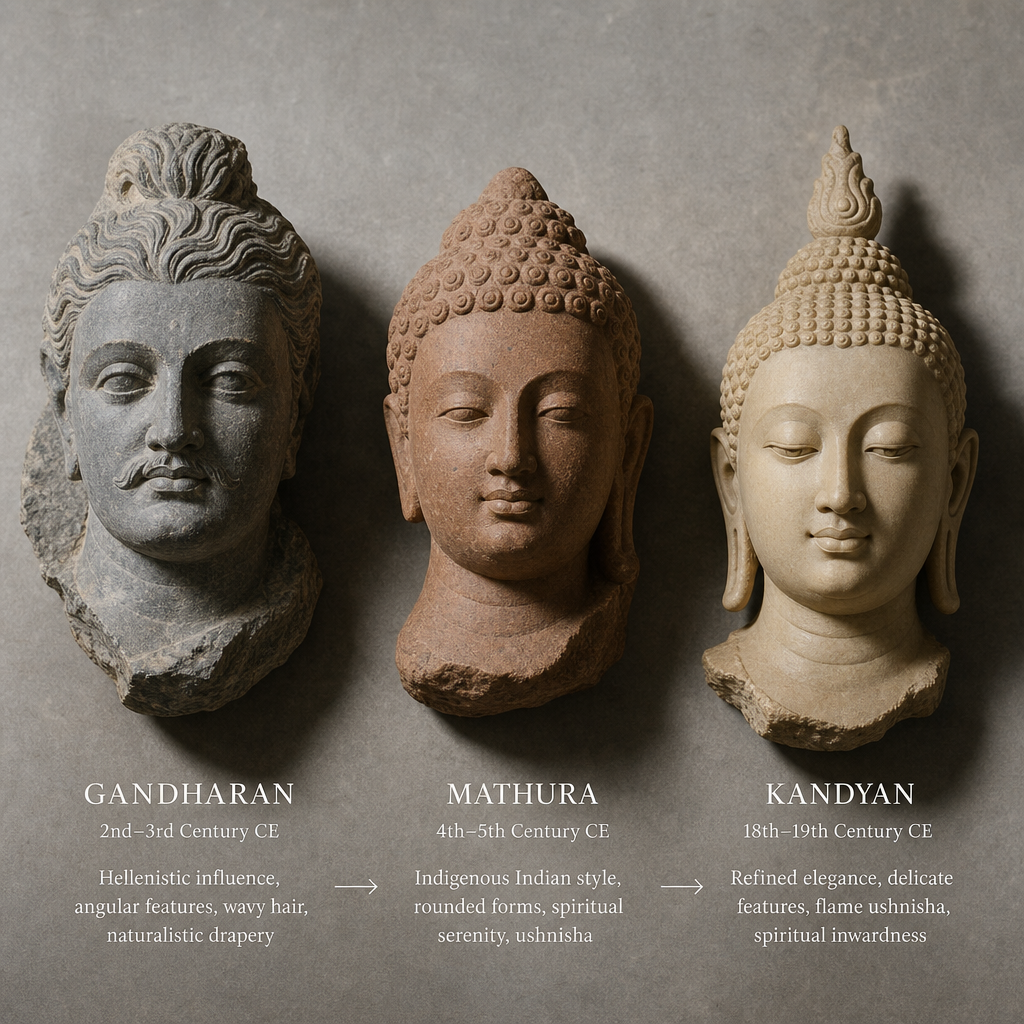
The shift toward figurative sculpture came from the northwest, from the Gandharan ateliers clustered around modern-day Pakistan and Afghanistan. Gandharan sculpture is famous for its Greek-inflected realism, the product of Alexander the Great's campaigns and the subsequent Greco-Bactrian kingdoms. Drapery falls in wet, clinging folds reminiscent of Hellenistic marble work. Facial features are naturalistic rather than schematised. The ushnisha, the cranial protuberance marking the Buddha's supreme wisdom, appears as a modelled topknot rather than an abstract geometric form.
These conventions did not arrive in Sri Lanka directly from Gandhara. They were filtered through the Amaravati school of southern India, which had its own modifications: thinner, more linear drapery, a flatter pictorial sensibility, and an emphasis on narrative relief panels. Sri Lanka sits geographically close to South India, and the Amaravati influence is palpable in the earliest surviving Sri Lankan sculptures from the Anuradhapura period. The elongated earlobes, the downcast meditative gaze, and the transparent robe clinging to the body all derive from this Gandhara-to-Amaravati transmission chain.
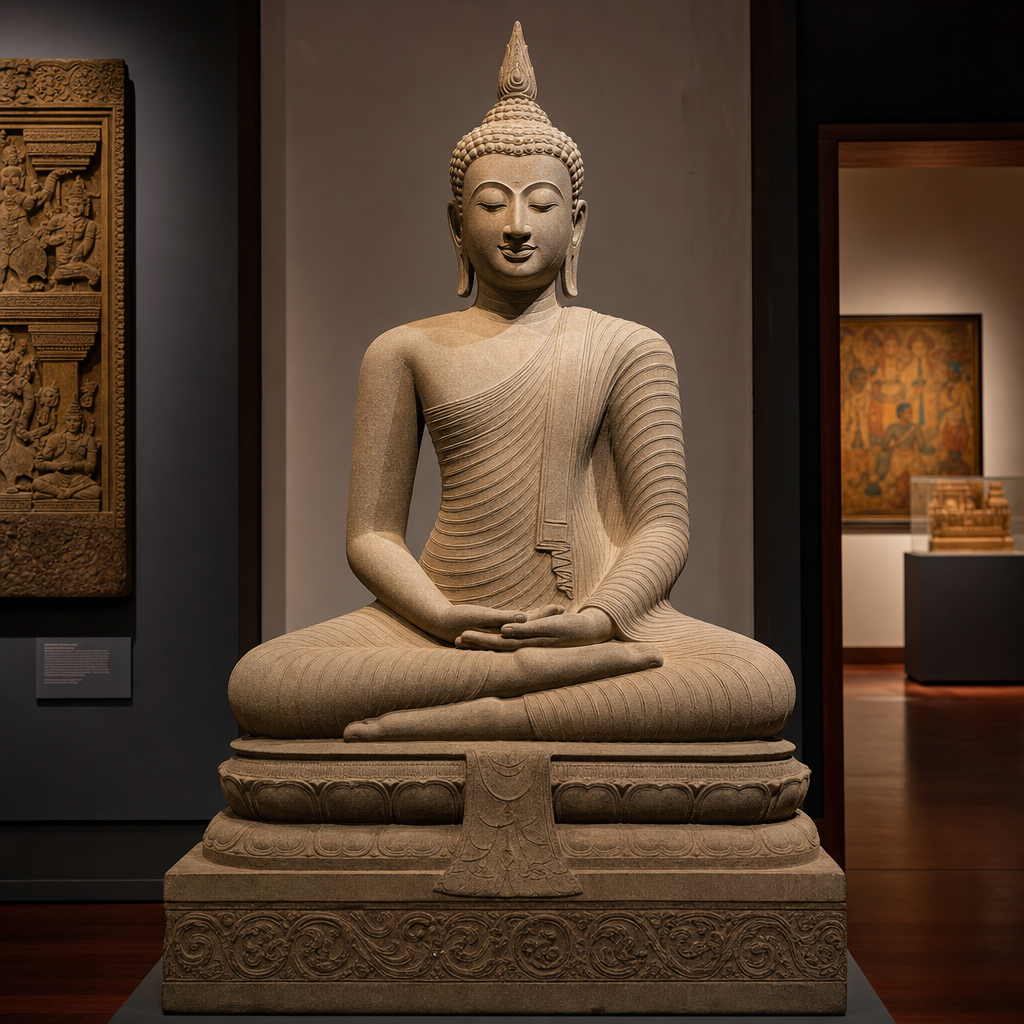
Pro tip: When examining an early Sri Lankan Buddha statue, look at the treatment of the robe. If the fabric appears almost invisible, clinging to the body with only thin parallel ridges to suggest drapery, you are looking at Amaravati-derived Gandharan influence working through a South Indian filter. This is one of the clearest ways to distinguish genuinely early Sri Lankan iconography from later Kandyan work where robes are rendered in bold, stylised folds.
The Anuradhapura Period: First Synthesis on the Island
The Anuradhapura period (circa 250 BCE to 1017 CE) represents the longest continuous phase of Sri Lankan Buddhist culture and the crucible in which a distinctively Sinhalese sculptural language began to form. The ancient capital of Anuradhapura served as the centre of Theravada orthodoxy, and its art reflects that doctrinal conservatism: images are restrained, iconographically precise, and avoid the devotional exuberance that characterises later Mahayana-influenced work.
The Samadhi Buddha of Anuradhapura
The most celebrated single monument of this period is the fourth-century Samadhi Buddha, a seated meditation figure carved in crystalline limestone. Art historians consistently cite it as one of the finest examples of South Asian Buddhist sculpture. The face carries an expression of profound interior calm, the mouth barely suggesting a smile, the eyes half-lowered in a state that is neither sleep nor waking. This quality, difficult to define but immediately recognisable, became the aesthetic ideal that Sinhalese sculptors pursued for more than a millennium afterward.
The Samadhi Buddha's hands rest in the dhyana mudra, the meditation gesture, in the lap. This posture would remain dominant in Sri Lankan sculpture across every subsequent period, a point of continuity that distinguishes Ceylon Buddhist sculpture from, say, Thai traditions where standing and walking Buddhas are equally canonical.
Material Choices and Their Significance
Anuradhapura sculptors worked primarily in limestone and granite, materials available locally in Sri Lanka's dry zone. Bronze casting existed but was secondary. This material preference established a pattern: Sri Lankan Buddhist sculpture would remain predominantly a tradition of stone and, later, wood carving rather than metal casting. Collectors should understand this distinction when comparing Sri Lankan pieces with Burmese or Thai examples where bronze dominates.
The Polonnaruwa Transition and Mahayana Influence
When the Chola dynasty from South India conquered Anuradhapura in 1017 CE, the Sinhalese Buddhist kingdom relocated its capital to Polonnaruwa. The following two centuries produced a second golden age of Sri Lankan sculpture, and the artistic output of this period shows a noticeable shift in ambition and scale.
The most famous examples are the colossal rock-cut figures at Gal Vihara, carved directly into a granite face in the twelfth century under King Parakramabahu I. The complex includes a seated Buddha in meditation, a standing figure over seven metres tall, and a reclining figure measuring fourteen metres in length. These are not intimate devotional objects. They are statements of royal power expressed through Buddhist imagery.
The Polonnaruwa period absorbed Mahayana iconographic elements from the Indian mainland, including some decorative elaboration of the crown and jewelled ornamentation that had no place in strict Theravada iconography. This was not a doctrinal shift but a visual one, driven partly by contact with the Sailendra kingdom of Java and partly by the competitive desire to match the visual grandeur of mainland Buddhist monuments. The tension between Theravada austerity and decorative elaboration that emerges here would define Kandyan art three centuries later.
"The Gal Vihara sculptures represent the culmination of Sri Lankan monastic art. They show a culture in total command of its visual language, able to operate at any scale from intimate votive image to monumental rock-cut colossi." - Susan Huntington, The Art of Ancient India, 1985.
The Kandyan Buddha Style Defined
The Kandyan Buddha style is the most immediately recognisable strand of Ceylon Buddhist sculpture for Western collectors, and for good reason. It is visually dramatic, technically accomplished, and iconographically distinct enough to be identified at a glance once you know what to look for. It emerged from the Kandyan Kingdom, which controlled the central highlands of Sri Lanka from 1469 until British annexation in 1815.
The Flame Ushnisha
The single most distinctive feature of a Kandyan Buddha statue is the flame-shaped ushnisha. Where Gandharan and Anuradhapura images rendered this cranial protuberance as a smooth topknot or a series of tight curls, Kandyan sculptors transformed it into an elongated tapering flame, often spiralling slightly and rising to a sharp point. This flame ushnisha has no parallel in Thai, Cambodian, or Burmese iconographic traditions. It is specific to Sri Lanka and functions as the most reliable dating and provenance marker for collectors.
Jewelled Ornamentation and Gilded Surface
Kandyan Buddhas frequently wear jewelled necklaces, armbands, and ear ornaments. This is iconographically unusual for Theravada traditions, where the Buddha as renunciant monk should wear no adornment. The Kandyan court resolved this tension by depicting the Buddha as a universal monarch, the chakravartin, simultaneously monk and king. The gilded lacquer surface, applied in multiple layers over jak wood, creates a richness that elevates these objects beyond simple devotional tools into ceremonial presences.
Seated Posture and Hand Gestures
The seated padmasana or lotus position, with both legs crossed and the soles of both feet visible, dominates Kandyan production. The hands are almost always in dhyana mudra, the meditation gesture. Some Kandyan pieces show the bhumisparsha mudra, the earth-touching gesture associated with the moment of enlightenment, but this is less common. A common mistake among first-time buyers is confusing this posture with Thai Chiang Saen-period Buddhas, which share some surface similarities. The decisive difference is always the flame ushnisha and the treatment of the robe, which in Kandyan work appears in bold, clearly defined parallel ridges rather than the flowing naturalism of Thai examples.
Pro tip: If you are comparing a purported Kandyan Buddha with a Thai piece at auction or from a dealer, turn the statue to a three-quarter angle and examine the profile of the head. The Kandyan flame ushnisha will project distinctly forward and upward, often with a subtle tilt. Thai ushnishas tend to be more symmetrically vertical. This profile test eliminates most ambiguity about regional attribution.
Comparing Sri Lankan Sculptural Periods
For collectors evaluating Ceylon Buddhist sculpture across different periods, the following comparison captures the essential differences between the three major traditions.
|
Feature |
Anuradhapura Period (250 BCE to 1017 CE) |
Polonnaruwa Period (1017 to 1232 CE) |
Kandyan Period (1469 to 1815 CE) |
|---|---|---|---|
|
Primary Material |
Limestone and granite |
Granite and bronze |
Jak wood with gilded lacquer |
|
Ushnisha Form |
Smooth topknot or tight curls (Gandharan influence) |
Smooth dome with elongated neck |
Distinctive flame shape, tapering to a point |
|
Robe Treatment |
Thin, clinging, near-transparent (Amaravati influence) |
Schematised parallel ridges |
Bold parallel ridges, often gilded |
|
Ornamentation |
None (strict Theravada austerity) |
Minimal, some Mahayana decorative elements |
Jewelled necklaces, armbands, ear ornaments |
|
Dominant Posture |
Seated meditation (Samadhi) |
Seated, standing, and reclining |
Seated meditation, padmasana |
|
Scale |
Small votive to monumental |
Monumental (Gal Vihara colossi) |
Small to medium temple and domestic scale |
Collecting Ceylon Buddhist Sculpture: What to Look For
In practice, the Sri Lankan pieces that reach the specialist market today are predominantly Kandyan-period or Kandyan-influenced works, produced from the seventeenth century onward. Genuinely ancient Anuradhapura or Polonnaruwa pieces are almost exclusively in museum collections. This should calibrate your expectations as a collector: you are almost certainly looking at Kandyan or post-Kandyan production, and the relevant questions are about quality, authenticity of craftsmanship, and iconographic correctness rather than archaeological age.
What Distinguishes a Quality Kandyan Piece
The first thing to assess is the carving of the flame ushnisha. On a well-made Kandyan statue, this will be a single fluid form carved from the same piece of wood as the head, not a separately applied element. The transition from the hair to the ushnisha should be smooth and anatomically convincing. Poor reproductions show an obvious join line or a mechanically uniform texture across the ushnisha surface.
The second assessment point is the face. Kandyan facial conventions are precise: elongated, slightly downward-curving eyes often with a visible outline; a small, composed mouth; and a broad, serene forehead. The nose is straight and relatively long. Excessive sentimentality in the expression, with an upturned smile or wide-open eyes, indicates either a post-colonial tourist-market piece or a mainland Asian statue being misattributed as Sri Lankan.
The Role of Lacquer and Gold in Authenticity Assessment
Authentic Kandyan lacquering is a labour-intensive process involving multiple coats applied and polished before gold leaf is laid. The result is a surface with visual depth, not the flat metallic coating you see on mass-produced pieces. When you examine the lacquer in raking light, a genuine piece will show subtle undulation reflecting the layers beneath. A reproduction will show a uniform, almost mirror-flat surface that catches light identically across its entire area.
At HD Asian Art, the Sri Lankan pieces in our collection are selected precisely because they meet these iconographic and material criteria. We source directly from specialists with documented provenance, and every piece is assessed against the Kandyan canonical standards described above before it reaches our customers. This is not a casual operation, and the difference in the objects shows.
Frequently Asked Questions
What makes a Sri Lankan Buddha statue different from a Thai Buddha statue?
The most reliable visual difference is the flame ushnisha. Thai Buddhas, across all regional styles from Sukhothai to Rattanakosin, render the ushnisha as a rounded topknot or a lotus-bud form. Kandyan Sri Lankan Buddhas use a tapering flame finial specific to that tradition. Additionally, Sri Lankan Kandyan pieces are predominantly carved in jak wood with gilded lacquer, while Thai production favours bronze casting. The iconographic vocabulary of jewelled ornamentation on Kandyan pieces also sets them apart from the more austere Thai Theravada aesthetic.
Did Gandharan art directly influence Sri Lankan Buddhist sculpture?
The influence was indirect rather than direct. Gandharan sculptural conventions, including naturalistic drapery, the modelled ushnisha, and the elongated earlobes, reached Sri Lanka via the Amaravati school of southern India. Sri Lanka's geographic proximity to South India made Amaravati the primary transmitting medium. You can see this layered transmission most clearly in Anuradhapura-period pieces where the transparent clinging robe is an Amaravati adaptation of Gandharan drapery conventions rather than a direct copy of Gandharan originals.
What is the Kandyan period and why does it matter for collecting Ceylon Buddhist sculpture?
The Kandyan Kingdom controlled Sri Lanka's central highlands from 1469 until British annexation in 1815. It was the last independent Sinhalese Buddhist kingdom, and its court provided sustained patronage to sculptors, painters, and craftspeople working within a tightly regulated canonical tradition. This patronage produced a body of work with remarkable iconographic consistency and high technical standards. For collectors, Kandyan-period sculpture represents the apex of Sinhalese Buddhist art in a format (small to medium wood sculptures) that can be acquired, displayed, and appreciated in a domestic setting.
How can I tell if a Kandyan Buddha statue is authentic or a reproduction?
Examine four things in sequence. First, assess whether the flame ushnisha is carved from a single piece of wood continuous with the head. Second, look at the lacquer surface in raking light for depth and undulation rather than flat uniformity. Third, check the facial conventions: elongated downward-curving eyes, a composed small mouth, and a broad serene forehead. Fourth, assess the robe treatment: bold parallel ridges on an authentic piece, soft or irregular lines on a reproduction. No single test is conclusive, but all four together give a strong probability assessment.
Are Sri Lankan Buddha statues appropriate for use in a home altar or meditation space?
Yes, and their iconography supports this use directly. The dominant Kandyan posture is the seated meditation figure with hands in dhyana mudra, making these statues inherently suited to meditative environments. Their Theravada doctrinal lineage, the oldest continuous school of Buddhism, also means they carry iconographic meaning consistent with a broad spectrum of Buddhist practice traditions. The gilded surface and ceremonial presence of Kandyan pieces make them equally suitable as significant focal points in a dedicated altar space.
What materials are used in authentic Kandyan Buddha statues?
Jak wood is the primary carving medium, chosen for its density, workability, and resistance to tropical humidity. The carved surface is prepared with multiple coats of lac resin, which is then polished before gold leaf is applied. Some pieces incorporate inlaid semi-precious stones for the jewelled ornamentation. Authentic pieces will have a surface with visible depth and material warmth. Crystal, ivory, and precious metal were used for votive objects and royal commissions, but these are rarely available on the collector market today.
Have you had the experience of comparing a Sri Lankan Buddha statue with pieces from other Asian traditions and noticing details that suddenly made the regional differences clear? Share what you observed, as it genuinely helps other collectors calibrate their eye.
References
-
The Metropolitan Museum of Art: South and Southeast Asian art collection and research resources
-
The British Museum: collection database covering Sri Lankan and Gandharan Buddhist sculpture
