



Provenance Documents for Art: A Collector's Verification Guide
Provenance Documents for Art: A Collector's Verification Guide
The strongest proof of provenance for any artwork combines original bills of sale, exhibition and loan records, auction catalog entries with lot numbers, and a conservator’s condition report. A certificate of authenticity alone is not sufficient. Before completing any purchase, request the following:
- Original bill of sale or gallery invoice (with seller name, date, price, and object description)
- Auction catalog entry or sale record (with lot number, sale date, and house name)
- Exhibition catalog citations or loan records
- Photographs showing the work with the artist, in a collection, or in a documented exhibition
- Conservation or restoration report from a named conservator
- Accession numbers from any museum or institutional collection
- Export and import documentation for works originating outside the United States
Pro Tip: Always request originals or notarized copies, and ask the seller for written permission to contact named prior owners, galleries, or institutions directly to verify the details supplied.
Key Takeaways
Provenance for art is a dossier of primary documents, not a single certificate, and the strongest records combine original bills of sale, auction lot records, exhibition citations, and a conservator’s condition report.
| Point | Details |
|---|---|
| Request originals first | Always ask for original bills of sale, invoices, and auction records, not photocopies, before committing to a purchase. |
| Check databases before buying | Run every significant purchase through the Getty Provenance Index, FBI National Stolen Art File, and Interpol before finalizing. |
| COAs are not provenance | A certificate of authenticity requires supporting primary documents; verify the issuer’s credentials independently. |
| Gaps need disclosure, not concealment | Transparent documentation of ownership gaps, with cited research steps, is the professional standard and more credible than a false chain. |
| HDAsianArt documentation | Each eligible HDAsianArt sale includes an itemized invoice, provenance notes, high-resolution label images, and a conservator’s condition report. |
Table of Contents
What is provenance and why does it matter for collectors?
Provenance is the documented ownership history of an artwork, recorded chronologically from the artist or original creator to the present owner. A complete record lists owner names, transfer dates, methods of transfer, and the locations of the work over time, as defined by the University of Texas Libraries provenance research guide.
Three reasons provenance matters:
- Legal title and seizure risk. Without clear ownership history, a work may be subject to legal challenge, civil seizure, or criminal forfeiture if it is later identified as stolen or illegally exported.
- Market value and resaleability. Documented ownership history directly affects auction estimates, insurance valuations, and a buyer’s ability to resell. Works with strong provenance consistently achieve higher prices.
- Ethical and repatriation concerns. Colonial-era acquisitions and wartime looting remain active legal and ethical issues. The Metropolitan Museum’s repatriation of artifacts to Thailand and Cambodia illustrates how institutions and private collectors face real consequences when ownership history is unresolved.
Pro Tip: A provenance statement that openly acknowledges gaps and cites the research steps taken to fill them is more credible than a falsely unbroken chain. Gaps honestly documented invite verification; gaps concealed invite suspicion.
What documents commonly prove provenance for art?
Provenance is not a single document. It is a dossier assembled from multiple primary sources, each covering a different period or transaction in the ownership chain. The Saint Louis Art Museum’s provenance research guide notes that dealer stock books and accession notes are among the core documentary evidence, and that unbroken records are rare.
Primary transaction documents
- Original bill of sale or gallery invoice. Check for: seller’s full name and contact details, buyer’s name, date, price, and a description matching the object’s dimensions and medium.
- Auction catalog entry. Verify the lot number, sale date, auction house name, and that the object description matches the work in hand. Sotheby’s and Christie’s maintain searchable archives of past sales.
- Dealer stock book entry. These internal records often include acquisition dates, stock numbers, sale prices, and purchaser details. The Getty Provenance Index holds tens of thousands of transcribed entries from dealer archives, including records from M. Knoedler & Co.
Exhibition and institutional records
- Exhibition catalog citation. Confirms the work was publicly displayed, identified, and attributed at a specific date.
- Museum accession or loan record. An accession number ties the object to an institutional collection and its associated research files.
- Conservation or restoration report. Documents the object’s physical condition at a specific date, confirms its identity through technical description, and records any interventions.
Supporting evidence
- Photographs with dated context. Images showing the work in a studio, home, or exhibition, with identifiable people or settings, can anchor ownership to a specific period.
- Letters and correspondence. Signed letters between prior owners, dealers, or the artist referencing the work add strong circumstantial support.
- Export and import documentation. For works originating outside the U.S., customs declarations and export licenses from the country of origin are legally significant.
- Catalogue raisonné listing. An entry in the artist’s complete scholarly catalog of works is one of the strongest forms of art provenance certification available.
What a certificate of authenticity is not
A certificate of authenticity (COA) and a professional appraisal are not provenance. Artbusiness that attractive-looking documents can be falsified and that a COA is only as reliable as the credentials of its issuer. An appraisal assesses value, often assuming authenticity; it does not independently verify ownership history. Both require supporting primary documentation to carry weight.
For digital works, the C2PA specification describes cryptographically signed provenance manifests that bundle assertions and claims into tamper-evident records, a standard increasingly relevant for born-digital art and digitized provenance files.
How do museums and experts verify provenance?
The verification workflow used by museum registrars and provenance specialists translates directly into a practical process for collectors. ArtVault Software’s provenance tracking guide outlines the core steps: physical label examination, catalogue raisonné cross-referencing, and direct contact with previous owners or estates.
- Physical inspection. Examine the object for labels, stamps, stencils, and inscriptions on the reverse or base. These often carry gallery names, inventory numbers, or exhibition stickers that link directly to archival records.
- Catalogue raisonné check. Search the artist’s published catalogue raisonné for the work. An entry confirms scholarly recognition and typically cites prior exhibitions and collections.
- Auction archive search. Search Sotheby’s and Christie’s online archives by artist name, title, or medium. Match the lot number and sale date to the documents provided by the seller.
- Dealer stock book research. Contact the named gallery or search the Getty Provenance Index for stock-book entries referencing the work or the prior owner.
- Contact named parties. Reach out to the estates, galleries, or institutions named in the provenance chain to confirm the details. Request written confirmation.
- Stolen-art database checks. Run the work against the FBI National Stolen Art File (NSAF), Interpol’s Stolen Works of Art database, and the Art Loss Register before finalizing any purchase.
- Exhibition and accession record review. Contact museum registrars directly for loan and accession records. Many U.S. institutions can confirm whether a work appeared in their collection or exhibitions.
Pro Tip: Document every verification interaction in writing, including the date, the name of the person contacted, and their response. This record becomes part of the provenance dossier and protects you legally if ownership is later disputed.
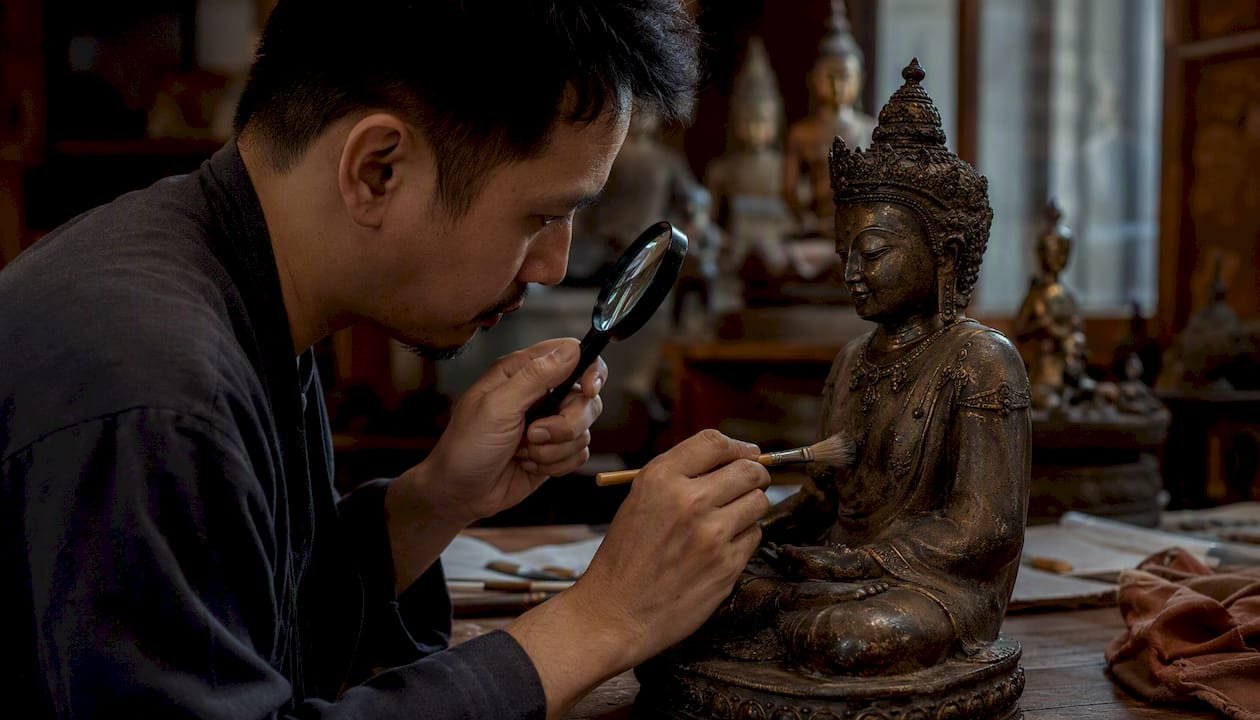
For authentication guidance specific to Asian bronzes, the HDAsianArt guide on authenticating antique bronze Buddha statues covers the physical markers and documentation types most relevant to that category.
Where can you search provenance records and databases?
- Getty Provenance Index (Getty Research Institute). The strongest resource for dealer stock books and exhibition sale records. Searchable online; particularly useful for European and American dealer histories from the 19th and early 20th centuries. Access is free.
- Sotheby’s and Christie’s archives. Both houses maintain searchable online databases of past auction results. Lot-level records include sale dates, estimates, and object descriptions. Useful for tracing auction-to-auction ownership.
- Archives.gov (U.S. National Archives and Records Administration). Relevant for works with U.S. government collection history, wartime records, or federal agency provenance. Search by record group or agency.
- Museum accession and exhibition records. Contact registrars at U.S. museums directly. Many institutions have digitized portions of their accession files and can confirm whether a work appeared in their collection.
- WorldCat and library catalogs. Search for exhibition catalogs by artist name or institution. Exhibition catalogs are primary sources that often reproduce provenance lists and ownership histories.
- FBI National Stolen Art File (NSAF). A free, searchable database of stolen art reported to the FBI. Run any significant purchase through it before completing the transaction.
- Interpol Stolen Works of Art database. Covers internationally reported stolen works. Accessible online; particularly relevant for works with European or international ownership histories.
- Catalogue raisonnés and artist estates. For works by well-documented artists, the estate or foundation managing the catalogue raisonné is the authoritative source for inclusion and attribution.
For provenance research specific to Asian antique sculpture, the HDAsianArt provenance research guide covers archival practices and documentation types relevant to Cambodian, Thai, Indonesian, and Vietnamese works.
What are the red flags in provenance paperwork?
- Photocopies provided without access to originals, and no explanation for why originals are unavailable.
- Missing or unverifiable contact information for named prior owners, galleries, or institutions.
- Repeated “private collection” entries with no names, dates, or locations across multiple ownership periods.
- Inconsistent dates, dimensions, or medium descriptions between documents and the physical object.
- Lot numbers or sale records that do not match the auction house’s own published records.
- Sellers who refuse to permit direct contact with named prior owners, estates, or institutions.
- Identical provenance language appearing across multiple unrelated lots from the same seller.
- COAs issued by individuals or organizations with no verifiable credentials or recognized expertise on the artist.
Vetting a COA requires checking the issuer’s credentials independently. A COA from an artist’s authenticated estate or a recognized foundation carries weight; one from an unverified private party does not. ArtBusiness.com emphasizes that good-looking documents can be forged and that independent verification of any issuing authority is non-negotiable before relying on a certificate for a purchase decision.
If red flags appear: pause the purchase, request original documents, run stolen-art checks across the FBI NSAF and Interpol databases, and engage an independent conservator or provenance researcher before proceeding. For practical guidance on spotting authentic art, a step-by-step external reference is available from Eman’s Gallery.
How should you handle gaps in provenance history?
Unbroken provenance records are rare. Most artworks, particularly those more than a century old, have periods where ownership is undocumented. The professional standard is to treat gaps as research tasks and document them transparently, not to paper over them with vague entries.
A commonly applied heuristic in the trade holds that a substantial portion of documentary support combined with credible circumstantial evidence may be acceptable for lower-risk works, while any uncertainty should be noted and disclosed. This threshold is not a rule; it is a practical starting point for risk assessment.
Gaps require heavier scrutiny in specific circumstances:
- Wartime periods (1933–1945 in Europe). Any gap during this period for European works triggers mandatory additional research under U.S. and international guidelines. The Association for Research into Crimes against Art (ARCA) and the Commission for Looted Art in Europe are relevant resources.
- Colonial-era acquisitions. Works originating from Southeast Asia, South Asia, or Africa acquired before the mid-20th century may carry repatriation risk regardless of subsequent legal transfers.
- Antiquities and temple art. Works in this category face the strictest scrutiny. U.S. Customs and the Department of Justice actively pursue repatriation of illegally exported cultural property. A gap of several decades for a Cambodian or Thai temple sculpture is a significant legal risk, not merely a research inconvenience.
- Contemporary works. A gap of a few years in recent ownership history is generally less concerning if the current chain is well-documented and the work is not subject to export restrictions.
When should you hire a professional provenance researcher?
The decision to commission professional research turns on three factors: purchase price, legal risk, and the presence of wartime or colonial-era gaps.
- Trigger point: high purchase price. For acquisitions above $10,000, the cost of professional research is typically a small fraction of the transaction value and the potential legal exposure.
- Trigger point: legal or restitution risk. Any work with a gap during 1933–1945, or originating from a jurisdiction with active cultural property agreements with the U.S., warrants professional review before purchase.
- Trigger point: antiquities or temple art. Works in this category should be treated as requiring professional provenance research as a baseline, not an optional step.
Cost and timeline factors:
- Hourly researchers typically charge rates that vary by specialization and geographic scope of the research required. Archive travel, translation, and document retrieval add to the total.
- Flat-fee provenance reports are available from some specialists for defined scopes of work.
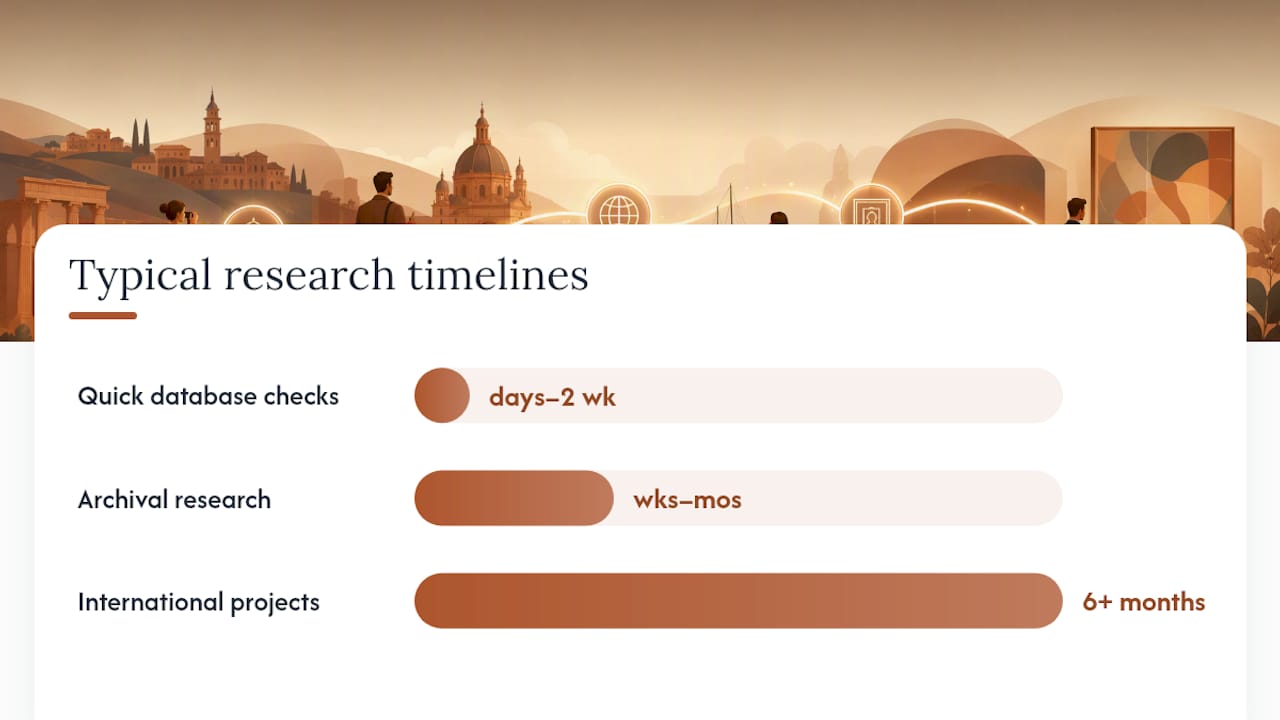
- Quick database checks (FBI NSAF, Interpol, Getty Provenance Index) can be completed in days to two weeks by a researcher familiar with the tools.
- Archival research involving physical archive visits, dealer estate contacts, or foreign-language records typically takes several weeks to several months.
- International provenance projects for high-value or legally complex works can extend to six months or longer.
For buying high-value art safely online, including escrow arrangements and documentation checklists, Eman’s Gallery provides a practical external reference.
How HDAsianArt documents provenance for buyers
HDAsianArt’s documentation process for each eligible work covers the following steps: archival research into the object’s collection and exhibition history, collection of original documents where available, high-resolution photography of the front, reverse, base, and any labels or stamps, a conservator’s condition assessment, and secure record-keeping in both hard copy and verified digital format.
Each sale includes:
- An itemized invoice with a full object description (dimensions, medium, origin, estimated period)
- Provenance notes citing prior collections, exhibitions, or dealer records where documented
- High-resolution images showing all labels, stamps, inscriptions, and condition details
- A condition report from a named conservator where available
- Export and import documentation for works originating outside the United States
Buyers can verify each element directly. Named prior collections and institutions are cited with contact information where available. Accession numbers and catalog citations are linked to their source records. For works where gaps exist, HDAsianArt documents the research steps taken and discloses the gap transparently rather than presenting a false chain.
To request further provenance documentation, permission to contact prior owners or institutions, or additional research for a specific work, contact HDAsianArt directly through the gallery. The Buddhist art collection guide and the Asian sculpture dynasty identification guide provide additional context on documentation practices for specific categories.
Pro Tip: When originals are not available, a chain-of-custody affidavit signed by the consignor and the dealer gives added legal weight to the transfer record, as recommended by ArtVault Software’s provenance tracking guide.
An experienced collector’s perspective on provenance verification
The single most common mistake collectors make is treating a certificate of authenticity as a substitute for provenance research. A COA is a claim, not evidence. The question is always: what primary documents support that claim?
The second mistake is skipping the physical inspection. Labels, stamps, and stencils on the reverse of a work are often the most direct link to a specific gallery, collection, or exhibition period. They are also the hardest to fake convincingly. Before reading a single document, turn the work over.
A short checklist worth carrying when viewing or bidding:
- Ask for the oldest document in the provenance chain first. That document sets the baseline for everything that follows.
- Verify that the object description in every document matches the physical work in hand, including dimensions, medium, and any distinguishing marks.
- Confirm that named prior owners or institutions can be contacted. A seller who refuses this request is a seller worth walking away from.
- Run stolen-art checks before, not after, committing to a purchase.
- For antiquities and temple art, treat any gap of more than a decade as requiring explanation, not assumption.
The works that hold their value and their legal standing over time are the ones where the ownership history was verified before purchase, not reconstructed afterward.
Provenance documentation included with HDAsianArt purchases
HDAsianArt provides documented provenance with each eligible sale: an itemized invoice, provenance notes with cited sources, high-resolution images of labels and stamps, and a conservator’s condition report where available. For works originating outside the United States, export and import documentation is included as standard.
For collectors acquiring antique Asian sculpture, this level of documentation is the practical difference between a work that can be resold, insured, and lent to institutions and one that cannot. An antique Javanese Avalokiteshvara Bodhisattva statue or a seated bronze Javanese Preaching Buddha sold through HDAsianArt comes with the documentation needed to verify its history and support future transactions.
Contact HDAsianArt directly to request purchase-specific provenance documentation, extended archival research, or conservator reports for a specific work.
Sources
- Provenance research guide (University of Texas Libraries)
- Artbusiness
- Art Provenance Research (Saint Louis Art Museum LibGuide)
- Getty Provenance Index (Getty Research Institute)
- C2PA specification (Coalition for Content Provenance and Authenticity)
