



Lakshmi Statue: Wealth, Beauty & Spiritual Abundance
Lakshmi Statue: Wealth, Beauty & Spiritual Abundance
Most people who buy a Lakshmi statue choose one purely for its visual appeal, then wonder why it feels spiritually hollow on their shelf. The truth is that a Goddess Lakshmi sculpture carries centuries of iconographic meaning, and understanding that meaning changes everything about how you select, position, and relate to the piece.
Whether you are a collector of museum-quality Hindu deity art, a practitioner building a home altar, or someone drawn to the Hindu goddess of wealth as a symbol of abundance, the details embedded in every gesture, lotus, and owl matter far more than most buyers realise. This guide covers all of it.
Table of Contents
Quick Takeaways
|
Key Insight |
Explanation |
|---|---|
|
Four arms signal completeness |
Each arm of a Lakshmi statue represents one of the four Purusharthas: dharma, artha, kama, and moksha. A two-armed figure is a simplified devotional form, not an inferior one, but four arms carry the full theological statement. |
|
Gold coins pouring from the lower right hand signal active abundance |
This gesture, called Varada mudra combined with gold coins, distinguishes Mahalakshmi from her more meditative forms. It is the posture most associated with material prosperity and is the version most commonly placed in business settings. |
|
The lotus base is not decorative filler |
Lakshmi standing or seated on a lotus signals purity untouched by worldly impurity. Sculptures missing this element are either highly stylised modern interpretations or fragments of larger compositions. |
|
Owls appear in some regional forms as Lakshmi's vahana |
The owl (uluka) represents wisdom operating in darkness, the ability to see wealth and opportunity where others cannot. Sculptures that include an owl are specifically referencing Lakshmi's South and Southeast Asian regional iconography. |
|
Material affects ritual suitability |
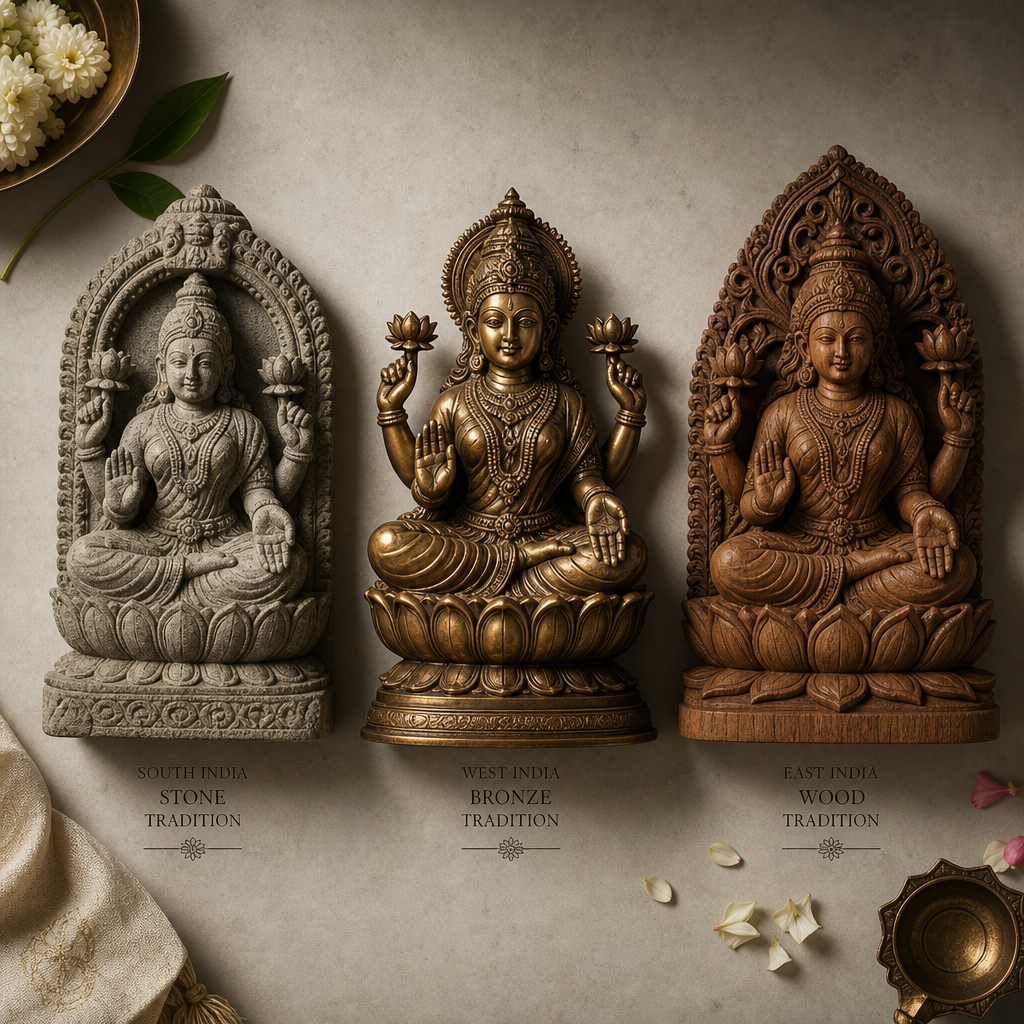
Bronze and brass figures are traditional for daily puja because they can be bathed (abhisheka). Stone sculptures are suited for fixed shrine positions. Wooden figures require more care regarding moisture and are generally display pieces. |
|
Regional styles vary significantly across Asia |
A South Indian Chola-style Lakshmi differs dramatically from a Cambodian or Javanese representation. The underlying deity is the same, but the artistic vocabulary, proportion canon, and decorative detail are entirely different traditions. |
|
Museum-quality sourcing preserves iconographic integrity |
Mass-produced resin Lakshmi figures routinely omit or merge iconographic details to reduce production complexity. A museum-quality Goddess Lakshmi sculpture retains the precise hand positions, attributes, and proportions specified in the Shilpa Shastra texts. |
Who Is Lakshmi and Why Does Her Iconography Matter
Lakshmi is one of the most important deities in the Hindu pantheon, revered as the goddess of wealth, fortune, beauty, prosperity, and spiritual abundance. She is the consort of Vishnu, the preserver, and her presence in any household or temple is considered an active blessing rather than a passive symbol. The name Lakshmi derives from the Sanskrit root laksya, meaning aim or goal, which tells you something important: she is not simply luck, she is the embodiment of purposeful, deserved prosperity.
In practice, understanding Lakshmi's theological position changes how you read a sculpture. She appears in the Rigveda as Sri, a goddess of fertility and royal power. By the Puranic period her iconography had crystallised into the form we recognise today: golden-skinned, four-armed, lotus-seated, often flanked by elephants. Each of those elements was codified in the Shilpa Shastra, the ancient Indian treatise on art and sculpture, and a skilled sculptor working in that tradition encodes all of them deliberately.
This is why iconographic accuracy matters when selecting a Lakshmi statue. A poorly proportioned or symbolically incorrect figure is not just an aesthetic problem. For practitioners using the sculpture as a focus for puja or meditation, the iconographic cues guide the contemplative practice. For collectors, iconographic fidelity is the difference between a culturally authentic object and a decorative approximation.
"The goddess Lakshmi is not merely a symbol of wealth in the material sense. She represents the ordered, auspicious, and righteous prosperity that sustains both the individual and the cosmos." - Devdutt Pattanaik, mythologist and author of Lakshmi: The Goddess of Wealth and Fortune
For collectors and practitioners shopping at a specialist retailer like HD Asian Art, the regional diversity of Lakshmi representations available, spanning South Asian, Southeast Asian, and East Asian traditions, means there is a figure suited to almost every purpose, space, and aesthetic preference. But that diversity also demands some knowledge before you buy.
The Symbolic Elements Encoded in Every Lakshmi Statue
Every element of a canonical Goddess Lakshmi sculpture is a deliberate theological statement. Once you learn to read them, you will never look at a Hindu deity statue the same way again.
The Four Arms and What Each Holds
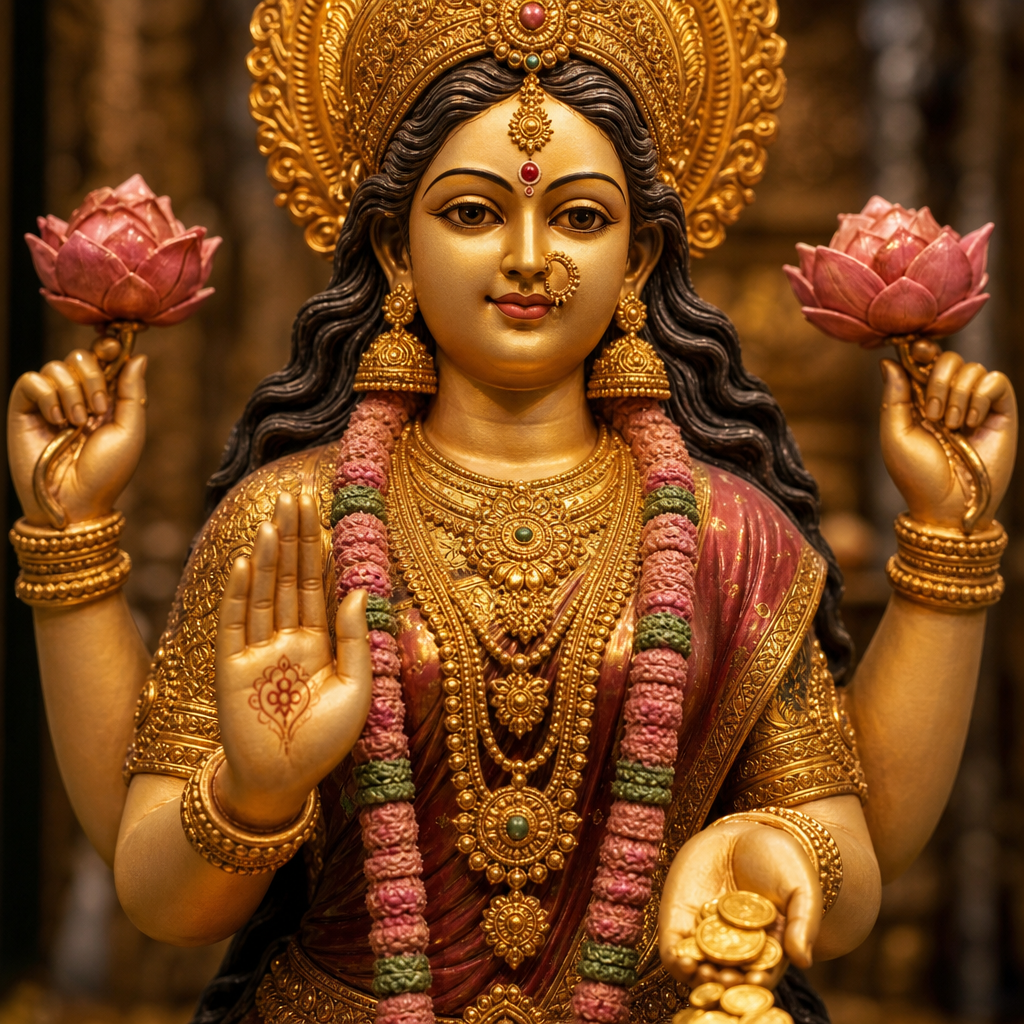
In four-armed Lakshmi representations, the upper right hand typically holds a lotus bud, signalling spiritual liberation and the possibility of transcendence. The upper left hand holds another lotus or a pot of amrita, the nectar of immortality. The lower right hand is extended in Varada mudra, the gesture of giving, often with gold coins pouring from the palm. The lower left hand holds a pot of gold or rests on her thigh in Abhaya mudra, the gesture of protection.
This arrangement is not arbitrary. It maps directly onto the four goals of human life in Hindu philosophy. You are simultaneously being offered prosperity, protection, spiritual growth, and liberation from a single figure.
Elephants, Lotus, and Water
Many Lakshmi sculptures, particularly those depicting Gaja Lakshmi (Lakshmi with elephants), show two royal elephants flanking her, pouring water over her from their raised trunks. Elephants in Indian iconography represent royal power, rain, and the abundance of the natural world. The water they pour is both literal (rainfall sustaining crops) and symbolic (the continuous blessing of prosperity flowing into a life).
The lotus deserves special attention. In Buddhist and Hindu art across all of Asia, the lotus growing from muddy water represents the soul rising from material entanglement toward spiritual clarity. Lakshmi's lotus throne is specifically pink or red, distinguishing it from the white lotus associated with purity alone or the blue lotus associated with Vishnu.
Colour and Material Symbolism
Classical texts describe Lakshmi as golden-skinned (Suvarna), which is why traditional bronze castings are left with a warm golden finish rather than patinated to dark brown. Red clothing signals auspiciousness and energy. Green in some regional forms signals growth and agricultural abundance. When you see a Goddess Lakshmi sculpture with these colour relationships preserved, you are looking at a figure made by someone who knows the tradition from the inside.
Pro tip: When evaluating a Lakshmi statue for purchase, look at the hands first. Sloppy or ambiguous mudras are the most common quality indicator. A skilled sculptor working in the Shilpa Shastra tradition renders each finger position with precision because those positions have specific meanings that change the figure's ritual function entirely.
Types of Goddess Lakshmi Sculpture Across Asia
Lakshmi worship spread across Asia with Hinduism and Buddhism, and each regional tradition adapted her iconography to its own artistic vocabulary. Understanding these regional variations is essential for collectors and for anyone making a deliberate choice about which tradition resonates with their practice or aesthetic.
South Indian Chola and Vijayanagara Styles
South Indian bronze Lakshmi figures from the Chola period (9th to 13th centuries CE) represent the high-water mark of Hindu sculptural tradition. These figures are characterised by sinuous, elongated proportions, heavy jewellery rendered in extraordinary detail, and a fluid quality in the drapery that no other tradition quite matches. The Vijayanagara period that followed (14th to 17th centuries) produced slightly more ornate figures with heavier crowns and more complex decorative treatment.
Collectors specifically seeking this aesthetic should look for figures with the distinctive Chola tribhanga (triple-bend) posture, the slightly tilted hips and inclined torso that give South Indian bronzes their characteristic dynamism.
Cambodian and Khmer Lakshmi Representations
In Khmer art from the Angkor period (9th to 15th centuries CE), Lakshmi appears both as an independent deity and as part of Vishnu narrative reliefs. Khmer Lakshmi figures tend toward a more architectural stillness compared to South Indian work. The faces have the characteristic Khmer serenity, slightly downcast eyes, a faint smile, and extremely refined surface treatment. The crown forms are distinctly Khmer rather than South Indian.
For collectors interested in Southeast Asian Hindu art, a Cambodian-style Lakshmi statue offers an entirely different cultural and aesthetic experience from its South Indian equivalent, while representing the same deity with equivalent theological seriousness.
Javanese and Indonesian Variations
Java produced some of the most sophisticated Hindu-Buddhist sculpture in Asia during the Mataram and Majapahit periods. Javanese Lakshmi figures often appear in contexts that blend Hindu and Buddhist iconography, reflecting the syncretic religious culture of medieval Java. The stone-carving tradition of Java is particularly notable for its extremely fine surface texture and the complex patterning of jewellery and textiles rendered in hard andesite stone.
How to Choose a Lakshmi Statue That Matches Your Purpose
The single most useful question to ask before buying is: what is this figure for? The answer shapes every subsequent decision about material, scale, style, and iconographic form.
For Active Puja and Daily Ritual Practice
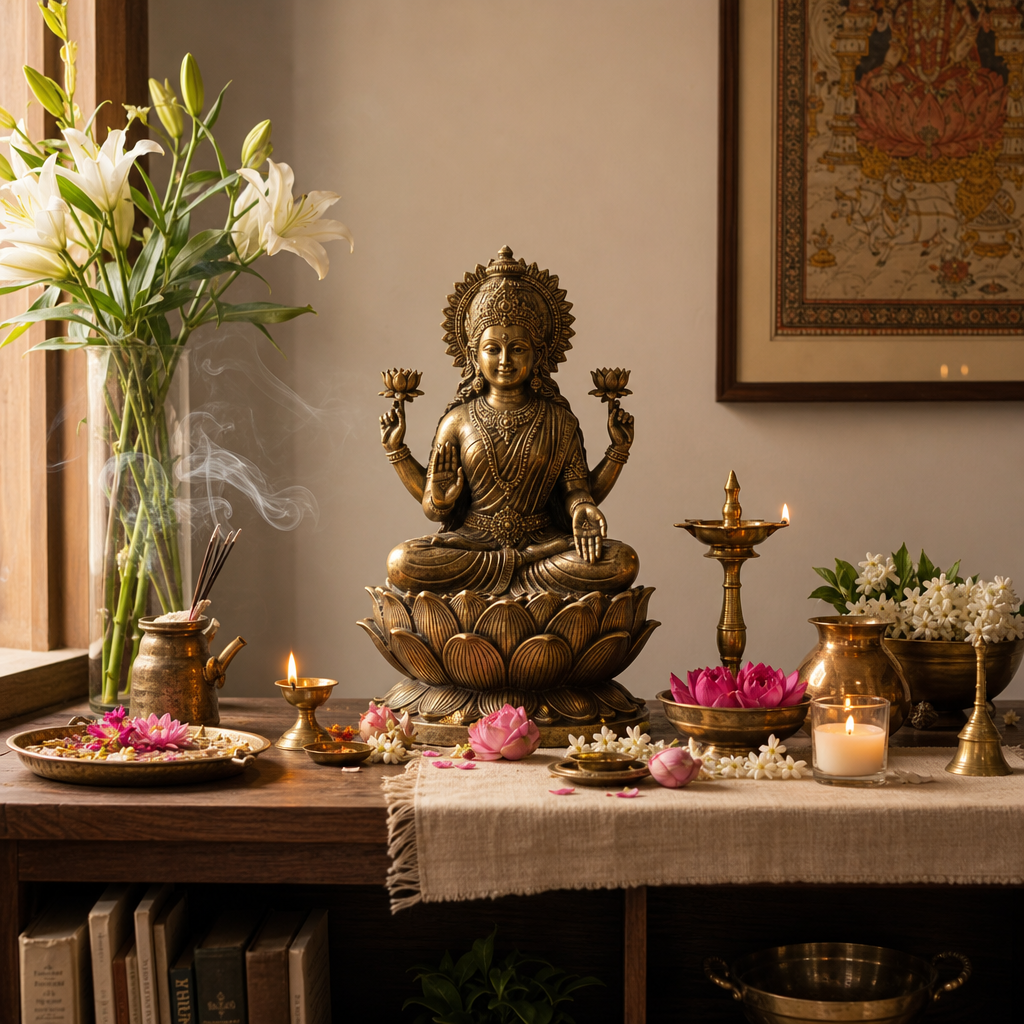
If you are building a home altar and plan to perform daily puja, which typically involves offering flowers, incense, water, and occasionally bathing the figure, bronze or brass is the correct material. These metals are traditional for ritual use precisely because they are non-porous, easy to clean, and considered auspicious in Indian metallurgical tradition. A figure between 15 and 30 centimetres in height is practical for most home altar settings. You want a four-armed Mahalakshmi with the Varada mudra and gold coins clearly visible.
A common mistake is choosing a stone figure for daily puja use. Stone is beautiful but porous, difficult to clean if you are offering milk or honey as part of abhisheka, and can stain permanently. Stone belongs in a fixed, dry position.
For Display and Collection
Collectors focused on artistic quality should prioritise iconographic accuracy, quality of finish, and regional authenticity over ritual considerations. A museum-quality stone or bronze figure from HD Asian Art's Hindu deity collection represents a different category of object from a puja statue, though many collectors use both types. For display, larger figures command more visual presence. A 45 to 60 centimetre bronze Lakshmi in the Chola style can anchor an entire room.
For Home Decoration with Spiritual Resonance
The largest segment of buyers occupy a middle position: they want something beautiful, spiritually meaningful, and appropriate for a home environment. For this purpose, the most versatile choice is a seated Padmasana Lakshmi in bronze, between 20 and 40 centimetres, with a warm golden finish. This form reads as both an art object and a devotional image, works in living rooms and dedicated meditation spaces equally well, and is robust enough for everyday placement without requiring special care.
Pro tip: Avoid purchasing a Lakshmi statue without confirming the hand positions are iconographically correct. Specifically, the lower right hand should not be in Abhaya mudra (palm raised toward the viewer in a stopping gesture). That position is protective and is iconographically assigned to Durga or Kali, not Lakshmi. The error appears regularly in mass-produced figures and signals that the manufacturer was not working from canonical sources.
Placement, Orientation, and Care for Your Lakshmi Sculpture
Placement protocols for a Goddess Lakshmi sculpture come from Vastu Shastra, the Indian science of spatial arrangement, which overlaps significantly with Feng Shui in its underlying logic of directional energy flows. These are not superstitions to be indulged or dismissed; they are accumulated empirical wisdom about how humans relate to objects in space and how those relationships shape attention and intention.
The Northeast and East Directions
The northeast quadrant of any room is considered the most auspicious zone in Vastu Shastra, associated with divine energy and spiritual clarity. This is the preferred position for any home altar or puja corner. If northeast placement is not architecturally possible, the east wall is the next preference, as it receives the morning sun, which is traditionally associated with new beginnings and Lakshmi's energy of fresh abundance.
The figure should face into the room, ideally toward the entrance. The idea is that Lakshmi is blessing the space as people enter it, rather than turning her back on them. Placing a Lakshmi figure facing a wall is considered unfavourable in most traditional interpretations.
Height and Cleanliness
In traditional Hindu practice, sacred images are placed at or above eye level, never on the floor. This signals respect and also has a practical rationale: it prevents accidental contact with feet, which is considered disrespectful. A dedicated shelf, cabinet, or purpose-built altar at chest to eye height is ideal.
Cleanliness around the figure is non-negotiable in devotional contexts. Dust, clutter, and broken objects placed near a Lakshmi statue are considered actively inauspicious in traditional Vastu interpretation, representing the conditions that repel rather than attract prosperity. Regardless of your theological position, maintaining a clean, ordered altar space has undeniable practical benefits for the quality of meditation and focused intention.
Comparing Lakshmi Statue Styles: Stone, Bronze, and Wood
Choosing the right material for your Lakshmi statue is not a matter of personal preference alone. Each material has specific properties that make it better or worse suited to particular uses, environments, and budgets. The table below compares the three most common materials used in museum-quality Hindu deity sculpture.
|
Feature |
Bronze / Brass |
Stone (Sandstone, Schist, Granite) |
Wood (Teak, Rosewood) |
|---|---|---|---|
|
Ritual suitability |
Excellent. Traditional for daily puja and abhisheka (ritual bathing). Non-porous and easy to clean. |
Moderate. Suitable for fixed altar positions with dry offerings only. Porous stone can stain. |
Limited. Moisture from offerings damages wood over time. Best treated as a display material. |
|
Iconographic detail |
Excellent. Lost-wax casting allows extremely fine mudra detail, jewellery, and facial expression. |
Very good. Stone carving can achieve remarkable detail, particularly in South Asian and Southeast Asian traditions. |
Good for large-scale figures. Fine detail is achievable but less durable over time. |
|
Durability and longevity |
Exceptional. Bronze objects from 1,000 years ago survive intact. Requires occasional polishing only. |
Exceptional. Stone is effectively permanent with minimal maintenance. Avoid thermal shock. |
Moderate. Vulnerable to humidity, insects, and UV light. Requires periodic treatment with oil or wax. |
|
Display versatility |
High. Works indoors in any setting. The warm golden tone of traditional bronze finish suits most interiors. |
High for fixed positions. Heavy weight limits repositioning. Particularly suited to garden shrines if stone is weather-resistant. |
High for interior display. Warm organic tones work particularly well in natural, Japandi, or South Asian-influenced interiors. |
|
Typical price range for museum-quality figures |
Mid to high. Significant variation based on weight, complexity of casting, and regional style. |
Mid to high. Carved stone commands premium prices due to labour intensity. |
Mid range. Often less expensive than equivalent bronze but still significant for quality hand-carved pieces. |
Common Mistakes Buyers Make When Purchasing Hindu Deity Statues
After years of observing how collectors and practitioners approach buying Hindu deity art, the same errors come up repeatedly. Avoiding them does not require specialist expertise. It requires slowing down and asking the right questions before purchasing.
Buying Based on Size Alone
A common mistake is assuming that a larger figure is automatically more impressive or more suitable. In traditional practice, the proportional relationships within a figure matter more than its absolute size. A 20-centimetre Chola-style bronze with correct iconography and fine casting quality will always outperform a 60-centimetre resin figure with blurred mudras and generic facial features. When you are investing in museum-quality work from a specialist retailer, the craftsmanship and iconographic accuracy are what you are paying for, not the weight.
Ignoring Regional Provenance
Mixing iconographic traditions without awareness can create jarring visual inconsistencies in a collection or altar setting. If your primary Buddha statues are in the Thai style, adding a Cambodian Lakshmi beside them is coherent because both traditions grew from the same Theravada and Brahmanical synthesis in mainland Southeast Asia. But placing a South Indian Chola Lakshmi alongside a Japanese Zen-aesthetic Buddhist figure requires more thought about visual and cultural coherence.
Purchasing from Non-Specialist Retailers
The Hindu goddess of wealth is one of the most widely reproduced Hindu deity images in the world, which means the market is flooded with factory-produced figures that prioritise recognisability over accuracy. Retailers like HD Asian Art, who source museum-quality work directly from across Asia, are working from a fundamentally different standard than a general gift shop or mass-market online marketplace. The difference is visible the moment you compare the two side by side, particularly in the quality of hand positions, facial expression, and surface treatment.
The distinction between a specialist and a generalist retailer in this market is not snobbery. It is the difference between an object that will hold meaning and value over decades and one that will feel hollow within months.
Frequently Asked Questions
What is the difference between Lakshmi and Mahalakshmi?
Lakshmi and Mahalakshmi refer to the same goddess but in different aspects of her power. Lakshmi is the general name for the goddess of wealth, beauty, and fortune. Mahalakshmi (Maha meaning great) specifically refers to her supreme, most powerful form, often depicted with eight arms in Ashtalakshmi representations. When buying a Lakshmi statue, the term Mahalakshmi on a product description usually indicates a four or eight armed figure with the full range of auspicious attributes, rather than a simplified two-armed devotional image.
Is it appropriate to have a Lakshmi statue in a non-Hindu home?
Yes. Lakshmi statues have been collected, displayed, and venerated by people outside the Hindu tradition for centuries. In Southeast Asia, Lakshmi iconography merged with Buddhist traditions to produce syncretic forms that were never exclusively Hindu in practice. Many collectors, meditation practitioners, and home decorators from diverse backgrounds place Lakshmi sculptures in their homes as symbols of abundance, beauty, and positive intention. Approaching the figure with respect and some knowledge of its iconography is the relevant standard, not religious affiliation.
Which form of Lakshmi is best for attracting prosperity?
The form most specifically associated with material prosperity is Dhanalakshmi, one of the eight Ashtalakshmi forms, depicted with gold coins pouring from her lower right hand. For business settings, this form is the traditional choice. Gaja Lakshmi, the form flanked by elephants, is associated with royal and agricultural abundance and is considered appropriate for the home. Santanalakshmi, associated with family prosperity and the blessing of children, is the preferred form in household contexts where family well-being is the primary intention.
How should I clean and maintain a bronze Lakshmi statue?
For bronze and brass figures used in daily puja, wipe with a soft dry cloth after each use. For deeper cleaning, use a mild solution of warm water and a small amount of mild dish soap applied with a soft cloth, then dry immediately and completely. Never use abrasive cleaners, steel wool, or acid-based metal polishes on sacred figures, as these strip the patina and surface detail. For bronze figures used for display rather than ritual, occasional application of a specialist metal wax will protect the surface and maintain the warm golden finish.
What is the significance of Lakshmi standing on a lotus compared to sitting on one?
Standing Lakshmi (Sthanaka Lakshmi) represents the goddess in an active, dynamic posture, ready to move, bestow blessings, and engage with the world. This form is often chosen for puja rooms where active engagement with abundance and prosperity is the devotional focus. Seated Lakshmi (Asana Lakshmi) in Padmasana (lotus posture) represents stability, permanence, and deep-rooted prosperity. It is the form traditionally preferred for fixed altars and shrines where the goddess is being invoked as a permanent resident rather than a visiting blessing. Neither form is superior. The choice depends on what quality of Lakshmi's energy you are choosing to invite into your space.
Can a Lakshmi statue be placed in a bedroom?
Traditional Vastu Shastra generally recommends against placing deity images in the bedroom, primarily because the bedroom is associated with sleep and intimacy, which are considered incompatible with the sustained attention that sacred images deserve. The practical concern is that you may inadvertently show disrespect through inattention or positioning. However, many practitioners do place small devotional Lakshmi figures in their personal sleeping spaces, particularly in a dedicated corner or on an elevated shelf that is clearly differentiated from the sleeping area. If you do place a Lakshmi figure in a bedroom, ensure it is not positioned directly facing the bed.
Have you brought a Lakshmi statue into your home or practice space, and if so, what difference has it made to how you experience the room?
References
