



Lakshmi and Vishnu: Paired Iconography and Home Altars
Lakshmi and Vishnu: Paired Iconography and Home Altars
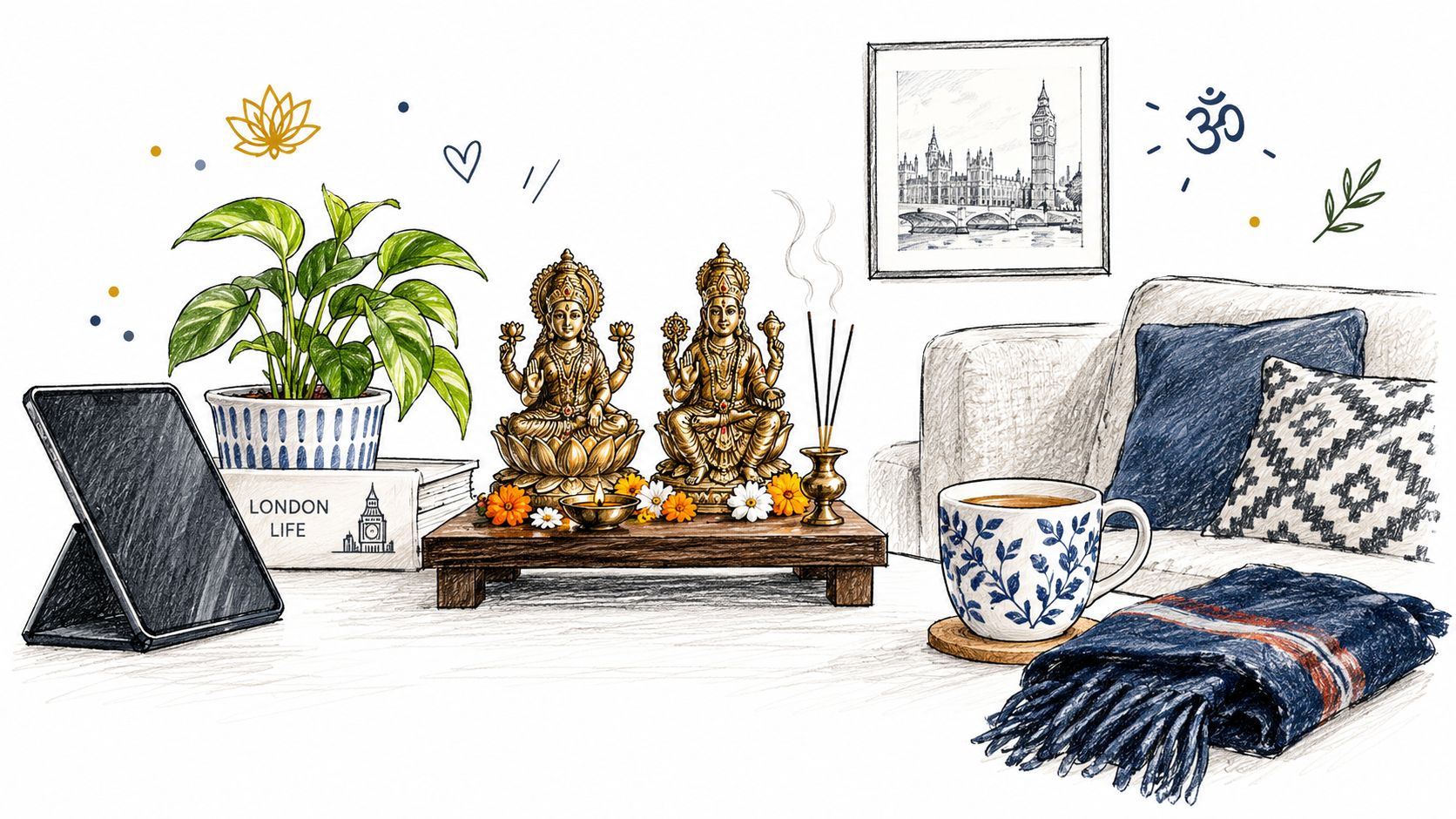
You're standing in a British living room, deciding whether the Lakshmi and Vishnu statue on your screen belongs on a home altar, a mantelpiece, or in a collection cabinet. The figures look serene, but the details matter. A conch, a discus, a lotus, a serpent, or a pair of elephants can change the form you're looking at and the meaning it carries.
For a practitioner, the image may become part of daily devotion. For a collector, it may be a carefully chosen work of religious art. In both cases, understanding the relationship between these deities comes before deciding where the sculpture should live.
Table of Contents
- The Divine Couple in Modern Practice
- Understanding the Sacred Relationship
- Identifying Key Attributes and Postures
- Regional Styles and Form Variations
- Choosing the Right Statue for Your Space
- Beyond the Consort Role
- Summary of Best Practices
The Divine Couple in Modern Practice
A Lakshmi and Vishnu image can sit in a British home while carrying a theology that reaches far beyond decoration. Vishnu represents preservation and continuity, while Lakshmi is associated with prosperity, auspiciousness and nourishing abundance. Together, they express a relationship between sustaining order and the conditions that allow life to flourish.
That relationship has clear relevance in the UK today. The Office for National Statistics Census 2021 figures recorded 1,032,775 people identifying as Hindu in England and Wales, including 1,020,533 in England and 12,242 in Wales. Hindu identification represented 1.7% of the combined population, rising from approximately 818,000 people, or 1.5%, in 2011, an increase of about 26.3% over the decade. Harrow and Leicester recorded particularly high concentrations, with 25.8% and 17.9% of residents identifying as Hindu respectively.
These figures describe religious affiliation, not how often people worship or whether they pray to Lakshmi, Vishnu, or both. They do, however, show why these images have a meaningful place in British domestic, temple and cultural life.
A shared image with different purposes
One household may use the pair as a devotional focus, keeping the surrounding space clean and reserving time for prayer or offerings. Another may value the sculpture as a reminder of family heritage. A collector might approach it through material, provenance, regional style and iconographic accuracy.
Those uses shouldn't be collapsed into one rule. A consecrated murti has a different devotional status from an art sculpture, and family customs differ between Vaishnava, Shakta and regional traditions. A thoughtful introduction to the pair should therefore make room for both religious practice and museum-quality visual literacy.
For a concise explanation of the pair as a symbol of balance, see this guide to the Vishnu and Lakshmi statue as a symbol of harmony, prosperity and divine balance. The important starting point is simple: before you decide where a statue belongs, learn what the figures are doing and why their relationship matters.
Understanding the Sacred Relationship
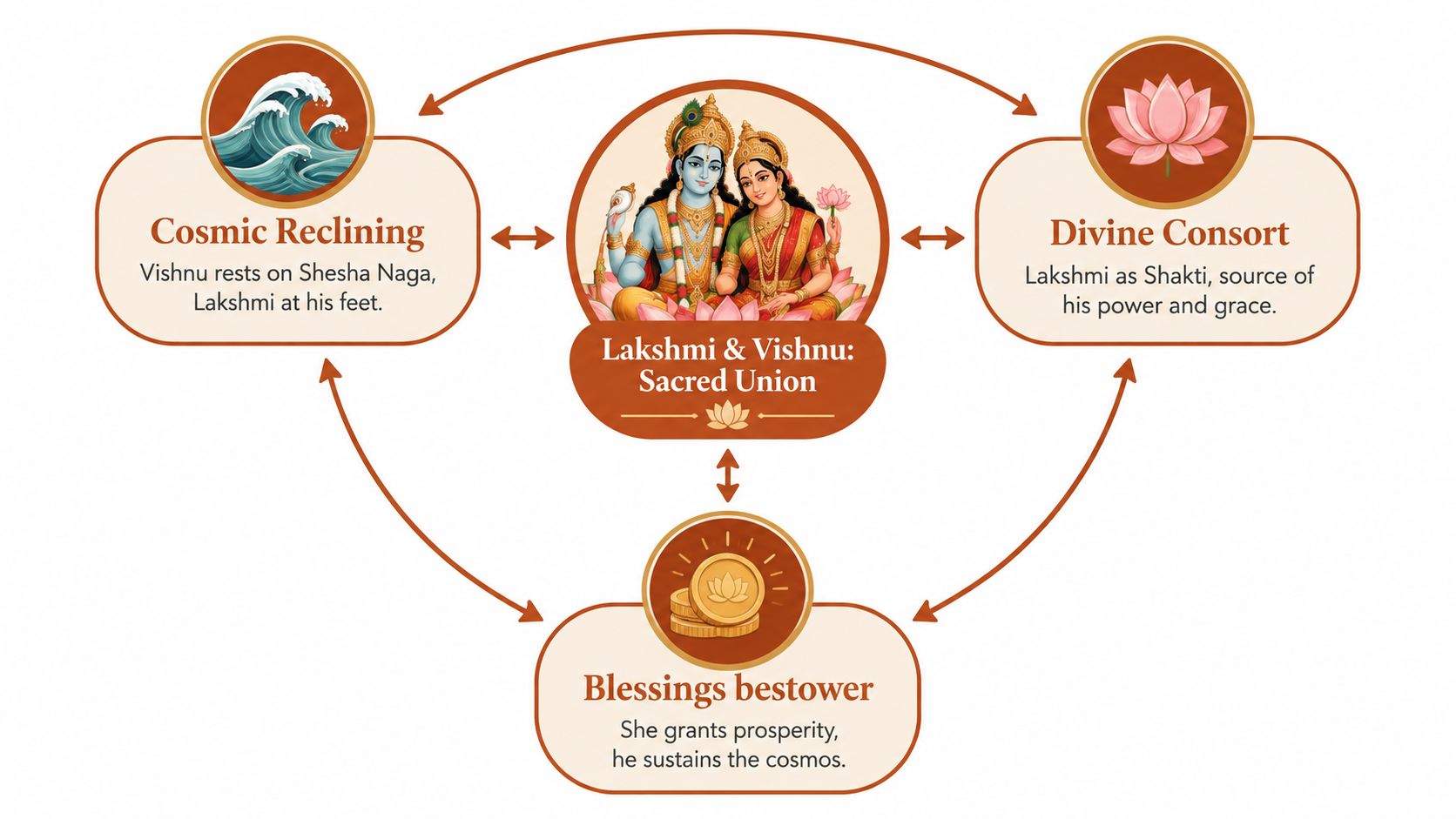
Begin with Vishnu reclining on the cosmic serpent Shesha. The serpent stretches over the primeval waters, forming a living support beneath the preserver deity. Lakshmi attends Vishnu at his feet, and from Vishnu's navel rises a lotus carrying Brahma, who begins the next cycle of creation.
The Victoria and Albert Museum's record of Vishnu and Lakshmi connects this composition with the recurring Hindu cycle of universal destruction and creation. The scene is not just a peaceful domestic moment enlarged to cosmic scale. It presents preservation as a state of deep, ordered stillness from which renewed creation can emerge.
Reading the relationship
The arrangement gives each figure a distinct role without separating them. Vishnu's reclining body conveys stability and cosmic continuity. Lakshmi's presence at his feet places care, prosperity and auspiciousness within that sustaining order. The lotus and Brahma introduce the movement from preservation towards creation.
This is why the pair often feels balanced rather than merely paired. Vishnu isn't a decorative male counterpart to Lakshmi, and Lakshmi isn't a decorative female counterpart to Vishnu. Their relationship communicates how order and abundance depend on one another. Preservation without nourishment would be sterile, while abundance without stability would be directionless.
In paired sculpture, Vishnu may be identified as Narayana. The name is especially familiar in forms such as Lakshmi-Narayana, where Vishnu sits or stands with Lakshmi in a close, formal composition. The precise arrangement varies by region and period, but the underlying relationship remains legible through posture, attributes and consort placement.
A question of tradition
Readers sometimes want a single answer about what Lakshmi and Vishnu mean in every household. Hindu traditions don't always work that way. A family may emphasise Vishnu's role as preserver, Lakshmi's role as grace and prosperity, their inseparability, or the particular form of Vishnu represented.
For readers exploring how planetary symbolism, family practice and devotional interpretation can intersect, it may be useful to ask questions Jyotish system through a qualified Vedic astrology resource. That kind of enquiry should complement, not replace, guidance from a temple, sampradaya or religious teacher.
Identifying Key Attributes and Postures
A collector can often identify Vishnu and Lakshmi by treating a sculpture like a museum object. Start with the overall hierarchy, then examine hands, attributes, gestures and the position of each figure. Don't rely on a single surviving feature, especially when the sculpture is damaged.
The Victoria and Albert Museum's Vishnu attribution identifies Vishnu through a frontal royal posture, tall central placement on a double lotus throne and the presence of attendant consorts. The British Museum also identifies the conch, discus, club and spherical earth as important Vishnu attributes.
Vishnu's visual vocabulary
The shankha, or conch, can indicate sacred sound and authority. The chakra, or discus, is another major identifier. A club and spherical earth may also appear, although attributes can be broken, missing or difficult to distinguish in older stone sculpture.
Look for a tall crown and a formal, frontal stance. Vishnu's central placement can establish hierarchy even when one or more weapons have disappeared. A British Museum guide discusses these attributes in relation to a damaged sandstone Vishnu from Java dated 1100–1500, and explains that the conch and discus were associated first with Vasudeva-Krishna before becoming part of Vishnu-related imagery.
A useful companion is this explanation of Vishnu's divine attributes and the symbolism of his four hands. It helps you read the hands as a system rather than treating each object as an isolated ornament.
Lakshmi beside him
Lakshmi may stand or sit beside Vishnu, hold a fly-whisk, or occupy a graceful seated position known as lalitasana. In this posture, one leg is pendant while the other is bent, creating a relaxed but dignified appearance.
A related Lakshmi-Narayana figure in the V&A shows Vishnu seated with Lakshmi on his left knee. Lakshmi places her right arm around his shoulders, while Vishnu's upper hands hold the conch and discus. His lower right hand forms abhaya mudra, the gesture of reassurance or fearlessness.
| Feature | What to examine |
|---|---|
| Central figure | Crown, frontal royal posture and overall height |
| Upper hands | Conch and discus, if preserved |
| Lower right hand | Abhaya mudra or another gesture |
| Consort placement | Lakshmi beside Vishnu or seated on his left knee |
| Base | Lotus petals, throne form and regional style |
Record each feature separately. A damaged hand shouldn't automatically disqualify an identification when the posture, crown, consort and remaining attributes support it.
Regional Styles and Form Variations
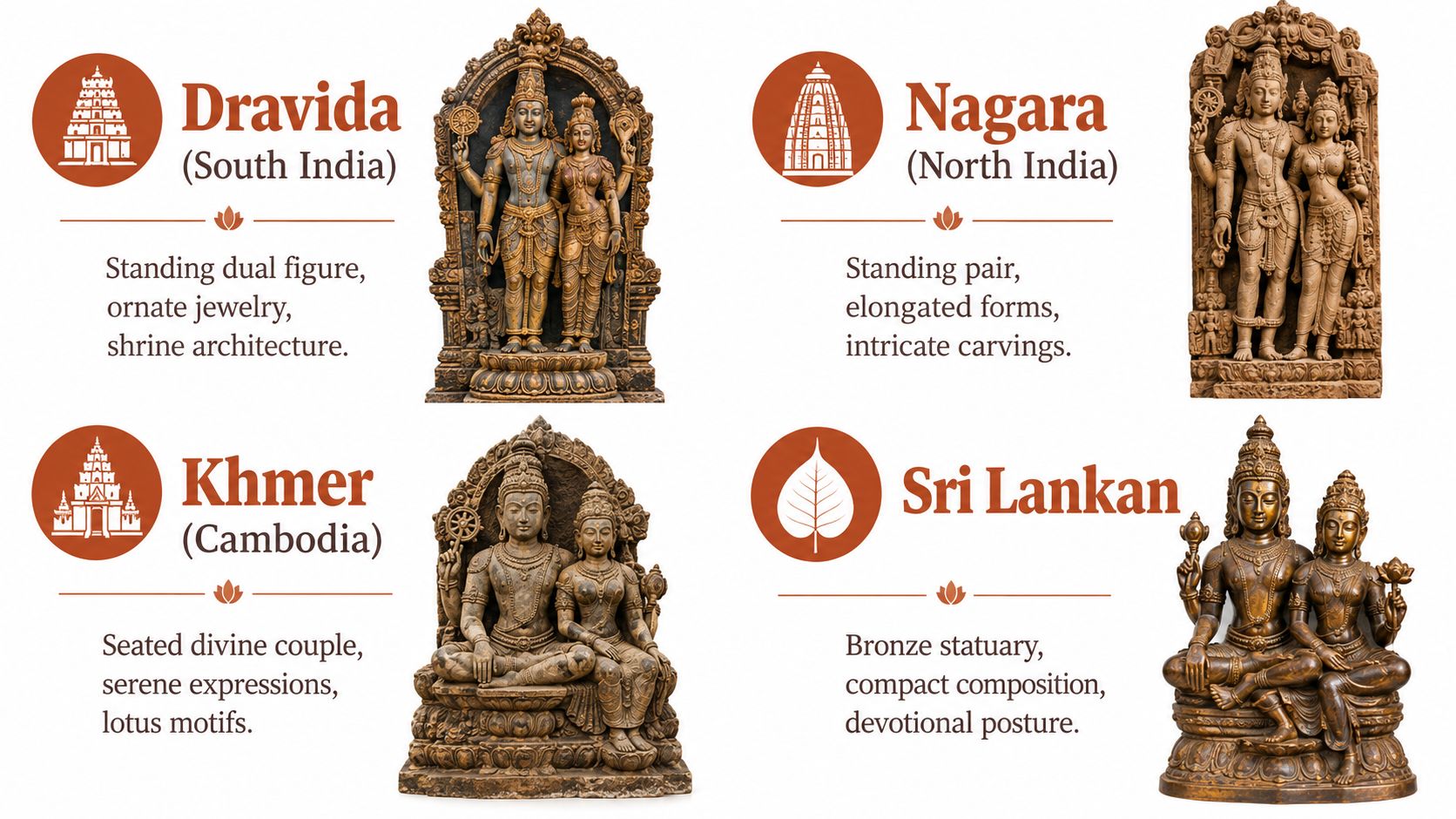
The phrase “Lakshmi and Vishnu statue” covers many artistic languages. A South Indian copper-alloy image may favour compact modelling and a richly worked base, while a North Indian stone sculpture may emphasise vertical rhythm, layered jewellery and architectural framing. Southeast Asian artists adapted related divine imagery through their own proportions, materials and courtly styles.
A collector should compare the visual logic of a piece rather than searching for one universal appearance.
Regional character
Dravida traditions from South India often reward close attention to casting, jewellery, hand gestures and shrine-related composition. A paired figure may feel intimate and concentrated, with the bodies arranged to support ritual viewing.
Nagara traditions from North India can produce more elongated figures and elaborate carved surfaces, often making the vertical silhouette especially important. The surrounding frame, lotus base and attendant figures may help establish the intended hierarchy.
Khmer and Sri Lankan works bring further variation. Khmer sculpture can present the divine couple with calm expressions and a composed seated arrangement, while Sri Lankan bronze work may favour a compact devotional grouping. These categories are useful points of comparison, not rigid rules. Workshop practice, period and local patronage also affect the result.
Avatar and independent forms
The V&A records a South Indian Lakshminarasimha sculpture made between 1750 and 1825. Vishnu appears as Narasimha, the man-lion avatar, while Lakshmi remains beside him. The copper-alloy casting was transferred from the India Museum to the South Kensington Museum, now the V&A, in 1879.
This form shows why the pair shouldn't be understood only as a calm, human-looking couple. The presence of Narasimha introduces protection, fierce intervention and avatar theology while Lakshmi brings a stabilising presence to the composition.
A different visual language appears in the V&A's nineteenth-century white-marble Gajalakshmi from Jaipur. Lakshmi sits centrally while two elephants pour water over or towards her. The elephants are not incidental decoration. Their lustration identifies the form and distinguishes it from a simple seated portrait of the goddess.
Choosing the Right Statue for Your Space
Selection begins with purpose. Ask whether the sculpture will support active worship, mark a meditation area, anchor a collection, or bring a culturally meaningful image into a living space. The answer affects the scale, material, placement and level of ritual attention the object should receive.
Material changes the atmosphere. Bronze or copper alloy can create a warm, reflective presence and may suit a traditional altar. Stone carries visual weight and can feel architectural. Wood offers a softer surface and may sit comfortably in a less formal interior. None of these materials is automatically more devotional or more appropriate than another.
A practical selection sequence
- Identify the form. Decide whether you're looking at Lakshmi-Narayana, a reclining Vishnu composition, Lakshminarasimha, Gajalakshmi or another related image.
- Inspect the attributes. Check Vishnu's crown, conch, discus and hand gestures. Look for Lakshmi's position, fly-whisk, lotus-related details or the elephants of Gajalakshmi.
- Match the scale to the room. A home altar needs enough surrounding space for respectful attention and practical cleaning. A large sculpture may dominate a narrow shelf, while a small piece can disappear in a busy cabinet.
- Review the object's status. Ask whether it is a consecrated murti, a ritual object, an antique sculpture or a contemporary art piece. The appropriate care and use can differ considerably.
The guide to selecting a Hindu statue for a home altar can support this comparison, particularly when you're weighing iconography against room and material.
Placement without false certainty
Census data records identity, not belief or active practice. Among people identifying as Hindu in England and Wales, 68.4% were aged 16–64 and 20.3% were under 16 in 2021, according to the Office for National Statistics analysis of religion, housing, health, employment and education. A relatively young and diverse population may include households developing new forms of intergenerational practice in modern British homes.
Practical rule: Treat direction, room and ritual advice as tradition-specific guidance, not as a universal UK-wide law.
A living room, meditation room or dedicated altar can each be appropriate, provided the placement is clean, stable and respectful. If the image is consecrated or your family follows a particular sampradaya, ask a temple or religious teacher before introducing fixed ritual expectations.
Beyond the Consort Role
Lakshmi is often introduced as Vishnu's consort and the goddess of wealth. That description is familiar, but it can become misleading when it makes her sound passive, secondary or merely ornamental.
Scholarly reference material notes that Shri and Lakshmi may once have existed as independent goddesses before becoming associated with Vishnu, while also emphasising that Lakshmi retains characteristics as an autonomous goddess. The Oxford reference entry on Lakshmi is useful precisely because it holds these two ideas together rather than forcing one to cancel the other.
Paired does not mean powerless
In a Lakshmi-Narayana sculpture, Lakshmi's position beside Vishnu expresses intimacy and theological partnership. It doesn't reduce her to a visual accessory. Her presence signifies prosperity, auspiciousness and the active grace that makes preservation meaningful for lived experience.
This distinction becomes easier to see when you compare paired and independent forms. In Gajalakshmi imagery, the goddess occupies the centre. The elephants' ritual pouring of water directs attention towards her, making her sovereignty and auspicious power the visual subject.
Lakshmi can therefore be understood through more than one lens:
- As consort, she is closely joined to Vishnu's sustaining role.
- As goddess, she carries her own authority and identity.
- As Gajalakshmi, she appears through a distinctive iconography of elephants and lustration.
- As a regional or family deity, she may receive emphasis shaped by local practice and lineage.
Why this matters to a buyer
A buyer who sees only “wealth goddess beside Vishnu” may miss the reason a sculpture was made in a particular form. The difference between a paired Lakshmi-Narayana figure, a reclining cosmic scene and Gajalakshmi is not purely aesthetic. Each arrangement directs attention towards a different theological relationship.
That doesn't mean every owner must adopt one interpretation. It means the object deserves a more careful description than “a decorative statue of a divine couple”. Understanding Lakshmi's independent identity lets a collector honour both the closeness of the pair and the goddess's own religious power.
Summary of Best Practices
A well-chosen Lakshmi and Vishnu image begins with identification, not impulse. Read the composition from the centre outward. Ask who occupies the principal position, which attributes survive, how the hands are held, where Lakshmi is placed and whether the surrounding symbols point to a specific form.
Keep these checks close when comparing objects:
- Read the attributes together. Vishnu's conch, discus, club, spherical earth, crown and formal posture work as a group. Missing details should be assessed alongside surviving evidence.
- Name the form accurately. A reclining Anantashayana or cosmic-rest image should show the diagnostic relationship between Shesha, Lakshmi, the navel-lotus and Brahma.
- Respect regional variation. South Indian copper alloy, Jaipur marble, Pahari painting and Southeast Asian sculpture can express related theology through very different visual conventions.
- Separate Lakshmi's roles. She can appear as Vishnu's consort and as an autonomous goddess. Gajalakshmi's elephants provide a clear example of her independent iconographic identity.
- Choose placement thoughtfully. A stable, clean and uncluttered setting supports respectful viewing, whether the object is used devotionally or displayed as art.
- Ask when tradition matters. Family practice, sampradaya, temple custom and consecration can affect how an image should be treated.
The more accurately you read the sculpture, the more deliberately you can decide how to live with it.
For a home altar, let the statue's scale and status guide the setting. For a collection, document material, regional attribution, posture, consort placement and surviving attributes. For an interior, make sure the object is presented with enough space to be seen as a meaningful image rather than lost among unrelated accessories.
HD Asian Art offers Hindu deity sculptures, including Lakshmi and Vishnu forms, alongside regional and material categories that can help collectors compare related works. Visit HD Asian Art to explore Lakshmi-Narayana, Vishnu and other South and Southeast Asian sculptures, then choose a piece whose iconography and intended setting you can describe with confidence.
