



Indonesian Hindu Sculpture Explained for Art Enthusiasts
Indonesian Hindu Sculpture Explained for Art Enthusiasts
Indonesian Hindu sculpture is defined as a category of sacred artistic forms, primarily from Java and Bali, that translate Hindu theology into stone, wood, and bronze through a visual language developed over more than a thousand years. These works are not decorative objects.
They are theological instruments, political statements, and ritual presences that served living communities. Understanding them requires knowing what they depict, where they stood, and why they were made. This guide covers the history, iconography, regional styles, and quality markers that serious collectors and researchers need to know.
How historical context shapes Indonesian Hindu sculpture
Prambanan temple complex is the largest Hindu temple site in Indonesia, dating to the 9th century. Its central shrines honor the Trimurti, the three principal deities of Brahma, Vishnu, and Shiva, with the Shiva statue standing nearly 3 meters tall inside a 47-meter tower. That scale communicates authority. These were not modest devotional objects. They were declarations of cosmic order made permanent in stone.
Sculptures at Prambanan do more than represent gods. They articulate a hierarchical cosmology and act as theological mediation of the Parabrahman, the absolute principle underlying all Hindu metaphysics. The spatial layout of the temple, organized according to the Tri Mandala system of three concentric zones, determines where each sculpture stands and what spiritual function it performs. Placement is not aesthetic. It is doctrinal.
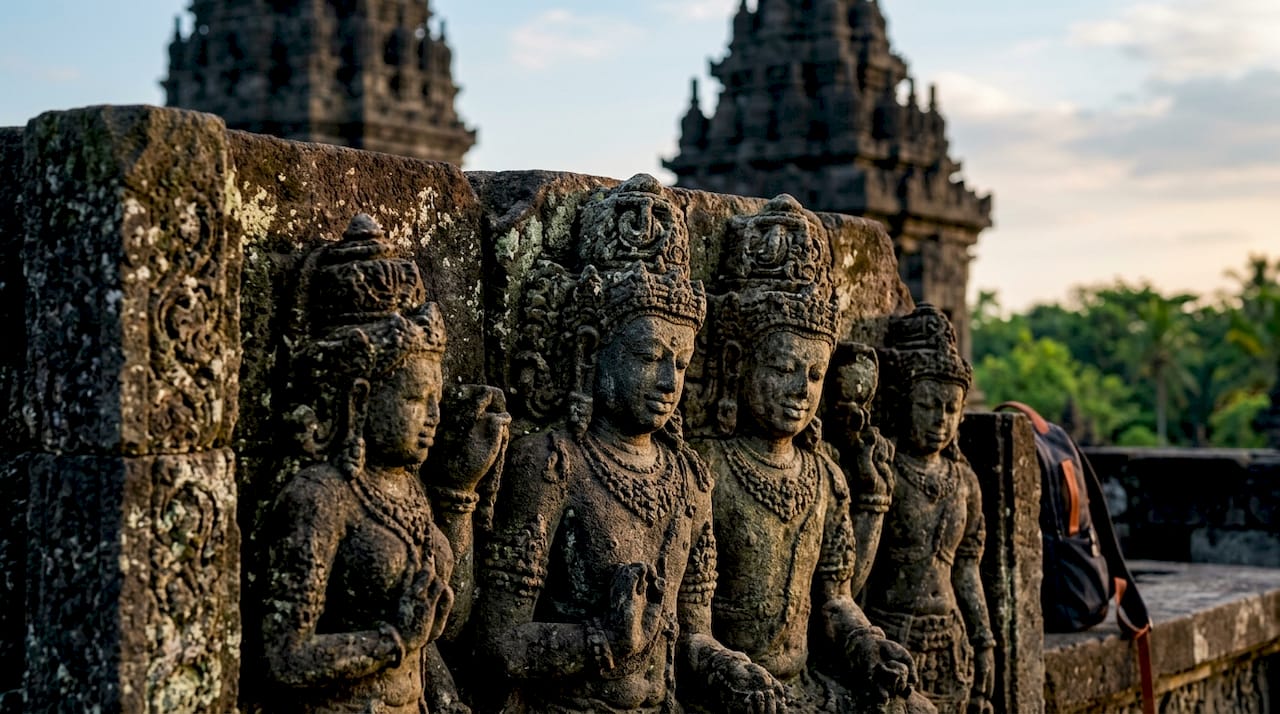
The Astadikpalaka reliefs at Prambanan add a political dimension that many collectors overlook. These eight guardian deity carvings represent ideal kingly virtues and were used to legitimize the authority of ancient Mataram rulers. Sculpture here functions simultaneously as theology and statecraft. That dual purpose explains why these works carry such weight, both historically and in the art market today.
Key functions of Hindu sculpture in the Javanese temple context:
- Cosmological mapping: Sculptures mark the hierarchy of divine realms from the earthly base to the transcendent summit.
- Ritual mediation: Figures serve as focal points for offerings, prayers, and priestly ceremonies.
- Political legitimacy: Guardian and deity reliefs reinforce the divine mandate of ruling dynasties.
- Narrative instruction: Relief panels depicting the Ramayana and Mahabharata teach moral theology to worshippers who could not read Sanskrit texts.
What are the distinctive styles and iconography in these sculptures?
The visual grammar of Indonesian Hindu sculpture is precise and consistent. Every attribute, from a crown’s shape to the angle of a hand gesture, carries a fixed meaning within the iconographic system. Collectors who learn this grammar can read a sculpture the way a musicologist reads a score.
Guardian figures, called dvarapala, are deliberately fierce. They display bulging eyes, fanged mouths, and weapons to repel negative forces at temple entrances. Deity images, by contrast, are serene and symmetrical, with elongated fingers, downcast eyes, and elaborate headdresses that signal divine rank. Balinese wood carving traditions combine these two registers, producing mask-dance figures that shift between terror and grace within a single composition.
The materials used carry meaning as well. Stone, particularly volcanic andesite, dominates Javanese temple sculpture because of its permanence and its association with the mountain cosmology central to Hindu-Javanese belief. Teak and suar wood are the preferred materials in Balinese carving, chosen for their density, grain stability, and resistance to tropical humidity. A teak Ganesha from Mas village and an andesite Ganesha from Prambanan represent the same deity but speak entirely different artistic dialects.
Temple carvings function as visual storybooks, depicting Hindu epics to teach moral and theological concepts without written text. The Ramayana panels at Prambanan run in sequence around the temple’s inner wall, requiring the viewer to circumambulate clockwise to follow the narrative. That physical movement is itself a ritual act.
Pro Tip: When studying a relief panel, identify the narrative sequence before assessing the carving quality. Panels that show continuous story flow across multiple registers indicate a master carver working from a theological program, not a decorative template.
Common iconographic elements to recognize:
- Lotus base: Indicates divine purity and transcendence above the material world.
- Trisula (trident): Marks Shiva and his destructive-regenerative power.
- Conch shell and discus: Vishnu’s attributes, signaling preservation and cosmic order.
- Elephant head: Ganesha, patron of beginnings and remover of obstacles.
- Multiple arms: Each limb holds a specific attribute; the number of arms signals the deity’s power level.
How do regional variations influence Indonesian Hindu sculpture styles?
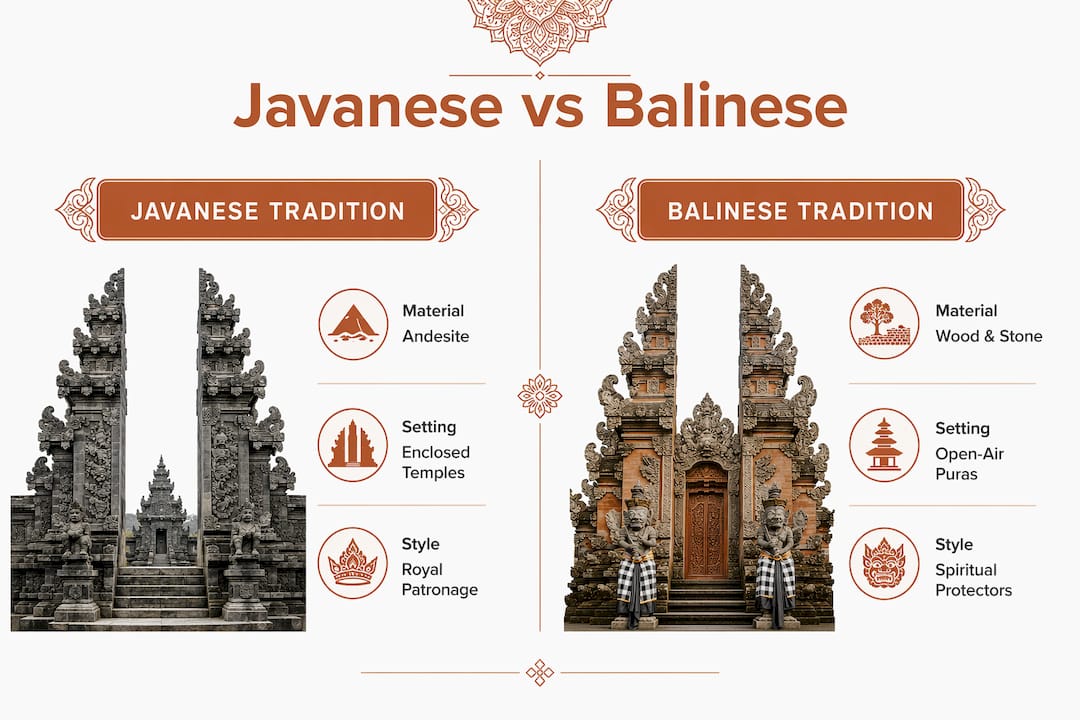
Javanese and Balinese Hindu sculpture traditions share the same theological source but diverge sharply in material, setting, and visual character. Understanding those differences is the foundation of any serious antique Indonesian Hindu sculptures comparison.
| Feature | Javanese tradition | Balinese tradition |
|---|---|---|
| Primary material | Volcanic andesite stone | Teak, suar wood, and paras stone |
| Setting | Enclosed temple sanctuaries | Open-air pura compounds |
| Dominant subjects | Trimurti deities, narrative reliefs | Guardian figures, Bhoma masks, Barong |
| Carving style | Formal, frontal, symmetrical | Dynamic, expressive, layered |
| Ritual context | Royal and priestly ceremonies | Community festivals and daily offerings |
| Key production centers | Prambanan, Borobudur region | Mas village, Ubud, Batubulan |
Balinese Hindu sculptures are integrated into open-air pura compounds, placed strategically as spiritual protectors within defined temple zones. The Bhoma face, a fierce mask carved above temple gates, deters negative energy from entering sacred space. This is not decorative architecture. It is a functional spiritual barrier built into the structure of daily religious life.
Javanese sculpture, by contrast, developed within enclosed sanctuaries tied to royal patronage. The Hindu-Javanese relief tradition at Sukuh Temple uses fertility motifs and mythological beasts to structure spiritual pilgrimages, organizing sacred movement through the temple complex. The reliefs are not illustrations. They are maps of a spiritual journey carved in stone.
Mas village in Bali remains the recognized center of fine wood carving, producing figures that combine technical precision with deep iconographic knowledge. Carvers there train within family lineages, passing down both technique and theological vocabulary across generations. That continuity produces a consistency of quality that distinguishes Mas work from tourist-market production.
How to assess the quality and authenticity of Indonesian Hindu sculptures
Authenticity assessment is the skill that separates informed collectors from buyers of decorative replicas. The difference between a hand-carved teak Ganesha and a machine-produced copy is visible to a trained eye, but only if you know exactly where to look.
- Check for tool marks. Hand-carved pieces show gouge textures and subtle surface irregularities. Machine-carved surfaces are uniformly smooth, with no variation in depth across the carved planes.
- Examine the back. Authentic hand-carved sculptures typically have a flat, unfinished back that shows the natural wood surface. A fully finished, symmetrically smooth back on all sides suggests machine production.
- Assess wood grain flow. In a quality hand-carved piece, the grain follows the natural structure of the wood and the carver has worked with it, not against it. Forced or interrupted grain patterns indicate poor material selection or mechanical cutting.
- Ask about production time. A quality Balinese wood deity figure requires weeks of work by a skilled carver. If a seller cannot explain the production timeline or the carver’s background, treat that as a warning sign.
- Verify the wood species. Teak and suar are the standard materials for quality Balinese carvings. Softer, lighter woods are used in lower-grade production pieces and will not hold fine detail over time.
Pro Tip: Ask the seller for close-up photographs of the carving’s interior recesses, the spaces between fingers, inside ear cavities, and around headdress elements. Machine carving cannot replicate the depth and variation that a hand tool produces in those tight spaces.
Ritual use also affects value. A sculpture that served an active function in a temple or household shrine carries a provenance that purely decorative pieces lack. That history does not always increase monetary value, but it deepens the object’s cultural significance and its interest to serious researchers.
What is the cultural and spiritual significance of these sculptures today?
Indonesian Hindu sculptures remain active ritual objects, not historical artifacts, within practicing Hindu communities in Bali and parts of Java. That living function distinguishes them from the art of many other ancient traditions. A Bhoma mask above a temple gate in Ubud is not a museum piece. It is a working spiritual presence.
Majapahit Ganesha statues demonstrate how context reshapes meaning. Within a temple, such a figure organizes ritual knowledge and channels devotional energy. Moved to a museum display case, the same object becomes an artifact of cultural history. Neither reading is wrong, but they are genuinely different. Collectors who understand this shift engage with these works more honestly.
The cultural significance of Hindu art in Indonesia today extends beyond religious practice:
- Cultural identity: Balinese communities use temple sculpture to assert and maintain a distinct Hindu identity within a predominantly Muslim nation.
- Moral education: Relief narratives from the Ramayana and Mahabharata continue to teach ethical frameworks through visual storytelling in temple settings.
- Preservation: Active carving traditions in Mas and Ubud sustain iconographic knowledge that would otherwise exist only in academic texts.
- International scholarship: Indonesian temple sculptures are central to the study of Hindu art’s spread across Southeast Asia, informing research at institutions from the Metropolitan Museum of Art to the National Museum of Indonesia.
The shift from ritual to collector context carries responsibility. Acquiring these works thoughtfully, with knowledge of their origins and meanings, honors the traditions that produced them.
Key Takeaways
Indonesian Hindu sculpture is best understood as a theological system made visible in stone and wood, where placement, material, and iconography each carry precise doctrinal meaning.
| Point | Details |
|---|---|
| Theological function | Sculptures at sites like Prambanan mediate Hindu cosmology, not just represent deities. |
| Regional distinction | Javanese stone traditions and Balinese wood carving traditions differ in material, setting, and visual style. |
| Iconographic literacy | Learning attributes like the trisula, lotus base, and Bhoma face unlocks the meaning of any piece. |
| Authenticity markers | Tool marks, grain flow, and unfinished backs distinguish hand-carved works from machine production. |
| Living heritage | Many of these sculptures remain active ritual objects in Balinese Hindu communities today. |
What I have learned from years with these objects
The most common mistake I see among new collectors is treating Indonesian Hindu sculpture as decorative art with a spiritual backstory. That framing gets it backwards. These objects were made to do something specific within a specific spatial and ritual system. The aesthetics are a byproduct of that function, not the purpose.
The sacred geometry embedded in temple layouts like Prambanan is not ornamental. It encodes a complete metaphysical worldview. When you understand that the Tri Mandala spatial system determines where a sculpture stands and what it does, you stop seeing a beautiful stone figure and start seeing a theological argument made permanent in andesite.
I also find that collectors consistently underestimate the political dimension of these works. The Astadikpalaka reliefs were not carved to please a god. They were carved to tell a kingdom who its ruler was and why that ruler’s authority was cosmically ordained. That is a sophisticated use of art, and it deserves to be recognized as such.
My honest recommendation: before you acquire any piece, learn to read its iconography. Identify the deity, the attributes, the hand gestures, and the material. Then ask where it came from and what function it served. A Majapahit bronze Vishnu from a documented collection tells a completely different story than an unsigned wood figure of unknown origin. Both can be beautiful. Only one gives you the full picture.
— James, HDAsianArt.com
Authentic Indonesian Hindu sculptures at HDAsianArt
HDAsianArt specializes in authenticated antique and traditional Indonesian Hindu sculptures, with each piece individually researched and documented by experts in Asian temple art.
The collection includes pieces such as a Javanese Avalokiteshvara Bodhisattva statue in the antique Indonesian style and a Majapahit standing bronze Vishnu representing the classical Javanese Hindu tradition at its finest. Every piece ships worldwide via insured DHL with full documentation. Collectors who want to build a collection grounded in cultural knowledge and verified provenance will find the HDAsianArt catalog a reliable starting point.
FAQ
What is Balinese Hindu sculpture?
Balinese Hindu sculpture is a tradition of wood and stone carving centered on guardian figures, deity images, and temple architectural elements within open-air pura compounds. It combines Hindu iconography with distinctly Balinese aesthetic conventions, particularly in the expressive treatment of guardian faces like the Bhoma.
How do I assess Indonesian Hindu sculpture quality?
Check for hand-tool marks, natural grain flow, and an unfinished flat back on wood pieces. Uniform machine smoothness and perfectly symmetrical surfaces on all sides indicate mass production rather than hand carving.
What makes Javanese and Balinese sculpture traditions different?
Javanese sculpture uses volcanic andesite stone in enclosed royal temple sanctuaries, while Balinese sculpture favors teak and suar wood in open-air community temple compounds. The visual styles also differ: Javanese work is formal and frontal, while Balinese carving is more dynamic and expressive.
What subjects appear most often in Indonesian Hindu sculpture?
The Trimurti deities (Brahma, Vishnu, and Shiva), Ganesha, guardian figures called dvarapala, and narrative relief panels depicting the Ramayana and Mahabharata are the most common subjects across both Javanese and Balinese traditions.
Do Indonesian Hindu sculptures still have ritual functions today?
Yes. Within practicing Balinese Hindu communities, sculptures at temple gates and within pura compounds remain active spiritual presences used in daily offerings and festival ceremonies, not historical artifacts.
