



Indonesian Buddhist Art: Majapahit & Srivijaya Legacy
Indonesian Buddhist Art: Majapahit & Srivijaya Legacy
Most collectors who pursue Indonesian Buddhist art focus on the obvious: Borobudur-inspired imagery and Balinese temple carvings. What they miss is the staggering depth of two empires that shaped every sculpture to come out of the Indonesian archipelago.
The Srivijaya Empire and the Majapahit Empire did not merely produce religious objects. They fused Indian iconographic tradition with indigenous Javanese and Balinese sensibilities into something that exists nowhere else on earth. Understanding that fusion is the difference between buying a decorative piece and acquiring something with genuine historical weight.
Table of Contents
Quick Takeaways
|
Key Insight |
Explanation |
|---|---|
|
Indonesian Buddhist art reached its peak under the Sailendra dynasty of the Srivijaya Empire |
Between the 8th and 13th centuries, the Sailendra rulers of Srivijaya patronized monumental Buddhist sculpture and architecture that blended Indian Mahayana traditions with Javanese aesthetics. |
|
Majapahit sculpture is defined by its geometric precision and use of red brick |
The Majapahit Empire (1293-1500) produced tall, slender-roofed temples with strong geometrical quality, and this architectural character directly influenced the sculptural forms made during that period. |
|
Javanese sculpture between the 8th and 10th centuries is distinguished by delicacy and serenity of expression |
Free-standing statues and relief sculptures from this period are not martial or imposing. Their defining quality is a refined stillness that collectors frequently describe as unmatched elsewhere in Asian art. |
|
Balinese Hindu statues represent a direct living continuation of Majapahit religious culture |
When Islam spread across Java and Sumatra in the 15th century, the Hindu-Buddhist courtly tradition migrated to Bali, where it has remained vigorously alive in temple sculpture and ritual objects. |
|
Indonesian art is a product of deliberate syncretism, not passive borrowing |
Javanese and Balinese artists did not simply copy Indian models. They adapted iconography to suit indigenous animist and ancestral beliefs, producing hybrid forms that have no direct Indian equivalent. |
|
The earliest surviving Buddhist structures in Indonesia date to the 4th century CE |
The Batujaya plastered brick stupas in West Java predate the Sailendra golden age by several centuries, establishing that Indian Buddhist influence arrived long before the great empires consolidated it. |
|
Bali is the primary source of collectible Hindu deity sculpture in the Indonesian tradition today |
The island's unbroken tradition of temple carving means that Balinese pieces carry authentic ritual lineage, making them particularly meaningful for spiritual practitioners and home altar decorators. |
The Srivijaya Empire and the Golden Era of Buddhist Art in Indonesia
Indonesia's engagement with Indian religious culture began at least as early as the 1st century CE, and the material evidence for Buddhist practice in the archipelago goes back to the 4th century. The Batujaya stupas in West Java, constructed from plastered brick, are the oldest surviving Buddhist structures in the country. But the true transformation of Indonesian Buddhist art came with the Sailendra dynasty, the ruling house of the Srivijaya Empire, which dominated the islands of Sumatra and Java in western Indonesia between the 8th and 13th centuries.
Under Sailendra patronage, Buddhist art reached what historians consistently describe as its golden era in the archipelago. The Sailendras were Mahayana Buddhists, and their sculptural programs reflected the rich cosmological complexity of that tradition. The bodhisattva Avalokiteshvara, the cosmic Buddha Vairochana, and elaborate mandala-based temple layouts all became hallmarks of Srivijayan artistic output.
What makes Srivijayan Buddhist sculpture genuinely distinctive is its position at the crossroads of maritime trade. Situated on the ancient sea routes between the Near East and the Far East, the empire absorbed artistic influences from mainland India, Sri Lanka, and even further afield, then filtered them through a Javanese sensibility. The result is sculpture that shares vocabulary with Indian Pala-period bronzes but speaks in a different register altogether, one that is softer, more elongated, and more attuned to a sense of natural calm.
The Candi as the Central Artistic Form
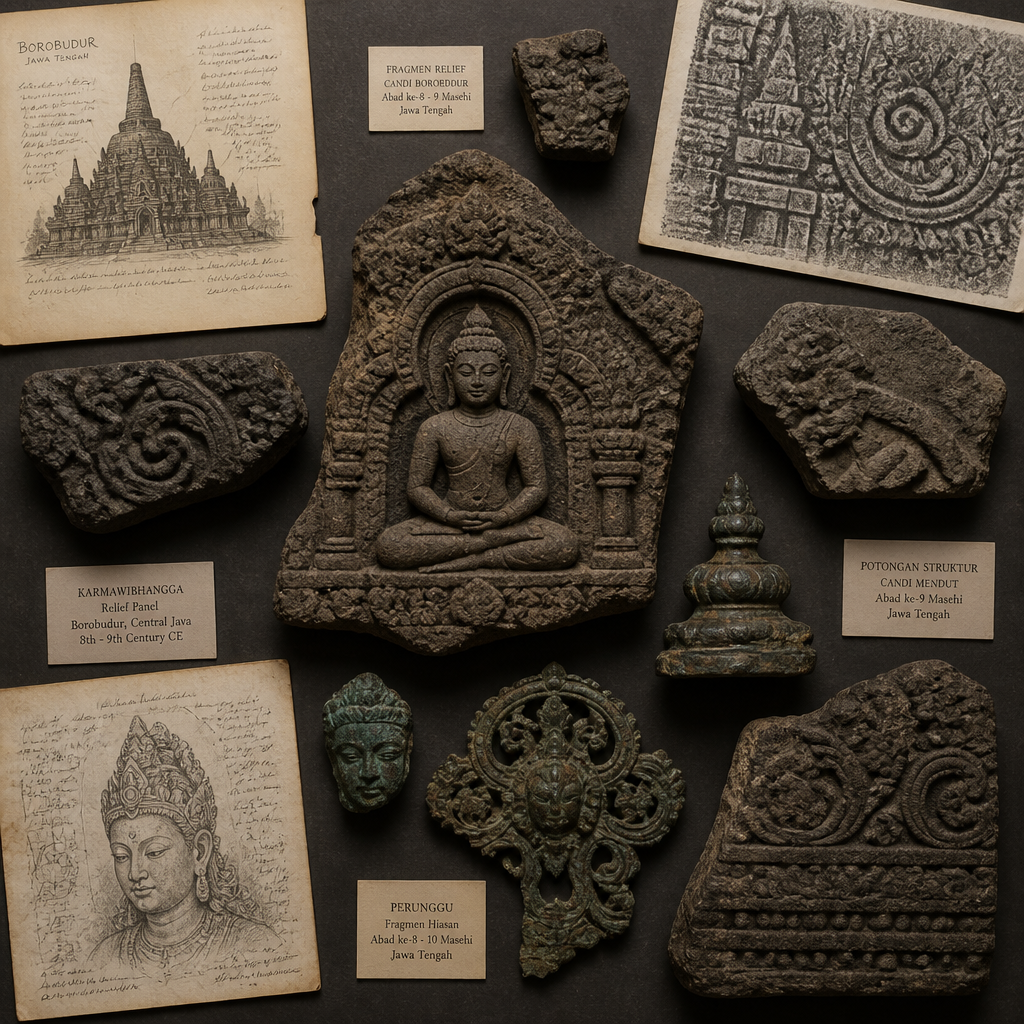
The physical container for almost all surviving Srivijayan and later Majapahit sculpture is the candi, the Indonesian term for Hindu and Buddhist temples and sanctuaries built between the 8th and 15th centuries. The candi was not merely an architectural shell. It was a three-dimensional mandala, designed to represent the cosmos, and every sculptural element within it carried specific theological meaning. Understanding that the statues you see in Indonesian collections were once part of these mandala-temple programs changes how you look at individual pieces.
Free-standing statues removed from their original candi context still carry the formal qualities that made them liturgically potent: the precise positioning of hands (mudra), the treatment of the throne or base, and the iconographic attributes held or worn by the figure. A collector who can read these elements is working with the object rather than merely looking at it.
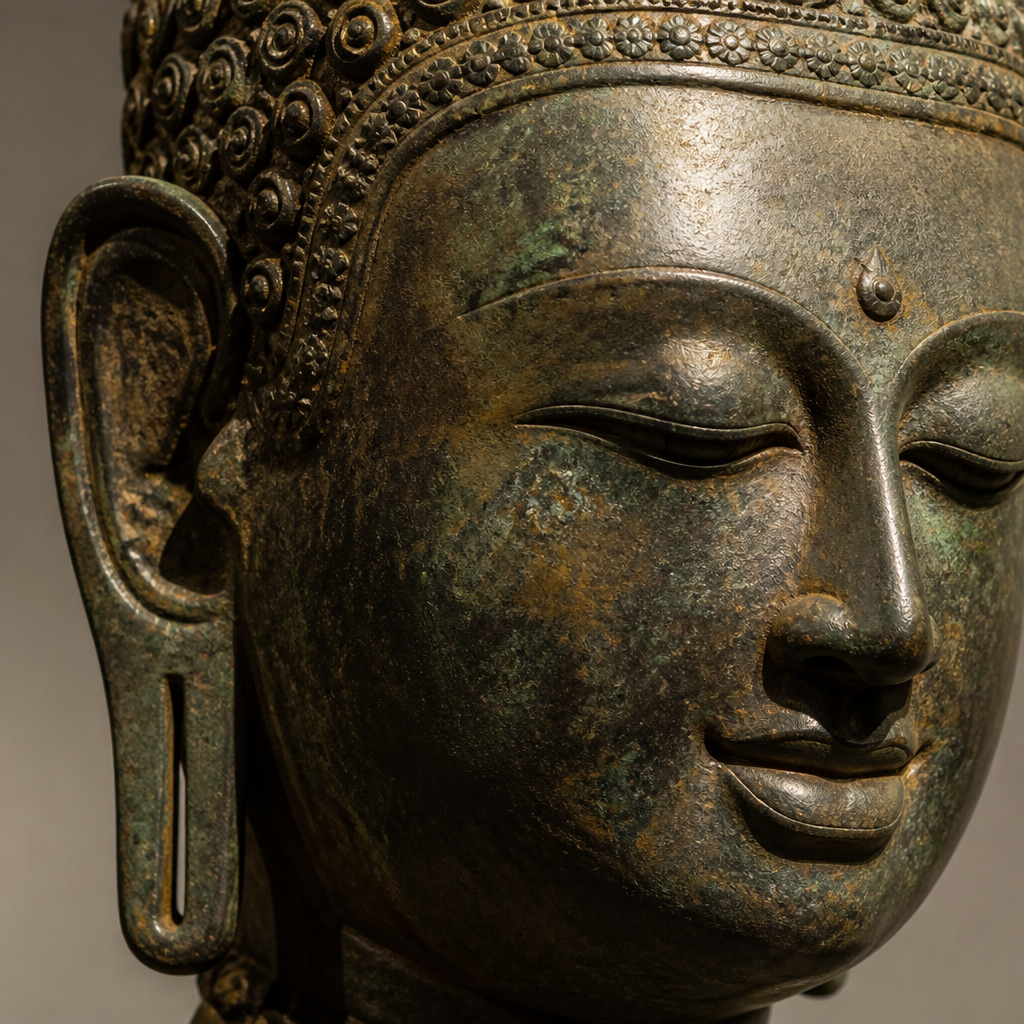
Pro tip: When evaluating any piece described as Srivijayan or early Javanese Buddhist, pay close attention to the treatment of the face. Authentic pieces from this tradition are characterized by a specific serenity of expression that is difficult to replicate convincingly. Hardness around the eyes or an overly symmetrical smile is a reliable early warning sign of later reproduction work.
Majapahit Sculpture: The Hindu-Buddhist Synthesis
The Majapahit Empire, which lasted from 1293 to approximately 1500 CE, represents the last great Hindu-Buddhist civilization of the Indonesian archipelago and the apex of what can genuinely be called a uniquely Indonesian religious art. Where the Srivijayan tradition leaned heavily Buddhist, the Majapahit tradition was syncretic in a very specific way: it merged Shaivite Hinduism and Mahayana Buddhism into a single theological and artistic system, producing imagery that deliberately fused the two.
Majapahit sculpture is immediately identifiable by several features. The architectural context from which it emerged, the tall red brick gates and temples with their slender, geometrically precise rooflines, gave Majapahit religious art a distinctive verticality and structural clarity. Sculptures from this period tend to have a more formal, monumental quality than the softer Srivijayan pieces, reflecting an empire at the height of its political confidence.
The Syncretic Deity Tradition
One of the most intellectually compelling aspects of Majapahit sculptural production is the creation of syncretic deity forms. The most famous of these is Harihara, the composite deity combining Vishnu and Shiva in a single image, which appears repeatedly in Majapahit royal cult sculpture. This was not artistic eclecticism for its own sake. It was a deliberate theological statement by Majapahit rulers who sought to position themselves as transcending sectarian divisions and embodying universal sovereignty.
For collectors and practitioners, this syncretic tradition explains why Indonesian pieces often resist the neat categorical labels that work for Indian or Thai sculpture. A Majapahit piece might carry the attributes of a Hindu god arranged within a compositional framework borrowed from Buddhist cosmology. Treating that as confusion or inconsistency misses the point entirely.
The Hindu-Buddhist art of the Majapahit and Srivijaya empires was not a provincial echo of Indian models. It was a sophisticated, self-aware synthesis that used Indian forms to express a distinctly Indonesian understanding of the sacred.
What Happened After Majapahit
By the 15th century, Islam had become the dominant religion across much of the Indonesian archipelago. The Hindu-Buddhist courtly tradition did not disappear. It migrated, carried by Majapahit aristocrats and priests to Bali, where it took root and has continued to develop ever since. This migration is why Bali today remains a living center of Hindu sculptural tradition in a predominantly Muslim nation, and why Balinese pieces carry a particular authenticity for collectors interested in the Majapahit legacy.
Iconography, Style, and What Sets Indonesian Sculpture Apart
Collectors new to Indonesian Buddhist and Hindu art frequently make the mistake of reading Indonesian pieces through the lens of Indian iconographic conventions alone. This produces misidentifications and, more importantly, a failure to appreciate what makes these objects extraordinary. Indonesian sculptors worked within Indian iconographic frameworks but consistently adapted them to suit local aesthetic values and indigenous spiritual beliefs, including animism and ancestor veneration that predate Indian influence entirely.
The concept of syncretism is central here. Indonesian art is not a diluted version of Indian art. It is a separate tradition that grew from Indian roots but developed its own grammar. The elongated proportions of Javanese bronze bodhisattvas, the ornamental richness of Balinese deity sculpture, and the architectural integration of relief carvings in candi structures all reflect choices that are specifically Indonesian, not Indian transplants.
Reading Mudras and Attributes in Indonesian Sculpture
The hand gestures (mudras) used in Indonesian Buddhist and Hindu sculpture generally follow Indian conventions, which means that a collector familiar with Indian iconography has a working foundation. The dhyana mudra (meditation gesture, both hands resting in the lap) appears on meditating Buddha figures throughout the Javanese tradition. The bhumisparsha mudra (earth-touching gesture, right hand reaching toward the ground) identifies the moment of the Buddha's enlightenment and appears frequently in Indonesian bronze work.
Where Indonesian sculpture diverges most dramatically from Indian precedent is in the treatment of ornamentation and the base. Javanese and Balinese sculptors tended to elaborate the throne, the lotus base, and the surrounding decorative field more extensively than their Indian counterparts. A relatively simple figure can sit on an extraordinarily complex base, which tells you something important about where the maker placed theological emphasis.
Pro tip: The lotus throne treatment is one of the most reliable indicators of regional origin in Southeast Asian Buddhist sculpture. Indonesian pieces, particularly Javanese bronzes, typically show double lotus petals arranged in a specific layered pattern that differs noticeably from Thai, Burmese, or Cambodian treatments. Study the base before you study the figure.
Balinese Hindu Statues: The Living Continuation of a Classical Tradition
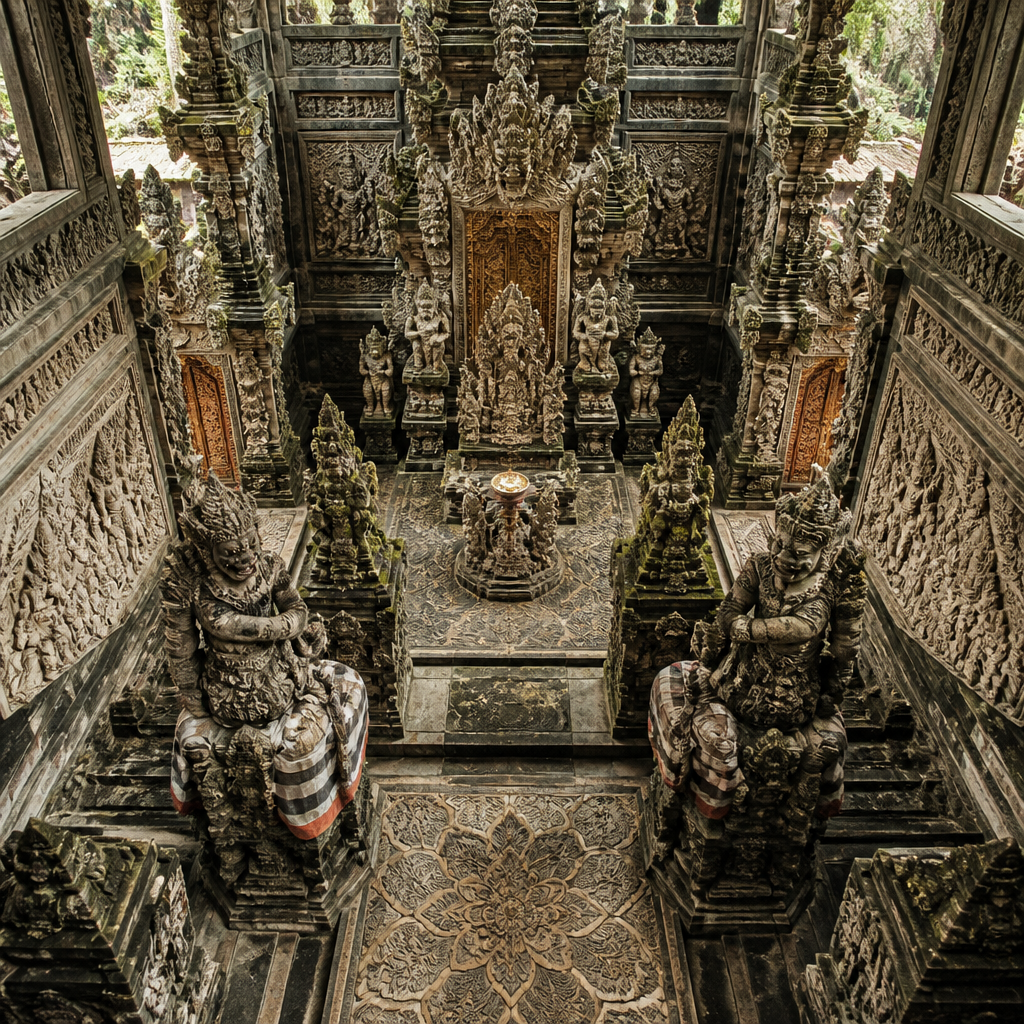
Bali occupies a unique position in the landscape of Asian religious art. It is the only place in the Indonesian archipelago where the Hindu-Buddhist tradition that flourished under Majapahit has continued uninterrupted to the present day. The island's temple culture, its elaborate ritual calendar, and its sculptural production all draw directly from the Majapahit inheritance, filtered through more than five centuries of distinctly Balinese development.
Balinese Hindu statues are not historical artifacts in the way that Srivijayan bronzes are. They are living religious objects, made by craftspeople working within a tradition that regards sculpture as an act of devotion, not merely artistic production. This distinction matters enormously for collectors and spiritual practitioners. A Balinese statue acquired today carries the same ritual lineage as pieces made four centuries ago, because the tradition itself is continuous.
The Major Deities in Balinese Sculptural Production
The Balinese Hindu pantheon draws primarily from the Shaivite tradition, with Shiva occupying the central position as the supreme deity. Ganesha, Durga, Saraswati, and Vishnu all appear frequently in Balinese temple sculpture. The treatment of these figures in the Balinese tradition differs from both the Indian originals and from Javanese Majapahit versions in ways that are immediately apparent once you have spent time with representative examples of each.
Balinese Ganesha figures, for instance, typically show greater ornamental elaboration than their Indian counterparts and often incorporate local floral and faunal motifs that have no Indian precedent. Balinese Durga is frequently depicted in her fierce form as Rangda, the demon queen, a figure with no direct Indian equivalent who represents the specifically Balinese synthesis of Indian iconography and indigenous spirit belief.
For those building a home altar or a focused collection, Balinese pieces offer something that purely historical Javanese works cannot: an unbroken devotional lineage. The craftspeople who make these objects today are doing exactly what their ancestors did in the Majapahit courts, and that continuity is legible in the work itself.
Comparison: Regional Sculptural Traditions Across the Indonesian Archipelago
Indonesian sculpture is not a monolithic category. The traditions that developed in Java, Bali, and Sumatra under Srivijaya and Majapahit influence each have distinct characteristics, and understanding those differences is essential for anyone building a serious collection or sourcing pieces for a specific devotional purpose.
|
Tradition |
Defining Characteristics |
Best For Collectors Who... |
|---|---|---|
|
Srivijayan Javanese Buddhist (8th-13th century) |
Soft, elongated proportions; Mahayana Buddhist iconography (Avalokiteshvara, Vairochana, bodhisattvas); serene facial expression; Indian Pala influence visible but transformed; bronze is the dominant medium for portable sculpture |
Prioritize historical depth, Mahayana Buddhist iconography, and the refined aesthetic of the Sailendra golden age; interested in the direct relationship between Indonesian and Indian Buddhist art |
|
Majapahit Javanese Hindu-Buddhist (13th-15th century) |
Geometric precision; syncretic deity forms (Harihara, deified rulers); monumental quality; strong vertical lines reflecting the architectural context of red brick candi temples; stone is common for large-format work |
Want the specifically Indonesian synthesis of Shaivite Hinduism and Mahayana Buddhism; interested in the political and theological ambitions of the last great Hindu-Buddhist empire of the archipelago |
|
Balinese Hindu (15th century to present) |
Elaborate ornamentation; Shaivite Hindu pantheon with Balinese additions (Rangda, Barong); continuous living tradition; rich surface decoration incorporating local floral and faunal motifs; stone and carved wood are prevalent alongside metal casting |
Seek pieces with active devotional lineage; building a home altar or sacred space; drawn to the visual richness of a tradition that has never stopped developing |
A common mistake among new collectors is treating these three traditions as interchangeable because they share geographic origin. In practice, a Srivijayan Javanese bronze and a contemporary Balinese stone carving of Ganesha are separated by more than a thousand years of artistic development and represent fundamentally different relationships to the Indian source material. Knowing which tradition you are working with sharpens every acquisition decision you make.
What Collectors and Practitioners Need to Know Before Acquiring Indonesian Pieces
Indonesian sculpture occupies a complicated position in the global market for Asian art. Genuine historical pieces from the Srivijayan and Majapahit periods are rare, tightly regulated under Indonesian cultural property law, and largely confined to museum collections. What the serious private collector or spiritual practitioner is realistically working with is either high-quality pieces made within the Balinese living tradition, pieces from the broader Southeast Asian region that show Indonesian stylistic influence, or carefully documented older pieces with clear provenance histories.
This is not a limitation. The Balinese living tradition produces sculpture of extraordinary quality, and the iconographic richness of the Indonesian Hindu-Buddhist synthesis is fully present in contemporary Balinese work. The mistake is approaching these pieces as inferior substitutes for ancient objects. They are not substitutes. They are the tradition continuing.
How Indonesian Pieces Fit Into a Broader Asian Art Collection
Indonesian Buddhist and Hindu sculpture pairs naturally with pieces from the broader Southeast Asian and South Asian traditions, but it does not blend seamlessly. Indonesian pieces have a specific visual register that tends to dominate rather than recede in a mixed display. A Javanese-style Buddha figure placed alongside Thai or Burmese Buddhas immediately draws the eye because its proportional language is different. This is a feature, not a problem, provided you understand it before making acquisition decisions.
For collectors already working with Buddha statues from Burma, Cambodia, Thailand, or Sri Lanka, adding Indonesian pieces introduces a genuinely different iconographic vocabulary that deepens the collection's intellectual scope. The Indonesian sculpture collection at HD Asian Art offers carefully sourced pieces that bring this tradition within reach for collectors and practitioners who understand what they are looking at.
For spiritual practitioners building a home altar, the syncretic nature of Indonesian Hindu-Buddhist art offers real flexibility. A Balinese Ganesha or a Javanese-style meditating Buddha can anchor a devotional space that honors the dialogue between Hinduism and Buddhism rather than enforcing a strict sectarian boundary. The tradition itself was built on exactly that dialogue.
Pro tip: When placing Indonesian sculpture in a home altar or display context, consider the base orientation carefully. Many Balinese pieces are designed to be approached from a specific direction, with the most iconographically significant face or attribute positioned to face the devotee. Rotating a piece for purely aesthetic reasons can inadvertently invert its intended meaning.
Frequently Asked Questions
What is the difference between Srivijayan and Majapahit sculpture?
Srivijayan sculpture, produced under the Sailendra dynasty between the 8th and 13th centuries, is primarily Buddhist in iconography, characterized by soft and elongated proportions and a serenity of expression strongly influenced by Indian Mahayana models. Majapahit sculpture, from the period 1293 to around 1500 CE, is syncretic, deliberately combining Hindu and Buddhist iconography in a more geometric and monumental style that reflects the architectural character of the empire's red brick candi temples.
Why is Bali the center of Hindu sculptural tradition in a predominantly Muslim country?
When Islam spread through Java and Sumatra during the 15th century, the Hindu-Buddhist courtly and religious tradition that had flourished under the Majapahit Empire migrated to Bali. Majapahit aristocrats, priests, and craftspeople brought their religious culture with them, and it took root on the island. Bali has maintained that tradition continuously ever since, making it the only place in Indonesia where Majapahit-descended Hindu sculptural and ritual practice remains a living, daily reality.
How do Indonesian Buddhist statues differ from Thai or Burmese Buddha images?
Indonesian Buddhist statues, particularly those from the Javanese tradition, have a distinctly different proportional language from Thai or Burmese images. They tend toward greater elongation, more elaborate lotus throne treatments, and a facial expression that leans toward serene detachment rather than the more luminous, idealized beauty characteristic of Thai work. The Indian influence visible in Indonesian pieces is primarily from the Pala school of Bengal and Bihar, while Thai and Burmese images draw from different regional Indian sources and from Sri Lanka.
Are contemporary Balinese Hindu statues considered authentic religious objects or decorative items?
This is not a binary choice. Contemporary Balinese Hindu statues are made within a continuous devotional tradition by craftspeople who understand their iconographic and ritual significance. They are genuine religious objects that also function as works of art and, in secular contexts, as culturally significant decorative pieces. The authenticity of a Balinese statue is not undermined by its being made recently. The tradition itself is what confers meaning, and that tradition is unbroken.
What iconographic features identify a statue as specifically Indonesian rather than Indian or Cambodian?
Several features are diagnostic. Indonesian pieces, particularly Javanese and Balinese work, typically show double-layered lotus petal treatment on the base, more elaborate decorative fields around the throne, and a softer integration of the figure with its architectural or ornamental surround. Balinese pieces additionally incorporate local floral and faunal motifs with no Indian or Cambodian parallel. The facial type in Javanese work is also distinctive, showing a specific combination of Indian idealization and local physiognomic features that separates it cleanly from Cambodian Khmer work or Indian Pala bronzes.
What should I consider when adding Indonesian sculpture to a home altar alongside pieces from other Asian traditions?
The primary consideration is iconographic coherence rather than visual matching. Indonesian Buddhist and Hindu sculptures were produced within a tradition that honored the dialogue between the two religions, so they sit naturally alongside both Buddhist and Hindu pieces from other traditions. Pay attention to the orientation of each piece, since Balinese sculptures in particular are designed to be approached from a specific direction. If your altar mixes Indonesian pieces with Burmese, Thai, or Indian works, the Indonesian pieces will likely function as visual anchors because their proportional language differs noticeably from neighboring traditions.
Have you encountered Indonesian Hindu-Buddhist sculpture in a collection or sacred space, and did understanding its Srivijayan or Majapahit origins change how you related to the piece? Share your experience in the comments.
References
